

Junior World Championships
Young fliers from 17 nations met at Sibiu, Romania, for the 1998 World Junior Free Flight Championships. In August, teams of under-18s competed on an airfield in the foothills of the Carpathian Mountains in three classes: F1A (glider), F1B (Wakefield) and F1J (gas).
Event overview and US team issues
- The US team suffered a few setbacks before and during the contest. Glider team member John Barron broke his foot about a week before departure; his 10-year-old brother Peter replaced him and performed well.
- F1J flier Justin Aronhalt opened his box in Romania and found his left stabilizers missing. After frantic faxing to his parents for plans, two replacements were built in time to retrim before F1J day.
- US representation was part-funded by the generous support of Max Men and by responses to an appeal published in Louis Joyner’s FF column in MA.
- A vacancy on one team required intensive coaching in circle-towing to fill the spot.
F1J (gas)
The 1998 Championships marked the first time the gas class was F1J rather than F1C. The smaller .061-powered models proved popular and easier for juniors than the previous .15s; most aircraft were small-scale F1Cs with fittings such as engine brakes, folding carbon props, blunt transitions, full-carbon structures and dural/carbon/dural booms.
- Equipment and engines
- Popular engines and preferences included Ukrainian KSs, Russian Rex and Unique motors.
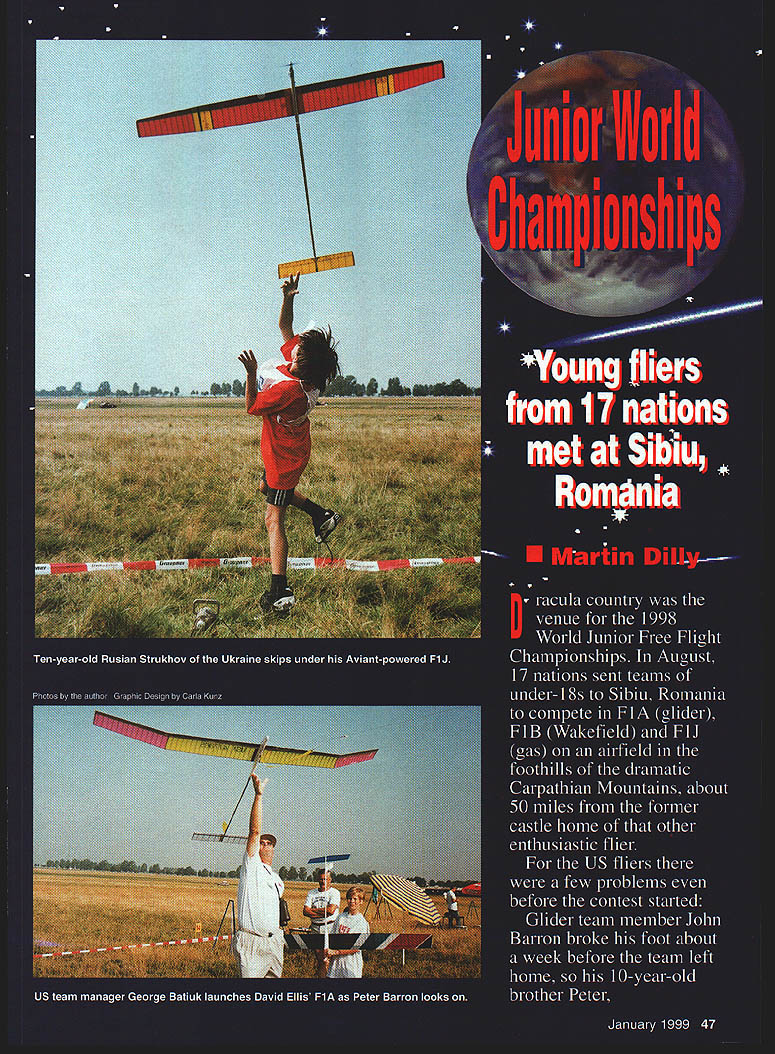
- At Sibiu, US fliers Justin Aronhalt and Austin Gunder flew Tom Hutchinson’s Maverick design with fixed surfaces and rolling-climb setups. Their models used dural/carbon booms and were powered by plain-bearing Norvel engines on 30% nitro.
- Some competitors used piped Samokisch-designed Aviant silencers; Valery Strukhov’s son Ruslan had a piped Aviant turning about 34,000 rpm with clappers at cutoff (an idea attributed to Hardy Brodersen), but without a brake.
- Contest highlights
- The air was tricky, with long dead patches that made timing and tactics as important as equipment. In Round Two Justin waited 15 minutes before launching until others had flown and a usable patch appeared.
- In Round Four Austin’s launch was slightly off and his engine cut at about 150 feet; energetic flapping and nearby lift kept the model at low altitude until it eventually landed near the launch line after maxing.
- Both Justin and Austin dropped a single flight overall, with Justin finishing 11th and Austin 14th. The lack of a third US team member left the US at the bottom of the F1J team results.
- The Russians won the F1J team title, flying conservative aircraft with medium aspect ratios, medium moment arms, parallel-chord centre panels and large-diameter carbon/dural booms.
- Eight of the 17 competitors reached the flyoff. All achieved the three-minute max of the first flyoff round, and five managed the four-minute max in the second flyoff round — prompting comments that two-minute steps might suit the mini-class flyoffs better.
- Several observers wondered whether Mavericks without auto functions might suit younger fliers better than the miniature F1Cs that dominate F1J, though such aircraft would be less competitive as fliers progress to F1C.
F1B (Wakefield)
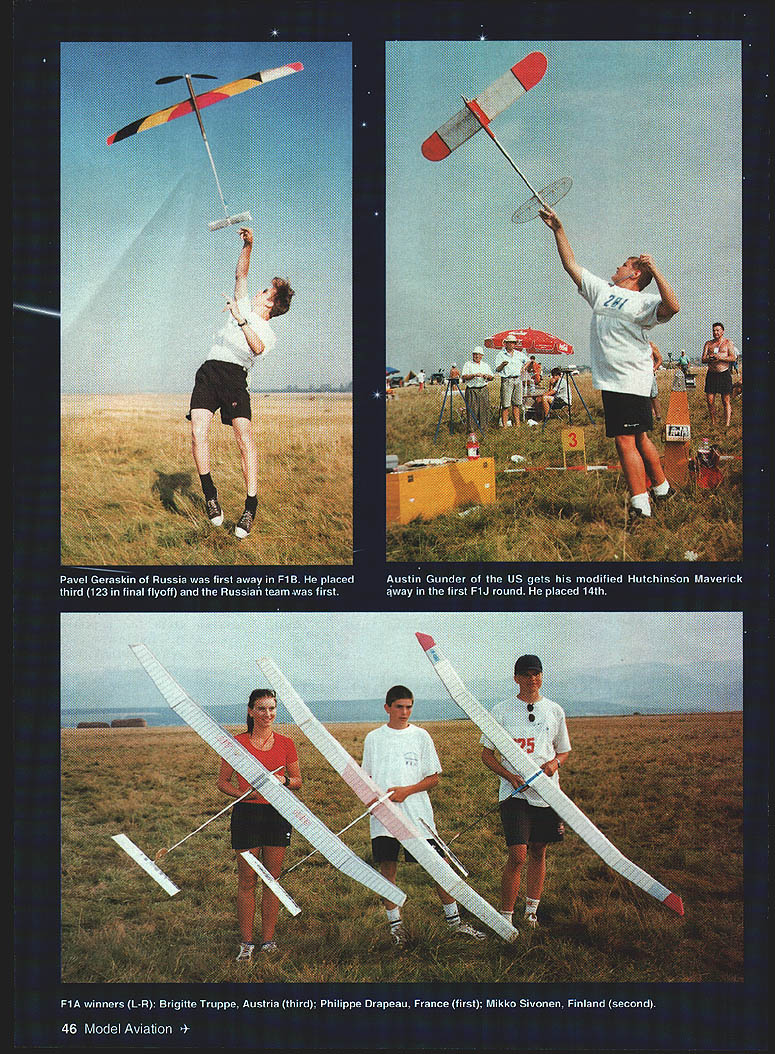
- Pavel Geraskin of Russia was the first away in F1B. He placed third (123 seconds in the final flyoff) and the Russian team finished first overall in F1B.
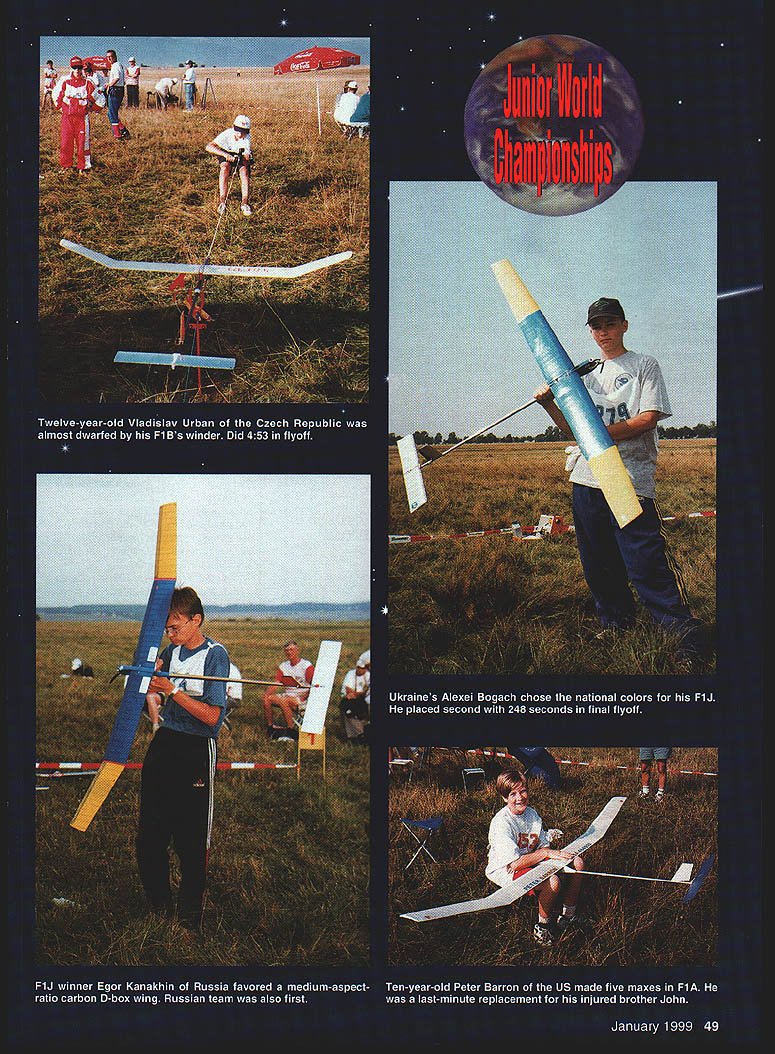
- Four competitors reached the flyoff in F1B. The Czech Republic’s solo entrant, 12-year-old Vladislav Urban, used a winder nearly as tall as himself and managed about 500 turns on his motor. He flew a “classic” wooden wing structure with zig-zag ribs and, with little adult help, came within seven seconds of the required five-minute time.
F1A (glider)
- Winners (left to right): Brigitte Truppe, Austria (third); Philippe Drapeau, France (first); Mikko Sivonen, Finland (second).
- Philippe Drapeau of France, aged 14 and a flyer since age seven, won the title. He flew a bunter launch very successfully and set the delay to the first bunt by eye rather than using a timer disc extension arm.
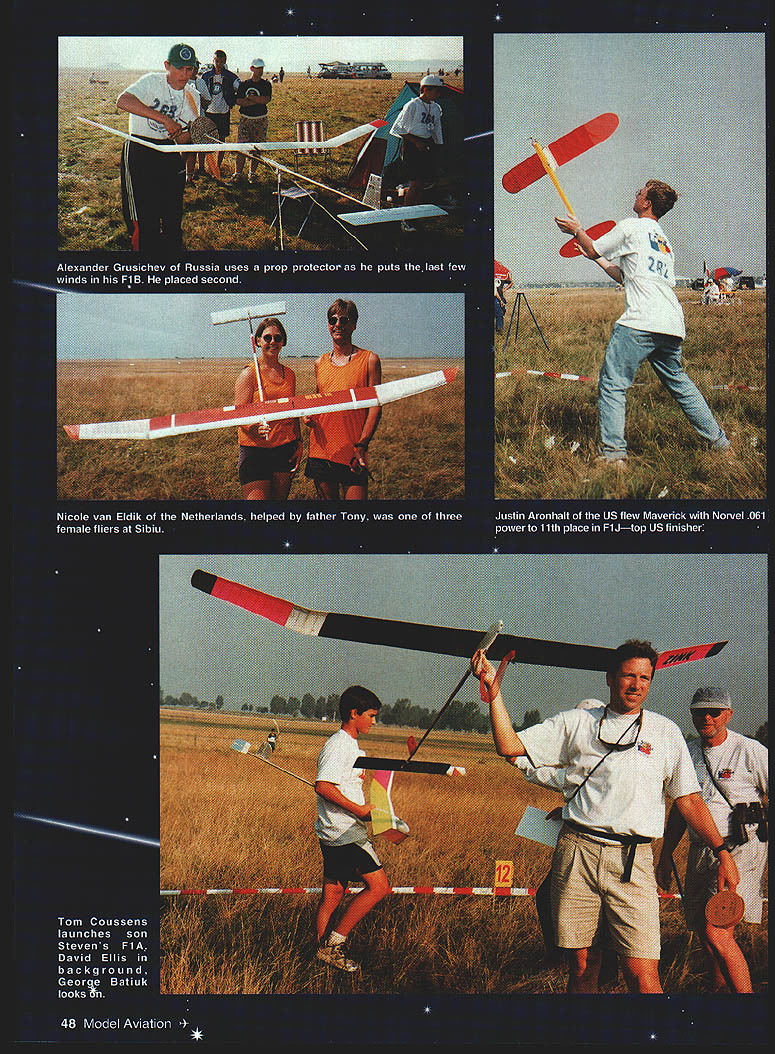
- Brigitte Truppe (Austria) placed third and was one of three girls competing. In the fifth round she came off the line at about 50 feet into strong lift and maxed; her bunting technique in the eight-way flyoff earned applause.
- Peter Barron (substituting for his injured brother) produced the sole US max in the first F1A round. In Round Four he executed a strong downwind tow into a good patch of air, achieving about double towline height in a minute without circle-towing or zoom.
- Equipment and techniques observed
- Several competitors used Superba gliders (produced by W Hobbies in Lithuania) or occasional Makarov gliders.
- David Ellis used a three-position active wing-wiggler and covered his models with Dacron rip-stop sailcloth. Stephen Coussens flew an ex-Don Zink model and dropped only the first round.
- The Czech technique in early rounds was often to launch and immediately flap to try to trigger enough lift to reach the 3.5-minute max.
- Conditions and contest flow
- The early part of the day was hot and dry; some models check-weighted at 8 a.m. had lost up to five grams by midday.
- As Round Six began, thunder rumbled and lightning flashed in the distant mountains; though the sky darkened for the rest of the day, the rain mostly held off.
- FIA (F1A) day saw the most activity, with all 17 nations competing under a slight mountain mist.
Notable moments and observations
- A number of teams displayed strong organisation and teamwork: the Polish team worked well together, while the Yugoslav team largely flew Vivchar models but lacked enthusiasm; one father acted as coach and trimmer and vocally directed his team.
- Several people noted the contrast between piped engines and simpler fixed-surface Mavericks; there was discussion about what equipment best suits junior development.
- The Romanian Modelcraft Federation ran an excellent Championships. Many competitors remember sharing a hotel with two traditional Romanian weddings, complete with violins, ethnic music, folk singing and enthusiastic dancing.
Results and further information
- F1A individual podium:
- 1. Philippe Drapeau (France)
- 2. Mikko Sivonen (Finland)
- 3. Brigitte Truppe (Austria)
- F1B: Pavel Geraskin (Russia) placed third in the flyoff (123); the Russian team won F1B.
- F1J: Russian team winners; Justin Aronhalt (USA) finished 11th, Austin Gunder (USA) finished 14th.
- See full results on page 54.
Martin Dilly 20 Links Rd. West Wickham, Kent BR4 0QW
Transcribed from original scans by AI. Minor OCR errors may remain.

