
Junior World Championships
by George Batiuk
Team
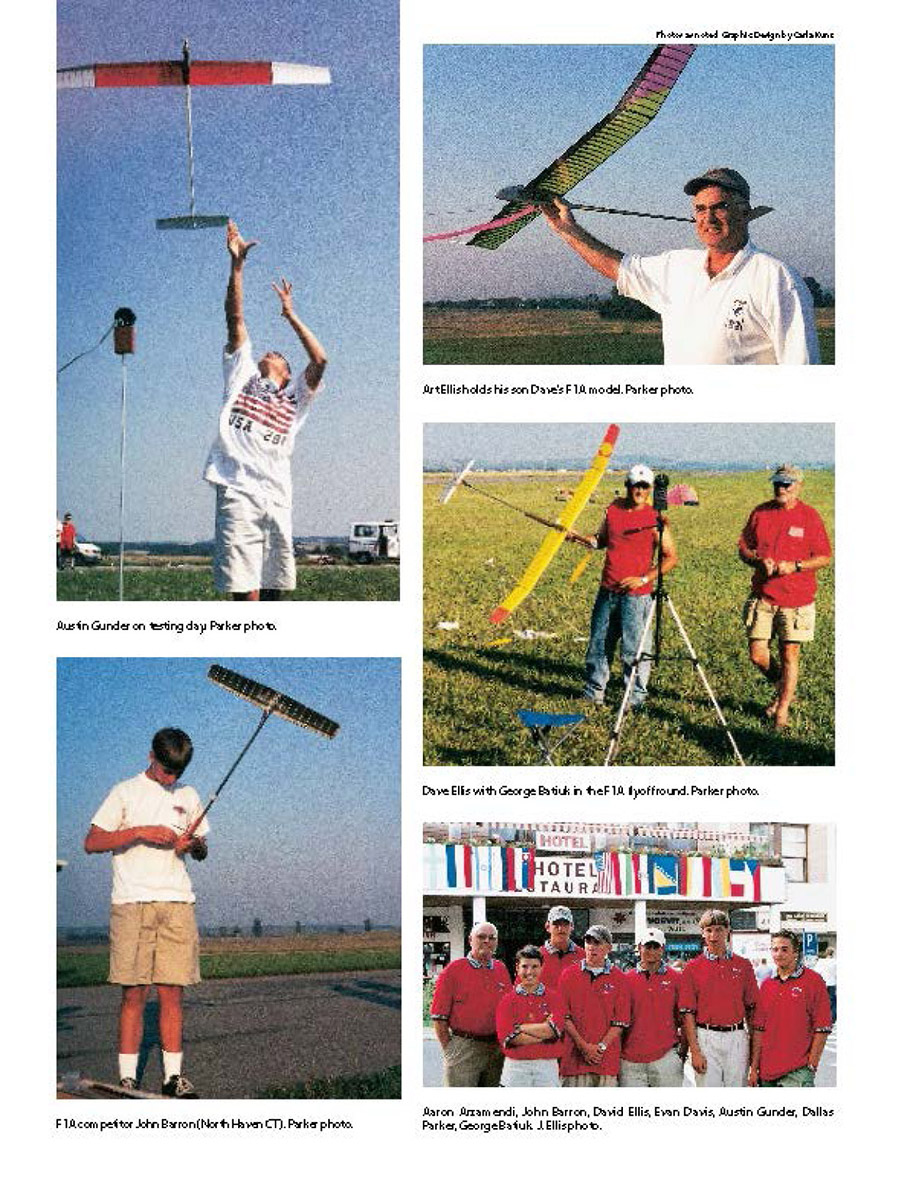
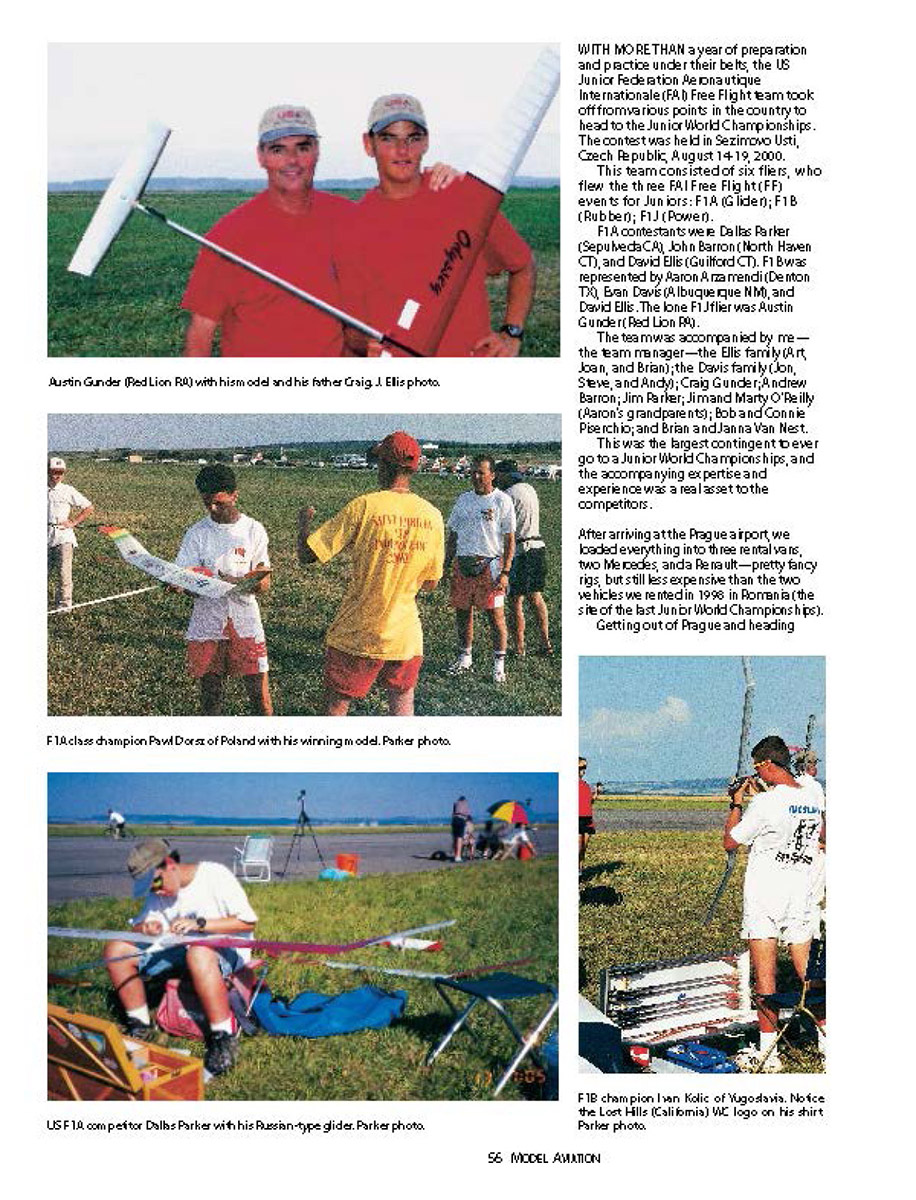
The U.S. Junior Fédération Aéronautique Internationale (FAI) Free Flight team traveled from various points in the country to compete at the Junior World Championships held in Sezimovo Ústí, Czech Republic, August 14–19, 2000.
- F1A (Glider): Dallas Parker (Sepulveda, CA); John Barron (North Haven, CT); David Ellis (Guilford, CT)
- F1B (Rubber): Aaron Arzamendi (Denton, TX); Evan Davis (Albuquerque, NM); David Ellis (also listed for F1B)
- F1J (Power): Austin Gunder (Red Lion, PA)
The team was accompanied by the team manager (the author) and a large support contingent:
- The Ellis family: Art, Joan, and Brian
- The Davis family: Jon, Steve, and Andy
- Craig Gunder; Andrew Barron; Jim Parker; Jim and Marty O’Reilly (Aaron’s grandparents)
- Bob and Connie Piserchio; Brian and Janna Van Nest
This was the largest U.S. contingent ever to attend a Junior World Championships; the accompanying expertise was a real asset.
Travel and arrival
After arriving at Prague airport, we loaded gear into three rental vans—two Mercedes and a Renault—and headed south for the 80-kilometer drive to the contest site. Navigating out of Prague was a challenge; we got lost twice (the author notes the Prague average is four). David Ellis acted as an able navigator.
We arrived in the Czech Republic four days before the competition started, giving the team plenty of time for practice and to participate in a World Cup event held at the same field. Several U.S. competitors performed well in the World Cup: Austin placed third in F1J, Dallas was seventh in F1A (of 98 contestants), and Bob Piserchio placed second in F1B.
Flying site and conditions
The flying site was an old airfield, perhaps a remnant from the communist era. The taxiway and runway were roughly 1.25 miles long, separated by a grass strip approximately 100 yards wide. Farmland on each side provided an overall flying area roughly two miles square with only a few scattered trees (and we found most of them).
Weather was generally pleasant with partly cloudy to sunny skies and light winds, but afternoons often brought strong gusts—16 mph gusts were frequent.
F1A (Glider)
F1A was a seven-round event, each round one hour long. The first round was a 210-second max; the remaining rounds were 180-second maxes.
The 210-second max proved difficult for many competitors, but Dallas Parker handled it well with a 211-second flight and a very nice performance. Calm conditions made staying clear of other competitors and keeping models aloft a challenge for the three U.S. fliers, but they still recorded some very good flights.
Dallas and John will be eligible for the next junior cycle, and the experience of this competition was invaluable. The class had 43 competitors; all the U.S. entrants finished around the middle of the pack, gaining experience that should move them up next time.
F1B (Rubber)
F1B used the same format as F1A. Each U.S. flier managed a strong 210-second first-round flight. However, wind was significant from the start and models drifted far, making recovery difficult for the chase crews.
Disaster struck in the third round when Evan Davis was processed and his motor was found to be 1.5 grams over the weight limit. Despite attempts to resolve the issue, he was disqualified. The overweight motors appeared to be the result of an inaccurate scale at home—multiple motors checked heavy by the same amount. This was a major disappointment given Evan’s hard preparation.
The other U.S. fliers continued to fly well. Aaron Arzamendi was forced to switch to a backup model after a first-round crash but completed the remaining flights and finished mid-pack. David Ellis flew consistently, maxing enough to make the seven-round flyoff. Conditions that day humbled many senior fliers, and maxing out was a tremendous effort—four contestants achieved it. The organizers delayed the flyoff until 6 p.m. because of the wind. Times were very close in the flyoff and David finished in third place in F1B.
F1J (Power)
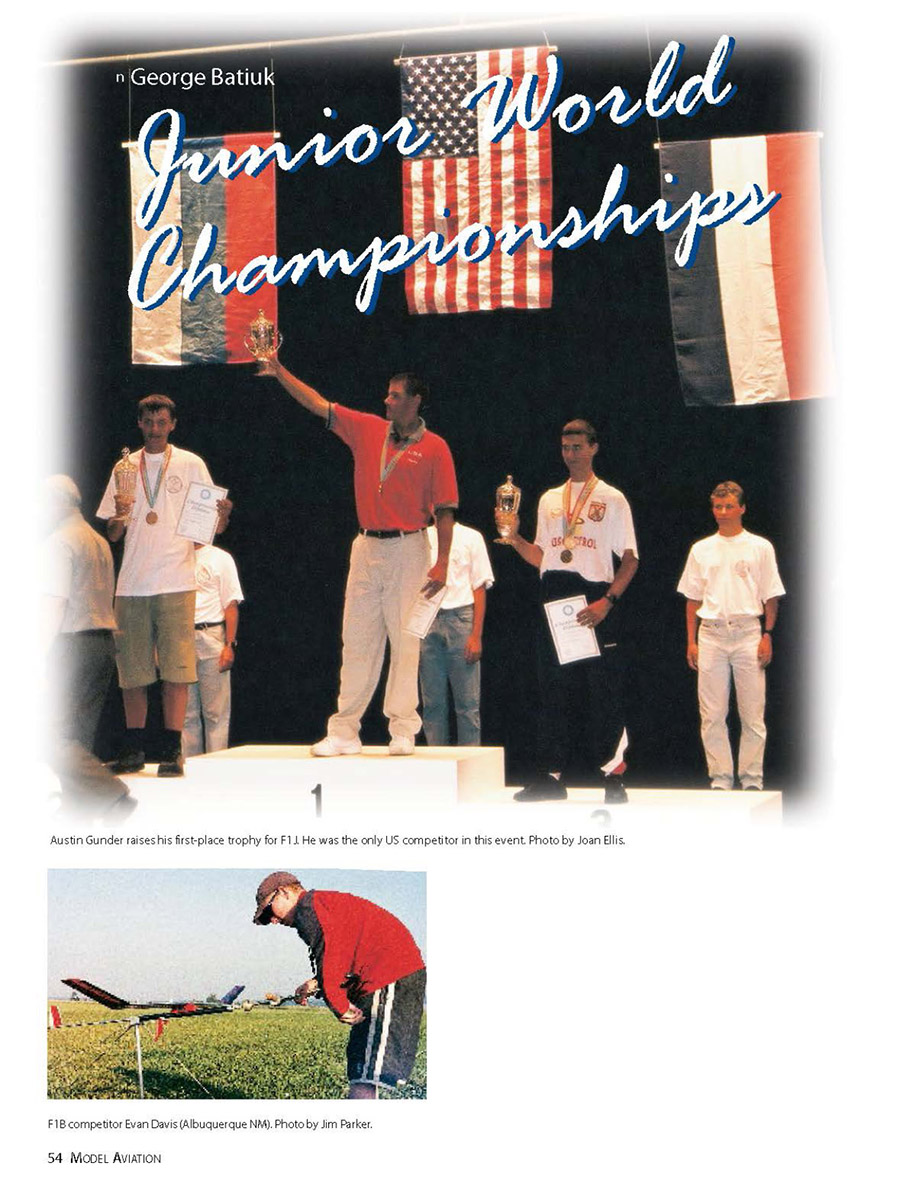
Austin Gunder was the lone U.S. entrant in F1J and attracted attention as one of the best fliers on the field. He was on the 1998 junior team and subsequently developed top-level F1J models with help from his dad Craig and Mik Achterberg.
The contest consisted of five flights: the first a 210-second max, the remaining four 120-second maxes, all with seven-second engines. Rounds one and two had light lift and little drift. By round three the wind increased dramatically and models were sometimes carried more than a mile in two minutes. Austin never had a completely clean flight, but his chase crew recovered his model each time.
All five rounds finished by 1 p.m., and the flyoffs were delayed until 6 p.m. because of the wind; all 13 competitors made the finals. The wind had not subsided when flyoffs began, but the organizers proceeded. With only a roughly 10-minute window to fly, Austin took the first calm spell and launched about four minutes into the round. Nine minutes later he was World Champion; the next closest competitor was 12 seconds behind.
Austin was a pleasure to coach—capable and polite—and is expected to go far in the sport.
Final day and practice
Because the awards ceremony did not begin until 4 p.m., most U.S. contestants returned to the field to fly on the last day. They tried to get as much flying as possible; Austin and Art Ellis reportedly flew F1A as well.
Results and awards
The Americans had plenty to cheer about at the awards. The national anthem recording worked and the team celebrated.
- F1A:
- Pawel Dorsz (Poland) — 1290 + 181
- Jiri Chudoba (Czech Republic) — 1290 + 150
- Eldad Fish (Israel) — 1290 + 144
- Team winner: Poland
- F1B:
- Ivan Kolic (Yugoslavia) — 1290 + 299
- Marian Sefranski (Poland) — 1290 + 228
- David Ellis (USA) — 1290 + 217
- F1J:
- Austin Gunder (USA) — 690 + 300
- Ilia Dovtorov (Russia) — 690 + 188
- Ivan Kolic (Yugoslavia) — 690 + 184
- Team winner: Yugoslavia
Thanks and next steps
Thanks to David Ellis and Evan Davis for participating in the Junior program. Both will be moving into the senior ranks—Evan after his first time in the program, and David after his third.
The Junior World Championships would not have been possible without the organizers’ hard work and dedication. The U.S. contingent thanks Vladimir Kube and his crew for doing a very nice job.
Junior flyers interested in entering the next program cycle should contact George Batiuk at (805) 546-8231.
George Batiuk 1759 Southwood Dr. San Luis Obispo, CA 93401
Transcribed from original scans by AI. Minor OCR errors may remain.

