
Juniors — Where to Find Them
E. J. Hartmangruber
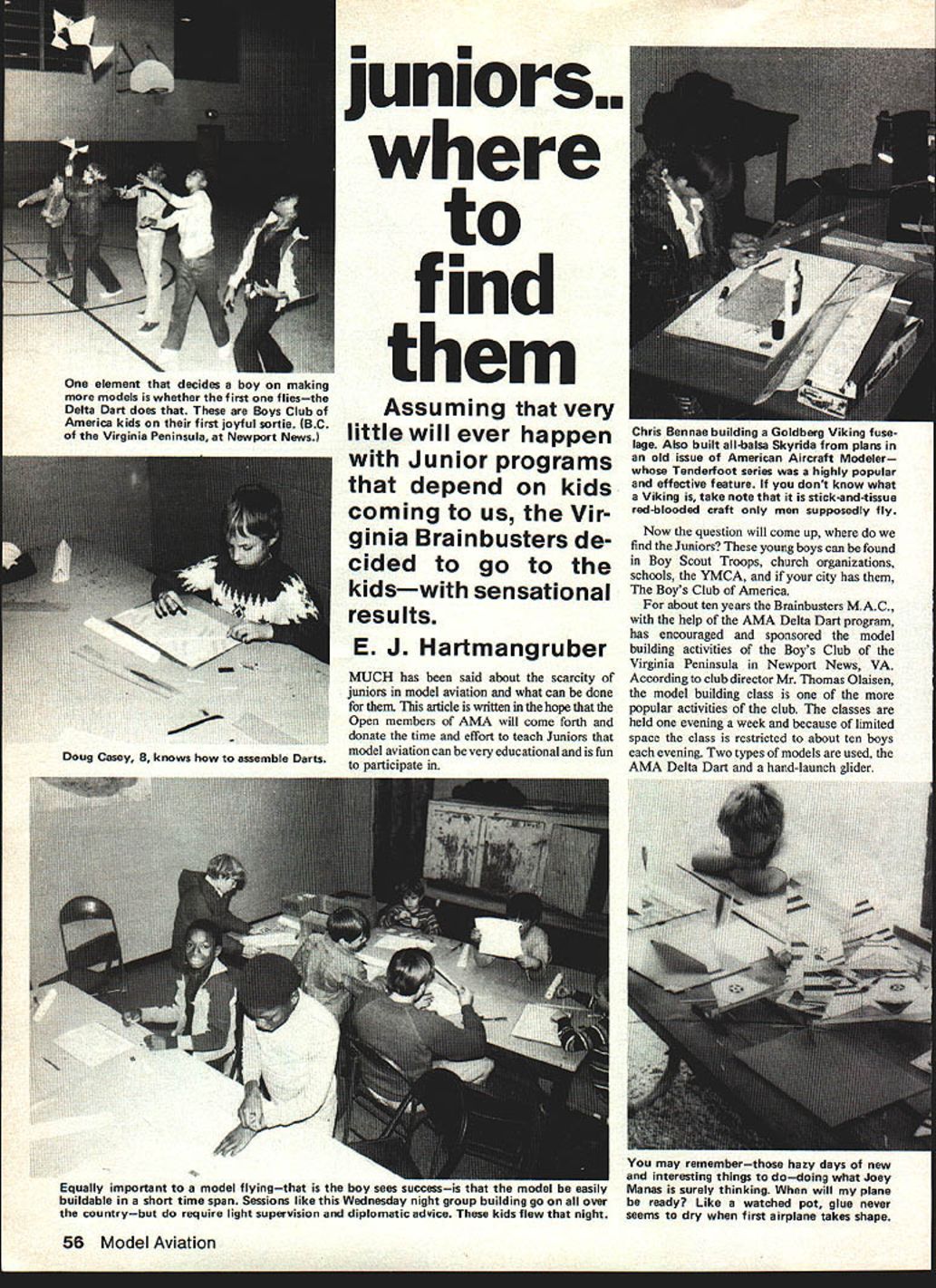
Assuming that very little will ever happen with junior programs that depend on kids coming to us, the Virginia Brainbusters decided to go to the kids—with sensational results.
Much has been said about the scarcity of juniors in model aviation and what can be done for them. This article is written in the hope that the Open members of the AMA will come forth and donate the time and effort to teach juniors that model aviation can be very educational and is fun to participate in.
Where to find juniors
These young boys can be found in:
- Boy Scout troops
- Church organizations
- Schools
- The YMCA
- The Boys' Club (if your city has one)
The Brainbusters and the Boys' Club program
For about ten years the Brainbusters M.A.C., with the help of the AMA Delta Dart program, has encouraged and sponsored the model-building activities of the Boys' Club of the Virginia Peninsula in Newport News, VA. According to club director Thomas Olaisen, the model-building class is one of the more popular activities at the club.
Classes are held one evening a week and, because of limited space, are restricted to about ten boys each evening. Two types of models are used: the AMA Delta Dart and a hand-launch glider. It is important that the models be easily buildable in a short time span so the boys experience success. Sessions like this Wednesday-night group building go on all over the country but do require light supervision and diplomatic advice. These kids flew that night.
What the Delta Dart and hand-launch gliders teach
Building the Delta Dart teaches boys to:
- Use tools
- Shape a wing
- Use sandpaper to smooth parts
- Follow written instructions
- Read simple drawings
- Use a razor blade properly to cut good joints
- Use glue properly to assemble parts
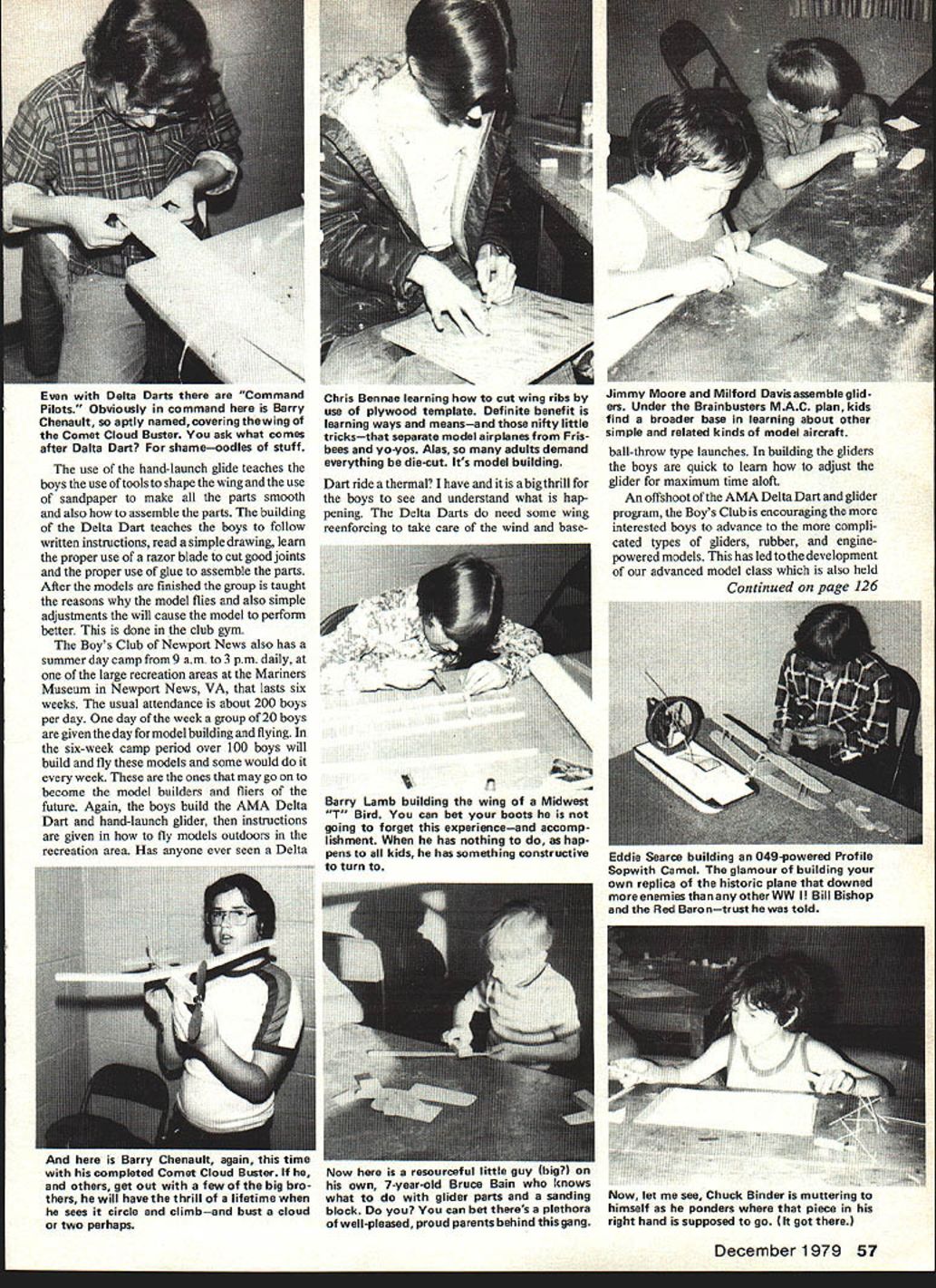
After the models are finished, the group is taught why the model flies and simple adjustments that will improve performance. Many of the models are flown in the club gym.
Hand-launch gliders similarly teach the use of tools, wing shaping, sanding, part assembly, and flight adjustment. These activities give boys an experience and a sense of accomplishment—something constructive beyond throwing a ball. Boys quickly learn to adjust a glider for maximum time aloft.
Summer day camp activities
The Boys' Club in Newport News also runs a six-week summer day camp (9 a.m. to 3 p.m. daily) at the Mariners' Museum recreation areas. Usual attendance is about 200 boys per day. One day each week a group of 20 boys is given a day of model building and flying. During the six-week period, over 100 boys will build and fly models; some return the following weeks to build more and a few may become model builders and fliers in the future.
Has anyone ever seen a Delta Dart ride a thermal? It is a big thrill for boys to see and understand what is happening. Delta Darts need some wing reinforcing to handle wind and baseball-type launches.
Advanced progression
An offshoot of the Delta Dart program at the Boys' Club has been the encouragement of interested boys to advance to more complicated types of gliders and rubber-engine-powered models. This has led to the development of an advanced model class.
For starters we use the Comet Fly Boy and Cloud Buster kits because these kits are excellent for teaching the fundamentals of built-up wing and fuselage construction and the finer points of model adjustments for best flights. After the boys have mastered these two models, they are encouraged to choose their own building projects. Several have progressed to more advanced free-flight and control-line engine-powered models. All that needs to be done is to ignite the spark of interest and help it grow.
Continuity and volunteer advice
If any club or club member volunteers to conduct a model group anywhere, do not make it a one-time event. Continuous instruction in flying operations is necessary to maintain and develop each boy's interest. With the Boys' Club there is always an influx of new members; occasionally a boy will show a real interest in the educational value and art of model building that may last the rest of his life. For others it may be something to do for a time, but they may later resume building and flying when older.
Editor's Note
At numerous flying sessions in many localities we have been impressed by the many enthralled kids—of all ages—who ask where these models can be found and how to fly them. Letters to the magazine reflect the same need for information. So if you're fortunate enough to be near a club where these activities are held, you'll find the assistance and guidance necessary.
The author, an outstanding rubber-powered expert familiar with market availability, was invited by MA to share his experience building and flying hundreds of these interesting aircraft. Although we speak of "scale," you will find meaningful coverage of non-scale items in the trainer and intermediate categories—great lead-ins to tackling the real scale stuff.
Transcribed from original scans by AI. Minor OCR errors may remain.

