

Just For the Fun of it
By Bill Winter
It never has bothered me that people might call my airplanes toys. If a neighbor thinks I am in my second childhood, I pity his ignorance. Subconsciously, he is just jealous. I know my models are not toys, and that is all that counts. Radio-controlled aircraft are being used all over the world in an amazing variety of scientific ways for the benefit of mankind.
Industrial and scientific uses
To quote an English newspaper (Daily Express): "All around the world, the commercial potential of the model aircraft is being examined with new interest. In industrial areas, they are being used to sample and monitor pollution levels. In Germany, models are used to carry light lines across gorges so that heavy cables can be taken over. In Suffolk they are being used to locate archaeological remains beneath the soil."
Examples of uses:
- Pollution sampling and monitoring.
- Carrying light lines across gorges so heavy cables can be installed.
- Locating archaeological remains beneath the soil.
Our own modeling press has frequently reported the industrial application of RC models, as for movie purposes—such as Ernie Huber's copter flying in The Towering Inferno, and those great English movies using huge chainsaw-powered Stukas, Spitfires, etc. RC scientific models have been flown off ship at sea (recovered by flying into a net) and many times on air-sampling projects. We know that Bob Munn has developed very advanced techniques for archaeological research in, we hear, Africa and other exotic locations.
Peter Miller and Jeff Hoer
Among the practitioners of this developing art is our good friend in England, Peter Miller, whose Tempe CL job was published in Model Aviation. From him we have an amazing story, and present only a couple of tempting pictures from his collection. Peter filled us in on another incredible chap, Jeff Hoer, his countryman, who has saved thousands of Pounds Sterling for the South Western Water Authority by taking aerial pictures of dyed effluent in estuaries during a full tidal cycle—a day's work for a real airplane or chopper. He searches for new springs with infrared color film; grass is a different color near springs. By the same method he plots flood lines, since underwater vegetation can be picked up for 10 days after flooding subsides. As a result of Miller's own story in the Daily Express, Hoer was interviewed on BBC.
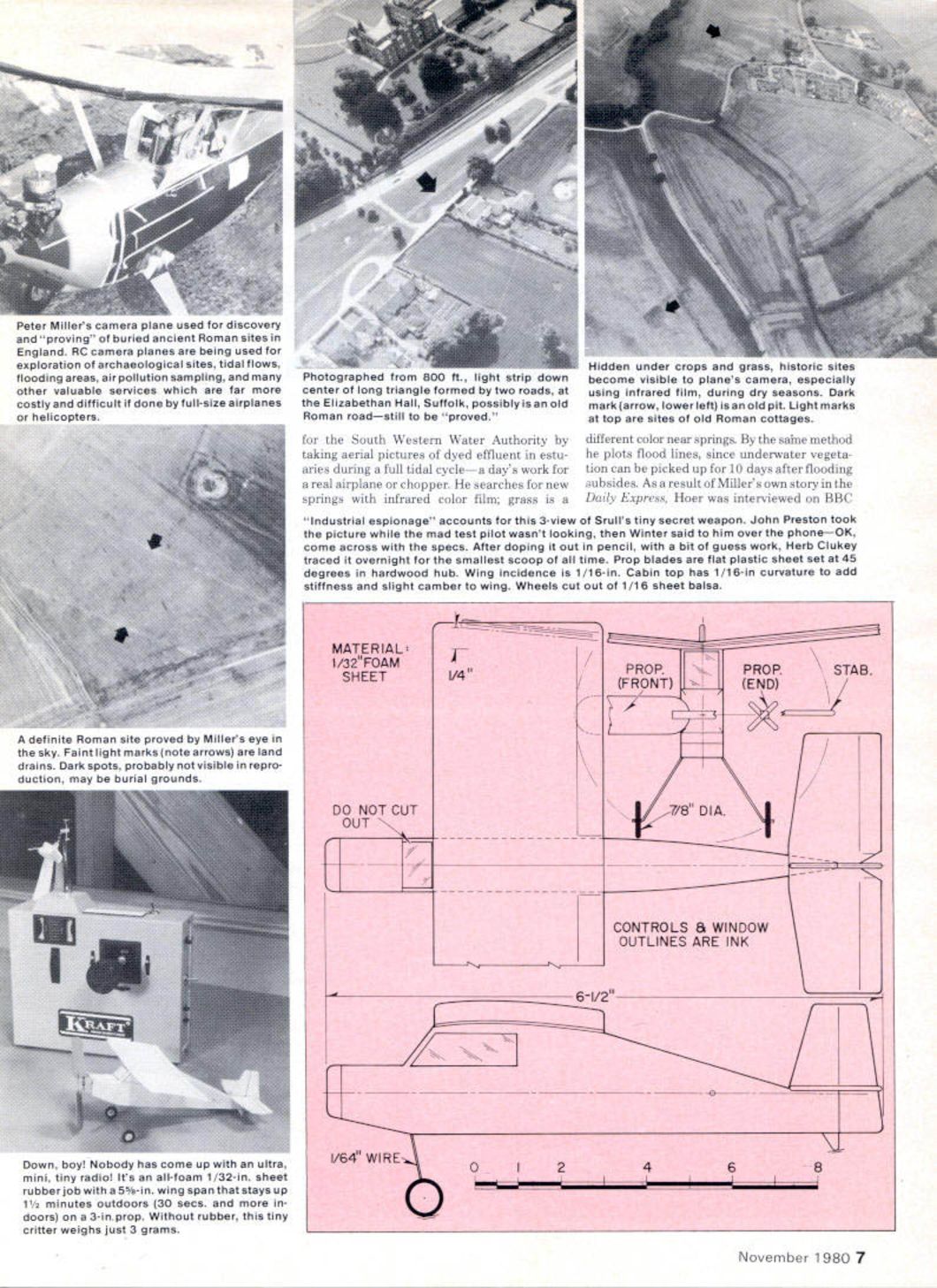
Don Srull's tiny secret weapon (3-view notes)
"Industrial espionage" accounts for this 3-view of Don Srull's tiny secret weapon. John Preston took the picture while the mad test pilot wasn't looking; then Winter said to him over the phone, "OK, come across with the specs." After doing it out in pencil, with a bit of guesswork, Herb Clukey traced it overnight for the smallest scoop of all time.
Notable construction details:
- Prop blades: flat plastic sheet set at 45 degrees in hardwood hub.
- Wing incidence: 1/16 in.
- Cabin top: 1/16 in curvature to add stiffness and slight camber to the wing.
- Wheels: cut out of 1/16 sheet balsa.
Camera planes and archaeology
Camera planes have been used in discovering buried ancient Roman sites in England. RC camera planes are being used to explore archaeological sites, tidal flows, flooding areas, air pollution sampling and other valuable services far more costly or difficult to do with full-size airplanes. Hidden under crops and grass, historic sites photographed from 800 ft with infrared film become visible—a light strip down the center, a long triangle formed by two roads. Using infrared film during dry seasons, dark marks probably indicate burial grounds.
Voodoos and miniature marvels
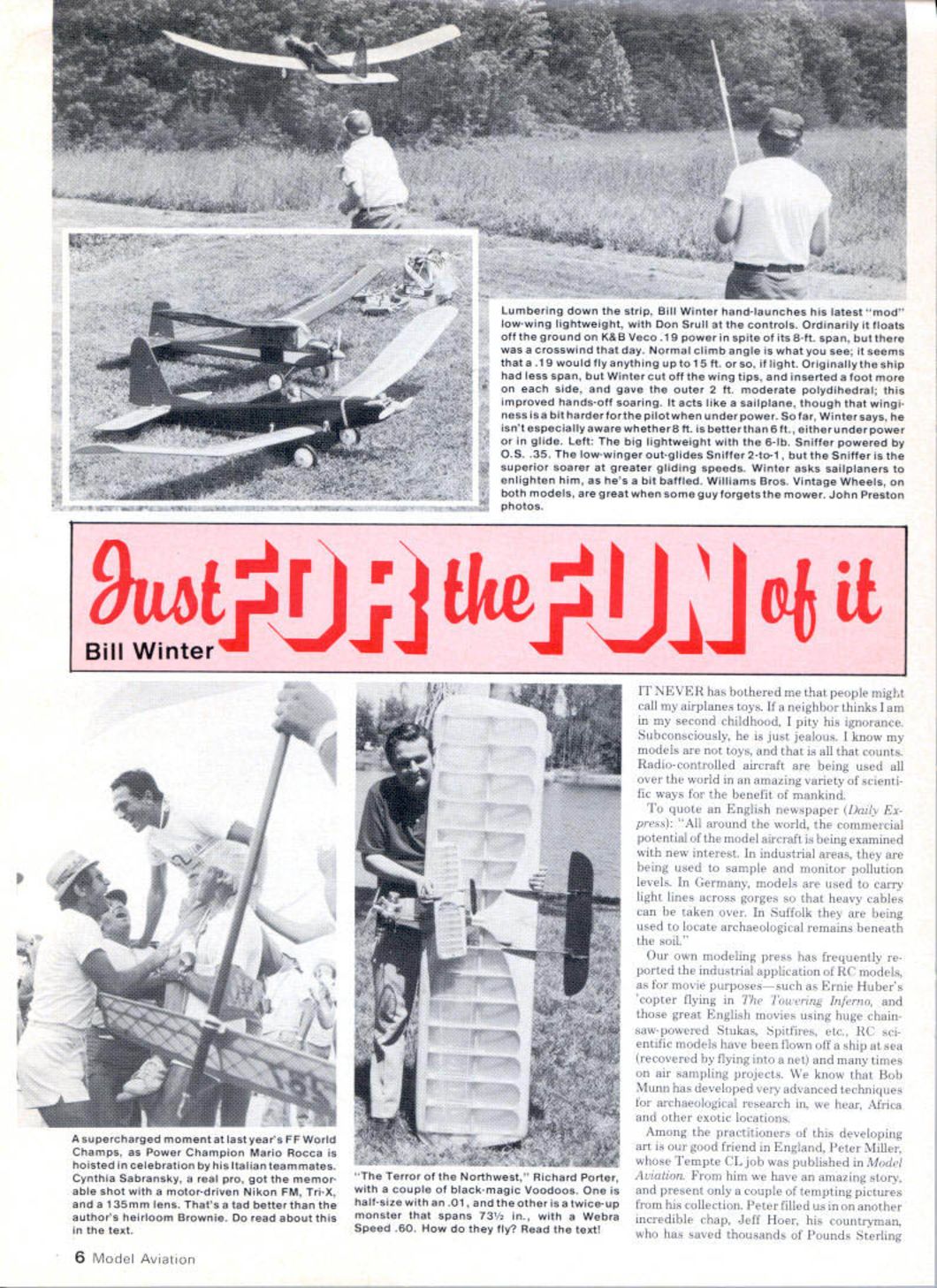
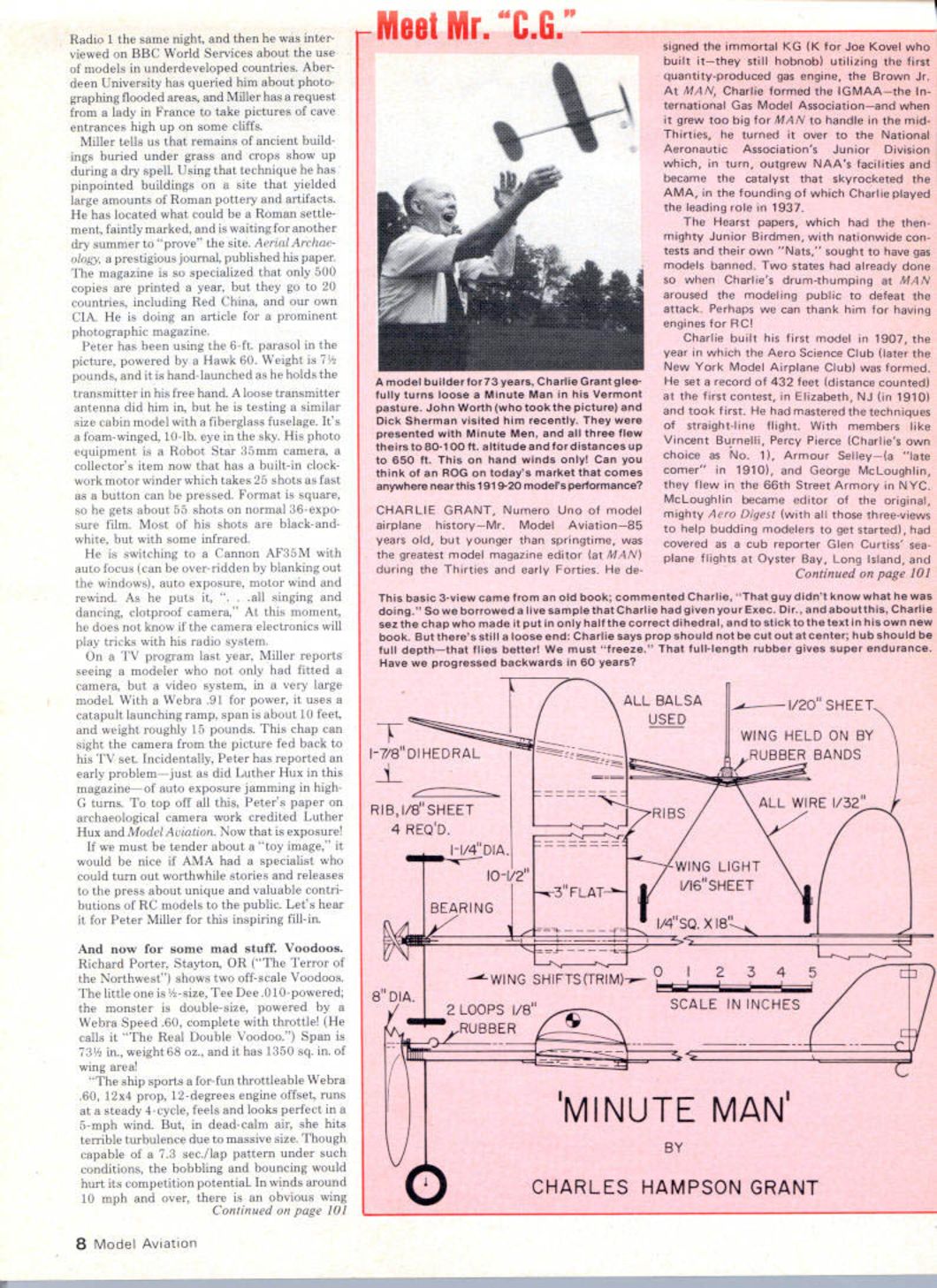
And now for some mad stuff. Voodoos. Richard Porter, Stayton, OR ("The Terror of the Northwest") shows two off-scale Voodoos. The little one is 1/2-size, Tee Dee .010-powered; the monster is double-size, powered by a Webra Speed 60, complete with throttle! He calls it "the Real Double Voodoo." Span is 73½ in., weight 68 oz., and it has 1,350 sq. in. of wing area.
"The ship sports a for-fun throttleable Webra .60, 12x4 prop, 12-degrees engine offset, runs at a steady 4-cycle, feels and looks perfect in a 5-mph wind. But, in dead-calm air, she hits terrible turbulence due to massive size. Though capable of a 7.3 sec./lap pattern under such conditions, the bobbling and bouncing would hurt its competition potential." There is a flexing problem that needs to be corrected.
He flies it on 70 feet of .021 line.
And, no, that teeny monoplane with the transmitter in another picture is not an RC job. It is something else. Spanning only 5½ inches, with a chord of two, and weighing but three grams without its one-foot loop of 1 mm rubber, it flies from 30 seconds to 1½ minutes—a Lacey make-believe. It can be flown indoors and out. That prop is only three inches in diameter—two thin flat plastic sheets glued at a 45-degree angle to a wood hub. It is made from 1/32 blue foam (industrial type), wire-cut for Don Srull—who else?—by a fellow Maxecuter. We leave the gory details to the 3-view. You got it—living room pylon racing.
Free Flight—what it's like
Blondes don't have all the fun, and neither do RCers. How does the other half of the world live? What does a Free Flighter look like? You never saw one? For shame.
As it sometimes happens, an editorial type latches onto a nifty picture that just screams for a story. What are all those crazy guys doing behind that Free Flight model? When did you last see such excitement and glee after a competition was over? Imagine what it is like to fly in a World Championships for Power, or Nordic, or Wakefield. You have to max out—to stand a chance of winning—for seven consecutive flights of three minutes each. Having done that, it's you against "them," the other survivors who propose to eat you alive if you don't get them first: the flyoff. Each flight upped a minute: four minutes, then five, then six, or whatever it takes to outlast the other guys for all the marbles. Put yourself in that picture. Imagine the building tension. When the end is reached, everyone goes mad with hysteria and nervous relief from following the gladiatorial elimination.
When we saw the incredible cover on the last 1979 issue of NFFS Free Flight, we asked the editor, John Oldenkamp, for the picture. Said he: "Herewith the picture. Not much to say about it, except that it's a hell of a photograph." It was taken at the last F/F World Championships by John's friend and assistant, Cynthia Sabransky, who obviously has excellent timing and a good eye. If she digs F/F it is because she manages to build an occasional one, and enjoys the sport/hobby as much as the guys, in spite of being a full-time student at SDSU in Graphic Communication. A keen student, obviously. She'd like to have time to build more than just an occasional crate.
If you wonder what turns on these Free Flighters, now you know—and we don't mean Cynthia. It's that showdown, the get-out-of-town-before-sundown flyoffs, the Russian-Roulette flight-by-flight shoot-out. Of course, there's much to be said for just flying: that high, fast climb, the smooth transition, the hypnotic silent glide. And they do it all without open gimbals. Fancy that!
When your RC model dies on landing
When your RC model lands and on the very next impulse drops dead, what do you do? Around here we take our baffling problems to Bill Hershberger, the old Pylon master, now retired and deep into servo research for industry. While he undoubtedly blesses us for the intrusion into his lab, he goes at the problem like a brain surgeon. You come out mighty humble.
So our air-hacker, having "belled up" (stopped working), was carried to the great "brain doctor." We had a dead battery—why? It got confusing, because we also had a loose Rx crystal! Do check that! And the LED in the charger was up to tricks. For our 225 pack it was dropping within 30 seconds from a 2A charge rate to six mA! Said he, "My, that would take you a couple of days to charge."
Also, we had a straight-run wire pushrod through a nylon tube. It had a bind at one point. How could that be possible? A tiny flexing of the stiff pushrod in the cabin end was moving the servo in and out on its servo-tape mounting against the fuse side, resulting in uneven neutrals after every rudder command. On that last flight we had to control the crate continuously. On its old Enya .09 and an S.O.R. S 1¼-oz. Perfect wedge CL tank (wedge down) installed 19 years ago, you get just two flights after dinner of a summer's evening. Steering with rudder becomes an occupational disease on flights that long.
The servo—which all the experts had blamed—was innocent. It was a Futaba, and it seemed to fascinate Bill, who said "those guys" really went to fantastic lengths. "Put in a cable," sez he, "remount the servos." He put a resistor in to drop the charger rate to 20 mA. But no one can see a reassuring red light. Do LEDs go bad? Neither of us had ever had a charger fail. Now, the crate is working just fine, real innocent-like. We'll lose it? What other gremlin might have gotten in? Our next hop will be all pins-and-needles.
Moral: everything must be perfect. Linkages must be perfect. No drag. No little things not quite perfect—even those so little you'd hardly spot them—can be compromised. Put us down as a true believer.
For contributors
This monthly feature is for all sport modelers—a place for bright ideas, unusual developments, interesting planes and events, whatever. Modest payment is made for pictures used. Help make it fun for other guys by showing us what you have.
Bill Winter 4330 Alta Vista Dr. Fairfax, VA 22030.
Transcribed from original scans by AI. Minor OCR errors may remain.

