
Just For the Fun of it
Bill Winter
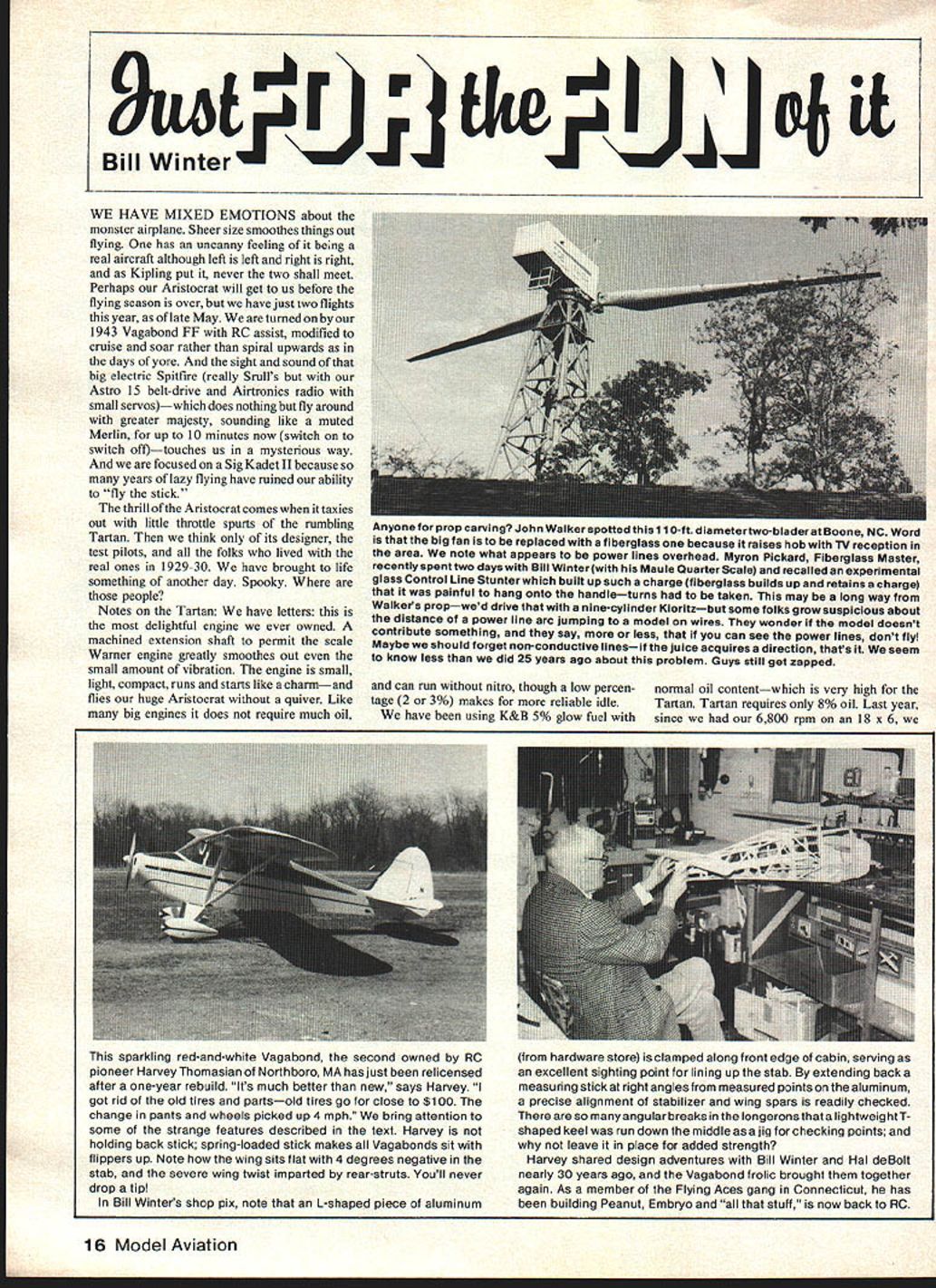
We have mixed emotions about the monster airplane. Sheer size smoothes things out in flying. One has an uncanny feeling of it being a real aircraft although left is left and right is right, and as Kipling put it, never the two shall meet. Perhaps our Aristocrat will get to us before the flying season is over, but we have just two flights this year, as of late May. We are turned on by our 1943 Vagabond FF with RC assist, modified to cruise and soar rather than spiral upwards as in the days of yore. And the sight and sound of that big electric Spitfire (really Srull's but with our Astro 15 belt-drive and Airtronics radio with small servos) — which does nothing but fly around with greater majesty, sounding like a muted Merlin, for up to 10 minutes now (switch on to switch off) — touches us in a mysterious way. And we are focused on a Sig Kadet II because so many years of lazy flying have ruined our ability to "fly the stick."
The thrill of the Aristocrat comes when it taxies out with little throttle spurts of the rumbling Tartan. Then we think only of its designer, the test pilots, and all the folks who lived with the real ones in 1929–30. We have brought to life something of another day. Spooky. Where are those people?
Notes on the Tartan
We have letters saying this is the most delightful engine we ever owned. A machined extension shaft to permit the scale Warner engine greatly smooths out even the small amount of vibration. The engine is small, light, compact, runs and starts like a charm — and flies our huge Aristocrat without a quiver. Like many big engines it does not require much oil and can run without nitro, though a low percentage (2 or 3%) makes for more reliable idle.
We have been using K&B 5% glow fuel with the normal oil content — which is very high for the Tartan. Tartan requires only 8% oil. Last year, since we had our 6,800 rpm on an 18 x 6, we allowed it to run a bit rich, and it smoked. Yesterday we leaned it out for more revs and found it was already peaking, even "rich." That high oil content causes smoke which confuses the familiar signals. You can lean it too much and it still smokes — and presumably gasses screw in the needle too much and can’t get full power. (Harry Roe, at World Engines, says we have an interesting theory, but he prefers to run tests to check.)
We’ve purchased two gallons of 15% nitro fuel and two gallons of straight methanol which, when mixed, cut the oil content in half, and with more methanol, achieved greater economy. The 7½% nitro resulting should offset two additional pounds (dummy engine, etc.), a gross of 28 pounds. If you run straight glow with lots of oil, get good rpm on the rich side, and then use a tach to monitor rpm as you set it leaner. From max rpm, drop off a bit as you would with any glow engine. This is not definitive yet, but it is where we stand — happily we add: Note: There now is an ignition Tartan as well.
Building the Piper Vagabond
We are building a Piper Vagabond 1/4-scale. At seven feet plus, and hopefully no more than 15–18 pounds for our O.S. 90, it goes more quickly in the shop, and that small reduction in size reduces the work time by at least a third. We suspect that if it was still more model-like with a straight .60 at say 15 lbs., it would be better suited to our psychology and fly just as well. And there is that blood oath: I will finish this thing! We must fly more if building is to pay off. If you're like me, you build to enjoy flying.
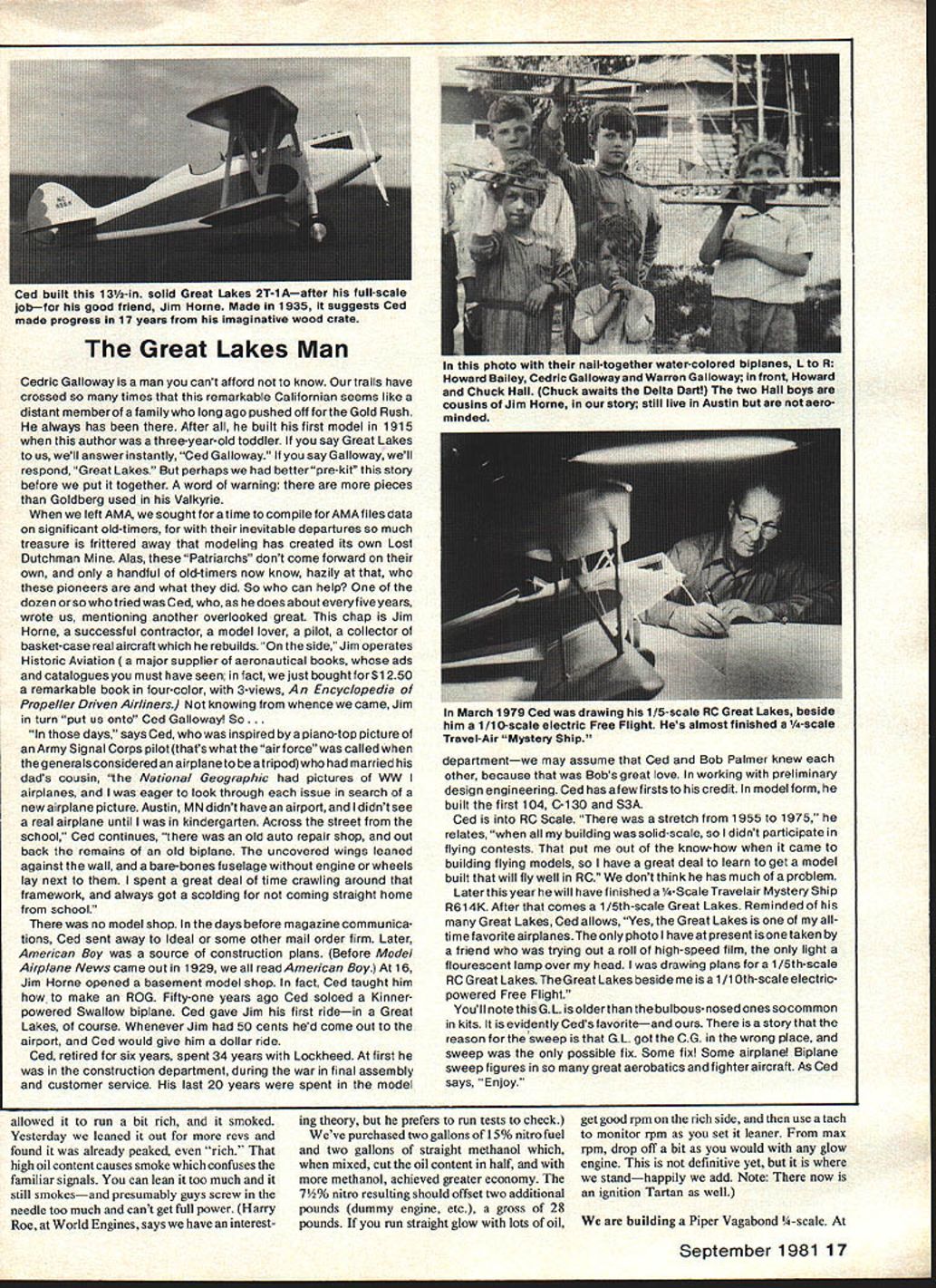
The Piper Vagabond is unique. A strange beast. What makes it unique is its universality as a good flier in all types and sizes. It is short coupled, with a wide chord and generous wing area. Tail surfaces can be scale even for Peanut. It is almost unbeatable on rubber, competitive with a Lacey or Fike. Ailerons are practically full span, almost strip-like. It is a stable Free Flight, a good Control Line subject, made to order for Radio Control and aerobatics. It's a box. But no one ever made a Scale model of this thing that was worth a hoot insofar as measurements, detailing, etc., is concerned.
The sides are not parallel, as 3-views show us. Width at the bottom longerons is greater than the top in the forward cabin area, narrower at the rear cabin. Longerons break sharply inwards at the top, roughly at 3/8 chord. The bottom also breaks, but farther forward, at the gear. The profile is not a long sweeping curve as we all build it. There are numerous sharp longeron breaks on both sides, top and bottom. Structure is virtually devoid of 90-degree cross pieces.
Scale incidence in the stabilizer is a flat negative four degrees. The wing is near flat. Tips are twisted to three degrees negative (we built it in) by the rear struts. You just know that the CG has to be far forward (probably at 20% chord) and that with such angular difference there is only one good trim speed, which can be upset by power variations. Piper cut eight feet off a Cub wing, hence the low-aspect wing on the Vagabond. Was it nose heavy? The stick is spring-loaded so that all Vagabonds sit on the ground with up elevator. We'd call this over-stable, and the problem is in having enough elevator power to hold the nose off on landing. Rear stick loads must have been heavy.
Oddly, we had hours on the real Vagabond, and it is the only ship among 25 to perhaps 30 lightplanes whose flying characteristics are now a blank. One thing prevented our abandoning it as a good 1/4-scaler: that rigging scared the daylights out of us. But we have a mimic Aeronca C-3 called the Airknocker with a similar setup. We converted the 20-year-old escapement model to servos on rudder and engine, have 3/16-in. negative in the stab, and a far forward CG, just like the Vagabond. It flies well with lazy realism at one trim speed. You throttle back, cruise, and enjoy. We also had lots of downthrust.
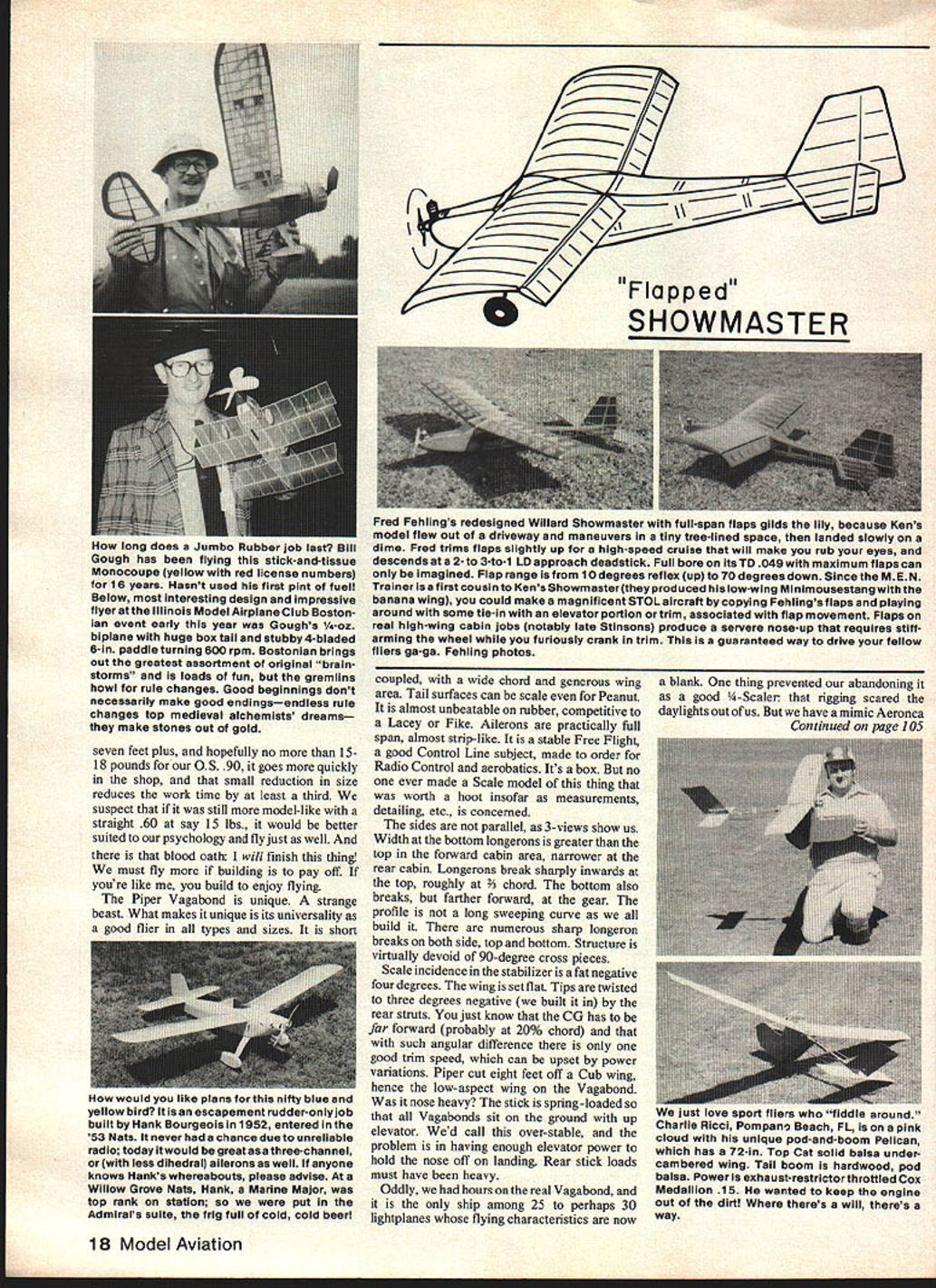
We have a stack of factory drawings. Bill Cavanaugh, who once owned shares in a Vagabond and wants to build one after us, Walt Mooney who actually owns one, and Harvey Thomasian supplied many dozens of pictures and various drawings (as did Shipp). Someone had converted Walt's to a bubble windshield, like a Champion, before he got it. Walt made some mods (still more twist and more dihedral). Hearing our comment that we sneaked in two degrees downthrust, Walt said he'd use five degrees down in his real one, but that would louse up the cowl. We found the fuselage structure so difficult to visualize that we built as we drew, coming back to the board to make changes as the object took shape.
Of Cabbages and Kings
We dream endlessly of the crates we'd love to make. Since "boyhood" we've been fascinated by the Boeing 100. It's a glamour biplane, a civil example of the Boeing P-12 fighter. It had a 450-hp Wasp — Williams Bros. would be exact for a 1/5-scale and, really, quarter scale is overkill. We call that thing 1/15, 1/4 and 5/8 scales — at least — to allow for the bulk of real ships. You have noted the zeroing in on 1/5th scale? If you have an eye for design, you suspect that someone in the Boeing organization had an influence on many airplanes over quite a few years. We see a strong resemblance to the popular Stearman PT-17. (We'd love to see a Boeing 100 at an airshow!) There is no relationship to Grumman, but the P-3 series of fighters is a similar setup. All these ships are great flying model bipes — especially the Boeing F4B-4. We had one at 45 inches, rubber-powered, and to watch it cruise sedately was to be reborn. The 100 has that Boeing profile — typical of fighters of the era, like the celebrated Hawker Fury (yet another!). The cockpit was high for visibility, the fuselage sloped down to the nose and to the fin.
And there is the ABC Robin, a cute British sport monoplane flown by the Prince of Wales among others. We made over 30 of them at 30-in. span for rubber. (Fernando Ramos has a great flying CO-2 version.) The wing is swept, and tips of all surfaces have the raked look common to many planes of that earlier day — the Jenny, the Albatross fighters, Nieuports. A 1/4-scale ABC Robin would be a conversation piece, and we guarantee an incredible flying machine if you like docility and realism.
You know we thirst for a four-motored electric Connie at about seven feet. The fuselage is round, so you laminate a bunch of circles and use external stringers for lightness. It does not have to be monocoque; you'll hardly notice the difference. That electric Spitfire (Kragness tells us the first Spit had stringers and fabric) is built this way. Or maybe the Stratoliner, the great Boeing airliner. It is round and fat with a big tapered wing. Nobody will build that (Poling says, "he'll build your Connie if you do"), but we'll get TWA colors, silver and red. And why not depress plans slightly for a higher CL and L/D — and that gives you wing twist effect. (On Fowler-flap ships, why not run out the flaps, fix them at very slight down?)
Silver Hill and Restorations
We've been to Silver Hill where we saw the Bellanca CF. The CF is the granddaddy of Bellancas from which sprang the ones we know, especially the Chamberlin-piloted trans-Atlantic Columbia. Old Giuseppe was an early-day Steve Wittman. (No one similarity in tips between Bellanca and Wittman designs.) Giuseppe wanted everything to lift. His fuselages had airfoil profiles. Wing struts were wide and lifting. In 1923, the CF was powered with a 90-hp two-row 10-cylinder Anzani. The wing was well undercambered forward on the airfoil, and a single, immense wing strut had ribs like a wing.
The strut is roughly triangular in planform, narrow at the fuselage and almost as wide as the wing where it attaches. The cabin for four passengers is covered in veneer, easily obtained in modeling thicknesses at a lumberyard. It has a windshield, but the pilot is seated behind the cabin in an open cockpit! The simple landing gear is pre-split-axle type, with the axle running straight across and easily rubber shock-mounted.
At Silver Hill they restore historic birds — these now dig deeper in the fossil strata. These machines will be rotated through the Air and Space Museum proper. There is a mini-museum at Silver Hill where the big ones rest. In another building, so clean you can eat off the floor, follow-on projects are coming to life. The Langley shop has snagged a wing and is plugging it into the Smithsonian. If Leonardo da Vinci greeted us, we would have said "Hi!" A bare-bones DH-4, an important original, is almost complete. Craftsmen make the rafters and ribs of these projects; guys in charge of different restorations have timetables they must keep. In other locked buildings wait a myriad of things to be done. One finds engines from the beginning of time. There are built-up indoor-type props he played with. It blows your mind.
Airplanes and assemblies loom in the shadows like a World War I Curtiss boat.
The chap managing the DH-4 showed us his next three projects — he should live that long! A Fowler (we never heard of it either) has a few deteriorated panels and a bunch of ragged scrap which no self-respecting garbage collector would bother with. Yet someday it will stand again. Some projects depend on just a few old photos, dusty scraps, and the restorer's research. It is beyond human ability to make these pieces whole, but these chaps do it. Things like the Horton flying-wing gliders, every last one of them, from the early-era days up to the jet anti-bomber attempts of World War Two, are tucked away; a long-nosed 190 Dornier 235 push-pull, the Shinden, ad infinitum, hibernating, unseen by human eyes.
Stuff arrives endlessly at Silver Hill as curators pursue faint trails to locate things. A SPAD in tatters — so novel it stands out way in the big room of finished projects. The museum folks are into a massive computer program to tell them what planes, engines, parts, etc., they have. Programmers have been hard at this for 2½ years! We saw dated crates still unopened — going back to 1932! We stood quietly in the exhibit hall before leaving. Given that chance, you rest a hand on that CF, close your eyes, blank out your mind, and let the spirits talk. And that's why, when our Aristocrat taxies, our mind floats among the spheres — more reason why we require a pilot to fly it!
Museum specialists write fabulous books about projects. This magazine has reviewed a couple by Walt Boyne — who took us through the labyrinth at Silver Hill.
"The chap doing the CF is meant threading the model through trees on either side, requiring an approach at fairly good speed so that you could react quickly to any side gusts which might throw the model toward a branch," Ken told us. "The other thing was that the end of the street is only 100 feet from my driveway, so the model had to be able to slow down rapidly, and that's where high undercamber became effective. By coincidence, on the page facing your item, Top Flite had a full-page ad on the Trainer series designed by me. They all have a family resemblance to the Showmaster, the main difference being in the wing sections for each. M.E.N. did buy my Minimousetang, nothing but a low-wing Showmaster with exactly the same wing."
Fehling, Flaps and the Showmaster
Fehling redesigned his wing for full-span no-nonsense flaps, controlled by a separate servo. They reflex about 10 degrees, and droop about 70. The effect on a plane as light as this was devastating. "I love it!" he exclaims.
"The aircraft was flown by rudder, elevator and flaps with TD 049 without throttle," Fred explains. "Takeoffs with moderate flap deflection were instantaneous, although climb-out was best with zero flaps. Top end was increased remarkably with slight reflex, and with full flaps and full power, well, now you know why it was named the 'Suspender.' Full-flap deadstick approaches would produce an L/D of about 2- or 3-to-1 with full control. This plane can truly be flown anywhere.
"My next design," Fred continues, "though flapless, was still banana-winged and the sort of plane you can fly day after day without tiring of its habits. It is still flying after six years."
As related in our original story, we had the opportunity of flying a diesel-powered Showmaster with just rudder and elevators. When trimmed it went like bel- -blazes, on the step, and responses were delightfully smooth, with a genuine sense of tooling things about. It came in fast and firm, or parafoil-like, depending on elevator. We still think it by far the best 2- or 3-channel machine we have seen, including our own.
Author's Note
As we go to press, Harry Roe advises that a few Tartans came through with undersized muffler holes, hence did not yield full power. The proper hole size is 1/8 in. Out of curiosity, we removed our bath exhaust extension and picked up an immediate 100 rpm increase. It is evident that monster engines introduce elements we don't deal with in ordinary models. We witnessed a near-crash of a Quadra-powered Stinson due to lack of power; when a replacement engine was used the result was the same. Experts offered no answers. We learned that some Quadras came through with improper gap settings. This one was under .005, almost closed. Opened to .015, both engines ran perfectly. We gap-checked our Quadra at .025 — we were told that it should be .015. We consulted Beckman (as you should — not Winter!) who says that all ignition engines should be gap-checked before use. The Quadra is an excellent engine, in wide use. Our comments on any engine don't guarantee that it won't require some analysis on your part.
Bill Winter 4330 Alta Vista Dr., Fairfax, VA 22030.
Transcribed from original scans by AI. Minor OCR errors may remain.

