
Just For the Fun of it
Bill Winter
As a member of the Free Flight Hall of Fame, I have always questioned my credentials simply because, until now, I had no design that meets SAM's cut-off date for old-time machines. I had many free flight jobs, and although competition was far from my mind, a few of these sport machines made a contest record for themselves. Now, for my present mode of flying, SAM rules mean nothing. I just like to watch the things soar—sport, not comp.
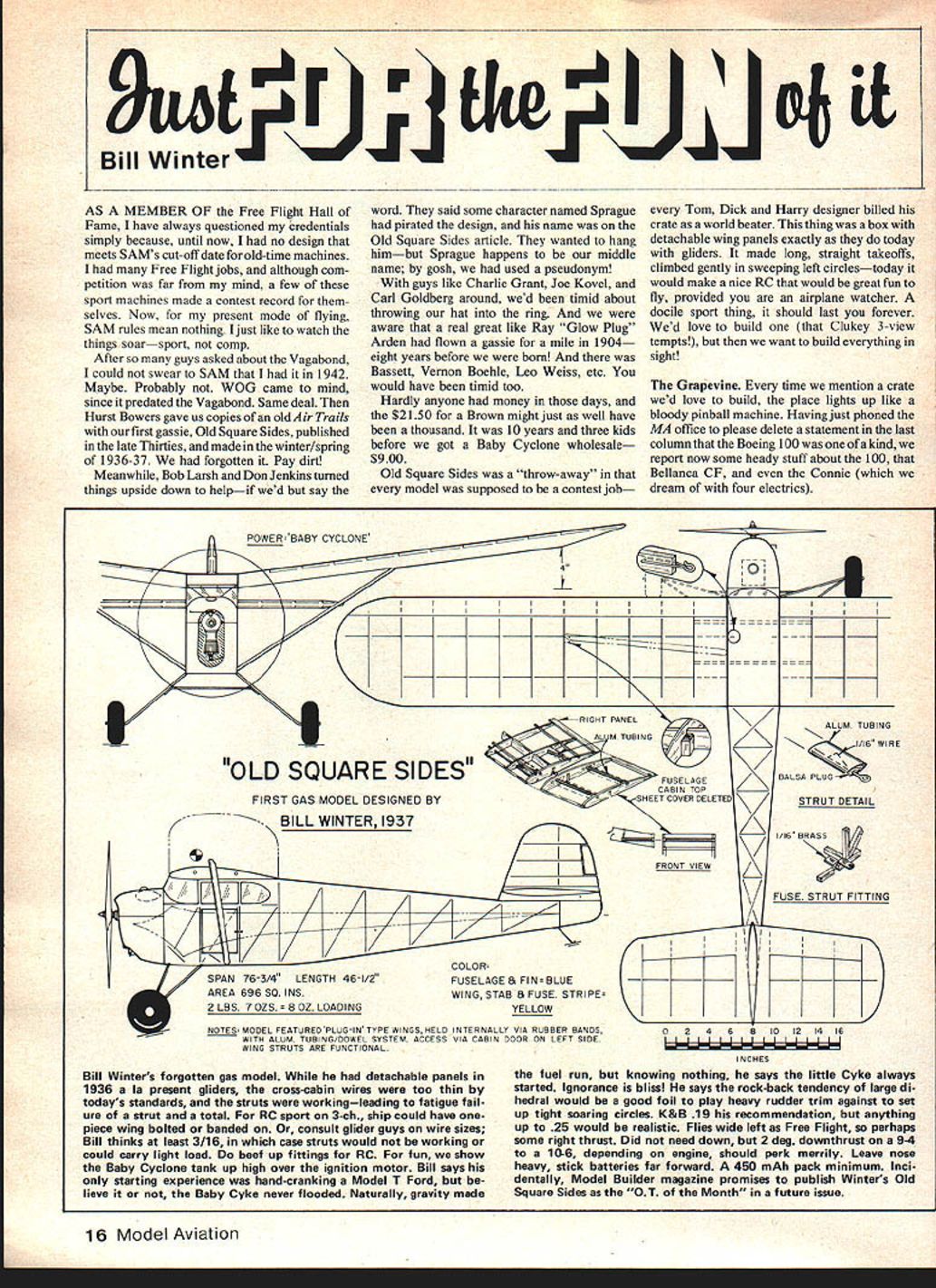
After so many guys asked about the Vagabond, I could not swear to SAM that I had it in 1942. Maybe. Probably not. WOG came to mind, since it predated the Vagabond. Same deal. Then Hurst Bowers gave us copies of an old Air Trails with our first gasser, Old Square Sides, published in the late Thirties and made in the winter/spring of 1936–37. We had forgotten it. Pay dirt!
Meanwhile, Bob Larsh and Don Jenkins turned things upside down to help—if we'd but say the word. They said some character named Sprague had pirated the design, and his name was on the Old Square Sides article. They wanted to hang him—but Sprague happens to be our middle name; by gosh, we had used a pseudonym!
With guys like Charlie Grant, Joe Kovel, and Carl Goldberg around, we'd been timid about throwing our hat into the ring. And we were aware that a real great like Ray "Glow Plug" Arden had flown a gasser for a mile in 1904—eight years before we were born! And there was Bassett, Vernon Boehle, Leo Weiss, etc. You would have been timid too.
Hardly anyone had money in those days, and the $21.50 for a Brown might just as well have been a thousand. It was 10 years and three kids before we got a Baby Cyclone wholesale—$9.00.
Old Square Sides was a "throw-away" in that every model was supposed to be a contest job—every Tom, Dick and Harry designer billed his crate as a world beater. This thing was a box with detachable wing panels exactly as they do today with gliders. It made long, straight takeoffs, climbed gently in sweeping left circles—today it would make a nice RC that would be great fun to fly, provided you are an airplane watcher. A docile sport thing, it should last you forever.
We'd love to build one (that Clukey 3-view tempts!), but then we want to build everything in sight!
The Grapevine
Every time we mention a crate we'd love to build, the place lights up like a bloody pinball machine. Having just phoned the MA office to please delete a statement in the last column that the Boeing 100 was one of a kind, we report now some heady stuff about the 100, that Bellanca CF, and even the Connie (which we dream of with four electrics).
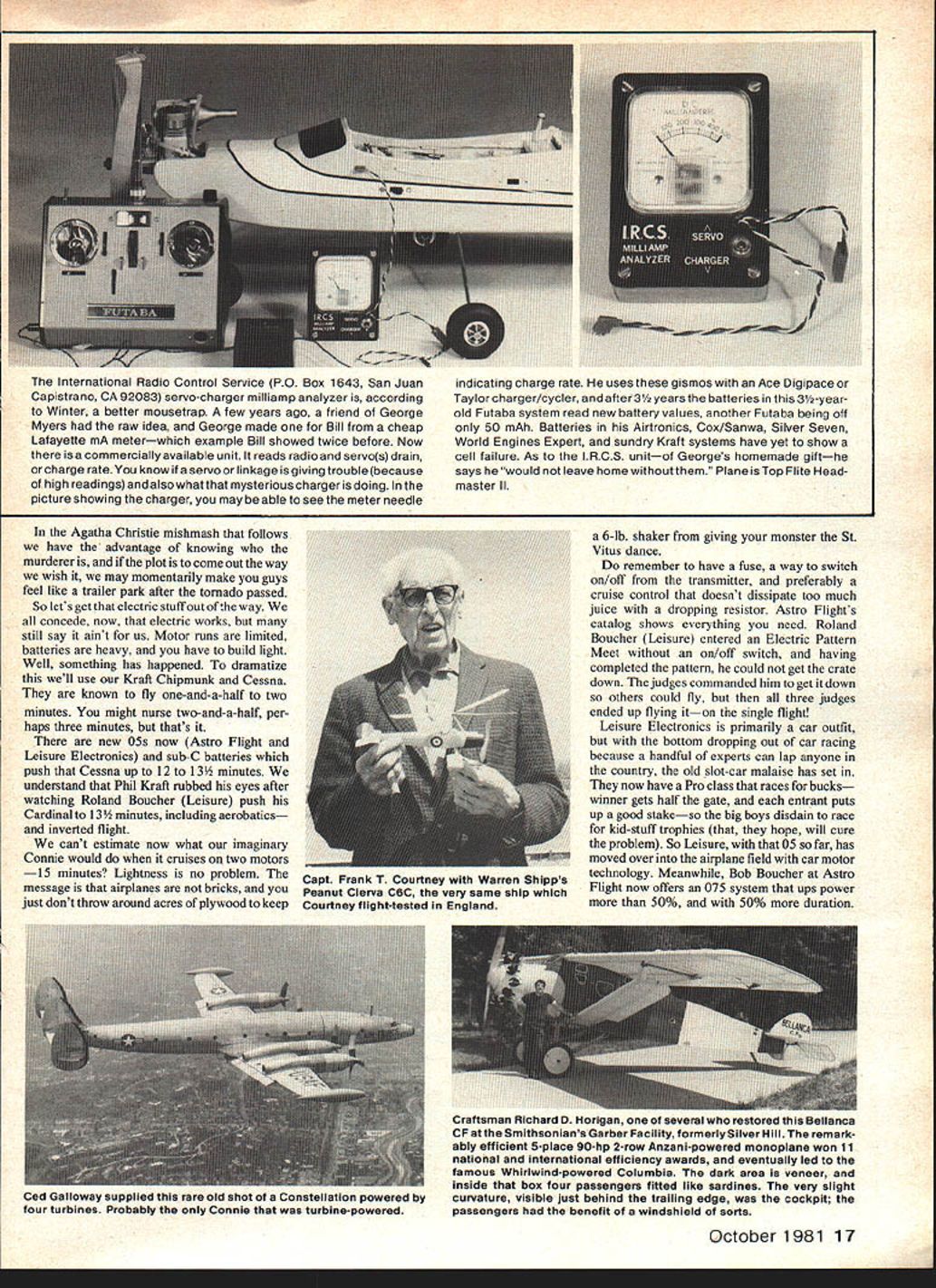
The International Radio Control Service (P.O. Box 1643, San Juan Capistrano, CA 92083) servo-charger milliamp analyzer is, according to Winter, a better mousetrap. A few years ago, a friend of George Myers had the raw idea, and George made one for Bill from a cheap Lafayette mA meter—which example Bill showed twice before. Now there is a commercially available unit. It reads radio and servo(s) drain, or charge rate. You know if a servo or linkage is giving trouble (because of high readings) and also what that mysterious charger is doing. In the picture showing the charger, you may be able to see the meter needle indicating charge rate. He uses these gizmos with an Ace Digipace or Taylor charger/cycler, and after 3½ years the batteries in this 3½-year-old Futaba system read new battery values, another Futaba being off only 50 mAh. Batteries in his Airtronics, Cox/Sanwa, Silver Seven, World Engines Expert, and sundry Kraft systems have yet to show a cell failure. As to the I.R.C.S. unit—of George's homemade gift—he says he "would not leave home without them."
Planes: Top Flite Headmaster II.
Electric—Just For the Fun of It
In the Agatha Christie mishmash that follows we have the advantage of knowing who the murderer is, and if the plot is to come out the way we wish it, we may momentarily make you guys feel like a trailer park after the tornado passed.
So let's get that electric stuff out of the way. We all concede, now, that electric works, but many still say it ain't for us. Motor runs are limited, batteries are heavy, and you have to build light. Well, something has happened. To dramatize this we'll use our Kraft Chipmunk and Cessna. They are known to fly one-and-a-half to two minutes. You might nurse two-and-a-half, perhaps three minutes, but that's it.
There are new .05s now (Astro Flight and Leisure Electronics) and sub-C batteries which push that Cessna up to 12 to 13½ minutes. We understand that Phil Kraft rubbed his eyes after watching Roland Boucher (Leisure) push his Cardinal to 13½ minutes, including aerobatics—and inverted flight.
We can't estimate now what our imaginary Connie would do when it cruises on two motors—15 minutes? Lightness is no problem. The message is that airplanes are not bricks, and you just don't throw around acres of plywood to keep a 6-lb. shaker from giving your monster the St. Vitus dance.
Do remember to have a fuse, a way to switch on/off from the transmitter, and preferably a cruise control that doesn't dissipate too much juice with a dropping resistor. Astro Flight's catalog shows everything you need. Roland Boucher (Leisure) entered an Electric Pattern Meet without an on/off switch, and having completed the pattern, he could not get the crate down. The judges commanded him to get it down so others could fly, but then all three judges ended up flying it—on the single flight!
Leisure Electronics is primarily a car outfit, but with the bottom dropping out of car racing because a handful of experts can lap anyone in the country, the old slot-car malaise has set in. They now have a Pro class that races for bucks—winner gets half the gate, and each entrant puts up a good stake—so the big boys disdain no race for kid-stuff trophies (that, they hope, will cure the problem). So Leisure, with that .05 so far, has moved over into the airplane field with car motor technology. Meanwhile, Bob Boucher at Astro Flight now offers an .075 system that ups power more than 50%, and with 50% more duration. That one turns a 7 x 4 at 13,500 rpm for eight to nine minutes—with on/off, the sky is the limit. Do write both companies for their latest poop sheets.
Then Ced Galloway (the Great Lakes man), who knows one end of an airplane from the other, showed us the rare Connie powered by four turbines, and suggests where the Electra nacelles came from. The Fowler flaps are run out, and a tad down to give a break to the hard-put camera plane.
The Connie
The Connie may have been the world's ultimate prop airliner. In its earliest form it could outrun a Zero at the Connie's best altitude. When the 707 jet appeared, the definitive Connie was within seven knots of the 707 point-to-point and had superior economics for airlines, although the 707 doubled its passenger figures. But jets were not to be denied. What performance do you suppose this turbine Connie had? It will make a spectacular electric. All Connies fly great as models.
Kragness and True Airspeed
Ned Kragness, a top-flight engineer/test pilot/et al., shocked us with a low speed figure, but then explained that figure was indicated. Indicated and true airspeeds differ widely at altitude. To know what the crate is really doing you have to multiply indicated airspeed by 1.75% per thousand feet of altitude. At absolute ceiling you'll be indicating stall speed, whereas the crate is going like gangbusters through the thin air. This will shake you up, but an indicated airspeed of 100 mph at 10,000 ft would be 117.75 true, and at 20,000 ft that low indicated would be 134 true. If we mess this up, may some high-time pilot write a letter to the editor and set down the facts for our mutual edification.
At absolute ceiling, extremely difficult to attain in any crate, indicated speed drops until it meets the stall speed . . . that's it, and the slightest quiver will send you tumbling 6 or 7,000 feet until heavier air permits recovery.
To convert indicated airspeed to true airspeed: True = Indicated × [1 + (altitude (ft) × 0.0175 / 1000)]
Obviously, models flown at higher altitudes should be more lightly loaded, too. But just think of big engines and accept the greater observed flying speed of the model. Perhaps a bit more area?
Warren Shipp on the Boeing 100 and Bellanca CF
Warren Shipp chips in on the Boeing 100 — we had a 1/5th scale in mind. This is confusing, sorry. The fourth production F4B-1A was an administrative transport for Asst. Sec. Air Davis S. Ingalls; blue fuselage, yellow wings and tail, with tail stripes. First one went to Bureau of Air Commerce as NS-21. Second model 200, P-2514-B, was NX872H, P&W test bed, French gray, Boeing green trim, then to Milo Burcham for air show work (1933 to WWII); modified red, silver, as NC-872H to Tallmantz. There were supposed to be four; third as 873H went through C, NC, NR, NX, N, for Boeing test and demo—Mantz in 1936–64. Fourth, NX874H, demo, sold to Japan. The 100A was a converted two-seater for Hughes. Two 100Es went to Thailand, export P-12E (old friend Gordon Williams shot this one in Thailand museum). The 100F became Army P-12F. Clear as mud, we suppose, but it is best we can do. It may have been Prototype 33 in 1928. (The "100" is in Kragness' log book.)
And that lovely picture of the Bellanca CF is thanks to Jay Spencer of the Smithsonian. Jay has finished a book on this truly remarkable aircraft for the Smithsonian—we'd guess you could buy it in a few months (contains a great drawing by George Clapp). Jay says we are the only one so far to single out that CF at Silver Hill. Warren Shipp gets into the story with a notation that the AAHS Journal, Vol. 10 No. 1, pg. 42, relates the CF to 1921, 5-seat, Anzani 90 hp. In 1922 it won 13 prizes for efficiency in aviation and international events—up to 1925. It was followed by the WB-1 (1925 Wright-Bellanca—the one we remembered and found in our Jane's All the World's Aircraft for 1925) and then by the WB-2. The CF was a country mile ahead of anything in the world.
When the phenomenal Wright Whirlwind appeared on the scene, things began to happen. Soon, the Bellanca Columbia evolved. You'll remember that Lindbergh tried to buy it before he turned to Ryan, but Bellanca feared such a hare-brained scheme as a transatlantic flight could ruin their reputation. What a mistake! The Bellanca Columbia, in our estimation, was a superior aircraft to the one that was named the Spirit. Just look at that CF picture and think 1921!
Frank Courtney
Our tale of mystery now turns to Frank Courtney's log book. Now in an old folk's home on the West Coast, Courtney is as sharp as a tack when Shipp, Hannan, et al., ask him about old airplanes. Courtney has flown probably more airplanes than any man alive—over 350 types. His log book seems to contain everything we ask about. Our Aristocrat. The CF. Courtney says Bellancas were always the most efficient airplanes.
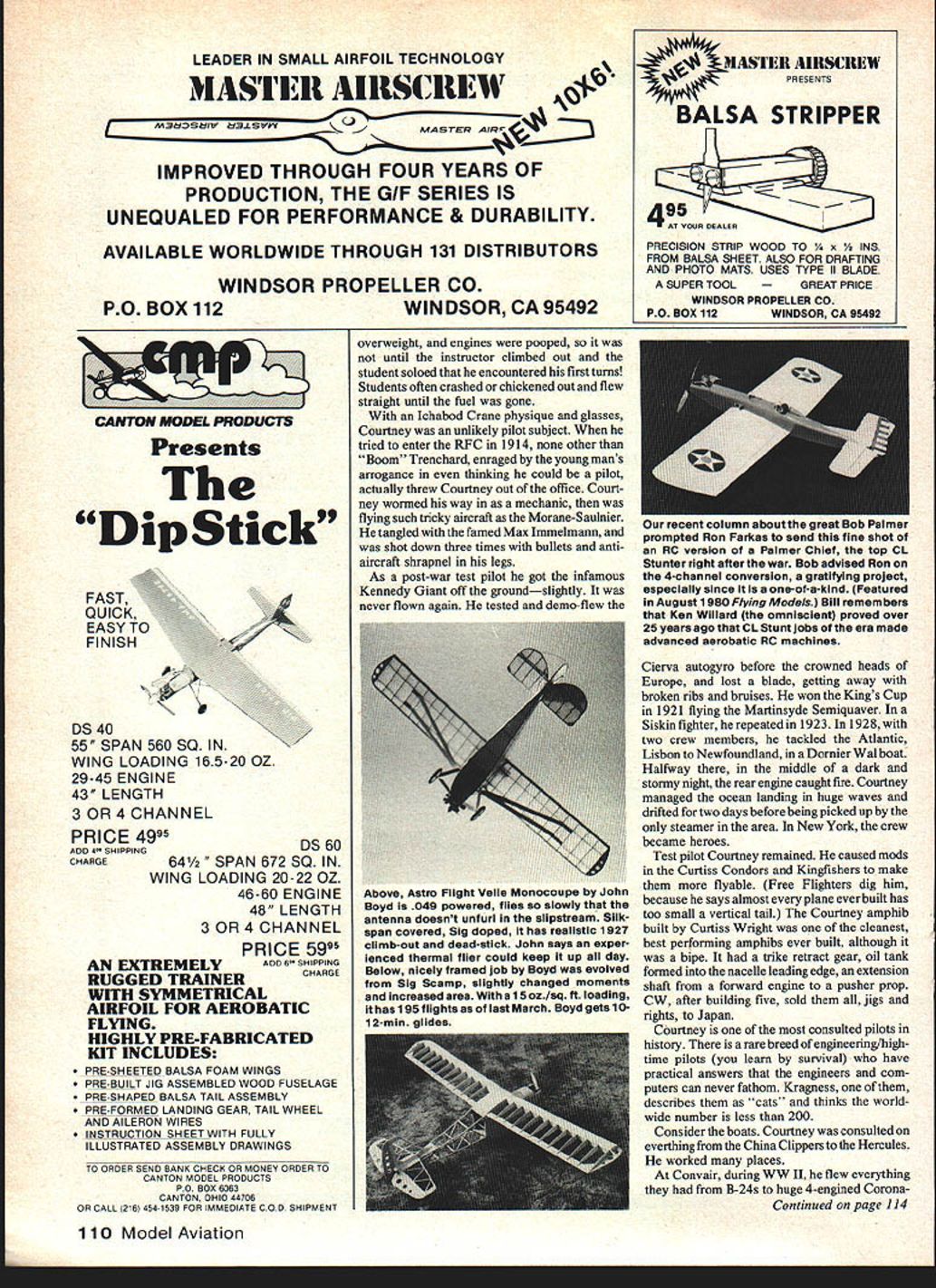
When Courtney began his career in 1913 at the Grahame-White Flying School in England, instruction consisted of straight flight, takeoffs and landings. Constant repair made the machines overweight, and engines were pooped, so it was not until the instructor climbed out and the student soloed that he encountered his first turns! Students often crashed or chickened out and flew straight until the fuel was gone.
With an Ichabod Crane physique and glasses, Courtney was an unlikely pilot subject. When he tried to enter the RFC in 1914, none other than "Boom" Trenchard, enraged by the young man's arrogance in even thinking he could be a pilot, actually threw Courtney out of the office. Courtney wormed his way in as a mechanic, then was flying such tricky aircraft as the Morane-Saulnier. He tangled with the famed Max Immelmann, and was shot down three times with bullets and anti-aircraft shrapnel in his legs.
As a post-war test pilot he got the infamous Kennedy Giant off the ground—slightly. It was never flown again. He tested and demo-flew the Cierva autogyro before the crowned heads of Europe, and lost a blade, getting away with broken ribs and bruises. He won the King's Cup in 1921 flying the Martinsyde Semiquaver. In a Siskin fighter, he repeated in 1923. In 1928, with two crew members, he tackled the Atlantic, Lisbon to Newfoundland, in a Dornier Wal boat. Halfway there, in the middle of a dark and stormy night, the rear engine caught fire. Courtney managed the ocean landing in huge waves and drifted for two days before being picked up by the only steamer in the area. In New York, the crew became heroes.
Test pilot Courtney remained. He caused mods in the Curtiss Condors and Kingfishers to make them more flyable. (Free flyers dig him, because he says almost every plane ever built has too small a vertical tail.) The Courtney amphib built by Curtiss-Wright was one of the cleanest, best performing amphibians ever built, although it was a biplane. It had a trike retract gear, oil tank forming the nacelle leading edge, an extension shaft from a forward engine to a pusher prop. Curtiss-Wright, after building five, sold them all, jigs and rights, to Japan.
Courtney is one of the most consulted pilots in history. There is a rare breed of engineering/high-time pilots (you learn by survival) who have practical answers that the engineers and computers can never fathom. Kragness, one of them, describes them as "cats" and thinks the worldwide number is less than 200.
Consider the boats. Courtney was consulted on everything from the China Clippers to the Hercules. He worked many places.
At Convair, during WWII, he flew everything they had from B-24s to huge 4-engined Coronas.
D. G. Marshall and the Quaker Flash
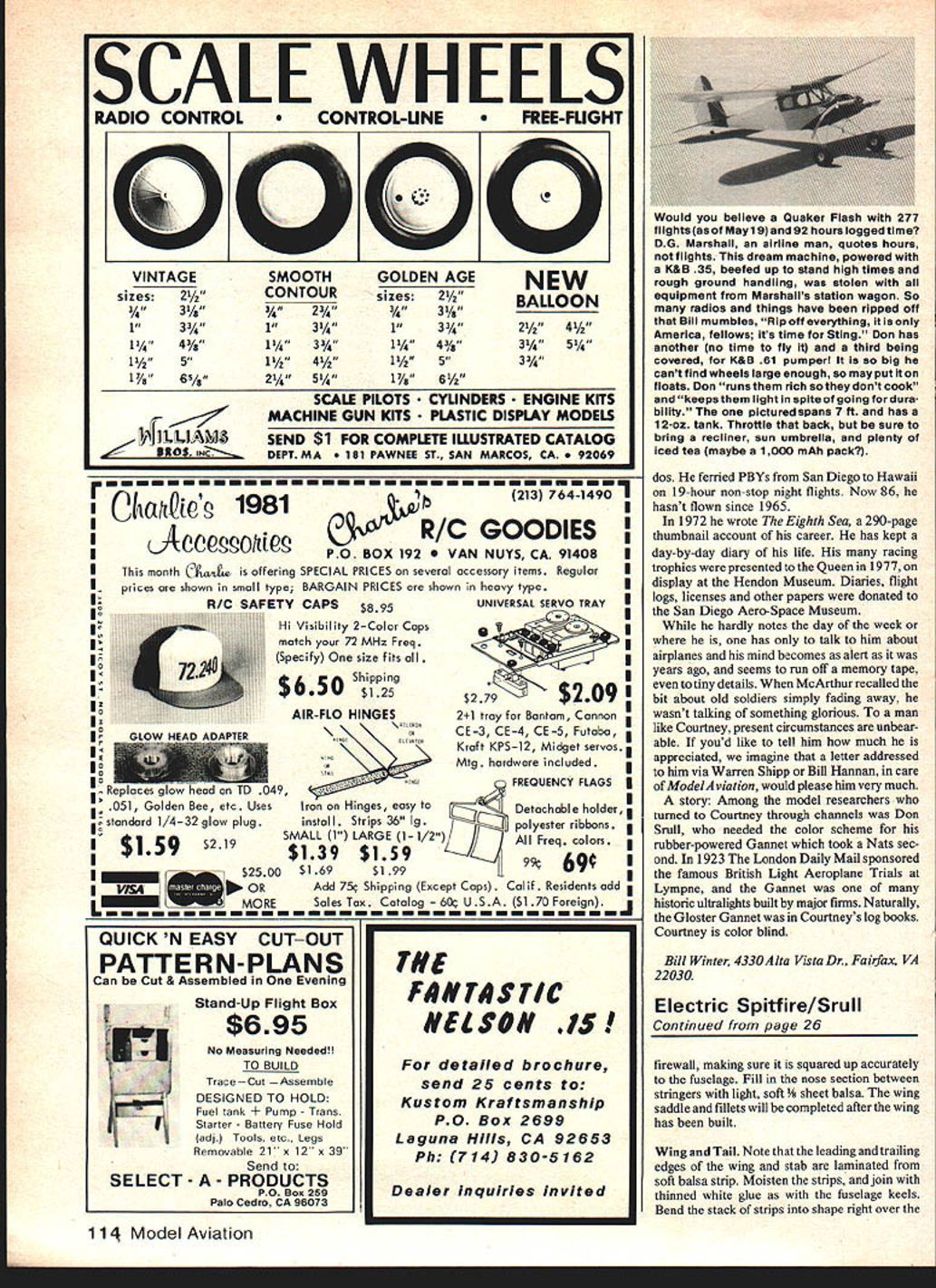
Would you believe a Quaker Flash with 277 flights (as of May 19) and 92 hours logged time? D. G. Marshall, an airline man, quotes hours, not flights. This dream machine, powered with a K&B .35, beefed up to stand high times and rough ground handling, was stolen with all equipment from Marshall's station wagon. So many radios and things have been ripped off that Don mumbles, "Rip off everything, it is only America, fellows; it's time for Sting." Don has another (no time to fly it) and a third being covered, for K&B .61 pumper! It is so big he can't find wheels large enough, so may put it on floats. Don "runs them rich so they don't cook" and "keeps them light in spite of going for durability." The one pictured spans 7 ft. and has a 12-oz. tank. Throttle that back, but be sure to bring a refill, sun umbrella, and plenty of iced tea (maybe a 1,000 mAh pack?).
He ferried PBYs from San Diego to Hawaii on 19-hour non-stop night flights. Now 86, he hasn't flown since 1965.
In 1972 he wrote The Eighth Sea, a 290-page thumbnail account of his career. He has kept a day-by-day diary of his life. His many racing trophies were presented to the Queen in 1977, on display at the Hendon Museum. Diaries, flight logs, licenses and other papers were donated to the San Diego Aero-Space Museum.
While he hardly notes the day of the week or where he is, one has only to talk to him about airplanes and he becomes as alert as it was years ago, and seems to run off a memory tape, even to tiny details. When MacArthur recalled the bit about old soldiers simply fading away, he wasn't talking of something glorious. To a man like Courtney, present circumstances are unbearable. If you'd like to tell him how much he is appreciated, we imagine that a letter addressed to him via Warren Shipp or Bill Hannan, in care of Model Aviation, would please him very much.
A story: Among the model researchers who turned to Courtney through channels was Don Snell, who needed the color scheme for his rubber-powered Gannet which took a Nats second. In 1923 The London Daily Mail sponsored the famous British Light Aeroplane Trials at Lympne, and the Gannet was one of many historic ultralights built by major firms. Naturally, the Gloster Gannet was in Courtney's log books. Courtney is color blind.
Bill Winter 4330 Alta Vista Dr. Fairfax, VA 22030.
Transcribed from original scans by AI. Minor OCR errors may remain.

