
Just for the Fun of it
Bill Winter
There's a traditional form of power which has been with us for years, but it goes unnoticed. At the field one sometimes hears old magazine articles recalled. It was in the modeling exhibit at the Smithsonian. Newsletters sometimes discuss it profoundly. About every five years it is published as a new discovery, but they just reinvent the wheel. Fly power!
Our first exposure to high-performance fly-powered aircraft was in the lobby of the Hotel Fort Shelby at a Detroit Nats during the Thirties. A thin ribbon of tissue sailed across the lobby like a towed banner without a tow plane. Some "genius" had stuck a fly to one end of the strip. Soon the lobby was the arena for a World War I melee with ribbons darting in all directions. Warfare breeds technical progress. Within the hour, streamers gave way to tiny paper gliders. Model Airplane News rushed to press with a serious article on the subject, and fly-power swept the country. Although there has been no improvement in power plants for nearly 50 years, there has been unrelenting development in airframes.
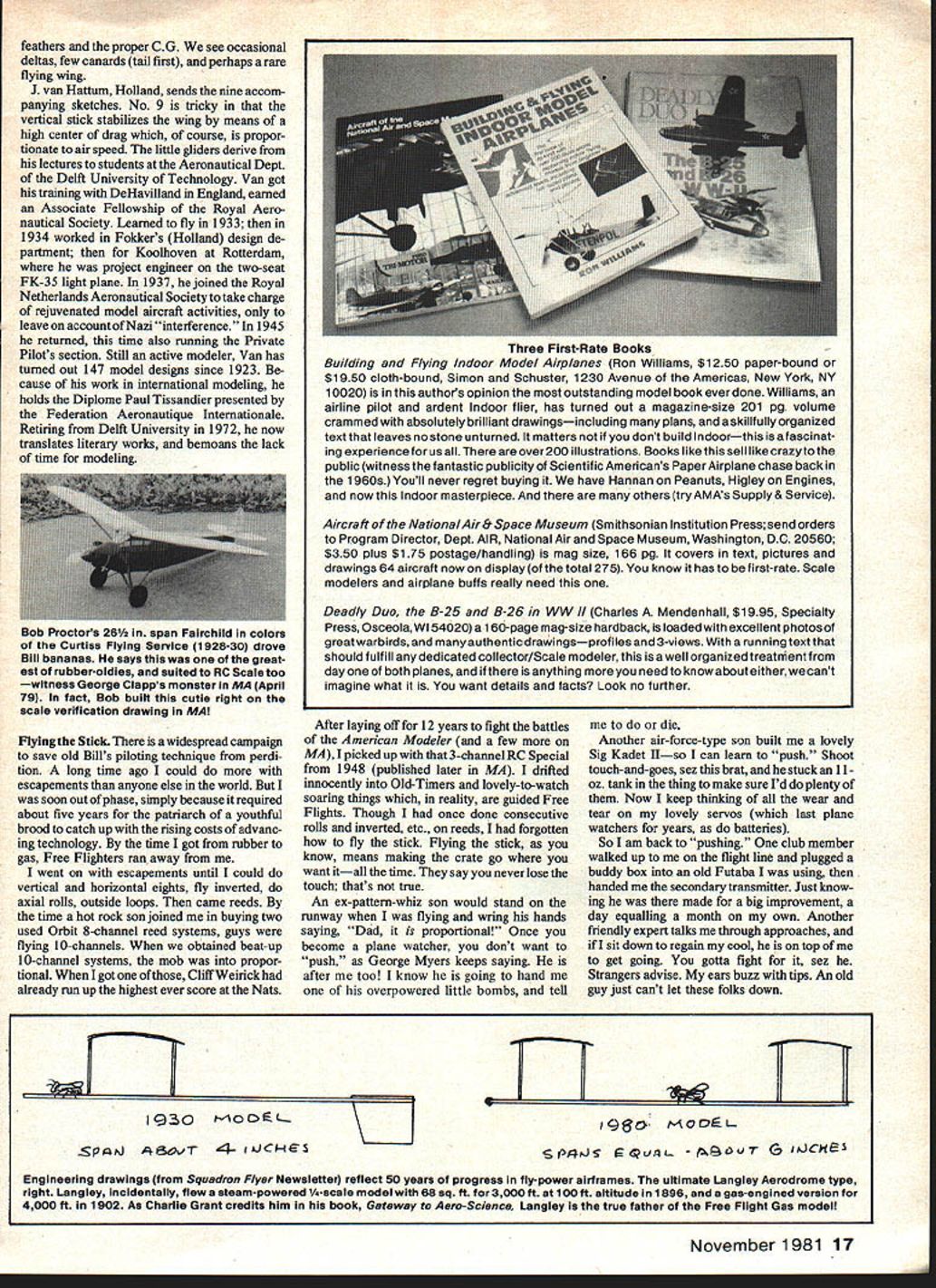
Fly-powered models made a TV show. We missed that epic covering, but the editor of Scale Staffel's Squadron Flyer observed that the machine was the first fly-powered biplane he had seen, that the area between the cabane struts seemed to be covered, and that a dab of clay was on the nose. He then presented, for our edification, profile drawings of the 1930 model and, a half century later, the refined 1980 model.
You'll note that the early job (years before the streamer was discovered at the Shelby) is surprisingly modern, a parasol with underslung fin and the engine up front. But the ultimate "fly" machine is a tandem, like the Langley Aerodrome, and the powerful fly sits amidships just where the Manley radial engine was located on the Aerodrome. Are they trying to tell us something?
We submit the obvious importance of analyzing this matter. What fly-brained genius began this technical revolution? How does one catch flies—so many of them, too? Our capture attempts render these delicate engines unusable. Will some group shout "stamp out cruelty to flies?" What about fly swatters, sticky stuff, and poison mists from cans? Verily, a weighty matter. Horses are an excellent source for flies but those winged quadrats have a high weight-to-power ratio, and that's supposed to be the other way around. What you need is an .02 fly, better yet an .01 if you can still find one.
Squadron Flyer's editor warned that he was training a bumblebee. Scare tactics, we think. Raised was the possibility of gluing a stick with a tail on it to the end of a dragonfly. Would Dragon Fly Mark I be eligible for Ornithopter events? AMA must do its duty. Limits must be set before all flies get out of control. A power limit? Displacement is not the answer. A flypower unit should be defined. We have a horsepower (wrong flies, remember), which is 33,000 foot-pounds per second. What is a standard fly? We come down firmly against pull-tests, modifications, and high-sugar-content fuel.
Before you reluctantly go, consider that the 1980 tandem-winged job is fully six inches, 50% bigger than the 1930. That's a quantum jump in area, quite a bit in gross. This provoking example of seemingly impossible lower power merely proves that your Monster Scale engine should be an ornithopter. Schnuerle wings—how could we have missed this amazing progress? What of the future? Multi flies? Obviously tandem. Ten tandem engines? Look out for the lamps!
Nine Lived Stability
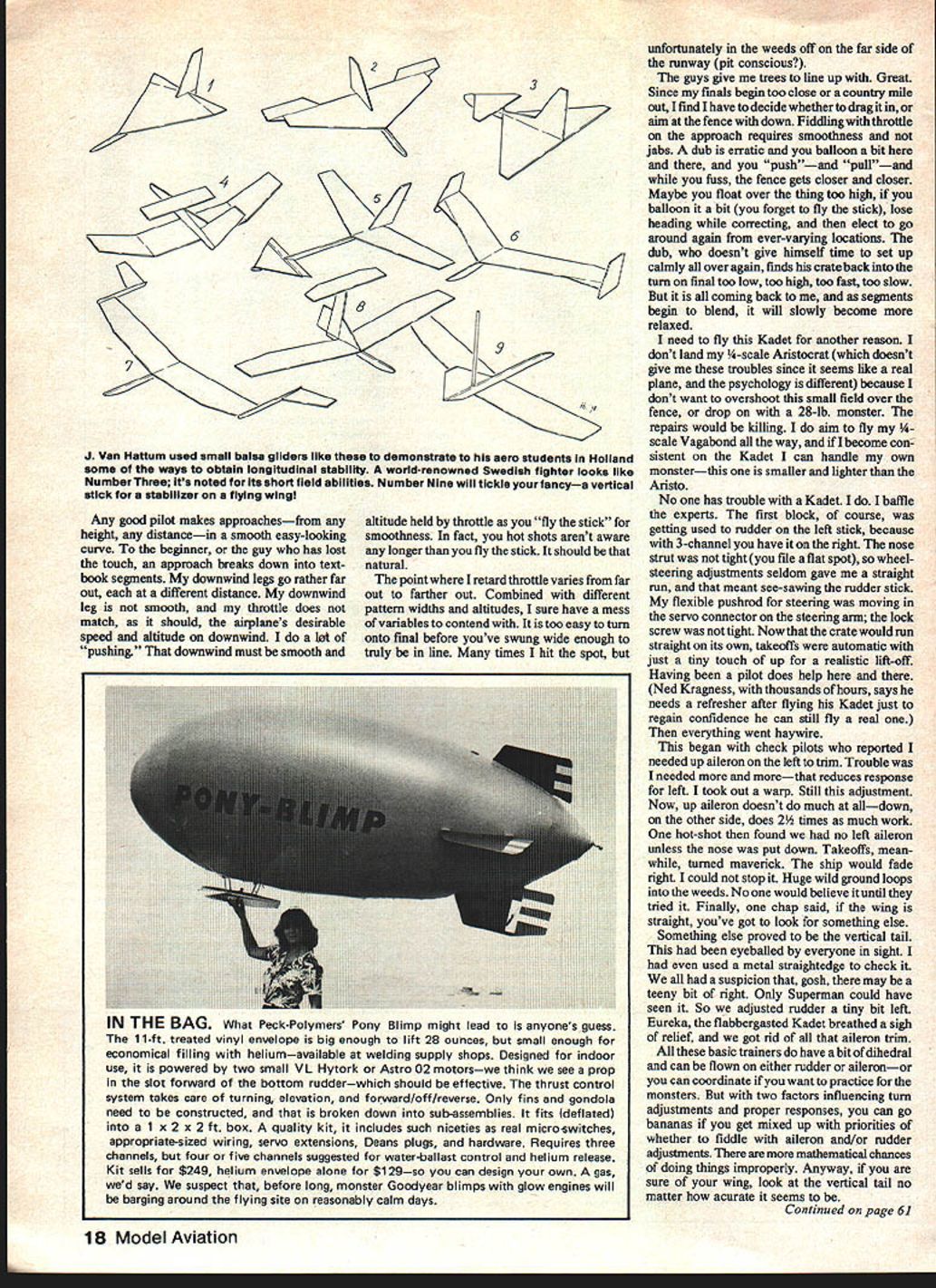
Stability is the keystone of all we do. That means a forward wing, tail feathers, and the proper C.G. We see occasional deltas, few canards (tail first), and perhaps a rare flying wing.
J. van Hattum, Holland, sends the nine accompanying sketches. No. 9 is tricky in that the vertical stick stabilizes the wing by means of a high center of drag which, of course, is proportionate to airspeed. The little gliders derive from his lectures to students at the Aeronautical Department of the Delft University of Technology. Van got his training with De Havilland in England, earned an Associate Fellowship of the Royal Aeronautical Society, learned to fly in 1933; then in 1934 worked in Fokker's (Holland) design department; then for Koolhoven at Rotterdam, where he was project engineer on the two-seat FK-35 light plane. In 1937 he joined the Royal Netherlands Aeronautical Society to take charge of rejuvenated model aircraft activities, only to leave on account of Nazi interference. In 1945 he returned, this time also running the Private Pilot's section. Still an active modeler, Van has turned out 147 model designs since 1923. Because of his work in international modeling, he holds the Diplome Paul Tissandier presented by the Federation Aeronautique Internationale. Retiring from Delft University in 1972, he now translates literary works and bemoans the lack of time for modeling.
- Training and early career:
- Trained with De Havilland in England; earned an Associate Fellowship of the Royal Aeronautical Society.
- Learned to fly in 1933.
- 1934: worked in Fokker's design department (Holland).
- Worked for Koolhoven at Rotterdam; project engineer on FK-35 light plane.
- 1937: led model aircraft activities at the Royal Netherlands Aeronautical Society; left due to Nazi interference.
- 1945: returned to run the Private Pilot's section.
- Retired from Delft University in 1972; continues translating and modeling.
J. Van Hattum used small balsa gliders like these to demonstrate to his aero students in Holland some of the ways to obtain longitudinal stability. A world-renowned Swedish fighter looks like Number Three; it's noted for its short-field abilities. Number Nine will tickle your fancy—a vertical stick for a stabilizer on a flying wing!
Flying the Stick
There is a widespread campaign to save old Bill's piloting technique from perdition. A long time ago I could do more with escapements than anyone else in the world. But I was soon out of phase, simply because it required about five years for the patriarch of a youthful brood to catch up with the rising costs of advancing technology. By the time I got from rubber to gas, Free Fighters ran away from me.
I went on with escapements until I could do vertical and horizontal eights, fly inverted, do axial rolls, outside loops. Then came reeds. By the time a hot-rod son joined me in buying two used Orbit 8-channel reed systems, guys were flying 10 channels. When we obtained beat-up 10-channel systems, the mob was into proportional. When I got one of those, Cliff Weirick had already run up the highest ever score at the Nats.
After laying off for 12 years to fight the battles of the American Modeler (and a few more on MA), I picked up that 3-channel RC Special from 1948 (published later in MA). I drifted innocently into Old-Timers and lovely-to-watch soaring things which, in reality, are guided free flights. Though I had once done consecutive rolls and inverted maneuvers on reeds, I had forgotten how to fly the stick. Flying the stick, as you know, means making the crate go where you want it—all the time. They say you never lose the touch; that's not true.
An ex-pattern-whiz son would stand on the runway when I was flying and wring his hands saying, "Dad, it is proportional!" Once you become a plane watcher, you don't want to "push," as George Myers keeps saying. He is after me too! I know he is going to hand me one of his overpowered little bombs and tell me to do or die.
Another air-force-type son built me a lovely Sig Kadet II—so I can learn to "push." Shoot-touch-and-goes, sez this brat, and he stuck an 11-oz. tank in the thing to make sure I do plenty of them. Now I keep thinking of all the wear and tear on my lovely servos (which last plane watchers for years, as do batteries).
So I am back to "pushing." One club member walked up to me on the flight line and plugged a buddy box into the old Futaba I was using, then handed me the secondary transmitter. Just knowing he was there made for a big improvement, and a day equalled a month on my own. Another friendly expert talks me through approaches, and if I sit down to regain my cool, he is on top of me to get going. "You gotta fight for it," sez he. Strangers advise. My ears buzz with tips. An old guy just can't let these folks down.
Any good pilot makes approaches—from any height, at any distance—in a smooth, easy-looking curve. To the beginner, or the guy who has lost the touch, an approach breaks down into textbook segments. My downwind legs go rather far out, each at a different distance. My downwind leg is not smooth, and my throttle does not match, as it should, the airplane's desirable speed and altitude on downwind. I do a lot of "pushing." That downwind must be smooth and altitude held by throttle as you "fly the stick" for smoothness. In fact, you hot shots aren't aware any longer that you fly the stick. It should be that natural.
The point where I retard throttle varies from far out to farther out. Combined with different pattern widths and altitudes, I sure have a mess of variables to contend with. It is too easy to turn onto final before you've swung wide enough to truly be in line. Many times I hit the spot, but unfortunately in the weeds off on the far side of the runway (pit conscious?).
The guys give me trees to line up with. Great. Since my finals begin too close or a country mile out, I find I have to decide whether to drag it in, or aim at the fence with down. Fiddling with throttle on the approach requires smoothness and not jabs. A dub is erratic and you balloon a bit here and there, and you "push"—and "pull"—and while you fuss, the fence gets closer and closer. Maybe you float over the thing too high, if you balloon it a bit (you forget to fly the stick), lose heading while correcting, and then elect to go around again from ever-varying locations. The dub, who doesn't give himself time to set up calmly all over again, finds his crate back into the turn on final too low, too high, too fast, too slow. But it is all coming back to me, and as segments begin to blend it will slowly become more relaxed.
I need to fly this Kadet for another reason. I don't land my 1/4-scale Aristocrat (which doesn't give me these troubles since it seems like a real plane, and the psychology is different) because I don't want to overshoot this small field over the fence, or drop on with a 28-lb. monster. The repairs would be killing. So I aim to fly my 1/4-scale Vagabond all the way, and if I become consistent on the Kadet I can handle my own monster—this one is smaller and lighter than the Aristo.
No one has trouble with a Kadet, I do. I baffle the experts. The first block, of course, was getting used to rudder on the left stick, because with 3-channel you have it on the right. The nose strut was not tight (you file a flat spot), so wheel-steering adjustments seldom gave me a straight run, and that meant see-sawing the rudder stick. My flexible pushrod for steering was moving in the servo connector on the steering arm; the lock screw was not tight. Now that the crate would run straight on its own, takeoffs were automatic with just a tiny touch of up for a realistic lift-off. Having been a pilot does help here and there. (Ned Kragness, with thousands of hours, says he needs a refresher after flying his Kadet just to regain confidence he can still fly a real one.) Then everything went haywire.
This began with check pilots who reported I needed up aileron on the left to trim. Trouble was I needed more and more—that reduces response for left. I took out a warp. Still this adjustment. Now, up aileron doesn't do much at all—down, on the other side, does 2½ times as much work. One hot-shot then found we had no left aileron unless the nose was put down. Takeoffs, meanwhile, turned maverick. The ship would fade right. I could not stop it. Huge wild ground loops into the weeds. No one would believe it until they tried it. Finally, one chap said, if the wing is straight, you've got to look for something else.
Something else proved to be the vertical tail. This had been eyeballed by everyone in sight. I had even used a metal straightedge to check it. We all had a suspicion that, gosh, there may be a little bit of right. Only Superman could have seen it. So we adjusted rudder a tiny bit left. Eureka—the flabbergasted Kadet breathed a sigh of relief, and we got rid of all that aileron trim.
All these basics then do have a bit of dihedral and can be flown on either rudder or aileron—or you can coordinate if you want to practice for monsters. But with the controls the way they now are, rudder adjustments and proper responses, you can go bananas if you get mixed up with priorities of whether to fiddle with aileron and/or rudder adjustments. There are more mathematical chances of doing things improperly. Anyway, if you are sure of your wing, look at the vertical tail no matter how accurate it seems to be.
For Fun/Winter
In trouble, you can really slow-fly the Kadet. Throttle back and up elevator held makes it descend like Luther Hux's parafoil. You can cruise about like an Old-Timer if it isn't overweight—mine has an O.S. .35 instead of a .40. I would have little trouble doing simple aerobatics, but when you are reborn you find takeoffs a mental block (again), and when that vanishes you begin to worry about approaches. If you have this trouble, fly the pants off it on endless circuits. Fortunately, I have no left-right problems.
Last evening the approaches began to come back. On the way, I thought. Then after the first circuit, climbing out, the engine faded (perhaps a glitch?), and, fearing to stretch for a go-round, I elected to put it down fast downwind, in the weeds off the runway end. I gave slight up, but it tore through the weeds so fast that it pulled off all three wheels! The nose strut came out, leaving everything intact. The front tire was off. That 11-ounce tank was still full. Some hot-shot! I could have used trim to slow it had I been quick-minded. Will I ever get my act together? Fellows, don't give up on me; I need all of ya.
On a heavenly evening, we drove the 50 miles to Shangrila and put up our 20-year-old Airknocker. Just rudder and engine. It is as smooth as silk, accurately responsive, and you can contour-fly the rolling terrain, working power as needed. Or you can circle high into the blue vault and sail for a half hour on idle, and then glide forever. The Rubber Scale guys who frequent the spot love the Airknocker with its reliable old Enya .09. Sometimes a guest R/Cer thinks he is flying the stick on elevator—he doesn't notice there is none until he tries to flare for the wheel landing! For this dream-like flying, an aileron is an obscenity. Old-time escapement men have tears in their eyes. Bill Cann actually shoots touch-and-goes. Fancy that.
We are not urging you to buy a Kadet. It is a fine sport trainer. So is the Falcon 56 and lots of others. Locally, the most common plane is an Ugly Stick and its many cousins. Every session brings out six to ten. As they say, 50,000 Frenchmen can't be wrong.
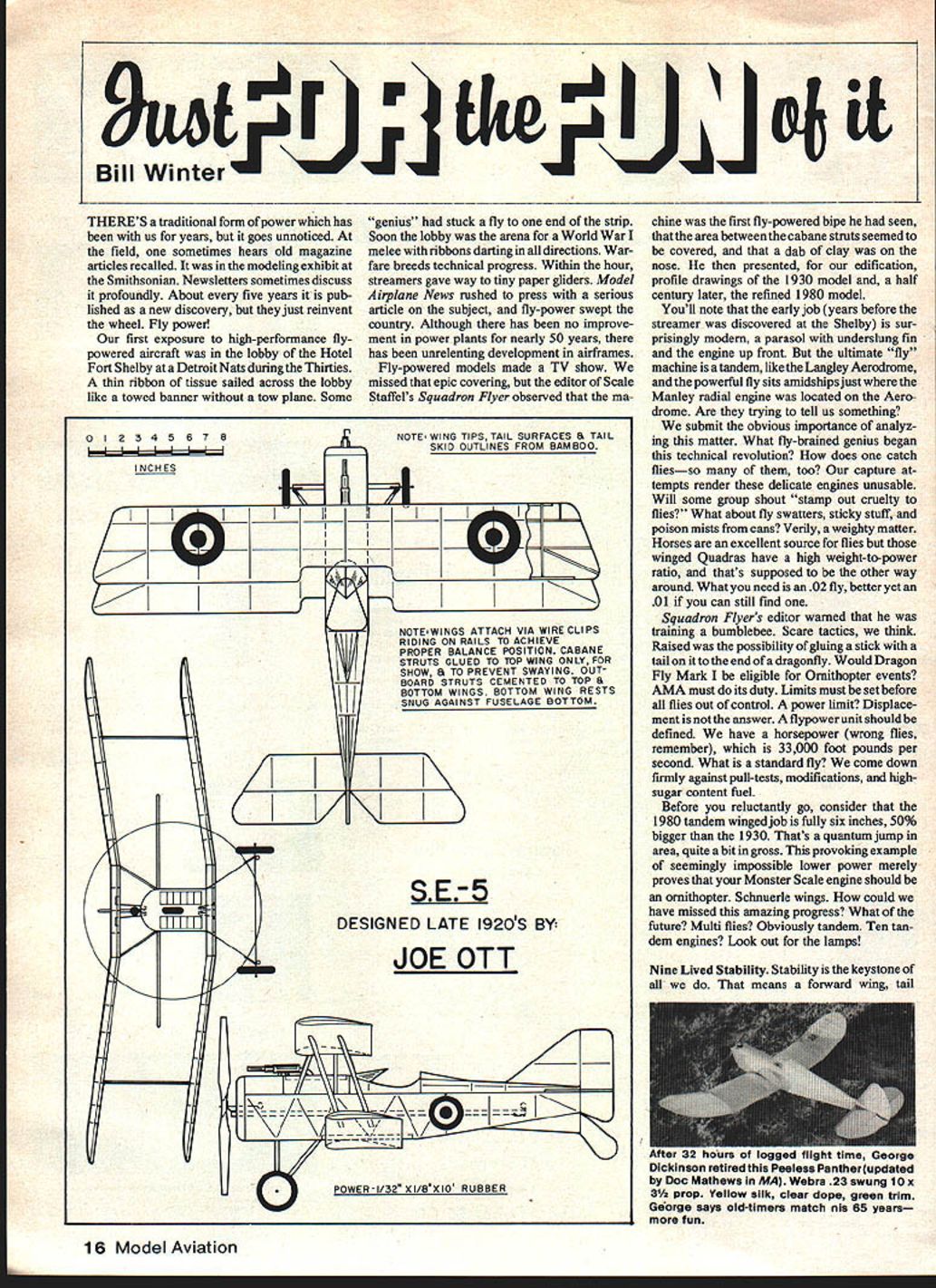
I am pestered to death by the Rubber Scale guys to "come home." Having published many of these things in the distant past, which experts now revive, I know that this is where realism is at. And CO-2 Scale looks even better. That Airknocker makes me nostalgic. For a taste of what this old stuff can be like, we asked Herb Clukey to draw up Joe Ott's SE-5 from the 1920s.
Ott's designs flew like birds. We don't understand why rubber freaks who get such fun from "campy" things don't run a Joe Ott event. The writer scaled up many Ott designs from the old Popular Aviation (later Flying—business aircraft, alas). MAN was not born until a couple of years later—in 1929.
The nation was Joe Ott mad. If you had the blessing of a slow walk under a thing like his SE-5 as it sedately chugged across a large field in the calm of a summer's eve, you have burned on your brain a picture of something imperishable.
In its original size, the SE-5 is a lovely flier—it is a kind of way-off stand-off scale for a rubber job. CO-2 would be nice. Scaled up a bit, lightly built, it would be fine as an .02 Free Flight, or as an RC with mini radio—maybe even elevators, though you don't need them. Bigger still for an .049, Joe Ott made my modeling life. If it were not for him, and Charlie Grant a bit later at MAN, I would not be writing this today. And you would not be wondering what this was all about!
The Maxecutters locked me up until I gave them a newsletter article on the old days of Rubber Scale. It is full of mentions of six-foot Bellancas, my old jobs in MAN, Flying Aces, Flying Models, et al., and even a 9-ft. Cessna in 1928. Every form of modeling is worth a shot. When my 1/4-scale Aristocrat turns slowly on low motor, I see a rubber job! Airplane watching is so fulfilling, I'd prefer others to fly my planes so I can really see what they do, and to enjoy. That's living.
Things That Go Bump In the Night
Hats off to Bob Boucher of Astro Flight for his continuing contributions to both modeling and full-scale via electric. It was his solar panels and electric motors that enabled the DuPont Solar Challenger to fly from Pontoise, near Paris, to Manston RAF Base near Dover, England, at an altitude of more than 11,000 feet and an average ground speed of 47 mph. It is hoped that DuPont will approve an attempt to set an altitude record of more than 30,000 feet at Edwards Air Base. How would you like to be six miles high in that feathery flying machine?
Bob's new OS-XL system, now shipping, has 20% more power and 50% more duration than his already popular OS. He's done the .075 too, and we sure hope he does the .15 (for that Spitfire we love along with Srull—and which was presented in MA last month). Won't that be something? And Leisure Electronics supplied us with a racing wind OS for Astro belt drive. We'll test it in a formerly .049-powered large, "peppy" glider of Srull's. Roland Boucher at Leisure says he has done some 13 minutes with a Kraft Cardinal—400% more, at least, than Kraft got.
Astro's new OS turns a 6 x 4 Cox at 13,000 rpm for 8- to 9-minute flights, or a 7 x 4 at 11,000—perfect for a 6-ft. sailplane. This is a hot-wind, featuring a special ball bearing and 6-cell, 1.2 amp battery.
Miscellany
Doug Pratt is videotape crazy. We play these Prince Valiant adventures through our color TV, and the guys go ape. You have no idea what you see after a session, or the gab between guys flying, and fascinating overheard conversations. Video will animate any club.
And we think all clubs should have at least one buddy box system. The rate of learning is fantastic. Confidence comes quickly. If you are a good pilot, a better one can sharpen you up more than you can believe—even to do maneuvers you think impossible.
A local show team has a Tartan Cub plagued by take-off engine failures. As we said two months ago, smoke does not always mean an engine is rich. When these chaps tached the engine and opened the valve three more turns, the rpm came up 1,000—to 7,000. We think an engine should be tached to max rpm from the rich side, then backed off a tad—and even the monsters need to be held nose-up for a lean test.
Bill Winter 4330 Alta Vista Dr., Fairfax, VA 22030.
Transcribed from original scans by AI. Minor OCR errors may remain.

