
Just For the Fun of it
Bill Winter
Fun doesn't come easy
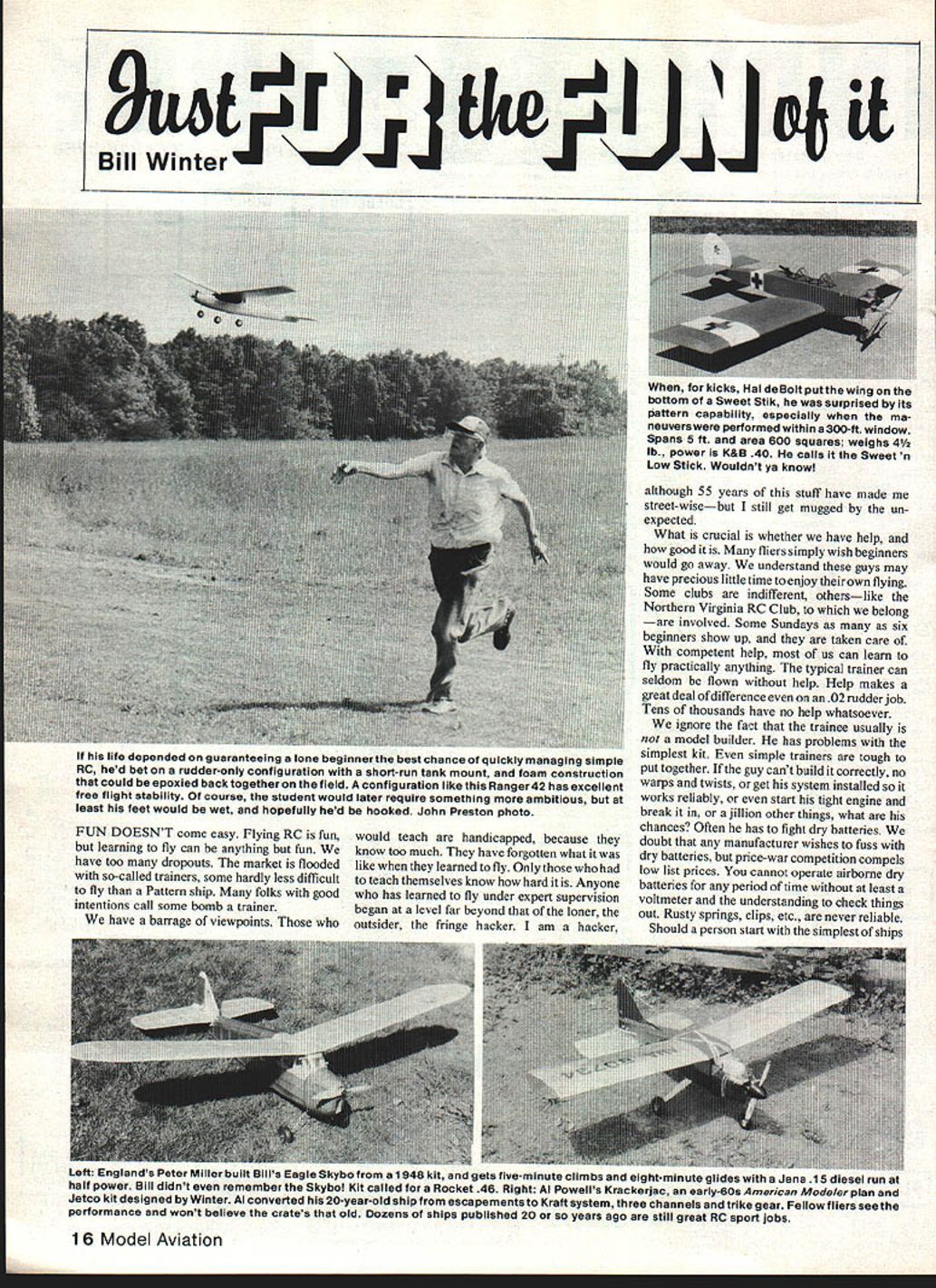
FUN DOESN'T come easy. Flying R/C is fun, but learning to fly can be anything but fun. We have too many dropouts. The market is flooded with so‑called trainers, some hardly less difficult to fly than a Pattern ship. Many folks with good intentions call some bomb a trainer.
We have a barrage of viewpoints. Those who would teach are handicapped because they know too much — they have forgotten what it was like when they learned to fly. Only those who had to teach themselves know how hard it is. Anyone who has learned to fly under expert supervision began at a level far beyond that of the loner, the outsider, the fringe hacker. I am a hacker, although 55 years of this stuff have made me streetwise — but I still get mugged by the unexpected.
What is crucial is whether we have help, and how good it is. Many fliers simply wish beginners would go away. We understand these guys may have precious little time to enjoy their own flying. Some clubs are indifferent; others — like the Northern Virginia R/C Club, to which we belong — are involved. Some Sundays as many as six beginners show up, and they are taken care of. With competent help, most of us can learn to fly practically anything. The typical trainer can seldom be flown without help. Help makes a great deal of difference even on an .02 rudder job.
Tens of thousands have no help whatsoever.
The trainee's handicaps
We ignore the fact that the trainee usually is not a model builder. He has problems with the simplest kit. Even simple trainers are tough to put together. If he can't build it correctly, remove warps and twists, get his system installed so it works reliably, start his tight engine and break it in, or handle a jillion other things, what are his chances? Often he has to fight dry batteries. I doubt any manufacturer wishes to fuss with dry batteries, but price‑war competition compels low list prices. You cannot operate airborne dry batteries for any period of time without at least a voltmeter and the understanding to check things out. Rusty springs, clips, etc., are never reliable.
Should a person start with the simplest of ships, a radio system should permit later expansion.
What level of flying do we want him to achieve?
Do we want a chap merely to successfully achieve flight, even if it means just a tail‑wagger with rudder only? Flight training always did fall into primary, basic, and advanced. In bigger ships, some of us would solo a guy in a Cub, others in a T‑6, and still others in a Northrop F‑5 jet. Given two seats in the latter, all three are trainers!
Suppose your life depended on training some guy to fly R/C. If he fails, you are to be executed. All this chap needs is to see his plane in the air and steer it around safely. If your life depended on that, what would you do?
A family example
We have a 16‑year‑old grandson — he stands 6 ft. 4 in. — who, after steering our free‑flight R/C Vagabond around on low throttle, wanted to get into R/C. Naturally, he wanted something exciting. But when we showed him many of our so‑called trainer kits, he recoiled. To him, the plans were a mass of mysterious lines. That things were direct, etc., meant nothing.
It so happened that we had an Ace Dick's Dream around, designed by that old fox, Owen Kampen. It is only an .02 job with a foam wing and a simple built‑up fuselage. The radio is single‑channel with a magnetic actuator that wiggles the rudder back and forth for proportional control.
The fuselage is sheet, with few pieces. After explaining this unattractive (to him) project, and telling him that the local experts like Srull and Bowers fly it for fun, he became interested. The deal was that when he built the plane, I would lend him the system — transmitter converted to Ni‑cads. His dad is an accomplished Pattern pilot, so while I believe that the boy could never fly that simplest of all R/C jobs by himself, he would get enough guidance that he'll probably get to steer it around. (Dad has no time for anything more difficult.) Such a ship/system won't go to waste afterwards, because it will always be fun — even when (and if) this "kid" advances to something more complex.
What comes next
Our idea of what comes next would be some simple kit — and that will take plenty of thinking with throttle and rudder, plus elevators that will be locked in place until he flies it on rudder and throttle. We'd prefer it to be .09‑powered, not even a roaring Schnuerle .10. Just possibly a .15. If the ship would fly with pep on the .15 and reasonably well on the .09 or .10, we'd opt for the smaller engine.
One beauty of a simple beginning is that the crate can usually be fixed on the spot; foam wings can be epoxied together. If your life depended on that kid's flying, you'd want on‑field repairability. Also, he will learn some building on that fuselage and tail assembly, attaching the gear, etc. — a baby step toward more advanced trainer construction. Of course, one could go the all‑foam trainer route, but we'd want a decent engine — which you don't always get. You can epoxy those trainers back together all day long, for weeks. They should be considered expendable, as George Myers states. But if they had elevators, we'd lock them neutral in the beginning. Remember, one sudden dive and perhaps that execution squad gets you!
As far as I'd go with that student is a four‑ or five‑channel transmitter and a three‑channel foamie, so he could use the radio later on something like a Falcon or Kadet, provided success gave him some momentum to join the crowd.
By coincidence, we admire another Kampen design, the Concept Models Aero 15. But we think it's too lively on a .15 for this purpose. One gets safe flights with an O.S. Max .10 and an 8 x 6. (I love it with a .15!)
Who teaches newcomers?
Who teaches these newcomers about setting up engines, what props to use with what airplane (not just engine)? If the boy staggered onto a diehard Kadet or Falcon with ailerons, we'd start him off by telling him to go easy on the ailerons — until he has confidence. A guy needs to hear a soothing voice, or feel a reassuring hand on a stick now and then. If he is a loner, his chances are dim, indeed, with all controls. A fully stable plane, capable of free flight and requiring only a nudge, is, in our opinion, absolutely necessary — unless one has the very best of patient help. Forget those .40‑powered classic "trainers." We've seen too many adults spend $500 and then auger in, pick up the pieces, and disappear forever. We don't have the perfect answer. No one does. Maybe we should all go back to the drafting board.
Into the wild blue yonder — rubber scale and contest anecdotes
That ranking Rubber Scale ace, Bill Henn (of Chambermaid fame — see the April 1979 Model Aviation) is still deluged with requests and questions from guys building that peerless wonder. That Chambermaid is winning just about every meet entered. Times are getting so high that Bill retired his C‑Maid while he was ahead.
He switched to a same‑size Folkert SK‑3 with pop‑up tail. Bill is Hung's favorite son. The DT (dethermalizer) was a bit of a nuisance in race‑plane events, so he flew without it at Johnsville and got 2:01, 2:40, 5:03, and, my gawd, 17:00 OOS. Weighing a few grams more than the C‑Maid, it has more rubber — four strands of .195 FAI, 13 in. dia. The OOS was on 1,300 winds. Back to another C‑Maid, only lighter — 45 grams! Afraid to wind it up, he could not use the FAC field at Durham, CT. After two maxes at Crossings FF Group (NJ), he concentrated on his P‑30 (in last issue NFFS), hit a boomer, and was gone. So he converted the C‑Maid on the spot to P‑30 by switching to a 9.5‑in. plastic prop with a 22‑in. (9 gr.) .160 FAI rubber — legal. His last flight maxed, and he won both Scale and P‑30.
For Fun — continued: trimming lessons and forgotten designs
Mac sent us a supplementary sheet with specific figures, and our C.G. was 1/2‑in. back of the extreme rearward position stipulated! With a chunk of lead in the nose, our Kadet just came alive: it grooved, trim changes settled down, ailerons became more effective, takeoffs easier, and botched approaches less of a panic. Today, it rolled right with vigor, but is very weak to the left. We know we are responsible — we'll get it. On the third takeoff a few hours ago, the wind shifted, blew a gale, extreme turbulence (planes were tossed like paper), and a dust devil went across the nose. We learned instantly how to use aileron on takeoff along with rudder. It was that or no airplane! Clawing toward the hedgerow (which creates a snow‑fence wind eddy), we chopped the throttle before clearing it. A gust pointed the crate straight up before we could touch the stick. But we got it down without damage. Two experts who were commenting as we went around both kept their mouths shut. Smart! After 55 years, yours truly learned two basics in one day. Learning is forever.
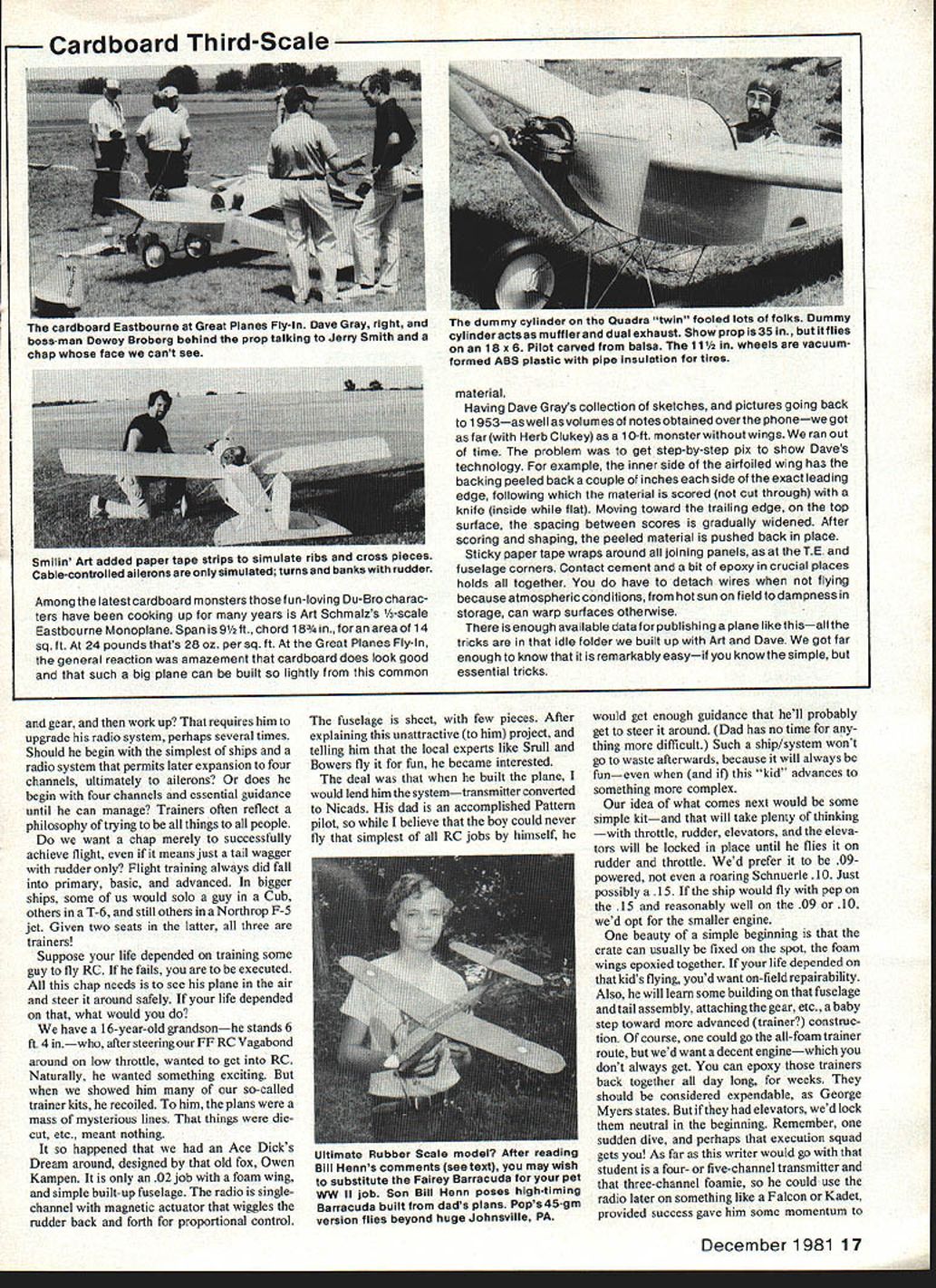
I am forever surprised by pictures of my own forgotten designs, and would like to share two good ones brought to my attention. Peter Miller, the model‑camera‑plane guy from England who made those wonderful pictures of lost Roman ruins, built an Eagle Kits Skybo of 1948 vintage. We'd guess it was about 6 ft., because it had a Rocket .46 engine. Peter actually had a kit. He flew it with a Jena .15 diesel, modified to reed valve with an R/C carb which cuts revs 50%. He R/Cs on rudder and throttle only. Running the Jena at half throttle, he climbs for five minutes and gets an 8‑min. glide — "really makes the local club glider pilots feel sick." With rudder he just keeps it headed into the wind, puts down the transmitter, lights a cigarette, and talks shop with other modelers. (Probably has a large vertical tail on the crate for weather‑vane‑ing.) Since there is no colored tissue in England, he used food dyes with wet tissue (when airbrushed onto Peanuts the added weight can't be measured). To fly that way, Miller's Skybo must have the correct thrust‑line relationship to profile.
George Myers tells us he flew some chap's Krackerjac. It did surprisingly well. That was in an old American Modeler early‑Sixties and was a Jetco kit, escapement and throttle on a Max .15. It roared like a "multi" and did first‑rate touch‑and‑goes. We'd forgotten it. Now we have assorted pix, including a nine‑footer! The picture sent by Al Powell shows his conversion to trike gear. The Bonner escapement and Citizen‑Ship radio are replaced by the Kraft Series 80, the skid and dope by MonoKote.
Al says the guys at the flying field would not believe this 20‑year‑old crate flies so well. We expected to enlarge it to .40 size from the .15, and D‑tube the wing front. It's a bit like a short‑coupled Kadet, and if you'd fuss with strip ailerons and a semi‑symmetrical airfoil, or a Falcon airfoil, with about three to four degrees of dihedral, you'd have a ball‑of‑fun sport machine. If they ever start an Antique and Old‑Timer R/C thing, we'll make out like a bandit. Dream on...
Lightning strikes — electric event
Leisure Electronics, a recent entrant into the field of electric flight setups, is staging a Grand Championship January 9 and 10, 1982. Co‑sponsors are Futaba and Sanyo. This is not a Pattern contest, or a Scale event, or anything you're familiar with — it's easier than that. The only task is Precision Duration: seven minutes on a 1/2‑minute motor run. Anything, as long as it's powered by an .05 electric motor, can enter. The Precision Duration event thins the field down to six finalists, then they go into a final three for the last‑one‑down wins. That last flight will be something to see — the last man down will be handed a check for $1,000. Other prizes include radios, chargers and $100 cash prizes for Best Direct Drive, Best Geared Prop, and Best Old‑Timer. Write to Leisure Electronics, P.O. Box 556, Newport Beach, CA 92661, or call (714) 552‑4540 for details.
The old order changeth
We'd like to say something about Sid Axelrod, whose loss to his family, to Top Flite, to all of us is very real.
Cardboard third‑scale — Du‑Bro and Art Schmalz
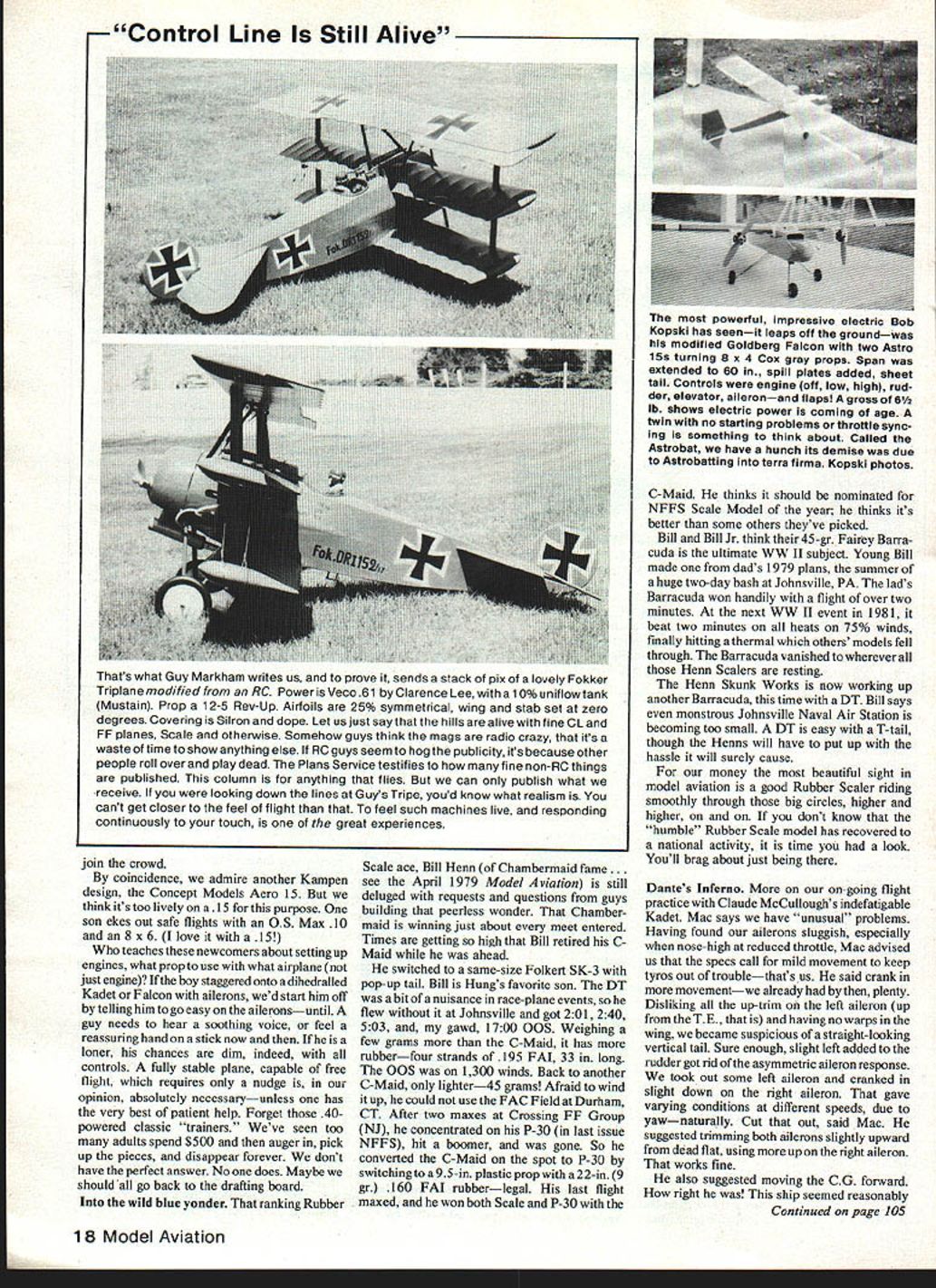
Among the latest cardboard monsters the fun‑loving Du‑Bro characters have been cooking up for years is Art Schmalz's 1/3‑scale Eastbourne Monoplane.
- Span: 9 ft
- Chord: 18 in.
- Area: 14 sq. ft
- Weight: 24 lb — that's 28 oz per sq. ft.
At the Great Planes Fly‑In the general reaction was amazement that cardboard does look good; such a big plane can be built lightly from common material. Having Dave Gray's collection of sketches and pictures going back to 1953, as well as volumes of notes obtained over the phone, we got pretty far. Herb Clukey assembled a 10‑ft monster without wings; we ran out of time to get step‑by‑step pictures to show Dave's technology.
An example of the technique: the inner side of an airfoiled wing has the backing peeled back a couple of inches on one side at the exact leading edge; the following material is scored, cut through with a knife inside the flat. Moving toward the trailing edge the top‑surface spacing between scores is gradually widened. After scoring and shaping, the peeled material is pushed back in place. Sticky paper tape wraps around and joins panels. The fuselage corners use contact cement with a bit of epoxy in crucial places to hold together but allow detaching wires to be removed. Changing atmospheric conditions, hot sun at the field, or damp storage can warp surfaces; otherwise there is enough available data for publishing a plane like this. All the tricks are in the folder built up by Art and Dave; they got far enough to know it is remarkably easy if you know a few simple essential tricks.
The gear workup requires upgrading the radio system perhaps several times. One should begin with the simplest ships and a radio system that permits later expansion.
Transcribed from original scans by AI. Minor OCR errors may remain.

