
Just For the Fun of it
Bill Winter
Hatfield — Second Annual Electric Fly
There is something about southeast Pennsylvania that lures us to travel—not that we'll compete in anything that takes the World Championship; we prefer the pleasantries of chitchat and hacking around the club field. The last time we shared the indignities of three modelers and 12 airplanes in one car was the Flying Aces Club Rubber Scale Nats—a fun-fly thing even with competition. That weekend at Johnsville Naval Air Station near the City of Brotherly Love is the kind of memory you treasure. The guys who flew found their fun in each other and in each other's dream ships.
So here we are again: four guys and a mess of strange crates all in one car. Destination: Hatfield, PA. May we just ramble on?
There was the mad test pilot Don Srull (he tolerates ancient hackers), Tom Schmidt, a quiet, smart gentleman who understands the vagaries of air molecules, and MA's peerless Doug Pratt, a hot-shot rocketeer more recently fascinated with flying the stick (a Gee Bee freak). Being from the divining-rod school of thought, in close confinement with modelers who actually think, we poked our Flintstonian concepts at them until someone threatened to draw pictures. Pratt's precision navigation almost took us off course on the morn of the meet.
To prepare for the next day's festivities, we sat up to 2 a.m. watching Pratt's video of the DCRC's Bealeton, VA Scale Meet, where Henry Haffke's Gee Bees were sensational—as usual. The R-1 (Flying Silo) with a .90 took off (seemingly without raising the tail), turned beautifully, and landed superbly—three-point squats without bouncing. Henry later phoned to note that his smaller R-1 (published in Flying Models) has a wing loading of 60-plus ounces: provided it has good takeoff speed it grooves and flies magnificently, but don't mush.
While we occupied a flea-bag motel looking at movies, electrics were hooked to car batteries outside, charging away.
Conditions and general impressions
Sunday was windy. Tents blew down, metal posts buckled, occasional wings snapped; crates were tied down all over the place. Even so, these guys provided some of the best flying we've seen anywhere. None of us was tired at day's end, which we attribute to the lack of engine noise.
With wind gusting to 35 mph and pouring over an adjacent low hill and factory buildings—creating some of the worst crosswind conditions imaginable—we didn't dare fly our own big stuff, although Pratt put up an electric Gentle Lady several times. Curious guys had come as far as 500 miles to this center of electric flight. The Keystone RC Club (KRC) did not disappoint.
Notable flights and pilots
- Bob Kopski launched an electric glider, made himself comfortable in a recliner, and towed around under high scudding clouds for 69½ minutes. He then made fast passes with an .05-powered Astro Sport—darn near as fast as a 1/4A pylon racer—with Split Ss at each end, precision inverted high-speed passes, and crisp four-point rolls that would delight any Pattern pilot.
- John Hickey, KRC's president, flew a Jack Rabbit (designed by John Szary) fitted with two .02s. Fast and sensational, the wind seemed not to exist for him. If you think electric must mean floaters with low wing loadings, you'd be shocked—this machine had a 16-ounce wing loading.
- Heinz Koerner, who has done nothing but electric for 10 years, flew twin- and four-engined models. The four-engined ship, almost glider-like, was steady and groovy in the wind—the prop wash of four motors over the wing gave an airliner-like impression.
- Ellis Grumer put up Astro's 6-ft. Porterfield with an Astro .15 and belt drive, landing on the spot in that gale—lovely work. Other seasoned pilots flew snappy crates over nearby factory roofs and parking lots, eking out lift and making many spot-on landings using on-off power control to reach the field. Even hot-flying models were getting motor runs of five to seven minutes while doing full-bore aerobatics.
Learning and support
There was a van set up with sample electrics and support equipment, plus experts explaining charging techniques, motor/prop/battery relationships, and how to get optimal performance. Electrification is not a rival to gas so much as another very worthwhile approach; one should not expect miracles from the first attempt—like anything, you have to give it a chance and stick with it.
Even though we were blown away by the wind and the savvy of this group, the Hatfield event will always be a highspot for us.
Editor's Note
When the dust settled, Dave Burr of Indiana, PA swept the meet. His original design—using a Gentle Lady wing and a Leisure .05 wing section—won Duration, and his modified Electra-Fli took Aerobatics; the two scores were high enough to get him first overall. Impressive. —DRP
---
For Fun — Winter
Continued from page 17
RC and Free Flight
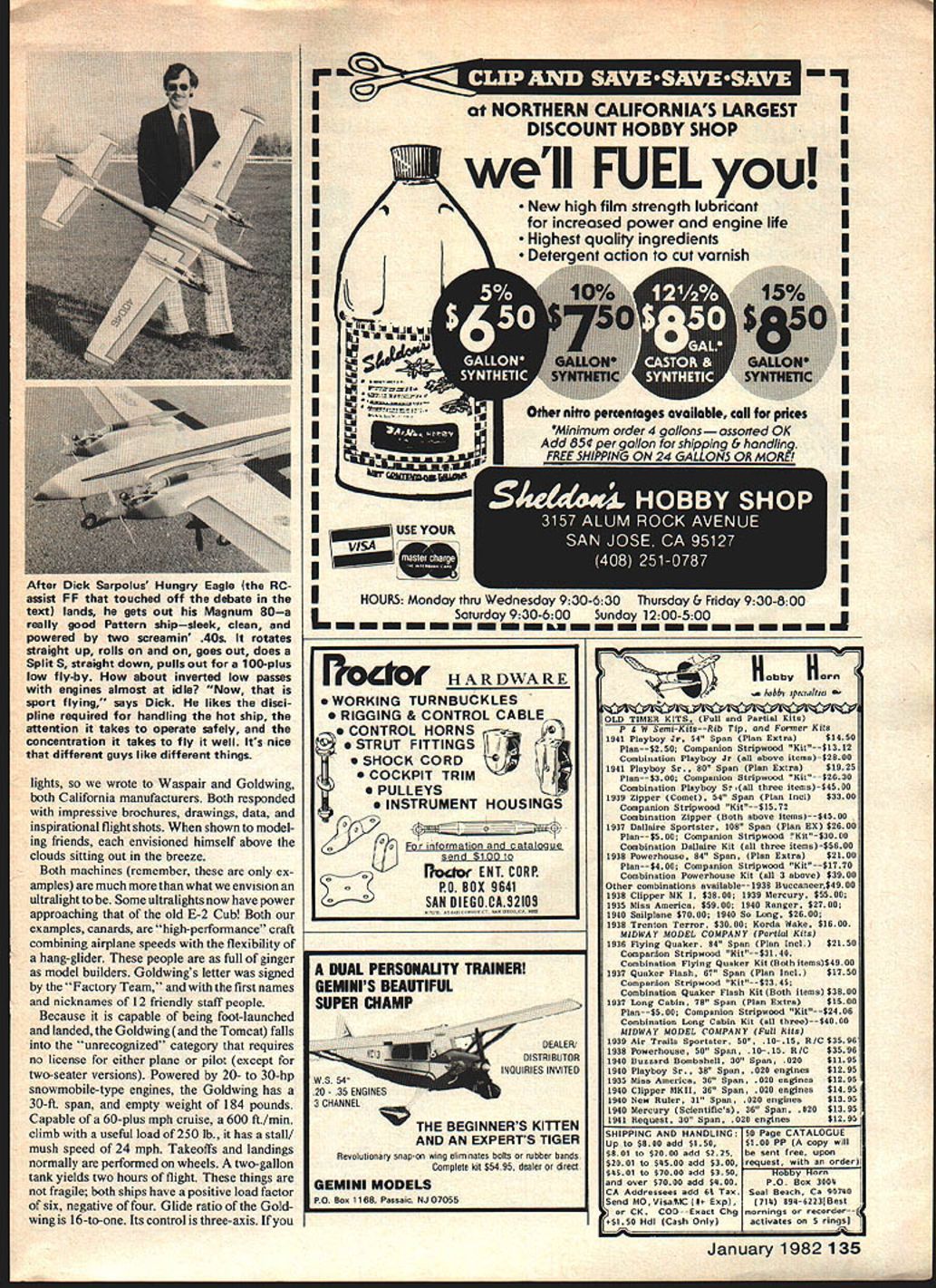
RC allows many of us to attain maximum enjoyment from Free Flight with minimal radio use. I may not touch a stick for 15 minutes. The fact that many use RC does not imply that pure Free Flight is threatened; using RC in a Free Flight crate does not take away the sense of belonging to Free Flight.
If RC-assist ever offends the Old-Timers, SAM could consider restrictions, but technically speaking, using RC on a Free Flight design still feels like FF to me.
FAST and RC Schneider Trophy Seaplanes
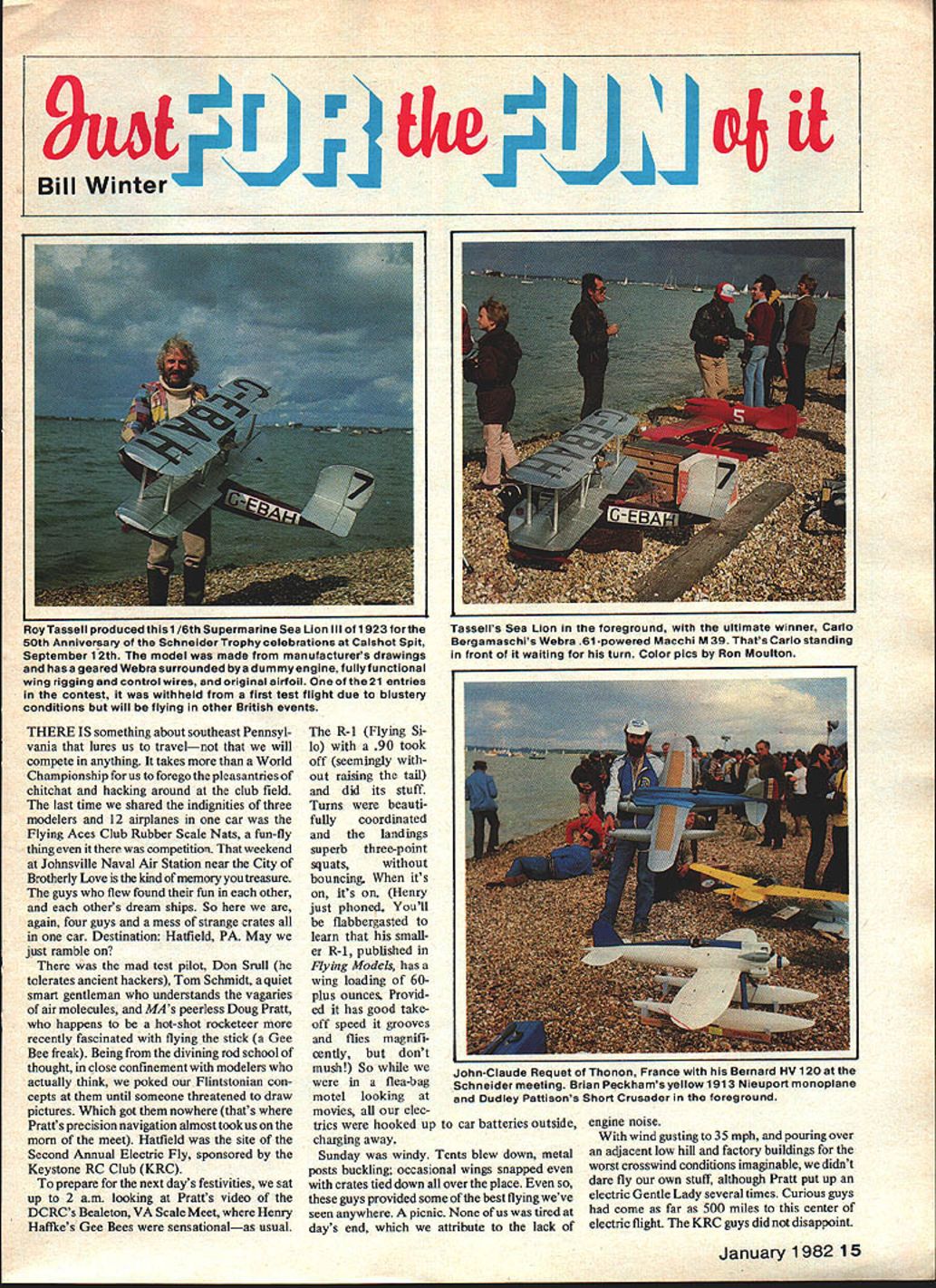
Not long ago, California's FAST Club intrigued the nation with club projects and RC demonstrations. In early September, Ron Moulton (Model & Allied Publications) reported on British-sponsored Schneider Trophy RC meets celebrating the 50th anniversary of the last full-size event at Calshot.
The meet was well organized, with 22 entrants from Italy, France, and the U.K. flying 12 different types of historic racing seaplanes. To qualify, entrants had to fly five laps of the course. Nine pilots made it through with two judged flights each; eleven others scored either flight or static points.
Carlo Bergamaschi (Italy) won with an A-39, piling up 1,153 static and 1,224 flight points, totaling 2,377. C. Martegani (proxy) flew a Sopwith Tabloid to a total of 2,276. If you collect back issues of MA, you might work up your own RC masterpiece.
Ultralights — Sherlock Holmes and the Waspair Tomcat
This ultralight tale begins with a clipping about canards and a reference to William H. Martin's 1909 patented model, intended to suggest full-size ideas. We tracked leads through National Geographic photos of Ed Sweeney (former owner of American Modeler) in a twin-engined ultralight at Oshkosh, and learned Ed is involved with Gemini and associated with Jerry Nelson. Ron St. Jean also reported spotting Ed and crew test flying in the desert. Ultralights had become a respectable business.
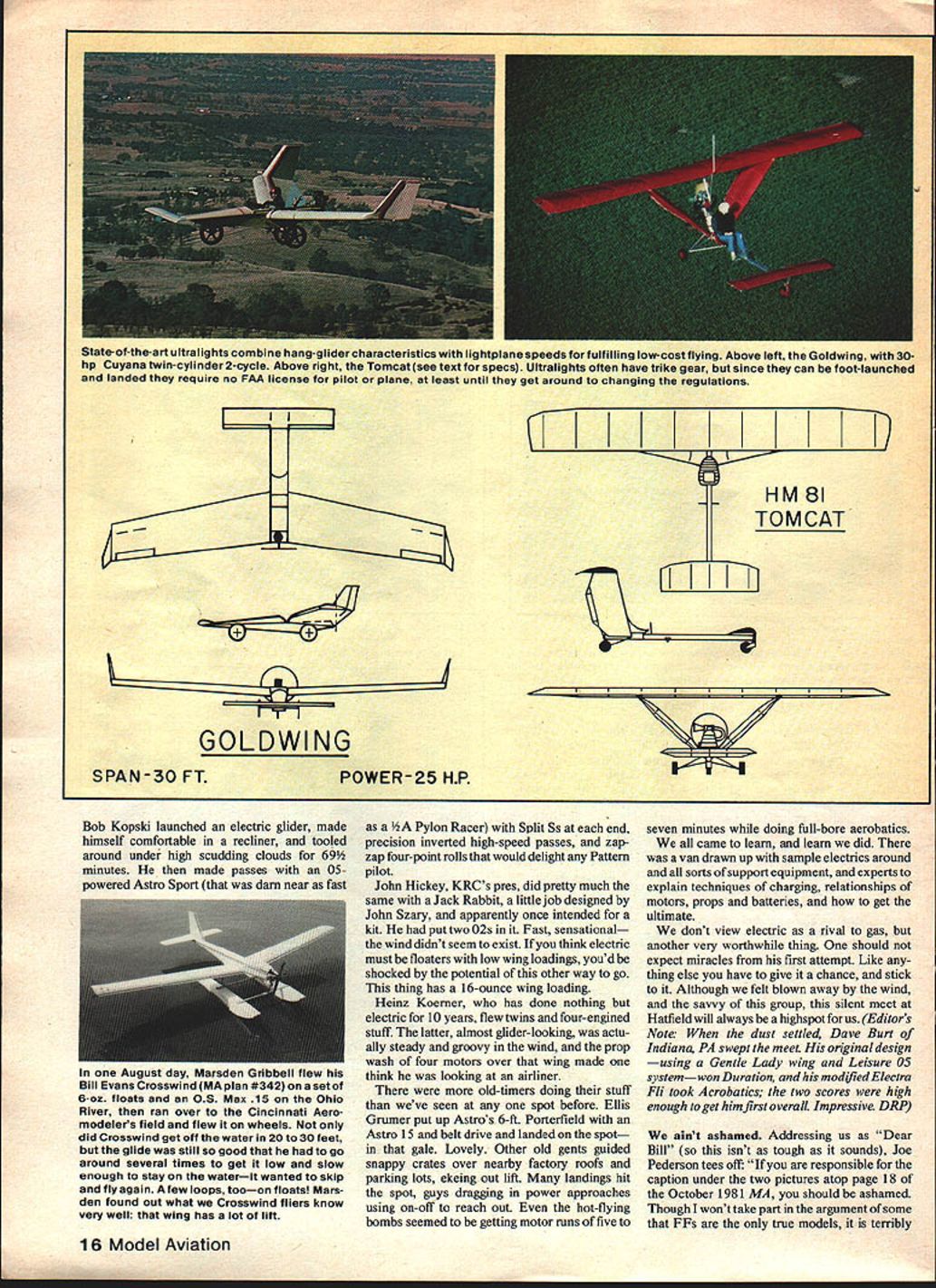
Selling for less than $4,000, the Goldwing kit requires no machining, welding, or bending, and is assembled with rudimentary tools. Its canard, winglets, tips, rudder and elevator use hot-wire foam cores; spars and bulkheads come finished. Components go together at the field in about 10 minutes—similar to assembling a 1/4-scale Aristocrat.
Of special note is Waspair's H.M.81 Tomcat, a pusher canard that echoes Martin's 1909 concept. Robin Haynes and two brothers founded Waspair in England in 1971; the firm moved to California in 1979 and has sold more than 2,200 aircraft. The Tomcat comes in single- and two-place versions, with direct or geared drives. Prices range from $3,695 (direct-drive single) to $4,495 (two-place geared drive). With a 30-foot span and a Cuyuna 30-hp twin at 5,800 rpm, the standard Tomcat takes off in about 110 ft., climbs 800 ft./min., cruises at 40 mph (top 56), and stalls at 19 mph. Minimum speed with stick full back is 28 mph. For transport, wings fold to a compact package; the canard tilts on two axes, and the dihedral wing panels couple roll and yaw responses.
Of interest to modelers, the Tomcat's aerodynamics—canard pre-stall behavior and main wing washout—make it effectively stall-resistant with the stick fully back. Wing panels are double-surfaced and ready to receive spars and ribs at the field. Ground steering is via a steerable nose wheel tied to the joystick.
On the back burner — 1/2-scale safety and big machines
Being involved with 1/2-scale flying has highlighted safety concerns. Some large machines have crashed; one 150-lb. Grumman amphib was lost on its first flight. Don Godfrey described many installation mistakes in MAN, and John Maloney of World Engines warned about vibration-induced contact "floating" on push-pull external switches mounted on servo boards.
Big multi-quad and giant-scale projects (a reported six-Quadra B-36 with a 27½-ft. fuse, a Northrop multiengined flying wing) are ambitious but demand experienced teams and strict oversight. We have reports of lost radio at low altitude and heavy consequences. Pre-flight checks, scheduled maintenance of servos and batteries, and careful handling are essential. These models may be "just models," but their size and mass make them essentially RPVs; they deserve disciplined procedures and a safety checklist. This is not about rules to police enthusiasts, but about preserving the fun and reducing risk.
Antiques, Old Timers, Nostalgia, and dates
During discussion with SAM over cutoff dates for classes like Vagabond, WOG, and Old Square Sides, Bob Lash (SAM Acceptance Committee) clarified the historical cutoff: the original Old-Timers cutoff was December 31, 1941, but due to publication lead times this was changed to December 31, 1942 to include pre-war designs published later. Another consideration was a Free Flight rule change that deleted an old cross-section rule, creating the "Pencil Bombers." Using 1942 as the cutoff helped preserve the intended time era.
Suggestions to allow any model meeting certain cross-section rules were rejected because processing non-published designs would burden contest directors. SAM did offer a special post-1942 class at Champs once, but only two to three crates were entered; the event is therefore not currently offered though it remains in the rulebook.
Bob Lash is offering inexpensive plans from the nostalgia era for $0.50 plus $.65 postage, including a copy of an All American design published in Air Trails after the war (Arden .19 powered) and his own Fillinella (published in M.A.N., September 1955).
Rules for Nostalgia:
- Eligibility: models published or kitted in the 1943–end of 1956 timeframe.
- Engines: plain shaft bearing, loop scavenged motors, not manufactured after 1956.
- No weight requirement. Engine classes follow AMA except Class D starts at .501.
- Contest practice has combined .049–.089 and .090–.650 into two classes so far.
This Nostalgia class bridges Antiques and Old-Timers, filling a historical gap and reviving interest in many terrific designs from that era.
Closing notes
There are many great airplanes from these eras; a little research will pay dividends in performance. For example, a 1/2 A Firecracker published in M.A.M. can be tuned for pylon-like behavior with a sequence of selected props. Bill Winter, 4330 Alta Vista Dr., Fairfax, VA 22030.
Transcribed from original scans by AI. Minor OCR errors may remain.

