
Just For the Fun of it
Bill Winter
You will hate me for this. I am going to tell you what goes on at your flying site during the week when you're at work (or at school).
It is impossible to pick a time when others are not flying. There's a 10 a.m. curfew at my field, but there are guys waiting to fire up even on a Monday morning. Some days are busier than a Saturday. By afternoon, four in the air at once is commonplace. Airline pilots on layover do four‑pointers with pattern jobs. Five flights equate with an afternoon. The retired guys are out in force. (One calls me "Sonny.") Sparkling stories flow. Our numbers are matched by guys playing hooky from work. Beginners show up — and that gives us all plenty to do.
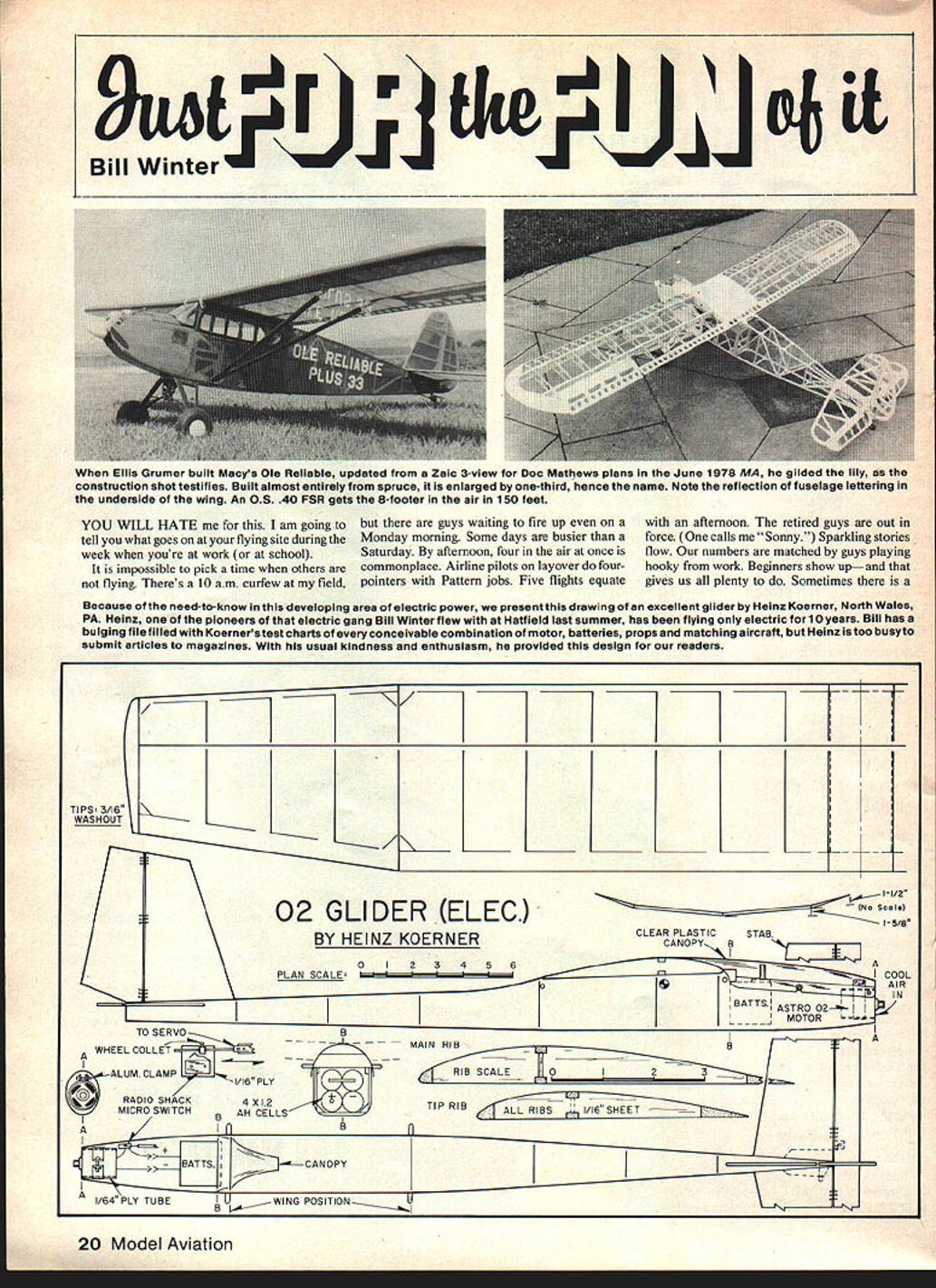
Sometimes there is a need‑to‑know situation in this developing area of electric power, so we present this drawing of an excellent glider by Heinz Koerner, North Wales, PA. Heinz, one of the pioneers of that electric gang I flew with at Hatfield last summer, has been flying only electric for 10 years. I have a bulging file filled with Koerner's test charts of every conceivable combination of motor, batteries, props and matching aircraft, but Heinz is too busy to submit articles to magazines. With his usual kindness and enthusiasm, he provided this design for our readers.
Young Talent — Tim Harris
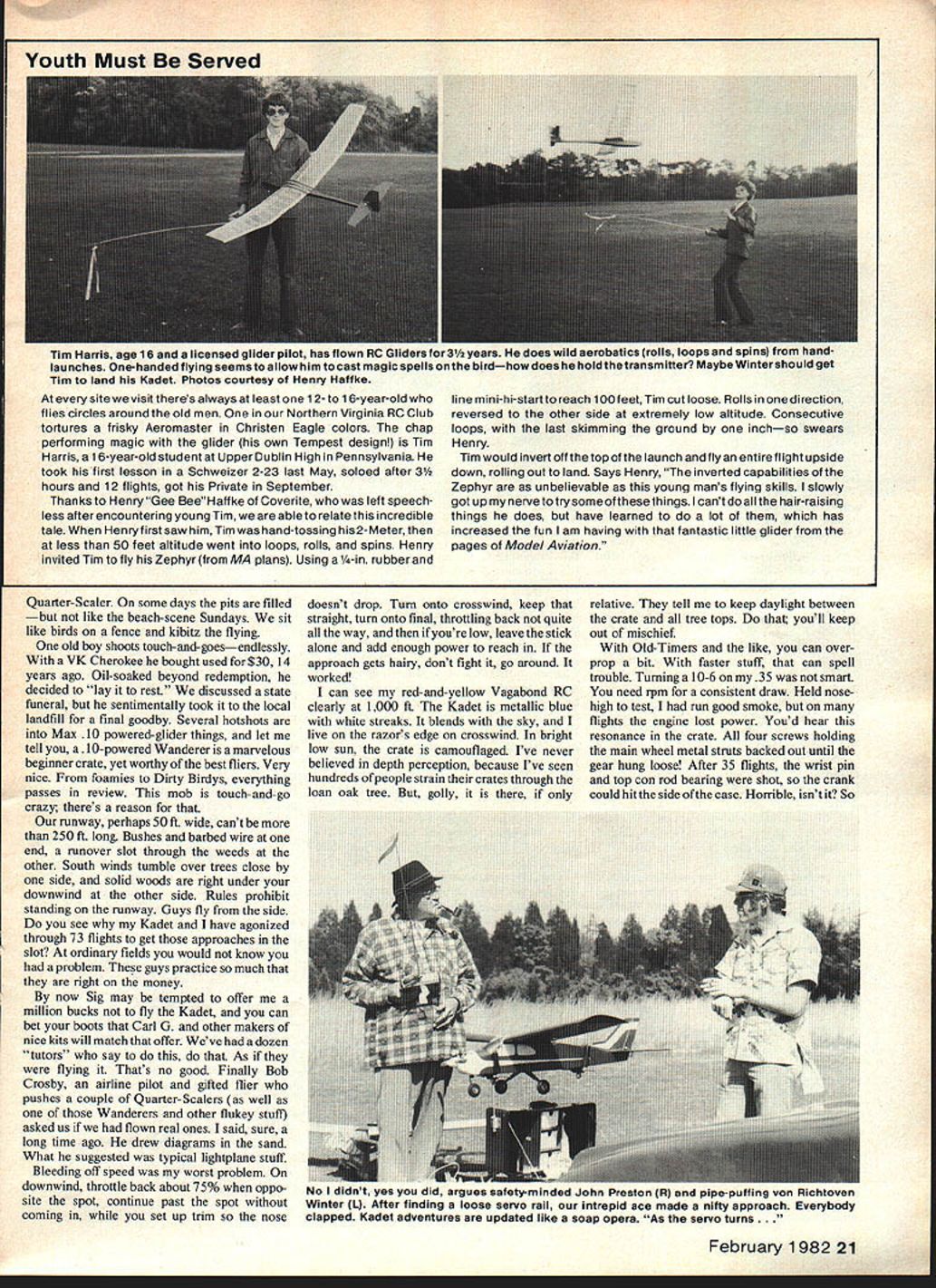
At every site we visit there's always at least one 12‑ to 16‑year‑old who flies circles around the old men. One in our Northern Virginia RC Club tortures a frisky Aeromaster in Christen Eagle colors. The chap performing magic with the glider (his own Tempest design) is Tim Harris, a 16‑year‑old student at Upper Dublin High in Pennsylvania. He took his first lesson in a Schweizer 2‑23 last May, soloed after 3½ hours and 12 flights, and got his Private in September.
Thanks to Henry "Gee Bee" Haffke of Coverite, who was left speechless after encountering young Tim, we are able to relate this incredible tale. When Henry first saw him, Tim was hand‑tossing his 2‑meter, then at less than 50 feet altitude went into loops, rolls, and spins. Henry invited Tim to fly his Zephyr (from Model Aviation plans). Using a 1/4‑in. rubber and line mini‑hi‑start to reach 100 feet, Tim cut loose. Rolls in one direction, reversed to the other side at extremely low altitude. Consecutive loops, with the last skimming the ground by one inch — so swears Henry.
Tim would invert off the top of the launch and fly an entire flight upside down, rolling out to land. Says Henry, "The inverted capabilities of the Zephyr are as unbelievable as this young man's flying skills. I slowly got up my nerve to try some of these things. I can't do all the hair‑raising things he does, but have learned to do a lot of them, which has increased the fun I am having with that fantastic little glider from the pages of Model Aviation."
Quarter-Scaler and the Pits
On some days the pits are filled — but not like the beach‑scene Sundays. We sit like birds on a fence and kibitz the flying.
One old boy shoots touch‑and‑goes — endlessly — with a VK Cherokee he bought used for $30, 14 years ago. Oil‑soaked beyond redemption, he decided to "lay it to rest." We discussed a state funeral, but he sentimentally took it to the local landfill for a final goodby. Several hotshots are into .10‑powered glider things, and let me tell you, a .10‑powered Wanderer is a marvelous beginner crate, yet worthy of the best fliers. Very nice. From foamies to Dirty Birdys, everything passes in review. This mob is touch‑and‑go crazy; there's a reason for that.
Our runway, perhaps 50 ft. wide, can't be more than 250 ft. long. Bushes and barbed wire at one end, a runover slot through the weeds at the other. South winds tumble over trees close by on one side, and solid woods are right under your downwind on the other side. Rules prohibit standing on the runway. Guys fly from the side. Do you see why my Kadet and I have agonized through 73 flights to get those approaches into the slot? At ordinary fields you would not know you had a problem. These guys practice so much that they are right on the money.
By now Sig may be tempted to offer me a million bucks not to fly the Kadet, and you can bet your boots that Carl G. and other makers of nice kits will match that offer. We've had a dozen "tutors" who say to do this, do that — as if they were flying it. That's no good. Finally Bob Crosby, an airline pilot and gifted flier who pushes a couple of quarter‑scalers (as well as one of those Wanderers and other flukey stuff), asked us if we had flown real ones. I said, sure, a long time ago. He drew diagrams in the sand. What he suggested was typical light‑plane stuff.
Bleeding off speed was my worst problem. On downwind, throttle back about 75% when opposite the spot, continue past the spot without coming in, while you set up trim so the nose doesn't drop. Turn onto crosswind, keep that straight, turn onto final, throttling back not quite all the way, and then if you're low, leave the stick alone and add enough power to reach in. If the approach gets hairy, don't fight it — go around. It worked!
I can see my red‑and‑yellow Vagabond RC clearly at 1,000 ft. The Kadet is metallic blue with white streaks. It blends with the sky, and I live on the razor's edge on crosswind. In bright low sun, the crate is camouflaged. I've never believed in depth perception, because I've seen hundreds of people strain their crates through the lone oak tree. But, golly, it is there, if only relative. They tell me to keep daylight between the crate and all tree tops. Do that; you'll keep out of mischief.
With Old‑Timers and the like, you can overprop a bit. With faster stuff, that can spell trouble. Turning a .10‑6 on my .35 was not smart. You need RPM for a consistent draw. Held nose‑high to test, I had run good smoke, but on many flights the engine lost power. You'd hear this resonance in the crate. All four screws holding the main wheel metal struts backed out until the gear hung loose! After 35 flights, the wrist pin and top con rod bearing were shot, so the crank could hit the side of the case. Horrible, isn't it? So I am going down to a 9‑6 and let it run. Almost packed out, the run is consistent throughout. No overheating. Crosby said I had been creating vapor lock. I think he was right!
Yesterday brought good news and bad news. The bad news was that the sturdy Kadet (now 81 flights) still resonated. Our second O.S. .35 was obviously chasing its predecessor down the hole. The fact that the needle slipped in its clip wasn't helping. Now we were having fast flat flights, followed by mushy ones. A new tank and four prop changes didn't halt the resonance — but the crate is going well on a .10‑6 wood Zinger. This ship had been built for me, and by gosh, the front servo rail was loose, allowing the sides to drum against it. Still press‑fitted, the tray moves a tiny bit, accounting for the trim variations I was getting. All this because of the lack of a bit of glue. My next approach was right on, and as the ship rolled out, the pits burst into a round of applause. Do they cheer Hanno Prettner?
Trips and Club Fun
Having had a fascinating day with those electric guys at Hatfield, PA, we spent a weekend fun‑flying with the Fredericksburg Aero Masters. We loaded the big Aristocrat and the RC‑assist Vagabond into Mad Test Pilot Srull's station wagon, along with his nifty Kavalier, a big Lacey with an ST .46 (my Gawd!). We stayed over at Bill Kaluf's (Lt. Col. Ret., Army) and had a ball. Bill is a mad but neat builder with a house full of crates. Son Steve is a neat pilot. On a scale of one‑to‑10 in depth perception, Bill is a two, and I am a three. Bill extolls his Pica Rapier—with good cause.
With extensions and charging leads all over the garage, the place looked like Vegas from 40,000, what with all the tiny red and green lights glowing merrily. Doug Pratt showed the flag for Model Aviation with his fine‑flying Astro Flight 6‑ft. Porterfield, built from a kit with an Astro 15 and belt drive for a 13‑8. It glides amazingly well, and takes off from grass. He gets five touch‑and‑goes on a "tank". Club prez Charlie Rector took Doug in tow.
For a 30‑odd‑member club, this is quite an outfit. On the very spot in a park where the Union cannons roared, we all had a mighty busy two days of flying. A couple of Bryon jets streaked along the grass, lifting off like fighters on a mission. Fast, spectacular flights with long thrilling approaches and a roll‑out that went on forever. Greatest mix of crates we've ever seen in one spot, and they all performed to perfection.
Not having seen Top Flite's cranked‑wing Contender before, we were impressed, to put it mildly, by their realism and maneuverability, especially with that big center section wing flap in down. With flap down, the Contender behaves as if designed to stay on top of a rubber ball. Slowed down, it responds well, and can be bounced around like a yo‑yo. Lands almost like Hux's space shuttle, zipping in fast and then sitting down like a duck with virtually no roll. Steve and a buddy fly two Contenders in close formation. They land abreast. If the wheels don't touch at the same time, they consider it a bad demo. Try that on your bazooka. Power was an O.S. .40 FSR. Papa runs his on straight FAI fuel and raves about it. He saves a bundle.
The most realistic plane we've ever seen flew that Sunday afternoon: an Andrews Aeromaster with an O.S. .60 4‑cycle. A hush fell over the crowd. That 4‑cycle and the Aeromaster (with radial cowl) were a rare, perfect match of plane and engine — airspeed and sound absolutely appropriate for all maneuvers from slow flight to high‑speed passes and aerobatics. The Aeromaster is an all‑time great, and with a .60 4‑cycle engine, the result defies description.
The Aristocrat was on its good behavior, and as always, we passed the transmitter around. A couple of airline pilots were delighted and soon brought up other guys: "Joe or Charlie, here, is a pilot, and will you let him see what it's like?" None of those guys ever got out of the groove — not by an eyelash. The Vagabond Old‑Timer was a new one for these chaps. Old free‑flighters nobody knew came out of the crowd to talk about it. They all are nursing old Quakers, etc., and now, for the first time, realized how impressively their ancient kits could perform.
Driving home, munching on apples and cheese, we marveled about the niceness of people you meet this way when we all forget the competition required of us all merely to live. When clubs get to visiting and enjoying mutual fun sessions, this hobby is at its very best. We are going back!
Monster Fly‑in — Fort Meade
If fly‑ins are the happy hunting ground, we can't say enough about the Monster Fly‑in at Fort Meade, MD put on by the Meade Modelers. There was a made‑in‑Heaven autumn Saturday (Sunday's dismal wind and rain didn't break the spell!) during which our mad test pilot practiced his scale procedures while making demos with the Aristocrat. After four long flights we had used less than 1½ quarts of glow fuel on the Tartan.
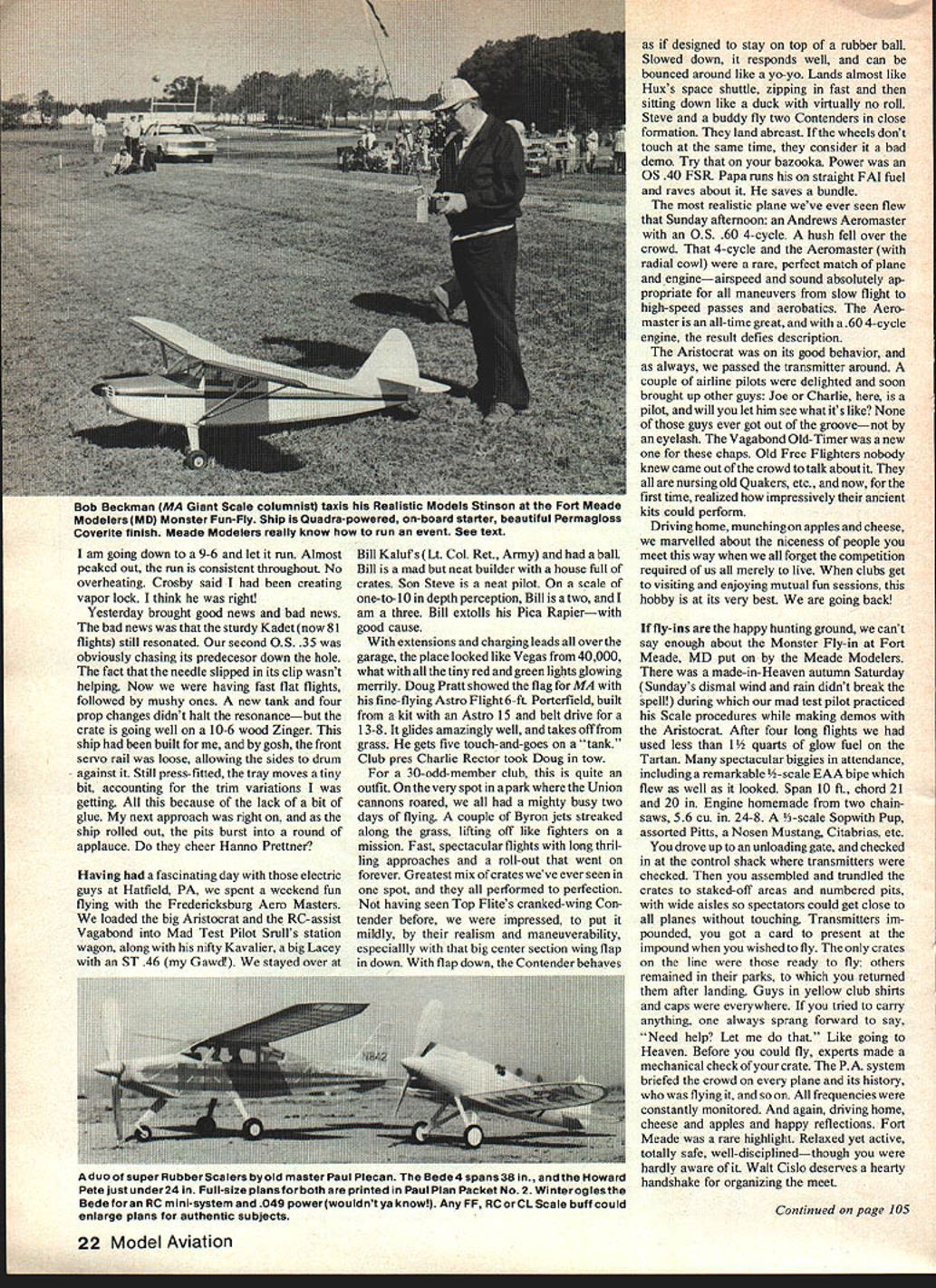
Many spectacular biggies in attendance, including a remarkable 1½‑scale EAA Piper which flew as well as it looked. Span 10 ft., chord 21 and 20 in. Engine homemade from two chainsaws, 5.6 cu. in. 2‑48. A 1/2‑scale Sopwith Pup, assorted Pitts, a Nosen Mustang, Citabrias, etc.
Event organization was first class. You drove up to an unloaded gate, and checked in at the control shack where transmitters were checked. Then you assembled and trundled the crates to stacked‑off areas and numbered pits, with wide aisles so spectators could get close to all planes without touching. Transmitters impounded, you got a card to present at the impound when you wished to fly. The only crates on the line were those ready to fly; others remained in their pits, to which you returned them after landing. Guys in yellow club shirts and caps were everywhere. If you tried to carry anything, one always sprang forward to say, "Need help? Let me do that." Like going to Heaven. Before you could fly, experts made a mechanical check of your crate. The P.A. system briefed the crowd on every plane and its history, who was flying it, and so on. All frequencies were constantly monitored.
Highlights:
- Relaxed yet active, totally safe and well disciplined.
- Crates impounded and released by card system.
- Mechanical checks by experts before flight.
- Wide, numbered pits with easy spectator access.
- Constant P.A. narration and frequency monitoring.
Again, driving home, cheese and apples and happy reflections. Fort Meade was a rare highlight. Walt Clislo deserves a hearty handshaker for organizing the meet.
Ole Reliable Plus 33 — Ellis Grumer
This will take a while. From Junior American Modeler days, I had held onto a scratchy plan of an Old‑Timer built by a then‑unknown Dee B. Mathews. That was the Kloud King, and when Model Aviation was turned on in 1975 without contributors or material, Doc's plan was resurrected. It was one of the top five plans for years. Doc then offered MA more Old‑Timers, but his first suggestion didn't excite us. Frank Ehling, the Wizard of Oz, suggested an Old‑Timer from a Zaic Yearbook, Ole Reliable. Macy design. It is one of the best Old‑Timers ever to come down the pike. Then at Hatfield this year, we ran into Ellis Grumer of Phillipsburg, NJ. He thought it was one of ours, but we couldn't remember it. He promised pictures.
Ellis calls it Ole Reliable Plus 33. If big is good, bigger is better — it's a one/third scale‑up. Let Ellis take over.
"About seven years ago, I got into RC after a lapse of 35–40 years when I flew free flight with a Brown Jr. in a Comet Clipper," he begins. "I thought it would be easy, but after several crashes realized it was more difficult than I thought. Fellow club members hid behind their cars when I flew. After building a couple of planes that were out of my class, I built Ole Reliable from the June 1978 Model Aviation. It was the first plane I managed to take off and land in one piece. I liked the way it flew and the strong construction, so I decided to build it to a bigger scale.
"It is built almost entirely from spruce," Ellis goes on. "To me, spruce is cheaper than balsa. I purchase a large plank and can cut it to any shape or size in my workshop. By drilling holes and cutting away excess wood, I held the flying weight to 11 pounds. The span is 8 ft., and the outer panels are pulled into the center section with rubber bands. Alignment pins are oak.
"The FSR O.S. .40 takes it off in about 150 ft. It's a slow and graceful flier. I must set the idling speed low to bring it down on our small field. Later, I added a trap door to drop a parachute. Once when I dropped the chute from 300 feet, instead of coming down it got into a thermal and went up out of sight."
We don't present these pictures just because we like Old‑Timers — we like everything. But once in a while, there comes a masterstroke to impress us all. Looking closely at the framework, layer after layer of details reveal themselves. And you'll note that he's changed the dihedral to just right for ailerons, while maintaining near free‑flight stability. You just know that it must turn as smooth as silk.
Plan Packet No. 2 — Paul Plecan
Give five stars to Paul Plecan for his Plan Packet No. 2 which includes superb full‑size plans for a Jumbo Rubber Bede 4 and the Ben Howard/Gordon Israel Pete designed for the popular mass‑launch Greve events. The plans are 22 x 34 in., printed both sides. The Bede at 38 in. and 6.5 oz. with 24 ft. of 1/8 flat rubber surely is a heavyweight contender, and RC schoolyard folks will find it a natural for a lightweight system on an .049. The Pete spans just under 24 in., weighs 2 oz. An 11 x 17 in. instruction sheet is more complete than anything that fits into magazines, loaded with bits of rambling hints and kinks. Country‑store stuff. For the $4.50 packet price — this is the second of six — the discriminating modeler is rewarded with a collector's item. For good measure there's a two‑sided info sheet that Paul calls "Books & Charts and Stuff," listing Repla‑Tech, Paul Matt, Karlstrom, magazine back issues and what‑not also available from Paul.
As a modeler, Plecan reminds us of Carl Goldberg. Both are perfectionists. Nothing ever seems good enough for such guys, and the wonder of it all is that they ever manage to let go of a project.
In the winter of 1936 when we applied for a post on Bill Barnes (eventually to become Air Trails), the interviewer had us greet a would‑be author off the street. He had drawn a Searcy 3‑view with an ancestor of the ball‑point pen. "Should we buy it?" the editor asked. Not knowing which end was up, we mumbled a meek "Sure." That was the first of thousands of things we would come to buy. It was the first thing Paul ever sold. For a generation, Plecan's plans were among the finest in the magazines. He remains a sharp designer of practical craft that fly with the best. If, like us, you happen to be a Plecan customer waiting for his overdue No. 2 Packet, know that Paul builds and flies these ships, and, like Orson Welles who talks of not releasing a wine before its time, Paul sticks with a project until the CG position and the angular differences are optimum.
(Paul Plecan, 3023 Saratoga St., Riverside, CA 92503. Subscription data with Packet No. 2.)
Bill Winter 4330 Alta Vista Dr. Fairfax, VA 22030.
Transcribed from original scans by AI. Minor OCR errors may remain.

