
Just For the Fun of it
ZERO DISPLACEMENT ENGINES
Fairey Flycatcher, we think, was the name of a classic British military biplane. Now we understand why. We are so indebted to all you "experts" who have explained fly-catching techniques. And we aren't surprised that the most impressive solution comes from old-timer Dale Willoughby of Scale Model Research. If his name rings a bell it's because he was a shaker and mover in the world of Scale, a pioneer in fiberglass shells and more. Let's just say he has forgotten more than most of us remember. He developed fly-catching to a fine art — says we took him back 30 years. That's more than I can do for myself.
"My greatest success in catching flies," he recounts, "was using a wide-mouth jar with holes punched in the lid for air. This is the 'Fly-Power Storage Area.' Upon spotting a fly I would carefully place a clear glass over it, approaching 'down-sun' so as not to cast a shadow. When the fly was inside the glass, I slipped a piece of cardboard underneath, and then matched the mouth of the glass with that of a mayonnaise jar, removing the cardboard to allow the fly to fly upward. It took patience.
"Then to the ice box," Dale goes on relentlessly, "to let him quiet down for about 20 minutes. Modern-day refrigerators might take less time, but never put flies in the freezer compartment. They die like flies. When ready for installation, use a pair of tweezers and a dab of Ambroid on the nose of the aircraft and dibble 'his' feet in the glue. A fly is equipped with a miniature 'half dumbbell' extending from his abdomen that must vibrate or he has no desire to fly. If the fly begins to warm up and become more active, a fast-drying cement probably is better.
"To launch, hold the aircraft between thumb and forefinger very lightly until 'he' pulls it out of your hand. Have a smidge of clay handy in case you misjudged the C.G. And don't count on straight flights."
Knowing that thousands are reading these revelations breathlessly, we urge patience. The big, green bottle fly is the best. Horse flies are scarce (so are horses!) and produce too much "fly power" in spurts. Also good is the fly that looks like a honey bee — do be careful. These double ball-bearing jobbies are recognized by their insignia, an "H" on the back. They hang around with butterflies that throng on flowers.
For covering, Dale used Japanese Super Lite white tissue with dope made from acetone and toothbrush handles, sparingly applied. Any genuine old-timer remembers dissolving celluloid, too — who could afford banana oil? We do spot a clue. Flies are air-breathing power plants. Baffling, however, is how Dale managed to select "him" flies. We can't tell the difference between boy and girl chickens (we almost said "chicks").
You saw the fly-powered model on That's Incredible? Don't forget this column was the first to tell you how to find free engines. Our next step is to sub-contract for a fine-mesh butterfly net. That is, if some white-coated sourpuss with a coarse-mesh net doesn't get us first. Ole!
The way we were. The Schenectady Union-Star for August 16, 1946 carried a four-column story with time-capsule pix of members of the Schenectady Aeroneer Club. There's a two-line banner headline: "Aeroneers Zoom Back Into Flying Picture as Members Return From War Service." Those were the days, my friend. But first, as Jackie Gleason used to say, "A little traveling music, please!"
RC is the rage. Not sure what the next rage could possibly be, since RC is supposedly the ultimate, but undoubtedly there will be one.
There have been rages before. From shortly after the Wrights until the Lindbergh flight in 1927, a sizeable hobby had developed. It was all rubber power—although peppered with compressed air. Little three-cylinder engines that worked like CO-2, but had huge balloon thin-walled metal tanks wrapped with spot-soldered music wire.
The "airplane" was magic. Kids forgot about wanting to be streetcar conductors. There had been magazines you never hear of, famous clubs, and—from about 1920 on—manufacturers who made 2,000 to 3,000 ready-to-fly models a day. From about 1909 on, catalogs were filled with juicy pix of kit models: the Wright, Bleriot and up to the Jenny and DH-4.
For a long time the quest was merely to make something fly. Models had flown remarkably well before this ancient writer was born, but communications were so bad, we were still reinventing the wheel 20 years later. You might use flour paste and tissue and kite sticks and sliced inner tubes, while in the next town guys were into balsa and silk and big, lightweight Loening amphibs, Heath Bullets, and Wacos. The caveman coexisted with the nuclear physicist, so to speak.
Never forget that it was Model Airplane News, on the scene in 1929, ignited a bit later by the one-and-only Charlie Grant, that got the stampede on the trail. It had been, until almost then, a 25-year battle merely to prove the supremacy of the tractor or twin pusher.
Until the early Thirties, rubber was king, although occasional gas models had been around ever since Ray Arden's in 1904—he met his wife when the crate flew a mile across New York's Van Cortlandt Park to land at her feet. But the sensational appearance of the Brown Junior flown by Max Bassett (1932-33 Nats) brought Space Shuttle-type excitement. The place jumped with Free Flights.
Contests were common long before WW I. The first Nats, encouraged by the National Aeronautic Assn., was in 1923—just Chicago and St. Louis groups. The Airplane Model League of America (AMLA) got it all together in about 1927-1930, with large meets and a Nats, and a tie-in with American Boy magazine (which published many excellent things—one a stick model that gained its flier a trip to the Olympics; we don't know if there had been a model event). AMLA faded into AMA, via Charlie Grant's International Gas Model Association in MAN, turned over to the NAA Air Youth's Division, then handed off to AMA, still a division of NAA.
Disappearing before the war were the Hearst papers' Junior Birdmen and Scripps-Howard's Junior Aviators.
Lady Luck ruled. Everyone figured he could beat anyone else, including Bassett. Clubs went to meets en masse. Sport and competition were inseparable. Wild, glorious fun. A barnstormer's life — carnival with everybody glassy-eyed with the lure of flight. It would never be better. Then, Jim Walker's U-Control suddenly seemed like more than a brick on a string.
The McCoy-Hatfield feud was sissy stuff compared to the strife between Free Flighters and Control Liners. With everything in a seething turmoil at the end of the wild-eyed age of innocence, World War II was upon us.
Said the Union Star, "A model airplane club (Aeroneers) which declined during the war because two-thirds of its members went into the armed forces, is now very much back in the Schenectady picture... biggest item on the club's agenda for 1946 is the Sixth Annual Invitation (AMA sponsored) Model Airplane Contest... (Rubber-Powered models, Towline Gliders and Free Flight and Control Line Gas models)." People swarmed to meets all over America. In New York in 1947 the Mirror drew 250,000 spectators to Grumman's Bethpage field. Radio, flown by a few wizards like the Good Brothers and Walker before the war, was soon to shake up the troops with AMA's successful attempt to get an examination-free frequency that required no Ham license. CL Speed was briefly Numero Uno, followed by the craze for U-control Stunt. Free Flight, as mass sport, was on the skids. Little things turned us off. Who could love a Pencil Bomber gasser? (Gosh, your editor-publisher did.) Ditto for Wakefield, where super shrewdies began to weigh individual cross pieces. When they cut down the rubber, many of us were washed up. The takeoff requirement in Power was abandoned. CL Team Racing looked exciting for a year or two, but Rat Racing was the quickie outcome. Those demolition-derby whapped-together quickies soon became a science. Everything else, too.
We can't go home again. Nor recapture the flaming spirit of a zany time. So thanks to Danny Sheelds, who dug up this historic material for us, we can show a few of the nostalgic Aeroneer pictures. The faces and the planes tell a story. No doubt we'll receive letters from California and Europe from some of these folks, and perhaps we'll all get to share some wonderful stories. We note that the Aeroneers Club was organized in the home of Jack Thelen, who was killed over the Marshall Islands in a Marine Corsair. How easily we forget.
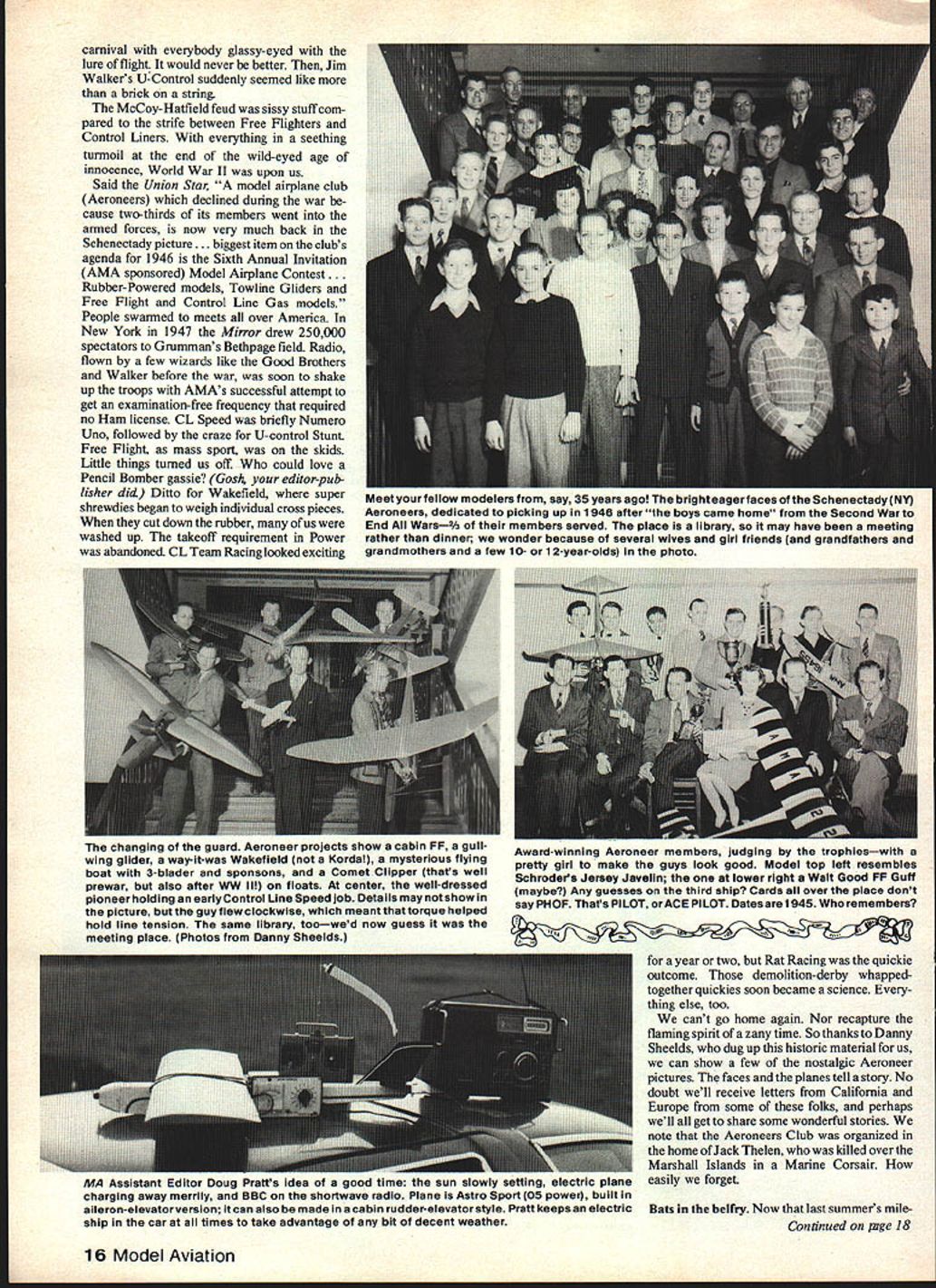
Bats in the belfry. Now that last summer's milestone recedes, our mind is as cluttered as your great-grandmother's attic, with pipe dreams of things to build. Two of my kids fly me into the ground. One, an ex-Pattern type out of it for six years, flew our humble Kadet on a visit. He made it look as good as we make it look bad. That did it. Another tech-rep brat in his area repaired the first guy's Phoenix V and then bought a brand-new unflown Mach I from a chap who was suddenly vamped by Quarter Scale.
They bought two Futabas with whistles and bells, and a new Airtronics XL Unlimited which also has chimes. We have one too, and last night was spent listening to the jazz it plays. The boys also have sundry Kraft stuff. We should mention that we fly our Quarter Scalers with an Airtronics XL and sometimes an Ace Silver 7 with mixing, etc. Also have a World Engines Expert charged up and no place to go, as well as a crazy mix of two old Futabas, Krafts, Sanwas, Airtronics, Ace—after all, we can't fly everything at once!
From what we see at the field, all radios seem to work fine. For me nothing has ever failed, and I am a hacker who has trouble with approaches.
Naturally, a grandson got turned on. He spent $20 for paints, etc., for a tail-wagging Dick's Dream. Is that possible? His old man and uncle also have a battered three-year-old Concept Air Scout and a lightweight Midwest O.S. .15-powered Champion which they love—they fly it in gales. The Lord protects the daft. They also sneaked away with my Realistic Stinson kit—now framed. And my Top Flite J-3—that's ready to go. In a valiant effort to keep up with these middle-aged youngsters, I got new glasses in order to see my blue Kadet (white also stinks unless against a blue sky). It has 73 flights, so don't write me off.
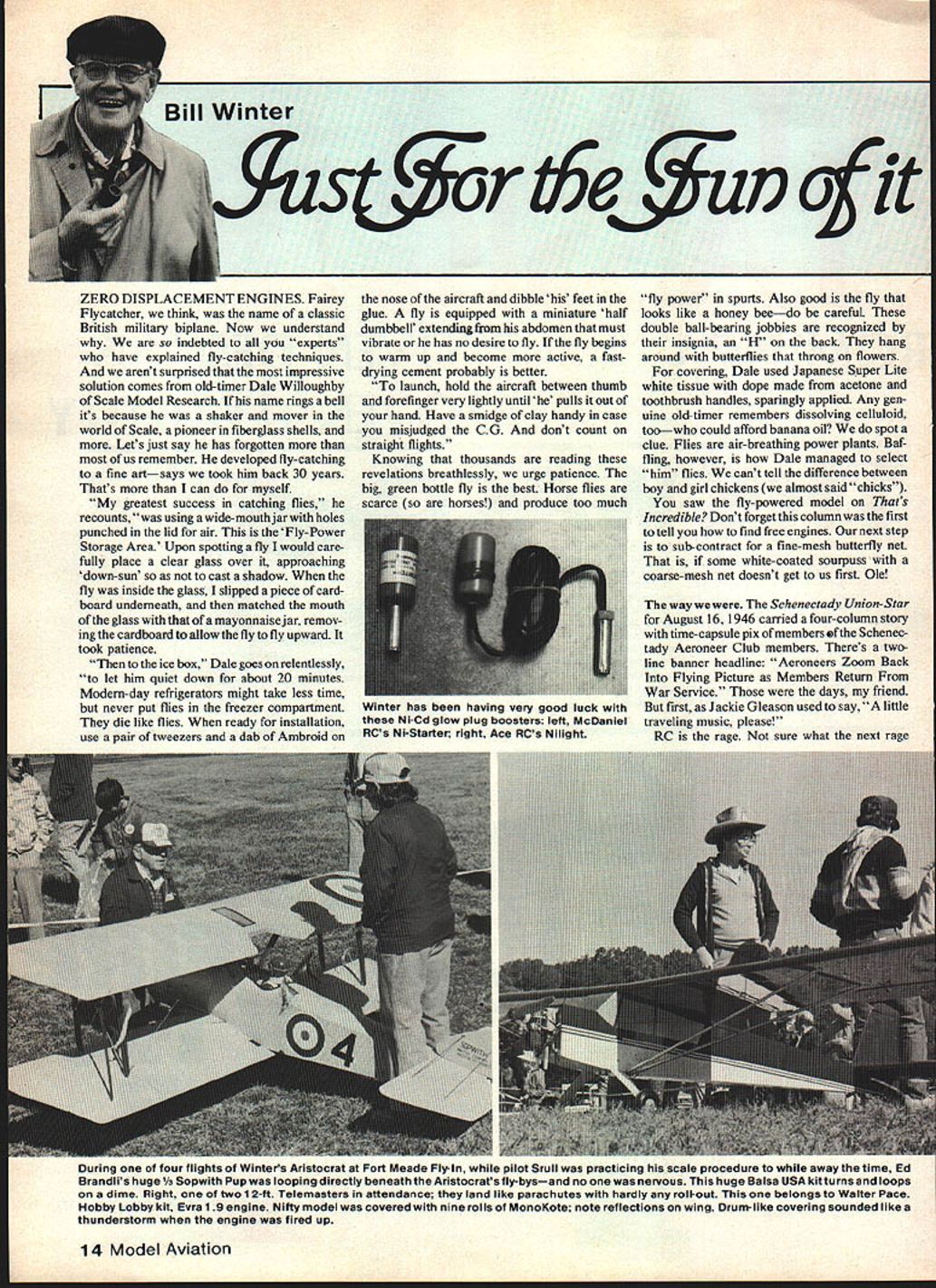
I am wiser after last year's confrontations. After three seasons I've decided glow drivers aren't for me. Even with a pot, I've blown plugs right and left. So have guys who use my box uninvited. They don't talk to me. I find Ace's Nilight Ni-Cd booster, and McDaniels' Ni-Starter, to be better than dry batteries, even at 1.2 volts. They hold a nice bright light, and if you don't over-prime your finger doesn't get whipped. Flip the prop through a few times, attach booster, hold prop and rotate to feel for bump. (But don't crank a plastic prop on a cold day. Engines get ornery then, and a plastic prop edge is sharp.)
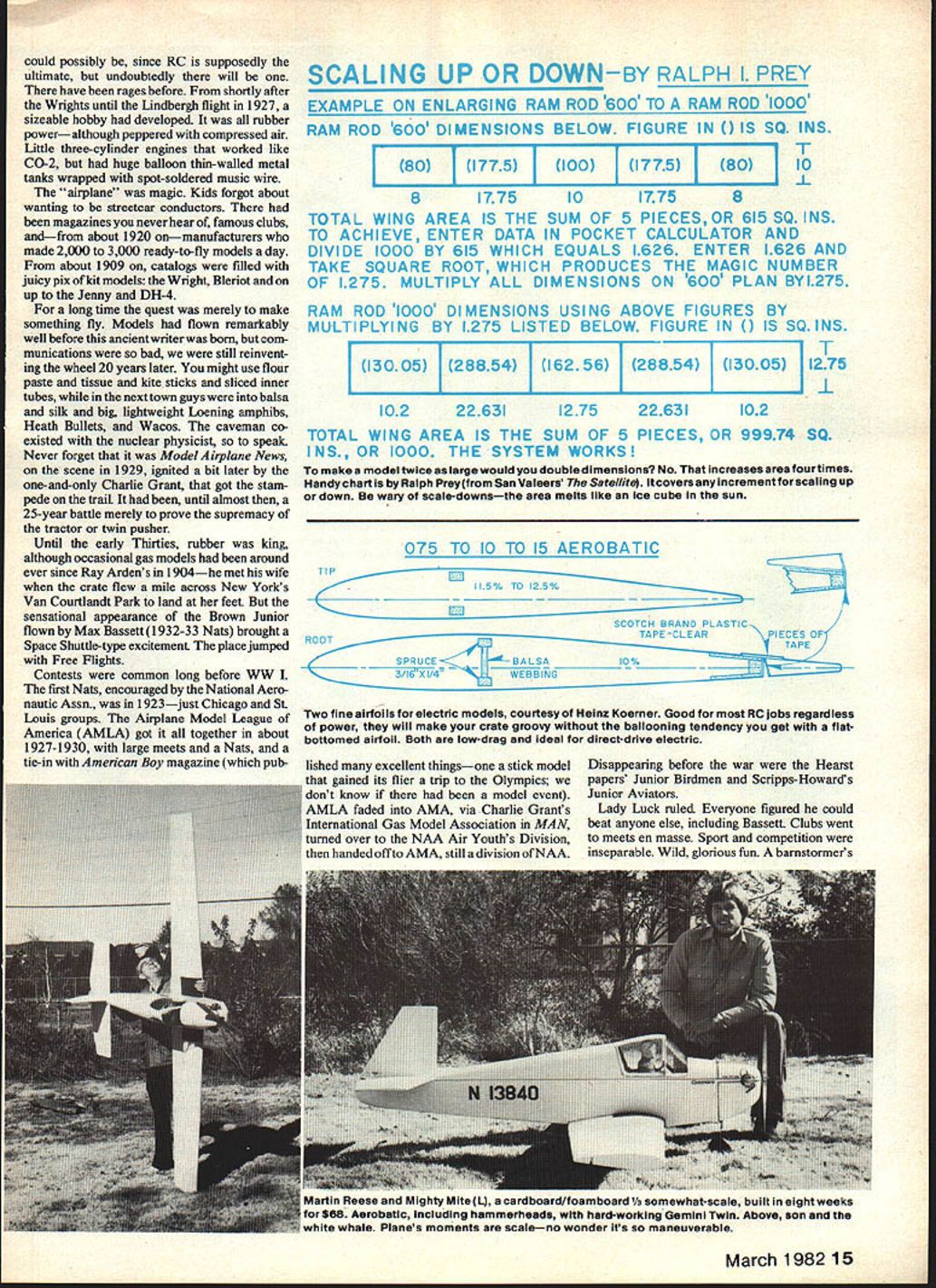
I've counted six transmitters in impound with switches on and needles pegged. Must check things like that when we fly the big Aristocrat. And I've seen dozens of crates shot down. Nobody ever proves anything, but after all, encroaching civilization brings paging services and evil surprises closer and closer. Thank goodness, the FCC is moving. I have been hit, but with slow sport stuff I've made saves. Post checks never find anything wrong. But, while all radios are good, they are made by humans.
It is smart to get your new system checked out. We've seen shorted crystals, bad soldering joints, solder bridges, uncleaned resin, solder flakes. We like gold-plated connectors, especially on those thin upright pins. Some other pins accrue invisible crud, and your system may have the jitters when first turned on. Or go bananas as you taxi out. Do slide connectors in and out a few times before you first fly a new system. Better, if possible, have a service man clean the connectors before you fly. Wish George Myers would tell you how. (George?) I do a vibration test by rubberbanding a system to ply, then to a Dremel jig saw table. The other day I had two servos on an unflown system drop dead. Bill Hershberger found poor receiver contact pins. See what we mean?
To you guys who are bewildered by the almost simultaneous appearance of interference, it seems every club should be aware of these other users; a frequency scanner may be one way to track them down. More on this in a future column.
Have a safe month.
John Preston 7012 Elvira Court, Falls Church, VA 22042
For Fun/Winter
Continued from page 18
The simultaneous appearance of the 1936-37 Old Squares Sides in Model Builder and Model Aviation, yes, it is really mine. MB's credited designer, John Sprague, is my middle name. Just funnin', Bill Northrop. Couldn't resist shaking up his liver bile. Incidentally, Poling and Bob Boucher tell me this ship is perfect for electric with an Astro 15 with belt reducer and a 12-8 or 13-8. 'Tis a mad, mad world.
Eight weeks, plus $68, equals 1/3 Mooney.
"Saw in your last column a picture of a cardboard airplane," begins Marvin Reese of Wichita. That would be Art Schmalz's 1/3-scale Eastbourne. "So here's pictures of my first cardboard and foam-core board attempt. Lots of help from Dennis Reichenberger, who has never built a plane from anything else. (Dennis, do come forward.) Stand far enough away, and it resembles a Mooney Mite M-18, 1/3-scale. I modified the plans and took liberties to expedite the project. The moments are correct. Wanted to throw it together as fast as possible to see if the project was feasible with a Gemini Twin—or any engine for that matter. Eight weeks, $68. Came in heavy at 184½ pounds (not really heavy for 1,800 sq. in. but almost too heavy for the twin Gemini). Wings and tail are foam-core board. Strongest, lightest frame I ever built.
"Also one of the most gentle planes I ever flew," Marvin continues. "Looks, flies, and sounds totally real. Landings make me look superior—smooth as mink. Rolls, loops and hammerheads with ease. Haven't tried sustained inverted, but with enough down elevator this will be added to my logbook."
He will use foam-board and cardboard heavily from now on. His big fuselage took two weeks to build, and it came out a bit crooked. Had he framed it with cardboard, Marvin thinks, then chopped lightening holes, added a long stringer on both sides to eliminate the square look, and covered as usual, it would have been stronger and lighter and could have been done in two nights at $2.00, plus covering.
Such kits would be a cinch. Just sheets of material and patterns. People have demonstrated how to get cambered surfaces from both core-board and corrugated cardboard. We once saw a Bridi .60 cabin job on the field—lovely, but so what? Later, playing back video, we heard a background conversation. It was foam-core board! Good paint job. You'd never know the difference.
Ron St. Jean has bonded silkspan-like paper to hot-wire cut cores that stand up to big comp Free-Flight stresses. Composites are coming. (Editor: An article by Ron St. Jean describing his processes will appear in this magazine as soon as it can be scheduled.)
The Joe Ott caper. Joe is back in business. The man who turned us on during the Twenties with Rubber Scale jobs in Popular Aviation might just shake up the industry. We expect to have details next month. He's got a radio system with never-seen-before features. And a trainer which assembles in quick jigs. Very advanced features and techniques. Not scratch-built, either. For example, molded cabin has pilot painted on. Nifty removable motor mount allows replacement with bigger engine in minutes. Two wings, for calm or windy weather. Four channels. He die-cut painted sheets. A remarkable product, a remarkable man. At 83, he sounds like a 20-year-old. He was walking before the Wrights flew at Kitty Hawk. A pre-run kit is on the way.
Spooky stuff. In mid-1800s, Henson's 150-ft. Aerial Carriage. Experts say it might have flown given a suitable power plant. Construction equalled 1900-era stuff. It had modern features, including trike gear. They laughed him to scorn. His friend, John Stringfellow, for years tried to prove the concept by a series of models (about 20 ft.) powered by his own model steam engine (not enough power). That steam engine, about 1½ feet tall, developing about one horsepower, is on exhibit at the National Air & Space Museum. (Stringfellow was the first to build a workable model airplane power plant; if Langley is the father of power Free Flights, Stringfellow is the father of our engines.) Henson had two full-size versions in the Aerial Carriage. Many years ago, the Smithsonian bought one of them in England. That great institution ordered the priceless power plant shipped to America. On the Titanic.
Bill Winter 4330 Alta Vista Dr., Fairfax, VA 22030
Transcribed from original scans by AI. Minor OCR errors may remain.

