
Just For the Fun of it
FLIGHTS OF FANCY.
On this Sunday after Christmas we don't have the foggiest idea about where this column is heading. You guys have done me in. There is a file drawer full of folders containing, in some cases, five- to ten-page letters and dozens of pictures. The stuff that dreams are made of. But all columnists have space limits. Fun turns everybody on.
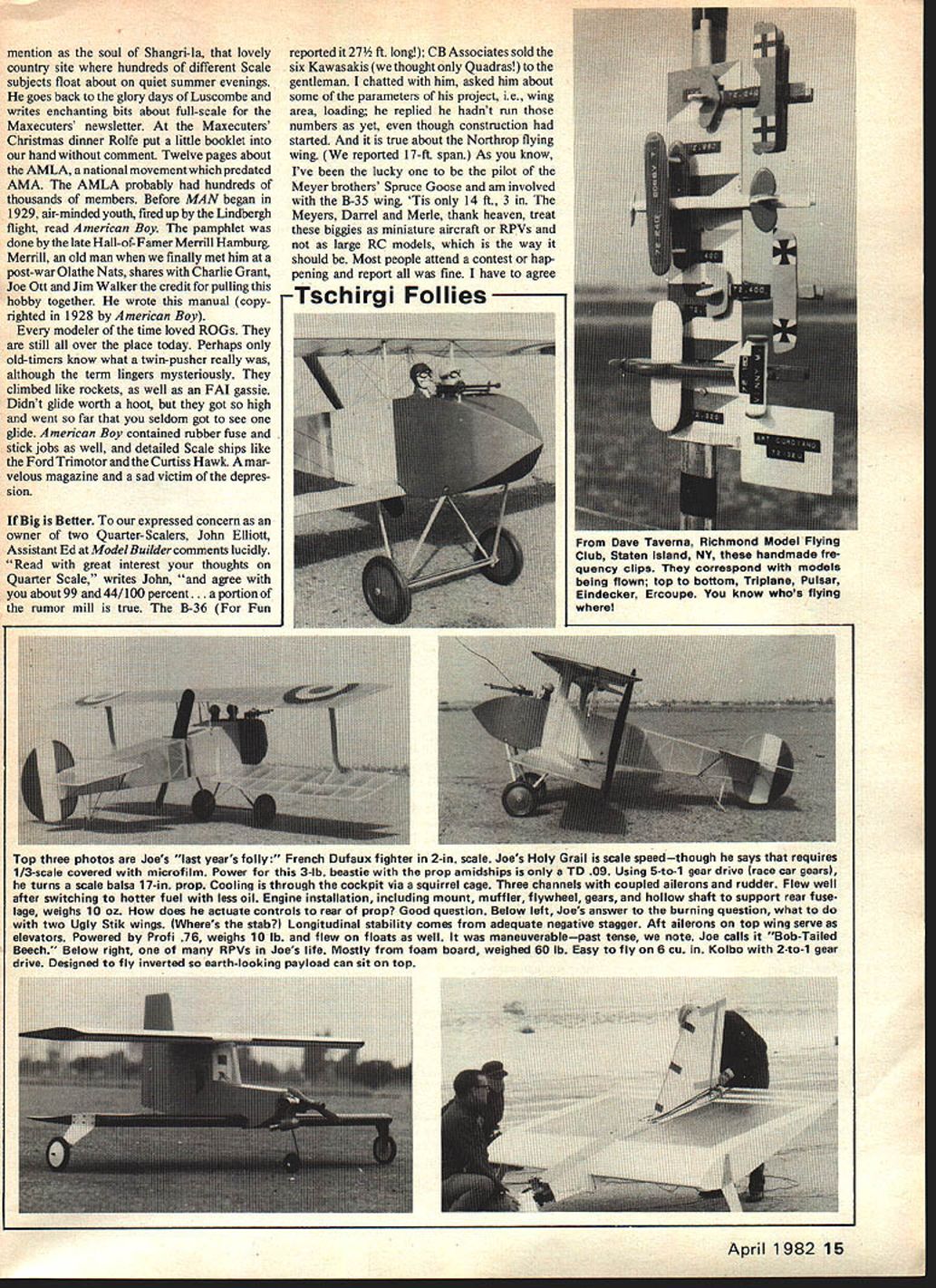
Typically, Joe Tschirgi begins, "I've greatly enjoyed your column, and since your interests parallel my own, I am sending a few photos that you might enjoy." They all say that. My interests parallel everybody's. Joe might be the most ingenious scale man we've ever run across; you know about his fantastic Brandenburg flying boats. Like many super-talented modelers, Joe—an ex-NVRCer living in California—was long ago drafted into a career in RPVs. Will you settle for our showing just a few of his latest ships?
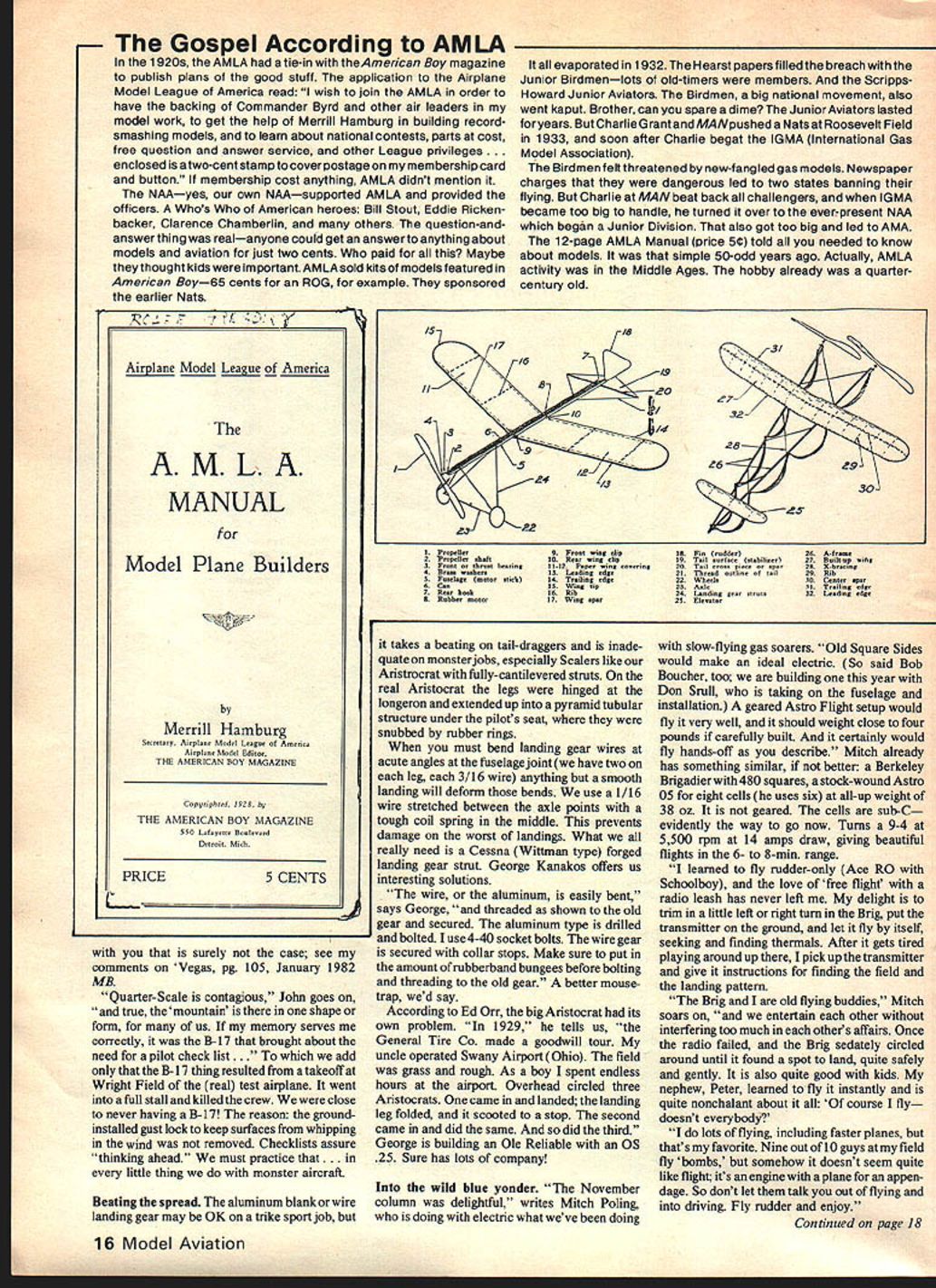
Rolfe Gregory's thing is rubber scale. Rolfe is a soft-spoken old-timer whose careers in both full-scale engineering (ancient pilot, too) and modeling obviously have been rewarding. He is one of those "mountain elves" we sometimes mention as the soul of Shangri-la, that lovely country site where hundreds of different scale subjects float about on quiet summer evenings. He goes back to the glory days of Luscombe and writes enchanting bits about full-scale for the Maxecuters' newsletter. At the Maxecuters' Christmas dinner Rolfe put a little booklet into our hand without comment — twelve pages about the AMLA, a national movement which predated AMA. The AMLA probably had hundreds of thousands of members. Before MAN began in 1929, air-minded youth, fired up by the Lindbergh flight, read American Boy. The pamphlet was done by the late Hall-of-Famer Merrill Hamburg. Merrill, an old man when we finally met him at a post-war Olathe Nats, shares with Charlie Grant, Joe Ott and Jim Walker the credit for pulling this hobby together. He wrote this manual (copyrighted in 1928 by American Boy).
Every modeler of the time loved ROGs. They are still all over the place today. Perhaps only old-timers know what a twin-pusher really was, although the term lingers mysteriously. They climbed like rockets, as well as an FAI gassie. They didn't glide worth a hoot, but they got so high and went so far that you seldom got to see one glide. American Boy contained rubber fuse and stick jobs as well, and detailed scale ships like the Ford Trimotor and the Curtiss Hawk. A marvelous magazine and a sad victim of the Depression.
If Big is Better.
To our expressed concern as an owner of two quarter-scalers, John Elliott, Assistant Ed., Model Builder, comments lucidly. "Read with great interest your thoughts on quarter scale," writes John, "and agree with you about 99 and 44/100 percent... a portion of the rumor mill is true. The B-36 (For Fen reported it 27½ ft. long!); CB Associates sold the six Kawasakis (we thought only Quadras!) to the gentleman. I chatted with him, asked him about some of the parameters of his project, i.e., wing area, loading; he replied he hadn't run those numbers as yet, even though construction had started. And it is true about the Northrop flying wing. (We reported 17-ft. span.) As you know, I've been the lucky one to be the pilot of the Meyer brothers' Spruce Goose and am involved with the B-35 wing. 'Tis only 14 ft., 3 in. The Meyers, Darrel and Merle, thank heaven, treat these biggies as miniature aircraft or RPVs and not as large RC models, which is the way it should be. Most people attend a contest or happening and report all was fine. I have to agree with you that is surely not the case; see my comments on 'Vegas, pg. 105, January 1982 MB.
"'Quarter-scale is contagious,' John goes on, 'and true, the "mountain" is there in one shape or form, for many of us. If my memory serves me correctly, it was the B-17 that brought about the need for a pilot checklist...' To which we add only that the B-17 thing resulted from a takeoff at Wright Field of the (real) test airplane. It went into a full stall and killed the crew. We were close to never having a B-17! The reason: the ground-installed gust lock to keep surfaces from whipping in the wind was not removed. Checklists assure "thinking ahead." We must practice that in every little thing we do with monster aircraft.
Beating the spread.
The aluminum blank or wire landing gear may be OK on a trike sport job, but it takes a beating on tail-draggers and is inadequate on monster jobs, especially scalers like our Aristocrat with fully cantilevered struts. On the real Aristocrat the legs were hinged at the longeron and extended up into a pyramid tubular structure under the pilot's seat, where they were snubbed by rubber rings.
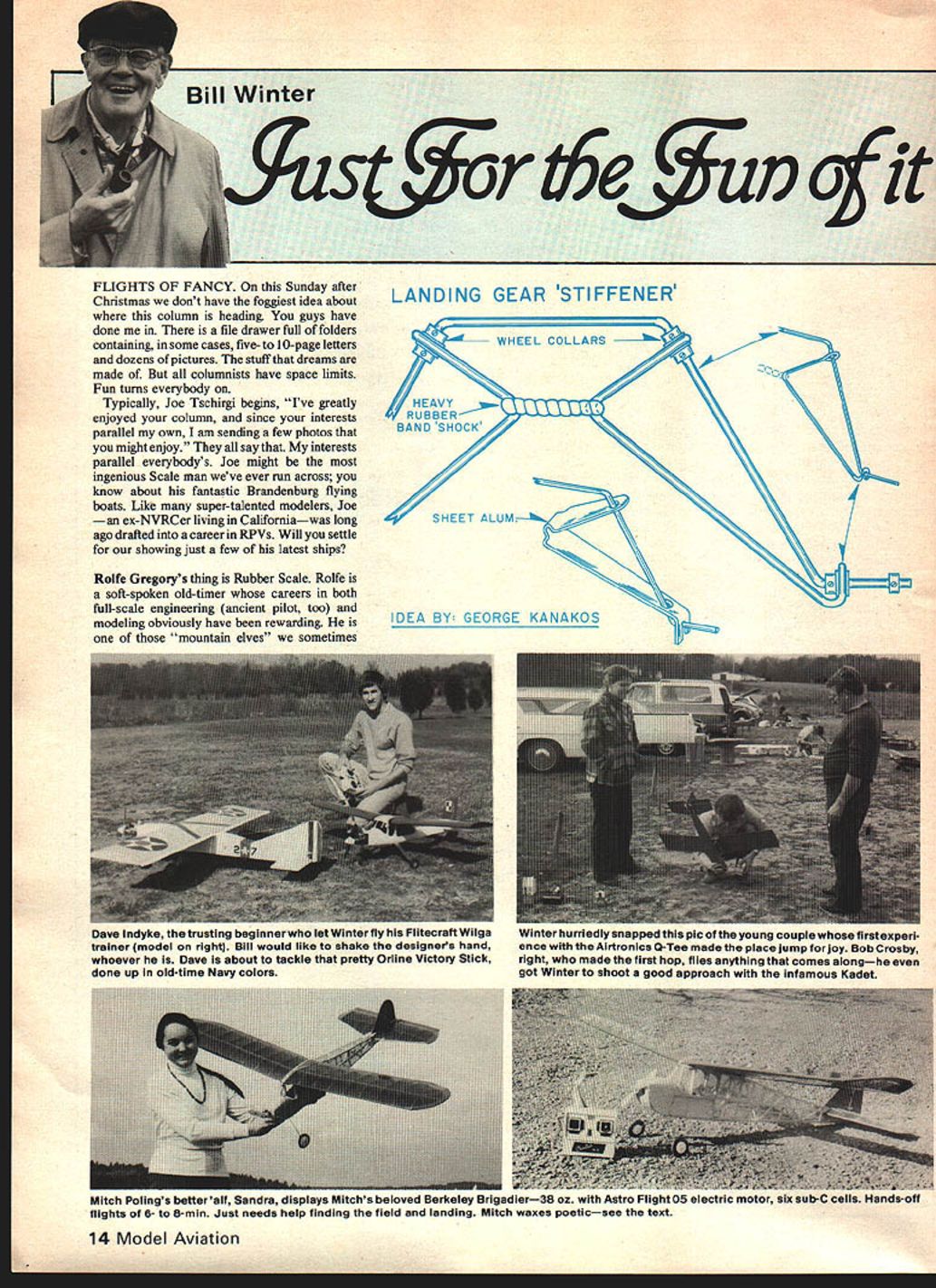
When you send landing gear wires at acute angles at the fuselage joint (we have two on each leg, each 3/16 wire) anything but a smooth landing will deform those bends. We use a 1/16 wire stretched between the axle points with a tough coil spring in the middle. This prevents damage on the worst of landings. What we all really need is a Cessna (Wittman type) forged landing gear strut. George Kanakos offers us interesting solutions.
"The wire, or the aluminum, is easily bent," says George, "and threaded as shown to the old gear and secured. The aluminum type is drilled and bolted. I use 4-40 socket bolts. The wire gear is secured with collar stops. Make sure to put in the amount of rubberband bungees before bolting and threading to the old gear." A better mousetrap, we'd say.
According to Ed Orr, the big Aristocrat had its own problem. "In 1929," he tells us, "the General Tire Co. made a goodwill tour. My uncle operated Swany Airport (Ohio). The field was grass and rough. As a boy I spent endless hours at the airport. Overhead circled three Aristocrats. One came in and landed; the landing leg folded, and it scooted to a stop. The second came in and did the same. And so did the third." George is building an Ole Reliable with an OS .25. Sure has lots of company!
Into the wild blue yonder.
"The November column was delightful," writes Mitch Poling, who is doing well with electric what we've been doing with slow-flying gas soarers. "Old Square Sides would make an ideal electric. (So said Bob Boucher, too; we are building one this year with Don Srull, who is taking on the fuselage and installation.) A geared Astro Flight setup would fly it very well, and it should weigh close to four pounds if carefully built. And it certainly would fly hands-off as you describe."
Mitch also has something similar, if not better: a Berkeley Brigadier with 480 square, a stock-wound Astro 05 for eight cells (he uses six) at all-up weight of 38 oz. It is not geared. The cells are sub-C—evidently the way to go now. Turns a 9-4 at 5,500 rpm at 14 amps draw, giving beautiful flights in the six- to eight-minute range.
"I learned to fly rudder-only (Ace RO with Schoolboy), and the love of free flight with a radio leash has never left me. My youngsters trim in a little left or right turn in the Brig, put the transmitter on the ground, and let it fly by itself, seeking and finding thermals. After it gets tired playing around up there, I pick up the transmitter and give it instructions for finding the field and the landing pattern.
"The Brig and I are old flying buddies," Mitch soars on, "and we entertain each other without interfering too much in each other's affairs. Once the radio failed, and the Brig sedately circled about until it found a spot to land, quite safely and gently. It is also quite good with kids. My nephew, Peter, learned to fly it instantly and is quite nonchalant about it all: 'Of course I fly—doesn't everybody?'
"I do lots of flying, including faster planes, but that's my favorite. Nine out of ten guys at my field fly 'bombs,' but somehow it doesn't seem quite like flight; it's an engine with a plane for an appendage. So don't let them talk you out of flying and into driving. Fly rudder and enjoy."
We do. But every time we take out our 20-year-old Airknocker (Enya .09 also 20 years old), guys keep asking how a plane can fly without elevators. Twice we've had experts of many years standing take over after the 'Knocker' was trimmed in high circling flight, and they nurse it along, nudging the elevator stick and trimming it — and it has no elevators. They found out only when they tried to flare for a landing! However, we do prefer the comfort of flippers to really adjust climb and soaring. What everyone forgets is that the power, not elevators, is the altitude control. You can skim the ground with the Airknocker, following undulating swells, just by throttling back and adding barely enough rpm to skim the tall grass. (But we still drive that Kadet, and have brand-new glasses, hopefully to see it better on long approaches.)
Get thee behind me, Satan. Life would not be the fun it is without guys like John Oldenkamp. He has a way with sticks. There's a touch of the unorthodox in his structures, versatility in the projects he chooses. Being a crack photographer he favors us with pictures of frames and crates that leave us staring into space. A proof of his spell-binding art is that little Half Korda, published when MA had barely begun. That little sheet-balsa rubber job is still one of the most popular subjects on the plans list. Even RCers must be building it. When Oldenkamp is mentioned, folks listen.
"Although much of your column is devoted to RC, an area foreign to me, I have to admit that you have me teased to do some building," John begins. "A 2.5 times Crackerbox for thermal tasks. I attended an informal B.S. session last week and got enough scoop on which rig to buy and how many channels to get. Loan papers pending!
"I just spent the last week cranking out three delightful all-sheet rubber jobs for street and small field flight. Would not trade those creative moments for a week in Yosemite. My dilemma at 50 is not which way to go, but how many, and whom to take along with me. Shame on us all for not making plans earlier to include everyone.
"That, of course, is impossible, but nevertheless, add my thanks to the rest for your excellent job of putting the excitement and charisma of modeling back within public reach."
People who never built an ROG should not throw stones. Go build a Half Korda and test your intelligence.
Quickies. Son Mike swiped my Top Flite J-3, whipped it together, and handed it to son Robert, a classy pattern pilot (average age, 35). So Rob went bananas over the slow, stately Cub. Says it snaps slowly, nose steeply down. Picture-book snaps by nosing up, then backing throttle and (as motor fades) throwing in rudder. Snaps nose-high. Amazed to find out my Piper test-pilot instructor did snaps that way with this poor student.
Bob makes wheel landings to stay within the field or slows it up for steep sink to the spot. Told him how to forward and side-slip with a Cub, and by gosh, this crate is exactly like the real thing. He managed to drop a wing once on approach, so we told him to crank up both ailerons 3/32 of an inch (from neutral). Equivalent of washout and a reflex airfoil. (Claude McCullough laid that tip on us with the Kadet.) Now it really flies.
Rob's Mach 1 and Phoenix V are biting their nails. These guys flew the Midwest Champ, which is nothing more than deBolt's basic Champ, a favorite slow-flying trainer for maybe 25 years. It is a true lightweight on a .15; they fly in gales with ballast. Raves. DeBolt rotates wing and stab angles to incorporate downthrust you don't see. That works better than ordinary downthrust — don't know why. Hal did that with his first Live Wire in about 1950.
That Air Scout by Concept — we found it fast, groovy, beautifully coordinated. Mike loves it. An Owen Kampen design, it has been taken over from Concept by Ace. The .15 takes a 7-in. diameter prop, but it flies far nicer on an 8-4. A three-channel joy if you've had stick time.
Srull is still flying our Flitecraft Cardinal. Moves out like a Kavalier on ailerons and a .35. So smooth your problems vanish, provided you have gone beyond Primary. We're fascinated by Flitecraft's boxy .29 trainer for three channels. Looks different, high cabin, stumpy. It's a somewhat-scale of the Polish Wilga. If you have soloed, you'll love this as a step up. Asked a beginner — who was doing well — if we might fly his. You find yourself fooling around on rudder by banking and unbanking as if the rudder was aileron. Would love to have one for fun flying — my speed.
Highly impressed by Airtronics Q-Tee. Until now, we've seen it flown only on TDs with huge thrust offsets, right and down, and guys zooming all over the joint fighting the wind with the crate going like a rocket-kite. So along came a beginner, a young couple. His first crate, never flown. A birthday gift from her. If it flew, he was in for a big Christmas. She was there to judge. If it didn't fly, his Christmas would not be aeronautical. One of our instructors helped put it up. Quite beautiful and a glide that went forever — two 360s over the fence! The happy couple jumped up and down, mad with delight. Things like that get to you.
Bill Winter, 4426 Altura Ct., Fairfax, VA 22030.
Transcribed from original scans by AI. Minor OCR errors may remain.

