
Just for the Fun of it
Bill Winter
Introduction
Where we live has a significant effect on the kind of models we build and the ways we enjoy them. Geographic location is a major ingredient in the modeling mix, as the following adventures remind us. The stories that follow blend traditional American ingenuity with imagination and a generous spicing of fantasy — just for the fun of it.
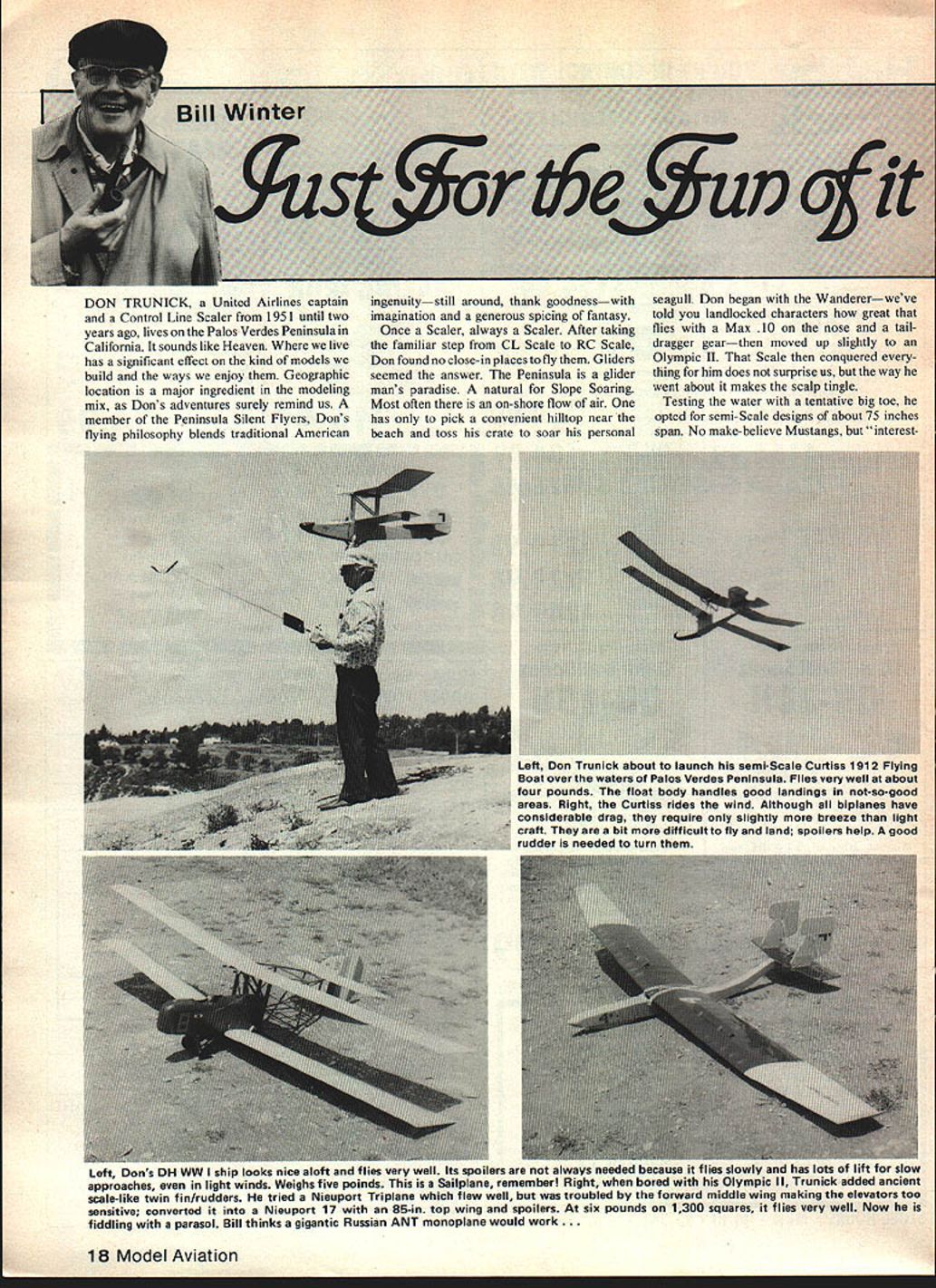
Don Trunick — Peninsula Slope Soaring
Background
Don Trunick, a United Airlines captain and a Control-Line scaler from 1951 until two years ago, lives on the Palos Verdes Peninsula in California. A member of the Peninsula Silent Flyers, Don’s flying philosophy mixes scale sensibilities with glider flying and a taste for off‑beat designs.
From CL Scale to RC Gliders
After taking the familiar step from CL scale to RC scale, Don found few nearby places to fly powered scale models. Gliders proved the answer — the Peninsula is a glider man’s paradise for slope soaring. Most often there is an onshore flow of air; pick a convenient hilltop near the beach, toss the crate and soar like a personal seagull.
Don began with the Wanderer (a fine flier with a .10 on the nose and taildragger gear) and moved up to an Olympic II. Testing the water, he opted for semi‑scale designs of about 75 inches span rather than high‑performance “make‑believe” warbirds. Finding his off‑beat crates performed well without too many adjustments, he dove headfirst into biplanes — encouraged by the fact that his 4–5 lb gliders did surprisingly well. “Biplanes look nice in the air, and I had not seen anyone do them,” Don explains.
Some of Don’s Ships
- Semi‑scale Curtiss 1912 flying boat: about 4 lb; float body handles landings in marginal areas and rides the wind well.
- Nieuport triplane (initial trial): flew well but had elevator sensitivity due to a forward middle wing.
- Nieuport 17 conversion: 85‑inch top wing, spoilers added, about 6 lb and ~1,300 sq. in.; flies very well.
- Parasol and other experiments: Don has fiddled with parasols and even mused about a gigantic Russian ANT monoplane design.
Rather than take off on another round‑the‑world flight, we’ve selected a few of Trunick’s photos — fun is where you find it.
Orange Banana — Bernard Cawley and the Showmaster
Background
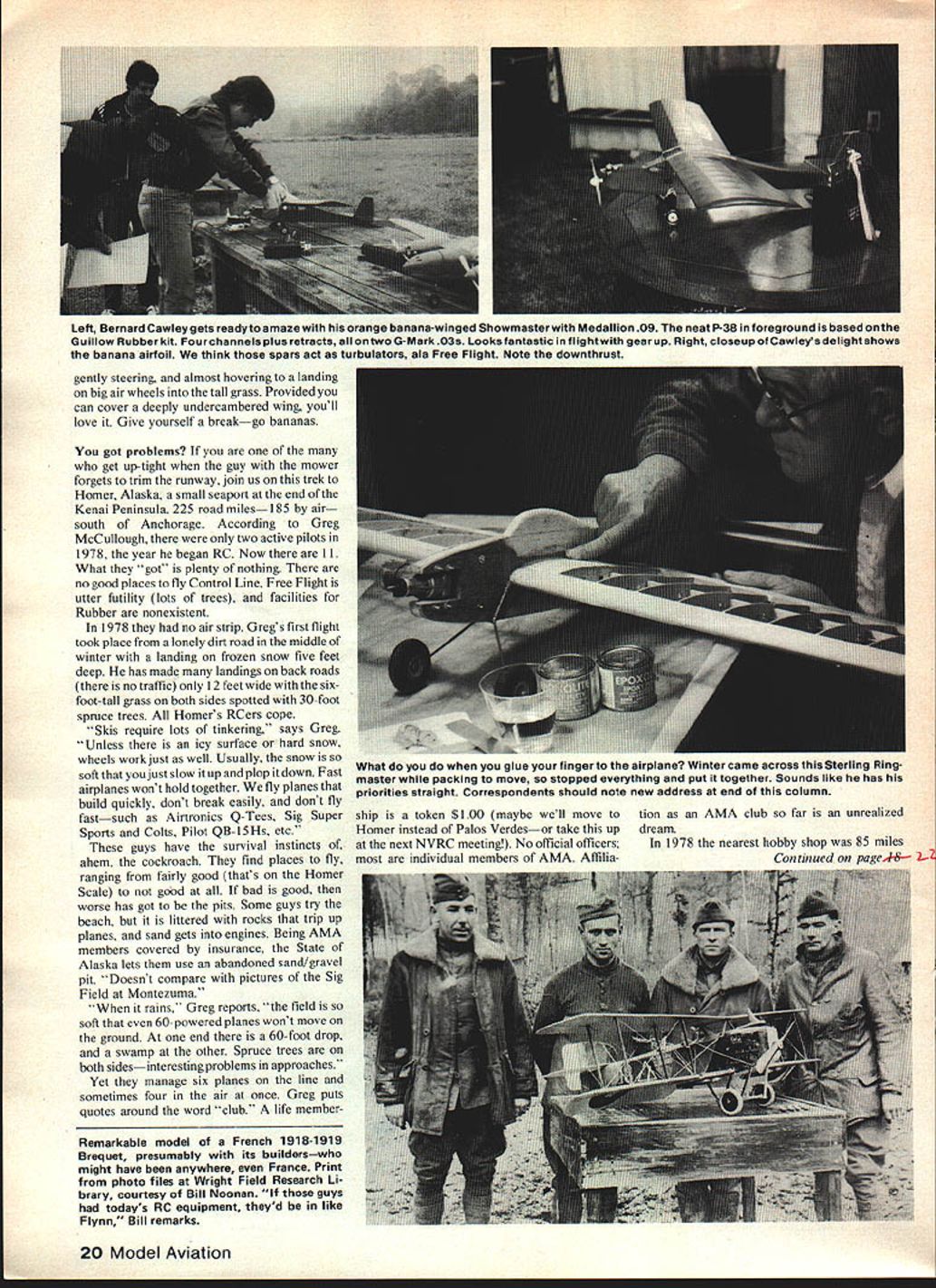
Bernard “Bernie” Cawley, treasurer of the Boeing Hawks, is a bit of a maverick, a newcomer to RC, a lover of Half‑A models and a dabbler in electrics. His first successful RC was an Airtronics Q‑Tee, which survived two tough years. Wanting something he could fly in nearby soccer fields and schoolyards and use for touch‑and‑goes, he turned to Ken Willard’s Showmaster — the “Banana Winged Masterpiece.”
Bernie’s Showmaster (modifications and specs)
Bernie modified the flapped Showmaster plans from RCM into a practical, three‑channel sport ship:
- Engine and tank: Medallion .049 with a Hiscott throttle; 1‑oz round tank.
- Radio/servos: Airtronics XL radio with Ace Micro servos on throttle.
- Power pack: Astro 250 mAh.
- Structure/gear: Redwood front spars; redwood fin/stab trailing edges; Hallco landing gear.
- Covering/finish: Orange Coverite, one coat of Glaskote.
- Weight: ~20½ oz.
- Prop/engine performance: Hiscott throttle/muffler turns a 6x4 at ~15,000 rpm; idle below 4,000 rpm and very reliable.
Flying impressions and contest performance
“The combination is magic,” Bernie reports. The little engine is quiet and flexible; in the air, other engines (except OS 4‑strokes) are easily drowned out. The Showmaster is maneuverable and responsive yet forgiving — it taught Bernie how to land and do touch‑and‑goes. He can fly tight low circles of about 20 ft radius (almost like control line) and manage the plane even on windy days.
At the Seattle Radio Aeromodellers Annual I/A Contest Bernie’s Showmaster taxied out, took off, flew, landed and taxied back — unusual for a .049 ship. The banana wing took third in both Novice Pattern and the Fun Fly against aileron/elevator ships. Bernie plans variations: a flat‑winged version with ailerons and a clipped wing (about 36 in.) for windy days.
Bernie adds a useful training observation: learning on two channels can teach pilots not to panic on dead‑stick landings — a valuable confidence builder.
Homer, Alaska — Flying in the Bush
Background and conditions
Homer, a small seaport at the end of the Kenai Peninsula (225 road miles south of Anchorage), presents daunting flying conditions. According to Greg McCullough, there were only two active RC pilots when he began in 1978; now there are 11. They have no good places for Control Line, Free Flight is almost impossible because of trees, and Rubber‑powered events are impractical.
Greg’s first flight was from a lonely dirt road in winter with a landing on snow five feet deep. Pilots often land on back roads only 12 feet wide, flanked by six‑foot grass and 30‑ft spruce trees. Skis require a lot of tinkering; unless there is hard snow or ice, wheels usually work because the snow is so soft you can just slow down and plop down.
What flies in Homer
They favor planes that are easy to build, durable and not fast:
- Airtronics Q‑Tees
- Sig Super Sports and Colts
- Pilot QB‑15Hs
Beaches are poor choices — rocks damage planes and sand fouls engines. The State of Alaska allows them to use an abandoned sand/gravel pit (insurance and AMA membership help), though the field has serious drawbacks: a soft surface when it rains, a 60‑ft drop at one end, swamp at the other, and spruce trees lining approaches. Despite this, they sometimes put six planes on the line and fly four in the air at once.
Organization and resources
Greg’s “club” is informal: no official officers, life membership is a token $1, and AMA affiliation is an unrealized goal. In 1978 the nearest hobby shop was 85 miles away (Anchorage); Homer now has its own shop, plus a few others within the region. With few local fliers to watch, Homer pilots devour magazines to see what others are doing — AMA and Model Aviation provide companionship and ideas.
Greg’s perspective
Greg believes a beginner can start with almost any sport plane depending on available experienced help and the quality of the airstrip. He built several models before finding one that fit his abilities and conditions — a Q‑Tee set up for three channels. His path was fly, crash, rebuild and learn.
His closing sentiment is one of pride rather than complaint: pride in a hobby that transcends obstacles and a love for aviation. He urges others to spread the hobby and support organizations like AMA. Facta non verba.
To be or not to be — RC‑Assist and Free Flight
The debate
Competition Free Flighters often object to labeling models that carry radios as “Free Flight,” even when the radio is used sparingly as an assist. The editor has supported RC‑Assist as a pleasant and useful approach, but the definition remains contentious.
After publishing pictures of Dick Sarpolus’ Hungry Eagle — a high‑performance model launched as a free flier and retrieved with RC — Joe Ed Pederson wrote to object to calling it an FF. Joe acknowledges the utility of RC‑Assist but restates the “pure” Free Flighter’s viewpoint well:
“Even if you don’t touch the transmitter for 15 minutes at a time, you still have an RC model, and you still are an RC pilot by virtue of the fact that, at any point in that flight, you have the potential to control the model. The essence of FF is the risk, the challenge and the enforced discipline of one shot at catching a thermal. Your radio, whether or not you use it, changes that essence.”
Closing thought
The controversy boils down to definitions and the spirit of the event: is the potential for control enough to reclassify a model, or does minimal use of radio preserve the Free Flight experience? Reasonable people differ; the important thing is enthusiasm for flying and respect for the various traditions that make the hobby rich.
Transcribed from original scans by AI. Minor OCR errors may remain.

