
Bill Winter
Just For the Fun of it
May I cry on your shoulder? We've just moved. Only a few blocks, but it can be described in one word: trauma. The first thing a self-respecting modeler looks at is the shop space, right? Mine is a step up, roomy, bright, just the right places for benches and shelves. But it is piled high with boxes of all shapes and sizes. The Great Pyramid. Oh, God, how I'd just like to go fly. Maybe camp out all year and forget the workaday world. And there's a patient book editor—two in fact—who threaten to juice up the cattle prod: "You're goin' to slip a year, fella!" The kids are all long gone, but I have more children than ever. Made of wood. Not having much time to build; I don't know where they came from, so how come this population explosion of battered airplanes?
Once before (17 years ago) I solved that problem by giving away my crazy jobbies to anyone who would have them, stomped on the rest, and went 12 years without building anything. Not this time—never again! Flyline Models, a couple of towns away, agreed to store them. That took two station wagons. The tattered flying circus filled the loft. As awesome as dinnertime at Waterloo.
As I engage in what is jokingly called writing—you are reading it—there's a fat cat slumbering on my desk, on top of the For Fun file. So, between sentences, I console myself by hanging pictures in the "office." The direct approach. A cheer-me-up gift from Hank Clark, a lovely framed red-and-yellow Waco in acrylics, just above the bulletin board (which already looks as if a mob of kids were trying to pin the tail on the donkey). Over there a Frank Tinsley original in oils of a flight of Hawker Furies—a genuine Air Trails cover from 1935. Behind me an Alfred Owles watercolor original of a diving P-51 against a somber sky, a trailing arc of fire behind it as some twin streaks earthward, yellowish streaks yammering from four wing cannons aimed into the hall. All sorts of sentimental junk, framed displays of fabric from the restoration of the Wright Flyer and a Bleriot XI. Several original stock certificates from the Wright Company. Amidst this reassuring air show, a Preston blow-up of the big Aristocrat taking off hangs next to an autographed picture of General Sherman.
And all those crates I said I wanted to build—what of them? The four-electric-motor Connie? Heck, I can't fly that safely from our little field. Face it, my Kadet approaches never got ironed out—this spring's number one task. The 8-ft. Korda? Grit the teeth. The Old Square Sides (my first gassie in 1936–37)? Who can write off a sentimental ego trip? The 1/4-scale Vagabond, needing radio covering. Finish things begun. Must, must, must. The nuttiest common sense rears its ugly head: another month, the crates in storage will picket the joint. I don't fly. Building is such fun. Or is it?
What's under that cat? Joe Ott—sorry Joe. Now, if I am "retired," Joe is super-retired. He runs a corporation with 300 employees, and sometimes calls late at night or on a weekend when the office is quiet. This 83-year-old enthusiast is about to introduce a trainer RC with all sorts of novel tricks. We have a rough plan—so interesting we don't know quite what to make of it. It should fly like a bird—that we can see. And a new radio system to go with it. Just to show you how different old foxes like Ott and Charlie Grant can be, the transmitter has a see-through panel displaying all control positions. On a rainy day you might sit for hours playing with that.
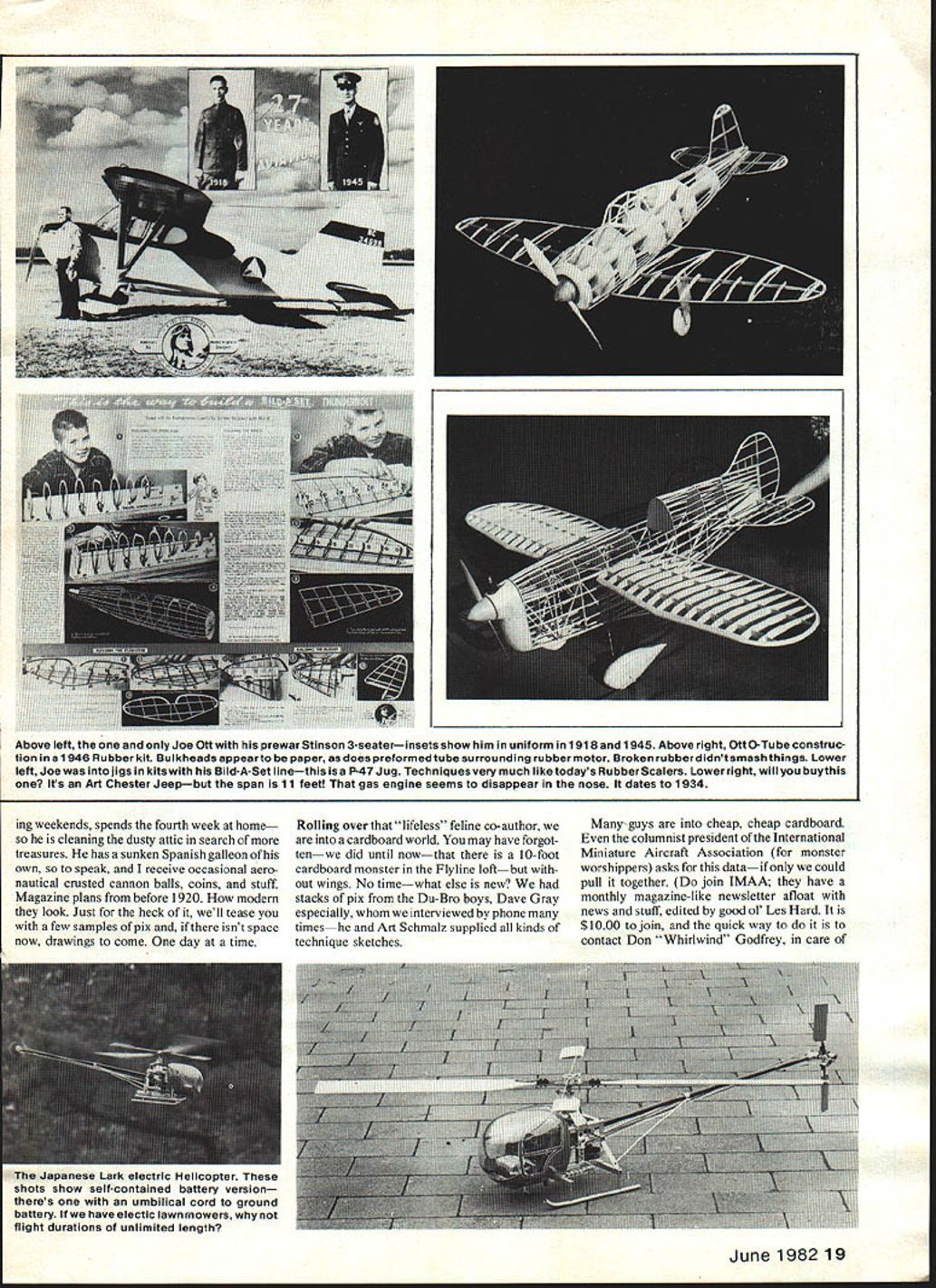
All you guys who wrote about that ancient rubber SE-5 of Joe's, which we showed as a 3-view some months back, will be tickled to know that Joe has supplied piles of plans, catalogs and pictures—and we hope to get it organized for the AMA museum to be part of the new headquarters building. Joe slaves three weeks a month, including weekends, spends the fourth week at home—so he is cleaning the dusty attic in search of more treasures. He has a sunken Spanish galleon of his own, so to speak, and I receive occasional aeronautical-crusted cannonballs, coins, and stuff. Magazine plans from before 1920. How modern they look. Just for the heck of it, we'll tease you with a few samples of pix and, if there isn't space now, drawings to come. One day at a time.
Cardboard models
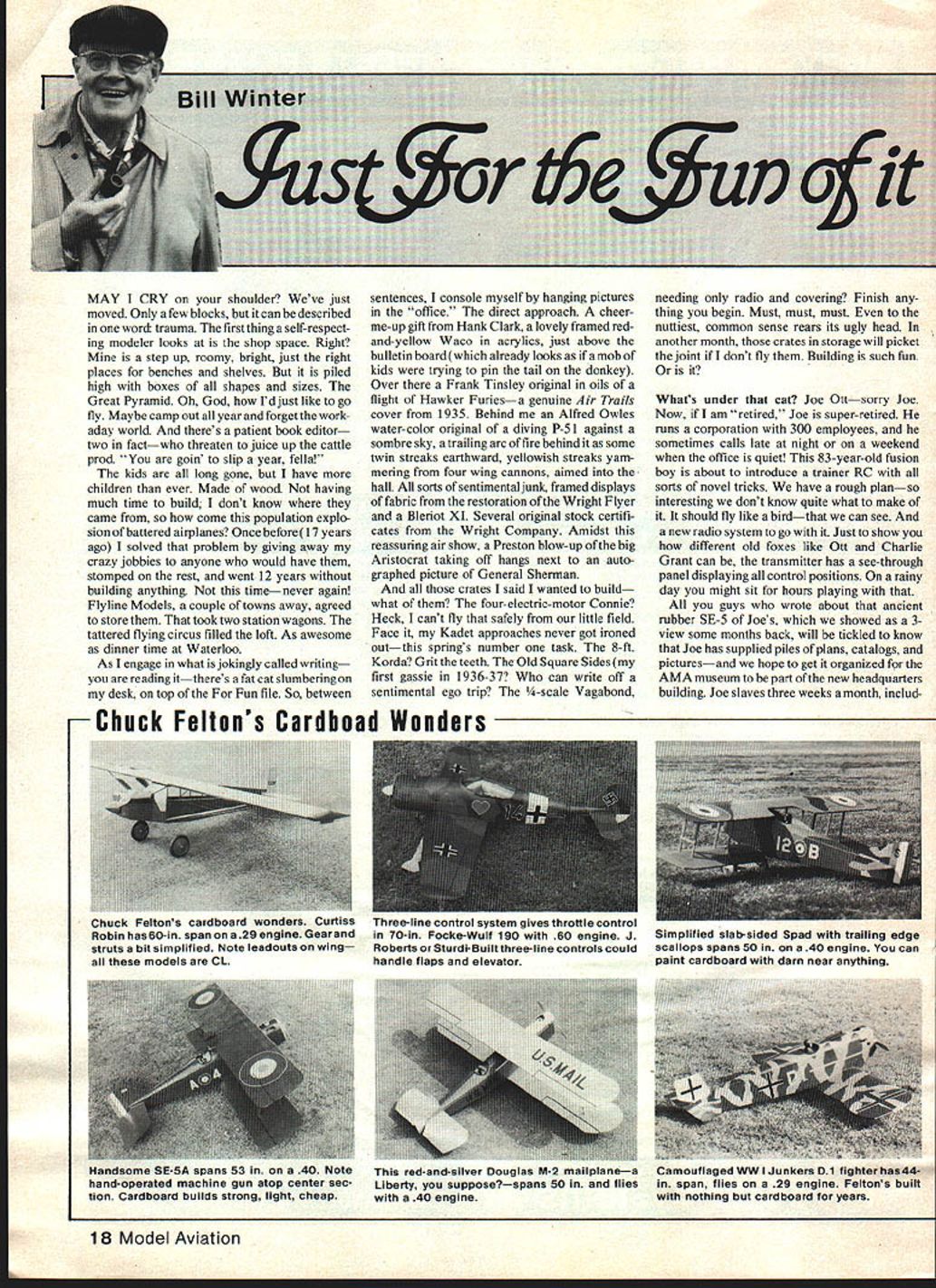
Rolling over that "lifeless" feline co-author, we are into a cardboard world. You may have forgotten—we did until now—that there is a 10-foot cardboard monster in the Flyline loft—but without wings. No time—what else is new? We had stacks of pix from the Du-Bro boys, Dave Gray especially, whom we interviewed by phone many times—and Art Schmalz supplied all kinds of technique sketches.
Many guys are into cheap, cheap cardboard. Even the columnist president of the International Miniature Aircraft Association (for monster worshippers) asks for this data—if only we could pull it together. Do join IMAA; they have a monthly newsletter-like magazine afloat with news and stuff, edited by good ol' Les Hard. It is $10.00 to join, and the quick way to do it is to contact Don "Whirlwind" Godfrey.
I became interested in cardboard about five years ago. A friend at Douglas was flying his R/C cardboard originals at that time. I had to try my hand at one. It got me hooked, and I have built nothing but cardboard since then.
"I realize cardboard is not really new. However, previous designs have not really taken advantage of cardboard's unique properties to create good-looking models that appeal to the average builder. Mr. Reese's Mighty Mite is an example of a fine-looking craft in which any modeler could take pride. I would guess that not one of you readers could tell from the photos that it was constructed from cardboard.
"Cardboard doesn't have the glamor image of balsa, foam or fiberglass," Chuck laments, "but its advantages are numerous. It is light, strong, and resists damage. Cuts easily without cracking or splitting, and large sections can be formed in a continuous piece, reducing building time. Best of all, it is low cost. It can be found almost for free at any shopping center in the form of discarded boxes. I buy it commercially (we recommend you do that), but not one of my models uses more than $5.00 worth of cardboard.
"The intent of my articles was to introduce modelers to a new and (to me) exciting aspect of the hobby. I don't know if my construction articles generated interest—very little feedback. I enclose photos of my designs, all made from 1/8-in. corrugated cardboard."
Right off, as an old editor, we say that no contributor should be discouraged by lack of feedback. People write only when some guy goofs or when they disagree. Usually, no one writes, but when you travel and fly, you see magazine projects galore. People build them—no need to worry. We do note that Chuck's earlier ships had diamond-top airfoils—that works great (even the famous Riley Wooten flew such airfoils in Combat). Chuck's later ships show a series of flats forward of the main spar, almost imperceptible, and some are so close to a "normal" foil you hardly can see the difference.
Dave Gray carried this to the ultimate. His sparless wings are uniformly cambered. For a space of about two inches around the leading edge, you peel back the paper lining (inside of wing) and fold it over so it can be put back in place during assembly. The corrugations exposed are scored by using a stop on your knife to prevent penetration through the other side. The spanwise slits are between corrugations at the extreme edge, graduating to every other corrugation at the severe curve, and are spaced progressively farther apart (up to 2 in.) going back on the chord. Put down the flat bottom, stick on ribs, fold flap back in place as you wrap the single wide piece around, and back to the T.E. Dave uses nothing but Weldwood contact cement. He allows the paper edge on the cardboard to extend beyond the corrugations so it can be wrapped around edges and things like fuselage corners, and stuck down with contact cement or white glue. Or, if cardboard is simply butted, use common paper wrapping tape, wetted to stick. It is a snap, truly. The firewall is ply. Add a landing gear channel block and, if you wish, a balsa (or spruce) strip butted to a single-surface stab and fin, etc., for strength; maybe balsa to seal the tail surface edges, which can then be rounded. (Dave, a purist, uses no such wood, other than a 1/32 ply doubler where dowel tubes and struts attach.) The stab is braced to the fuselage and fin by two cabled wires and turnbuckles, top and bottom, and to the sides of the fin. Finish can be almost anything, including ordinary enamel. Don't store in hot or humid places with wires left tight—as from wing pylon (Moraine style) to wing panels. Material expansion once curled up one of Dave's crates when it was left in a barn overnight. Just loosen a few turnbuckles.
We promise to do a column a few months down the line on this subject. Plenty of pix, too. Good folks have gone to great lengths to provide data, so we owe you and them.
Transmitter trays
Why Americans are so reluctant to use transmitter trays we don't understand. Well, maybe we do. Anyway, they are de rigueur in Europe, and one supposes they may make for precision flying with the transmitter always properly aligned so you don't get cockeyed stick movements—and they are easy on the arms. Of course, we do have straps which come with many good sets, but the writer has seldom seen them used. (In five years of local flying, we just saw our first Cuban Eight. Why is that? Twenty years ago everyone practiced such eights. It was regarded as the supreme way to acquire coordination—and they are fun to do, even if you fall off the sky.)
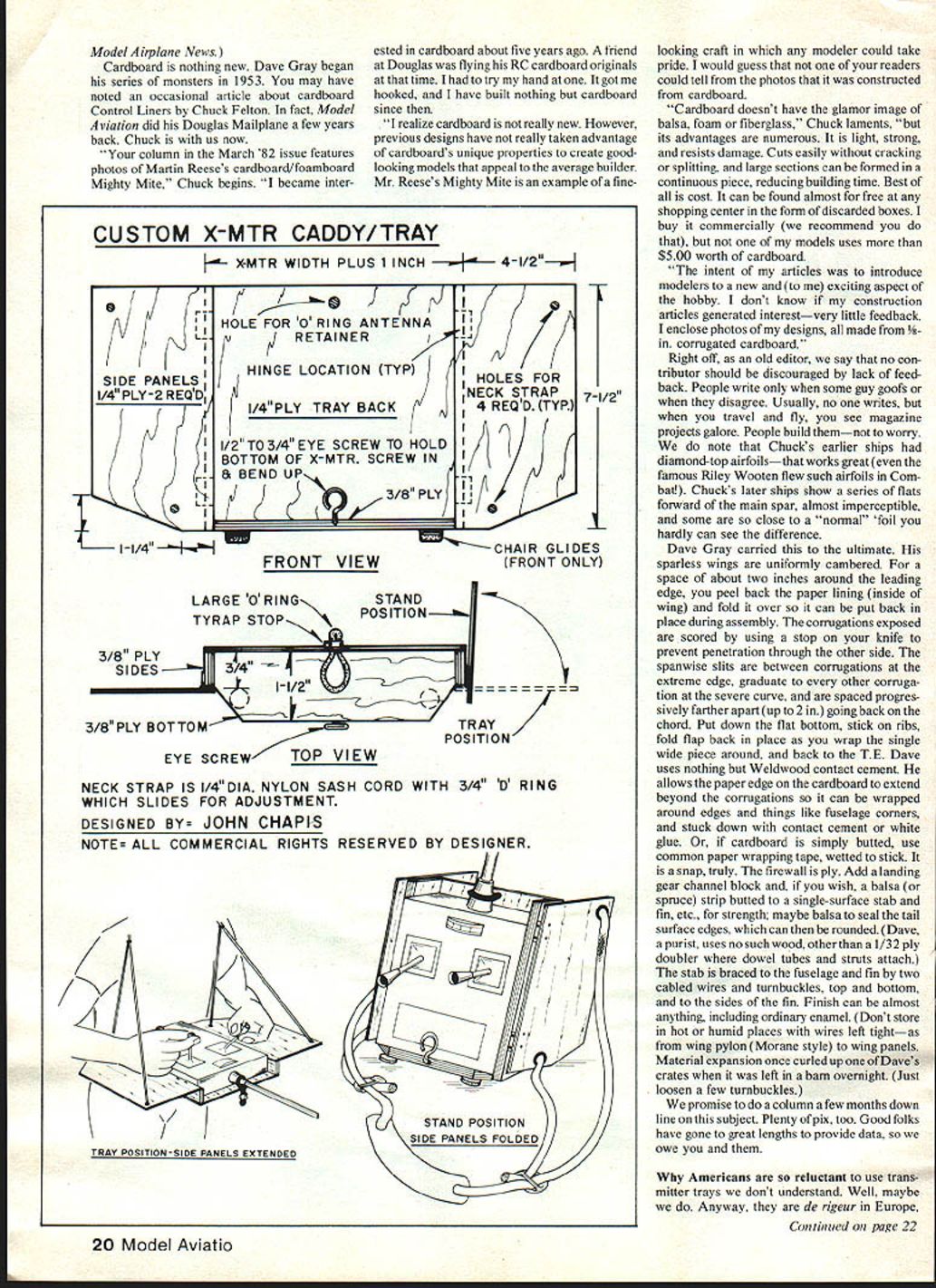
Says John G. Chapis (we just tossed out the danged cat): "I notice that more and more fliers are looking into using transmitter trays. Although most are just looking, a few have only copied trays already in use. Knowing there had to be a better way, I came up with a transmitter/caddy tray. I enclose drawings. The big plus is that the unit is not a flat board with a recess to mount the transmitters. The side panels fold back to act as a stand while not in use as a tray. This helps greatly to prevent someone from tripping over your antenna when starting your engine or when just waiting to fly.
"It doesn't take long to get used to, believe me. I can't imagine flying without it. As a matter of fact, I've been handed a transmitter or two since I started using my caddy/tray, and I had problems without it to depend on for stability. I was all thumbs and just didn't feel as secure without it."
Why don't I use a tray? Or even the straps? One feels like a kid being dared to jump off a high limb, should he try a tray. Macho in a way. A circus high flier who disdains nets. Maybe I don't want to be the first on my block? How about you?
Kordaplane and Korda stories
We envy John Oldenkamp, an ex-editor of the Free Flight Digest. He has more fun than we do. Listen. "Your Kordaplane RC assist sounds lovely, but at 900 squares it might truly be majestic on a weak .15 or a strong .10. Rubber-powered? Certain! Giant Scale Gumband has got to be coming soon. Here's what we do to stage a great media event. First, we get Don Snell (my neighbor years back) or someone like him to erect the control frame for our 8-ft Korda, 1/20 ribs, 11.19-in. root chord, 1/4-sq. longeron. All-up 24–38 oz. Big prop. 1:3 P/D ratio. We get George Perryman and Bob White and a Chevy 4x4 to hold, while Mean Joe Greene winds the mutch, you and Korda launch. I light the fuse and take pix. We get Howard Cosell to . . ."
"You must remember that I live in the land of the die-hard. If we are too busy or cannot afford the gas and grub to make a weekend at Taft (the last remaining regional venue—precious 240 miles away), we do nothing. There are no fun-flys for the likes of us. I suspect we will have to opt for FF RC assist, indoor, whatever. Purity has been, and will be, the downfall of the West Coast FFer. If we can't do five minutes unassisted, we usually pack it in, or don't show up. Our club site is a truly miserable place—tricky and turbulent, filled with tissue-eating eddies, and rattlesnakes, and not fit for anything over two minutes, but it would be a terrific RC site. (Not with those snakes, it won't.)
"Back to the Kordaplane. Had a dream about that one last night, of all things." (Stay away from those swinging doors, guys—and the cat is back.) "Thing is, I have, right over the bed, a brand new once-flown Korda Victory, all snazzy orange and black, like the plans from Golden Age, so I guess it grew as I was dozing off. Korda eight-footer, therefore, last seen about dawn, heading southwest over Maricopa, eight miles from Taft. We do live in a special world, do we not?"
For Fun/Winter
Continued from page 22
Speaking of fun, about 18 months ago, engineer-type Associate Editor Ross McMullen heckled us to write up the Sky-Lark EH-1, a Japanese RC helicopter. It is electric powered, and connected by an umbilical cord to a battery source on the ground. Don't laugh. It has advantages—the manufacturer ran full pages in a Japanese magazine (so thick that more ad pages appear in front of the contents page—some 500 pages total—than there are pages in all but one American magazine). Bloodhound Ross chased down details. We note with pleasure that the reply was addressed to Mr. McMullen. Let's just quote:
"The Sky-Lark EH-1, the world's first Electric Helicopter, has been well accepted by modelers because of stability and potential performance. You can easily practice flying in your yard or garage without disturbing neighbors by using power cord (optional). One point of advice: The Sky-Lark draws max 20–30 amps during flight. Use 12V 35–40 Ah capacity (found in Corolla-class cars) for power cord flight, or quick-charging flight pack. 12V batteries for engine starter (he means typical electrical starter) cannot be used for these purposes.
"To charge Ni-Cd pack, first discharge cells until rotor comes to complete stop."
Some red-ink scribbles reveal that Ross calculated flight duration. At 1.2 amp-hours, 25 amps per flight, it comes out to 2.9 minutes—let's say three. At that rate you get about three minutes of flight—much less than one would like for a proper "For Fun" session.
The power cord is special silicone, seven meters long. All this is in meters, so it's time to learn the metric system like they want you to. Length is 846 mm, rotor diameter 992 mm. With 9.6V, 1200 mAh flight pack, Mabuchi RS540A x 2, gross is 1.55 kg, empty 1.2 kg. Price of the semi-kit was, at the time, 38,000 yen—not bucks, for Heaven's sake. (Marketed by K. K. Shimasa, #2-1 Honmachi, Shibuya-ku, Tokyo, Japan 151.)
Off into the sunset. From Ron Moulton, MAP, England: "Glad that piece about Dr. F. B. Thomas and his 1925 round-the-pole flying was of interest. FBT sent me a 16mm movie which must have been taken around 1927 which shows the whole works in action with outside-the-circle joystick and throttle, landings, takeoffs, and prangs.
"F. B. Thomas was flying Control Line in this country in 1925. To be technical, they were Round the Pole, rather than U-Control, but even so Thomas was flying on the handle and had ideas for the use of a bellcrank pre-1939. The ingenious bit is that very early models were remotely powered with a large engine at the pylon base, driving a wire torque rod out of the model via bevel gears, using a bicycle front-wheel fork to carry the mechanism."
For Fun recalls a guy named Broderick in California who, in 1909, flew a big steam-powered crate on a length of clothesline. It flew into the barn and everything went up (down?) in smoke. Gosh, those ancients really had fun.
Bill Winter, 4426 Altura Ct., Fairfax, VA 22030
Transcribed from original scans by AI. Minor OCR errors may remain.

