
Just For the Fun of it
Bill Winter
Don't ask us to make sense. If this be retirement, we'd better go back to work—for a rest. Sunburned, stiff as a board from all the hand‑launching. You'd have to be nuts to run with some heavy clunker with a sick engine, but if it is only a few steps and a push, what the heck.
You'd be surprised how much flying goes on during the week. People seduce us away from typewriter, drafting board and workbench. And we entice so many salaried guys to cheat off an afternoon that certain nearby employers probably will sue us for wrecking their production schedules. The designers, experimenters, and gung‑ho guys come out with strange contraptions—when the crowd is not there.
There's a third world of suppliers who have wholesale pipelines, and guys who operate services. You can find anything, or get anything done by cheerful folks always glad to help out. There's a quantum jump in your learning curve. Bill Hershberger devotes his weekdays to quiet test sessions of future Ace equipment, and he is really into servo research. Since most of our problems revolve around servos which make mysterious humming noises, we always need to know when a servo is not safe to fly. So we cajole him.
The thing that will get you, if nothing else does, is a servo. Depend on that, if you fly a lot. Anyway, Bill makes his distance checks in the air, flying a six‑foot ship out of sight; at that point he pulls up to see the planform, then heads it back, momentarily out of sight. (Don't you try that!)
We stumbled over a nearby Ace service center, of all things, operated by Clarence Ehlich—the guy whose monster Ugly Stik we keep hearing about. He had finally crashed it due to nulls caused by cables and flying wires, and from both Clarence and Bill we hear talk of going back to the old‑fashioned vertical whips—which we, too, have wondered about. When you point a transmitter antenna at a receiver antenna that runs along the bottom of the ship, say, as it flies directly away or toward you, you ain't got much, especially when big utility wires and cables abound.
Hershberger doesn't like to scare anyone, so he keeps mum. But we learned that it is impossible to make a flight without at least one null—it cannot be avoided—and frequently there are many that a fast ship flies through. Some systems have far more resistance to nulls than others, so a servo can be driven over, and if the ship is fast, you whip it out of a spiral turn only to fly through the same null again and again until it is kaput.
The very next day after this discussion the unbelievable happened to our eight‑foot powered soarer. A slow ship in a null is something else. It may not fly through it before wild gyrations start. We fought this thing for 1,500 feet and finally managed to land out of sight behind a slope—undamaged. Various frequencies are vulnerable in different areas—our green‑and‑white is bad at this field. But other guys glitched in the same location—for us it was always on the far‑out downwind leg just prior to turning onto the crosswind leg. There were tall lights at a nearby field, long cyclone fences, a lot of parked cars, and even motorcycles. Hershberger made a complete check of our electronics—OK. It was assumed we had flown too close to some C.B. in the crowd, or that motorcycle ignition had got us—it is a menace. Beware of crowds and parked cars.
We've seen, and flown, some surprising airplanes. And we've encountered floods of beginners—12 one Sunday at a nearby club spot. Don't hold your breath for anyone to solve the beginner problem. The crucial thing is whether the beginner has any help, how good it is, and how willing he is to accept it. Many won't. (The more advanced his "trainer," the more and better help the beginner must have.) How independent the human spirit! For most beginners, it is survival of the fittest. Communication is imperative, so there are thousands of "lost sheep" we rarely see.
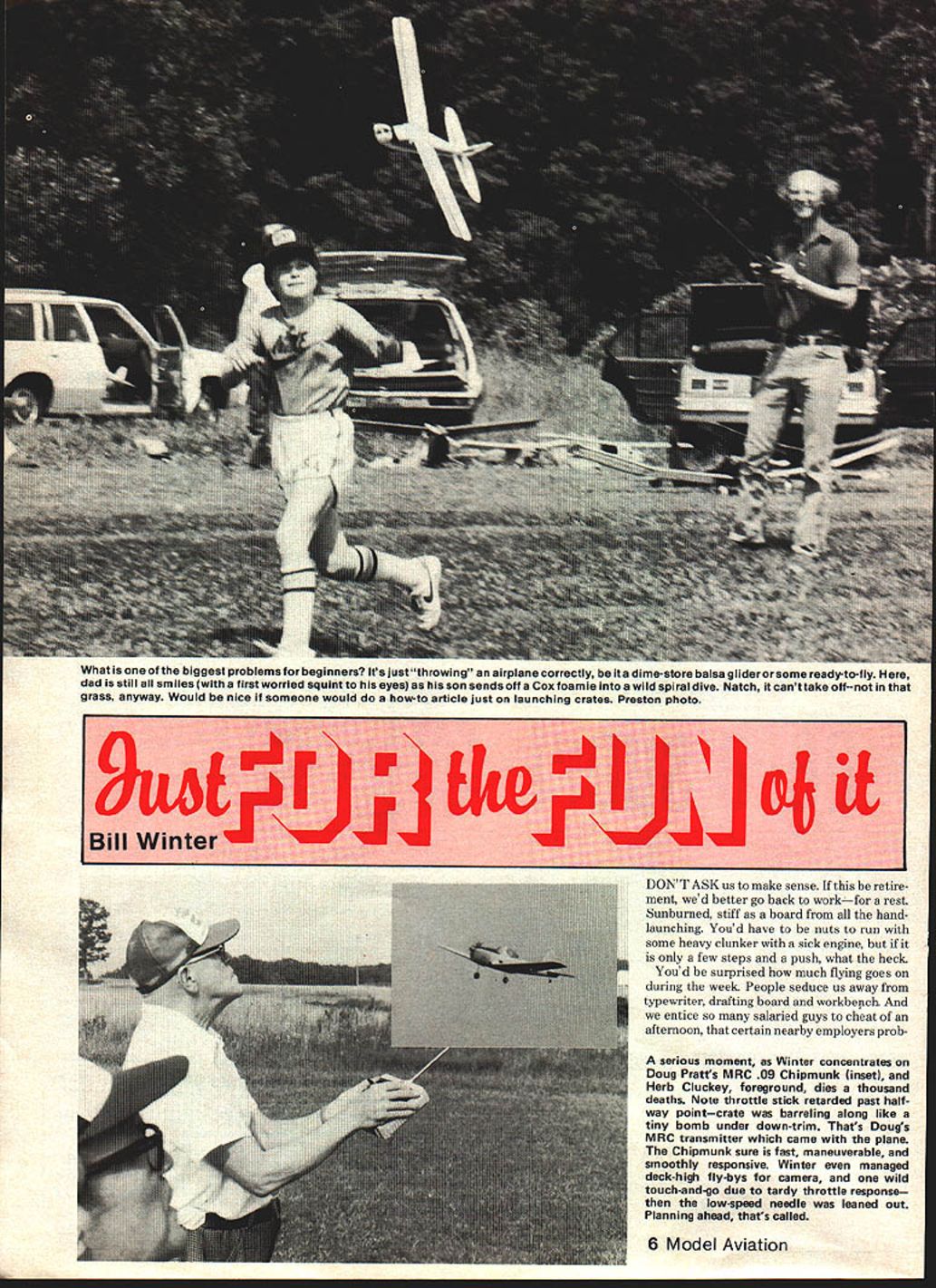
Never mind control in the air. Give any kid a hand‑launched glider and he cannot even throw it properly—he must be shown. We watched three chaps with a sailplane: two waited at the foot of a slope while the third hand‑launched it—absolutely straight up. Did they learn? Of course not. After three such launches the ship was no more. Not a single glide! But there is the other extreme.
Doug Pratt and the Chipmunk
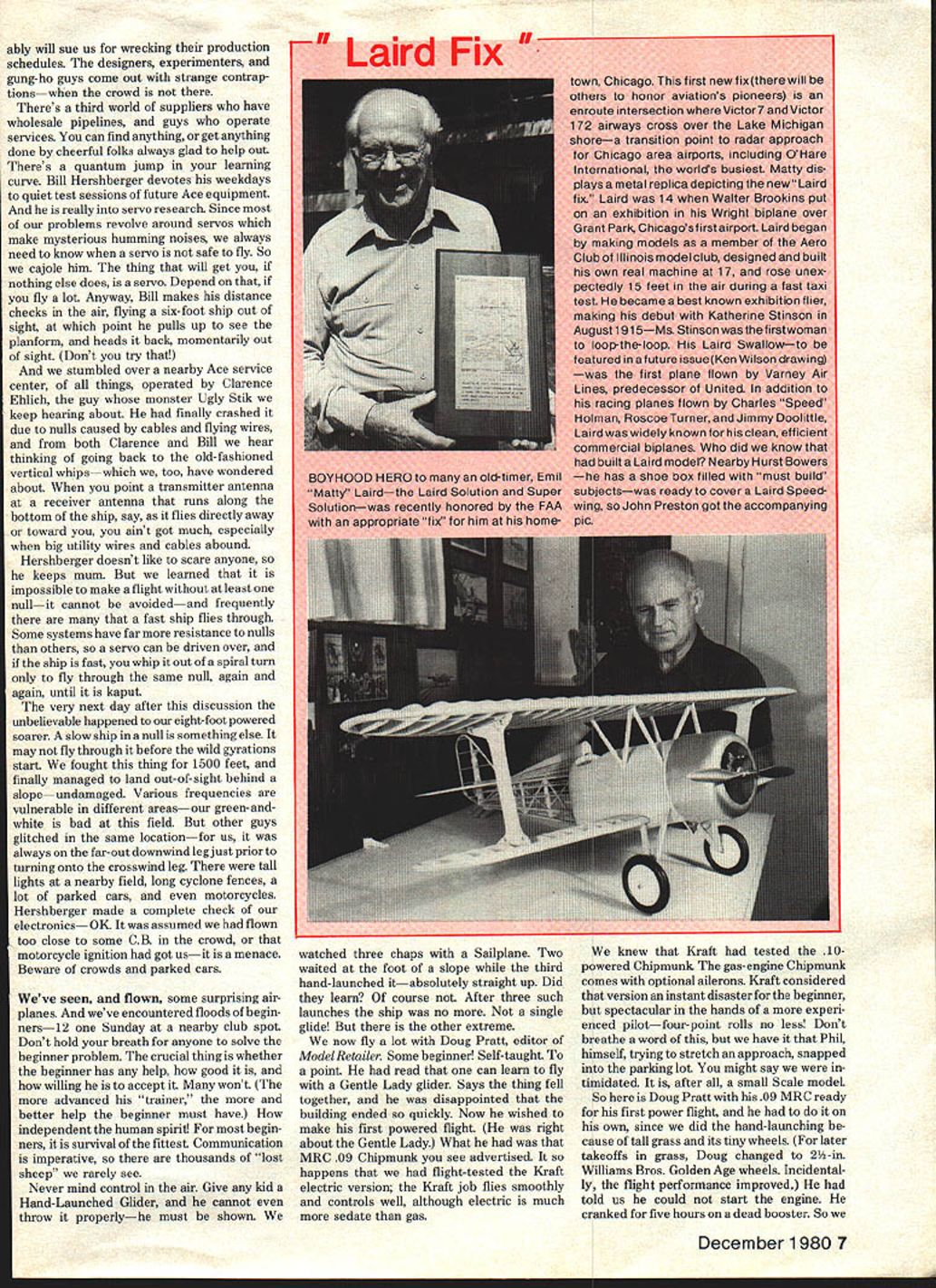
We now fly a lot with Doug Pratt, editor of Model Retailer. Some beginner? Self‑taught—to a point. He had read that one can learn to fly with a Gentle Lady glider. He said the thing fell together, and he was disappointed that the building ended so quickly. Now he wished to make his first powered flight. (He was right about the Gentle Lady.) What he had was that MRC .09 Chipmunk you see advertised. It so happens that we had flight‑tested the Kraft electric version; the Kraft job flies smoothly and controls well, although electric is much more sedate than gas.
We knew that Kraft had tested the .10‑powered Chipmunk. The gas‑engine Chipmunk comes with optional ailerons. Kraft considered that version an instant disaster for the beginner, but spectacular in the hands of a more experienced pilot—four‑point rolls no less! Don't breathe a word of this, but we have it that Phil himself, trying to stretch an approach, snapped into the parking lot. You might say we were intimidated. It is, after all, a small scale model.
So here is Doug Pratt with his .09 MRC ready for his first power flight, and he had to do it on his own, since we did the hand‑launching because of tall grass and its tiny wheels. (For later takeoffs in grass, Doug changed to 2‑1/2 in. Williams Bros. Golden Age wheels. Incidentally, the flight performance improved.) He had told us he could not start the engine. He cranked for five hours on a dead booster. So we said, if you can't start an engine in five minutes, you ain't never going to start it. We put the Sullivan starter to it (yeah, we gave up hand‑flipping after all these years!) with our glow driver, and off it went.
It would run well, but the instant the tank ran dry it would stop with a thunk, and we'd wait for it to cool off. Low‑to‑high response was sluggish, so we leaned the low‑speed adjustment—another of many beginner problems. (If it had cut abruptly, it would have been running too lean.)
To your columnist, it does not matter that the engine is tight. Just break it in in the air, running a bit rich, and simply steer around. After three flying sessions, Doug's .09 Enya became quite easy to start—for him. If you have patience breaking in a troublesome engine, it will last for years. (We aren't talking of ringed engines, some of which seat in a single run, but you should not run them ragged immediately, anyway.) So here, again, a beginner needs help. Gas engines have balked newcomers since the beginning of time, and even a "good" engine is a relative matter in that some are just easier to handle than others, but none are simple for the neophyte.
The importer had told us that about one in 20 of these hand‑lapped engines runs very tight when heated up. (Beginners should, in general, find out about low‑nitro fuels, cool plugs, spray‑bar plugs, long and short plugs—a piston in some engines strikes a long‑reach plug.) We launched a bit rich, and within 10 feet we felt Doug's tiny application of up elevator. Holy cow! Then he was barreling around the sky—high up, far out, back and forth—screaming long downward turns—with good recovery—that made one imagine a Mustang over France. Left and right, going and coming, didn't trouble him. On his third flight he was going apace. He accepts our occasional quiet comment (we think!) on throttling and trim, and when to go gently on the stick. Then he asks us to make a flyby or two for his camera.
He had us cornered. What do you do when a "student" can snap‑roll on his third flight? It had been many years since we flew anything fast and hot, and never anything this small. We'd try. It was easy! That Chipmunk is smooth, responsive, beautiful on the controls—even though it goes like a bat out of you‑know‑where on down trim. We were used to old‑timers and slow stuff—a long‑time plane watcher. This thing put us back in the cockpit—a pilot's airplane. You guard against slowing up too much, and you must avoid horsing the controls—which can snap it. This is definitely not a trainer. Soon, we were coming by, slightly diving at the camera, once getting a thrilling high‑speed touch‑and‑go—throttle at slow. The plane took over. This was flying again. (P.S. We went right back to enjoying slow stuff.)
Doug? He must be a natural‑born pilot. But the slow Gentle Lady had got the right‑left confusion out of his system—and that had been easy because he fools around with an electric Volkswagen Bug. All in all, the Canadian‑built Chipmunk must be a magnificent airplane. No wonder we see so many at air shows.
The Evolution and good design
Equally impressive, in an entirely different way, was an Evolution, once manufactured by Dumas, we believe. As you may remember, it came with detachable outer panels if you liked high lift; with panels in place it is a subtly blended power/glider with the emphasis tilted toward the power side. You will find a picture of Paul Sprongeren with his Evolution in the long‑wing configuration. It possesses the finest combination of power and gliding performance I've ever seen, with surprising capability in a high wind. It tracks beautifully, with smooth coordinated turns and banks, and is precisely stable. And the glide lasts forever. It had a Max. 15, and with a trike gear it got off unshorn grass quite handily.
To us, it seemed perfection in its kind. You can get the proportions from the picture. Why not design something like it? You'll be in for a pleasant surprise. Why do good designs die? This machine is pure poetry in flight, not a slow poke. We found it had been designed by Bob Brugger and was originally published in the June 1970 RCM. In fact, when we mentioned this to RCM's Dick Kidd, he quickly sent us a plan—also plans for another gem we'll talk about next month.
Electric flying: lessons and safety
As a beginner in electric we've learned very quickly the things you must and must not do. With the help of experienced modelers assisting in flight evaluations of numerous ready‑to‑fly jobs, many of them electric—and boy, have these guys pulled some boo‑boos—we have these offerings.
There is a two‑level situation:
- Ready‑to‑fly foamies: These have a reasonable climb at good airspeed, followed by a long plateau as the ship cruises on less power, then a natural descent determined by the plane's weight, dwindling power, and configuration. Our test specimens do about 3 to 3‑1/2 minutes—plenty for a beginner. If he goofs, it will be with 10 to 30 seconds most likely, and three minutes can seem like an hour to him. Usually there is a long run‑out which can make landings difficult, since the ship can remain airborne for a great distance in ground effect.
- Built‑up electric ships: These offer extended flights with a long glide and an ability to soar (we're talking four to eight minutes, at least). This produces a free‑wheeling prop situation, which can run batteries down so far that a reversed cell is possible at the next fast charge. Sooner or later, any type of ship can land in weeds—many times on a bad launch or aborted flight—and the batteries and/or motor can burn out within 30 seconds if you don't get to the ship quickly (it has no fuse). Nose‑overs can snap a prop, and the same damage can occur. All this is unnecessary.
If you build electric, you want the lightest frame possible and a ship with enough area to reduce wing loading. A motor shut‑off truly is imperative. This can be achieved on a two‑servo ship by a push‑pull switch activated by an abrupt, short down elevator to operate the switch. Ideal is a three‑servo ship: two channels for elevator and rudder, the third to shut off the motor. With the third servo it is easy to operate a three‑position on‑off switch that also gives idle or some measure of cruise. Or you can turn off and on by command in the air; when the motor starts to die, shut it off. Don't let the motor run until dead.
Practical cautions:
- Don't run your motor on the ground to impress yourself or friends. This overheats both motor and batteries and damage easily results.
- Don't let batteries sit too long uncharged. Nicads can lose a lot of charge in a week's time.
- If batteries have been standing some time, trickle‑charge them overnight before giving a fast charge. If batteries not recently charged are given a fast charge you may encounter a reversed cell and destroy the pack.
- If you fly ships with good glide time and a prop that free‑wheels a long time, fast‑charging is dangerous.
- Use a fuse. These can be found at Radio Shack, etc.
Fuse guidelines (approximate):
- Astro 02 (FF and RC): 8 amp
- .05 through .15: 10 amp
- .25: 14 amp
- .40: 20 amp
We imagine that a three‑servo setup can be depended upon for prompt shut‑off in the air or in a nose‑over, and then the fuse might not be absolutely required—but it is insurance. Our advice is that you research this mode of flying before you dash out and fall on your face. Also, there are speed controllers. The info appears in many ads and is in Astro's literature and in Bob Boucher's book The Quiet Revolution. Read all airplane makers' directions for electric models. You'll find warnings such as never charging through a car cigarette lighter while the auto engine is running—do that and you have no battery pack. We've seen experts do this. Look alive, man!
Maxwell Bassett and modeling history
For the 50th anniversary of gas‑powered modeling, Dave Ritchie of Hatfield, PA is preparing a super documentary about Maxwell Bassett, who is to gas models what Bill Brown, Jr., is to gas engines. "The most sensational event ever to take place in modeling history was Bassett's appearance at the old AMA Nats in 1933, in Atlantic City, where he creamed the finest rubber models in the country. It was the equivalent shock in modeling of the Russian Sputnik and the first atomic blast in New Mexico. Not long afterwards, we watched Bassett knock off all the early gassies at the first Eastern States Contest in New Brunswick, NJ. Dave covers Bassett's entire career from early pre‑war rubber days to the Nats in 1937."
For this labor of love—and we do hope it gets published—Dave has amassed many nostalgic photos. He has interviewed Bassett, Walter Hurleman, Jr. (who was in his dad's shop when Bill Brown, Bassett, and Walter Hurleman, Sr., perfected and manufactured the first Brown Jr. engines; later they were made by Ed Roberts). He also talked to early Philly modelers who knew Bassett, Brown or Hurleman—including Matty Kania.
Here is a pic of the 12‑year‑old Bassett in 1928, holding two little rubber jobs. Here's another, taken on May 10, 1932, which shows Brown, Bassett, and two other chaps at the first glass model meet ever. All used Brown Jr.'s, created in Hurleman's shop where Bill Brown had apprenticed in 1931. A wing number reveals this is Maxwell's fifth gassie! The stab looks to be more than 50% of the wing area, with a chord one‑third greater than the wing's. According to Dave, this was an attempt to combat the ship's tendency to go into left‑hand spiral dives under power. Did they think of right thrust? All of Bassett's jobs were assembled on a crutch—for which everybody in Brooklyn took credit years later.
His first cabin‑type (we bet that ended the torque‑spiral—it foreshadowed the Zipper) was entered in the 1932 Atlantic City Nats. Stability was still a problem. His nine‑second flight was a huge loop (meaning it went straight, at least), ending in a crash. But on June 11, 1932 another picture shows Bassett with his seventh gassie, the first to exceed the NAA record of 1 3/4 minutes for "other‑than‑rubber" power, set by compressed air. For his .60 displacement engine, the model spanned only 48 inches. No wonder he had problems! Bassett had almost reached the pinnacle. The following year, he blew everyone out of the water. The gas craze was on.
Dave Ritchie is into history and old‑timers. So we show you his Comet Clipper with detailed captions so you can enjoy the state of the art of another day.
We could ramble on forever, but if you are to see some nice pix and other goodies, we must chop the motor. Just one more thing to you guys who keep on flying in spite of all sorts of handicaps: the fun of model flying will never fade, even if it comes to just reading about it—unless you say "uncle." We don't know what that word means, do we!
Re Santos Dumont
In the October issue one sentence—actually one word—unfortunately gave the impression that I believed the Wrights had used a drop‑weight at Kitty Hawk, and that, therefore, I supported the Brazilian claim that Santos Dumont was the first man to fly.
Of course, we know he was not.
Nowhere did I say he was—the title was a question. The answer should more clearly have stated that he was not.
The sentence in question read in part (regarding wheeled takeoff), "... a very fine point indeed." I used the word "fine" to mean minuscule, as in the fine point in a clever contract. Alas, it has other meanings—such as good, excellent, point‑making.
I more properly should have used the word "curious." But that would have been only half‑clear. Ideally, I should have had the presence of mind to add a sentence to settle the matter, such as: "In truth, the Wrights did not use a falling weight at Kitty Hawk. It was first used in 1904."
I expect to use in a future column some of the interesting inputs from the folks who wrote about Dumont and the Wrights.
To be factual, I never said that Dumont was the first to fly. (The Brazilians are firm that he did, which is what raised the novel question for a heading.) Nor did I say the Wrights had used a falling weight at Kitty Hawk. It was that unfortunate sentence which gave the wrong impression.
Bill Winter 4330 Alta Vista Dr. Fairfax, VA 22030
Please take advantage of this column—it should be yours, not mine.
Transcribed from original scans by AI. Minor OCR errors may remain.

