
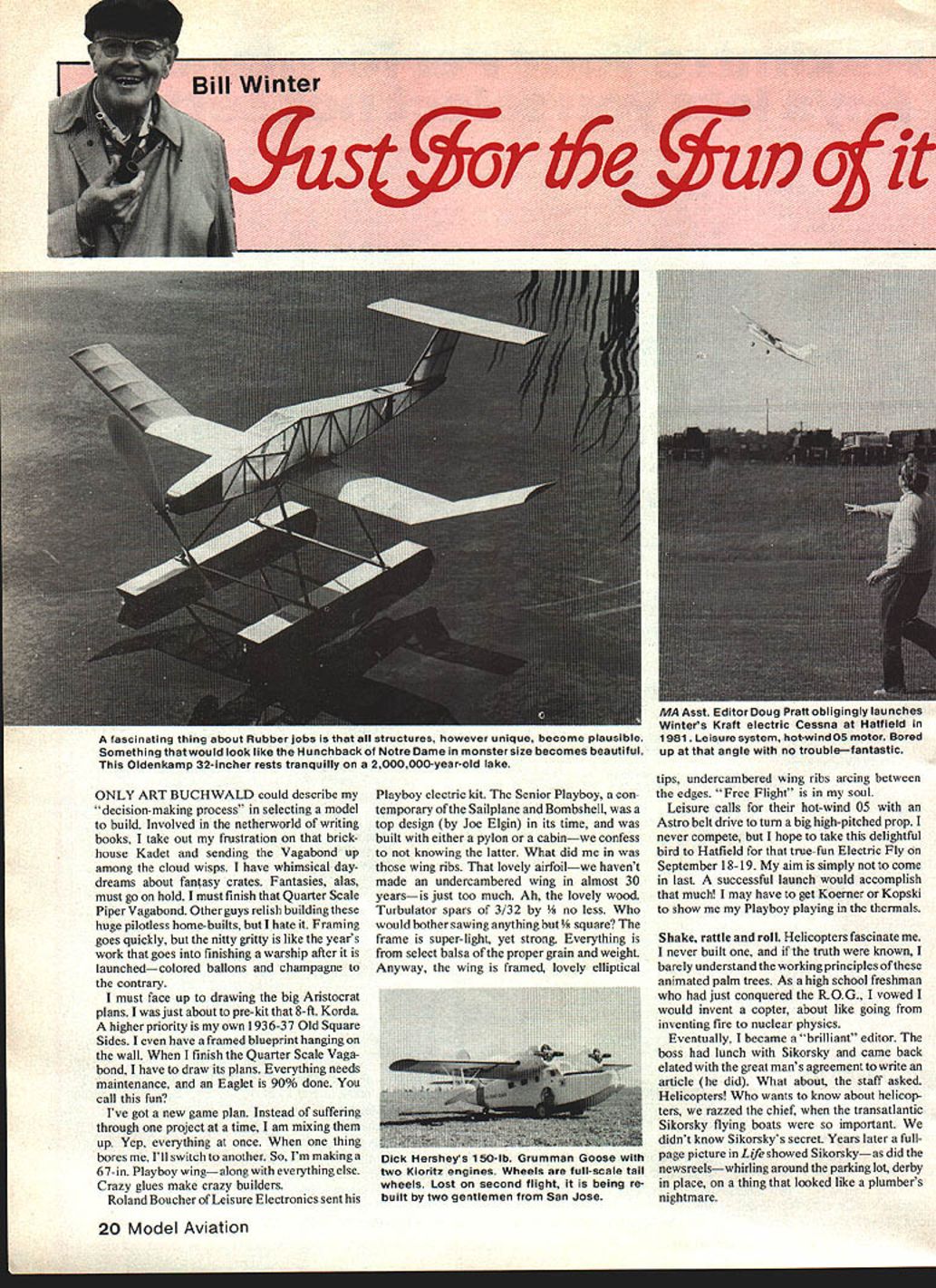

Bill Winter
Just For the Fun of it
Choosing projects
Only Art Buchwald could have described my decision-making process in selecting a model to build. Involved in the netherworld of writing books, I use modeling to take out frustration—turning that brickhouse Kadet into something that sends the Vagabond up among the cloud wisps. I have whimsical daydreams about fantasy crates, but fantasies, alas, must go on hold. I must finish that Quarter-Scale Piper Vagabond.
Other guys relish building huge pilotless home‑builts; I hate them. Framing goes quickly, but the nitty‑gritty finishing work can be like the years of effort poured into a warship after it is launched—no colored balloons and champagne, contrary to appearances. I must face up to drawing the big Aristocrat plans. I was just about to pre‑kit that 8‑ft Korda, but a higher priority is my own 1936–37 Old Square Sides; I even have a framed blueprint hanging on the wall. When I finish the Quarter‑Scale Vagabond, I have to draw its plans. Everything needs maintenance, and an Eaglet is 90% done. You call this fun?
I’ve got a new game plan. Instead of suffering through one project at a time, I’m mixing them up—everything at once. When one thing bores me, I’ll switch to another. So I’m making a 67‑in. Playboy wing—along with everything else. Crazy glues make crazy builders.
The Playboy electric kit
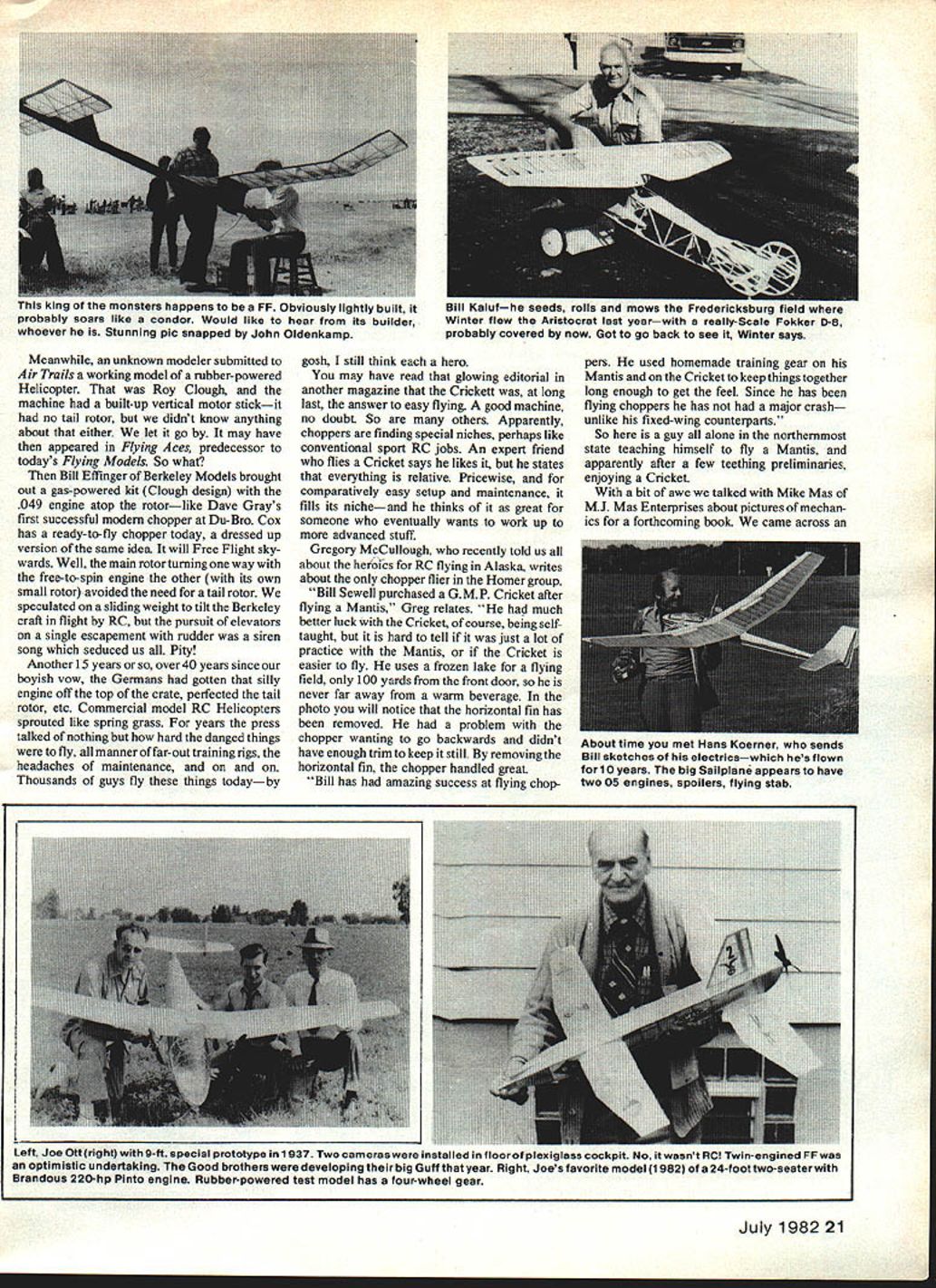
Roland Boucher of Leisure Electronics sent his Playboy electric kit. The Senior Playboy, a contemporary of the Sailplane and Bombshell, was a top design in its time (by Joe Elgin) and was built with either a pylon or a cabin—we confess to not knowing much of the latter. What got me were those wing ribs: that lovely undercambered airfoil (we haven’t made an undercambered wing in almost 30 years) is simply too much to resist. Ah, the lovely wood. Turbulator spars of 3/32 by 1/8 inch—who would bother sawing anything but 1/8 square? The frame is super‑light yet strong. Everything is select balsa of the proper grain and weight. Anyway, the wing is framed with lovely elliptical tips and undercambered ribs arcing between the edges. Free flight is in my soul.
Leisure recommends their hot‑wind .05 OS motor with an Astro belt drive to turn a big, high‑pitched prop. I never compete, but I hope to take this delightful bird to Hatfield for the true‑fun Electric Fly on September 18–19. My aim is simply not to come in last—a successful launch would accomplish that much! I may have to get Koerner or Kopski to show me my Playboy playing in the thermals.
Helicopters: fascination and history
Helicopters fascinate me. I’ve never built one, and if the truth were known, I barely understand their working principles—animated palm trees, it seems. As a high‑school freshman who had just conquered R.O.G., I vowed I would invent a copter—about like going from inventing fire to nuclear physics.
Eventually I became an editor. The boss had lunch with Sikorsky and came back elated with the great man’s agreement to write an article. “What about the staff?” they asked. “Helicopters?” we razzed the chief, when the transatlantic Sikorsky flying boats seemed so important. We didn’t know Sikorsky’s secret then. Years later, full‑page pictures in Life and newsreels showed Sikorsky whirling around the parking lot on a machine that looked like a plumber’s nightmare.
You may have read glowing editorials claiming that the Cricket was, at long last, the answer to easy flying. A good machine, no doubt—so are many others. Apparently choppers are finding special niches, perhaps like conventional sport RC jobs. An expert friend who flies a Cricket says he likes it but stresses that everything is relative: pricewise, and for comparatively easy setup and maintenance, it fills its niche—and is great for someone who eventually wants to work up to more advanced stuff.
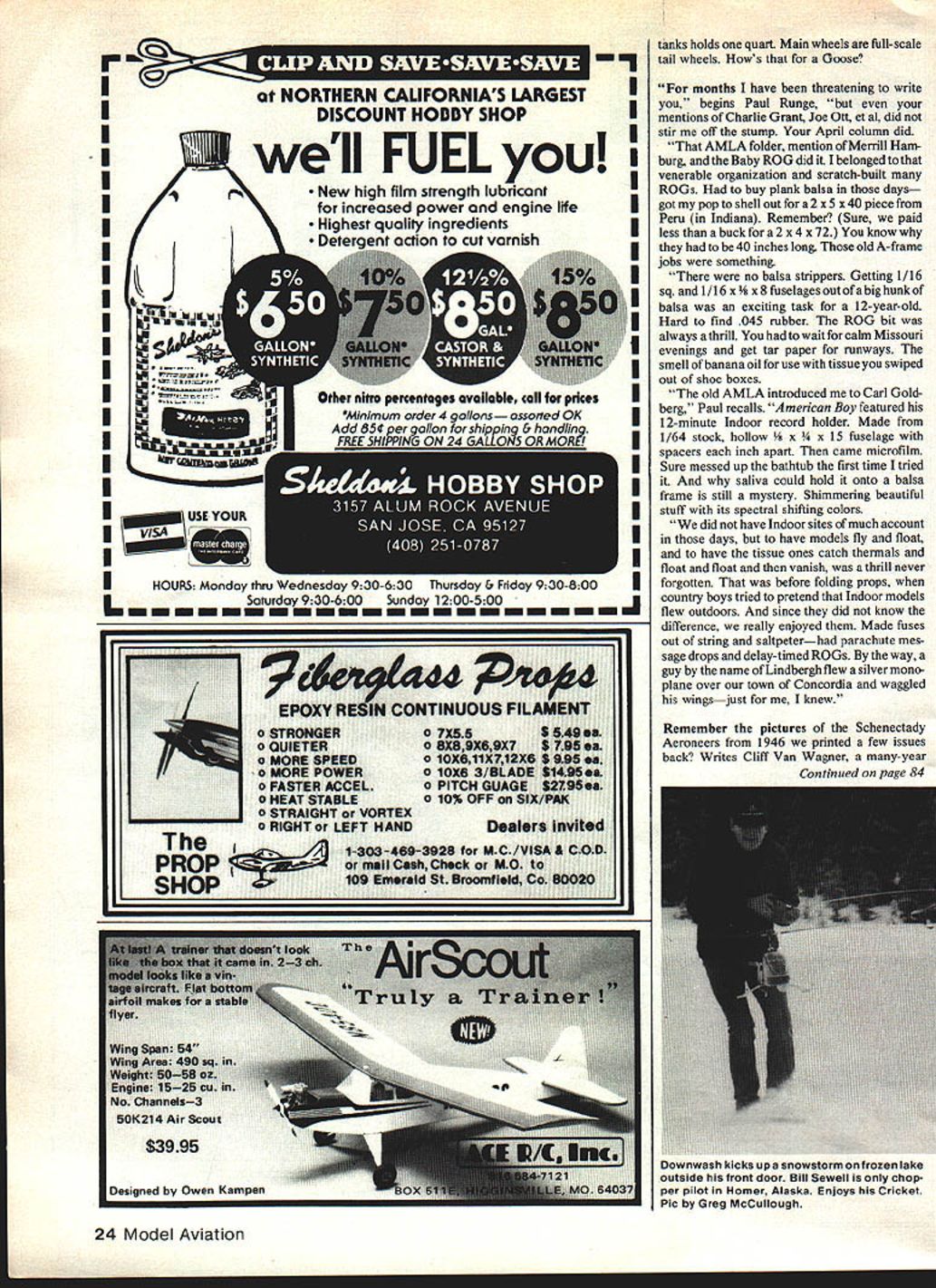
Gregory McCullough, who recently wrote about RC flying in Alaska, tells of the only chopper pilot in the Homer group:
- Bill Sewell purchased a G.M.P. Cricket after flying a Mantis. He had much better luck with the Cricket, being self‑taught, but it’s hard to tell whether it was practice with the Mantis or that the Cricket is easier to fly. He uses a frozen lake for a flying field, only 100 yards from the front door, so he is never far from a warm beverage. In the photo you will notice the horizontal fin has been removed. He had a problem with the chopper wanting to go backwards and didn’t have enough trim to keep it still. By removing the horizontal fin the chopper handled great.
- Bill has had amazing success at flying choppers. He used homemade training gear on his Mantis and Cricket to get the feel. Since flying choppers he has not had a major crash—unlike his fixed‑wing counterparts.
With a bit of awe we talked with Mike Mas of M.J. Mas Enterprises about photos and mechanics for a forthcoming book. An informational sheet for a flying demo said that at the time he was flying a Kalt. The sheet noted that Mike specializes in design and prototype work for the model helicopter field, has logged over 8,000 hours on choppers, and works with many manufacturers (including Kalt and Hirobo in Japan and Schluter in Germany). As a national champion for several years, he was undefeated in many major contests and even pioneered inverted sustained helicopter flight, among other records. By adding a 35mm still camera to the undercarriage and a trip switch on the transmitter, he managed shots “in areas where you dare not enter.”
Early experimental choppers
We once received a photo of an unknown modeler who submitted a working rubber‑powered helicopter to Air Trails. That was Roy Clough, and the machine had a built‑up vertical motor stick—it had no tail rotor, but we didn’t know anything about that then. It may have appeared later in Flying Aces. Bill Effinger of Berkeley Models later brought out a gas‑powered kit (a Clough design) with a .049 engine atop the rotor—like Dave Gray’s first successful motor chopper. Cox has a ready‑to‑fly chopper today that’s a dressed‑up version of the same idea; it will free‑flight skywards. The approach of mounting a small free‑spinning motor and rotor to counter the main rotor avoided the need for a tail rotor. We once speculated on a sliding weight to tilt such craft for RC control, and the pursuit of elevators on a single escapement with rudder was a siren song that seduced many of us.
Another 15 years or so—over 40 years since my boyish vow—the Germans had gotten that odd engine off the top of the crate, perfected the tail rotor, and commercial model RC helicopters sprouted like spring grass. For years the press talked about how hard these things were to fly, the far‑out training rigs, and the maintenance headaches. Thousands of guys fly them today.
In the bag: big models and mishaps
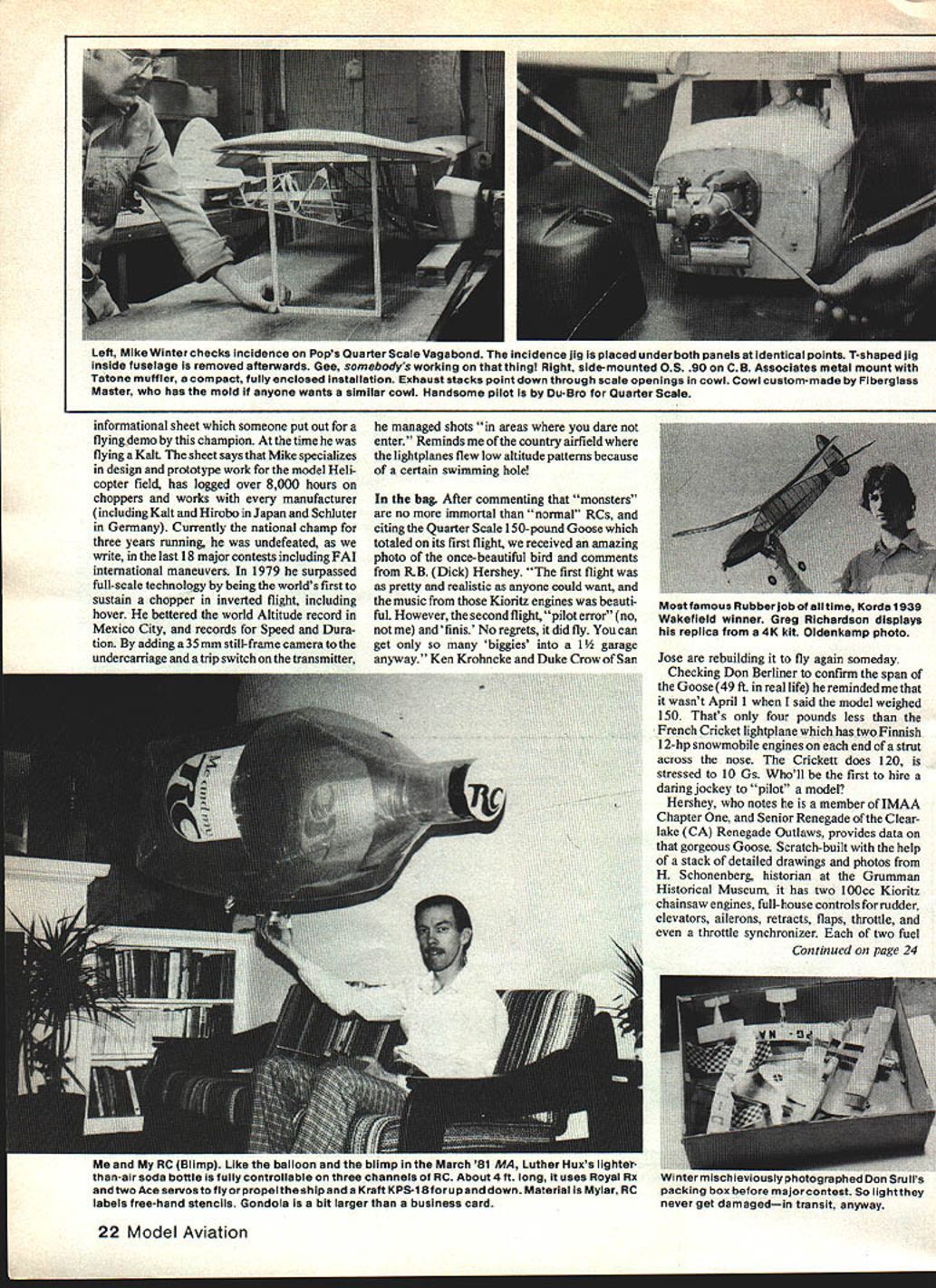
After noting that “monsters” are no more immortal than “normal” RCs, and citing a Quarter‑Scale 150‑pound Goose that totaled on its first flight, we received an amazing photo and comments from R.B. (Dick) Hershey.
- The first flight of his Goose was as pretty and realistic as anyone could want, and the music from those Kioritz engines was beautiful. However, the second flight ended with “pilot error” (not Hershey) and “finis.” No regrets—it did fly. You can only get so many big ones into a 1½‑car garage anyway.
- Ken Krohncke and Duke Crow of San Jose are rebuilding it to fly again someday.
Checking with Don Berliner to confirm the span of the real Goose (49 ft.), he reminded me it wasn’t April 1 when I said the model weighed 150 lb. That’s only four pounds less than an odd French Cricket lightplane which has two Finnish 12‑hp snowmobile engines on each end of a strut across the nose. That Cricket does 120 mph and is stressed to 10 Gs. Who’ll be the first to hire a daring jockey to “pilot” a model?
Hershey, a member of IMAA Chapter One and Senior Renegade of the Clearlake Renegade Outlaws, provided more data. The scratch‑built Goose used detailed drawings and photos from H. Schoenberger of the Grumman Historical Museum; it has two 100cc Kioritz chainsaw engines, full‑house controls for rudder, elevators, ailerons, retracts, flaps, throttle, and even a throttle synchronizer. Each of two fuel tanks holds one quart. Main wheels use full‑scale tail wheels. How’s that for a Goose?
Memories: ROGs and AMLA
Paul Runge wrote to recall the old AMLA folder, mention of Merrill Hamburg, and the Baby ROG. He belonged to that venerable organization and scratch‑built many ROGs. Back then you had to buy plank balsa—Paul remembers getting a 2 x 5 x 40 piece from Peru (in Indiana). There were no balsa strippers; getting 1/16 sq. or 1/16 x 1/8 fuselage stock out of a big hunk of balsa was exciting for a 12‑year‑old. Finding .045 rubber was hard. The ROG bit was always a thrill: you waited for calm Missouri evenings and tar paper for runways, and used banana oil with tissue you swiped out of shoe boxes.
The old AMLA introduced Paul to Carl Goldberg. American Boy featured Goldberg’s 12‑minute indoor record holder. He remembers microfilm (and messing up the bathtub the first time he tried it) and how saliva seemed to bond film to a balsa frame. Those tissue models that caught thermals and just floated away were thrills never to be forgotten. That was before folding props, and country boys tried to pretend indoor models flew outdoors—we really enjoyed them.
Cliff Van Wagner, a long‑time member of the Schenectady Thunderbolts and Aeroneers, wrote about photos printed from 1946 showing club members at Mount Pleasant High School. He still has the January 1940 Air Trails with the Airhopper and the beat‑up fuselage—memories of Free Flight and night contests with lights mounted in fuselages.
Clubs and events
Tom Brennan, who in his 56 years went from ROGs to real B‑29s and B‑47s and back to ROGs, is in modeling for the fun, as is his club (Marin Aero Club, CA). They have no officers, no dues, and most meetings are social. Their 10‑contest schedule this year shows them to be a FAC‑oriented group leaning toward Rubber. With a strong emphasis on flying and fun, the 25‑member group is big on juniors; Hal Makinson conducts three classes a week for them. They put up one trophy per event—an idea Tom says was picked up from one of our editorials in the 1950s—and sometimes have 30 people fly for it.
What pleases me is that the club picked up on our expressed concern that nostalgia clubs should be aware of the significance of pioneers like Joe Ott and designated June 6 as Joe Ott Day. Two Scale events were flown, over and under 20‑inch spans. Joe signed certificates for all participants.
Gadgets, parts, and resources
A few items worth passing along:
- RAM Models (Ralph Warner) sent a sample of the RED 10 Dual Servo Setter. It looks like an English safety device that can return up to four servos to preset positions in the event of interference or transmitter failure. RAM makes many lighting systems for planes and boats. We haven’t used this unit extensively yet but are interested in reports from users.
- For top‑quality three‑line bellcranks and three‑line handles, contact Leon Rytkarsky, 7787 Archdale Ave., Detroit, MI 48228. Leon was also offering a quantity of G‑S Bearcat and Skyraider kits at $28.95.
- Satellite City announced a one‑hour VHS video cassette on the use of Hot Stuff (fiberglassing/adhesives). Clubs and hobby shops may borrow it free for 60 days with a $30 refundable deposit. Permission to copy is granted for club use.
These are not plugs and nobody is taking ads for them—some things deserve reporting if we mean what we say about having fun.
Beginners, cyclers and batteries
Because by his own admission he is a perpetual beginner, the Aero Masters Club in Fredericksburg made me an honorary member. We perpetual beginners are a woeful lot: either experts are bewildered, or there are 33 degrees of experts. Modeling life is a constant learning curve for virtually all of us who fly actively. Knowledge often comes from getting mugged occasionally when you are riding high.
For instance, I went five years without a single cell failure and without replacing any batteries. The planes I fly most happen to have Sanyo cells—a coincidence. After my return to active flying, friends insisted I must use cyclers for dependability. They were right. I learned odd things.
- A Sanyo 450 pack might go beyond 700 mAh when cycled. (A scientist told me this means little—high readings don’t guarantee longevity; cell variation is statistical.)
- I use a Taylor cycler/charger and an Ace Digipace which indicate mAh and state of charge. I settled on cycling packs three times a year: when you start to fly, about one‑third in, then two‑thirds of the season.
- Pride goeth before a fall. On the first day of flying last season, 19 guys cracked up at the club field. One morning we plugged a pack into the charger and a light came on. Stupidly, we then plugged the charger into the wall: no charge. If a light comes on when you plug the pack into the charger before plugging the charger into the wall, the polarity may be reversed—some connectors encourage such mistakes.
Problems continued. Some chargers aren’t balanced. If you use one half of a charger (just an airborne pack), the charge rate can be considerably higher than rated—extra milliamps that can fool you.
My flight pack once showed 24 minutes on the Ace Digipace, but after charging and recycling I got only 4.2 minutes. The pack read well at rest, but under load it failed. Merlin, who fixes my junk, tested the pack under a 500 mA load and it held. On cycle mode the cycler reverted to charge during partial discharge, which led Merlin to open the pack. Testing each cell under load revealed a tricky cell: it didn’t short or go open but had high internal resistance. Partially discharged, it would “quit” and then, once rested, come back up to voltage. I had been flying with that cell for God knows how long.
The debate now is whether to replace single faulty cells or throw out the whole pack. Pattern fliers probably won’t be replacing individual cells in critical packs. A flying buddy recently found ten bad cells across his fleet. Aberle suggests that if you find one bad cell, another is probably not far behind—mine were almost all four years old. Being penny‑wise can be fatal; I’m going to bite the bullet and replace packs as fast as I can.
Not all new batteries are good either. One son bought 24 cells and found four inferior. As a beginner, I think we all need cyclers—you can’t fly by the seat of your pants; you must trust the instruments.
Closing thoughts
Modeling is for the fun of it—building, flying, tinkering, meeting friends, learning from mistakes, and sometimes getting mugged by reality. Whether it’s an undercambered Playboy wing, an experimental chopper, a giant Goose, or a small ROG that floats on a summer thermal, the point is the joy of the hobby. Keep building, keep flying, and keep having fun.
Transcribed from original scans by AI. Minor OCR errors may remain.

