
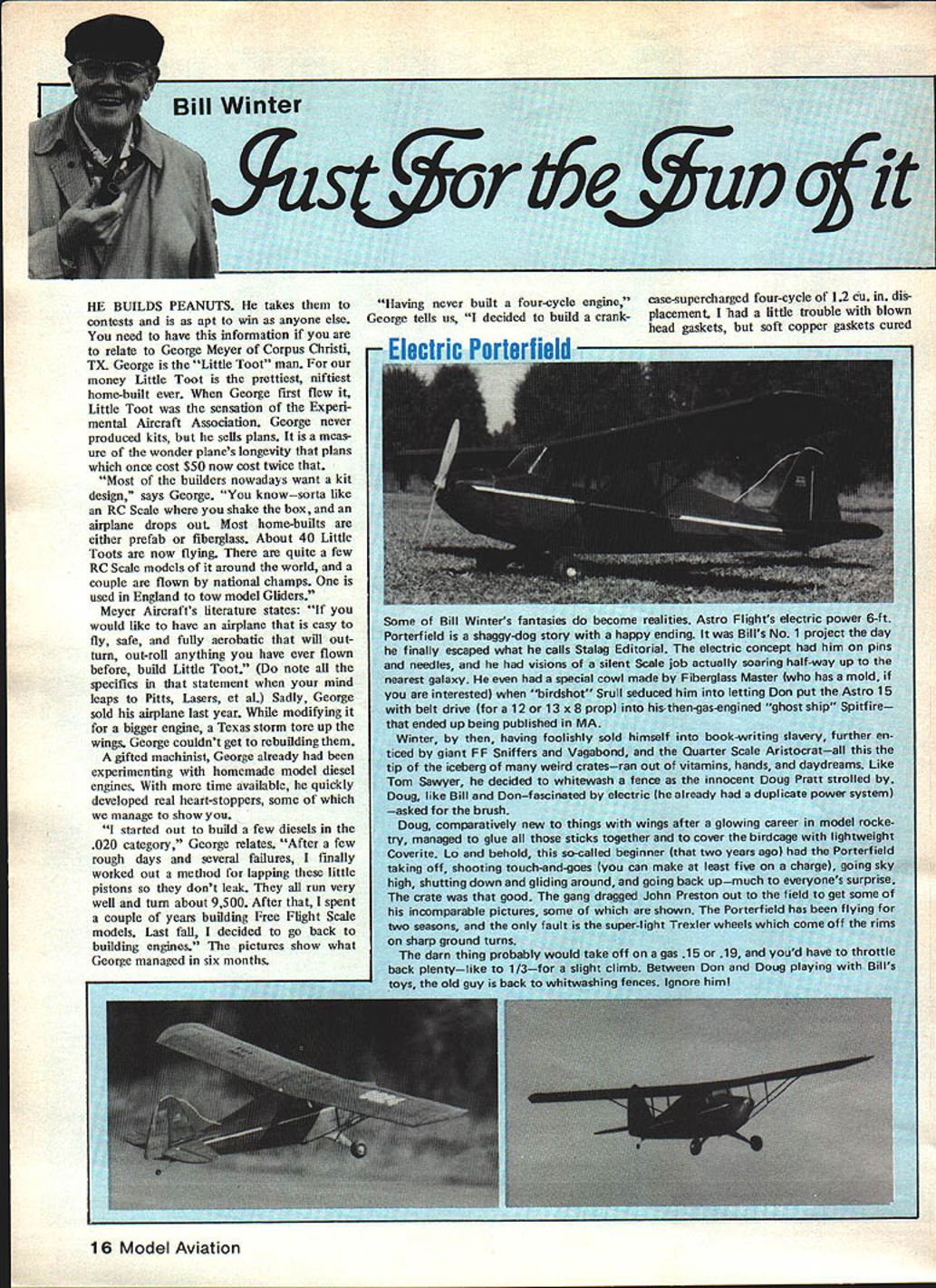
Bill Winter
Just For the Fun of it
By Bill Winter
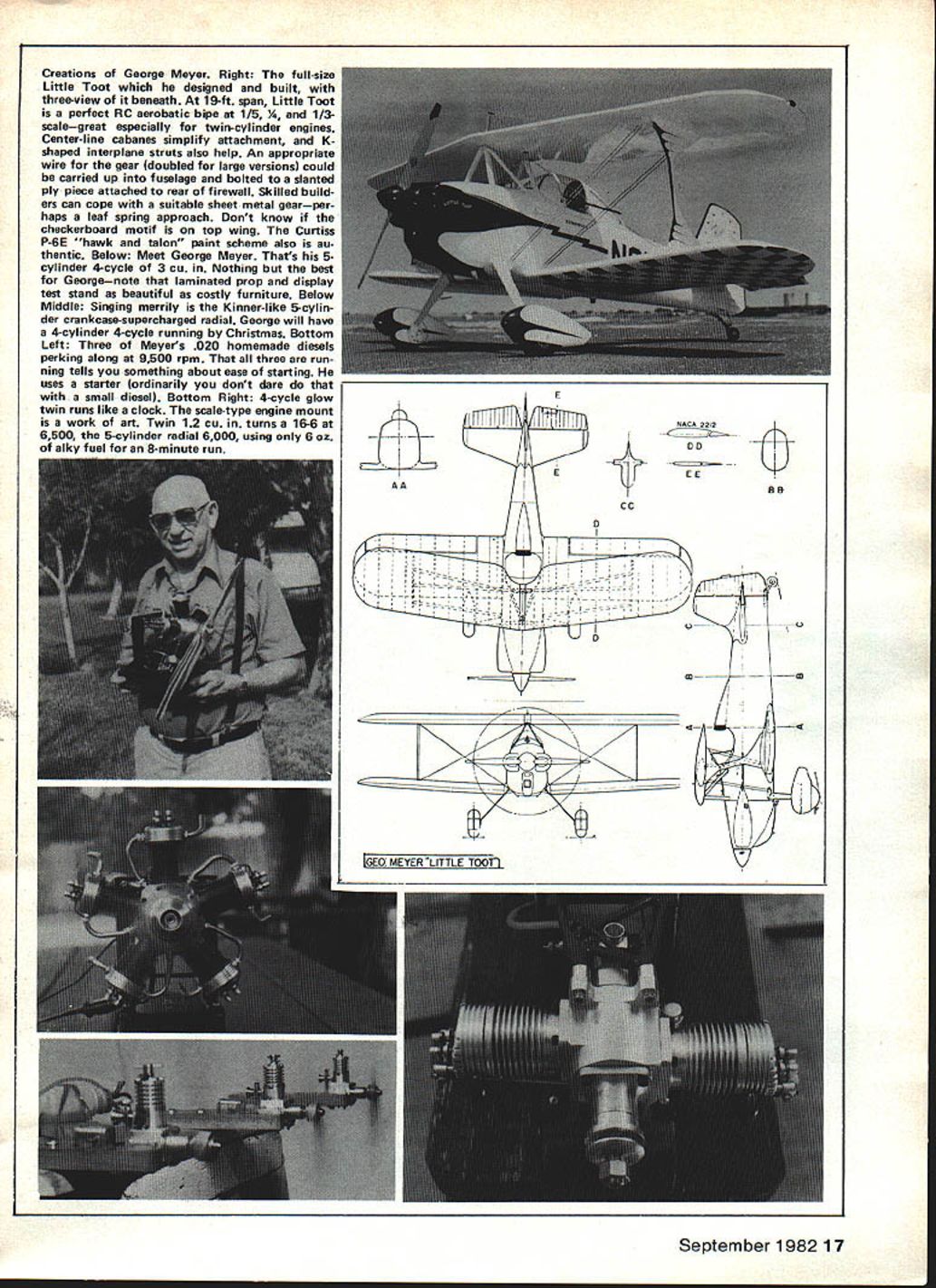
HE BUILDS PEANUTS. He takes them to contests and is as apt to win as anyone else. You need this information if you are to relate to George Meyer of Corpus Christi, TX. George is the "Little Toot" man. For our money Little Toot is the prettiest, niftiest home-built ever. When George first flew it, Little Toot was the sensation of the Experimental Aircraft Association. George never produced kits, but he sells plans. It is a measure of the wonder plane's longevity that plans which once cost $50 now cost twice that.
"Most of the builders nowadays want a kit design," says George. "You know—sorta like an RC Scale where you shake the box, and an airplane drops out. Most home-builts are either prefab or fiberglass. About 40 Little Toots are now flying. There are quite a few RC Scale models of it around the world, and a couple are flown by national champs. One is used in England to tow model gliders."
Meyer Aircraft's literature states: "If you would like to have an airplane that is easy to fly, safe, and fully acrobatic that will out-turn, out-roll anything you have ever flown before, build Little Toot." (Do note all the specifics in that statement when your mind leaps to Pitts, Lasors, et al.) Sadly, George sold his airplane last year. While modifying it for a bigger engine, a Texas storm tore up the wings. George couldn't get to rebuilding them.
A gifted machinist, George already had been experimenting with homemade model diesel engines. With more time available, he quickly developed real heart-stoppers, some of which we manage to show you.
"I started out to build a few diesels in the .020 category," George relates. "After a few rough days and several failures, I finally worked out a method for lapping these little pistons so they don't leak. They all run very well and turn about 9,500. After that I spent a couple of years building Free Flight Scale models. Last fall, I decided to go back to building engines." The pictures show what George managed in six months.
"Having never built a four-cycle engine," George tells us, "I decided to build a crankcase-supercharged four-cycle of 1.2 cu. in. displacement. I had a little trouble with blown head gaskets, but soft copper gaskets cured the problem. After seven hours running time it turns a 16×6 prop at 6,500."
"Since it ran well I decided to build a five-cylinder 3 cu. in. radial. Its valve train is like the old Kinner—five camshafts, six gears. The carb is a Perry 21. I still think it should be sleeved down a little. The carb is mounted back on the gear case. The front gear case has five holes to let fuel in. The crankcase intake pipes lead to the crankcase. It turns 6,000; an 18×6 runs 8 minutes on 6 oz. of glow fuel."
"My latest project is a four-cylinder in-line. The crankshaft is finished with four throws and five mains. It has an oil system with pressure mains and rods. I hope to have it running by Christmas."
George Meyer — Engine Creations (summary)
- .020 homemade diesels
- Lapped pistons to prevent leakage
- Run about 9,500 rpm
- Easy to start; he uses a starter (unusual for small diesels)
- 1.2 cu. in. crankcase-supercharged four-cycle
- Soft copper head gaskets cured blown head gasket problem
- After seven hours, turns a 16×6 at 6,500 rpm
- Five-cylinder, 3 cu. in. radial
- Valve train like old Kinner: five camshafts, six gears
- Perry .21 carb mounted on back of gear case
- Front gear case has five fuel holes; crankcase intake pipes lead to crankcase
- Turns 6,000 rpm; 18×6 runs 8 minutes on 6 oz. glow fuel
- Suggested that it might be sleeved down a little
- Four-cylinder in-line (in development)
- Crankshaft: four throws, five mains
- Oil system with pressure to mains and rods
- Expected to be running by Christmas
Little Toot — Design Notes
- Full-size Little Toot span: 19 ft.
- Excellent RC aerobatic biplane at 1/5, 1/4, and 1/3 scale
- 1/4-scale: less than 5 ft. span
- 1/3-scale: somewhat more than 6 ft. span
- Recommended CG: in front of the leading edge of the bottom wing (especially with the top wing sweep)
- Structural features:
- Center-line cabanes simplify attachment
- K-shaped interplane struts assist rigidity
- Gear: appropriate wire (doubled for large versions) could be carried into the fuselage and bolted to a slanted ply piece attached to rear of firewall
- Skilled builders can produce suitable sheet-metal gear—perhaps a leaf-spring approach
- A checkerboard motif on the top wing is uncertain; Curtiss P-6E "hawk and talon" paint scheme is authentic
- Meyer Aircraft contact:
- Meyer Aircraft, 5706 Abby Dr., Corpus Christi, TX 78413
Photo Captions (cleaned)
- Right: The full-size Little Toot which George designed and built, with three-view beneath. At 19-ft. span, Little Toot scales well for 1/5, 1/4, and 1/3 RC versions—great especially for twin-cylinder engines.
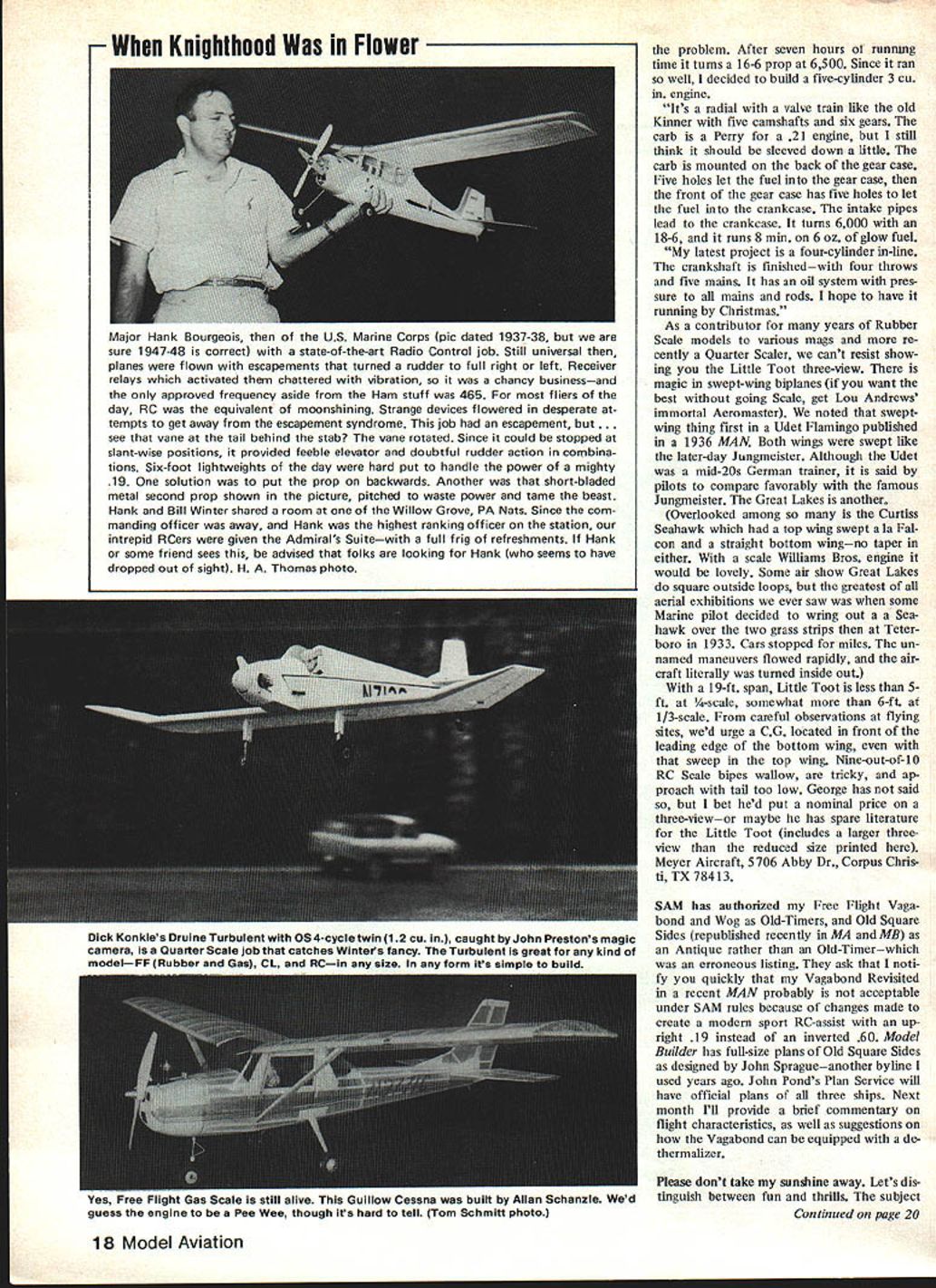
- Below: Meet George Meyer. That's his 5-cylinder 4-cycle of 3 cu. in. Laminated prop and display test stand are as beautiful as costly furniture.
- Below middle: Kinner-like 5-cylinder crankcase-supercharged radial. George expected to have a 4-cylinder 4-cycle running by Christmas.
- Bottom left: Three of Meyer's .020 homemade diesels perking along at 9,500 rpm. That all three are running tells you something about their ease of starting.
- Bottom right: 4-cycle glow twin runs like a clock. The scale-type engine mount is a work of art. Twin 1.2 cu. in. turns a 16×6 at 6,500 rpm; the 5-cylinder radial 6,000 rpm, using only 6 oz. of alky fuel for an 8-minute run.
SAM Authorizations and Plans
SAM has authorized my Free Flight Vagabond and Wog as Old-Timers, and Old Square Sides (republished recently in MA and MB) as an Antique rather than an Old-Timer—which was an erroneous listing. They ask that I notify you quickly that my Vagabond Revisited in a recent MAN probably is not acceptable under SAM rules because of changes made to create a modern sport RC-assist with an upright .19 instead of an inverted .60. Model Builder has full-size plans of Old Square Sides as designed by John Sprague—another byline I used years ago. John Pond's Plan Service will have official plans of all three ships. Next month I'll provide a brief commentary on flight characteristics, as well as suggestions on how the Vagabond can be equipped with a de-thermalizer.
Safety, "Monsters," and the Future of Scale Modeling
Please don't take my sunshine away. Let's distinguish between fun and thrills. The subject is super big, super heavy, super powerful RC Scale models. Thrilling? Maybe. Fun? From letters to this column and to the AMA (I often am copied in) from many who enjoy big airplanes as I do, but not "super monsters" (which worry us), a "problem" is arising. The "monsters" are scaring modelers who see a trend toward too much size, weight, and/or power.
Some people already have a "pre-emptive strike" attitude—stop the "monsters" before they stop us! It's not that anything disastrous has happened yet. It is a matter of what might happen. There is worry about setting off mass hysteria, especially if outside agencies get involved and tell us how and when we must fly any RC model. Life can be made miserable for us if this thing gets so out of hand (I refer to the way we handle this hot potato as much as I do to the "monsters" themselves) that some of us may someday conclude that golf is better than models. To preclude that, we need some perspective.
For many years Nosen made big models. There was no talk of danger—those were lightweight .60-powered craft. The 2 cu. in. Quadra came along, and people beefed-up Nosens; still there was little cause for alarm. We assimilated the Quadras. The Quarter Scale movement promoted by Bill Northrop and MB took off. Some alarm was heard, a forerunner of the present situation, but mostly as an imagined problem, since nothing terrible happened.
Some argued in magazines about "kinetic energy," related to mass and velocity, but engineering types without prejudice or affiliation made us see that, on this basis alone, the Quarter Scaler was no more dangerous than a high-speed Pattern or Pylon model, or even a typical high-powered aerobatic "sport" model. AMA even repealed its 40-lb. weight limit—on the basis that it's not what we fly but how and where we fly that affects safety. That "where" is the writer's chief concern.
Hundreds of big models were built, and some were crashed. But a fatality that did occur was not caused by a monster model. Measures that followed effectively have eliminated the circumstances that permitted the accident. Let's keep in mind that we haven't found it necessary to outlaw Control Line even though, as government statistics show, an average of three foolish souls a year, beyond our organized control, tangle fatally with high-tension lines.
Our sport activity gradually assimilated Quarter Scale, now blended in quietly for at least five years. Of course, Quarter Scale is a generality. It can mean a span of only 4 ft. in the case of a home-built or well over 50 ft. if the subject were a B-36. But we built reasonable crates, and common sense and strict precautions generally ruled the day. A handful of people then figured that if big was good, bigger was better. Groups tackled community projects like the eight-engined Spruce Goose—but responsibly. These planes seemed to be operated in remote places, and they involved only .40s and .60s. But some shivers were noted when we began to see and hear of twin Quadras or more. Worry came out into the open when we started to think of models weighing up to and over 100 pounds at a speed of 100 mph—the kinetic energy arguments came back, along with thoughts of a 26-in. prop(s) turning at 7,000-plus.
A Cautionary Anecdote (Club Safety — Pin Order)
When a B-29—only several inches smaller than a full-size Pitts—lost engine control on takeoff, the pilot aborted the flight. Thinking he was still first, he exchanged pins by putting his pin on first and the second flier's under his. He then went back to his plane and turned on, causing the second flier's plane to go wild. Lucky he wasn't in the air yet. No major damage was done.
It was an accident, but the main problem here was the first flier wasn't really thinking. Never, never reverse the order of the pins! When he saw the other pin up, he should have checked it out. When he came to the board the second time, he basically became second in line to fly, not first. Since the season is now getting underway, we bring this to everyone's attention, since some of you may not have yet flown under the new system. Think safety and courtesy! Remember, we all want to enjoy this hobby and not endanger anyone.
Have a safe month.
John Preston 7012 Elvira Ct., Falls Church, VA 22042
Can Guidelines and Devices Help?
I let fancy run when I wonder if some sage IMAA or AMA safety committee could come up with a magic safety number for any plane on a scale of one-to-ten, and be guided thereby. No simple task: there is size, speed, power, wing loading, type of plane, etc. Perhaps it is difficult to compare pears and apples, but there is a common denominator: they both are fruit of about the same size, and if you were to bop some pal in the head with either a pear or an apple, the result would be the same. But pears or apples and watermelons are something else—the difference is obvious. There could at least be guidelines for what might be flown where. People sometimes leave transmitters on—in and out of an impound area.
If a huge prop is a "problem," can't we at least minimize its danger? For example, in a recent issue I wondered what to do with a RAM device which returns two servos to preset positions in the event of radio failure, interference, etc. Why not kill the engine(s)? On page 129 of the July issue, R. F. Enterprises announced a Servo Guard that weighs 1 oz., which reduces throttle automatically if a malfunction is detected in any part of the system, with ample time to land before battery failure. If such things work, why not require them on "monsters"?
One energetic critic demands a weight limit of 10 lb. (Do—you see what overreaction can be if we don't show restraint?) I influenced him to think up to 20 lb., but that was it for him. My Aristocrat weighs almost 28 lb. So I wonder what impositions I would accept. I'd like 25 lb., would accept 20 for this 9-ft. 4-in. plane, and would build something to 15 if that's what it ultimately took to save the movement for "Quarter Scale" as opposed to unlimited "monsters" (15 lb. is especially constraining with any big engine). I speak for no one but myself. I do think 15 pounds could be counter-productive, since a 6-lb. engine leaves only 9 lb. to work with.
I see nothing to be gained by making my 28-lb. Aristocrat weigh 20 pounds. Since I have a non-acrobatic "classic"-period ship, I realize the aerobatic pilots (who roll vertically with a Pitts or who fly faster, more heavily wing-loaded fighters like Mustangs) have different requirements from mine. I have watched hundreds of such airplanes fly and have never felt a twinge of concern. On the other hand, I have seen, as you have, things on a Sunday afternoon when nothing larger than 5-ft. or so was at the field. But all big plane pilots are thoughtful when a true mammoth appears, although so far they are as scarce as hens' teeth.
Our common thought is where might all this end. Unchecked, we could see hundreds of projects—well, why not four Kawasaki ducted fans on a Boeing 747?—and as the less skilled come out of the bushes, would our good record come to an end? Such planes require full-scale techniques, not common modeling methods of construction. Frankly, I know these requirements are beyond my knowledge and skill in spite of 55 years of flying. I could make one that flies. But why?
Inspection, Procedures, and Personal Practices
It might be wise, however distasteful, to consider that real "monsters" are not models, but RPVs. Well, we suppose, any RC model is an RPV. But the concern is for conditions midway between what we think of as models and real planes, rather like home-builts.
Safety checks at a fly-in? I have gone through them. Who can see into my batteries? No one asks their capacity or if I cycle them. Of course I do, and more frequently than I like. What about my servo pot wipers? Every time I experience chatter or servo talk in my sport jobs, it proves not to be a dirty pot, but the setting of the wipers—which I would not have known about except for "Merlin," who keeps me straight. Switches, along with batteries, are a failure point—as well as rods, clevises, you name it. What standards should be used for any truly critical inspection of a real "monster"? Does anyone really know how to inspect? I've seen a big CAP-20 strip its standard-size servo gears. IMAA, hard guidelines, please!
Why did I build a 9-ft. 4-in. Aristocrat? Primarily because I had to build and fly Quarter Scale in order to know what I was talking about. We can be safety-minded in choice of aircraft projects. For me that meant maximum stability, easy handling, and slow flight—the ingredients for fun and relaxation. The real plane, a high-wing cabin type, had a high-lift airfoil, and was built before flaps were commonplace. This meant more wing area, since those old guys didn't want to land at high speeds, and they wanted to get in and out of small places. With an 18-in. chord, the model has acres of area. With only a 1.32 cu. in. glow engine, it gets in and out of a very small strip, climbs well at two-thirds throttle, cruises at 50% throttle or less, and hangs all day nose-high at just above idle. I limited myself to 2 cu. in. displacement.
Although I don't crash models, I am not a good flier, so I committed myself to having an expert pilot execute all takeoffs, approaches and landings. No one should ever contemplate an aircraft that can "get ahead" of his proficiency. All guest pilots, including airline pilots who fly for fun, are told the machine is restrained in "every direction," it is flown like the real craft, a point-to-pointer. It is never looped, steeply dived, or snapped. When my pilot (Don Srull) does the Scale Procedure Turn pattern, spectators always are impressed by the flight realism. In fact, it flies like a baby carriage, and it is virtually automatic on touch-and-goes.
Why am I so conservative? Because, having been a pilot, I am not able to take chances. I don't want to embarrass fellow modelers with some "event," nor do I wish to be sued. I am concerned first for the person who might sue. Never take a chance should be the motto of any "big" scale builder. Any "monster" is taking a chance in my book.
Twenty years ago I had a 6-ft., .19-powered, 6-lb. model which suffered a chattering relay, and it penetrated a roof, knocking all pictures off a bedroom wall. It's enough of a chance that I can't sit in the plane as a pilot, but must rely on a remote link. But if you argue anything related to that remote link, you are saying that no RC airplane is safe, including a 1/2A. No one can seize on that statement, because safety in anything—even getting out of bed—involves percentages (as does crossing a street or driving a car). Statistics say that golf carts are 12 times as dangerous as model airplanes, including those flown by mysterious C/L people near power lines.
I stand close to my Aristocrat pilot (who doesn't need me), but I don't "call." I watch for other aircraft, anything, and alert him in a split second. We start the engine facing away from the pits and kill it before turning the landed plane toward the pits (new for us in 1982). We anchor the plane firmly. I want to know about every tiny screw, including those which hold hatches. We follow tight procedures through filling, priming, "feeling the bump." We know what we are going to do when aloft—every time, all the time. I sometimes mutter about the length of a climb-out or the distance of a turn or degree of bank. I drive Srull crazy, probably.
I'd like to try a twin but won't. You know what a red-line is. You might exceed it and live in a real airplane if the gentlest of inputs are used. Do you know what a blue-line is? On a twin it is the speed which you must have to continue safely if an engine fails. It is unforgiving. If you are below blue-line, you have bought the farm. (There's the problem of instant interpretation at a distance.) In models that means holding down on takeoffs to gain excess speed, maintaining very low-angle climb-outs. There is scale effect, too, and you are not in the crate watching some "clock." Nor is the airspeed measurable in any way. I am sure you have all seen some lovely twin which has flown many, many times seemingly taking off with plenty of airspeed, snap instantly with an engine failure.
Anyone who flies a flapped airplane should know how to use those flaps, including the first flight. The loading is higher. Perhaps safe flying with flaps by remote control requires three fixed positions. A Stinson noses up with flaps, a Navion pitches down to a near-steep approach angle. One-third flap eases takeoffs and landings, two-thirds is pretty potent, and full is more brake than lift. Proportional is guessing. If you can't handle that, you shouldn't fly that crate. I have watched famous experts spread a gear and scrape the belly (you see this on videotapes) when they had flaps but did not use them. Flaps are more than scale novelties.
Any crate flown before spectators should have had enough prior flights to ensure proper performance. We were pleased at Ft. Meade when asked how many flights the Aristocrat had. Presumably if not enough, they would have said you can't fly.
AMA, IMAA, and What to Do
There is a president of AMA, now John Grigg, who has certain limited powers spelled out in the bylaws the modelers approved years ago and revised recently. I don't know John well, but he certainly speaks his mind (reasonably, I feel) in that monthly column. The executive director (John Worth) exists to carry out—that is, execute—the will of the Executive Council. The Executive Council members, elected by you, normally vote on anything according to what the folks at home think. As with the nationally-elected government (Congress), practically any EC vote shows varying yeas and nays. Having observed AMA since its birth in 1937, and having worked within as editor for six years, I know to expect compromise decisions when controversy is involved.
Nothing good ever happens overnight. What the grass roots stir up certainly gets put through the wringer at the next Executive Council meeting—typically from one to three months off, and the result is as long or longer to get published. In complex things with conflicting grass roots expression, a sensible decision may take two meetings. This "monster" airplane "problem"—the threat that many people feel can hurt all modeling by getting the FAA into the act—needs deliberate attention by AMA and the IMAA, not a quick fix that won't hold up.
I am not against anything. I don't wish to take away anyone's fun. And I don't want to lose my own. We have successfully assimilated big Scale, but we need to distinguish between "big" and "monster." A good place to start would be with affable Don Godfrey, IMAA president, who has his own columns in Model Airplane News and High Flight. As IMAA president, he welcomes letters.
Like AMA, IMAA has 11 district representatives. If you are concerned, communicate with those who can affect things from within. But, please, no tirades or stirring up the pot outside of modeling—we don't need controls imposed from outside by people who don't know what can be handled safely. We need reason and peer pressure to avoid extremism. The warning flag is waved—let's put our own lid on the situation before somebody does it for us.
Editor's Note
New safety rulings, effective immediately, resulted from the AMA Executive Council meeting on June 26. Insurance coverage is limited to models not over 55 lb. weight, and spectator separation from the flight line must be at least 65 feet when flying models over 20 lb. See "AMA News" section for more details.
Let's fly for the fun of it. Next month we promise a circus.
Bill Winter 4426 Altura Ct., Fairfax, VA 22030
Transcribed from original scans by AI. Minor OCR errors may remain.

