

Bill Winter
Just For the Fun of it
Keith Hearn — a remarkable man
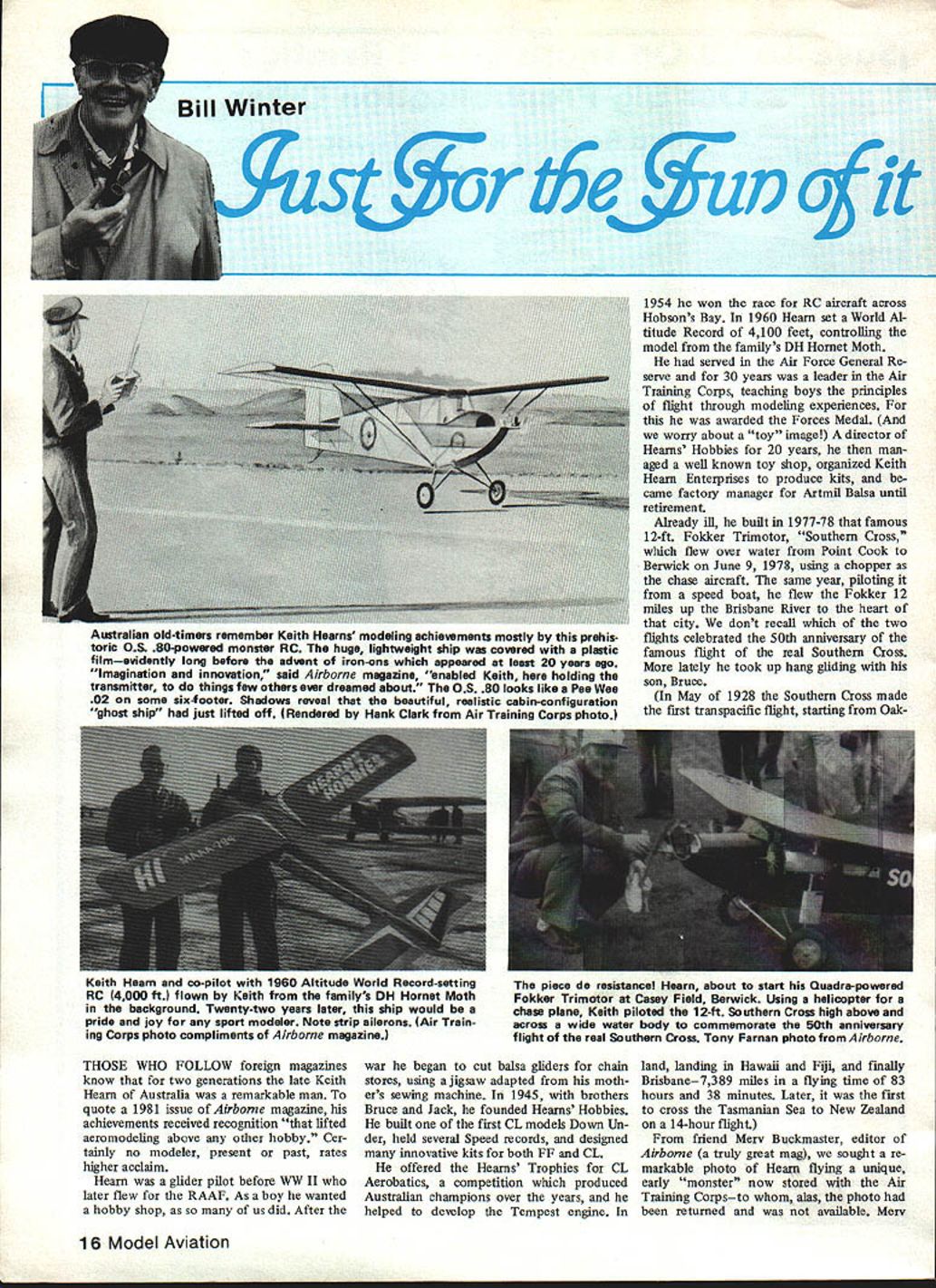
Those who follow foreign magazines know that for two generations the late Keith Hearn of Australia was a remarkable man. To quote a 1981 issue of Airborne magazine, his achievements received recognition "that lifted aeromodeling above any other hobby." Certainly no modeler, present or past, rates higher acclaim.
Hearn was a glider pilot before World War II and later flew for the RAAF. As a boy he wanted a hobby shop. After the war he began to cut balsa gliders for chain stores, using a jigsaw adapted from his mother's sewing machine. In 1945, with brothers Bruce and Jack, he founded Hearns' Hobbies. He built one of the first control-line models Down Under, held several speed records, and designed many innovative kits for both free flight and control line.
He offered the Hearns' Trophies for CL aerobatics, a competition that produced Australian champions over the years, and he helped to develop the Tempest engine. In 1954 he won the race for RC aircraft across Hobson's Bay. In 1960 Hearn set a world altitude record of 4,100 feet, controlling the model from the family's DH Hornet Moth.
He served in the Air Force General Reserve and for 30 years was a leader in the Air Training Corps, teaching boys the principles of flight through modeling experiences. For this he was awarded the Forces Medal. He was a director of Hearns' Hobbies for 20 years, then managed a well-known toy shop, organized Keith Hearn Enterprises to produce kits, and became factory manager for Artmil Balsa until retirement.
Already ill, he built in 1977–78 that famous 12-ft Fokker Trimotor model, "Southern Cross," which flew over water from Point Cook to Berwick on June 9, 1978, using a helicopter as the chase aircraft. The same year, piloting it from a speedboat, he flew the Fokker 12 miles up the Brisbane River to the heart of that city. More recently he took up hang gliding with his son Bruce.
(The real Southern Cross, in May 1928, made the first transpacific flight: Oakland to Hawaii to Fiji and finally Brisbane—7,389 miles in a flying time of 83 hours, 38 minutes. Later it was the first to cross the Tasman Sea to New Zealand on a 14-hour flight.)
From friend Merv Buckmaster, editor of Airborne, we sought a remarkable photo of Hearn flying a unique early "monster" now stored with the Air Training Corps; alas, the photo had been returned and was not available. Merv did send other shots you’ll appreciate. The Hank Clark artwork you see is a precise drawing of the takeoff photo that fired this writer's imagination.
Two-way street — letters and the columnist’s life
All columnists would succumb to the crunch of death-row deadlines if it were not for letters from loyal followers. Most columnists necessarily deal with technical specialties, but a few of us rattle cages. My six readers aren't quite sure when we are having fun or freaking out. Since it is an ungodly chore to play hanky-panky with a typewriter on a bright, calm morning when the blue sky beckons, I am looking for sympathy. The coffee is hot, the Hermes stone-cold, and I am about to be entertained by one of our storytellers.
L. G. Schmidt — "in this for the fun of it"
"This is my first effort to talk back," writes L. G. Schmidt of St. Pete, FL, "having been busy all this time with the usual winding of the cast, putting the clock out, and beating the wolf back from the door. Now, for the first time in my life, I have all this time to do the things I've always wanted to do. I have either now on hand, or have built at one time, every kind of critter that flies of its own volition. I just took an inventory. I have 43 models in flyable condition, four more wouldn't, and a dozen more designs drawn up. Sounds like I forgot to mention a partridge in a pear tree."
(P.S.: He later adds four control-line models, seven indoor models, and some hand-launched gliders that "burst" in the shoulder — making the forgetting a pleasure.)
"It's obvious I'm in this for the fun of it. I rarely go to contests. I am primarily a designer-experimenter. All of my garbage is original. I have yet to step on the field, however, without being informed that I am flying a modified Whifflepoof. (Author: Whifflepoofs have a glide you wouldn't believe.) It is inevitable that some of my designs will resemble other people's work. There just aren't that many ways to put a ship together working within the limited force arrangements that the very nature of these birds has thrust upon us. Lord knows, I try!"
"Have noted with interest the captions under pictures. Of particular interest were two peanut-size Chambermaids that supposedly fly outdoors. One claims an 8-gram weight, the other a fantastic 4.5 grams. I just happen to have a Manhattan Cabin that bends the beam a shade over 4 grams, and a good sneeze would blow it apart. I have an uncovered Chambermaid (see sketch) which is around 8 grams. Don't see how I'll wind up less than 1/2 oz. It comes apart. The wing and canopy lift off, and I have two pods for the bottom—one with wheels and the other for retract gear. A Chambermaid at 4.5 grams is terrific. The darned thing's got more bones than a herring. These fellows have got to know something that I don't know. Perhaps my scale is wrong—the Messrs. Ohaus will be delighted to hear that."
"Keep on doing what you are doing. I know about this time last year that you weren't dismayed by all the wailing and gnashing of teeth."
L. G., you don't know how euphoric I am about my 300-lb ducted-fan 747 with four Kawasakis. (Don't get shook up about that—I'm just kidding!)
Early RC memories and the Buccaneer
"In 1948, after three years in the Air Force," Jack Hearn recalls, "RC was just getting started, so I bought an Aero-Trol transmitter, receiver, and escapement."
Author’s note: In those days anyone could assemble such a kit system in a long evening. At the heart was a single-tube receiver—a tiny gas-filled tube that flashed a lovely purple light if you shorted anything. It idled at perhaps 1.5 mA and, on signal, dropped to about 0.3 mA. This minuscule current change caused a relay armature to move from one dead contact to a live one, which triggered an escapement to move the rudder to full-on for as long as the signal was held. Vibration rattled the relay—which wiggled the rudder. Joy! Essentially it was only controlled free flight, and Chet Lanzo observed that the radio enabled one to choose the point of his crash. McNabb's 46.5 frequency system (Citizen-Ship) was the only one approved by the FCC, but the woods were filled with characters who flew on any frequency they happened to come up with. There were no crystals—or the transistor was not yet a gleam in someone's eye. Receivers were super-regens; all spots were actually subject to any transmitter, and you'd have 25 guys in line waiting to fly. Pins were for diapers. Sooner or later, usually sooner, all crates either crashed or flew away. Many people tried every weekend, all year long, and never got a flight. They loved it.
"The hobby shop owner suggested a Berkeley Buccaneer B Special," Jack recalls. If you write W.E. Technical Services (an MA advertiser), you will come upon Bill Einiger, plans and goodies of the Bucs and lots of other stuff—like the Snow White '20.' Bill and Joe Raspante were close friends, and Joe flew a scaled-up monster Buc in RC. Bill Einiger once sold sticks from a room over a garage in Berkeley Place—hence the name, Berkeley—in Brooklyn.
Jack's Buccaneer had a Forster .29 engine. The Forster .29 was a gem; such an engine had to be run continuously all day to break in on its gas/oil mixture. Jack used a solenoid fuel cutoff. Throttles came in the 1950s. "It was covered with silk, but since I didn't wet it first, it was a bit loose," Jack remembers.
After procrastinating for several weeks, Jack finally got up the nerve to fly his plane. The fuel shutoff was set for one minute to play safe, and he let it run 45 seconds before launching. It was adjusted to a rich four-cycle for safety. In that 15 seconds of flying time, the plane did two loops and a 360-degree circle just 10 feet off the ground! It landed safely. Two weeks later he plugged the venturi with wood with a 1/8-in. hole. He made two 90-degree turns and a downwind landing, which damaged the receiver. The plane went on the shelf.
"Twenty-three years later I again became interested in RC and joined the American Airlines Club here in Cleveland," Jack continues. "I had trouble with so-called trainers, and all the while kept looking at that old Buccaneer sitting on the shelf and wondering how it would do with modern engine and radio."
Rebuilding posed problems, but Jack still had the plans. He did a second modification, added elevator control, and covered it with MonoKote. It flew like a dream, and in a few weeks he was able to launch, fly, and land on his own for the first time. It would not take off very well because of the extreme forward location of the wheels.
That's Jack's story about the two Buccaneer Specials in the photo. He says nothing about the letterbox slots near the tips. Used on some real Stinsons, such slots are tremendously effective in maintaining airflow over a wing at high angle of attack (preserving aileron control), and it is difficult to stall a tip. Gene Foxworthy used them on his Hoosier Hotshot RC, a Nats winner. At the Indianapolis Airport, Gene taped over the slots and the ship flew across the big airport, skimming the ground, until it struck the fence at the far side—so evidently they add lift, too. Used with proper dihedral on the Hoosier, the plane would not lose altitude in continuous tight circles with twin rudders hard over.
The Smoker and Mid-State RC Club
Smokers? Between one son who flies RC on Long Island and another in Louisiana—and my flying with the NVRC in northern Virginia and frequent visits to the Aeromasters Club in Fredericksburg—I see or hear about everything on wings.
Warren "Pete" Hare, secretary/treasurer of the Mid-State RC Club, 4529 Lee St., Alexandria, LA 71301, reports from Cajun country. It's a sane, active group of 45 members who lease their site from the Town of Pollock. Pollock was once municipal and an old World War II fighter base.
Activities include:
- Glider competition
- Fun flies
- 1/2A pylon racing
They meet on fourth Mondays at the MacArthur Village branch of the Guaranty Bank and Trust Co. (7 p.m., open to the public) and try to show an AMA or Air Force Film Library film after each meeting. Members are interested in all phases of modeling—noteworthy.
The Smoker proves to be a scaled-down Phoenix for .40 power, designed and kitted by two members who did their own fiberglass work. Mike mentions he can pick up a kit for brother Rob at a most reasonable figure. There’s a picture of a Smoker (by Gus Vol) that turns us on.
Approaches, tail-draggers, and the Krackerjac
Speaking of approaches: consistent approaches and ol' Bill are lukewarm friends. You learn constantly by fiddling with your own stuff. Ailerons are not a big deal—frankly, in the end you'll find them safer than three-channel—but it is the getting used to steering on the left (on takeoff), coordinated with banking on the right, that is the initial problem. Mike is making me a Goldberg Eagle for my 1983 aerial sadism. That Kadet can't possibly live as long as an elephant—though it might!
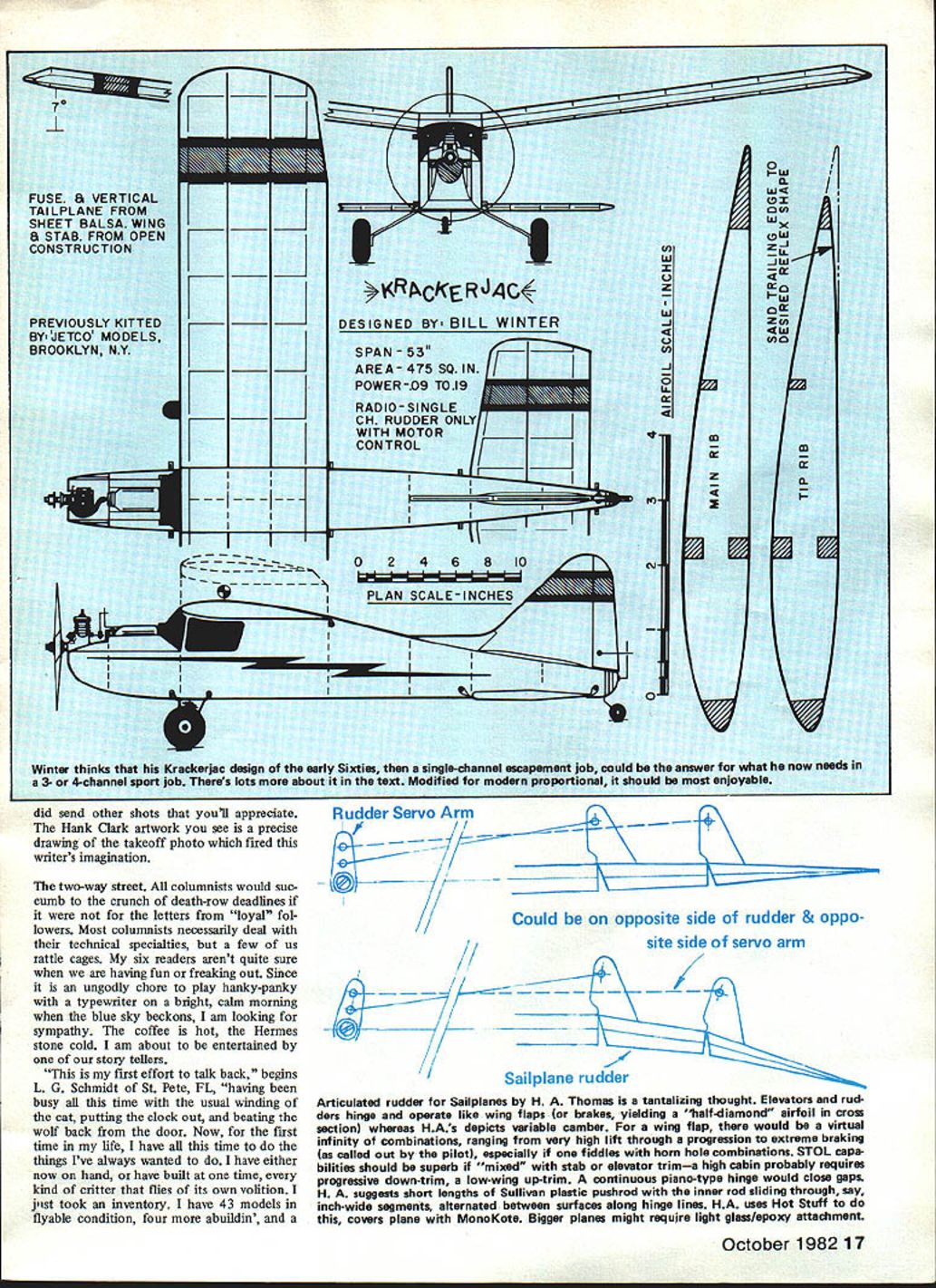
Designers always want to alter the other guy's concept. My biggest demand is a rock-stable platform for approaches. In the early 1960s I published, in Air Trails and kitted by Jetco, the Krackerjac single-channel for just rudder and throttle. Yes, planes do fly well without elevators. You will note the vague resemblance to the Kadet. In the days of rudder-only, the big problem was ballooning when coming out of turns into a wind, hence out-of-sight flights.
The Krackerjac had a thin wing for its day and a flat-bottomed airfoil that was almost symmetrical forward of the main spar. Hal deBolt, a control-line master and veteran indoor/outdoor flier, reasoned that an RC model would invert and do outsides with a symmetrical airfoil—seen in his Over and Under evolution of the Live Wire. In our own High Diver (also published), I met Hal halfway by using a two-thirds/one-third tail. That was when I abandoned traditional hand-glide tests—it wouldn't hand-glide! Heavy and much too big for its then-new K&B .15 (1953–54), it flew and glided like a dream and could fly inverted with a supplementary escapement.
The escapement guys didn't like the Krackerjac. Since it did not bob and float on its approaches but acted like a modern craft, it fell short on crosswind-into-final in the wind. It had to be approached close in, not from the next county. In a .40-size with elevators and ailerons, the Krackerjac could be a terrific sport ship: short-coupled with a big tail so, while steady, it can be thrown around as wildly as anyone would wish. The steadiness may come from the relationship of wing and stab positions, as well as the airfoil. The short coupling perhaps yields some biplane-like advantage or a very wide slot between the wing trailing edge and the low-located stab leading edge.
I opt for the tail-dragger. Mastering the technique of holding "up" during the initial roll, going to neutral briefly to let the tail come up, then pushing in gentle down to avoid early lift-offs—where a crate flounders and might snap—is satisfying. You just feel good when you conquer tail-draggers; it’s like flying a Cub on takeoff and climbout. But a trike modification is easy.
The OS Max .15—the miracle engine of its day—was throttled by an exhaust baffle. Throttle linkage and tank placement have evolved since. An ST .25 would be great with ailerons. You can decrease dihedral and D-tube the wing root to modernize the design.
Another great feature, first used by Walt Good on his Rudder Bug and later on Bonner's Smog Hog, was the mildly swept-forward trailing edge at the tip. Bottom sanding modified the airfoil, yielding automatic washout to oppose tip stalls. One wonders what a low-wing version would be like, with a closed cabin top and rounded cabin corners. For sport I would keep some dihedral. This is a fine airplane—another luck-out accident.
The Boucher brothers and electric flight
My gosh—I just discovered the Boucher brothers, Bob and Roland, are twins. Maybe you electric guys knew this, but I didn't.
In the early 1970s Roland often visited the American Modeler office. He later went off on his own (both had been with Astro Flight) and started Leisure Electronics, making a strong reputation in motors, batteries, and techniques. He now is into planes. Bob stayed with Astro and devoted many hours to educating me on electrics and developing data for ships such as Srull's Spitfire with my belt-drive .15 system.
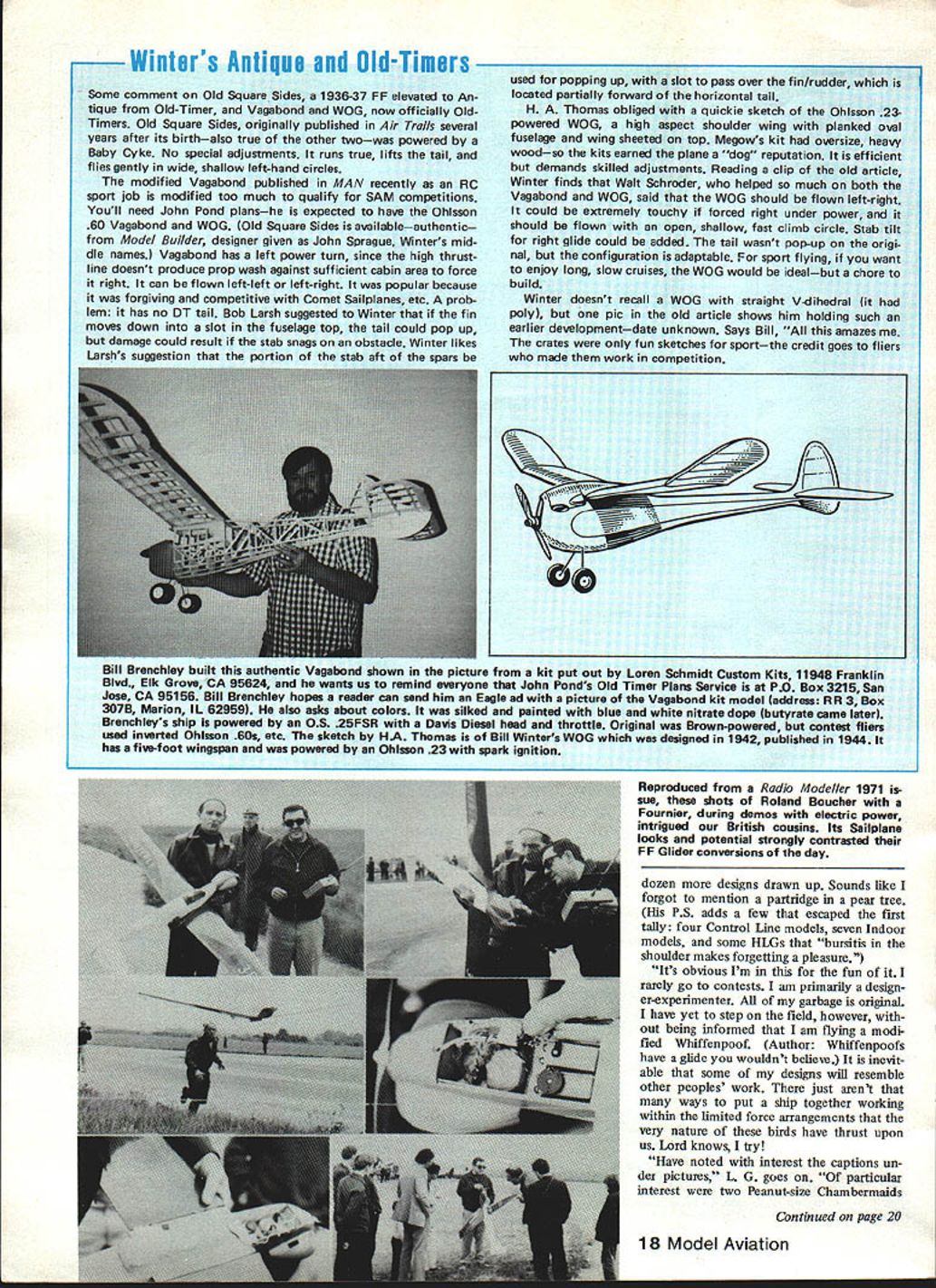
Roland made a name for himself in electric flight. The ganged pictures you see of Roland are from a 1971 Radio Modeller. He was then a consultant to Bristol in England and made what is regarded as the world's first practical RC electric demo at the MAC Show in April 1971. The model, a Fournier RF4, was a 100-in. job using two-piece wings from Astro Flight's Monterey sailplane. The motor was an efficient 10-oz Japanese 12-volt unit, filed and lightened, driving an 8x4 prop at about 9,500 rpm. It drew 7 amps; later rewound to draw 15 amps on 10.8 volts for 10,500 rpm—equivalent power to an .09 glow engine of the day. It gained 500 feet and did a loop. Roland said, "We are looking into the possibility of getting special batteries on the model market." The demo promised more gloriously quiet power models in the future.
Flying Models (June 1972) published Roland's "An Electric Record." Flying a one-kilometer closed course around two pylons along the bluffs by the Pacific, the same ship had flown 19.6 miles using a prototype 25 electric motor in a plane 20% larger than the stock Fournier kit with a one-shot silver-zinc battery (at 50% capacity on the day of the flight). The first 5 km were flown at an average speed of 46.6 mph, with no drop in speed until the 30th lap. Distance was 31 km in 29¼ minutes. More technical articles by Roland appeared in RCM in the years that followed.
Now, Bob is Astro and Roland is Leisure. And my grandsons are Pete and Jimmy, and I can tell them apart, too!
Darn, this runway is so short . . .
Bill Winter 4426 Altura Ct., Fairfax, VA 22030.
Transcribed from original scans by AI. Minor OCR errors may remain.

