
Just for the fun of it
Bill Winter
Accident analysis
Subject aircraft
- Five-year-old RC Special (scaled-down version of a 1948 design, published in the September 1980 MA).
- Cabin configuration, tail-dragger, flat-bottom airfoil, 5° dihedral.
- Three channels (no ailerons). Last powered by an ST .35.
Weather
- 90+ degrees, high humidity.
- Variable wind averaging 12–15 mph with gusts to 25+.
- Gusty, changing crosswind vectors from port to starboard.
Location
- Visited club field, 50 miles away.
- 560 ft well-mowed grass strip with unlimited approaches and plenty of airspace.
Aircraft log
- 131 flights on this airframe (fleet log for same period, about 700 total flights).
- Initially powered by a K&B .19. Long ground runs, delicate lift-offs, sluggish rudder response on the ground.
- Flight 22: pattern flier could not spin the model until shown that wiggling the rudder when nose-high produced tip stall entry.
- Flight 23: similar weather to the accident. Takeoff quartering out of a crosswind on a short strip; premature lift-off followed by a severe rudder correction into the wind, then back to runway line. Result: tip stall, roll to inverted, cartwheel — major cabin repair required.
- Flight 128 (same site): fast, long power approach, idled near threshold, slightly nose-down and fading off center line to the airplane’s left. Gentle flare plus slight rudder produced an abrupt roll toward the pilot line despite ample airspeed. At roughly 8 ft altitude it required alternating rudder inputs to maintain control; too close to the pits, a hard rudder to regain the runway resulted in an auger-in (spin) but no damage.
- During 1980–1981 the plane was flown with a Davis-diesel-converted ST .35 and served as a borrowed-engine test bed for an expert pilot.
- Aging and oil-soaked components produced a rearward CG by mid-1982; compensated by nose ballast. Wing loading increased to 18+ oz (per wing area as configured).
The flight (terminal accident)
- Engine showed overheating and unusual throttle re-setting at high and low speeds before flight.
- Taxied out and waited while a Scale modeler checked taxiing of another aircraft whose muffler was extremely ineffective — the other engine barked loudly and obscured sound.
- Initial run accelerated normally. Tail rose slightly; down elevator was held to build speed and avoid abrupt lift-off.
- Ground path was somewhat erratic; undue rudder corrections were required. True heading wheels skimmed the ground.
- A gust shifted from starboard to port; the right wing dropped about 15°. The model lifted off with seemingly adequate airspeed, but the rudder could not prevent a severe cartwheel/tip stall.
Radio
- The transmitter carried both brown-and-white and blue-and-white frequency clips. On the brown-and-white frequency the radio was susceptible to interference from the blue-and-white frequency when the antenna was down.
- Manufacturer inspection after the crash reported the receiver “totally detuned” with the antenna down. This problem was apparent before the crash; therefore the antenna was always kept up during operations and was not a causal factor in the accident.
- Lesson: never operate in the pits or taxi with the antenna down; previously the model had run high on power with the antenna down.
Tank and engine factors
- After the crash the tank could not be emptied or filled with an electric pump; it had turned brown with age and the clunk’s black neoprene had been affected by diesel fuel.
- Needle adjustments were being made on the last flight. Heavy corrections on takeoff and delayed lift-off — despite seeming adequate speed — likely produced a marginal loss of power due to a lean condition and poor wind penetration/control response in gusts.
- One contributing factor was that sound was obscured by the other aircraft’s barking muffler; the flight should have been aborted.
- Lack of diligent tank maintenance was obvious.
Pilot factors and aircraft characteristics
- At one’s own field a flier decides to fly or not based on aircraft and conditions. When traveling to a visited field, there is sometimes a subconscious drive to fly “no matter what,” even if conditions are poor but not obviously unsafe.
- Three-channel planes with flat-bottom airfoils and higher wing/power loadings are more prone to center-of-pressure forward movement with increasing angle of attack, tending to balloon. Simultaneous application of rudder and elevator can induce a snap-roll (tip stall).
- Ailerons and less dihedral are much safer for those who have mastered the basics: ailerons allow leveling of wings on takeoff even with crossed controls. Rudder alone produces turn-and-bank entry and can lead to tip stalls.
Conclusion
- They always blame the pilot — and in this case poor judgment was the prime factor, tantamount to pilot error.
- Contributing causes (radio susceptibility, tank condition, marginal power, gusty winds, design choices) must be recognized and acted upon to improve safety.
- Fortunately we usually walk away from our accidents and learn from them.
The design
- Guest pilots like the RC Special’s coordinated smoothness. It soars well in high-trim circles with the engine killed and tends to turn into lift and adjust its turn diameter automatically.
- Because the RC Special was a scale-down, wing area was less in proportion — area is a square function, not linear. Increasing chord by one inch would boost area and reduce loading.
- Recommended design changes for a knock-about sport plane better in crosswind:
- Give a bit of convex undercamber to reduce center-of-pressure travel (reduces nose-ups and ballooning compared with flat-bottom airfoils).
- Consider a trike gear to simplify ground handling.
- Use less dihedral and include ailerons.
- Provide adequate washout for sport models that spend most of their lives right-side-up — just in case.
- If rapid gusts can add or subtract 15–20 mph airspeed differentials, a ship can be flying one second and dead in the air the next, regardless of perceived attitude. Tip stalls can be “high-speed” stalls induced by wind shear.
- Construction notes: bolts break only when airspeed, plane density, and structural loads are high. Open structures yield; bolts break mainly on straight-in impacts and not during cartwheels.
Safety recommendations
- Fly fewer planes and devote loving maintenance to each.
- If the plane, engine, tank, radio, or weather are not right for your machine or beyond your previous experience, don't fly.
- Use rubber bands for attachment where appropriate; know the breaking characteristics of your fastenings.
Letters and profiles
Merlyn Welch (Ten Mile Hobbies, Hillsdale, KS)
- Merlyn Welch enjoys modelers' letters and writes as many as he can. Thanks to Doc Mathews, he’s been chewing over full-scale days with Merlyn (Kansas City “Municipal”).
- “I started building models in 1927, and the first plane I built was, I believe, out of Boys' Life,” Merlyn says. “Our first model was in 1927 and that mag was the American Boy. The kit was a stick model, mostly 1/16 sq., fifty cents plus postage. It never got to fly. I still have a Playboy Senior from 1942, now in restoration. But I will put in a single-channel escapement radio.”
- Retired for six years, Merlyn continues the hobby despite handicaps: after a heart attack he gave up hand-launching; his eyes aren’t what they should be and he believes he has no depth perception, so he often has another pilot land planes for him.
- “At present I have four radio jobs to go, 25 planes in all—CL and RC (and FF apparently)—most needing covering and two still in kit boxes. I would like to build a Quarter Scale, but think that’s little more than dreaming.”
- Advice: slip a scale-type into a sporty airframe (light wing area, simple boxy structure). A 1/4-scale Cub or Top Flite's .40-powered Big Cub are good bets for realistic, weather-tolerant flying.
- Letters to Merlyn H. Welch: P.O. Box 86, Hillsdale, KS 66036.
Keith Laumer and vintage designs
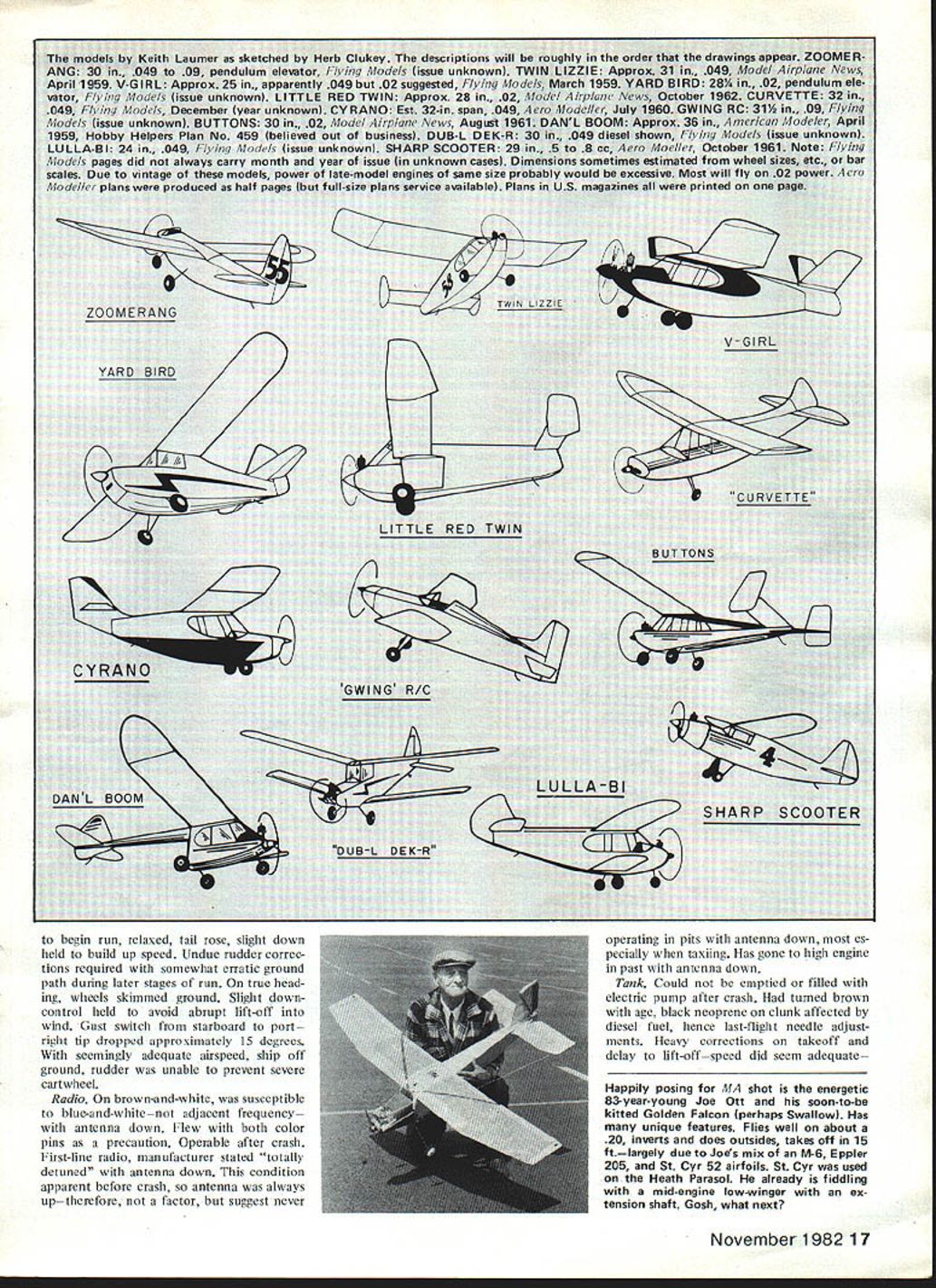
- Keith Laumer’s imaginative 1950s–60s layouts are missed. Magazines today need substantial advertising to survive; contributors are encouraged to design and share rather than merely complain to editors.
- Herb Clukey sketched thumbnail Laumer designs with help from Hurst Bowers (recently recovered from five bypasses).
- Flying Models and Aero Modeller carry long lists of vintage plans; Hobby Hideaway and Repla-Tech also distribute Aero Modeller plans. Write the involved editors (with issue data if possible) to request Xerox copies of plans for a small fee.
Free Flight and 1/2A nostalgia
- The beauty of 1/2A free flight (.02 to .049 engines) is that you can sketch a sport job to any configuration and be flying within days.
- Small-field free flights — a bushel-basket full of random short-field flights and slope launches — provide low-key pleasure without needing mile-long fields.
Profile pylon, tanks, and construction tips
- Avoid long engine runs; engines run longer when props unload. An external eyedropper tank works well if filled to a marked level: about one-third above the needle valve and two-thirds below.
- A coil of transparent fuel tubing can serve as a simple flat-mounted tank. If the engine has a tank mount, reduce capacity by placing spacers inside.
- Send pictures of builds to share ideas.
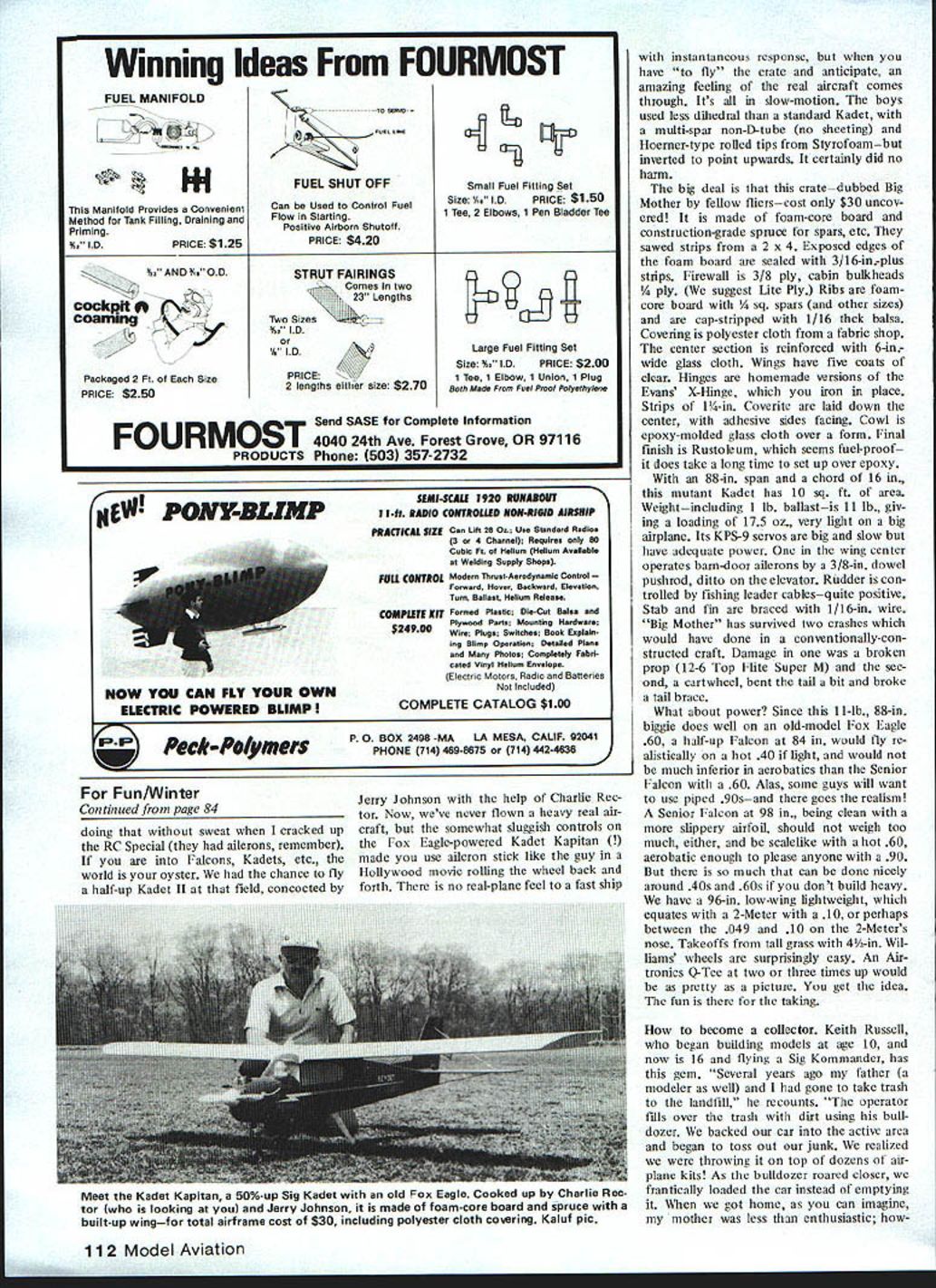
“Big Mother” — a lightweight giant Kadet
- A group in Fredericksburg built a large Kadet-style plane dubbed “Big Mother”:
- Foam-core board construction with spruce spars; ribs from foam-core board cap-stripped with 1/16-in. balsa.
- Firewall 3/8-in. plywood; cabin bulkheads 1/4-in. ply (Lite Ply suggested).
- Center section reinforced with 6-in. glass cloth; five coats of clear on wings.
- Hinges: homemade version of Evans’ X-Hinge ironed in place; cover added with polyester cloth.
- Cowl: epoxy-molded glass cloth over a form; final finish Rustoleum over epoxy.
- 88-in. span, 16-in. chord = about 10 sq. ft. area. Weight including 1 lb ballast ~11 lb (loading ~17.5 oz/ft²).
- Survived two crashes that would have ruined conventionally built ships.
- Power examples: an old-molded Fox Eagle .60 flew it adequately; half-up Falcons and similar big floaters can be made realistic with .40–.60 engines if built light.
How to become a collector (anecdote)
- Keith Russell (started building models at age 10; now 16 and flying a Sig Kommander) recounts finding dozens of airplane kits at a landfill while helping his father take out trash. They frantically loaded the car instead of emptying it; his mother was less than enthusiastic, but the haul was worth it.
Final notes
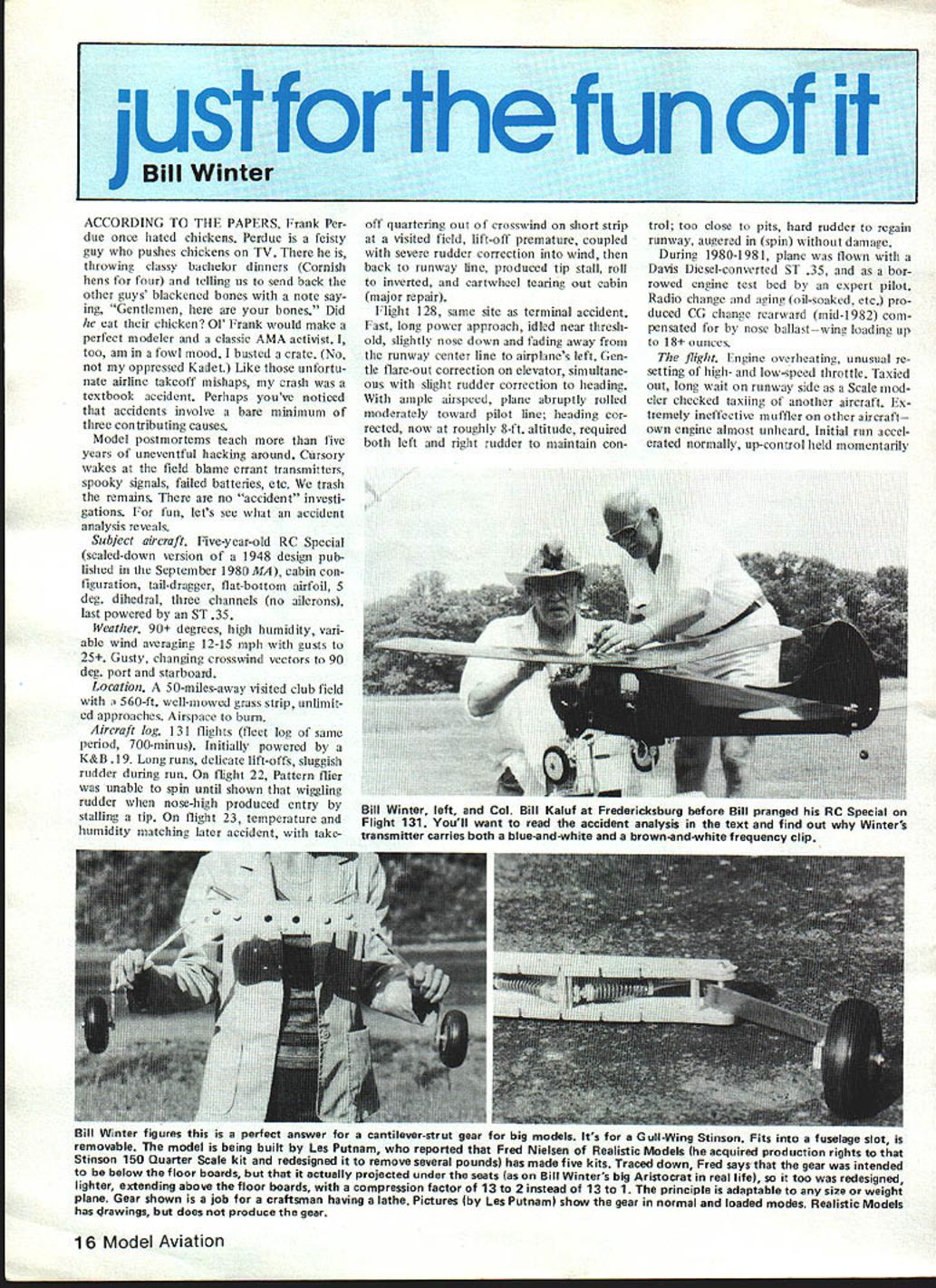
- Cantilever-strut gear ideas and quarter-scale kit developments were traced through modelers and small manufacturers; production rights and design adaptations (e.g., for the Stinson 150 quarter-scale) have been discussed among local craftsmen and shops.
- The big lesson: keep your equipment maintained, respect weather and field conditions, and don’t fly a marginal ship in marginal conditions. We fly for the fun of it — and should keep it that way.
Transcribed from original scans by AI. Minor OCR errors may remain.

