
Just for the Fun of It
Bill Winter
VIBES!
Flying sometimes has mysterious extra dimensions. One may fly routinely for months, then (when least expected) everything resonates: the field, fliers, flying, clouds, trees, the air itself. If only the day would never end. Like projections on the wall, images of flight drift before closed eyes at night. To sleep is to lose it!
Sunday began as a nothing day, hot and humid—but would turn cool and calm. To watch frequency pins instead of airplanes at the Sunday melee would be a downer. Other restless souls were stirring, it seems. By three o'clock, with Don Srull and Hurst Bowers, we felt the tug of Shangri-la, that never-never land in the rolling Maryland countryside. No planning governed what we tossed into the wagon.
- Don had a geared VL electric Bleriot canard FF Scaler.
- He also had a DH-6 rubber job.
- And a dusted-off Mattel Super Star whose batteries had not been charged in eight years.
(The Bleriot and DH-6 were winners at the FAC Nats, I just discovered in their newsletter.)
A teenager (who used to watch the Rubber Scale guys on Friday nights and now pushes the champs) walked up with a yellow Pietenpol Don had lost in the trees a week or two before. He immediately wound it for a long, circling flight. Some planes just want to fly. There must be an intangible fourth dimension to design, because unappreciated combinations of things you can never put a finger on somehow enable these unpromising crates to endure far beyond the sleekest, most expertly flown, efficient models. With minuscule power they work their way slowly aloft, and when free-wheeling, reach out, and out, and out.
That DH-6 rubber job—ugly, no stagger, boxy—is a winner year after year. It was on its last legs when we first saw it six years ago. It looks as weary as the Flying Dutchman, but every flight is a smooth and prosperous voyage.
In the center of the field there is a deep bowl from which the rubber-powered fliers launch in a not-always-successful strategy to avoid trees at one end. On top of a grassy knoll, we stuck the shining red-and-yellow RC-assist Vagabond on its stand.
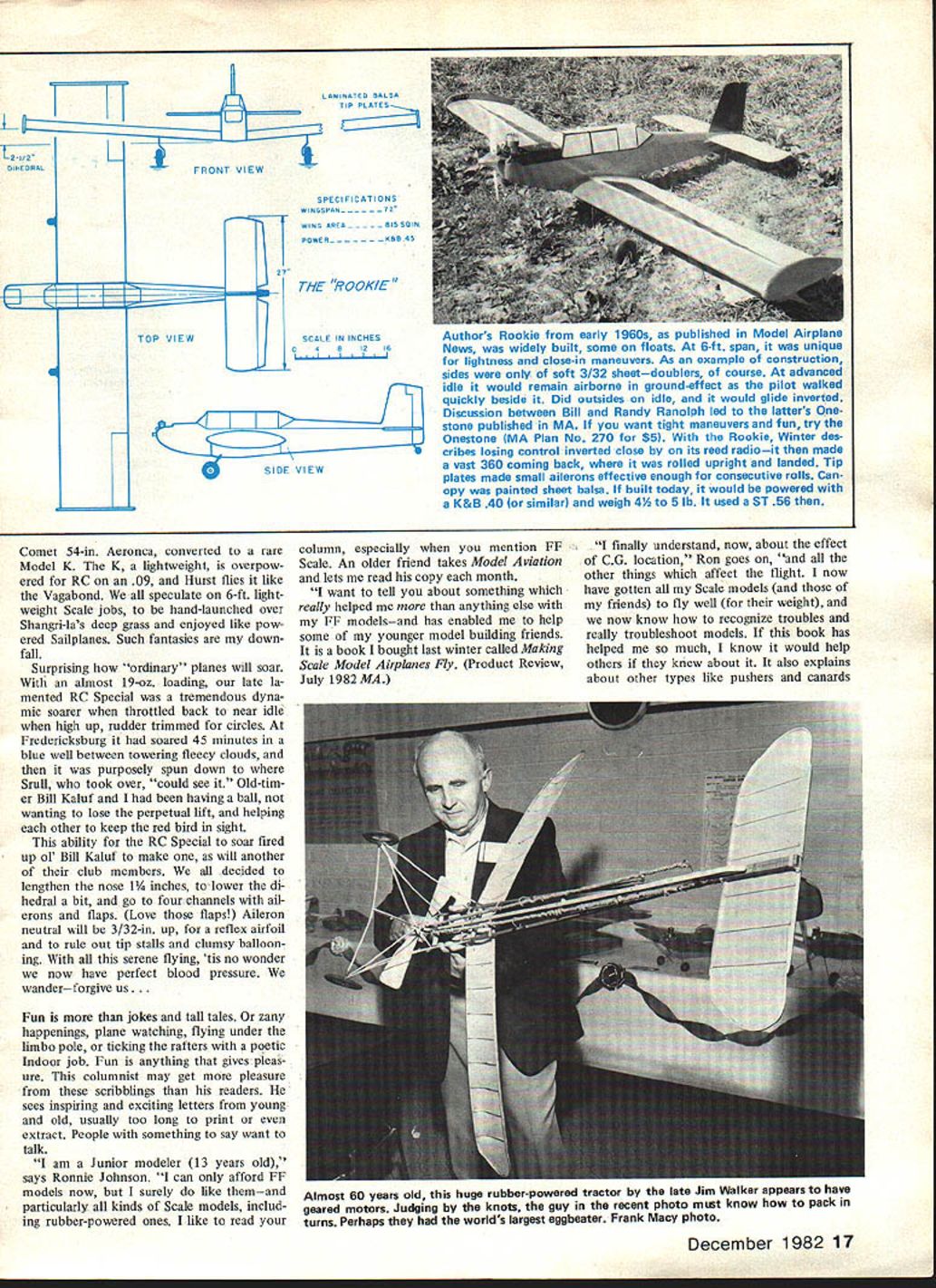
Holding altitude on idle with its Veco .19, the Vagabond then out-glides a lone RC sailplane pilot's Two-Meter, which gets the three of us into a discussion of Bowers' modified Comet 54-in. Aeronca, converted to a rare Model K. The K, a lightweight, is overpowered for RC on an .09, and Hurst flies it like the Vagabond. We all speculate on 6-ft. lightweight scale jobs, to be hand-launched over Shangri-la's deep grass and enjoyed like powered sailplanes. Such fantasies are my downfall.
Surprising how "ordinary" planes will soar. With an almost 19-oz. loading, our late lamented RC Special was a tremendous dynamic soarer when throttled back to near idle; when high up, rudder trimmed for circles. At Fredericksburg it had soared 45 minutes in a blue well between towering fleecy clouds, and then it was purposely spun down to where Srull, who took over, "could see it." Old-timer Bill Kaluf and I had been having a ball, not wanting to lose the perpetual lift, and helping each other to keep the red bird in sight.
This ability for the RC Special to soar fired up ol' Bill Kaluf to make one, as will another of their club members. We all decided to lengthen the nose 1-1/4 inches, to lower the dihedral a bit, and go to four channels with ailerons and flaps. (Love those flaps!) Aileron neutral will be 3/32-in. up, for a reflex airfoil and to rule out tip stalls and clumsy ballooning. With all this serene flying, 'tis no wonder we now have perfect blood pressure. We wander—forgive us...
Reflections on Fun
Fun is more than jokes and tall tales. Or zany happenings, plane watching, flying under the limbo pole, or ticking the rafters with a poetic indoor job. Fun is anything that gives pleasure. This columnist may get more pleasure from these scribblings than his readers. He sees inspiring and exciting letters from young and old, usually too long to print or even extract. People with something to say want to talk.
A Junior Modeler Writes
"I am a Junior modeler (13 years old)," says Ronnie Johnson. "I can only afford FF models now, but I surely do like them—and particularly all kinds of Scale models, including rubber-powered ones. I like to read your column, especially when you mention FF Scale. An older friend takes Model Aviation and lets me read his copy each month.
"I want to tell you about something which really helped me more than anything else with my FF models—and has enabled me to help some of my younger model-building friends. It is a book I bought last winter called Making Scale Model Airplanes Fly. (Product Review, July 1982 MA.)
"I finally understand, now, about the effect of C.G. location, and all the other things which affect the flight. I now have gotten all my Scale models (and those of my friends) to fly well (for their weight), and we now know how to recognize troubles and really troubleshoot models. If this book has helped me so much, I know it would help others if they knew about it. It also explains about other types like pushers and canards and helicopters—and why pushers can't climb straight up like tractor models and other things.
"Have you read this book? I know it would help others with FF Scale models if you would let them know something about it in your column."
Ah, me! In the dear, dead days beyond recall we all had to learn in Ron's way—and that of his friends—about building and flying models. It took the writer two seasons to get a model to fly—it skimmed the ground for an epic distance of 70 feet. Before the writer was born, many modelers had flown thousands of feet, but we all were forced to reinvent the wheel. Old-timers remember.
You can bet that Ron—and his friends—will find the handle on many problems, thanks to models. Can anyone truly and sensitively comprehend the nature of all that is lumped together in the word flight, without having mastered FF, even if only in rubber-power form? Many of us know only how to fly on an engine, not a wing, and to epoxy lead jumps on the nose or tail. All Juniors are not the sons of AMA fathers. Nor do they read, much less even see, all or any of our magazines. Yet a handed-down copy takes root, and a lucky product review of a good book affects a still wider circle of young people who, otherwise, would never know. You can be sure that these chaps have learned more on their own, by chance encounter, than all of the magazines put together would be able to teach them.
Book Recommendation
Bill McCombs, who has been writing scientifically about Scale design and flying (Model Airplane News published yet another of his works), do take a bow. Making Scale Model Airplanes Fly, by Bill McCombs, $7.95, Aircraft Data, Box 32021, Dallas, TX 75224.
Jane Eyre?!
I've always been a sucker for a "special" picture. As an editor often I would confront a writer with a nifty pic and ask him if he could write an article so I could share that marvelous shot.
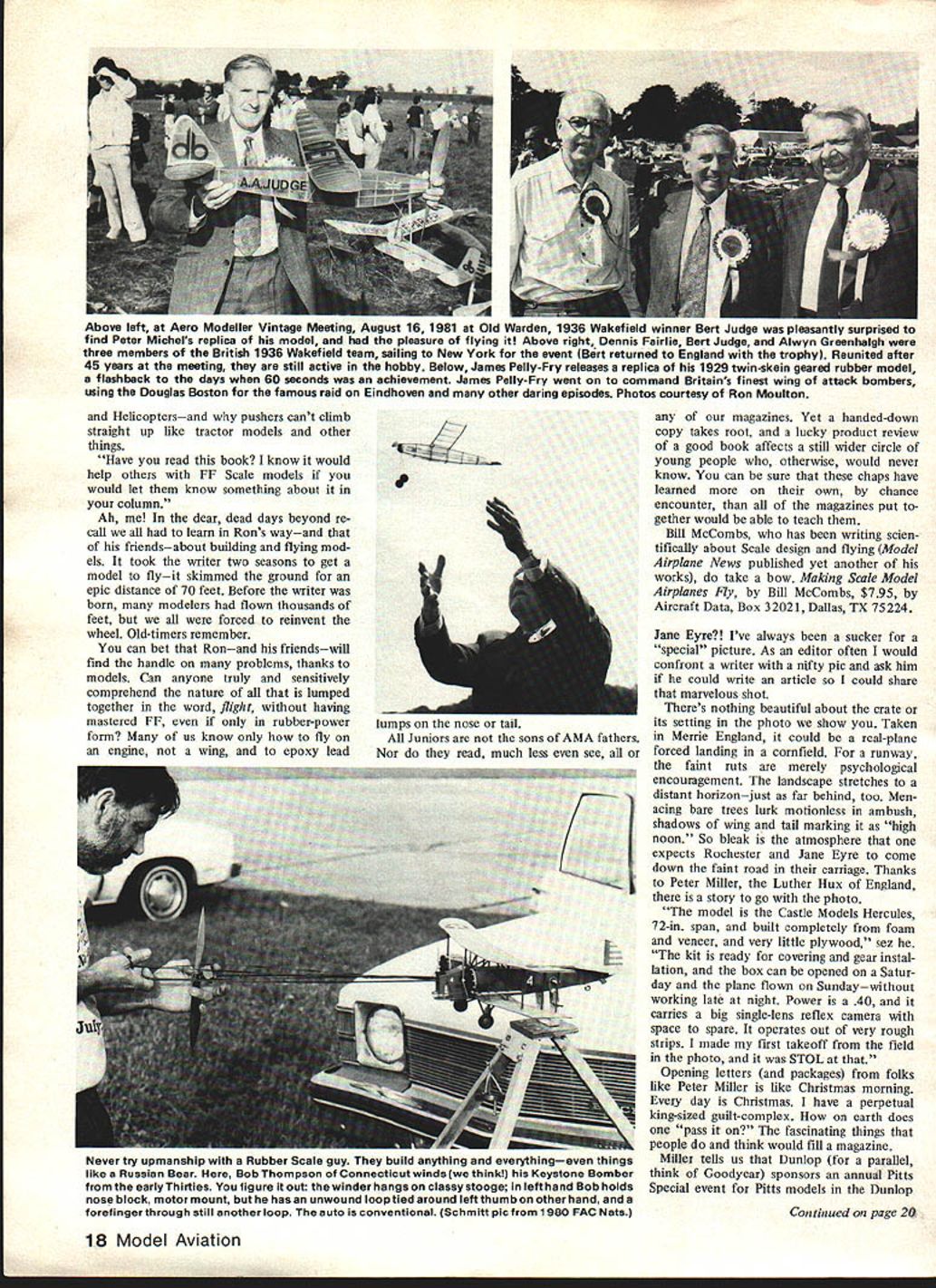
There's nothing beautiful about the crate or its setting in the photo we show you. Taken in Merrie England, it could be a real-plane forced landing in a cornfield. For a runway, the faint ruts are merely psychological encouragement. The landscape stretches to a distant horizon—just as far behind, too. Menacing bare trees lurk motionless in ambush, shadows of wing and tail marking it as "high noon." So bleak is the atmosphere that one expects Rochester and Jane Eyre to come down the faint road in their carriage. Thanks to Peter Miller, the Luther Hux of England, there is a story to go with the photo.
"The model is the Castle Models Hercules, 72-in. span, and built completely from foam and veneer, and very little plywood," sez he. "The kit is ready for covering and gear installation, and the box can be opened on a Saturday and the plane flown on Sunday—without working late at night. Power is a .40, and it carries a big single-lens reflex camera with space to spare. It operates out of very rough strips. I made my first takeoff from the field in the photo, and it was STOL at that."
Opening letters (and packages) from folks like Peter Miller is like Christmas morning. Every day is Christmas. I have a perpetual king-sized guilt complex. How can one thank someone? "Pass it on." The fascinating thing about people who do things like that is that they don't expect praise, and they think we'd fill a magazine.
Miller tells us that Dunlop (for a parallel, think of Goodyear) sponsors an annual Pitts Special event for Pitts models in the Dunlop colors—for RC, FF, CL, and static (a slew of eye-blinding color prints just went into our morgue). And he topped it off with full-size plans of our own Skybo FF kitted by Eagle at WWII's end. It stirs yet another of our hopeless fantasies. (Into the morgue.) With it came a 20-page Catalogue of Plans (List No. 3, 1982) from Ben Buckle's Old Time Plans Service (the British John Pond), illustrated with many great crates of yore, including many from the U.S. of A. The address is 9 Islay Crescent, Highworth, Wiltshire, SN6 7HL, England. (Cost: 20p.)
And thanks to a nice note from Don Hartman, an airline pilot who regularly gets to England and flies Old-Timers there with Dave Baker, editor of SAM 35 Speaks, we can tell you the English publication is full of goodies—three-views, airfoils, engine drawings—do try to get a copy. Baker's address is 22 Ellington Rd., Muswell Hill, London N10 3DG, England.
Plans, People, and Memories
A mention of Dale Willoughby, Scale Model Research, P.O. Box 685, Orange, CA 92666, who wrote the definitive piece on fiberglass for us on Grid Leaks in the early 1960s, produced a list of 50 great plans he has for Scale buffs (send one buck). Enjoy: "Just found a P-51 Razorback and a Curtiss O-52 Owl, both in prime flying condition—in addition to the listing. Appreciated your comments on old-timers . . . to date, I started 50 years ago with a Cleveland Winnie Mae and have run the gamut from microfilm to 13-ft. sailplanes, with two FAI RC Speed Sailplane records hanging on the wall. After 24 years in the Marine Corps, I retired and started to import RC sailplanes, then sold out to Windspell Models and started Model Helicopters—sold that, and started Model Jet Aircraft. Had an R&D contract with Lockheed Missiles for the Flying Fish, a cruise missile concept which didn't make it, now am into Scale Model Research with 410 different subjects and finding more . . . also photography on demand. Found and shot the PBY-5 on the Miller Beer commercial near Moses Lake, WA for John Szofer. Now getting data ready for a Quarter Scale Sopwith Snipe. Plans drawn, starting to cut the wood planks from Ecuador."
Alvin Johnson (prexy of Quarryville RC Club, Oxford, PA), noting Bob Benjamin's search for an Aeronca K plan, advises that Hobby Helpers plan No. 558 depicts a 1958 60-in., .15-powered job by Ed Yulke—suggests 50% to 100% up for Giant Scale. Benjamin, who'll be doing a series of cover paintings for a friendly model mag, thanks to Bob Lopshire, is onto the perfect plan, now in the hands of an eastern seaboard guy who has the real thing handy to inspect.
We flew along with the late Ed Yulke on numerous occasions and can say that his "K" is just lovely (as is Hurst Bowers' RC version of the Comet 54-in. oldie kit, part of that classic series which includes the Taylorcraft that is forever being modeled in many forms, even Indoor RC). Ed used the Babcock 465 freq. radio, which probably had less range than the 49 MHz kid stuff today.
We forget the prop diameter used on Ed Yulke's model, but the pitch was 4 in., which had a wonderful braking effect for nose-down glides and approaches when throttled. At 5-in. pitch, that didn't happen.
Someone else (we think O. W. Brown) sends clip sheets of that Little Toot from the December 1961 American Modeler. At 33-1/8 inches span, it was designed by the late Cal Smith (Cal was a one-of-a-kind master who tore out his hair trying to teach the writer how to fly Control Line back in 1946), and it requires precious little modification to make it a top RC that would be an equal to the Aeromaster. That plan is in Hobby Helpers Group No. 1261.
Frank Zaic and American Boy
Like the Mississippi, Frank Zaic rolls on forever. Frank, who published the famous Yearbooks and others (in distinctive orange covers) is a former patent draftsman, which enabled him to grind out formidable numbers of three-views of models for his books. He is, as far as we know, the first U.S. modeler to receive the world-famous Tissandier Award for outstanding contributions to international modeling. He started the original JASCO—the Indoor model wood was 20 in. long because of the limitations of his tiny saw table—during the Depression. In his new magazine-size book of 160 pages, Model Airplanes and the American Boy—1927–1934, he has achieved the wish of a lifetime. It's a grand collection of reprints, plans, articles—many by his fellow Hall of Famer, the late Merrill Hamburg.
American Boy lasted for more than 100 years. They even had their own building in Detroit. Their support of post-Lindbergh modeling enabled Hamburg to build an organization, the AMLA, which bequeathed AMA its heritage (folklore hand-downs, so to speak), actually achieved 400,000 members!
At $9.95 ($8.00 from the AMA HQ Supply & Service Section), Frank's monumental work not only contains a cornucopia of plans of the day, but a once-in-a-lifetime insight into Americana. They were kids then. The last issue of American Boy appeared in the early '40s. We had model magazines from 1920 on. Everyone grew older, the mags evolved steadily into "expert" stuff—in stuff really.
Like strip mining, we left behind us a barren landscape. Now the average age of the American modeler is double that of the time of the great adventure. Kids may be there still. Who knows? Few care. Who could afford to serve them? We don't even know how. Of course, we can carp about those "terrible" products that are made by the millions. If people took us seriously, there would be nothing at all.
Zaic has been collecting this rare material since 1966. His book is a time-warp.
Paul Plecan and Plan Packets
Having bought Paul Plecan's first published item, a P-35 three-view, in 1936, and having hired him as a staff draftsman on the old Air Trails before the war, we admire his long career as one of our great designers and draftsmen. Such idealism does not make a man rich. We have his Plan Packet No. 3, the Macchi-Castoldi M.C.72 seaplane on one side (1/10th scale—37-3/8 in.) and Arado 76 Trainer (1/10th scale, 31½ in. span) on the other.
"I've wanted to build for ages that M.C.72," says Paul. "A slick configuration and the silliest of all the beautiful Schneider Cup racers. I wanted a big version for hydrodynamic reasons—the big 'uns just hop off the water so much better! I am sure that Jumbo R.O.W. events will become very popular once the average guy sees how effortlessly these jobs rise off water. And after an explosion of old rubber in my Bede 4 at a recent Flightmasters meet—external winding is the only way to fly. I am playing it safe by going the motor tube route."
Paul's Packet No. 1 was an .049 Tornado II and a 30-in. Pilatus Porter; No. 2 the Howard Pete and Bede 4. They are $4.50 a pack, two for $8.50, three for $12. You'll find Paul at 3663 Polk St., Riverside, CA 92505.
Back on the Farm
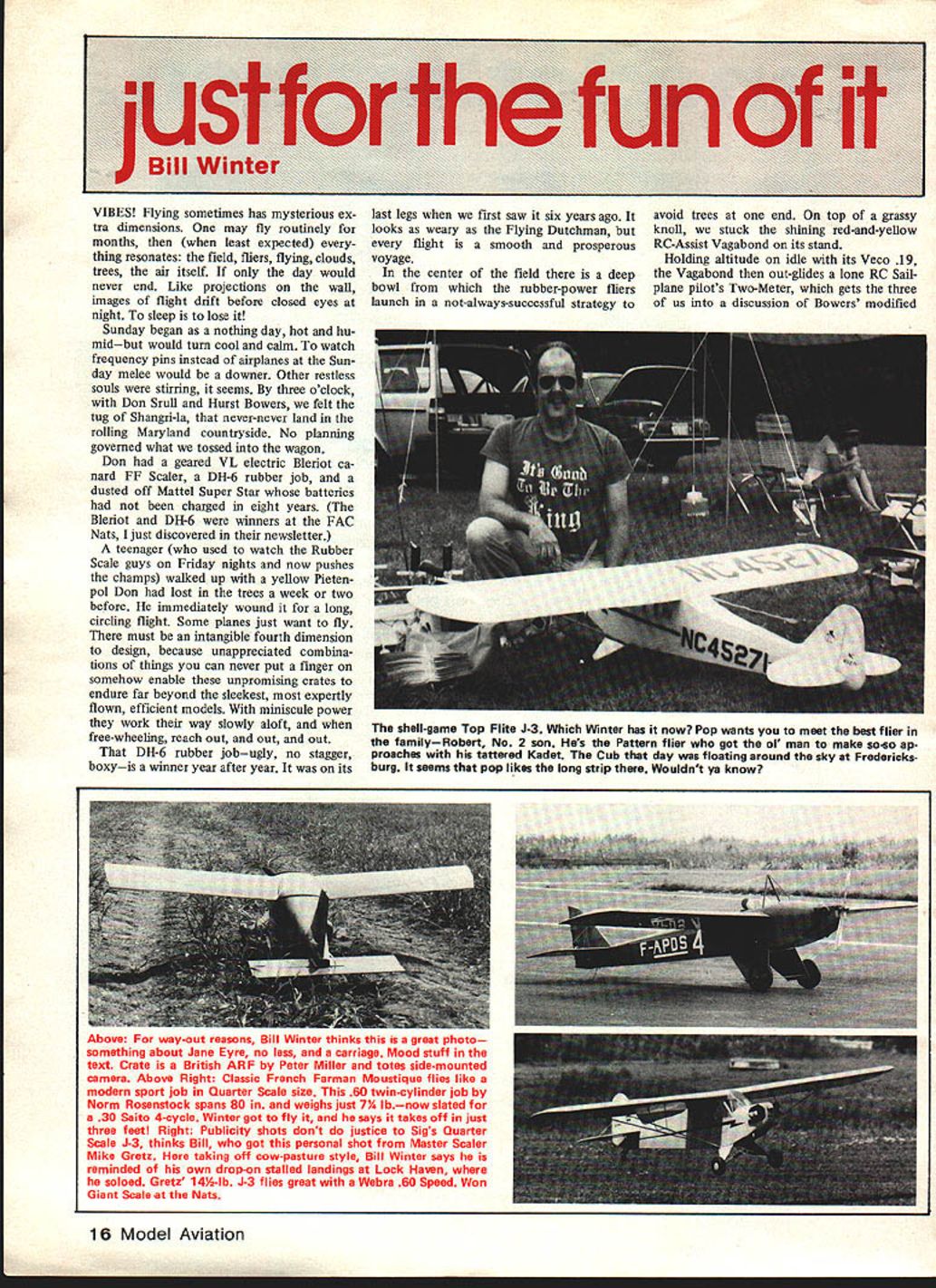
I finally got to see "my" Top Flite J-3, which son Mike borrowed, then built for son Rob, the Pattern guy who is utterly fascinated with the thing. It sounded awful on a K&B .40 screamer, so I lent the guys my custom Aldrich ST .46, ported for torque and lugging big props. "Heavens!" said Rob on his visit, "You said we stole your J-3 in your column, so here it is!" We urged him to take the pleasure crate home with him, and noted he didn't put up a fight. So there I was steering it sedately by at about 100 ft. when it conked out—he refused to take back the box, and erratic Willy put it down as smooth as silk. Maybe I had nothing to do with it. On red-and-white (useless where he flies) he finally got to wing out again his ancient Mach I without a glitch.
If you have flying problems, get a Pattern guy to comment while you struggle. It's all about feel and no "do this or do that." You dig that, and the approaches suddenly look like a million bucks. That family K&B .40 is in my persecuted Kadet. Polished inside, no compression, and you can't possibly get a pop by hand-flipping; it springs to life with a starter, and his description of it as an "animal" is right on. So, now, is the Kadet. The step up to a .40 from a .35 makes it far easier to fly—and smoother at all power settings. I now have 3/32-in. up-neutral on ailerons and a far-forward C.G. Yet, with up-trim on a dead engine, it glides slowly and holds altitude so well—and can be soared occasionally if you work at it.
Balance Point and Trimming
Here's what Claude McCullough said: "Your comments reinforced an idea I have had for some time. Namely, that Balance Point should be a part of trimming a model as much as incidence, control movements, etc. And you can't put a balance point down on a plan and have it right for all cases. The weight of the model, the power used, individual differences in the way the model is built, even the skill of the pilot all influence the choice of C.G. for that particular model." Hear, hear!
Two-Meter Mania and the Metrick
Meanwhile, son Mike, whom we left half asleep last month on a spread-out sheet as he tooled his Gentle Lady (.049), called about his Top Flite Metrick. You surely have noticed all the companies that suddenly went Two-Meter bananas. So many pieces, sez he. And the wing panels go on wires, as do the stab halves, and gee, the whole stab tilts for control. Now that he understands that he is into a typical sailplane man's Two-Meter, he's now Mono-Koting the thing. The Metrick definitely is not intended to compete (trade-wise) with the Gentle Lady, Drifter, or even the Bird of Time out of RCM, etc. We suggested to Mike that if he got out on a 100-degree-plus day with winds at 30 ("press on at all costs"!), he'd see that all sailplanes cannot be alike. Each is designed for an envelope of conditions and performance. Scott Christensen, at Top Flite, is a top sailplane pilot, and the Metrick reflects his input. It flies faster, and it turns very flat without a tip stall. And it requires more flying experience and a deft touch.
Norm Rosenstock's Farman Moustique
We got to see Norm Rosenstock fly his new quarter-scale Farman Moustique. This Farman is a strangely modern and pretty-looking crate in spite of its being a French antique. Bill Hannan loves this crate as a little rubber-power job. John Preston has an RC beauty with an ST .25. During its design, we argued with Norm that it would be a crime to overpower such a bird, but Norm kept saying that most of his plans customers insist on aerobatics with everything, even a Wright Flyer if there was one. Sure, we understand flight realism—and no one can build anything to fly at scale speed—but the Moustique had to have zip. Oh death, where is thy sting? So here it was with a Ross Twin 60, a span of 80 in., and 14.5 oz. wing loading for 8 sq. ft. of area and 7½-lb. weight. A floater, of course. My big Aristocrat almost floats at 38-oz. loading.
Norm's Moustique took off in three feet (zero in a breeze), and it recovers from a complete stall in about its own length. He flies flat, unbanked 360s by crossing controls. Now he tells me it would be better with a .35 to .45 sport engine! He thinks a .30 4-cycle Saito FA-30 would be ideal. Old Norm will be right-on with those "sport" engines—too bad his Farman is just a plan and not a kit. If a kit, I'd have to sit on yet another tantalizing fantasy.
About That "Turbulent"
"The photo of my (Turbulent) in the September issue is really a Jodel D-9, which you probably know," writes Dick Konkle. "Just can't resist poking a little fun." Since only two guys wrote about that glaring "error," I thank you all for realizing it was the gosh-awful typewriter that did it! I know the difference. Dick has more info.
"A little history on my D-9. A group of us bought plans for the full-size plane around 1958—I fell heir to the plans. When I bought a Gemini Twin I looked around for a design that had an exposed two-banger and also was reasonably aerobatic—the Jodel was my choice. Structure is all scale, including the sprung landing gear. The scale is 30% wingspan about 88 in., weight 13½ lb. She has done well in contests, usually first or second."
In the caption two issues back (Turbulent) I extolled the flying qualities of the Jodel. The same is true of the Turbulent. Both are magnificent subjects for Rubber, FF Gas, CL, or RC in any size.
By now, your editor is screaming for my frequency pin!
Bill Winter 4426 Altura Ct., Fairfax, VA 22030.
Transcribed from original scans by AI. Minor OCR errors may remain.

