
Just for the Fun of It
Bill Winter
SOMEDAY my Quarter Scale Vagabond may make me happy, but right now it is a king-sized pain. I keep adding little things. But, like Mount Everest, the project towers unchanging. Until you cover one of these things, you are still on the wrong side of the power curve.
For a plain Jane, the Vagabond hides a complex personality. I have letters with piles of photos from active modelers who also own the real thing. No two are alike. Walt Mooney asks a mutual flying friend how Bill is coming with "his" Vagabond.
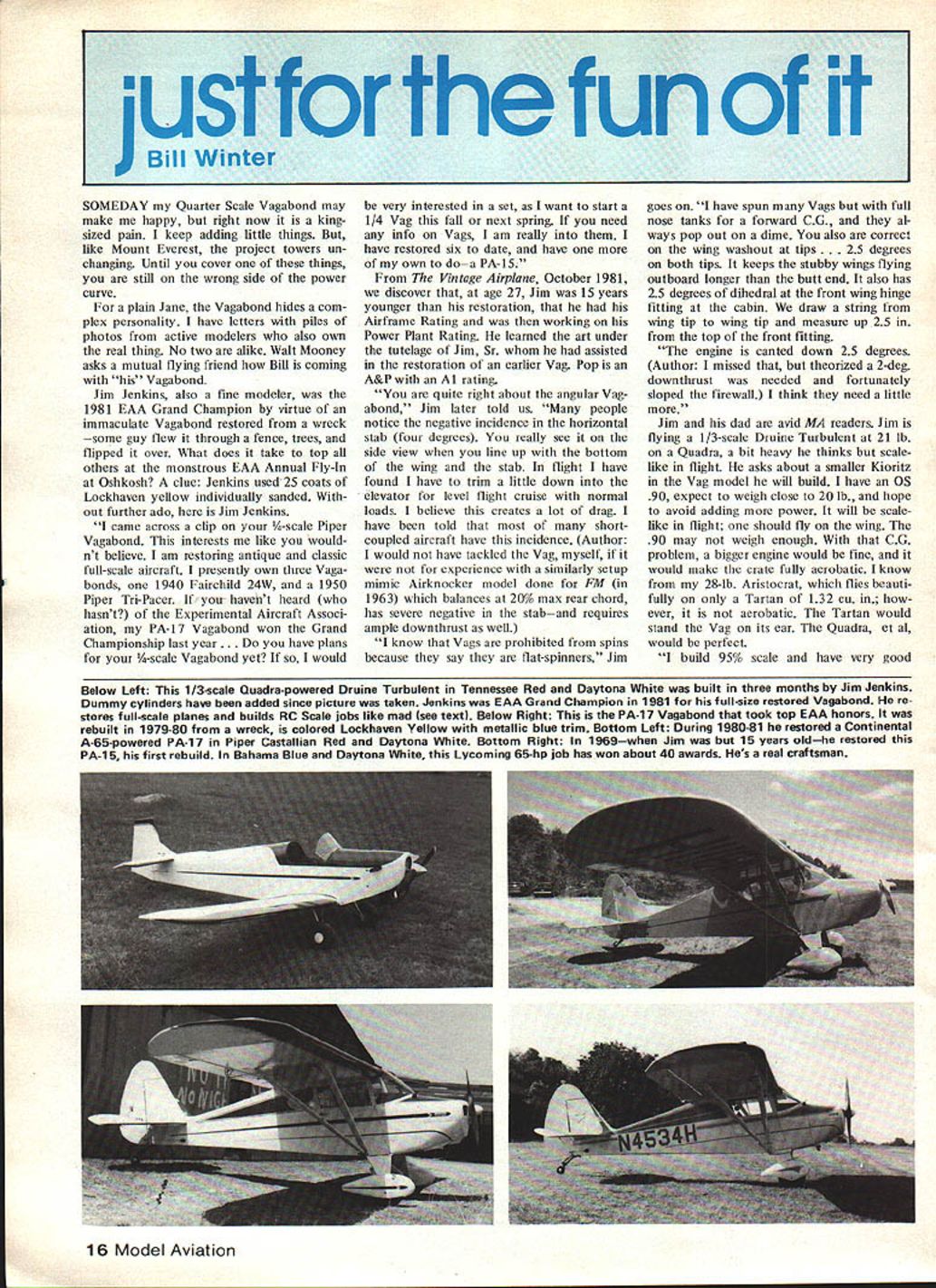
Jim Jenkins, also a fine modeler, was the 1981 EAA Grand Champion by virtue of an immaculate Vagabond restored from a wreck—some guy flew it through a fence, trees, and flipped it over. What does it take to top all others at the monstrous EAA Annual Fly-In at Oshkosh? A clue: Jenkins used 25 coats of Lock Haven yellow, individually sanded. Without further ado, here is Jim Jenkins.
Jim Jenkins
"I came across a clip on your 1/4-scale Piper Vagabond. This interests me like you wouldn't believe. I am restoring antique and classic full-scale aircraft. I presently own three Vagabonds, one 1940 Fairchild 24W, and a 1950 Piper Tri-Pacer. If you haven't heard (who hasn't?) of the Experimental Aircraft Association, my PA-17 Vagabond won the Grand Championship last year. Do you have plans for your 1/4-scale Vagabond yet? If so, I would be very interested in a set, as I want to start a 1/4 Vag this fall or next spring. If you need any info on Vags, I am really into them. I have restored six to date, and have one more of my own to do—a PA-15."
From The Vintage Airplane, October 1981, we discover that, at age 27, Jim was 15 years younger than his restoration, that he had his Airframe Rating and was then working on his Power Plant Rating. He learned the art under the tutelage of Jim, Sr., who in 1979 had assisted in the restoration of an earlier Vag. Pop is an A&P with an Al rating.
"You are quite right about the angular Vagabond," Jim later told us. "Many people notice the negative incidence in the horizontal stab (four degrees). You really see it on the side view when you line up with the bottom of the wing and the stab. In flight I have found I have to trim a little down into the elevator for level flight cruise with normal loads. I believe this creates a lot of drag. I have been told that most short-coupled aircraft have this incidence. (Author: I would not have tackled the Vag myself, if it were not for experience with a similarly setup Airknocker model done for FM in 1963 which balances at 20% max rear chord, has severe negative in the stab—and requires ample downthrust as well.)"
"I know that Vags are prohibited from spins because they say they are flat-spinners," Jim goes on. "I have spun many Vags, but with full nose tanks for a forward C.G., and they always pop out on a dime. You also are correct on the wing washout at tips—2.5 degrees on both tips. It keeps the stubby wings flying outboard longer than the butt end. It also has 2.5 degrees of dihedral at the front wing hinge fitting at the cabin. We draw a string from wing tip to wing tip and measure up 2.5 in. from the top of the front fitting.
"The engine is canted down 2.5 degrees. (Author: I missed that, but theorized a 2-deg. downthrust was needed and fortunately sloped the firewall.) I think they need a little more."
Jim and his dad are avid MA readers. Jim is flying a 1/3-scale Druine Turbulent at 21 lb. on a Quadra, a bit heavy he thinks but scale-like in flight. He asks about a smaller Kioritz in the Vag model he will build. I have an OS .90, expect to weigh close to 20 lb., and hope to avoid adding more power. It will be scale-like in flight; one should fly on the .90. The .90 may not weigh enough. With that C.G. problem, a bigger engine would be fine, and it would make the crate fully acrobatic. I know of a 28-lb. Aristocrat, which flies beautifully on only a Tartan of 1.32 cu. in.; however, it is not acrobatic. The Tartan would stand the Vag on its ear. The Quadra, et al., would be perfect.
"I build 95% scale and have very good luck." He is able to fly a scratch-built 7-ft. SR-8 Stinson Reliant, a 1940 Fairchild 24W scaled from his full-scale bird to a 6-ft. span, and a 54-in. Beech Staggerwing that is a good flier on an Enya .45. He is building a full-scale Gee Bee "E" with a 110-hp Warner, a beautiful flying aircraft, and observes that maybe the Granvilles should have stuck with these early-model sportsters. Info is from CAA certification flight reports and original CAA/FAA microfilm and data. If Jim would only come to my shop, my Vag would fly in a week!
Traveling music
When you fly a lot, you see self-designed aircraft and off-the-beaten-track guys whose efforts range from the "I'll try anything as long as it is different," to those with mundane-looking stuff which involve hidden aerodynamic trickery. Every flying site boasts a few independent souls, and it requires no calculator to realize that experimenters nationally run into the thousands. They are a clever lot, but their stuff never gets published. What might they tell us?
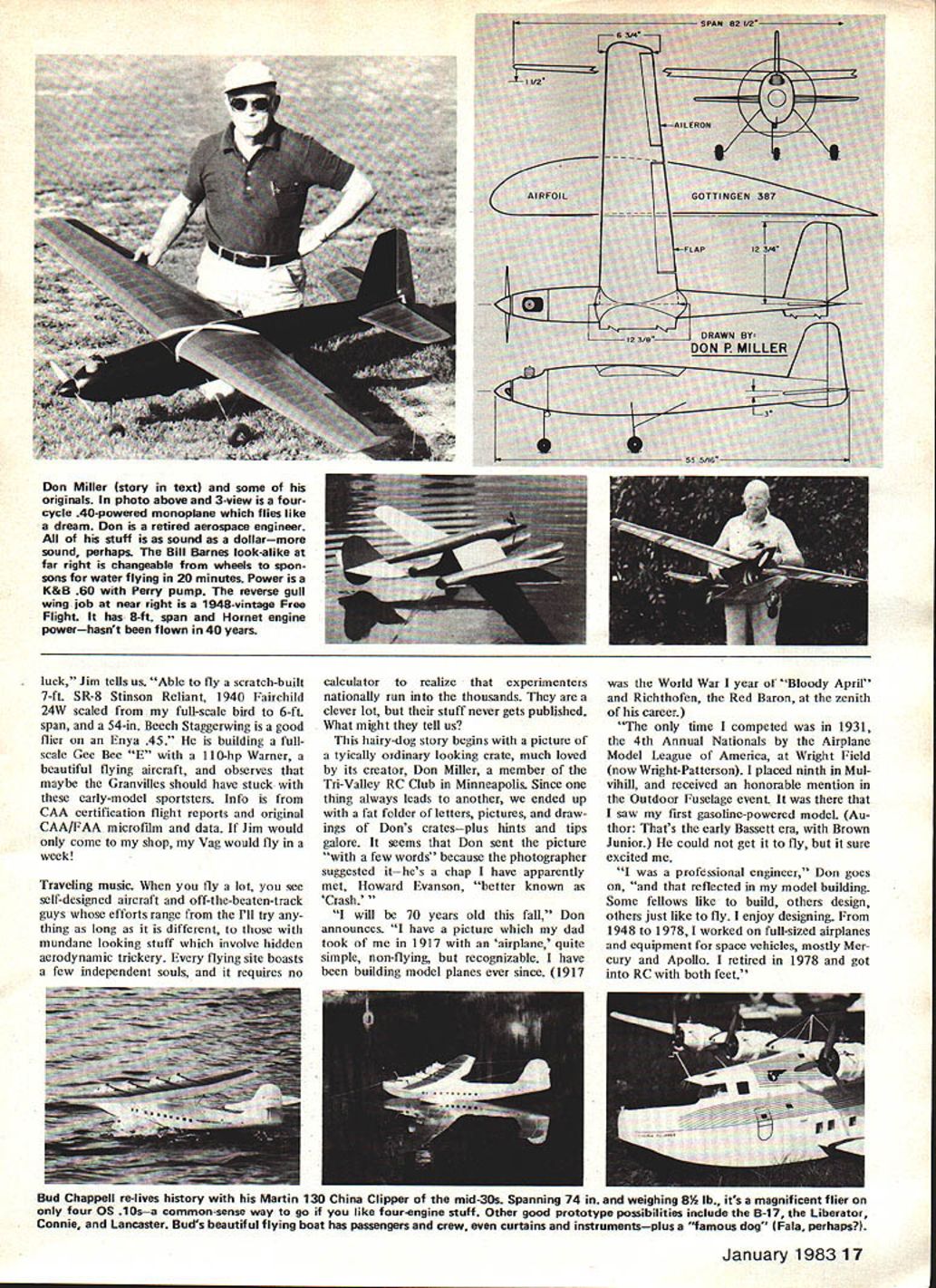
This hairy-dog story begins with a picture of a typically ordinary-looking crate, much loved by its creator, Don Miller, a member of the Tri-Valley RC Club in Minneapolis. Since one thing always leads to another, we ended up with a fat folder of letters, pictures, and drawings of Don's crates—plus hints and tips galore. It seems that Don sent the picture "with a few words" because the photographer suggested it—he's a chap I have apparently met, Howard Evanson, "better known as Crash."
"I will be 70 years old this fall," Don announces. "I have a picture which my dad took of me in 1917 with an 'airplane,' quite simple, non-flying, but recognizable. I have been building model planes ever since. (1917 was the World War I year of 'Bloody April' and Richthofen, the Red Baron, at the zenith of his career.)
"The only time I competed was in 1931, the 4th Annual Nationals at the Airplane Model League of America, at Wright Field (now Wright-Patterson). I placed ninth in Multiflash, and received an honorable mention in the Outdoor Fuselage event. It was there that I saw my first gasoline-powered model. (Author: That's the early Bassett era, with Brown Junior.) He could not get it to fly, but it sure excited me.
"I was a professional engineer," Don goes on, "and that reflected in my model building. Some fellows like to build, others design, others just like to fly. I enjoy designing. From 1948 to 1978, I worked on full-sized airplanes and equipment for space vehicles, mostly Mercury and Apollo. I retired in 1978 and got into RC with both feet."
Don came up with an idea that made it possible for the DC-3s (R4Ds?) which Admiral Byrd took on an expedition to the Antarctic in about 1947 (10 to 15) to take off from a carrier, fly over the Antarctic then back to base—all on snow. The skis, we assume, were slotted for wheels, because they retracted against the bottoms of the nacelles. Don would have gone with Byrd except the admiral could not have paid him—and he had a wife and child.
In the Mercury program while working for Honeywell, Don solved an intricate gyroscopic problem. One aspect was reaction jets to control vehicle attitude; they were either on or off with no proportional control, having to make and break electrical signals at different rates of rotation. They had to operate for 90 minutes—enough for one go-around—if the capsule lost compression.
On Apollo he worked with Astronaut Ed White to design a hand control by which the vehicle attitude could be controlled. It allowed the vehicle to rotate to a desired attitude so a space sextant could be used to calculate departures (if any) from course, then orient it (with 50,000-lb. rocket thrust) to make corrections, slow down for lunar orbit, then accelerate for escape.
Don also designed "strain gauges" to go into control sticks and rudder pedals on the first supersonic airplanes. On fast and large aircraft, surfaces cannot be operated directly by the pilot. Actually, strain gauges send a voltage proportional to the load applied to a computer, which sends electrical or hydraulic signals to the surfaces. Don doesn't know how they work today, but he designed the first ones.
He'll be surprised by all this, but we always talk about modelers' contributions to the science of flight, whatever form it takes.
"When I design an airplane and fellows say nice words," Don continues, "or when I fix something around the house and my wife says 'Good job—you just saved us $50,' it gives me a good feeling to think I have accomplished something. It is like the little boy who was pulling a wagon down the sidewalk. Some fellow admired the wagon and said, 'Hey, kid, where did you get your wagon?' The boy said, 'My dad made it out of his own head and he has enough wood left over to make another one.' I will be glad to share some details of my handiwork with other guys."
Don's ordinary-looking OS .40 4-cycle job uses a thick airfoil, the Gottingen 387. A bit over 15% thick with a root chord of 12-5/8 in. "Now, the Gottingen 387 would probably not mean much to many," he states, "even to present-day designers of full-scale airplanes. It was used on such airplanes as the Ford Trimotor, Lockheed Vega, and the Fokker, all back in the 1920s. (By Fokker, we assume he refers to the Trimotors, et al.) We know that models fly at very low Reynolds Numbers, and these old airplanes flew at much lower Reynolds Numbers than present ones, so I think those old airfoils do a better job on present-day models than present airfoils which fly close to Mach 1. The thick airfoils also give us much higher strength-to-weight ratios. And I go for any airplane (of any size) with a high S-to-W ratio, as well as a high ratio of high speed to landing speed.
"The tip rib is a Clark Y with a chord of 7 in. With wing tips, the span is 83 in., which gives us an aspect ratio of 8-1/2, and this results in a relatively small tip loss, or a better lift/drag ratio. The tests (Author: Reference is to early wind-tunnel tests.) of the Gottingen 387 were made on a 36 by 6-in. wing, six-to-one aspect ratio, speed of 40 mph. (Author: This is directly applicable to present RC models in terms of Reynolds Number). Characteristics are close to the Clark Y; the lift is higher but so is the drag, but not by a lot."
Don got us thinking about parallel-edged wings with tapering thickness from root to tip. The Fokker D-VII (regarded as such a threat that the Germans were required to destroy all D-VIIs after the Armistice—although Tony Fokker smuggled a trainload of components to Holland, and D-VIIs cropped up even into the 1930s) had such wings. So we phoned the guru, Ned Kogranss, who has flown over 360 types from WW I stuff to the jets, and has owned many early classics. After taking the wind out of my sails—you get into weird aerodynamics when even the under surface of a wing is of paramount importance—he expounded on tapered wing, twist, and what-not.
We all know the importance of washout twist on RC wings to avoid tip stalls and bashed approaches. Without twist the tip actually is operating at a higher angle of attack than the root—due to, among other things, tip losses, vortices, etc. Thus, it seems likely that some twist merely gets the tip to fly at the same angle of attack as the root. In the tapered wing, this condition is even more pronounced, so that it seems likely (again) that we may need more washout than commonly assumed.
One of Ned's interesting observations concerned a Ryan STA he had owned (he loves Vultee Vibrators and Robins) which, being wire-braced, allowed him to remove the washout. He gained 10 mph—but "scared the devil out of myself." As Chubby Checkers used to say, maybe we all should "Do the Twist!" And when you meet one of those do-it-yourself designers like Don Miller, ask him about his crate. You'll be entertained and probably enlightened.
Texas Winch Murders
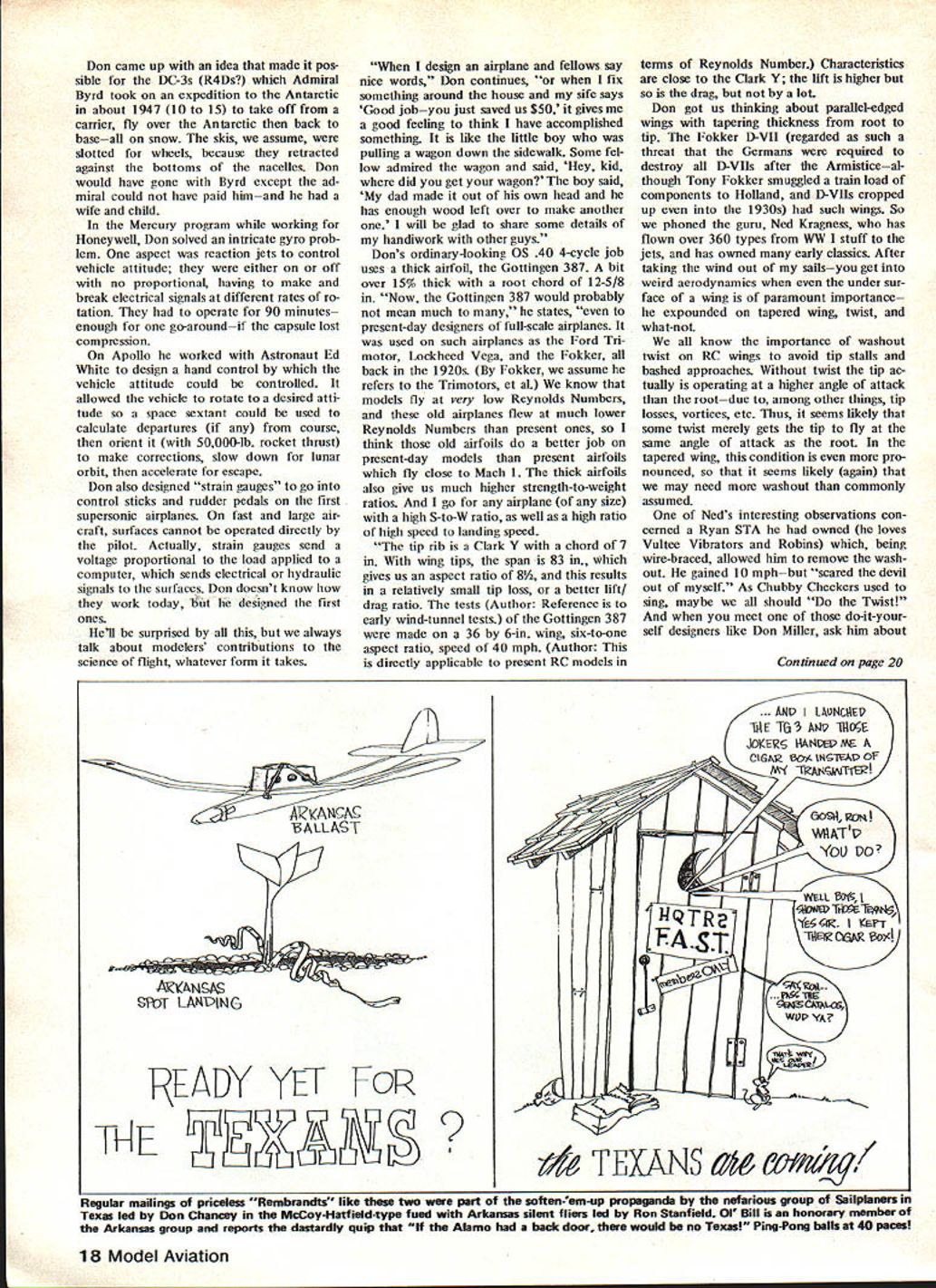
"You may not hear much up there about the traditional rivalry of Arkansas-Texas football games," writes our friend H. A. Thomas of Little Rock. "Well, there is a budding rivalry between our Sailplane club, of which you are an honorary member (Author: The only Razorback in Northern Virginia.), and the Texas bunch led by Don Chancey. They breezed up last fall and cleaned up our annual meet. We meet again this month, and we are better prepared. A few of our guys are razor-sharp. Don has been ridiculing our leader, Ron Stanfield, with a barrage of cute warnings. These are done in two colors, beautifully drawn. (FAST means First Arkansas Soaring Team—our club name.) Two recent Texas meets had totals of 12 and 10 contestants, including two of our boys. We had over 20 last year, and expect about 30 this year."
Those Texas cattle drivers address "our" beloved leader as Ron Stanfield, Half-FAST Leader; Group Captain Ron Stanfield, G.C., D.F.C., B.V.D.; and Mr. C.D. After viewing the accompanying illustrated ransom notes, ol' Bill is tempted to cut the gear off his Vagabond RC-Assist, attach a tow hook, and replace the K&B .19 with a lump of lead. The audacity of it all!
China Clipper!
Since the days of the great sailing ships, the words "China Clipper" evoke a spirit of adventure. We already were flying Gas models when the four-engine Martin flying boats and Pan American forged (in the 1930s) the island-hopping link from the New World to the ancient Orient. Until the logistical demands of WWII proved that land planes could conquer the great oceans (due to new air bases), it was assumed that the future lay with the flying boats, and even the follow-on Boeing 307s paled beside the behemoths envisioned in the postwar '40s.
Bud Chappell perceives his inspirational China Clipper as a viable alternate to having to build monster aircraft to satisfy the ego that is part of all of us. But let him tell it.
"I have been an avid modeler since 1934 (the glory days of the China Clipper) and enjoy flying and building RC Scale models," Bud tells us. "My RC experience began with escapements and tube-type receivers. I find that the thought of a model weighing more than 20 lb. and flown in public is terrifying. It is totally unnecessary to enter or to enjoy even the most complicated model aircraft. For example, my latest plane is a 74-in. Martin M-30 China Clipper. It is my own design and is powered by four OS .10 engines, and it has a gross weight of 8½ lb.
"It flies beautifully and realistically, as witnessed at the May 22 Brimfield, MA Hydro Fly-In. This is a complicated multi-engine model, not a profile, nor stripped-down in any way. The cabin is complete with pilot, cabin windows, seven passengers, and one very famous dog. It has a complete cockpit with captain, copilot, seats, instruments, etc.
"This description is not intended to be an exercise in self-praise," Bud makes clear. "Rather, it is offered as proof that any modeler's imagination and expertise can be 'scaled' to fit any given set of regulations. I submit that I have more fun showing and flying this model at this size than I would have if it weighed six times as much and had a span of 30 ft. It would then become a liability—or to put it another way, more work and worry than pleasure."
Safety
We know all about that, don't we? We have safety rules, the AMA preaches safety practices, clubs are safety-conscious, and yet we fear that violations could cost us dearly. Procedures are fine—up to a point. When you get right down to it, true safety is a private matter between the mind and character of the pilot and the machine which obeys his bidding. When we advance the throttle (assuming all else has been done to the best of our conscientious ability), safety—for one's self, the spectator, other fliers, property, modeling itself—is entirely in our own minds and perception. No one is perfect, and we may not do what is absolutely correct at all times, but our own codes, if we keep working at it, benefit from the correction of every little aberration we, ourselves, become aware of as we fly day in and day out, by the weeks, months, and years.
For two years now, the writer has been able to watch and observe, to put his own house in order. Yet I have serious gripes, and I am far more upset about "harmless" practices which are potentially more dangerous than all the monster airplanes that exist.
Consider the flight strip. The strip is so carefully laid out and distanced from the pits and people, where an airplane is supposed to take off and land, and where we expect many touch-and-goes. But the flight strip is no place for aerobatics, or even fast, low fly-bys. Yet we see and accept as many as four and five airplanes at a time milling about overhead—rolling, looping, inverting, doing wing-overs and stall turns—with cross-grain traffic and an occasional midair. Overhead, there are no horizontal references, and you may not know exactly where the pits (or anything else) are at a particular moment. People love to pour on the coal, then pull out abruptly at mid-strip for a straight-up climb. Or do a wing-over or a stall turn. I just watched a Quarter Scale under test by a hot pilot do this—with an extremely low top to the maneuver, turning toward the pits while lining up the down path. No one, including club safety officers, raised an eyebrow. Overhead, especially right over the strip, is only good for stiff necks.
Recently I was one of 600 men with ships in the air. To my left was the other pilot, a man dedicated to safety, to helping beginners, a ramrod type. Yet his screaming Half-A passed back and forth in front of me—on one pass no more than 15 ft. away and 10 ft. up (it strayed to the near edge of the strip). My son, a Pattern pilot, with an arm on my shoulder to drag me down, kept yelling intelligence into my ear. That pilot had no awareness of himself. Clearly, he did not consider it dangerous. His "innocent" .049 pylon job was, say, a half-second from my head. Why must we all cram ourselves over the flight-strip airspace?
For piloting comfort and accuracy, aerobatics are best done at 45 degrees elevation to yourself, and that puts any plane well off the end of the strip and greatly reduces the chance of a mishap. Fly-bys and passes should be done at or beyond the far side of the strip. There is much more than the possibility of equipment or structural failure, or pilot error, that can cause trouble when maneuvers are done too close to the pits and people.
There are other hazards involved in flying low over the strip in front of the pilot line. Third-order harmonics increasingly are being found as an accident cause. We first learned of this through Bill Hershberger's experiments, and prevailed upon AMA to publish his useful table some time back.
I am not an expert, but I don't find any experts telling us simple stuff we truly should know about. We should know that transmitters should not be within 12 ft., better 15 ft., (a wavelength) of each other. On our field there is a row of small pine bushes along the pilot line, and when pilots select spots between two bushes, this crucial distance is maintained. But, if you take two frequencies beside your own, multiply one frequency by two, then subtract the second frequency from the total, you often find that these two other guys set up a third-order harmonic (your frequency!) that gets to your receiver if you taxi close by in front of them. There are many combinations. Try your calculator!
I walked Don Srull's Spitfire out to the runway, along a taxi strip off one end of the pilot line, and all servos went berserk—and that was a highly selective receiver. If the two offending guys happen to get chummy while flying and their antennas are close together, this fortified effect can prang a landing or taking-off airplane—and well down the strip! Put them right together, and you can hit a new narrow-band receiver surprisingly well up in the air.
To fly and stunt over the strip is gauche. Hot passes are from hunger. There are many other things to consider, but this is not my province.
An important letter came to this column from Louis Guerrieri, a large model pilot and an attorney, who has carried on with us a skilled, impressive discussion. It was arranged with Executive Director John Worth that Lou's letter be published in the AMA News section of the December 1982 issue rather than in this column. We urge you to study it. For the first time someone has lent a useful perspective to the safety question from a legal point of view. It boils down to the fact that any activity necessarily involves the possibility of accidents, and that a key consideration is that models be flown in a "routinely safe manner." "Routinely" is the active word.
Finally, in a recent issue of Flightline, the IMAA magazine, there was an excellent two-page diagram of a safe field layout as seen through the eyes of big-plane fliers. IMAA's map illustrates some of the points this writer is making, especially concerning staying away from that flying strip except to take off and land. If your field has enough space, do take all precautions, not only in field layout and procedures, but also in the way you fly.
Safety depends on you—no one else. Yet many of us stew about monsters when we really should be looking at ourselves, each of us, and our everyday flying habits.
Bill Winter, 4426 Altura Ct., Fairfax, VA 22030.
Transcribed from original scans by AI. Minor OCR errors may remain.

