
Just for the Fun of It
Bill Winter
On Monday mornings, Garfield (the cartoon cat) pulls the blanket over his head. I talk about fun. The rain is coming down in buckets, a dank wind is howling, and it is 9:07. At least I'm not stuck in rush-hour traffic. As the briefing guy on Hill Street Blues says, "Be careful out there!"
Before A.C. (air-conditioning) tamed August in D.C. (District of Columbia), smart old pols survived by spending their time at Atlantic beaches. My August flying sessions were few and far between, mostly early morn or late afternoon at Shangri-la, where our lazy Vagabond RC-Assist caught thermals on every flight but one on five consecutive low-key sessions. September slipped through our fingers—dreary wind-up of a book. After all, there would be October and, with a bit of luck, a golden haze and but little wind into November.
Our book publisher sent back a 7-lb. manuscript including Xerox copies of 200 illustrations for us to check the wonders wrought by a copy editor and to answer a zillion queries. Deadstick? What is that? Please describe! Like a short-tailed hoss, we couldn't swat all the flies. We even called the MA editor and said, "No more. I won't even write my name." "Oh, dear," said he. But here I am!
I am "building" what my flying buddies call a "rubber ducky." Once I would build nothing I did not design. Kits made me feel "me, too." I hated prefabrication and wouldn't use a die-cut rib. Fiberglass shells were 105 shells to me. MonoKote was tinsel stuff for guys who couldn't swing silk-and-dope. One letter less, and epoxy would be a four-letter word.
These days I avoid the drawing board. I beat the curds out of that hapless Kadet, have an Eaglet on hold, and have conned son Mike (crossed fingers) into making an Eagle for me next year. Once I did the Pattern on reeds; now I can't be bothered with rolls or inverted. That bores me—and I'm now lousy at it. Going inverted off a half-loop, I either finish the loop or execute an inverted stall, or chase the ghost riders in the sky. Yes, I will do a spot of glassing if I must, and I MonoKote everything (Coverite Micalfilm has my rapt attention). Time is of the essence. Flying, not building, now counts. If it takes a "rubber ducky," count me in.
You remember the Flitecraft ad that showed the guy standing on a wing panel stretched across two blocks? I had one, but for two years could not get it back from Don Srull, who flew it on an ST .46 to practice aerobatics. By the way, it is equipped with an early Cox-Sanwa, the first radio I got after a 13-year hiatus (this seven years ago), and with all this flying it never missed a beat and no servo developed a quiver.
I also had a Futaba RTF complete with K&B Veco .19 and an ancient Futaba system. For three channels it pleased me well and now gathers dust. I watched young guys with Flitecraft's Wilga. It may be in the eye of the beholder, but I liked its Polish looks (not a joke, son) and its coordination in flight.
Why do I want a "rubber ducky"? This one is a good aileron trainer, and my Kadet is in advanced old age. Also, I am sentimental. How's that? Gary Leonard, the Flitecraft genius, is now Jayhawk—reorganized, I guess. He calls Jayhawk the Little Airplane Company. That grabs me. There is pop and ma and two "kids," and to see a picture of these crates stacked like cordwood makes one wonder just how much a family can live, work, and play together. Little Airplane Factory, indeed!
The instruction booklet is filled with wonderful pix. A bit like a Harry Higley picture-jammed book. (If you don't have Harry's books, you are the loser.) I once asked Gary why the K&B .40 mounted in such a small crate. He said the wild men insisted on that .40. Some guys have told me that they broke wings. I tried breaking one over my knee—the Futaba RTF wing, too—and you have to be a Samson to do it.
One presumes guys dive past the red line, then haul back on the stick—a stupid way to fly! So this crate (Cardinal) now has a beefy joiner, a huge cut-to-outline timber that slips into two holes in the foam (epoxied in), extending way out on the wing. The balsa skin is gone— butted-joined balsa gives trouble on many skinned wings because the glue joint seems to lift. Actually, I think such wings work better (turbulation?), but guys think something is wrong. (Soft foam stretches underneath.) Skinning now is one piece, a thin, hard plastic-like finish. The tail surfaces now are die-cut from foam-core board.
At first you worry about that, but the surface layers are something hard and tough, and what looks like a flat open edge is sealed. I did add a balsa front piece to both the fin and stab (I can't leave anything the way it is supposed to be). And I found that the Top Flite iron can be set to 2-1/2 easily, or whatever it takes, with no sign of damage to the foam core. I do put bigger wheels on everything, including that Eagle, because most grass runways are not billiard-table smooth. Replacement parts for the Cardinal are available at nominal cost. For example, you can buy an assembled fuselage with trim for $16.95—a tempting way to quickly build an otherwise original if you want to fool around. I have an OS .35 in it, and with the red fuselage and white flying surfaces, the Cardinal is purty.
There are many other interesting, good RTFs and ARFs if you are in a hurry. Please do see the competitors' ads.
By now you guys must feel like philosophical bartenders. I fell in love with my own Krackerjac after seeing Herb Clukey's drawing in a recent For Fun column, but I decided to scale it up (with ailerons and less dihedral) for a K&B .40. I get emotional about engines, too.
We all have pet engines, and in general, while we know that almost every make is just great, we don't want to be bothered with "facts." I don't yearn for Schnuerles because of my leisurely sport flying and preference for using generous props. But many combos demand Schnuerles. For a non-Schnuerle, there is nothing more potent than that baffled K&B .40 (K&B also makes Schnuerles). After Arden .09 and .19 spark-ignition, then glow, I enjoyed many years of flying on a (tireless) K&B .32.
I had, perhaps, the first spark-K&B .15, the engine that put the U.S. into the FAI F1C picture in the early '50s. I enjoyed the first K&B .19, which had the broadest, yet fine, tuning needle I ever saw—and it started with a prime on the first flip, always. You needed that when we were all on 27 MHz. When the previous flier set up his final, the first guy to start up was next (I always won that selfish race). Came all those greenheads—.23, .35, and then the .45 (which was numero uno for RC in the days of the Astro Hog).
So now I still run K&B .19s and .40s. But then I love the Enya lapped .09, which you need to break-in forever. Don't care. Its small venturi gives suction you wouldn't believe—and reliable runs for whole tanks even when they're in peculiar places. Mine still flies after 20 years. The OS .30 is another pet. I'd settle for a baffled, lapped engine any day, but I do feel better with ball bearings. One man's meat ... STs are great, too. I've run many a Fox. It is hard, indeed, to find a bad engine today.
So yesterday I framed two sides for a big Krackerjac. I kid Claude McCullough that I think it will go better than a Kadet. I mentioned the bit about a flat-bottom airfoil, nearly symmetrical forward of the front spar. He says he thinks that's what he had on his great Fletcher Scale model (you forgot that one—for shame!). He's from Missouri, I mean Iowa. Do you know Sig might make a .90 Kadet? The way I fly Kadets, they won't have to cut the weeds on the runway overruns if I turn loose a Kadet "Grande!" Hope they produce it. (I knew a guy with an 18-ft. Falcon!) And I gave my Quarter Scale Piper Vagabond to Norm Rosenstock. While he was here to demo his Moustique during "black" August, I said, "You cover the wings, and I'll trust you to test fly it"—but be careful of my beloved OS .90. I do expect to get a shot at flying it next year.
Meanwhile, one mag wanted the plans, but nothing in the world could get me to the drawing board to fix up the crude working drawings. Meanwhile, the giant Aristocrat stood idle all year. I am whitewashing fences again. I hope to persuade the guys at Fredericksburg to store it (they don't know it yet), so it can be flown twice a year when we visit. (They said yes!) They do have that son-of-a-gun runway, too! I can swing a good landing when I have 560 feet of nice, short grass. Pilot Srull will die a thousand deaths when I mutter: "Hey, let me land it." Running its Tartan (28 lb., peppy, on 1.32 cu. in.) is one of earth's great pleasures.
The electric guys have me snowed. You should see the stuff. I've sent (for checking) my Old Square Sides plans, an authenticated Antique, to Bob Boucher at Astro Flight. It would be perfect for his 15 with belt reduction—maybe even direct drive (I have two). The Old Square Sides has a 6-ft. span—the ball park with Astro Flight's 6-ft. Porterfield. (Bob is updating his full line of motors. The word cobalt flies around.) He'll mark up the plans and return. Meanwhile, I've sent plans of my Skybo (see Clukey drawing) to Roland Boucher at Leisure to check out for geared .05. I think I'm serious.
There's a revolution now in electrics. We have reached the point where a new (1982) .05 almost equals last year's .15s, but of course all sizes will soon take a quantum jump. Srull tried his Leisure .05 in a Goldberg all-foam RTF Ranger 42 (he appropriated that crate from me, too). After takeoff it fights its way through ground turbulence, tears around at break-neck speed, and gets so high he has to bring it down before it goes out of sight. Switching on and off, he plays it like a fiddle.
Coming in with power fading—if you avoid running the batteries all the way down and deadstick, you do the batteries a big favor—it really skims but touches down smoothly on pavement like an F-15 coming home. But there is enough elevator power to ease a plunk-down on grass. It flew fine on a 6-3 prop, but the improvement on a 6-4 was fantastic. Pitch is all-important in electric. You must play with it if you are going to get peak performance, much more so than with a gas engine.
Worth (our AMA executive director) put an Astro Flight 15 with belt drive in his ancient Buzzard Bombshell. It flew on an Enya .35, now 20 years old. Dear Bob Harrah built this crate. It appeared in RCM in about 1972 and really started the popular Old-Timer RC movement. A best-seller among their plans, Bob sent it to me in a huge crate with an uncovered RCM 40 in 1975—packed in excelsior and colored jelly beans! It stood around so long that the engine froze. So John Worth took it over and flew it just everywhere, even near the boardwalk at the beach.
With electric, Worth suddenly needed props for the next day. The best prop for that combo is a Zinger 13-8. But few hobby shops stock such oddball sizes. How about the 14-6 from my .09? It might work. John had a couple and I had three—so off he went to Shangri-la, of the tall grass and rolling hills. It flew off his hand using the 14-6 and managed five-plus minutes. It may do 10 minutes if he gets those 13-8 Zingers.
Like the flying of a newly soloed pilot, our writing flight path grows zig-zag, but getting down in one piece is all that counts. Two days (that turned into 10 days) passed since the last sentence. Absolutely perfect flying weather, and you know what that means. Warm, sunny, calm (or near calm), the weekday fliers thinking spring had returned. The Kadet with the .40 goes like blue blazes, and approaches suddenly seem "easy." Today is unbelievable, but I ache all over, so writing is easier.
Just this minute Hurst Bowers dropped in with a museum-quality 1/2A (Pee Wee) that looked terrifically familiar. My Old Square Sides Antique from 1936–37! He even had gotten my AMA number—719. When I got over the shock, I said, "It sure will be nice to see that fly at Shangri-la." He said, "Well it is yours." Like winning the state lottery. I'm going to put in an Ace magnetic actuator and enjoy it—no, I must hang it up! I'm speechless.... well, I was going to tell you about some interesting planes I've seen, all of them kits or ARFs, and wild magazine themes.
Three of these turned out to be Pilot models. We now have many planes which truly require a new hot engine of between .30 and probably .35 displacement. I have a Pilot Aero Sport which Srull flies on a .25. It is a lovely looking mini-Pattern thing. Our experience is that we'd like a slightly longer gear and bigger wheels for grass, and Don says he wishes for a tad more power. It is supposed to be .19 powered, but our old .25 didn't attain its promising potential in aerobatics—and a .40, again, is just too big. (One week later he installed an OS .25—quite lively. He says more powerful than the old OS .30.) All are beautifully made and even finish decorated. The chap with the Haigh said everything fits together with extreme precision. Our Aero Sport had a 1-in. goof in cowl length, great otherwise.
Two chaps had flying problems with the Christen Eagle. You get whatever existed in the real aircraft when you go Scale. Vague talk of some doctor in California who wrote a definitive paper on rigging an Eagle. One correction was one degree of upthrust to stop a slight climb when trimmed in inverted (no ill effects otherwise). I have noted a number of bipes in model form which started out as dogs, but flew like dreams when the CG was moved far forward, beyond what books say. On a .40-powered EAA Bipe flown by a prominent Scaler, the CG was one inch in front of the lower wing leading edge. If takeoffs on a bipe are erratic, and similar jazz, do try that. Ratty takeoffs get in the groove.
A strange-looking delta with a slot through the wing for the prop, the engine being well forward of the trailing edge, proved to be a Force One from RCM. Very sensitive in roll. An unusual tricky-looking bird which goes like mad, gets off and comes down well. It likes to stay in power dives—so be careful! Man, don't use much aileron travel.
A nice .25-powered shoulder-wing proved to be a Sportster 20 by Dick Sarpolus that appeared in MAN and also was kitted. Quiet, not very fast, but fine aerobatics with ease. Easy flying, pretty bird, which has the top hatch designed as a canopy which extends back over the wing. Eye-catching feature. Lifted off, everything up front is fully exposed. What looked like a Goldberg Eagle turned into an Estes Skyhawk as it approached. Then the tapered wing made us think it was another Flitecraft. The fuselage shell suggests the Little Airplane Factory influence gets around. An impressive, nice flying three-channel trainer-sport.
What must be the world's most realistic flying Mammoth Scaler (built by Les Putnam) proved to be a 106-in. D.H. Moth in 3-1/3-in.-to-the-ft. scale, kitted by Practical Scale of Germany (imported by Doc Brooke, the two-time World Champion Pattern flier). A mere $415! But well worth it to anyone who doesn't count cost for absolutely perfect flights. It looked as safe as a three-wheel bicycle. At first marginally powered by a 4-blade propeller, a stub pipe which carried exhaust outside was removed, and rpm jumped 1,000. Weight was 30 pounds.
Speaking of CG location, we noted it balanced at the front end of the last full-chord rib on the bottom wing. Both wings have generous sweep-back. The CG is at the front of the center section cut-out.
How it floated! Asked to test fly it, Don Srull was so fascinated he kept it at his field for two hours. Incidentally, a C.B. Quada exhaust system (plus big scale tube exit) cured the power problem. Loops, rolls—majestic. It did snap two lift wires—45-lb.-test fishing leader (at the fittings). Now has 65-lb.-test wires. Even with broken wires, structural integrity of wing panel attachment is so good that the crate stayed in one piece.
An Ant-type job, which has load-carrying wires, broke both wires under its stabilizer. Be warned, guys, these breaks are occurring at the fittings, so it seems obvious that some form of bushing or eyelet (control-line style) might be used. Brittle wire must not be sharply bent.
Don't ask how I know, but if you are building anything really big, use the most rugged and powerful servos you can find, and carry a pack that really does a job with those loads. You don't see or even hear flutter all the time, but it is working in rapid, tiny movements—that will eventually get any servo that is on a man's errand. Control surfaces should be mass-balanced, and faster, modern aircraft should have aerodynamic balancing (lots of antiques and classics have that, anyway) as found on real crates with hinge lines back on the surface's chord. We still don't know all that we must learn.
OK, OK, I give up. We are going to crash-land this semester. The phone keeps ringing, things keep happening—and you might as well put the pillow in your lap and cradle your head. Another flying session—going on two weeks now of fantastic weather, and today broke the heat record. It is November, barely.
The NVRC has nearly 250 members now, and they are trying to fly at once. The guy that owns that Sportster 20 who does so well began flying this year. He had heard you must have a trainer, and until the summer he was flying a genuine 1950 Live Wire Trainer. It fits in perfectly. He was a jet jockey in the Air Force, developed restart and flame-out landing techniques. They joked that they wanted to name a base after him, but he said, "You only name bases after dead people—not me!" He opted for airline piloting for a longer life. He owned two Pitts and a third aerobatic job we forget. Flew air shows. Then he was grounded, hence the Live Wire.
The Live Wire was auctioned off at a club meeting. So out comes a kid no higher than your belt buckle, his mother in support. Our man spotted "his" Live Wire and showed the kid how it flew. "It's slow," said the little guy. "Everything flies faster." By the time we turned around the crate was way up, and by gawd, the kid was tooling around like a veteran. I love Live Wires and had talked DeBolt into kiting that trainer—maybe the first true RC kit ever. Doug Pratt found a camera to get a picture for this column of the veteran pilot, the tiny kid, his ma, and the incredible ancient Live Wire. The damaged camera was out of film!
Another jingle. Sons Mike and Bob on Long Island back from a club Sunday session. They had flown my Evans Simitar Deuce. It is designed for a K&B .20 but has in it that superb OS Schnuerle .25. Right off the board it flew with no trimming. Inverted rolls, the works—within 30 seconds. So easy to fly that they said if I can handle my .40 Kadet, I could enjoy the Simitar.
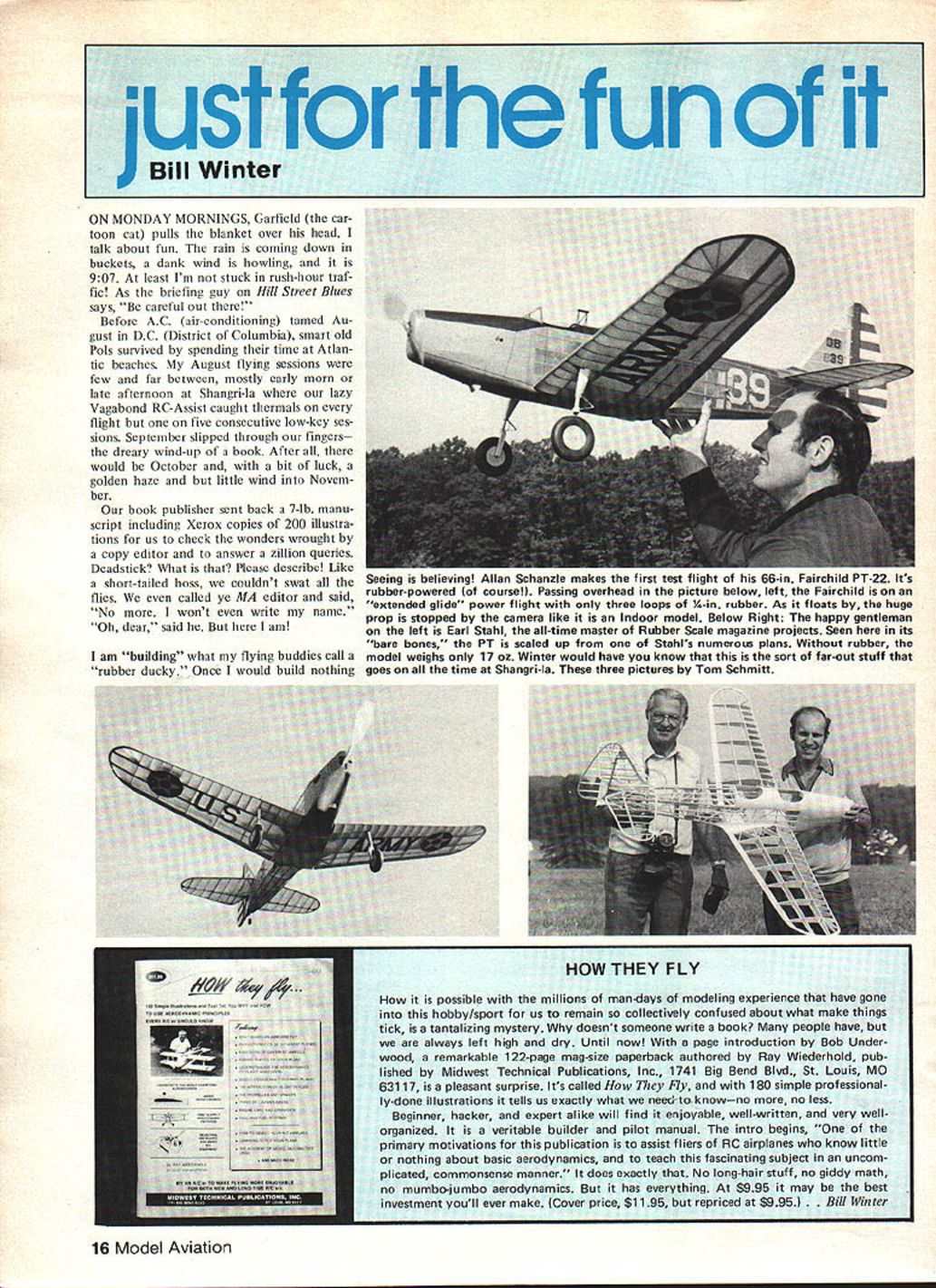
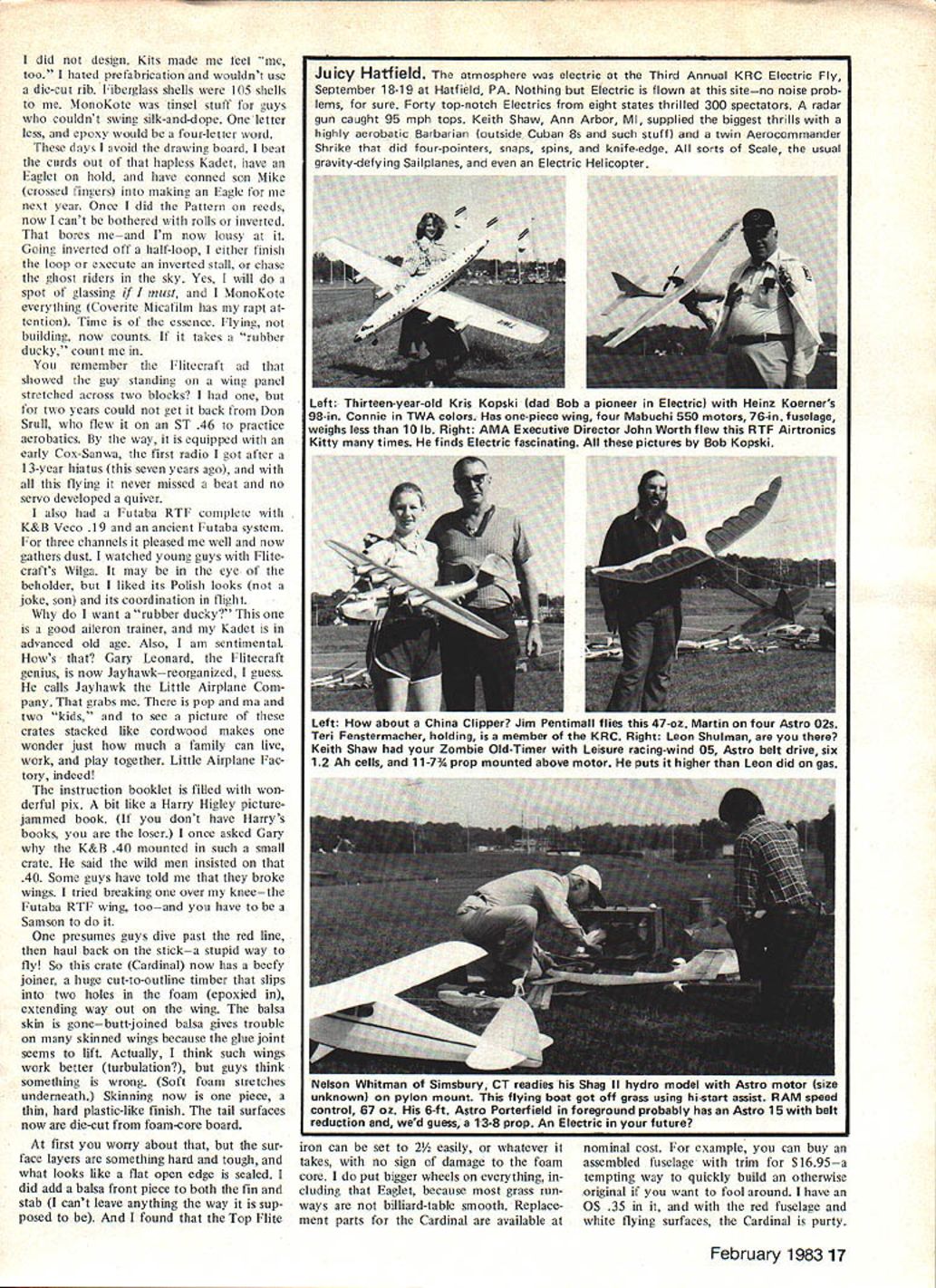
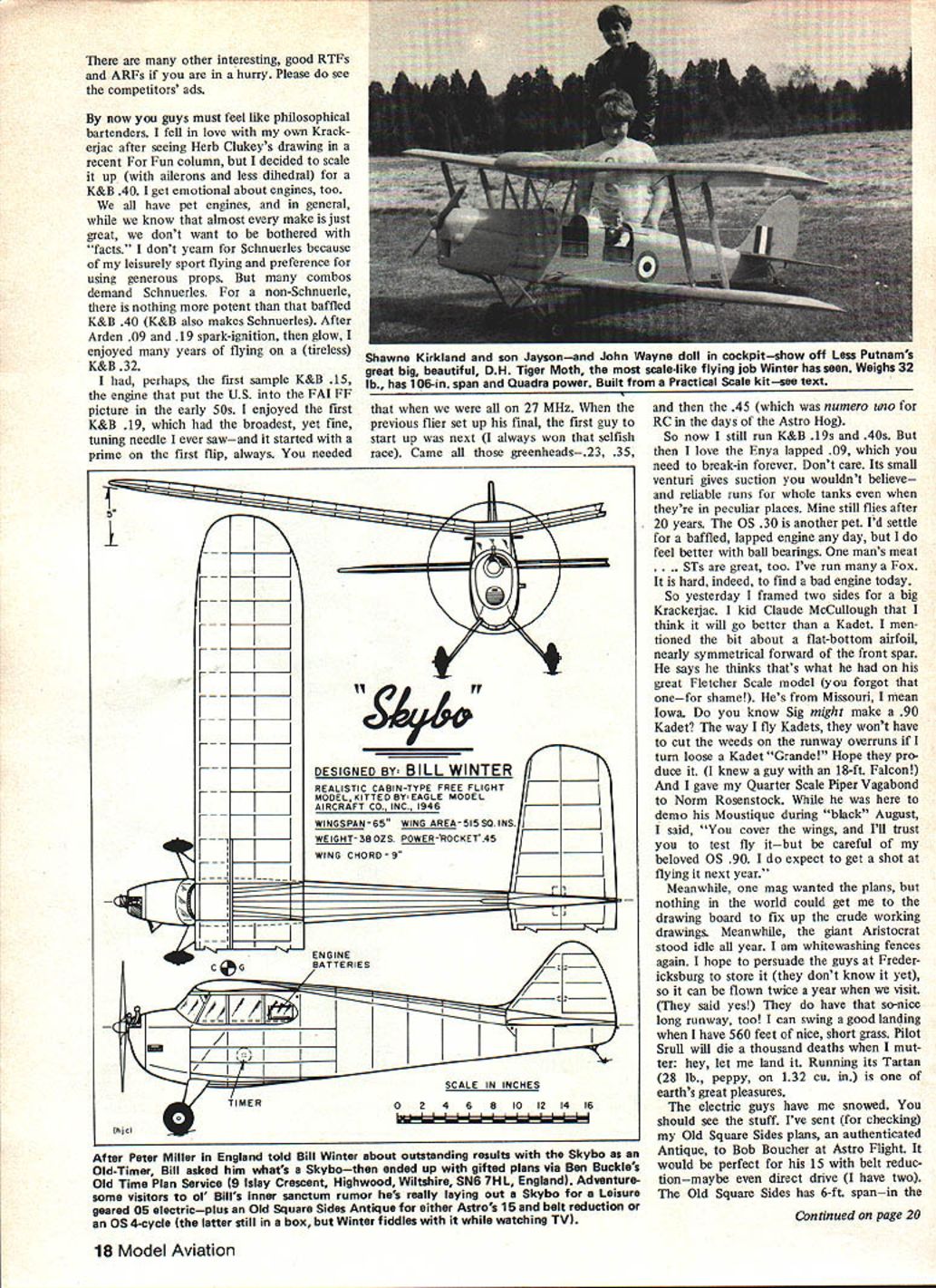
I went down to Flyline Models Saturday night—"for Halloween"? After a family get-together, I staggered in late in the evening. The Maxecutters were there. And what they and Allan Schanzle's 5-1/2-ft. rubber-powered Fairchild PT-22 low wing had done was neat. Allan was intrigued by my "stories" about 6-ft. Rubber Scale in the old days, and one 9-ft. Cessna, his giant, lovely PT in blue and yellow, stars, and red-white-blue striped rudder, was top quality even for those Maxecutter experts.
How to test it? Told him that we used to put a giant on smooth pavement, wind a few turns by hand, and let it taxi. Kept adding turns until the tail lifted. More until the wheels barely showed daylight. Ballast then if needed. Just add low power turns for an "extended" glide, and go from there.
You have to sneak up on rubber biggies because a wind-end is as a pile of sticks. But Allan had tall grass at Shangri-la. The midnight strategy was for early more-extended glides on three loops of 1/2-in. rubber, launched from the brow of a depression. Reports the next day said it was flying. The consensus was that if he gets it up to 75 feet he'll lose it eventually. Weight without rubber is 17 oz. The tests stopped when they broke the rubber. How's that? Must have been one heck of an extended glide! (No damage.)
Remember Srull's Jungmeister in MAN? It had an .049 with only aileron and elevator controls. Now it has an old Max .10, not a Schnuerle—we do miss that grand .10. It's also full-house. So in the early morn on a narrow, quiet road at the foot of Shangri-la, eight quick flights. Somewhat fast, but that doesn't trouble the eye. Darting over the hill and into the valley, looping and rolling, and steering around scattered trees, shooting lovely touch-and-goes and long power approaches.
Years ago there was a classic movie—in the '20s probably. Ernst Udet gracefully tooling around his Flamingo at near water level, winding in and out of towering white icebergs. It must have taken quite a camera pilot to chase him around. Swooping in endless turns and banks, hypnotically dreamlike. Well, that's the souped-up Jungmeister. We didn't talk. You want a superb small Scale that matches the biggies? Get a plan from MAN—and modify it.
You should know that there is, at long last, a Society of Electric Aircraft Modelers. In the mail today came a 10-page newsletter—a mini-magazine in its treatment. Top-notch writing and organization. Articles, tips, drawings—full of stuff all we electric beginners need. They have about 100 members already. If you want electric stuff in a nutshell, write this group at 11632 Flamingo Dr., Garden Grove, CA 92644. Membership is a bargain $10. President Frank Heacock can be reached by phone at (714) 539-3450.
Now that the new frequencies are a fact, you'll be interested to know that AMA is testing two systems on 926 MHz, UHF. After hearing some guy ask Bill Hershberger if he was going to fly "it" today, we asked what "it" was. "It's a sub-antenna on the transmitter about 6 in. long, and another short receiver antenna that sticks out of the top of the wing like an upside-down beeper." One item to be used by the modeler is the 459-MHz British system that has been modified.
Performance is sensational—to the limit of vision, not directional, no glitches so far. Bill flew an outdoor test plane from inside his car with the hatchback open. After a cold test of the engine his scope was picking up perfect signals from inside the refrigerator. Somewhere down the line, application will be made by AMA to FCC for approval, perhaps for a spot, more likely for a range of frequencies. There's more space "up thar."
Did you hear that thud? This column just crashed! After repairs, we hope for a better flight next month!
Bill Winter 4426 Altura Ct. Fairfax, VA 22030
Transcribed from original scans by AI. Minor OCR errors may remain.

