
Just for the Fun of It
Bill Winter
NOISE IS A DOWNER. The flying sites lost, if put together, could outstretch the Great Wall of China. Our dismay over "unreasonable" neighbors is more acute than ever. We've had study after study. We persist in thinking we've done our part. Horsefeathers!
We have never really faced up to the problem. While we may have some relatively good mufflers, it is pure luck if we happen to purchase an engine that is reasonably quiet. One wonders about this because pipes are not inherently noisy (which proves an engine can be run quietly).
We think of the "noisy" old lady who lives 4½ miles away from one lost site (true). Or of the bomber-raid cacophony of lawn mowers; in fact, decibel readings show local traffic louder than models in the distance. That's irrelevant. Our engines have distinctive tones—and citizens at large don't share our love of that heavenly sound.
When mufflers were first decreed, modelers sought mufflers that decreased power the least. To be legal was frequently the only criterion. There is still one muffler, widely used, which eloquently proves that philosophy is still with us. All it does is point the sound—which is propelled vast distances as a sharp bark. The bedeviled manufacturer is caught between a rock and a hard place because customers oppose any efforts to quiet it down—too much power loss, you know.
The loss of flying sites is something that happens only to the other guy, never to us. Until...
Why do muffler and engine manufacturers fail to produce reasonably quiet engines? They have learned that you would not buy their engines if they were quieter and that you would turn to a competitive brand. Who shall be the first? The modelers are at fault, and so are the manufacturers. The problem is curable. But don't hold your breath.
There probably is only one realistic starting point, and that is for "officialdom" to program an effort comparable to the devotion with which we pursue things like new RC frequencies. Are you safe? Is your site secure? People you don't know were not safe, and their sites are gone. Will you be next? We (consumer and industry) might all try getting our heads on straight.
I am involved with folks at a distant flying place to save their site. When I first flew there, the housing area from which complaints came was pointed out. No one overflies it, and indeed it is so distant one barely sees the houses! Worse, the noise complaints also questioned safety.
If this site is to remain active—and it may not—the fliers will have to police every model with a decibel meter at a given distance, run safety checks (like a state auto inspection), and every plane must bear a sticker on which all related items have been checked off. Naturally in such a situation, some members react to this "persecution" with a let's-nuke-'em attitude, including the "chicken" fellow members who would rather fly than be dead.
Touch-and-goes. It's an early Wednesday morning in late November, and I stare out the window as the Hermes rattles along—noting the straight-up plume of wood smoke from a neighbor's chimney, the motionless trees, and a leaden gray sky. The weatherman says it will warm up later. The Vagabond RC Assist is primed to go. But I am thinking of King Arthur and the Knights of the Round Table who galloped off on noble missions, and the Raiders of the Lost Ark.
Since I began as editor (Bill Barnes in 1936) until this very moment, the mail has been dominated by people looking for plans (accurate, mind you!) of strange and all-but-forgotten airplanes, for sources of information, for clues as to where and when things were published.
An unending stream of people write everyone in sight, all the magazines, the columnists, folks who get mentioned in print. Finding what they want is a life-and-death matter to these desperate researchers. If you mention some guy's need—because you can't help—another wave of letters follows from guys all over the world who have those plans, or back issues, or know when and where something was printed. One feels like a marriage broker. And, since nature abhors a vacuum, you wonder why some model aviation museum library and reference service has not been established.
The Rubber Scalers really have a grapevine. They know about every real plane that ever existed; they swap plans, pictures, old articles and clippings, sit in libraries—you'd be surprised at who sits and dreams in the National Air & Space Museum's library. They ferret out color chips, pieces of genuine fabric. They are preeminent historians. They find old kits and have plans collectively of just about anything.
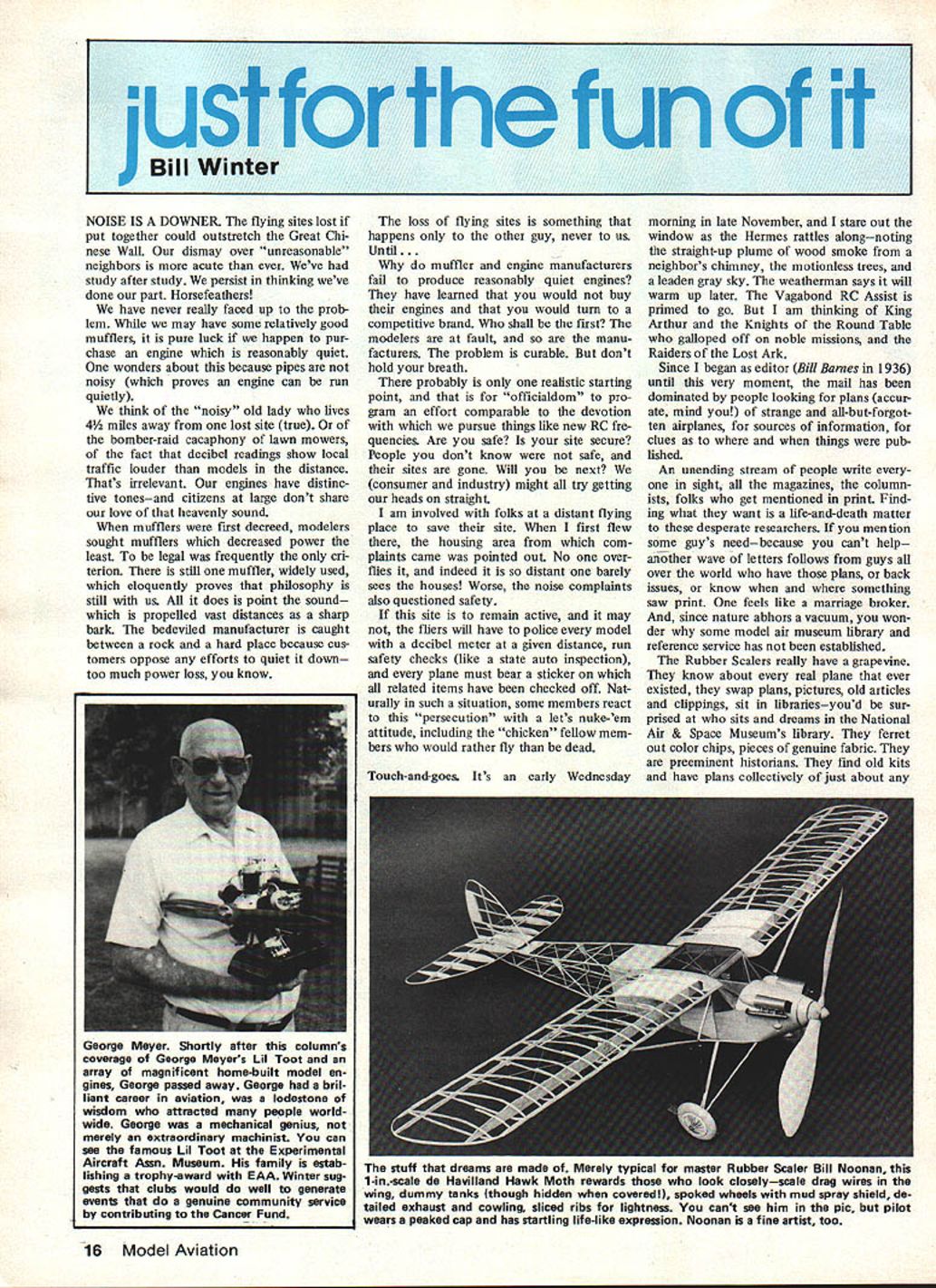
Shortly after the column's coverage, George Meyer's Li'l Toot—an array of magnificent home-built model engines—was exhibited. George passed away. His brilliant career in aviation, a lodestone of wisdom, attracted people worldwide. George's mechanical genius and extraordinary machinist's skill can be seen in the famous Li'l Toot at the Experimental Aircraft Association Museum; his family established a trophy award. Winter suggests clubs would do well to generate events of genuine community service, contributing to the Cancer Fund. Stuff dreams are made of.
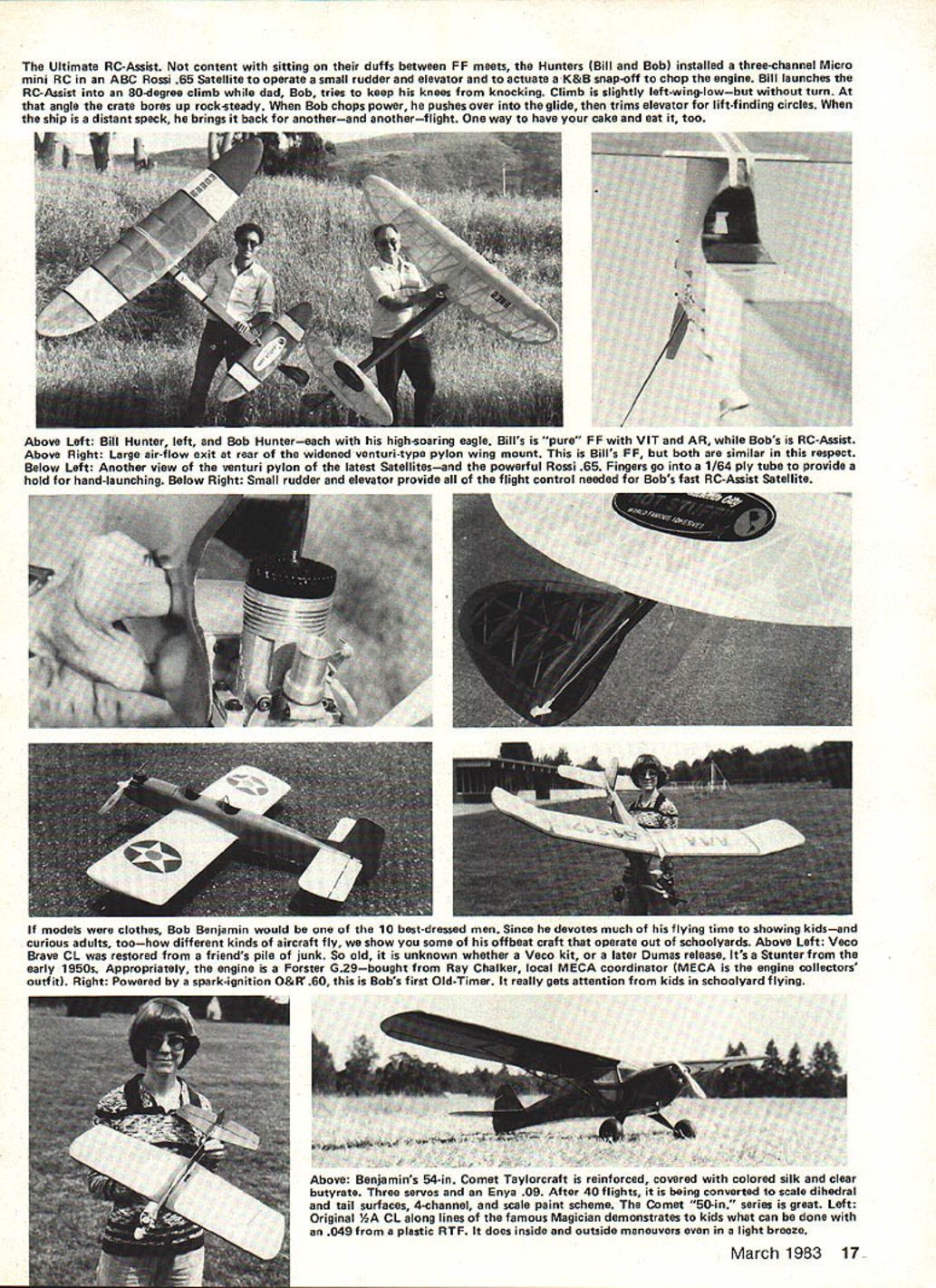
Merely typical master Rubber Scaler Bill Noonan's 1-in.-scale de Havilland Hawk Moth rewards a close look: scale drag wires, wing dummy tanks (though hidden), covered spoked wheels, mud-spray shield, detailed exhaust cowling, sliced ribs—lightness you can't see. It may be the finest scale model that was ever kitted, most kits dating from before many current builders were born.
The Aeronca K comes to mind. Since early post-WW II days, a series of 50-in. scale flying models by Comet has remained popular. Comet in its early days had more designer talent than all subsequent producers lumped together. Monogram, Top Flite, and Carl Goldberg models were generated by ex-Comet people. At Comet many of our great creators worked, like Joe Konefes of Bombshell fame. Started by three guys during the late 1920s—legend has it that their total starting capital was about $200, and one of the principals was a laundry man—by WWII they had 500 employees, the biggest model plane manufacturer the world has seen. Among those 50-in. fliers, the T-Craft alone has been great for Rubber, FF Gas, Radio Control, and it has even been flown indoors with RC.
We mentioned that Hurst Bowers modified the Aeronca into the "K." Came a letter from artist Bob Benjamin, a gifted modeler and a full-scale pilot, who wanted to build a Quarter Scaler. Sources given were not "precise" enough, other readers told us. Bob Lopshire had a definitive Quarter Scale plan, it turned out, and it had been given to well-known scale flier Bob Karlsson. There was a real "K" to check out. The plans were not for general distribution, so we suggested that if you ran into Bob Karlsson you might try the bended-knee approach. Karlsson sent me the plans—I just opened them.
Three readers then sent (to help Benjamin) Hobby Helpers plans, or actual tear sheets from an early American Modeler. That was a bit upsetting, because we had often flown with the talented late Ed Yulke, who designed it, and knew the crate quite well. A beautifully engineered airplane (Ed was an engineer with Luscombe, and later Republic) but with cascaded escapements. (No, I can't send you plans, alas.)
All this prompted a letter from Dick Gleason (Gleason Enterprises, 1704 29th Ave., S.E., R.2, Box 125, Austin, MN 55912). Dick operates a plans-finder service. He offers information (at a cost) on 560 different makes and 1,600 models for which line drawings have been published over the past 50 years. Many are in plan form. During 1935 the writer had published a rubber-powered Waco D. So here to prove Dick's point was a plan, redrawn on one sheet from a number of plates in MAN. Dick claims he corrects errors and clarifies construction. He did an excellent job, believe me.
Enclosed was a three-view of a mysterious Stinson PT tandem low wing—I had drawn it, published somewhere. "What scale?" he asked. I don't remember doing the drawing or that the real plane existed. Dick has been doing this for five years—and I had never heard of him! Three years ago, 50 of his old kit plans, plus 42 RC projects—inked on Mylar—were destroyed by fire, but like the Phoenix, he rose from the ashes.
Bob Benjamin, incidentally, is the Cessna 140 owner who chided us on our confusion about flying the 120 in days of yore. Seems I had confused it with the 140 (which had flaps) while subconsciously assuming the 170 had been the 140.
"I have on several occasions (after careful checkout) flown the 140 in there," Bob tells us ("there" being an abandoned grass-field airport, now an RC site), "to give the guys who don't often get that near to the big ones a chance to check her out. I emphasize—lots of attention from neighborhood kids." There have been comments in the model press about getting all types of models to areas where kids and non-modelers can see them. This idea is right on the mark—for those modelers who know what they are doing. Seeing a newcomer wipe out his RC trainer against the side of a school is not what we want to show the general public. I make a practice of flying something like this Old-Timer, or a Control Line job, or a small Scale-type RC from this schoolyard at least once a week, weather permitting, making a practice to take as much time as necessary to talk to the kids. Occasionally, one of the homeowners walks over to chat. In three years, I have never had a negative comment.
I'll send you some stuff on a couple of sport Free Flights, and hopefully on the Peanut rubber job my wife is building. She loves the full-scale 140, dislikes model engines if she has to get near them, thinks Trexler wheels are super, and is beginning to do some nice work on small Rubber Scale building projects.
We hear Bob is doing some model-mag cover paintings, too. (Just saw Model Builder!) A man for all seasons...
Which prop?
"Of recent interest were your comments (and others) concerning engine stroke, torque, prop size, etc.," says Richard Aley of Honolulu. "For what it's worth, I would like to add my—
"Every engine has its own unique set of horsepower and torque vs. rpm curves. Generally the rpm for peak horsepower is not the same as for peak torque. 'So what?' you say. All you have to do is use a prop that will allow the engine to run at its peak horsepower rpm and live happily ever after. Right? Yes, but only if you're running the engine on the bench.
"What seems to have been overlooked," Dick continues, "is not how much horsepower or torque an engine is capable of producing but how much is converted to thrust with a given airplane and propeller combination. In other words, propeller efficiency.
"For every airplane, in a given flight condition, there will be a propeller that will give maximum efficiency in converting horsepower to thrust. In order to make this a harmonious relationship, the engine used must be able to turn that most efficient propeller at the engine's peak horsepower rpm.
"If you have a Schnuerle-ported .60, it must turn around 15,000 rpm to develop close to peak horsepower. If you mount it in a contemporary Pattern airplane and use an 11-7 or 11-8 prop, the engine will develop close to its peak horsepower in the air, the prop will be fairly efficient in converting this horsepower to thrust, and the airplane will perform very well (although it will fly quite fast).
"If you take the same engine and propeller and put them on a 1/4-scale J-3, the airplane will fly slower, which will cause the engine to lug down to somewhat less than peak horsepower rpm, and the prop will be inefficient, producing less thrust for a given horsepower output. You could install a different prop to give a more efficient prop/airplane match, probably an 18- or 20-in. diameter, but this would only lug the engine down more, so it would produce less horsepower. The answer to this problem is either a 'chain-saw' engine to turn the larger prop directly, or a belt drive (or gear drive) that will turn the larger prop, yet allow the engine to run at its peak horsepower rpm.
"What this means," Dick concludes, "is that every engine/airplane/propeller combination is a compromise. On larger, slower sport-type models, it may be necessary to use a larger engine turning a larger prop at below peak horsepower rpm in order to get adequate performance out of the model. The significant point is that the airplane/propeller/engine combination must be selected to give you the performance you desire. Because of the many variables involved, this is usually only accomplished by trial and error."
Prop/plane combinations truly are infinite. Running an engine on the ground is, at best, a relative indication. Dick doesn't mention prop unloading, but it is implicit in all that he said. We know that if a prop speeds up in the air, sometimes by 1,000 rpm or more, only when the plane moves forward at an appropriate airspeed does a prop blade, like a wing section, meet the air at a proper angle of attack.
If the plane is "dirty," too big, or too heavy for its prop (and power), the prop may partially unload or never unload. It labors like a hod carrier, or just flails the air. Small 1/2 A engines must scream; their props tend to small diameters and low pitch. For typical sport models, 5- and 6-in. pitches are common, with 6-in. generally considered the dividing line between low and high pitches. Try counting the 10-6 props you see on engines of approximately .40 cu. in. displacement.
We know that high pitches get into high gear, like overdrive, if the ship is clean and fast, or when any crate is dived or in on the descending leg of a maneuver. Low pitch is low gear for "climbing hills" or accelerating quickly—but like roaring along the Autobahn in second gear. High pitches keep your so-called trainer coming in fast under power, while a lower pitch brakes the approach speed, making things less hectic coming "over the fence."
Engine rpm and prop diameter play a veritable duet in terms of prop wash which strikes against the port side of the fuselage, fin, etc. The side profile calls the shots. A high cabin with a low thrust line may lean to the right under power like a pylon FF. I note this effect slightly on my battered Kadet. Not being expert, I find that if the ship gets running to the right on takeoff, much heavier rudder applications are needed, especially in a crosswind from the left when ailerons plus rudder are required. I get to zig-zagging. But if it runs left, it is easily corrected, and crosswinds don't matter much. My nose wheel produces a wide left turn when taxiing, but the takeoff is true after an occasional brief early touch or two of right rudder. My big Sniffer RC-Assist, with a very high cabin, leans to the right regardless of torque; my Vagabond RC-Assist turns left with torque regardless of prop wash.
Pylon Free Flights normally can't turn left safely under power. With some RC ships designed to go where they are pointed, like low-wing Pattern jobs, prop wash is not a problem. Their pilots argue that you never need offset engine thrust. But typical trainers usually demand right thrust. There sometimes is an offset thrust "reversal." When my big Sniffer turned right under power, I removed its right thrust, and the ship became vicious to the right—it was worse! Apparently, the angle of the prop wash against the port side of the cabin encountered the profile at a smaller angle when right thrust was present.
Once I tested (for fun) the effects of props on a 1/2A pylon FF (my Firecracker in MAN, circa 1950). Results were contrary to the books. A tiny one-bladed prop from a K&B Infant .02 (the first .02) on the OK Cub .049 leaned the pyloned Firecracker tight left in a sweeping turn. Progressively increasing diameters and/or pitch opened the left power turn, and at the end of the line, the crate was leaning hard right. (Luckily, I missed the prop that would have looped the ship into the ground!) That was the full-octave torque and prop wash effects. Prop wash increases rapidly with diameter.
A friend had a delightful cabin-type rubber-powered sport model. He preferred left/right patterns in FF; gas to produce an S-transition that minimized drift in the wind. He added more rubber so that torque would tighten the left and increase the climb. We argued it would go right instead—and that the prop wash would be more effective than torque. It did. Prop wash is a mighty force if given some surface to work on.
Such crude test methods we used! For the Citizen RC published in MAN in the late 1940s, we had to know what improvement a glow Arden .09 (glow was just coming in) would show over ignition. We tied the crate to a long rubber strand which allowed it to accelerate, stretching the band by perhaps 25 feet before the crate was snubbed to a stop. A wee bit of unloading. The difference in stretch was more tangible than taching rpm at rest.
Recommended prop sizes you find with an engine are best for that engine to reach its max rpm and peak power, as Richard Aley said, but put in the proper size crate for the displacement, it may make much noise but "go nowhere." An inch more diameter, as from 7-4 to 8-4 on a .15, may prove best for the plane, which then comes alive. Power and thrust are then right for the one engine/plane combination, even though the engine may not be developing its ideal performance. Many planes will fly better with engines developing more torque, the prop luggers, but we buy engines by the scream.
If your crate pleases you, that's all that counts. If it works, don't fix it! But if it doesn't cut the mustard, and you know it is not a lead sled, it is properly balanced, and it is not grossly mismatched with its engine, then fine-tune props. That is, try extremely modest changes in pitch and/or diameter.
Overpropping is a tricky thing. Not only is it infinitely more likely to ruin an engine with sustained use, but the season, high humidity and/or temperature, and the nitro content of the fuel, even hot or cold glow plugs and other jazz all have effects. For example, we once had a heavy 6-ft. Live Wire with a Veco .29. In the summer it required a mighty heave with an 11-4 prop. Alas, since low pitch with downthrust will make a crate sometimes nose down before the wing generates more lift with increasing speed (there is a "square" in the lift formula), the ship grazed the ground (on a rigid flight path) before heading skyward. In the winter, with a 12-5 prop, the same ship would float off the hand without our taking a step and climb steeply, rocking gently like some huge rubber-powered R.O.G.
"I was most surprised to see Bob Thompson's photo on page 18 of the December 1982 MA," says Mark Finnegan. "For Fun had wondered what Bob was doing with several rubber loops attached to various fingers like some string puzzle. It was taken at the 1980 FAC Nats at Wright Field, Dayton. The plane is a Keystone Bomber taken from Cleveland plans (Keystone Pirate Bomber). On the original plan the engine nacelles are profiles, so Bob made them three-dimensional.
"Bob appears to be back-winding," Mark goes on. "For those unfamiliar with the practice, you pull out two loops of rubber and, while holding one, wind the other backwards a few turns. When all the loops are placed on the prop hook, they automatically wind up something like a braided motor, automatically taking up slack that might otherwise cause CG problems in the glide.
"The 'classy rubber stooge' and the 'conventional auto' in that photo are both mine! Bob and I shared both stooge and car. Plans for the stooge appeared in the FAC News about a year ago."
Bob tipped off a well-kept secret when he mentioned that this year's Maxcutter Meet will include a Bill Winter event. (Last year, it was Earl Stahly.) Mark had expressed his difficulty in choosing between my plans for a Mr. Mulligan (be advised that the top longerons are square corners, not rounded off as I assumed years ago before accurate drawings had been released) and the Grumman F3F. The short-nosed, pot-bellied Grumman does not permit much rubber, so we've advised Mark if he wanted a biplane of the era with those gray Navy markings, he might do better with the swept-winged (both wings) Curtiss SOC-1—lightened up with modern techniques. Anyway, it should be a weird experience watching what good fliers do with all those FF Rubber Scale jobs—our bread-and-butter mag projects from the days when no one could lift $15 worth of groceries!
Eureka! I am really building two electrics! I'm a beginner—if you want answers, follow Polling in MB, which had three great features in an issue I saw last night. As a beginner, I'll pass on my own experiences.
First, Astro Flight has a new hot armature for the two reduction-belt 15s I have. One (13-8 prop at 5,500 rpm), which was in Don Strull's magnificent Spitfire, I expect will get a 1,000 rpm boost, possibly more duration. We'll test fly it in the Spit (more anon). The second updated system goes into my 6-ft. Old Square Sides Antique.
Last night we joined John Worth, who flew his Buzzard Bombshell with a pack of 16 sub-C cells and the old Astro 15 with belt drive (and the 14-6 prop from my OS .90). With less than full charge, it flew in the cold dusk for 12½ minutes. Bill Poythress and I timed and made an altitude evaluation with crude triangulation. We calculated that it got up to at least 800-plus feet, maybe as much as 1,100 feet. With power shut off, the glide was about that of a sport engine-powered RC job, with a bit of noticeable sink. A flight of 15 min. is quite possible without aid of warm air or lift. New Astro motors coming up will surpass even the hot-winds just now appearing.
In my Skybo I am using a geared .05 Leisure electric motor which swings an 11-8 on only six sub-C cells. I look for thermalling flights. Leisure can give me (beyond this) a 50% increase in motor run and 30% increase in rpm with the geared .05 with six, perhaps seven, sub-C cells. A new generation of motors is being developed by both manufacturers.
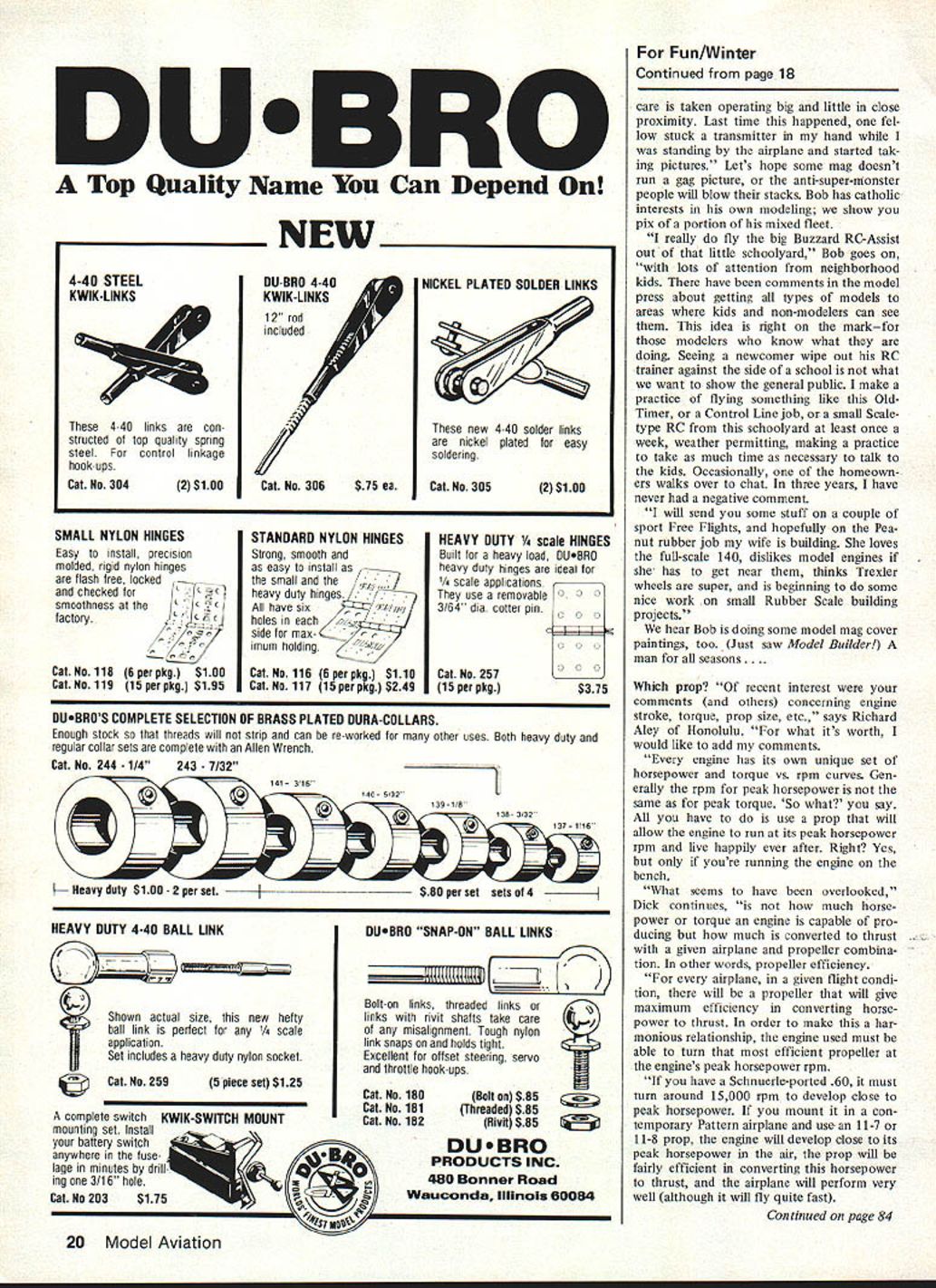
There's lots more. For this month, I'd like to show you some tips by Bob Kopski which appeared in an info sheet he gave out at the Annual Electric Fly in Hatfield, PA. And a wiring diagram from the SEAM Newsletter — a remarkable publication. Do join SEAM if you want to keep up ($10.00). Society of Electric Aircraft Modelers, 11632 Flamingo Dr., Garden Grove, CA 92644. You'll be shocked!
Bill Winter 4426 Altura Ct., Fairfax, VA 22030.
Transcribed from original scans by AI. Minor OCR errors may remain.

