
Just for the Fun of It
Bill Winter
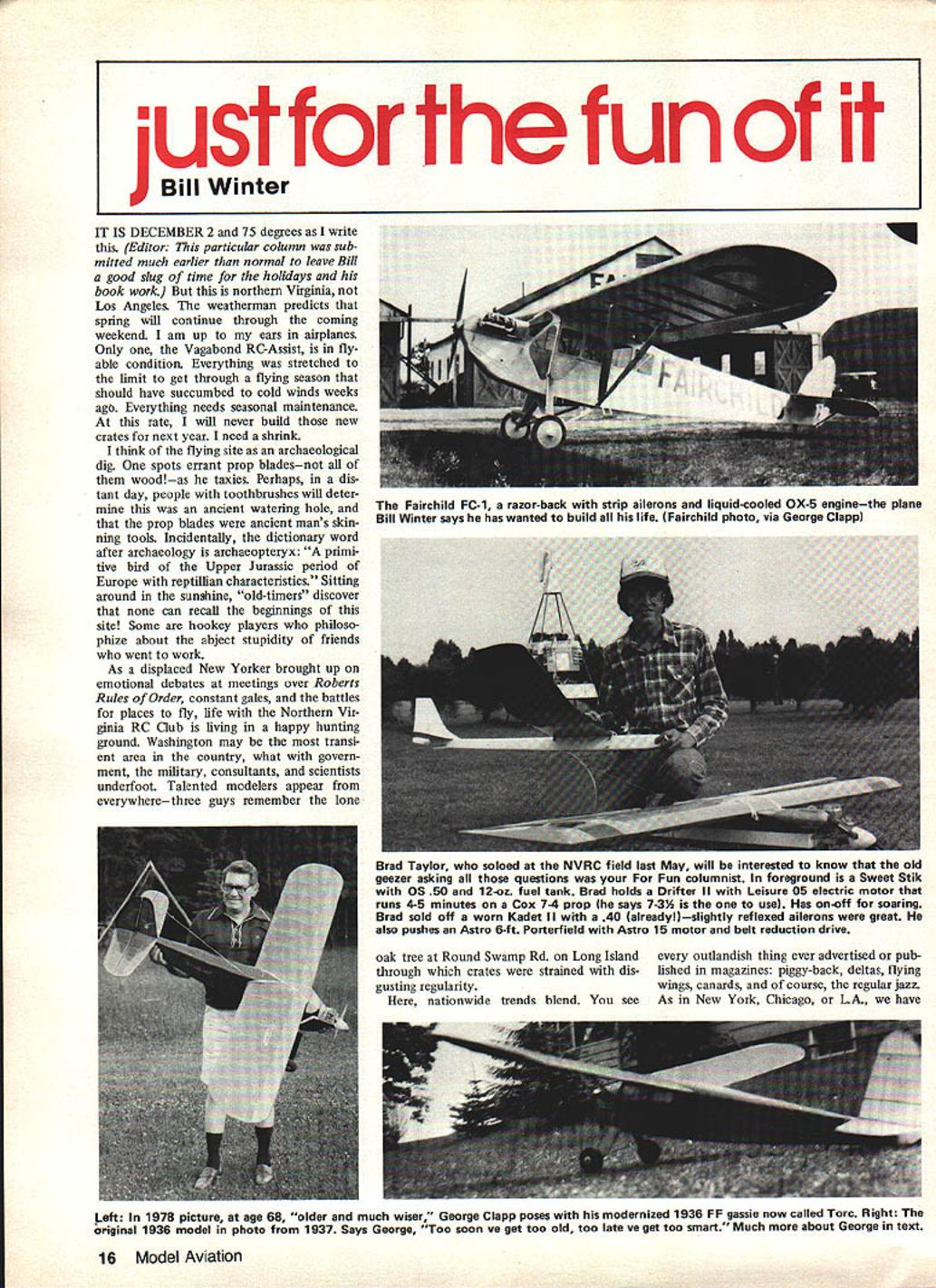
It is December 2 and 75 degrees as I write this. (This column was submitted earlier than normal to leave me a good slug of time for the holidays and my book work.) But this is northern Virginia, not Los Angeles. The weatherman predicts the spring will continue through the coming weekend. I am up to my ears in airplanes. Only one — the Vagabond RC‑Assist — is in flyable condition. Everything was stretched to the limit to get through a flying season that should have succumbed to cold winds weeks ago. Everything needs seasonal maintenance. At this rate I will never build those new crates for next year. I need a shrink.
The flying site and the people
I think of the flying site as an archaeological dig. One spots errant prop blades — not all of them wood! — as he taxies. Perhaps, in a distant day, people with toothbrushes will determine this was an ancient watering hole, and that the prop blades were ancient man's skinning tools. Sitting around in the sunshine, the "old‑timers" discover that none can recall the beginnings of the site. Some are hockey players who philosophize about friends who went to work.
As a displaced New Yorker brought up on emotional debates over Roberts Rules of Order, constant gales, and the battles for places to fly, life with the Northern Virginia R/C Club is a happy hunting ground. Washington is a transient area — government, the military, consultants, and scientists move through all the time — and talented modelers appear from everywhere. Nationwide trends blend here: piggy‑back planes, deltas, flying wings, canards, and the regular jazz.
Membership grows by leaps and bounds; someone is being soloed almost every time I go out to fly — sometimes half a dozen a weekend day. Membership is approaching 200. NVRC has several bigger club neighbors with about 500 members and three flying sites. The young folk excite: a big‑club ecosystem, a complex community functioning as an ecological unit.
Several fliers come two counties away; one fellow routinely drives 60‑odd miles. Others drive farther. Some guys fly the same airplane year after year. Most crates go back beyond memory; nobody knows where they came from. Some were bought at club auctions and recycled time and time again; others are found hanging in rafters when homes change hands. Older guys remain good pilots but don't want to build anymore; they rely on the aeronautical flea market. The kids are too young to drive, but supportive folks drop off and pick up. Within months some youngsters fly better than us after a lifetime of fun watching and talking.
Electric flight and the motor mount
Electric flight is one of the liveliest trends at the field. Claude McCullough (Sig) has been milking a Kadet for better performance for a year, and a young chap applying the same tricks to electric flights is beautiful to behold. He carries a digital voltmeter and knows precisely the peak of his electric power plant. We now have digital chargers, meters, and auction goodies becoming common at the field.
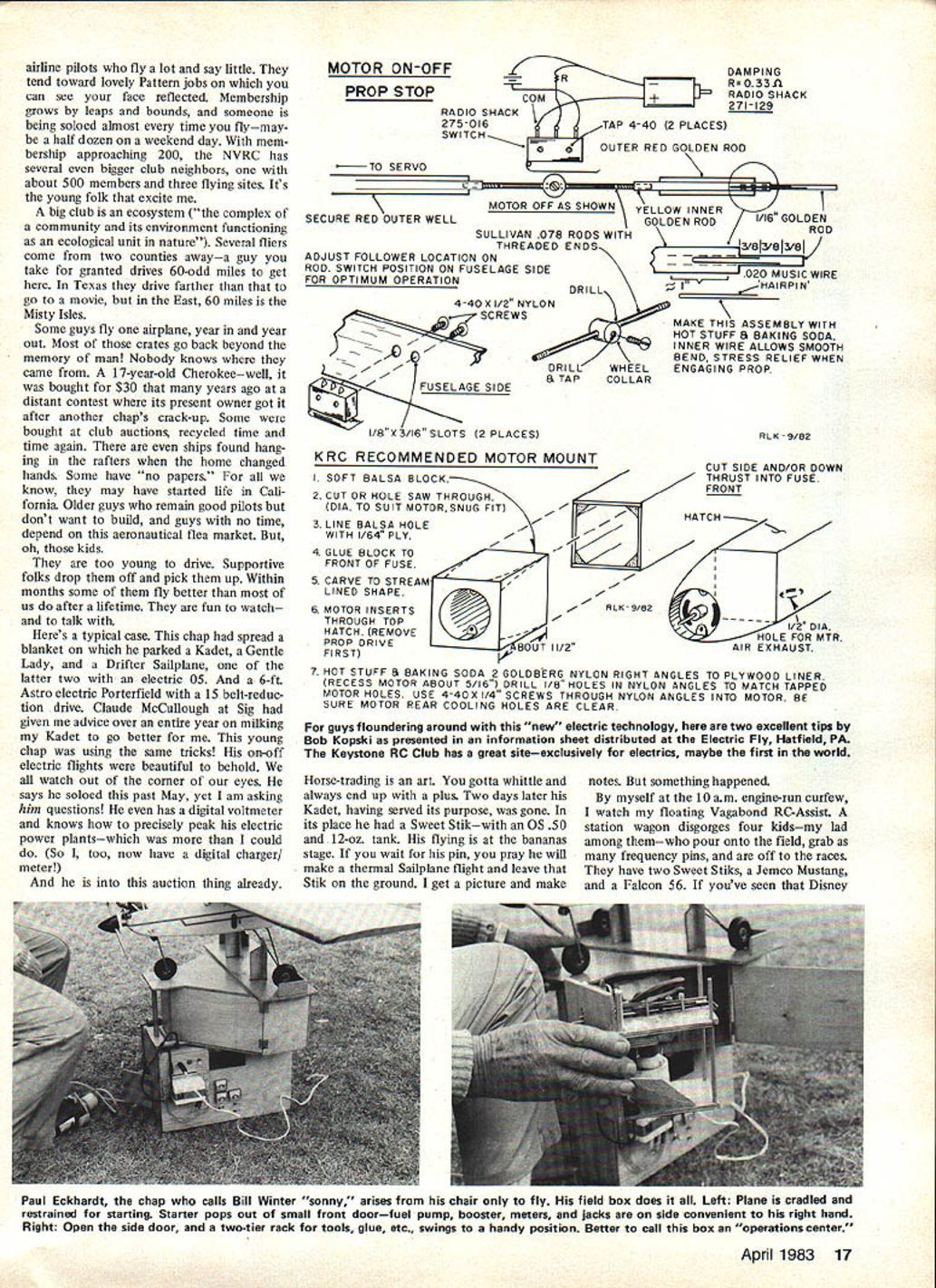
For those floundering with the "new" electric technology, here is a recommended motor mount by Bob Kopski (distributed at the Electric Fly, Hatfield, PA). The Keystone R/C Club has a great site — exclusively for electrics, maybe the first in the world.
KRC recommended motor mount
- Soft balsa block.
- Cut a hole (hole saw) through the block — diameter to suit the motor, snug fit.
- Line the balsa hole with 1/64" plywood.
- Glue the block to the front of the fuselage.
- Carve the block to a streamlined shape.
- Motor inserts through a top hatch. (Remove prop drive first.)
- Use hot stuff and baking soda. Use Goldberg nylon right angles to the plywood liner. Recess the motor about 5/16"; drill 1/8" holes in the nylon angles to match the tapped motor holes. Use 4‑40 x 1/2" screws through the nylon angles into the motor. Be sure motor rear cooling holes are clear.
Horse‑trading, young fliers, and the joy of flying
Horse‑trading is an art. You gotta whittle and always end up with a plus. Two days after borrowing a Kadet, a young fellow traded it away and turned up with a Sweet Stik — an OS .50 and a 12‑oz. tank. His flying is at the bananas stage: energetic, exuberant, and sometimes nail‑biting. If you wait for the pin, you pray he will make a thermal sailplane flight and leave that Stik on the ground.
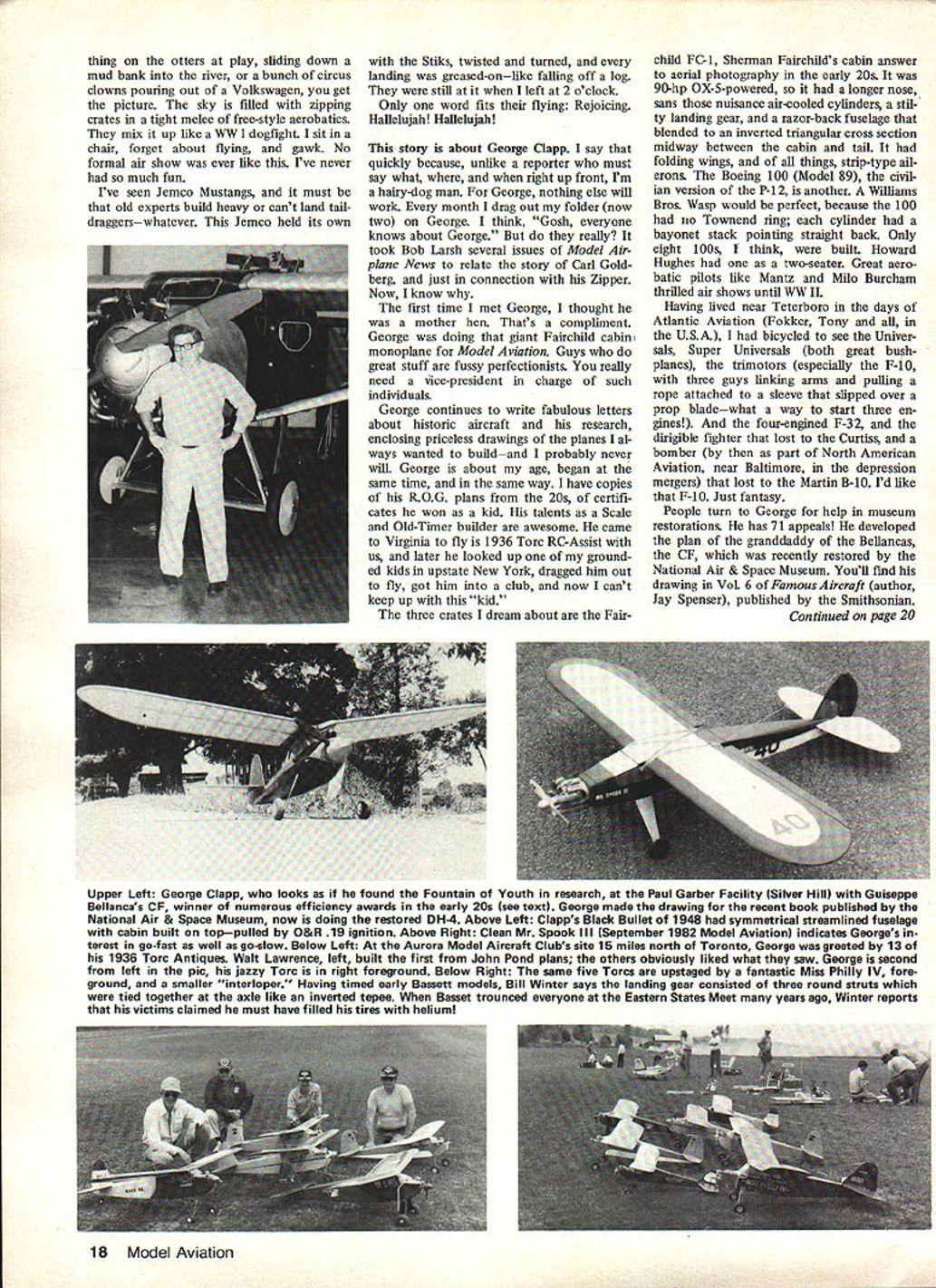
One Sunday I sat by my Vagabond at the 10 a.m. engine‑run curfew and watched a station wagon disgorge four kids — my lad among them — who poured onto the field, grabbed frequency pins, and were off to the races. They had two Sweet Stiks, a Jemco Mustang, and a Falcon 56. The sky filled with zipping crates in a tight melee of free‑style aerobatics; they mixed it up like a WW I dogfight. I sat in a chair, forgot about flying, and gawked. No formal air show was ever like this. I've never had so much fun. Only one word fits their flying: rejoicing. Hallelujah!
George Clapp
This story is about George Clapp. For George, nothing else will do. Every month I drag out my folder (now two) on George. I think, "Gosh, everyone knows about George," but do they really?
The first time I met George, I thought he was a mother hen — and that's a compliment. George was building a giant Fairchild cabin monoplane for Model Aviation. Guys who do great stuff are fussy perfectionists. George continues to write fabulous letters about historic aircraft and his research, enclosing priceless drawings of planes I always wanted to build — and will probably never finish. He is about my age and began modeling at the same time I did. I have copies of his R.O.G. plans from the 1920s and certificates he won as a kid. His talents as a Scale and Old‑Timer builder are awesome.
George came to Virginia to fly his 1936 Torc RC‑Assist with us and later looked up one of my grounded kids in upstate New York, dragged him out to fly, got him into a club, and now I can't keep up with that "kid." Members of the Aurora Model Aircraft Club once lined up 13 Torcs to greet George; they get together on a long weekend each summer and fly the "Clapp Armada" on floats off a lake north of Toronto. Walter Laurence designed the foam floats; George now waters his Torc with a set of Walt's floats.
George researches and helps with museum restorations. He developed the plan of the granddaddy of the Bellancas, the CF, which was recently restored by the National Air & Space Museum. You'll find his drawing in Vol. 6 of Famous Aircraft (author Jay Spencer), published by the Smithsonian. In the early 1920s Bellanca won roughly a dozen national and international awards for efficiency. Bellanca's four‑place monoplane did an honest 100 mph on a 90‑hp two‑row, 10‑cylinder Anzani, and its design elements influenced future production jobs like the Wasp‑powered Skyrocket.
George's projects include Fokker trimotors, Fairchilds, and more. He recently received original 1925–27 factory drawings from Fokker in Holland for the Josephine Ford trimotor. When I told George about driving a Model T and watching the dirigible Los Angeles drift by, he spoke of the Shenandoah passing over his town at night. He waxes poetic about Balbo's Savoia‑Marchettis over the Hudson and remembers the roar of dozens of Isotta‑Fraschini engines as if it were yesterday.
George gets ecstatic about Doc Mathews' Ole Reliable Old‑Timer; it resembles the Torc in many details. Frank Zaic's Yearbooks, with their hundreds of three‑views, have saved much for posterity — and Frank is still at it. George Clapp has put fun and joy into many lives; some mother hen!
Anecdote: George tracked down Charles Macey about a gas‑powered model called Ole Reliable. Macey replied, "No, you must have the wrong number. Me design an airplane? Noooo." After some pleading, Macey admitted he hadn't published the design and didn't think of it as a particularly good flier. The coincidence of two similar, independently conceived designs delighted George.
Classic aircraft and memories
The three crates I dream about are the Fairchild FC‑1, Sherman Fairchild's cabin answer to aerial photography in the early 1920s; the Boeing 100 (Model 89), the civilian version of the P‑12; and a Williams Bros. Wasp. The Fairchild FC‑1 had a longer nose to enclose the radiator‑cooled OX‑5 engine, stilted landing gear, a razor‑back fuselage, folding wings, and strip‑type ailerons. The Boeing 100 had no Townend ring — each cylinder had a bayonet stack pointing straight back. Only a handful were built.
Having lived near Teterboro in the days of Atlantic Aviation, I bicycled to see Universals, Super Universals, F‑10 trimotors, F‑32 four‑engine birds, and assorted experimental machines. The early years of aviation were rich in invention and spectacle.
If you visit Washington, DC, take in the Paul Garber facility (Silver Hill) — it’s more fun than the downtown museum. The Bellanca CF is there.
Torcs, floats, and old timers
Torcs are everywhere. Do try one. When George visited the Aurora club, 13 Torcs lined up to greet him. George is doing plans on the Fairchild KR biplane series, including the one‑of‑a‑kind KR‑135 with tapered wings and a six‑cylinder Ranger.
We have George riding thermals now with his Torc: climb up, throttle back, set a circle trim, put the transmitter on the ground, and wait for lift. He is puzzled that only two hawks have appeared and seem to ignore his Torc. Our Virginia buzzards near a local landfill swarm around Old‑Timers and circle with them; those feathered spongers take lift any way they find it.
Control surfaces: ailerons, rudder, and flutter
Behold the lowly aileron. A simple device, yes, but it has more tricks up its sleeve than a magician. An aileron is nothing but an infinitely variable wing warp. If you have an accidental warp in a model, regardless of category, you have a displaced fixed aileron; the greater the airspeed, the more pronounced its effect. A Free Flight so handicapped splinters to destruction as it puts its nose down and spirals.
Intentional "twists" hold up the inside wing tip in a circle on free‑flight gliders, rubber, and gas jobs. If the aileron is hinged, it varies wing camber — more lift on one side than the other — so the plane rotates about its roll axis. With little or no dihedral you really tilt and need elevator to bring the turn around. With dihedral the aileron couples with it to produce a smooth turn‑and‑bank; required elevator varies.
Ailerons also vary drag asymmetrically and in the opposite sense to lift changes. This can make things rough at low speed. As speed declines, ailerons are generally the first to lose effectiveness, then elevator, then rudder. If dihedral is present you usually can maintain control with rudder on approach, but such approaches can become erratic because the rudder couples with dihedral to produce unwanted turn‑and‑bank corrections. Novices often stall out while zigging and zagging.
Vintage and classic designs often have minimum vertical tail area. Research around WWII showed many stall‑spin accidents resulted from inadequate vertical tails. Old designers minimized structural weight, so these airplanes require strong coordination of aileron with rudder. Down‑aileron does most of the work and has more drag than up‑aileron; if you were to cancel the drag difference, you'd need disproportionately more up travel. Some airplanes become "rudder" airplanes — you must be heavy on rudder to coordinate.
I couple a bit of rudder with aileron on some of my models (for example, 20% rudder with aileron on one classic Aristocrat) to make the turns come around nicely on climb‑out. But you must decouple by the time you land, or rudder corrections will couple with dihedral and the crate will wander into the rough.
Ailerons love to flutter. Modelers know that aileron linkage and hinging can't be sloppy. Mass‑ and dynamic‑balancing the control surfaces was the prewar cure: put some surface area forward of the hinge line or add a mass balance forward to prevent flutter. Balanced surfaces reduce servo loads and battery drain significantly. Fast, powerful scale jobs should always have properly balanced controls; if an ancient type does not permit it, don't fly it at high speed.
To minimize flutter, avoid tapering an aileron to a thin trailing edge. On many trainers you will find slab ailerons with no taper — simple, robust slabs with rounded edges.
Ailerons can also be confused with flaps: a single dangling aileron or an asymmetrical flap can produce surprising lift‑drag behavior. With small flap deflections the lift increase outweighs drag; at larger deflections drag grows disproportionately. A flapped classic plane run up to takeoff speed with flaps retracted, and then popped to one‑third flap, can jump into the air like an elevator. Full flap then produces so much drag that climb is impossible and the model settles steeply.
Closing
Nothing — and everything — has changed. We still put the stick over and listen to the music the airplane makes as it goes down and around. What that music sounds like is your business.
Bill Winter 4426 Altura Ct., Fairfax, VA 22030.
Transcribed from original scans by AI. Minor OCR errors may remain.

