
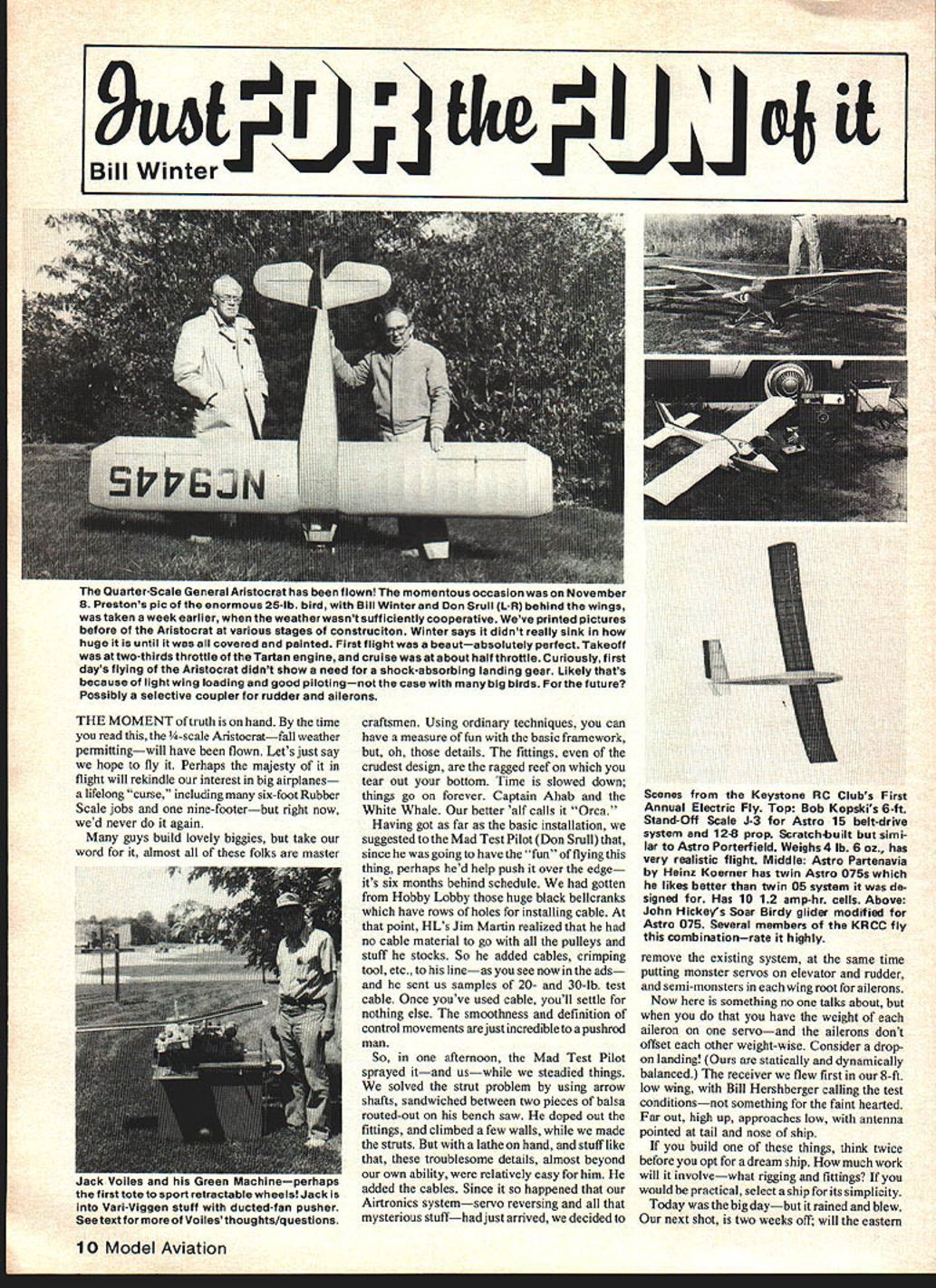
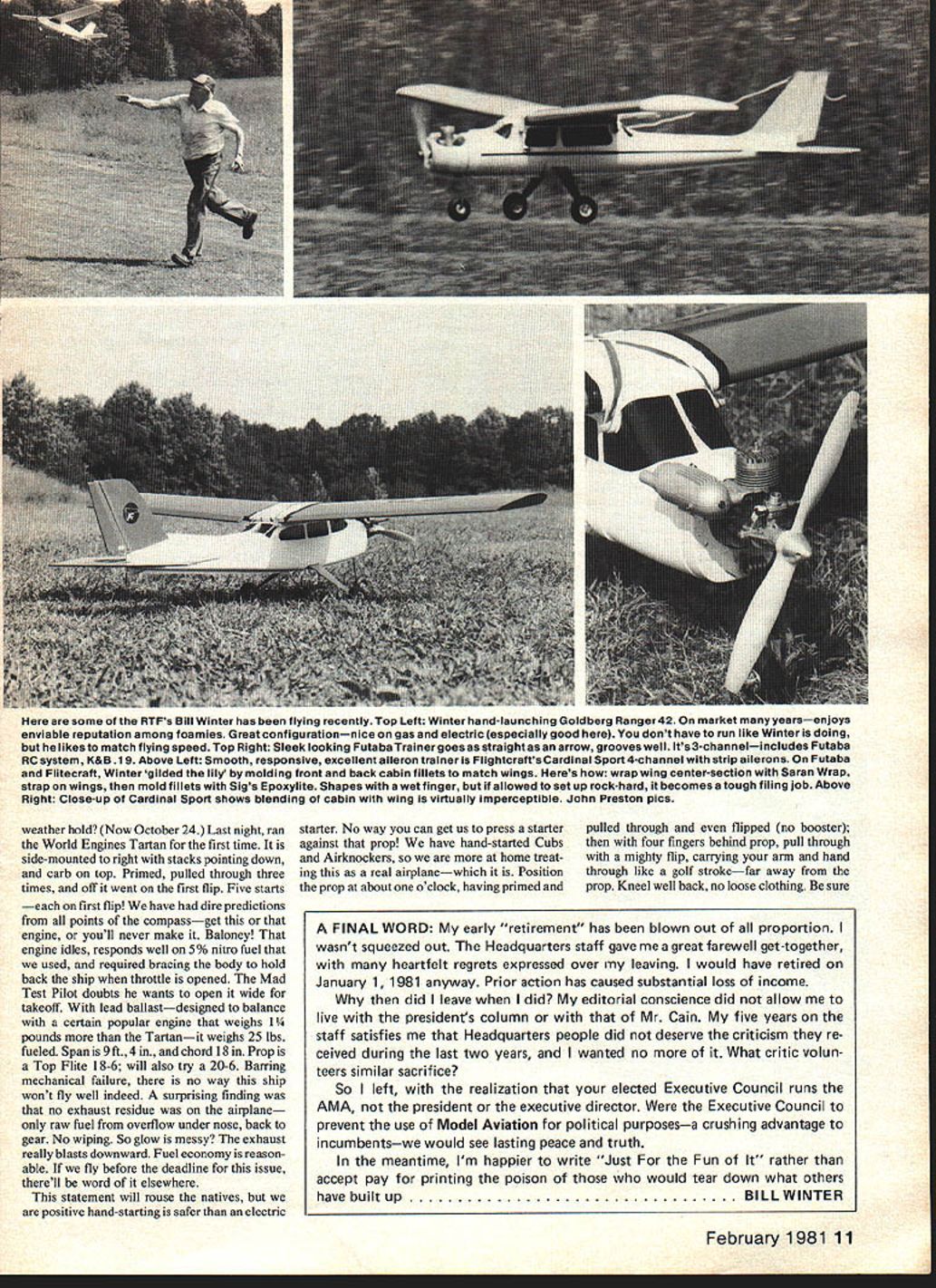
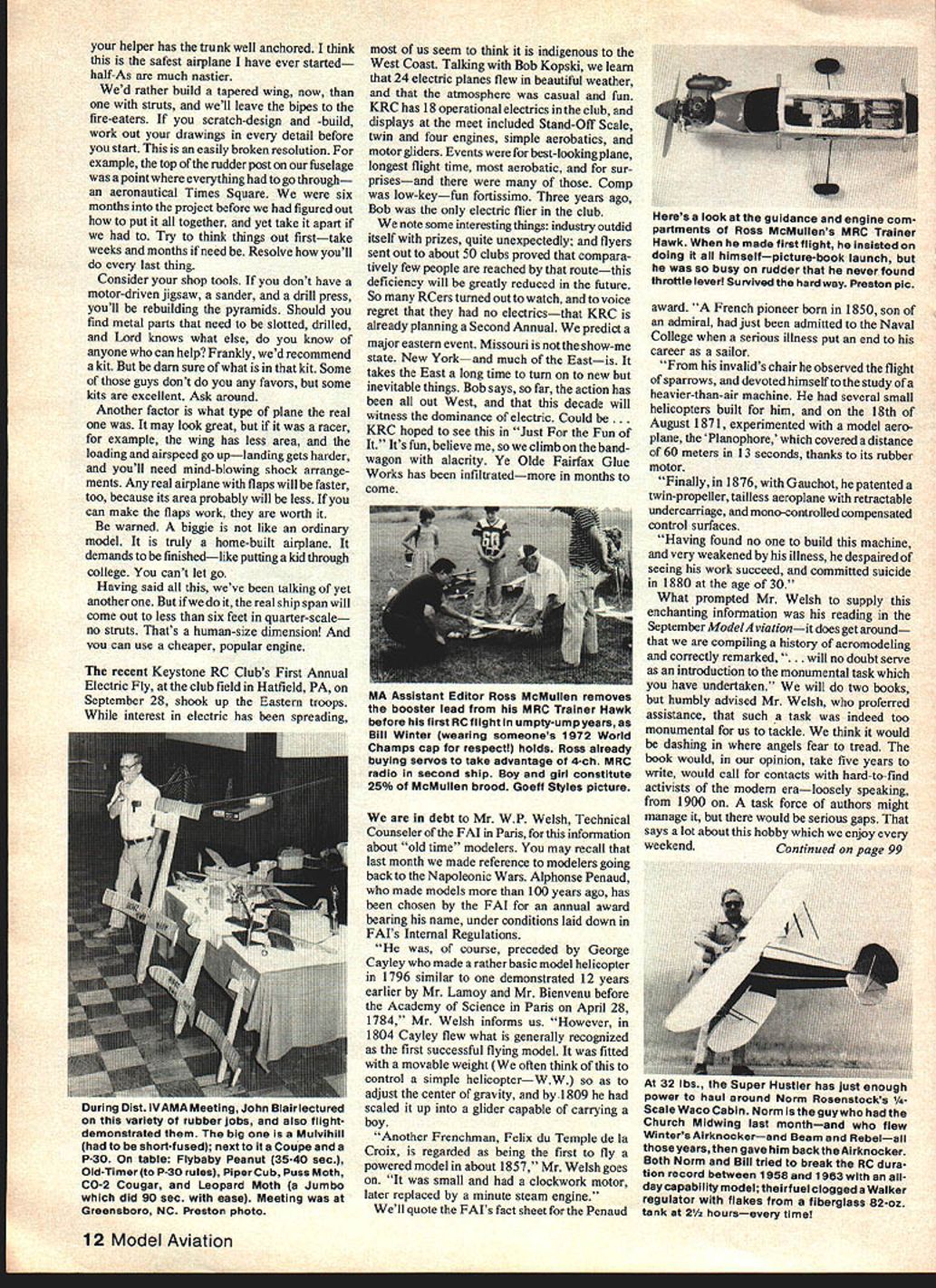

Just For the Fun of it
Bill Winter
Quarter‑Scale General Aristocrat
The moment of truth is on hand. By the time you read this, the 1/4‑scale General Aristocrat—weather permitting—will have been flown. Let's just say we hope to fly it. Perhaps the majesty of it in flight will rekindle our interest in big airplanes (a lifelong "curse," including many six‑foot Rubber Scale jobs and one nine‑footer), but right now we'd never do it again.
Many guys build lovely biggies, but take our word for it: almost all of these folks are master craftsmen. Using ordinary techniques you can have a measure of fun with the basic framework—but, oh, those details. The fittings, even of the crudest design, are the ragged reef on which you tear out your bottom. Time is slowed down; things go on forever—Captain Ahab and the White Whale. Our better half calls it "Orca."
Having got as far as the basic installation, we suggested to the Mad Test Pilot (Don Srull) that since he was going to have the "fun" of flying this thing, perhaps he'd help push it over the edge—it's six months behind schedule. Don got Hobby Lobby's huge black bellcranks with rows of holes for cable attachment. HL's Jim Martin realized there was no cable material to go with all the pulleys and stuff he stocks, so he added cable, a crimping tool, etc., to his line and sent us samples of 20‑ and 30‑lb test cable. Once you've used cable you'll settle for nothing else—the smoothness and definition of control movements are just incredible compared with pushrods.
One afternoon the Mad Test Pilot sprayed it—and us—while we steadied things. We solved the strut problem by using arrow shafts sandwiched between two pieces of balsa routed out on the bench saw. He doped out the fittings, climbed a few walls, and, with a lathe on hand, made struts. Those troublesome details, almost beyond our ability, were relatively easy for him. He also added the cables.
Since our Airtronics system (servo reversing and all that mysterious stuff) had just arrived, we removed the existing system and installed monster servos on elevator and rudder and semi‑monsters in each wing root for ailerons. Here's something no one talks about: you have the weight of each aileron on one servo—and the ailerons don't offset each other weight‑wise. Consider a drop‑on landing! (Ours are statically and dynamically balanced.) The receiver we used first was one we had flown in our 8‑ft low wing, with Bill Hershberger calling the test conditions—not something for the faint‑hearted: far out, high‑up approaches low, with antenna pointed at tail and nose of ship.
If you build one of these things, think twice before you opt for a dream ship. How much work will it involve—what rigging and fittings? If you would be practical, select a ship for its simplicity.
Today was to be the big day—but it rained and blew. Our next shot was two weeks off; will the eastern weather hold? (Now October 24.) Last night we ran the World Engines Tartan for the first time. It is side‑mounted to the right with stacks pointing down and the carb on top. Primed, pulled through three times, and off it went on the first flip. We had five starts—each on the first flip! We have had dire predictions from all points of the compass—get this or that engine, or you'll never make it. Baloney! That engine idles and responds well on the 5% nitro fuel we used, and required bracing the body to hold the ship when throttle is opened. The Mad Test Pilot doubts he wants to open it wide for takeoff. With lead ballast (designed to balance with a certain popular engine that weighs 1¾ pounds more than the Tartan), it weighs 25 lbs fueled. Span is 9 ft. 4 in., chord 18 in. Prop is a Top Flite 18‑6; we'll also try a 20‑6. Barring mechanical failure, there is no way this ship won't fly well indeed. A surprising thing was that no exhaust residue was on the airplane—only raw fuel from overflow under the nose back to the gear. No wiping. So glow is messy? The exhaust really blasts downward. Fuel economy is reasonable.
If we fly before the deadline for this issue, there'll be word of it elsewhere.
Hand‑Starting: Safety and Procedure
This statement will rouse the natives, but we are positive hand‑starting is safer than an electric starter. No way you can get us to press a starter against that prop! We have hand‑started Cubs and Airknockers, so we are more at home treating this as a real airplane—which it is.
- Position the prop at about one o'clock, having primed and pulled through and even flipped (no booster).
- With four fingers behind the prop, pull through with a mighty flip, carrying your arm and hand through like a golf stroke—far away from the prop.
- Kneel well back, no loose clothing.
- Be sure your helper has the trunk well anchored.
I think this is the safest airplane I have ever started—half‑A's are much nastier.
Building Advice: Planning, Tools, and Design Choices
We'd rather build a tapered wing now than one with struts, and we'll leave the bipes to the fire‑eaters. If you scratch‑design and build, work out your drawings in every detail before you start. This is an easily broken resolution. For example, the top of the rudder post on our fuselage was a point where everything had to go through—an aeronautical Times Square. We were six months into the project before we had figured out how to put it all together and yet take it apart if we had to. Try to think things out first—take weeks and months if need be. Resolve how you'll do every last thing.
Consider your shop tools. If you don't have the following, you'll be rebuilding the pyramids:
- Motor‑driven jigsaw
- Sander
- Drill press
Should you find metal parts that need to be slotted, drilled, and Lord knows what else, do you know anyone who can help? Frankly, we'd recommend a kit. But be darn sure of what is in that kit. Some suppliers don't do you any favors, but some kits are excellent. Ask around.
Another factor is what type of plane the real one was. It may look great, but if it was a racer, for example, the wing has less area, and the loading and airspeed go up—landing gets harder, and you'll need mind‑blowing shock arrangements. Any real airplane with flaps will be faster, too, because its wing area probably will be less. If you can make the flaps work, they are worth it.
Be warned. A biggie is not like an ordinary model. It is truly a home‑built airplane. It demands to be finished—like putting a kid through college. You can't let go.
Having said all this, we've been talking of yet another one. But if we do it, the real ship span will come out to less than six feet in quarter‑scale—no struts. That's a human‑size dimension! And you can use a cheaper, popular engine.
Electric Flying: Keystone RC Club Fly
The recent Keystone RC Club's First Annual Electric Fly at the club field in Hatfield, PA, on September 28 shook up the Eastern troops. While interest in electric has been spreading, most of us seem to think it is indigenous to the West Coast. Talking with Bob Kopsky, we learn that 24 electric planes flew in beautiful weather, and that the atmosphere was casual and fun. KRC has 18 operational electrics in the club, and displays at the meet included Stand‑Off Scale, twin and four engines, simple aerobatics, and motor gliders. Events were for best‑looking plane, longest flight time, most aerobatic, and for surprises—and there were many of those. Competition was low‑key—fun fortissimo. Three years ago, Bob was the only electric flier in the club.
We note some interesting things:
- Industry outdid itself with prizes, quite unexpectedly.
- Flyers sent out to about 50 clubs proved that comparatively few people are reached by that route—this deficiency will be greatly reduced in the future.
- So many RCers turned out to watch and voiced regret that they had no electrics—that KRC is already planning a Second Annual.
We predict a major eastern event. It takes the East a long time to turn on to new but inevitable things. Bob says, so far, the action has been all out West, and that this decade will witness the dominance of electric. Could be.
KRC hoped to see this in "Just For the Fun of It." It's fun, believe me, so we climb on the bandwagon with alacrity.
Historical Notes: Early Modelers and the Penaud Award
We are indebted to Mr. W. P. Welsh, Technical Counselor of the FAI in Paris, for information about "old time" modelers. You may recall that last month we made reference to modelers going back to the Napoleonic Wars. Alphonse Penaud, who made models more than 100 years ago, has been chosen by the FAI for an annual award bearing his name, under conditions laid down in FAI's Internal Regulations.
He was, of course, preceded by George Cayley, who made a rather basic model helicopter in 1796 similar to one demonstrated by Lamoy and Bienvenu before the Academy of Science in Paris on April 28, 1784. Mr. Welsh informs us, "However, in 1804 Cayley flew what is generally recognized as the first successful flying model. It was fitted with a movable weight so as to adjust the center of gravity, and by 1809 he had scaled it up into a glider capable of carrying a boy."
"Another Frenchman, Felix du Temple de la Croix, is regarded as being the first to fly a powered model in about 1857," Mr. Welsh goes on. "It was small and had a clockwork motor, later replaced by a miniature steam engine."
We quote the FAI's fact sheet for the Penaud award:
- Penaud was a French pioneer born in 1850, son of an admiral, who had been admitted to the Naval College when a serious illness put an end to his career as a sailor.
- From his invalid's chair he observed the flight of sparrows and devoted himself to the study of a heavier‑than‑air machine. He had several small helicopters built, and on 18 August 1871 experimented with a model aeroplane, the "Planophore," which covered a distance of 60 meters in 13 seconds thanks to its rubber motor.
- In 1876, with Gauchoit, he patented a twin‑propeller, tailless aeroplane with retractable undercarriage and mono‑controlled compensated control surfaces.
- Having found no one to build this machine and very weakened by his illness, he despaired of seeing his work succeed, and committed suicide in 1880 at the age of 30.
What prompted Mr. Welsh to supply this enchanting information was his reading in the September Model Aviation that we are compiling a history of aeromodelling—and he correctly remarked it will no doubt serve as an introduction to the monumental task we have undertaken. We will do two books, but humbly advised Mr. Welsh that such a task is too monumental for one person. The book would, in our opinion, take five years to write and would call for contacts with hard‑to‑find archivists of the modern era—loosely speaking, from 1900 on. A task force of authors might manage it, but there would be serious gaps. That says a lot about this hobby we enjoy every weekend.
We have so many letters chock‑full of ideas, new crates, and useful comments on things we never thought of, that we are beginning to feel the editorial pangs of running a miniature magazine. Though we can't use all of them, do keep writing.
Letters and Technical Notes
We received several letters with useful tips and observations:
- One correspondent prefers a high‑rpm Schnuerle and notes that displacement alone doesn't relate directly to torque—this is a job for Superman.
- He loves Robart servo arms and the transfer linkage (so do we).
- His coil‑spring extension needle valve snapped off the needle due to vibration; he had a straight brass tube extension with a 4‑40 socket head. The point missed is that a coil‑spring extension can be bent back and anchored so that the knob turns as usual. We use this on our big Aristocrat because we don't want "amputated" fingers.
- For a modified Vari‑Viggen, he offers the formula: V = P × N / 1376, where P = pitch in inches, N = rpm, V = mph (allows 23.3% slip).
What We Are Doing / Current Projects
- Half‑way on a 6‑ft Vagabond RC‑assist of our own old‑timer free‑flight design. Cleaner by far than our big Sniffer, it will weigh 1½ to 2 lbs less, so we look forward to first‑class soaring. Quite a few of you have asked why it isn't a registered Old‑Timer. We weren't sure of the dates but have now established it was built in 1942. Pond has a plan.
- Have scaled up the Mad Test Pilot's tiny foamie you saw a couple of issues ago. It's 11½ inches; if we finish it, we'll throw our hat into that Kennedy gym where the Maxecuters squadron of Flying Acres make you feel so humble. Build it in two days? Incidentally, if you haven't at least built a small ROG, you ain't paid your dues.
- Putting together a Pilot Model Sport‑III with a K&B .19 (.19–.25). Ours is the trike version, and we anticipate great things from this aileron low‑wing using Airtronics' new tiny servos, a small pack, and the XL transmitter with servo‑reversing capability, linear and exponential controls. This so‑called R/C model—you do have to do some work—it's a remarkable kit. It bowls over our visitors.
- Fuselage molded in tough plastic; wings and tail built like your best aerobatic jobs, neatly covered in white film (hinge slots even cut). Great hardware. Our only objection: tiny wheels—good on paved surfaces, but we have to use bigger wheels for grass.
- We've flown Kraft's electric Cessna and Chipmunk. You don't get long, lively flights as with gas, but both fly excellently—good for three minutes plus. If you must use electric because of flying conditions, these are fine products. Watch for long motor run‑out during prolonged descent; later stages of the approach to landing are extended.
- Since Chipmunks fly remarkably well (recall our recent comments on MRC's .09 version), try the bigger Midwest F.R. We've urged Doug Pratt of Model Retailer to put one together—we both anticipate great flying.
- Also flew MRC's Trainer Hawk and Futaba's trainer. Especially impressed by Flitecraft's Cardinal Sport cabin for 4‑channels and ailerons. This is a going machine—groovy, responsive, and a great aileron trainer. It proved tough: interference rolled it into a vertical corkscrew into the woods; it tore through giant trees and came out virtually unscathed.
- Bob Boucher's Astro Flight Porterfield (6‑ft scale electric) is still before us, but the Mad Test Pilot tempts us to switch to a 1/4‑scale Lacy with Astro's prop‑drive .05. It's quite small, acres of wing area, a box, all straight edges—ugliness can be beautiful! If so, we'll make a ghost ship out of that Porterfield with only a .15 gas engine. Also have the original 6‑ft Live Wire plan—an RC Old‑Timer.
- We have to learn to build faster! Super glue (and no 'Stuf, of course) is a lifesaver—cuts time in half.
In between, we are writing two modeling books and sundry articles. We aim to really retire in two years—or so—and build and fly all the time. The best laid plans of mice and men... P.S. Forgot the 10‑ft cardboard monster!
What's happened to you FF and CL guys? Have you given up? Next month: lots of great CL from George Aldrich.
Bill Winter, 4330 Alta Vista Dr., Fairfax, VA 22030.
Ready‑to‑Fly Notes and Criticisms
Not everything is perfect in ready‑to‑flies. On a number of sheet‑balsa‑covered wings one finds a tendency of the butted sheet to lift slightly off the foam. You can see the seams in the proper light. (Veneer would cure it.) Actually, it does not affect performance, we find, and we've cut up wings with a Dremel jigsaw to check bonding. It is OK, but much foam is very soft and it "works" slightly. Noting a wrinkle near the root on one cabin model after one flight, we were afraid to put it up again. At home, we found that the wing could not be broken over the knee. To soothe customers, some kind of a joiner would be advisable—though it isn't essential.
We do find a grave fault in plastic continuous rudder hinges. When the horn is at the bottom of the rudder, it will pry the rudder askew. Replace those hinges with a mechanical type. We knocked off one rudder just hooking up the pushrod! An easy fix.
A Final Word
My early "retirement" has been blown out of all proportion. I wasn't squeezed out. The Headquarters staff gave me a great farewell get‑together, with many heartfelt regrets expressed over my leaving. I would have retired on January 1, 1981 anyway. Prior action has caused substantial loss of income.
Why then did I leave when I did? My editorial conscience did not allow me to live with the president's column or with that of Mr. Cain. My five years on the staff satisfies me that Headquarters people did not deserve the criticism they received during the last two years, and I wanted no more of it. What critic volunteers similar sacrifice?
So I left, with the realization that your elected Executive Council runs the AMA, not the president or the executive director. Were the Executive Council to prevent the use of Model Aviation for political purposes—a crushing advantage to incumbents—we would see lasting peace and truth.
In the meantime, I'm happier to write "Just For the Fun of It" rather than accept pay for printing the poison of those who would tear down what others have built up.
BILL WINTER
Transcribed from original scans by AI. Minor OCR errors may remain.

