
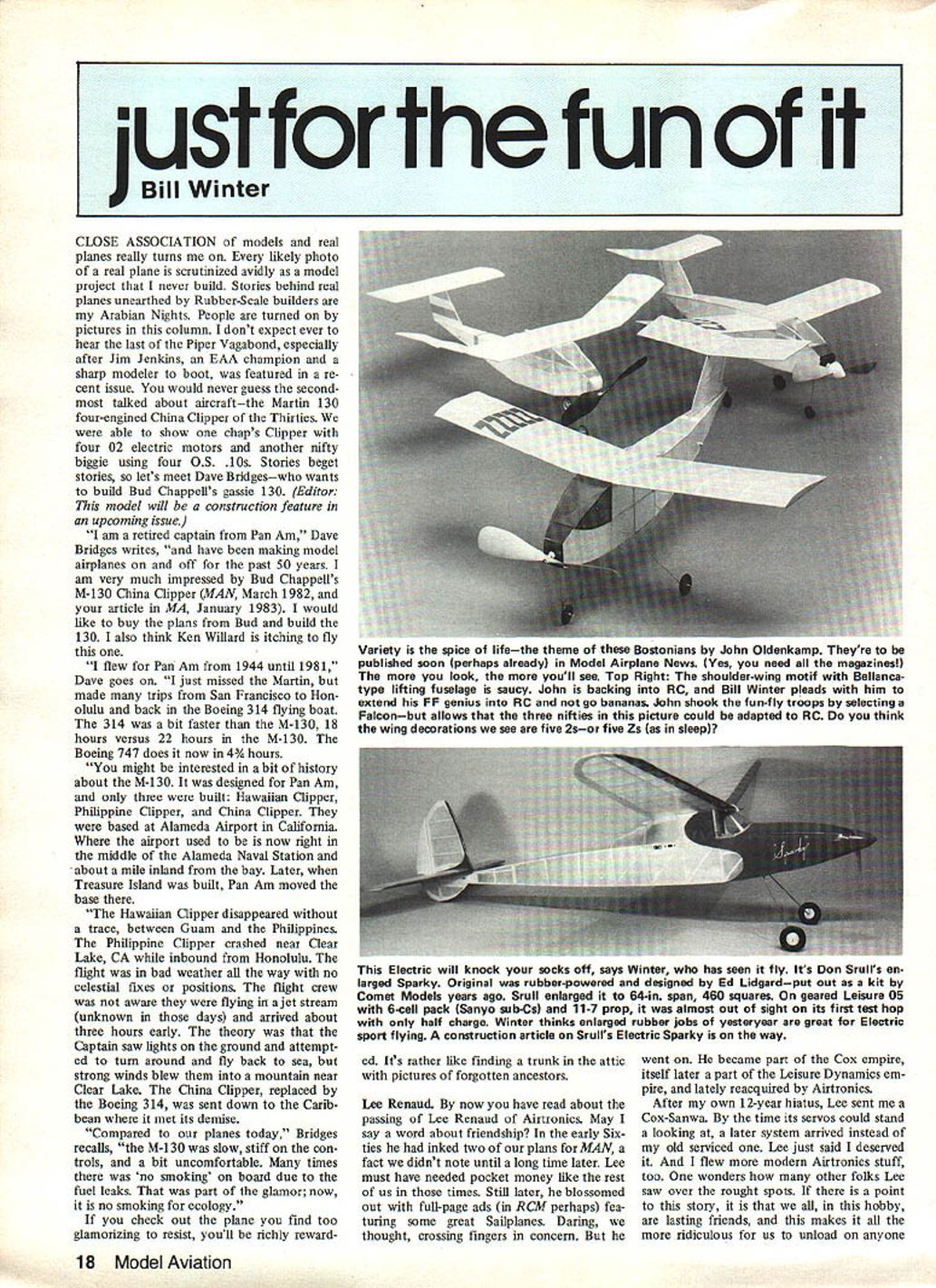



Just for the Fun of It
Bill Winter
Close association of models and real planes really turns me on. Every likely photo of a real plane is scrutinized avidly as a model project that I never build. Stories behind real planes unearthed by Rubber-Scale builders are my Arabian Nights. People are turned on by pictures in this column. I don't expect ever to hear the last of the Piper Vagabond, especially after Jim Jenkins, an EAA champion and a sharp modeler to boot, was featured in a recent issue. You would never guess the second-most talked-about aircraft—the Martin M-130 four-engined China Clipper of the Thirties. We were able to show one chap's Clipper with four .02 electric motors and another nifty biggie using four O.S. .10s. Stories beget stories, so let's meet Dave Bridges—who wants to build Bud Chappell's gas M-130. (Editor: This model will be a construction feature in an upcoming issue.)
"I am a retired captain from Pan Am," Dave Bridges writes, "and have been making model airplanes on and off for the past 50 years. I am very much impressed by Bud Chappell's M-130 China Clipper (MA, March 1982, and your article in MA, January 1983). I would like to buy the plans from Bud and build the 130. I also think Ken Willard is itching to fly this one.
"I flew for Pan Am from 1944 until 1981," Dave goes on. "I just missed the Martin, but made many trips from San Francisco to Honolulu and back in the Boeing 314 flying boat. The 314 was a bit faster than the M-130, 18 hours versus 22 hours in the M-130. The Boeing 747 does it now in 4½ hours.
"You might be interested in a bit of history about the M-130. It was designed for Pan Am, and only three were built: Hawaiian Clipper, Philippine Clipper, and China Clipper. They were based at Alameda Airport in California. Where the airport used to be is now right in the middle of the Alameda Naval Station and about a mile inland from the bay. Later, when Treasure Island was built, Pan Am moved the base there.
"The Hawaiian Clipper disappeared without a trace, between Guam and the Philippines. The Philippine Clipper crashed near Clear Lake, CA while inbound from Honolulu. The flight was in bad weather all the way with no celestial fixes or positions. The flight crew was not aware they were flying in a jet stream (unknown in those days) and arrived about three hours early. The theory was that the Captain saw lights on the ground and attempted to turn around and fly back to sea, but strong winds blew them into a mountain near Clear Lake. The China Clipper, replaced by the Boeing 314, was sent down to the Caribbean where it met its demise.
"Compared to our planes today," Bridges recalls, "the M-130 was slow, stiff on the controls, and a bit uncomfortable. Many times there was 'no smoking' on board due to the fuel leaks. That was part of the glamor; now, it is no smoking for ecology."
If you check out the plane you find too glamorizing to resist, you'll be richly rewarded. It's rather like finding a trunk in the attic with pictures of forgotten ancestors.
On Friendship and Lee Renaud
By now you have read about the passing of Lee Renaud of Airtronics. May I say a word about friendship? In the early Sixties he had inked two of our plans for MAN; in fact we didn't note it until a long time later. Lee must have needed pocket money like the rest of us in those times. Still later, he blossomed out with full-page ads featuring some great sailplanes. Daring, we thought, crossing fingers in concern. But he went on. He became part of the Cox empire, itself later a part of the Leisure Dynamics empire, and lately reacquired by Airtronics.
After my own 12-year hiatus, Lee sent me a Cox-Sanwa. By the time its servos could stand looking at, a later system arrived instead of my old serviced one. Lee just said I deserved it. And I flew more modern Airtronics stuff, too. One wonders how many other folks Lee saw over the rough spots. If there is a point to this story, it is that we, in this hobby, are lasting friends, and this makes it all the more ridiculous for us to unload on anyone.
Someday, goldarnit, I will write a column as planned. But things and people keep blowing me out of the water. I go ape over many club newsletters, some of which I look forward to more than the magazines. And the magazines. I read things which drive me bananas. And the "old-boy grapevine" is an international network of black-magic guys doing strange and wonderful things. Like the prewar Chinese air-warning system: by signaling hilltop to hilltop, the Chinese could alert an inland target a good hour or more before the Japanese bombers could get there.
As to newsletters, FAC's is thick, full of crazy fun, all sorts of R&D, and plans of the world's strangest airplanes out of the remote past. These guys think nothing of flying Handley-Page biplane transports, or the Vickers Vulcan, or ugly British torpedo planes of the early '20s. Huge, crazy-angled crates, complete with ladders on the side so a pilot could climb up to a lofty cockpit—as for cleaning gutters. It goes on forever. I think the editors chew on funny mushrooms.
Magazines? Let's just take the unending statements that you must never build a biggie that weighs more than 12 pounds per cubic inch of displacement. On glow, that is kaput. I kick the cat in despair.
How anyone can ignore the wing loading is beyond me. The "12-lb. rule of thumb" does suit many crates, but it is wrong for many exceptions. Was the crate a classic lightplane, like a Robin or a Moth? Did the real plane have flaps? Was it a fighter, or a no-holds-barred acrobatic machine? For example, Haffke's rotund Gee Bee recently published in MAN fits the rule—it is also glow .90-powered, and Haffke has published one Gee Bee (a good one as he flies it), with over 60 oz. per sq. ft. wing loading! On the other hand, there is nothing wrong with my 18-lb. Vagabond with an O.S. .90. At 9/10ths of 12 pounds, it would weigh less than 11 lb.
If you can pardon me mentioning my 10-ft., 4-in. Aristocrat (again) at 28 pounds on only 1.32 cu. in. displacement (Tartan), I am a mortal sinner because it is supposed to weigh (by the 12-lb. rule of thumb) only 16 pounds; if so, it would be a no-wind floater. It flies majestically (as a 1929–30 classic should), and you know that it is weighty only on the roll-out momentum—also realistic. Compare it with many similar Stinsons, etc., that mush along on 2 cu. in. displacement. They weigh, on average, 22 to 25 pounds. OK by the 12-lb. rule? Don't you believe it. They could take 3 cu. in. Why?
The Stinson is a sublime configuration, as good as they come. But the real one carried four people, whereas the Aristocrat carried three—and the Stinson had flaps. In the olden days speed ranges were often miserable—the top speeds relative to stall and landing speeds. You had to have lots of wing area in the old days with relatively low power—to land easily in small, runwayless "aerodromes." Or on a farm field when a drop of water conked out an OX-5 carb. And then take off!
Flaps were a quantum leap. Wing area was reduced drastically for better cruise. That means much higher wing loadings on your big model (of the same general type), and the need to shoot for the 12-lb. figure per cu. in. (Since sluggish performance persists, it is a Catch-22 situation.) Speed range was better because flaps maintained fairly comparable landing speeds. An 18- to 20-lb. (not 24–26) Stinson with 2 cu. in. would compare with my Aristocrat at 28 lb. on 1.32 cu. in. How come? Well, the spans are roughly equal, but the Aristocrat, an older vintage, scales to an 18-in. chord, the Stinson to 13½. On a 9-ft. plane, forgetting the loss due to the cabin width, that translates into a 4½ sq. ft. difference in wing areas between what only looks like two similar-type planes. The difference in wing loadings is stupendous—yes, do build the Stinson as lightweight as you can, but use still more power. Flaps are not just fun stuff. You must play them precisely on the Stinson, et al., if you want top results.
Consider Doc Brooke's magnificent imported kits (high-priced, but worth it). His huge Tiger Moth floats like a feather. Fantastic. Sure, it's a biplane, but I've watched superb examples weigh 30–32 lb. or more, and they fly majestically on a 2 cu. in. old-model Quadra, capable of lifelike loops and rolls and glorious dead-stick forced landings. At that weight, 3 cu. in. would make it a P-12! Yet they tell us don't build it over 24 lb. if we abide by that 12-lb. per cu. in. thing. At 24 lb., under that rule, you'd almost have to fly the Tiger Moth like the indoor models.
Heavy spark-ignition engines are mainstream. For Scale, they lend balance, and as I know of a twin-engined Kawasaki job that made much news, 14 lb. of ballast wasn't enough. Some of them are inexpensive and reliable—I have a Quadra and would never knock it. There is a point in the individual's perception of economy, etc., where ignition takes preference, but glow as well as spark suits my own crates. Some Stinsons and the like can't hold altitude at less than full throttle on some (the legit size) ignition engines, yet with glow my far-heavier Aristocrat can make gentle figure-eights at near idle—on 1.32 cu. in. glow. I had nothing to do with that. It's just that the suggested 12-lb. bit, and ignition, is better for some, if not most, big crates according to type—but there is something haywire when everything to the contrary is universally censored. You can't read this anywhere!
Al Altman and Practical Limits
Al Altman, until recently a director of, now an advisor to, the IMAA—the "big"-plane association—has his head screwed on right. He is a practical guy. He digs the philosophy of Electric, which is not his game, takes diesels and Davis heads with me (Al has great results from a Davis-head Fox Eagle II turning a real club of a prop, a glow engine that lends itself to dieselization with remarkable facility). We chat about all things RC though, of course, his love is big airplanes. We agree that planes requiring field repairs of major components should not be flown again that day—and with very good reason.
"I have to go along with Don G. on the 12-lb. per cu. in. limit," Al begins. "Without such reasonable guidelines, too many guys will be doing real crazy stuff. This is not an absolute by any means, but experience has proven the 12-lb. figure is a very practical limit. Not only power loading but wing loading must also be considered—and usually exceeding the 12 lb. per cu. in. results in an excessively high wing loading. I, for one, think a wide speed envelope and a low stall speed envelope are almost as good as romance.
"It seems," Al continues, "that a glow-type engine per cubic inch will outperform a gasoline-burner." (Author: My 1.32 cu. in. glow turns a Top Flite 18-6 up to 7,000–7,100 rpm and is roughly comparable to the old-model 2 cu. in. Quadra, but with less weight.) "This, plus the favorable wing loading of your Aristocrat, results in a good-flying bird with what appears to be radically minimum power. Also, you are not a hot-rod type. You fly the Aristo like it should be flown. It's not a Cap 20 or the like, and it's not flown that way."
When you analyze what we both had to say, you will find we really agree. I fly two classics which had no flaps, hence more area. The Aristo does the Scale Procedure with positive speed and preciseness. Naturally, no vertical maneuvers are involved; one did not roll or stunt the real aircraft. In RC, if you want good vertical performance, the better off you are with more power and less weight. A loggy crate does terrible stall turns and wingovers, and piloting actually is far more difficult. For aerobatics—don't kid yourself—you must first be a well-grounded pilot.
Really, all I want is to see an end to this business of hiding glow in the closet. It fits well within limits; conversely, a 3 cu. in. on glow would break the bank at Monte Carlo. At 2 to 5% nitro and only 8% oil, and a few dozen biplane flights a year, I am not concerned about fuel that costs less than $10 a gallon. On the other hand, my big-tank Kadet .40 is rocking my budget. It flies much more often. How many flights will you make?
The Old-Boy Network and "Pappy" deBolt
On to the old-boy network—and "Pappy" deBolt. He writes letters crammed with experimental stuff, on the fringes oftentimes, but it almost always works out. I have not won an argument with Hal for well-nigh 50 years. If he told me that I should use props with big holes in the blades, I wouldn't laugh. I've been through this with him on strip ailerons, full-symmetrical airfoils, etc. He tries bigger props than anyone else in Pylon, and he makes them work. He is into prop unloading in the air. Of him, George Aldrich writes, "Gosh, Hal has forgotten more than we want to know."
A long friendship was mildly strained when, as editor of MA, I failed to print the second portion of his prop article. While I had faith, all the would-be aerodynamicists and computer engineers (hordes of those guys!) tarred and feathered everyone from the poor editor on down. I figured the world (unlike me) wasn't ready for Harold. It isn't theory with him, but curiosity and a search for better things. Like Dizzy Gillespie, Hal uses a wildly-bent trumpet. He interprets aerodynamics, and the music is fine if you don't condemn that crazy horn.
He is at it again—and some of this coincides with much of my long-buried ideas for new crates. Hal loves racing planes and big models. He's had a long fixation with the sleek Caudron racers. But if you go big enough to get the required wing area, the fuselage reaches coast-to-coast. I often eye a Fokker racer—just to be different—and wouldn't it be magnificent? But if I flew it, what would happen? I'm not that curious. Wonders Hal (so do I): Why not cheat? I then picture a Zero—a bit wingy as it is for a fighter, and a fine example of the Japanese artistic eye for lovely outlines. If the wing area was upped, other things in proportion (but leaving the fuselage alone), one would have a sport, Sport Scale. Not useful for competition, but it would be a very nice, easy-to-fly sport model with class. The wing could be fudged for any degree of performance, even to a Zero look-alike powered soarer (you could do this with a P-40 or whatever). Hal is the determined type. His answer is a 1/3-scale wing on a 1/4-scale fuselage—if he can find anyone to agree. I did. I bet he will build a mad Caudron that will handle as easily as an over-scale Sig Kavalier.
He also is flying a 2-meter sailplane on rubber power. He gets straight flights of more than 1,000 ft. What shook him up was the amount of rubber needed to turn a big Wakefield prop—24 strands of 1/4. So I just phoned him. Had he flipped? He was getting about 30 ft. altitude, so we tried lower pitch—and the climb improved considerably. But the power ran out like gangbusters. Then he went in the middle, and now has the world's wackiest rubber job that climbs fairly well and circles, but with that big prop it glides like a brick, also busting blades. He's trying folders. We had a long discussion out of my old Rubber Scale days about prop block dimensions.
Don't ask me what he is up to. I'd bet that 2-meter is just a handy test platform. Speaking of big pylon-racing props, guys write: "What has he done lately in pylon?" For shame. Hal, like me, is an ancient mariner, not a NASA test pilot. I tried to argue him out of his belief that his depth perception was shot. I am of the school of thought that no one really has it. The lone oak tree at Round Swamp on Long Island embarrassed too many fighter pilots years ago for me to believe. But Hal's problem was real. The pod had been inside some kind of plastic lenses, and now, for an old boy (pardon me, Hal), he's back to sharper flying. I'm jealous. I can't judge height coming over the fence, and my landings are all up and down the strip, often in the rough.
"Props prove interesting," Hal tells us, still speaking of his 2-meter with rubber power. "The Wakefield sizes provided a limited climb with a long, low flight in the ground effect. A much smaller, low-pitched prop gave a good climb and altitude but not much distance. Something in between gave decent altitude and a much longer 'cruise' altitude, plus the longest distance — the most realistic flight. This was all with the same amount of rubber, which is limited by cost and the ability to wind it.
"What was noticed with the big props," he continues, "is that once two-thirds of the winds are gone, you do better by stopping the prop. Fold it. During the last portion of the flight, the slow-turning prop actually increases the sink rate. Basic, I suppose, unless you could reduce the flying speed so that the prop did not act like a brake.
"Srull with his prop shape parallels my findings with gas props." (Author: Srull acquired a technical paper with a conclusion that the wide point of the prop should be one-third out on the blade length, and the outer two-thirds rather pointed—it works wonders on Rubber Scale.) "It helps to reduce the drag at the hub and tip. He might find some more with progressive airfoils—interesting to play with.
"My latest best prop for the Quadra is a 20-12 with the drag-reduction ideas. Most guys snicker at it until they see it unload and pull in the air. A surprise with this one was noise reduction. Noticeably quieter in the air. Leads one to believe that other props are doing a bit of 'air thrashing' instead of pulling. Sound seems to be a good gauge to work with for props." This could go on forever.
Electric and Scaled-Up Rubber Designs
This may shock the Electric world, but it appears that scaling-up old sport rubber jobs yields better performance when compared with virtually all of those snub-nosed, high-drag gas Old-Timers. Perhaps the ultimate in Electric sport.
Electric already is splitting, and resplitting into widely diverging configurations, as in RC in general. Most newcomers are putting .05s into sailplanes—like the Gentle Lady, the Windrifter II, and (like my son, Mike) into the Top Flite Metrick (that gets more slippery). Others are using reduction-drive 15s in scale Porterfields and the like. Still others go for Buzzards, etc., with the same 15, though new .05s can fly it, too. Some go multi-engine with .02s and .035s, etc., especially scale types (because power and thrust is even, and you never have an engine-out crisis). Tiny bombs with single and double .02s will scream up to 90 mph or so, and even do 4-pt. rolls. Really hot pilots convert the Barbarian to Electric for advanced acrobatics. The ship I will talk about is pretty, climbs like crazy (though not skyrocket), glides beautifully. Cutting right through the middle of everything, it's sensational. It will knock your socks off.
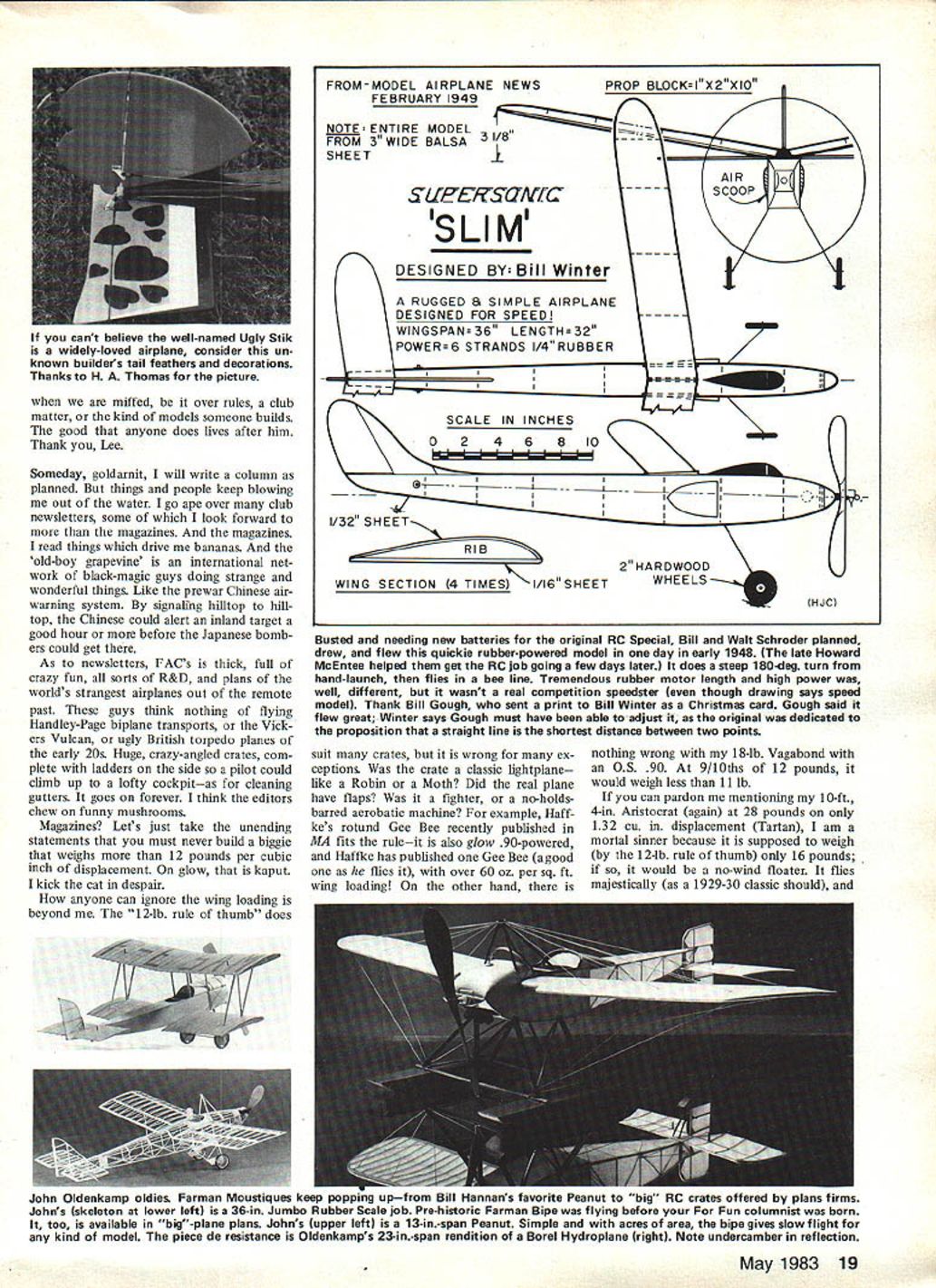
I've got to drag Don Srull into this. Now, older modelers will remember Ed Lidgard's Sparky Rubber design for Comet. Ed had an eye for beauty and proportions—one of our all-time greats. (His Sparky just showed up in another mag, in a different form.) This Sparky spans 64 in., has only 460 sq. in. area for a Leisure geared .05. It was turning an 11-7, although 11-7½ or an 11-8 may do better.
Electric guys are cramming in all sorts of multi-cell packs. Seven sub-Cs is a favorite on the .05. Both mine and Don's have the standard, factory-supplied 6 sub-C Sanyos, as in Leisure's big Playboy RC-assist FF. Other points: you can fly well with recommended charge rates and periods with factory-supplied chargers, but anything over an .05 requires a voltage doubler as well to convert car battery 12V to, say, 28 or 30. And if you want the precise charge on anything that gives absolute maximum power without overcharging, you need a charger with a digital readout in 1/100ths of a volt, or a digital voltmeter from, say, Radio Shack. Things are still new, and model farms are proliferating, so definitive answers are yet to come on many tradeoffs between voltage, weight, thrust, wing loading, etc.
The big yellow Micafilm-covered Sparky was given only a 7-minute charge on the first flight, 10 minutes on the second. Roughly half-charged. No one expected what was to happen. Total shock. It ran quickly on a true track with tail-dragger gear, lifted off in turbulence, and somewhere between one and two minutes of the flight, it was a speck. With on-off, the motor was shut down and the model glided. Then back up. A long approach across a wide field at about 4-ft. height was dragged in with power inputs to avoid stakes near a narrow road on which it landed gently. It is plain as day that this airplane, using on-off, will fly on any warm day, even with no thermals though perhaps with gentle lift to decrease the sink rate, for 15 or 20 minutes. Extra-long flights with soaring seem virtually unlimited, if there is lift around.
Obviously, the glorious Wakefields of yesteryear (when wing loadings and cross-section rules applied), such as the Korda, Ron Warring jobs, Frank Zaic's, and Cahill's fantastic Clodhopper will make world-beating "sport" .05 Electrics when scaled-up 50%. Srull wants me to start the big "gas" Korda I had talked about—at 6-ft. span. But I just laid down sides on my own original, a low parasol with 515 squares. Geared .05s now will fly Old-Timers (gassies) at areas of up to 720 sq. in. or so, if lightweight. And Astro Flight has motors up to 40s! So-called Schoolyard Scale models (and why don't all those columnists discover that Gas Schoolyard needs no apologies?) will fly beautifully on .02s and .035s—the former ideal for the .02 gassies.
Don't compare Gas and Electric. The latter is a new and entirely different challenge. I love my gas floaters and Old-Timers, but there also is a great thrill when you see an Electric bore into the heavens, then shut down and float, ready to start up whenever you wish. Think about all those Wakefields. Sparky is right out of believe-it-or-not. (Editor: Srull's scaled-up Electric Sparky will be a future MA construction presentation.)
Loose Ends and New Engines
Talking about a Pilot Aero Sport, a .19 job which we fly on an O.S. Schnuerle .25, it was observed that many crates seem to call for something equally good but in the mid-range of .25 to .40 power, the latter being just too big. World Engines asks if I had considered their newly-announced O.S. FSR .28. It is a bored-out .25 FSR with the same physical dimensions as the .25 FSR case. And available in both airplane and helicopter versions is a new O.S. .25 FSR ABC.
"Scotty" at World also notes the completely redesigned .30 Wankel. Improved metallurgy and cooling gain increased durability, fewer repairs, and elimination of the old aluminum cooling shroud. Scotty thinks these are my answer to a "hotter" .30 to help bridge the gap between .25s and the too-bulky .40s on many aircraft now on the market.
People ask about a recent discussion of desired anti-tip/stall washout. I did not think Pattern people would be confused. Some are. Washout on a Pattern machine will give variations in right-side-up and inverted, and such pilots always (I hope) maintain adequate airspeed anyway. For hacking around, washout is life insurance.
And Cliff McBaine, who builds museum models, writes: "I must take issue with Don Miller indicating the use of the Gottingen 387 on the Vega and Fokker and Ford Trimotors (MA, January 1983, page 18). It is well documented . . . all the Vegas had a Clark Y18 at the root and a Clark Y9.5 at the wing tip. The Fokker had a unique Fokker airfoil. (Ref. U.S. Civil Aircraft, Vol. 1, by Joseph P. Juptner). According to Juptner in Vol. 2 and 3 of U.S. Civil Aircraft, the Trimotor used a Gottingen 386, not 387. I have not been able to locate a 386 in my extensive file of airfoil data. Juptner could be wrong in this case . . . ." (Author: Except for the Vega, my file copy of Jane's All the World's Aircraft does not list profiles. The Vega's was given as a modified Clark Y. Also, Miller's long letter was in longhand, and in the extractions it is possible that I could have missed a word such as "like." I cannot file old "papers" which repose in cartons. I don't question McBaine's facts.)
The Final Word
From Scale Statel Newsletter: "In this wonderful world of foam, fiberglass and ready-to-fly models, aerodynamics is becoming a lost art. This is a pity, because aerodynamics has been very INSTRUMENTAL in making airplanes fly. Which is why we have terms like piano wire, elevator horn, bell crank, wing chord, and scale effects to mention too many. Take airfoils. Where would we be without the fine examples of the past?"
Many famous men have contributed to aerodynamics. One of the finest men was Bruce Bukhard, inventor of the fuselage, which he created to hold the wing and tail apart. He was wondering what to call the space between the wing and tail when his French chef, Armand, shouted that dinner was ready. "Just a moment, Armand," he replied, and there it was.
One very important contribution was made by Willie Flapdoodle, who never worried about how a plane was balanced. He just put the CG in a little box and moved it around during the first few flights, and when he found the right position, he glued it in place. This is very useful if the CG happens to be outside the structure. It stops the slipstream from blowing it away.
And on and on . . . Enough already!
Bill Winter 4426 Altura Ct. Fairfax, VA 22030
Transcribed from original scans by AI. Minor OCR errors may remain.

