

Just for the Fun of It
Bill Winter
Dyna-Jet memories
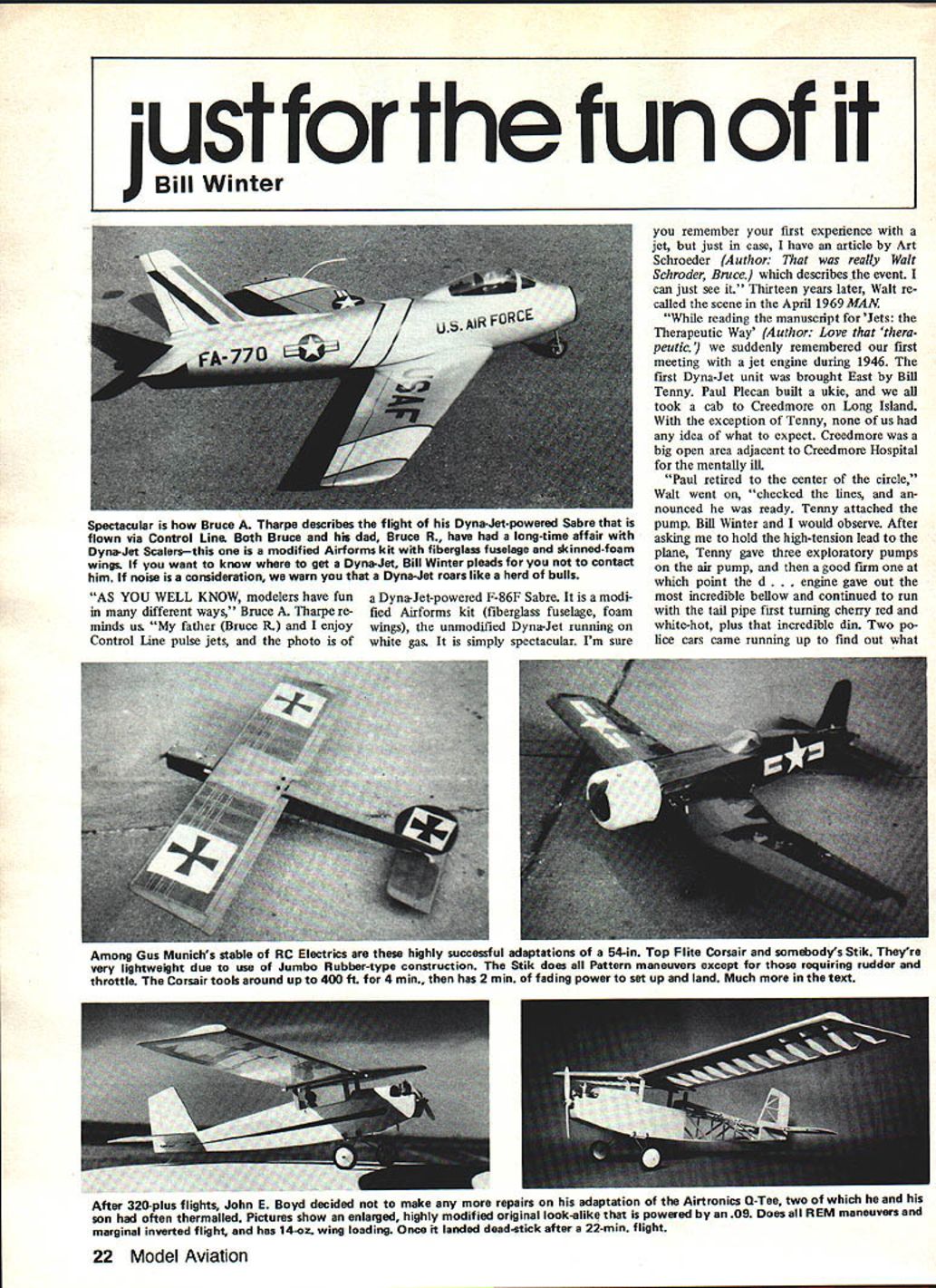
“As you well know, modelers have fun in many different ways,” Bruce A. Tharpe reminded us, sending a photo of a Dyna-Jet–powered F-86F Sabre. The model is a modified Airforms kit (fiberglass fuselage, foam wings), the unmodified Dyna-Jet running on white gas. “It is simply spectacular.”
Thirteen years earlier Walt (Art) Schroeder recalled his first meeting with a jet engine. In 1946 the first Dyna-Jet unit was brought east by Bill Tenny. Paul Plecan built a ukie, and a small group took a cab to Creedmoor on Long Island — a big open area adjacent to Creedmoor Hospital. Paul set the model in the circle, Tenny attached the pump and, after a few exploratory pumps, the engine erupted in an incredible bellow, the tailpipe glowing cherry red and white-hot. The din brought two police cars running. Then, suddenly, the engine stopped. Silence was indescribable, and the day ended with suitable explanations to the police and a very memorable cab ride.
Early encounters with pulse jets
Unknown to Walt, Bill Winter had already heard a 5‑inch pulse jet. At Johnsville Naval Air Station in 1946, Ralph Barnaby introduced some enthusiasts to captured Nazi weaponry and to Mo Taylor, an ardent modeler and practical joker. Mo set up a 5‑inch U.S. pulse jet and lured visitors close to the tailpipe. One man walked up with a big torch and the world seemed to end — eardrums fluttered like reed valves. The experience left a lasting impression: the noise was out of all proportion to the small size of the engine.
Dyna-Jets in Scale — history and safety
Dyna-Jets enjoyed some popularity in Scale. Old-timers will recall excellent Dyna-Jet models from Cal Smith and Frank Lasheck. Early models were balsa-built, with asbestos and thin aluminum separating the hot jet from the fuselage; helpers had to race to pump air through the ship after landing to prevent fires. Modern practice uses fiberglass fuselage shells and better clearances around the tail pipe.
A number of clubs still fly pulse-jet models in CL Speed or CL Jet Scale. Bruce Tharpe notes that Western Associated Modelers (WAM) may be the only organization still sponsoring a true CL Jet Scale event and invited contact from other interested modelers. (Bruce A. Tharpe, 2380 Cabrillo Dr., Hayward, CA 94545.)
Caution: launching rails and twin-engined high-speed crates can be extremely hazardous — don’t try anything that risks escaping gravity.
Gus Munich — electric pioneer
Fleet and approach
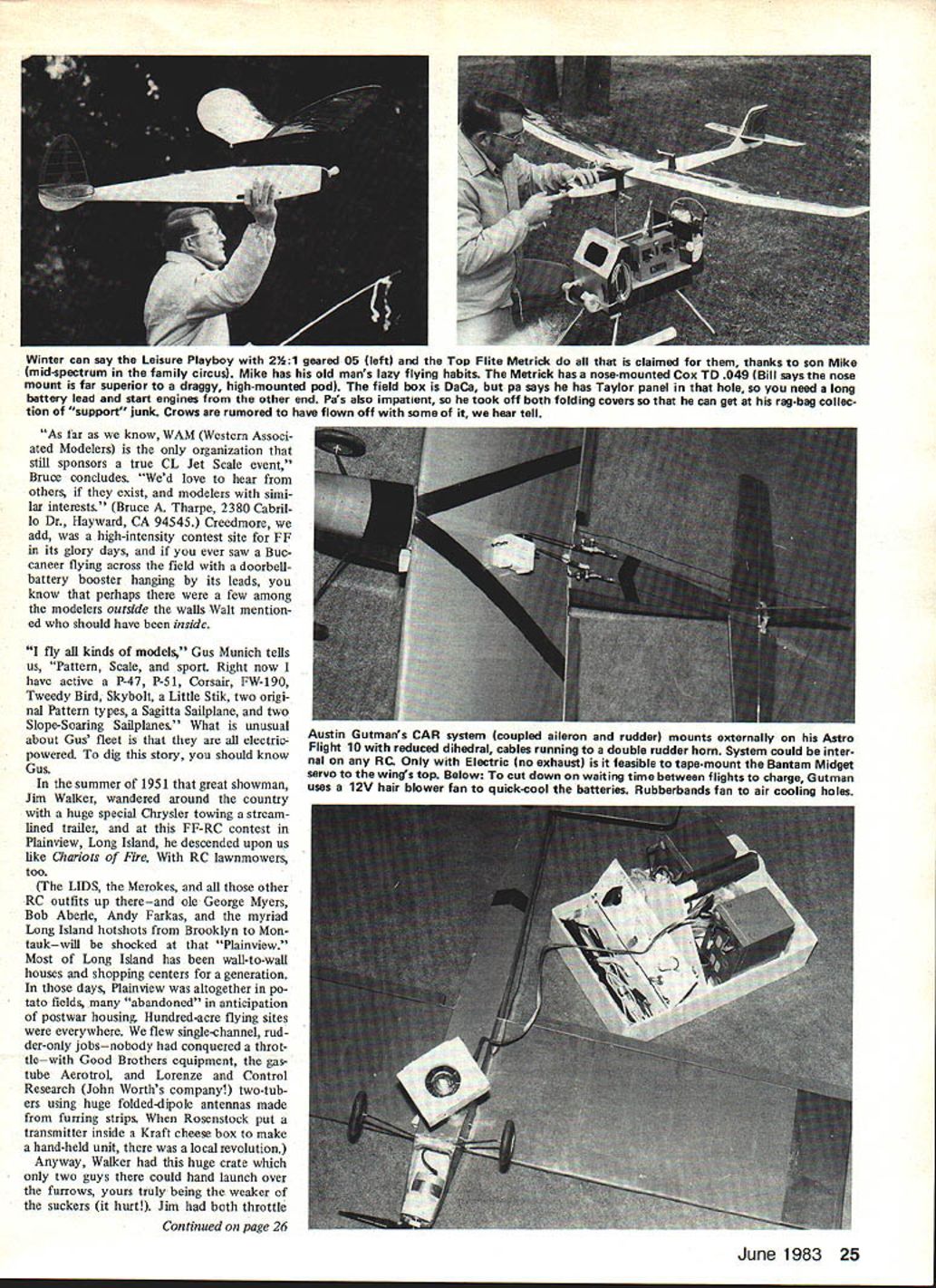
Gus Munich flies Pattern, Scale and sport models. His active fleet includes:
- P-47, P-51, Corsair, Fw-190
- Tweedy Bird, Skybolt, Little Stik
- two original Pattern types
- a Sagitta sailplane
- two slope-soaring sailplanes
What’s unusual is that these are all electric-powered.
Notable electric projects and gear
- Starter pod for Sagitta: motor from an Astro starter with a homemade 3:1 belt drive and seven cells; motor reworked with 1/8-inch ball bearings (likely an Astro 075). Using a hi-start, the Sagitta reached about 500 feet.
- Leisure Playboy with Leisure LT50: 2½:1 gear reduction; plug-in wings for car transport; airframe about 4½ oz (context implies very lightweight).
Gus experimented widely and learned to conserve battery “fuel” by shutting down the motor to set up landings. He reported flights up to 28 minutes, but typically used a 7‑minute charge for a 7‑minute flight.
Power recommendations (Gus’s experience)
- Scale aircraft ~550–600 sq. in., 40–48 oz: Leisure LT50 with gear reduction recommended.
- Models ~300 sq. in., 28–31 oz: LT50 direct drive recommended.
- Direct-drive motors: gray Cox 6-4 praised.
- Geared drives: Rev-Up 11-7, Rev-Up 11-7X, Top Flite 11-7 recommended.
- Gus had good results with a 10-6 Tornado on the Playboy: faster turning and longer runs, but slightly less climb.
Electric Stik — construction and performance
Gus built an Electric Stik (30-inch, symmetrical airfoil, 1-inch thick section) using lightweight balsa. Details:
- Control: aileron and elevator (Canon micro servos), Kraft Sport Series receiver.
- Receiver battery: 250 mAh.
- Servos: four small World Engines servos (0.6 oz each).
- Motor: geared LT50; pilot used six to eight cells depending on desired rpm.
- All-up weight of one example (with balsa wheels, blue MonoKote): 56½ oz; span 54 in; wing area similar to the Playboy.
- Construction notes: stick-and-former technique, formers 3/32 in. sheet, 1/8 sq. stringers, 1/16 ribs, 1/8 sq. spruce spars, 1/4 × 1/8 TE and LE; firewall soft 1/4 balsa with 1/16 fill near nose; cowl from bottom of a Clorox bottle.
- Performance: on a 15-minute charge, about 4 minutes of good aerobatics plus ~2 minutes of diminishing power for landing; typical six-minute flights on 15‑minute charges; altitudes around 400 ft. Gus reported takeoffs from rough fields and trim adjustments to get satisfactory climb.
Q-Tee, IDDFAVS and large rubber-influenced designs
A discussion on powering the little Q-Tee produced strong mail. John E. Boyd built two Q‑Tees covered with clear-doped silkspan and trimmed with red tissue; once he thermalled one for about 15 minutes — a thrilling moment for him and his son.
Boyd later designed IDDFAVS (“If It Don't Fly It Ain't Worth S---”), a larger derivative with changed moments and aspect ratio. Powered by an Enya .09, it handled many maneuvers, marginal inverted flight, and achieved a wing loading under 14 oz per sq. ft. Boyd logged long service (320-plus flights) and a longest dead-stick of 22 minutes.
On large, lightly built six-footers with a .19 engine: Gus describes a gentle takeoff — slow taxi, tail raises, brief low-speed run, then a float-off. With careful trim and throttle management such ships can climb and thermally circle; a six-footer on a .19 can do inverted circle flights.
Historic finds — Korda, Goldberg and Sadler
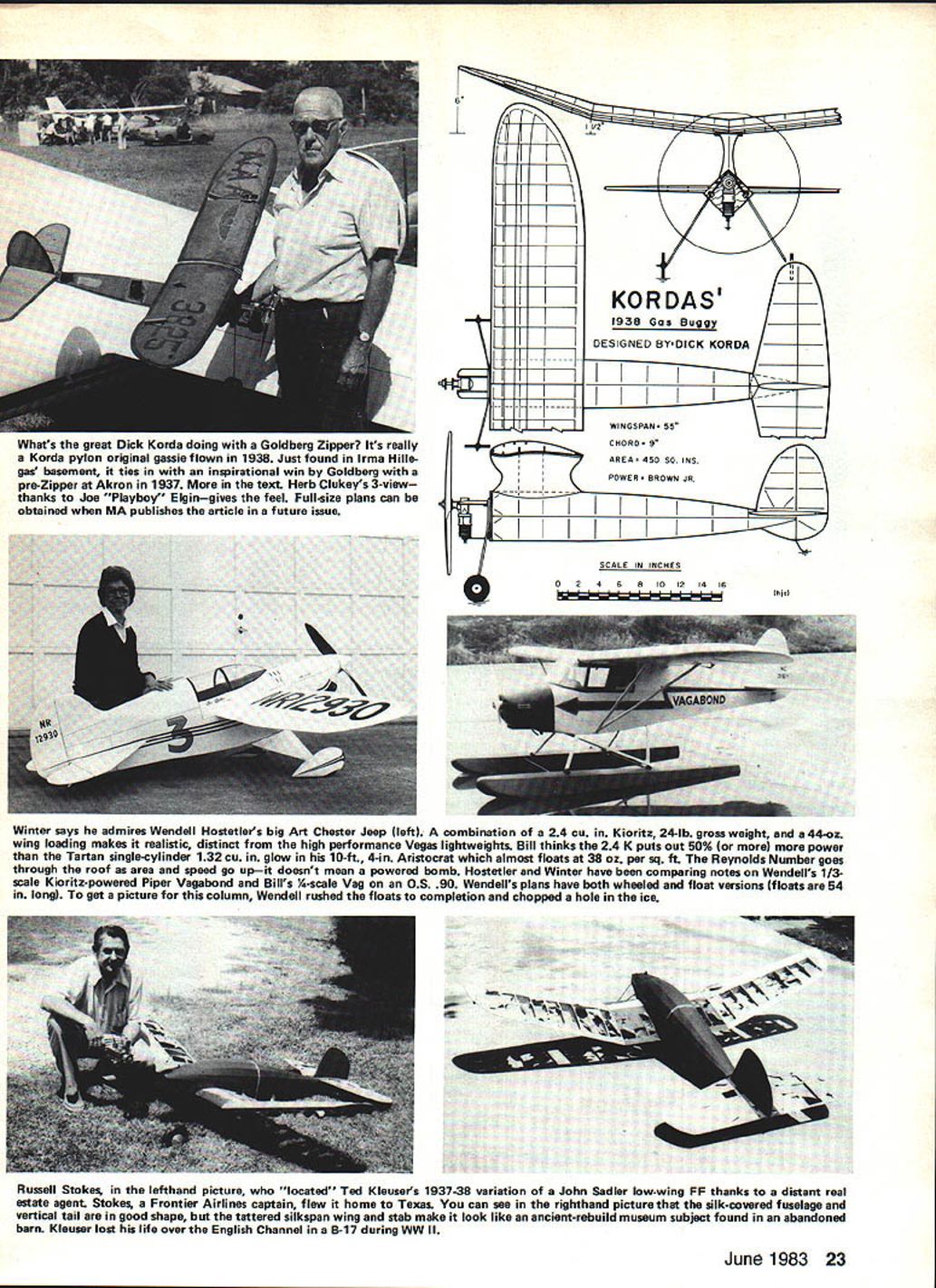
Joe Elgin reports that Irma Hillegas offered an old Dick Korda gas model from the basement. The crate dates to before Korda’s famous Powerhouse and seems to have flown in 1938; one picture and a three-view by Herb Clukey are available. The model has elliptical tips, polyhedral, a 54 in. span with a 9 in. chord, and was originally powered by a Brown Jr. After 45 years Korda’s model weighed 24 oz without pencil batteries and had about 450 sq. in. area.
Carl Goldberg’s 1937 pylon Gas Bird and the later Comet kit (and the Zipper craze) are part of the era’s history. Korda’s early involvement with gas models, his craftsmanship, and the period AMA numbers (late 1930s) are cited as evidence of the model’s vintage.
Another rare antique surfaced: a mid‑thirties low-wing free-flight built by Ted Kleuser (and associated with John Sadler’s designs). Russell Stokes of Texas located one such bird, packed it into a Frontier flight and brought it home. The model wears a Forster .99, has a tapered wing and flat streamlined fuselage; silk-covered fuselage survived well, wing fabric in tatters, and the Forster still runs. The model carries AMA number 3014, likely just prior to Korda’s 1938 AMA number. Stokes’s find may be a Sadler variant or a one-off survivor.
Adhesives — cyanoacrylates and practical notes
The “war of the nozzles” continues. Popular cyanoacrylate (CA) brands mentioned include Jet, Hot Stuff, Zap and others. Some users reported clogged feeder tubes and difficulties with nozzle sizing.
Practical tips and product notes:
- Accelerator spray: a squeeze-spray accelerator can be applied to one surface (6–8 in away) and the joint cures instantly.
- Golden West solvent: ultra‑super solvent for separating instant-glued joints and removing CA from fabric coverings (handle with care — flash point and safety considerations apply).
- Bob Hunter (Hot Stuff) offered technical info: manufacturers often fill 2‑oz units under controlled atmosphere and use weight-fill. Shelf life of unopened 2‑oz units on the bench is about one year; refrigeration (freezer) can extend life to 1½ years. Do not return opened units to the refrigerator (condensation accelerates deterioration). There are many CA formulas — some are inexpensive drugstore types, others are specialized dental/medical grades (Hot Stuff is used in some medical manufacturing).
Nozzles, tips and dispensing
Bob Hunter’s nozzle advice:
- Use about 3/4 in. of tubing inserted into the spout, bevel the tube end and fit smoothly (may need slight enlargement of the spout).
- Proper tube insertion reduces clogging; if clogging occurs, the plug is often at the tip and can be pulled off.
Production numbers and variants vary by manufacturer; there are many CA formulations for different uses. Handle all solvents and accelerators with appropriate safety.
Jigs, tools and bench aids
- A-Just-o-jig: once unfamiliar, now invaluable for many bench tasks.
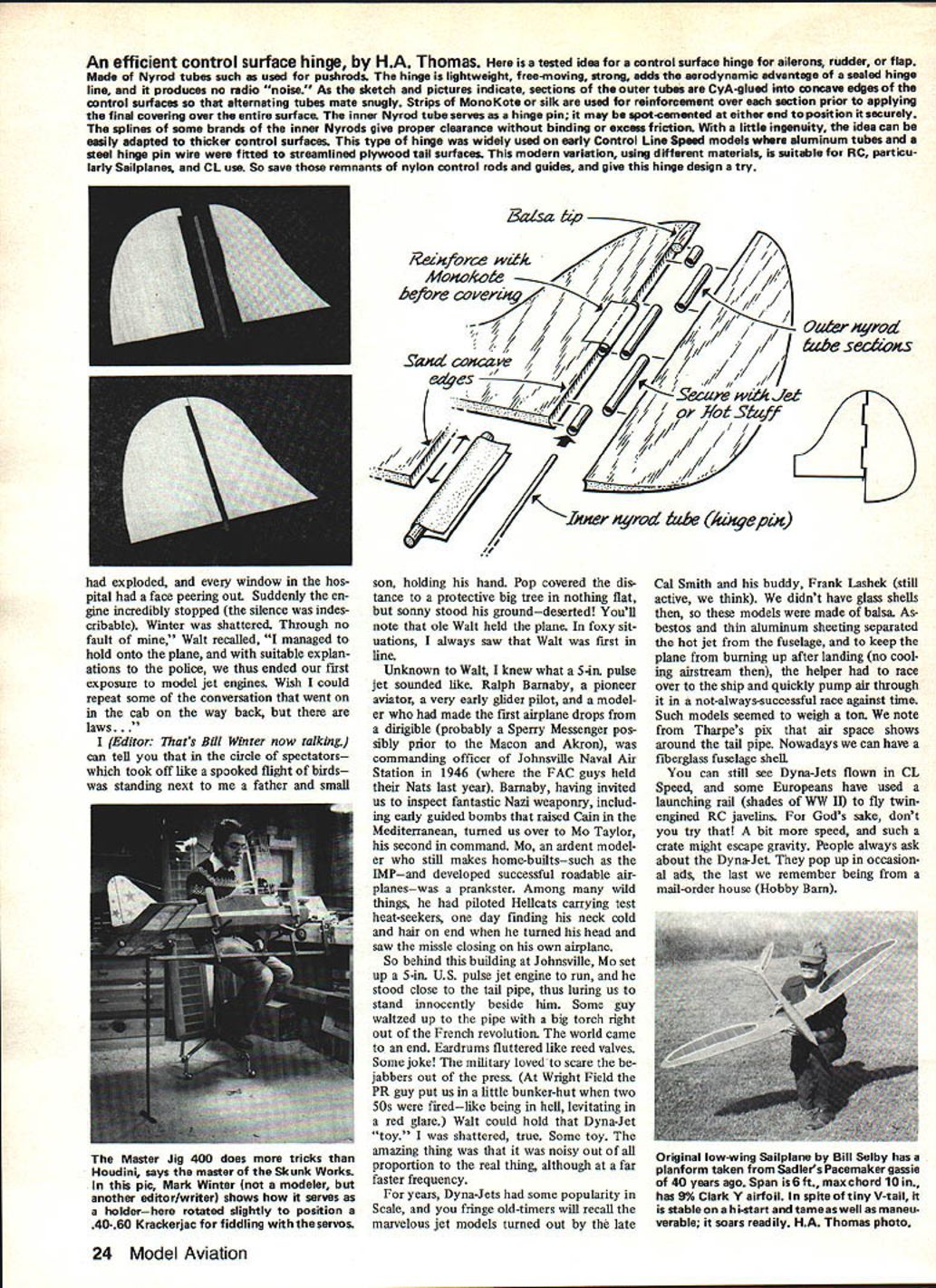
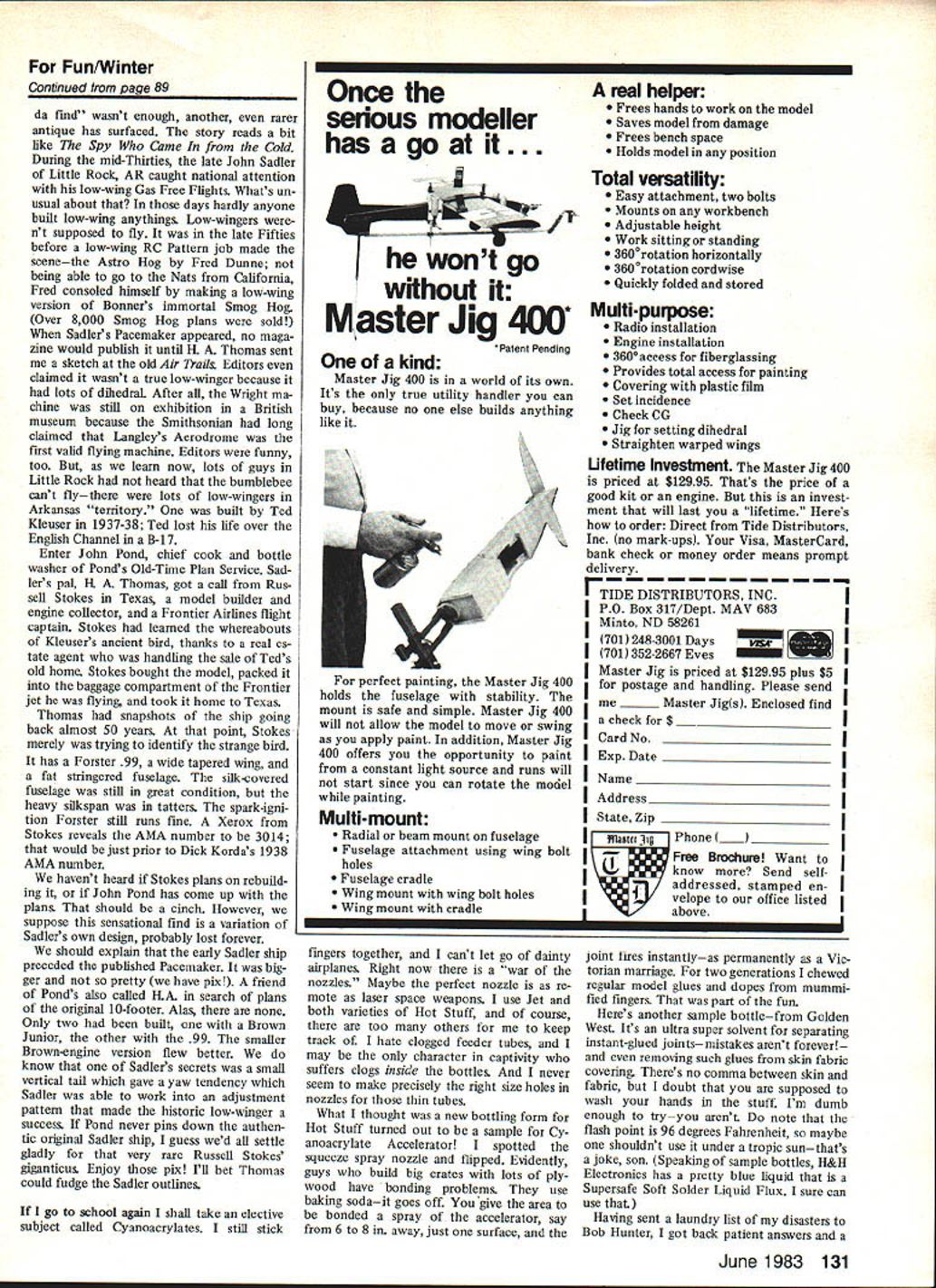
- Tide Distributors Master Jig 400: a versatile rotatable steel-bar jig that holds fuselages or wings, allows rotation, checking incidence, CG, setting dihedral, covering, painting, etc. It supports working while sitting or standing and can be swung out of the way with the model attached — a boon for shop organization and avoiding bench rash.
Big airplanes — Wendell Hostetler and scale effect
Wendell Hostetler’s quarter-scale Piper Vagabond and his Art Chester Jeep demonstrate the magic of scale. The Jeep, with a .24 Kioritz and about 24 lb gross, has a wing loading of about 44 oz per sq. ft. — surprisingly flyable and realistic in handling. Larger models often tolerate heavier loadings better; doubling model size increases area as the square and raises Reynolds numbers, improving aerodynamic behavior in some respects.
Hostetler added floats to a Vagabond and even demonstrated operations on a hole cut in ice. Larger, rugged sport flying benefits from realistic scale loading for day-to-day use.
Corrections and clarifications
- On flap effects (April 1983 column): the intended point was that increasing flap increases drag dramatically and lowers L/D. (A mis-phrasing suggested the opposite.)
- A previous typographical error listed P‑22 (Ryan) instead of P‑19 (Fairchild).
Control-surface hinge idea
H. A. Thomas has explored a lightweight, low-friction hinge using sections of small nylon tubing (as used for pushrods), glued into matching concave edges of control surfaces. Alternating tubes mate to form a simple, free-moving hinge line that is light, strong and radio‑quiet. (Sketches and photos accompany the idea in the original column.)
(Continued on page 134)
Transcribed from original scans by AI. Minor OCR errors may remain.

