

Just for the Fun of It
Bill Winter
WHY IS IT ALWAYS a Monday morning column time? I sit, hands folded behind my head, listening to voices. I don't lack material. But the voices whisper "Wakefield." I don't want to write about Wakefields any more than you expect to read about them, but the voices insist on sharing an experience.
I see a Buzzard Bombshell and a hot summer afternoon when a flight can last forever. The man had handed me the box and said, "How about bringing it in?" It was low on the horizon, a dot several farm fields away. I never touched the stick after pointing its nose toward home. It kept coming, and coming, and coming. Over the cyclone fences of the adjacent ball field it came, over the goal posts where we were flying, right at us, looming larger and larger. A subliminal sonar (radar?) pinged 100 ft., 75 ft., 50 ft., 25 ft. Turn it! Which way (as if that mattered)? The decision was simply too much ... The better 'alf just shattered the reverie: "I don't hear that typewriter going."
I seldom think about Wakes except when some World Champs gets reported, and I look to see how our "boys" did. There was a time when many of us built Wakes. I loved them. They were fun for me, once. We all kidded ourselves into thinking that any of us could win something. It was only after much of the luck element was wiped out by inevitable rules evolution that we turned off.
In the glory days of Wake for me, from the mid-'30s to roughly 1950, the rules were quite different from now. You did need a wing area of 200 squares (plus or minus 10), a minimum weight of 8 oz., and there was a fuselage cross-section requirement. Rubber was anything you needed; spell that "rope." But model performance had to be limited if contests were to be feasible. Maximum flight time limits were imposed. Rubber was severely limited. When guys ended up with tubular stick models (and how does Bob White make those things so pretty?) and machined front ends, the lights went out for many sport modelers.
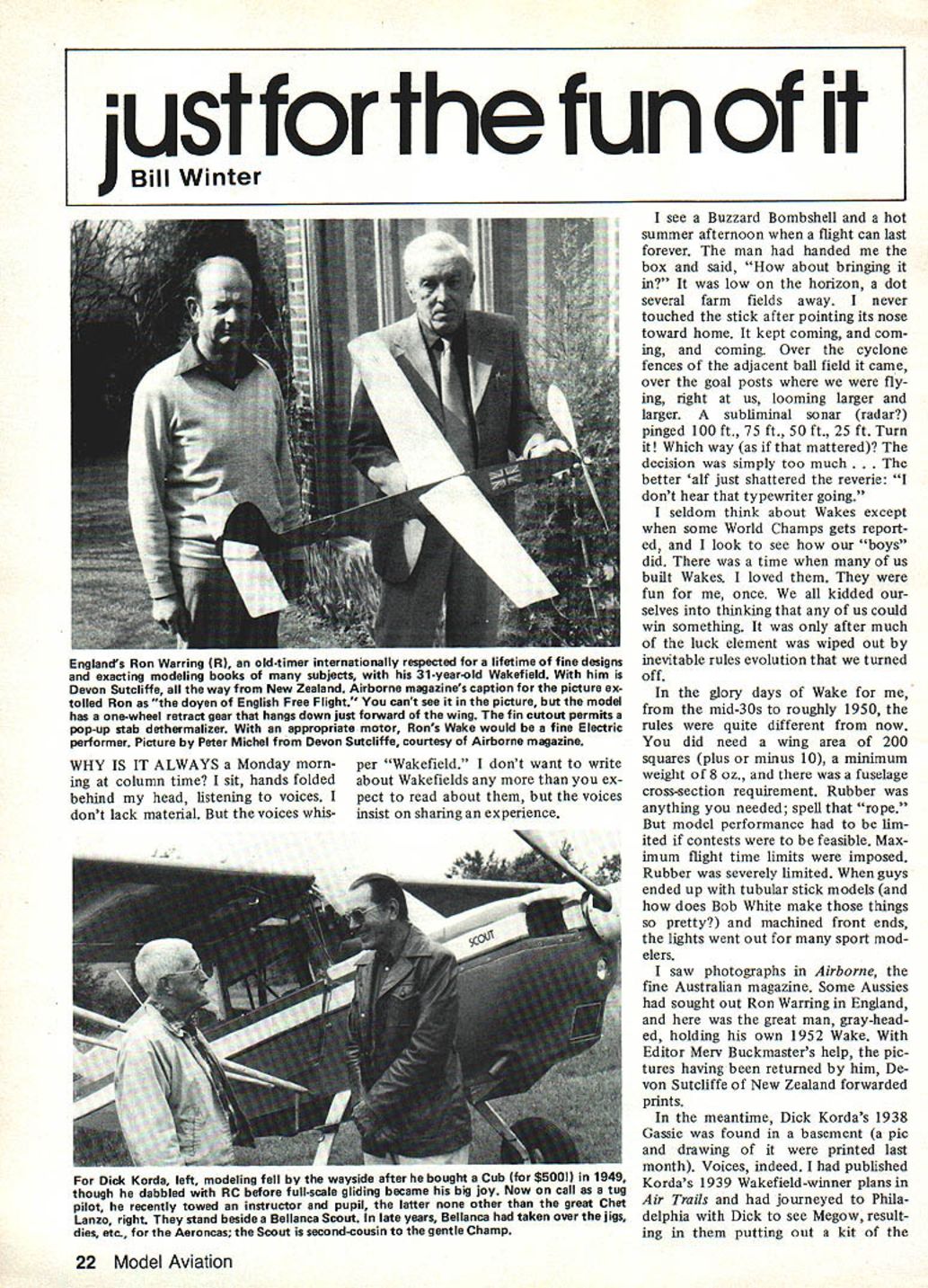
I saw photographs in Airborne, the fine Australian magazine. Some Aussies had sought out Ron Warring in England, and here was the great man, gray-headed, holding his own 1952 Wake. With Editor Merv Buckmaster's help, the pictures having been returned by him, Devon Sutcliffe of New Zealand forwarded prints.
In the meantime, Dick Korda's 1938 Gassie was found in a basement (a pic and drawing of it were printed last month). Voices, indeed. I had published Korda's 1939 Wakefield-winner plans in Air Trails and had journeyed to Philadelphia with Dick to see Megow, resulting in them putting out a kit of the model.
The 1939 Wakefield Cup contest was weird. Set up by the Polk brothers of New York, it was to be held on Teterboro Airport in New Jersey, but we all ended up on the world's most pathetic golf course across a nearby state highway. The English team had arrived in uniforms, natty blue blazers, we think, and they remained horrified for years by the barbaric environment for the sacred cup. (Models from other countries were proxy-flown.) The English fliers had black Dunlop rubber, and the sun snapped every motor far short of its capacity. In desperation, they lined up on each side of a stretched motor and made newspaper tents for shade (The London Times?).
The night before at the New Yorker Hotel, the processing team, made honest by meticulous English team members, had split hairs. Korda had to shave 1/16 in. from the trailing edge of his wing (or stab — we forget which) to come within area. And he had to tape two pennies to the belly to make the weight limit. Korda wound the next morning, and his ship was up for 44-plus minutes.
With Al Casano, I had timed Korda's first flight, and I remember clearly that we had to lie on our backs, eyes shaded, as the crate hooked low lift and slowly worked its way up for 20-odd minutes. It circled down, and at low altitude hooked another thermal in the same spot and went back up. Then came thin clouds, a weak sun, and a dust-blowing breeze. Dick had it locked.
Moving right along, I just had a fabulous phone chat with Dick.
Gosh, did anyone know that Dick made that flight on just hand winds of the rubber motor? He had busted his motor the night before and had tied it with thread in 12 places. (I would guess he pulled out the nose block to mildly stretch the rubber for the hand-winds.) He didn't seem to know that I had timed the flight, but he remembers a picture of two timers on their backs. (I was badly sunburned through a shirt!) Also, he says that they drove in circles, following the model, and retrieved it just a quarter-mile away. And he had not remembered that it came down in midflight and that it had thermalled twice. Said Dick, dryly, "I proved the model was worth two cents."
Possibly the world's most famous model, ever. Dick's ship was inspired by Gordon Light's Wakefield winner of the early 1930s. (Gordon, retired, still has his winning Wake. It was designed to fit in a packing box sent to Gordon when he proxy-flew a still-earlier Moffett model from some guy from Down Under. The size of the box set the wingspan. Gordon's 1935 Wakefield winner was resurrected in the August 1976 issue of Model Aviation. In Gordon's day, everyone used hollow, boxlike motor sticks, and you wound outside the crate right on the removable motor stick. When Gordon's model won, it was proxy-flown by J. E. Pelly-Fry — who still writes us.)
Dick Korda remarks that one could not possibly get enough downthrust, so he "thought of" a lifting stab. Time does funny things. I think that Gordon Light had a lifting stab, even with a slight undercamber. Besides, lifting stabs were commonplace (weren't they?). Earlier on, apparently Dick didn't have a lifting stab. In 1937, Air Trails published a prior (to the winner) Korda model under the title, "54 Minutes." As they say, "you can look it up." I'd bet Dick already was using a lifting stab. So he probably was remembering a one-design continuity.
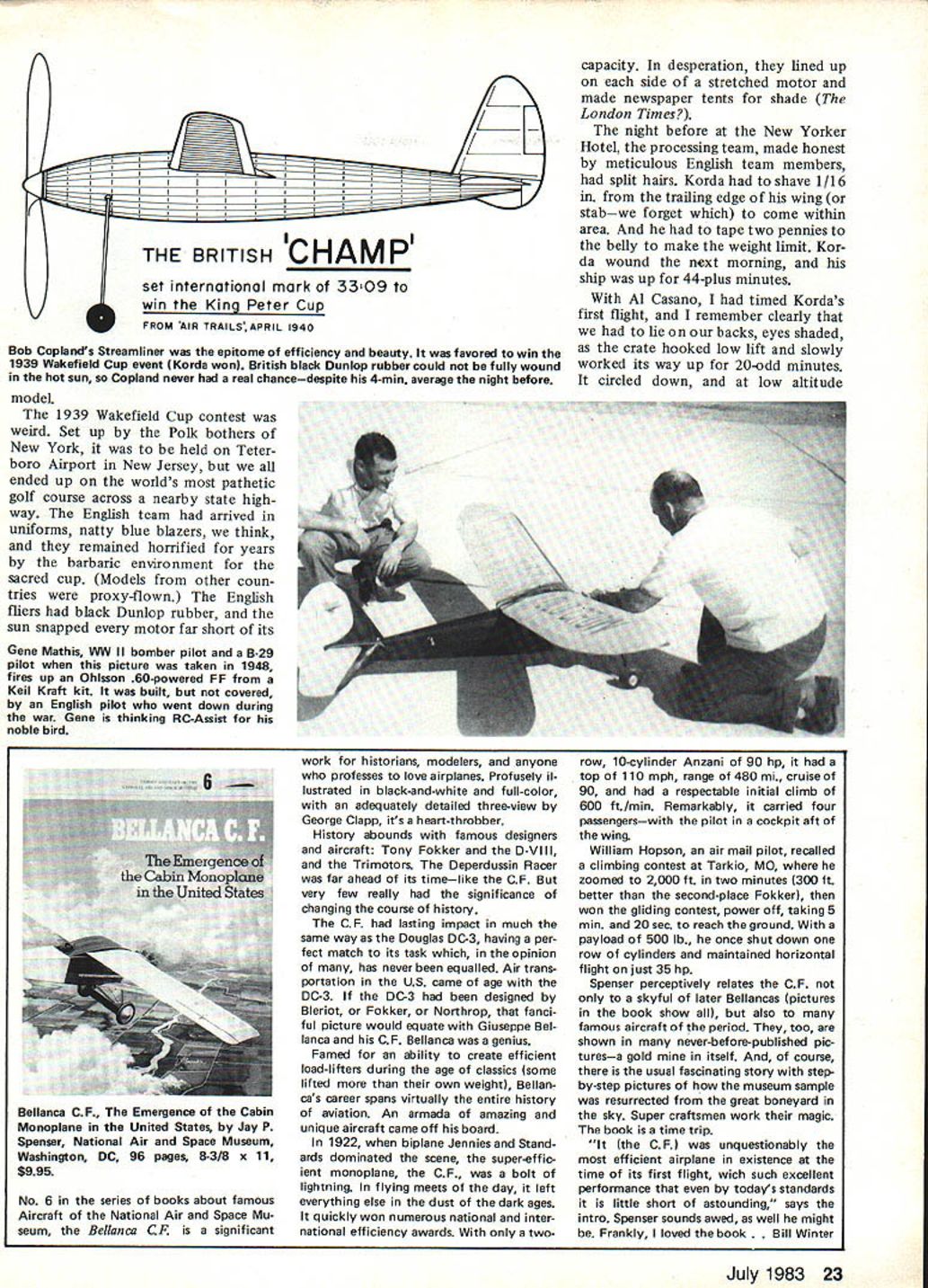
When Dick became a pilot of full-size sailplanes, models fell by the wayside. He did some RC. Now, he doesn't do much sailplaning, but he remains on call as a tow pilot. Recently, he towed a two-placer — an instructor and, of all people, a student named Chet Lanzo.
Chet is world-famous for his Rubber jobs. But you may not know that he is one of the true pioneers in RC — along with Ross Hull, who developed the first escapement system in the early-to-mid-1930s, the young Good brothers, who followed on his heels, and the late Clinton B. DeSoto. Hull, who was electrocuted in an early TV experiment, described his RC work in QST magazine, the organ of the American Radio Relay League.
Lanzo, as far as we know, was the first (perhaps only) man to fly an indoor microfilm-covered job by Radio Control. He didn't have an airborne pack—just a short piece of thin wire attached to the rudder. At the Indoor site in Kansas City, probably at the 1948 Olathe Nats, he blasted it with a 100-watt transmitter. The wire bent slightly in response as it heated, and the slow-flying job would steer away from walls. They laughed when he put RC in his Towline Glider at a slightly later Olathe Nats — until he flew! He caused a blizzard of protests.
Among my fantasies foolishly revealed in an earlier column is an 8-ft. Korda for either a K&B .19 or (more appropriately) a geared or belt-reduction .15 electric motor. (I was paralyzed by the size of the "Quarter Scale barn" I laid out on paper.)
Suddenly, the unpredictable Don Srull cranked out that scaled-up Comet Sparky (plans and article in this issue—editor). He subsequently has laid out a big Simmers Jabberwock, also for a geared Leisure .05. He (and others) has pushed on with his own gear systems with ratios as high as 5:1, with one of those 15-in.-dia., 10-in.-pitch folding fans. A blind man can see the bottom line. The old Rubber jobs were probably the finest, most efficient configurations ever built. (I'll bet RC Pattern fliers understand Warring's Wake.)
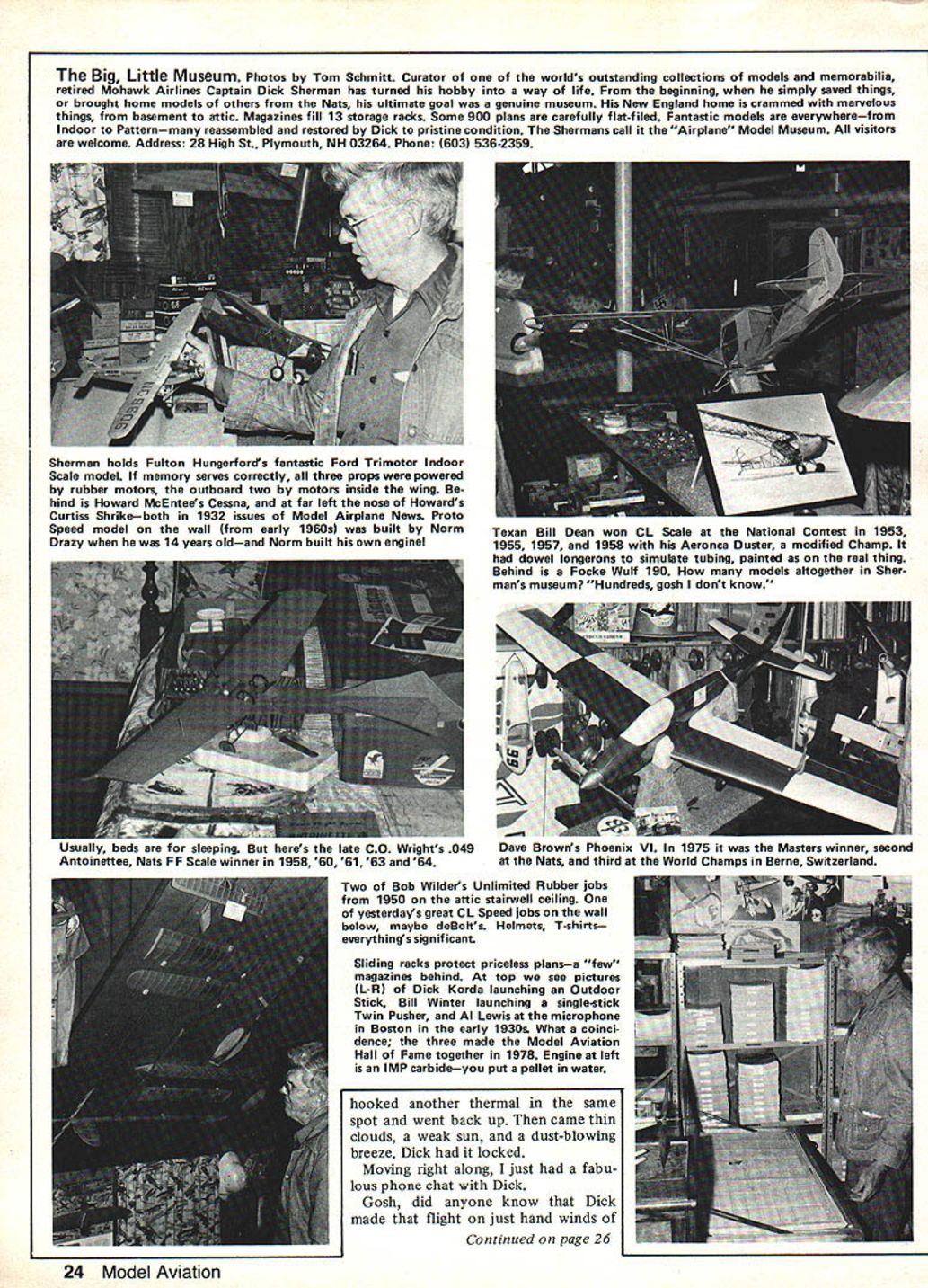
I spent last night surrounded by Frank Zaic's many yearbooks (it is now Tuesday, praise the Lord) looking at all those mighty old-rule Wakes. Gosh, what beautiful machines. Half-up Wakes, about 5- to 6-ft. spans, are superb electric jobs for reduction-drive .15s (or even .19 glow). For sleek, super-gliding sport jobs, they could be superior to Old-Timer Gassies, which were often awkward attempts at handling power. The Wakes allow one to shoot for the ideal. No better or more beautiful (aerodynamically speaking) than Bob Copland's prewar Wake (from England) has ever been designed (see drawing).
People still recall Copland's Streamliner with awe. At the 1939 Wakefield Cup contest, it was the expected winner. The night before contest day, it averaged an easy 4 min. Because thermals weren't the factor in England that they were in the U.S., the British jobs had long motor runs. The Copland job, with its perfectly streamlined fuselage of circular cross section and plug-in tapered wings, was the epitome of beauty and efficiency. But the failure of the British black rubber—we used brown rubber in those days—sabotaged a model that had won all over England and the Continent.
There's a chance that Copland's ship still exists. The clues have been fed to Hurst Bowers, AMA Museum coordinator. It had reposed in the Air Trails office after Paul Plecan drew the plans for the April 1940 issue. It had been crushed by a falling book. This brought tears to Frank Zaic's eyes—who then re-built it and flew it at a Chicago Nats. And Dick Sherman reports that Chet Lanzo had swapped models with Copland when they both were team members. Dick says Chet still has it. However, this writer suspects it is an earlier Copland creation—generally similar, but with a box fuselage cross section.
Folks who are discovering the wonders of .09-.10-powered soaring planes with tail-dragger gear are reinventing the wheel. Dozens, if not hundreds, of magnificent designs are waiting for your touch of genius.
I didn't want to write about Wakes. The "voices" made me do it.
In the spring a "young" man's fancy turns to servos and batteries. (It was late March when this was written.) If the first flying session of the year took place on the same day nationally, it could be called National Demolition Derby Day. The local guys had 19 wipeouts on the first good Sunday last year.
Just because everything worked flawlessly (usually!) when last winter's chill winds intruded doesn't mean that you can take things for granted in the new season. Sneaky battery cells defect to the enemy. Servo pots get filthy, and occasionally the pot contacts and wipers are too weary to bother. Ignored engines give up the ghost—usually right after lift-off. Rust flakes grind up ball bearings.
Preventive maintenance is the 11th commandment. Hopefully you've made a New Year's resolution to do something about annoying and erratic things that turned last year's flying into a battle of wits.
Being an incurable procrastinator, with a Lower Sloibovian Air Force of rag-tag vintage in which darn near everything is incompatible, I have been trying for months to get something in shape for the summer skirmishing. All batteries were charged every 30 to 45 days, and now I charge and recycle all those about to go off to the flying battle. I discovered that one Old-Timer has been flying on just three good cells (not much servo use, so I got away with it). In the six years I have been flying again, I haven't cracked-up due to equipment in more than 1,000 flights. Dumb luck! But if I haven't piled-in due to batteries, I must be doing something right.
As a hacker, I guarantee you cannot operate indefinitely without some kind of problem unless you have a cycler/charger—crack-ups are as certain as death and taxes otherwise. I happen to have an Ace Digipace and a Taylor. The former provides a digital readout in minutes, and the latter has knobs which click and indicate capacity in mAh. A cycler runs down the batteries under an appropriate load to a safe minimum voltage; then it automatically goes on charge.
A cycler warns of a tiring pack, and it betrays bad cells. For example, if the Digipace is set on the test mode, and if it instantly switches over to charge, you have trouble. Many guys read individual cells (that's a pain, and I don't trust it because, if there is one bad apple, another may not be far behind). It's smart to have well-matched cells. If you have a pack that now reads, say, 50 minutes but was well over 90 when new, what sense is there in adding one cell that can go 90 to others that poop out at 50? We pay enough for our radio/plane systems that false economics are senseless. Battery packs aren't all that expensive.
I have Sanyo packs which, after five years, still read out values almost equal to new-cell ratings. When do you discard a pack? I know guys who sneak a few flights with only 30 to 45 min. capacity. That scares me to death. When a 500 mAh pack reads under 400 mAh or under 60 minutes, I throw it out; it probably is many years old, anyway. Sometimes after a many-flight session, I cycle the batteries when I get home—just to confirm what flying time really is left. I see readings of as little as 15 all the way up to 45 (a buddy had only 3!), and occasionally better than 60 (the latter on Old-Timers). You get to know in this way roughly how many flights you really could have made—and it's smarter to quit while you're ahead.
How often should you cycle? Some guys do it quite frequently, saying one has 1,000 cycles safely available. (I guess they mean charging times.) Others recommend different times. You might do it once a month or several times a season, but the lower the readings, the more you have to beware—and that forces one to recycle more often to "feel the pulse," another argument for tossing out tiring packs. I cycle before the season's first flights, in late spring, perhaps twice during the summer, and once coming into fall. Remember, I am not an expert. I am lucky—maybe that will rub off.
I have no time for thorough servo maintenance. But servos practically shout at you if they have an ailment. If they chatter and quiver (assuming you don't have bad hinging, binding pushrods, or whatever (which is another subject)), you'd better do something now. Send them off for service, fix them if you know how, find a smart friend, or buy new ones. There are many servos that can be bought inexpensively. You'll see many brands on the field; ask the guys using them how well they are pleased.
In my own 1,000+ flights (not counting zillions in the old days), I have had only one dirty-pot problem—that on the Kadet's ailerons. I usually fly leisurely.
The metallurgy of an engine for reduced friction, longer wear, better cooling, higher rpm, and all sorts of good stuff has been on my mind. I had resolved to write George. My engines would bless me for small favors. George beat me to the punch. First came a letter from J. L. Ruby of Microlon, Inc., P.O. Box 1529, San Marcos, TX 78666, along with fascinating literature. Then came the box of 20 cc bottles, and finally a letter from George telling me how he uses it.
"Microlon is sending you a 'care' package of the CL-100, or POWR+ as they call it for models," said George. "It's well-known in the full-size aircraft field—ads in Trade-a-Plane list: 'This engine Microlon at X hours, etc.' A Quadra will take three of the little bottles. Just put it in a quart of fuel (gas) and run it while you fly. For glow you dribble it into the venturi while running. A single 20-cc bottle will do a .60."
According to instructions, "POWR+ contains a cleaning complex which dissolves carbon and varnish and prepares the metal pore structure for the formation of a film by burnishing impregnation of a modified resin." The one-time treatment is permanent, and the film is self-healing. "The lubricity of the film is such that further wear is very unlikely. The engine should run smoother, produce more power, and be more responsive. Microlon becomes an integral part of the metal and in a properly treated engine all bearing surfaces become Microlon instead of metal." Not that you'd want to, but if you wished to remove the micro-thin film, you'd have to machine away the impregnated metal. A wide line of Microlon products are extensively used in both the automotive and aviation fields.
Smelling the flowers. Letters are filled with clever how-to tricks, kooky adventures, humor, sentiment, joy, nostalgia, provoking thoughts, and endless descriptions of flying machines. Hey, "Smitty" with the flying-wing gliders, what's your last name? The world awaits! Also, "John" from Cantonment, FL, who sent pictures of many interesting models, your last name, please.
"I was a teenager in Bloomington, IN during the Zipper blitz," Gene Mathis begins. (Author: At the 1939 Nats, well over 700 Zippers competed.) "In those days Carl Goldberg came to our high school convocation and gave a lecture, illustrating it by flying an ROG around the auditorium. That night he visited us at a special meeting of our club, the Bloomington Torque Twisters. I still cringe at the name. We were smitten.
"Our guru was a chap named Kenny Baldridge who now and then emerged, blinking, from his basement with a mysterious apparatus and a Guff aircraft with the mighty Brown D on the nose. (Author: Walt Good was highly successful with his FF Guff design.) Our parents," Gene goes on, "viewed most of our model building and flying with amused tolerance, except they thought old Kenny was a bit much, perhaps a wacko who was having a bad influence on us.
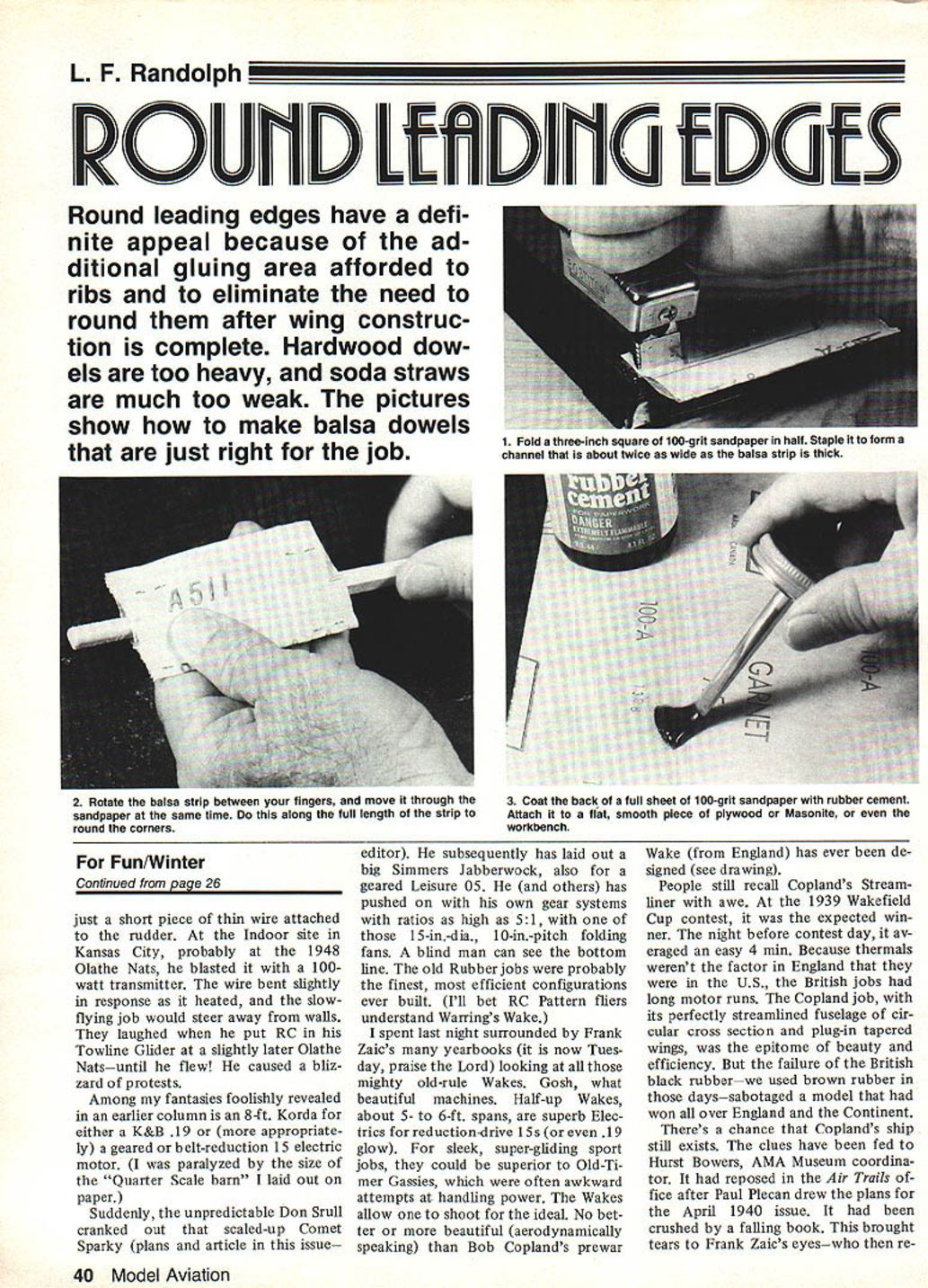
"While on TDY in England in 1948," Gene recalls, "my navigator bought a Keil-Kraft kit and built the airplane in the picture, but didn't get it covered. We brought it home in the bomb-bay of a B-29. Later, he was killed on a mission on the Yalu (Korea), and his widow gave me the unfinished aircraft. I finished it, and the picture shows me and my flight engineer firing up the Ohlsson .60 for its maiden flight. I still have it and expect to RC-assist it—when my trifocals and trembling thumbs finally put a stop to my making like a fighter pilot with a Pattern machine, which ain't all that far away."
"Often my mind's eye reruns a picture from my salad days: a Zipper, red fuselage and yellow wings, circling in a thermal on a sunny day in southern Indiana, the $7.95 Sky Chief having retired from its labor, going higher and higher and drifting downwind over the wooded hills—out into the boondocks where there are no roads, and a young man sweating and panting trying to stay under it on foot, knowing in his heart it is a goner, and thinking to himself, 'if only through some magic I could reach out and give it some down-elevator!'
"It's a pity my buddies of the MonoKote, foam, and seven-channel generation cannot savor those golden days of Cahill and Korda and the other giants, nor experience the genuine adventure that aeromodelling was."
(Gene's flight engineer went on to pilot's school and was killed in a B-47 that rolled in shortly after takeoff.) Nothing has changed. We are all Kenny Baldridges, emerging from our shops, blinking, with mysterious apparatus.
Electrics confusing?
In glow-engine RC, there's a spectrum of trainers for learning to fly or to fly better. In Electric you need a different "trainer," one which enables you to operate a system of fair cost without damage through innocent error. If you are flying Electric for the first time, you are a raw beginner. Probably you know how to fly—so learning to fly isn't the problem.
Many guys have a big head start, and technology is in a rapid evolution that stresses ways of getting ultimate performance. New hackers need basics. Motor numbers which once roughly equated with glow engine displacement mean nothing anymore. An .05 electric motor may equate with a Max .10 or even a .15, not an .049!! Do you need direct drive turning a small prop at glow engine rpm or a reduction drive to turn a big, high-pitched prop at lower rpm?
There are many ways to go, but what's best for you? Basically, that's an airplane that's a cinch to fly, something relatively slow, a bit of a floater—so reliable that you can master the system operation with repeated flights.
A good entry point is a 6-ft. glider with an .05 on the nose. It may require downthrust (sometimes as much as 10 degrees to avoid power mushing). The Gentle Lady is one of the easiest. The .05 will fly it fine with direct drive (ask for a Pattern-wind motor) on about a 7-4; if geared, such as 2½:1, it will need roughly an 11-7 prop which will turn more slowly but give more thrust. With a 3.8:1 geared system (some go up to 5:1) you can turn a folding prop of as large as 15-in. diameter and 10-in. pitch. Note that the pitch goes higher with lower rpm. But direct drive is fine. Believe me, you must have a fuse if you want the most protection of the motor/battery system, and you must have a shut-off as well. I've done a lot of moanin'. They don't usually give you a fuse—different motors require different values. For the .05, it is a 32V, 20–25-ampere fuse. Radio Shack has a fuse holder, and the plug-in fuses are colored to designate capacity, yellow in this case. You have to solder the holder into the wiring harness that comes with the motor, as well as the charging jack (to suit your installation.)
The shut-off is a microswitch attached to the side of the motor servo (three channels) with servo tape so that retarding the transmitter stick causes the servo arm or pushrod (or whatever) to bump the switch. (With two channels, an instant-on full-down bumps the switch.)
For the geared .05 the supposedly best wing area is 600 sq. in. Srull's scaled-up Sparky has 480 sq. in. with a 64-in. span. My new parasol has 515 squares at 56-in. span. I have heard of as much as 700 squares, an extreme.
The overwhelming advantage of the powered glider is its ability to perform with one size motor of either direct drive or reduction drive and with an option of three distinct families of props. A wide spectrum of flight performance characteristics is available with it. Usually, one would have to build special airplanes to suit one or the other motor types (direct drive or geared). For instance, on direct drive, 250 to 300 sq. in. is recommended, roughly half the area recommended for a reduction-drive crate. With the .05, the little Goldberg Ranger 42 at 240 squares and the Fliteline Megowcoupe at 290 squares do well. With vastly higher wing loadings, they are faster by far on power, whereas the bigger jobs are slower and glide far better—but they get up there!
With 325 sq. in., Clarence Haught's little model demonstrates some of what a larger wing does over a small model's wing. A loading that makes a small Rubber job a lump of lead results in a ghost-ship floater in a big Gassie. Identical models, one slightly heavier, fly entirely different. One is a champ, the other a dog—with the same airfoil. The scale of possibilities includes literally thousands of variations.
All of which reminds us of Paul Garber, Curator Emeritus of the National Air and Space Museum of the Smithsonian Institution. Paul, who as a boy saw the Wrights fly, is a world expert on kites, and he makes the Washington newspapers during the annual Kite Fly on the Washington Monument grounds.
"We don't know much about dragons," he comments, "but we sure know they fly great."
Bill Winter, 4426 Altura Ct., Fairfax, VA 22030.
Editor: Bill asks us to advise all readers who write to columnists—to Bill Winter and all the others, and to AMA HQ and MA editorial offices, for that matter—to always put the full name and address on the letter, and not just on the envelope. Envelopes do become detached, and if the full name and address is not on the letter itself, a response or even proper credit in the magazine may be impossible.
Also, we plead with you to take it easy on Bill Winter for miscellaneous questions (but do keep on sending him good material for the columns). Bill is being inundated with questions which really should be addressed to other category columnists (addresses at the end of their columns). When a response is needed, please include a pre-addressed stamped envelope. — Carl Wheeler
Transcribed from original scans by AI. Minor OCR errors may remain.

