
Just for the Fun of It
Bill Winter
What is the future of radio control? What lies beyond the proliferation of sticks, knobs, buttons, switches, and kooky levers? Only Arthur Rubinstein could manage such stuff, and he is gone. I am a player-piano man.
You can't predict the future on the basis of present technology. Prophecy is a game of one-eyed jacks with jokers and wild cards. There was a Hollywood flick, just before the war, which depicted a future of imaginative machinery—but ended up with a huge cannon to shoot a man to the moon. Some prediction. Jules Verne had fictionalized the moon cannon a half-century before that.
We have gyros to help steer helicopters or to keep wings level. I need a button (one, mind you) to take over on my approaches so the plane will always touch down perfectly on a postage stamp. An automatic pilot? Too simple. A self-programmable autopilot that does absolutely everything? Think "stunt" and the crate does the pattern? Maybe someday we shall import from Madagascar (at $49.99) the non-thinking man's black box (why must it always be black; how about red-white-and-blue?). Will it cope with mid-airs? A walnut-sized on-board radar? Some wiseguy would drop chaff. Or Ken Willard could introduce a stealth design. We need only look back to see that 1983 is only a milestone.
This is not nostalgia. If it were, we'd refer you to the March 1976 MA and an article by George V. Sosic about Nikola Tesla, probably the wildest electrical genius who ever lived. Old Nikola was into alternating current for long-distance power transmission (they were trying to light cities with DC current!) and was the prime mover in the water-driven turbine power plant at the foot of Niagara Falls. Tesla wanted to harness lightning, also to create resonant vibrations through the earth to be focused at a point on the opposite side of the globe. When he turned on experimental apparatus out West, it drew so much electricity that a nearby city went blotto, and an annoyed populace reined him in. Who knows, he might have shaken the sphere apart. You can understand Tesla, a contemporary of Edison and Marconi, if you realize he was (in the early 1900s) an R/Cer. He demonstrated remote-controlled model submarines at a New York City scientific show. You'll find his schematics in that MA back issue. That's nostalgia. But it happened before I was born.
Early Experimenters and the Escapement
Experimenters toyed with radio control between the two Great Wars, with a few unknown R/C pioneers well before WW I. Significantly, the early motor-driven gear-trains to turn a rudder or tab would eventually evolve into the modern servo, but modern RC was founded on the escapement. In spite of infuriating limitations, it gave a fast enough response to make control practical. Although the Good brothers made impressive flights during prewar Detroit and Chicago National Contests, many modelers concluded that as soon as any RC job made its first modest turn, it was doomed. No RC job could recover from the resulting earth-smashing spirals!
Since these fine-looking models were often flown by teams of free-flighters and hams, the radios worked perfectly. Control was something else. By the time a "servo" ground slowly to, say, right rudder, it took an eternity to grind back to opposite rudder before the crate went berserk.
Triggering the signals was another ball game. The late Joe Raspante, before the war, flew a gigantic Buccaneer with a telephone-dialing system. What could be simpler? You just dialed a digit. What you got was something else. Until into the Fifties, we watched Joe make many attempts. The crate always flew away while Joe dialed furiously. The ship responded, but Joe was riding the bull.
Sal Taibi was the only man who could launch Joe's monster. Sal's technique was to grasp the landing gear in two hands, hold the crate overhead, then sprint down the field—far enough to kill any but the most well-conditioned Nordic flier—until flying speed was attained; he then would let go of the wheels. At Chicago, Sal suddenly disappeared as the Buc sailed on. Sal vanished into a hidden drainage ditch.
With the escapement, you pushed a button or closed a switch; voila, instant rudder. Until about 1950, the escapement rudder-only crates flew well enough, even without throttles, to make thousands happy.
Accounts from the 1930s
In the January–February 1983 issue of Airborne, the great Australian model mag, Jim Fullarton (it is my impression that Jim may go back to the age of steam!) did a remarkable article on the early days of radio. Jim began with an account of an airship in a theatrical act in 1912 in Dundee (my birth year!), guided by radio over the heads of the audience. If we assume that it was hydrogen-inflated, the audience was spared the ultimate thrill. The 15-ft. dirigible had two airscrews for propulsion (varied thrust for steering?) and two more on a vertical axis for altitude control. Bomb-bay doors opened to drop flowers on the audience. The radio? A spark transmitter and a coherer tube receiver, the tube filled with iron filings which became receptive on signal. Almost 50 years later, we had remote-control cars which used a similar "receiver." The current from the coherer tube worked a relay which caused a drum to rotate by means of a ratchet, contacts on the drum activating controls.
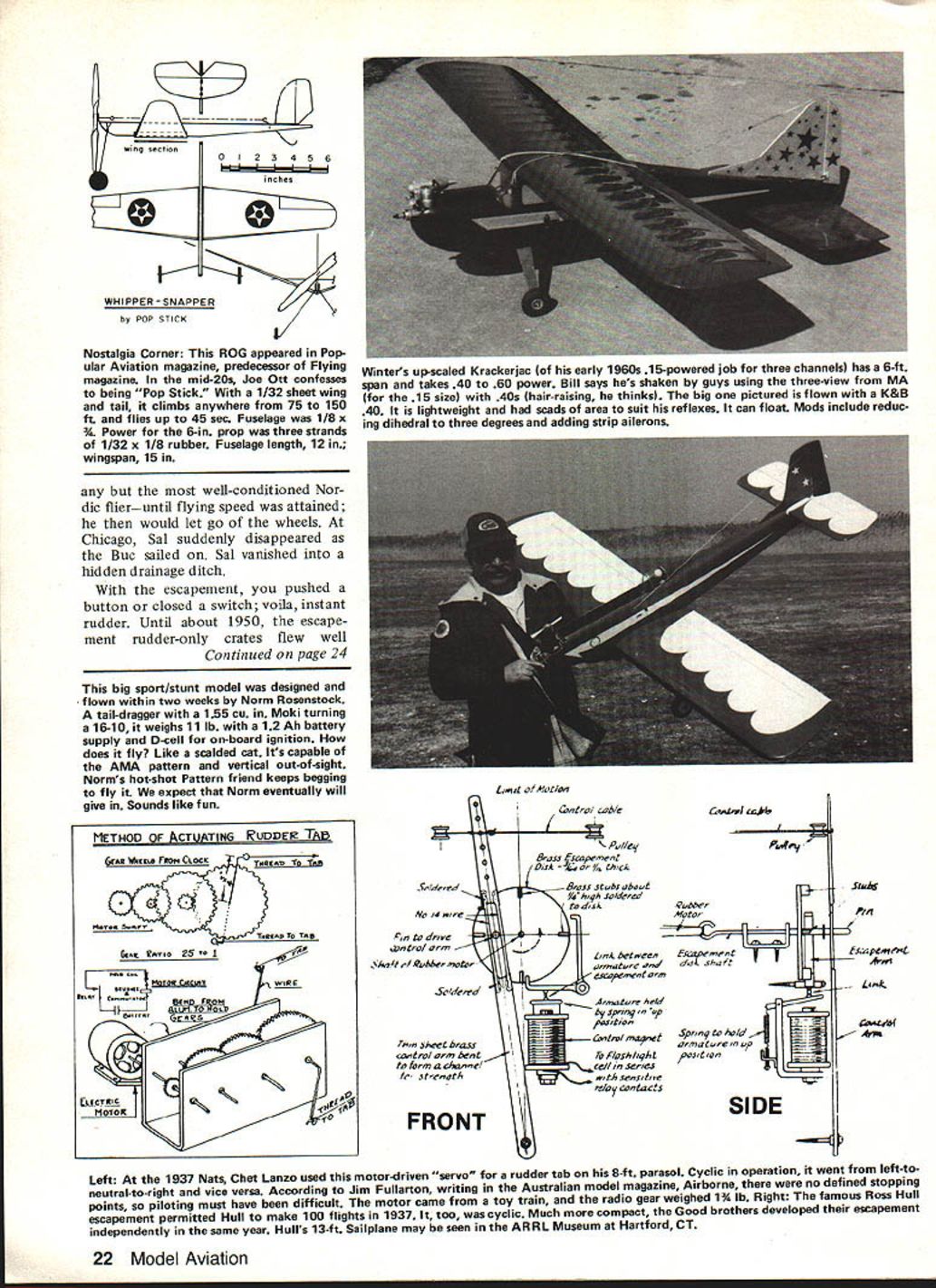
Fullarton reports that RC was included in the 1936 U.S. Nats. While that didn't amount to beans, it inspired several entries at the 1937 Nats, including Chet Lanzo's 8-ft., FF-type parasol which "actually managed a flight—of sorts." Chet had managed to cut his radio weight to a mere 1 1/4 lb., by finding a "B" battery that weighed only 2 oz., and removing the bases from his three "valves." Chet flew this wunderkind on only a .45 Baby Cyclone.
Fullarton wrote, "The weak link in the system was undoubtedly his actuator which consisted of an electric motor from a model train, driving by way of a reduction gearbox (homemade like everything else) and a two-throw crank which operated the rudder. Operation was cyclic; that is, to get right rudder, you had to go Left–Neutral–Right—but there were no defining stopping points. The thing kept revolving as long as the transmitter was keyed, so that control must have been more or less a matter of inspired guesswork. In consequence, the report in MAN was distinctly skeptical, although Air Trails, which later published the plans, was much more enthusiastic."
Fullarton, to our amazement, knew A. G. Hull, brother to Ross Hull, both Australians. Ross, as mentioned in a recent column, was electrocuted in an early TV experiment, came to the U.S. where we first heard of him as an editor at QST, the organ of the then Radio Relay League of America. He was contemporary to the young Good brothers. Ross Hull, it seemed, had demonstrated rubber-powered models on the Williamstown football ground in 1916, helping launch the Australian modeling movement. When he became editor of Wireless Weekly in 1929, he actually published plans of the "Baby R.O.G."
When Ross joined QST as assistant editor in 1937, he fell in with Roland Bourne and Clinton B. DeSoto. I did know DeSoto, who was so far out that, when radio transmissions were banned during WWII, he did a piece for Air Trails on how to fly radio anyway by laying out a big rectangle of ground cable and then, hopefully, trying to keep the plane within the confines of that cable. Fullarton tells us that the three were part of a group who, studying the possibilities of RC, visited the soaring site at Elmira, NY. There, Ross met a chap named Carl Thompson, who was already flying a large model sailplane "with primitive one-way control." Hull acquired that model, rebuilt it, and installed his own control system. (The Hull sailplane is on exhibit at the Hartford, CT museum of the American Radio Relay League.)
A rare picture in Fullarton’s Airborne article shows Ross, two assistants, and the sailplane, a quite respectable 13-footer with a 10-lb. gross. Ross is standing by a surveyor's transit tripod on which, Fullarton says, was mounted the Bourne control stick, a ratchet device which automatically gave the correct number of pulses to operate the rudder. Fullarton goes on to say that the outstanding feature in Hull's sailplane was, for the first time, a rubber-driven escapement for operating the rudder. It was far ahead of clockwork and electric-motor-driven systems of the day—because electric motors were big and heavy. Cyclic, fast, and responsive, it enabled Hull to make 100 flights during the summer of 1937. DeSoto credited Hull for the invention of the actuator he dubbed the "Hull Escapement."
Fullarton also tells us that Hull was the only non-American name included in a list of 250 scientists (compiled by Congress after the war) who had made a significant contribution to our war effort.
The Good Brothers and the Rise of Fieldable Systems
Fullarton states that at the 1938 Nats the Goods were among five RC entries, the only entry to brave the 20 mph wind. The plane looped and crashed. In 1939, at the Detroit Nats, there were 11 entries. I recall glancing up in wonder as the big Guff flew the length of the field on a steady course, at least several hundred feet high. At either the 1940 or 1941 Chicago Nats, as a mesmerized free-flighter, I stuck close to the Goods and watched Walt fishtail a high approach to a soft landing right at my feet.
Some loose ends: Walt was the modeler; Bill, a "ham," was the radio man. The escapement, a simpler and more compact unit than Hull's, had apparently been developed separately, but concurrently, with Hull's development. It was given (in 1947) a Good brothers system (Beacon) and, with Walt Schroder, who built the plane which I designed, used that system in another half-dozen ships until the Lorenz-developed tiny gas-tube receivers around 1950. The Goods had compacted their transmitter into a big black box which you hung on a 9-ft.-high folded-dipole antenna.
On the first test flight, the 7-ft. original RC Special was launched by Walt Schroder in Canaan, CT, and the huge 40-in. stab clipped him in the back of the neck. The Ohlsson .60 behemoth lumbered on, having loosened Walt's head, climbed gently, and made a wide circle to land perfectly with a flare of opposite rudder to bring up the nose—a lucky guess. There was a distinct pounding noise. Walt couldn't hear it. I insisted that it sounded like a drum going boom-boom, so we put our ears to the transmitter! Silence. Then I put my hand on my chest. It was my heart! It also was so cold that the engine's venturi was plugged with ice.
If you would know how far we have come, in order to guess how far we may still go, the Good brothers system was something to behold. It was simple, utterly reliable, and had out-of-sight range, but you had to solve a Rubik's Cube to operate it, or anything that appeared during the following five years.
The airborne weight was about 1½ lb.; the battery supply consisted of a flat 45-volt B battery—about as high as a big coffee mug—an A battery, and two big flashlight cells. The escapement required two pen-cells. The frequency was 52 MHz. Superhet receivers had not yet appeared, so the fickle superregenerative types would pick up absolutely any signal within a country mile of your frequency. Fortunately, the nearest RCer might be a hundred miles away—and he hardly ever flew, anyway. Interference was an uncoined word. Since the receiver was as broad as the Midwest, the system had to be tuned by reading a meter plugged into the airplane before every session.
Old-timers will remember those almost out-of-sight ground checks as they tuned a receiver to the steady carrier wave emission from the keyed transmitter. You turned the knob in one direction until the escapement triggered—the plane had to be near enough for you to hear the click, or the assistant had to wave an arm. Then the knob was turned in the other direction until the escapement clicked again—then you centered the knob midway between the click points. What you had heard was the escapement pulling in, and releasing.
The crucial features of that receiver were its 3A5 hard tube and a polarized relay. Idle current was something like 7½ mA, and when the transmitter was keyed, a plate in the tube altered the flow of electrons between its other components to drop the current to, say, 4½ mA. The relay armature rested on a live contact—so you needed two switches, one to turn the radio on and off, and the other to shut off the escapement. When the tube current dropped, the relay armature activated an escapement in the aft end. The Good escapement was a four-arm affair which, upon signal, would move to a half-right position for as long as the signal was held; when the signal relaxed, the escapement went to full-right—where it stayed until you did something about it! To turn left now, one had to go back to half-right, neutral, then half-left, and finally to left. The escapement did not neutralize by itself. Further, you had to know what position was last used, in order to know what would happen next. I talked out loud, chanting right, neutral, left, neutral, right.
A witnessing dealer from Danbury, CT (the late Don Grout), 40 miles away, found that ridiculous: he went back to his shop and invented the compound escapement. One pulse for right, two for left. By then, Howard Bonner was pushing the famous SN (self-neutralizing escapement) which, however, still required you to go through right to get to left and to remember which was last. When we showed Don's gadget to Howard Bonner, he saw the light and the compound escapement, to be followed by later cascaded escapements giving multiple controls, soon to hit the market. (These escapements added an electrical "quick blip" contact so you could activate an SN escapement for engine or elevator.)
Installing and operating the Good brothers system could be fiendish. Current drain on the B battery was so high that one quickly learned how to reset the relay on the field—in order to keep the relay armature in the middle of the steadily lowering current range shown on the meter. The meter required a certain resistor across its poles; otherwise, the danged system was detuned when the meter was pulled out. Also, antenna length was super critical and had to be determined for your particular airplane. You'd start with a long antenna and clip it 1/4 in. at a time until you got a 1/10th mil drop whenever your hand touched the antenna. The antenna had to arrive neatly at the receiver from above, because its presence could detune the receiver.
You won't believe how the receiver was mounted. Receivers didn't come in tiny boxes. They were big and cumbersome with tubes, relays, and coils sticking out both sides of a mounting board. There were no printed circuits, no transistors, and only a madman could have predicted the chip. Univac hadn't been invented; when it was, it would fill an apartment. What you had were four Fahnestock clips on the base corners—as on some doorbell batteries. You ran rubber bands through the clips and to two bulkhead screws to hold the receiver down in case of a crash. You didn't want any wiring to break just because the receiver slid forward. Receivers were sometimes mounted inverted under the fuselage, hanging by those Fahnestock clips. The whole antenna system must be insulated from the airframe. Solder connections were crude. The operators developed ways to wet the filament contacts with Vaseline to keep from burning down. There was no BNC or coax—there were long springs, pieces of stiff wire and banana jacks. We had 1/8" jack plugs for battery to charger. The battery on the transmitter was sometimes built in—it had to be kept dry—and sometimes four cells were stacked in tube holders.
The first time I entered RC at the Nats, Harry Geyer, who made the Good brothers unit under the Beacon name, pulled my receiver, and all four hooks came loose. Remounted per his instructions, he then stuck a big hand through the door and lifted the 7-lb. crate by its receiver; he then shook it the way a dog shakes a bone! Fine, he pronounced.
When the small gas-tube receivers came along, Norm Rosenstock stuck his on a foam-rubber block, in turn stuck (by contact cement) to a tray at the front of the cabin, which could be slid out for servicing. That was the first "crash-proof" receiver. But with the Good brothers unit, it wasn't long before people mounted the escapement behind the receiver at the rear of the cabin—and it always got smashed in a crash. How? Well, the hefty Good receiver catapulted forward, damaging itself against the front bulkhead (which usually split), and then it recoiled by the rubber bands at the rear, sneakily crushing the escapement. It took a year to solve that mystery.
Takeoffs invariably were hand-launched. Before the trike gear (which appeared in the late Forties on Walt Good's Rudder Bug), heavy, marginally powered, slow-responding rudder-control tail-draggers were mad bulls you left alone! Early on, as with the first big free flights, big and heavy RC ships were launched by people holding the wing tips as the crates accelerated; then, sprinting like Chariots of Fire, the assistants kind of catapulted the struggling behemoths into full flight. At least we didn't have to mow grass.
Do realize that this is not a history of RC. It is just that, within a decade starting in, say, 1937, the escapement (pioneered by Hull and the Goods) opened up RC to the public. Few mention Ed Rockwood who, before the war, had quietly developed in California the first reed system. He may have had five-reed banks at that time; we are not sure. But in early postwar National Contests, we saw his five-reed jobs installed in 7-ft. Cub-like models (one of which, flown by another in his group, won the Nats). They, too, were finicky. Rockwood had servos, which used converted English toy motors. The reeds would weld themselves to contacts when the rest of the reed used this equipment—since we didn't know how to suppress arcing. Even on a common escapement, voltage spikes could hit 600 volts when an escapement was relaxed.
Relay contacts quickly became dirty and/or pitted due to voltage spike sparks, and crates smashed-up or flew away as often as they made successful flights. Chet Lanzo quipped that "radio control permitted one to select the location of his crash." In 1951, I went four months without a successful flight, although we flew on every weekend but one that year. But all this is only the tip of the RC historical iceberg—and only part of the age of escapements.
A landmark was reached in the late Forties when Vernon McNabb's 465 hand-held outfit gained the first approval by the FCC for license-free operation. We won't go into that incredible adventure beyond saying that we flew his test units before that, leading to our own private citizen airplane in an old MAN.
Proportional Control and Later Developments
The late Howard McEntee was fooling with proportional on rudder only; others soon followed with multiple proportional controls. So a fair account of radio control would make a historical tome.
A handful of folks who had a smattering of electronics fiddled with pulse rates and pulse widths, and they mixed them both for two proportional controls. We have heard tell that Jerry Pullin on the West Coast was the real father of proportional. He got the act together, and the early full-house proportional rigs popped up commercially in California like spring flowers. Who will tell his story? In the very early '50s, while on MAN, we asked Paul Runge what was new, and he said some guy in Virginia had a system called Galloping Ghost. That turned out to be our own AMA Executive Director John Worth, who had solved proportional elevator and rudder (simul) by mechanical means. That led to a four-part article. The linkage arms (actuator was a single infamous Victory motor) connected the rudder and elevator(s) so that position of a transmitter stick would enable these constantly threshing surfaces to average out on some desired flight path. On the ground, the plane looked and sounded like a wounded duck.
Hams concocted strange and wonderful rigs and crates. For example, Siegfried won a Nats circa 1940 with a 15-ft. giant which performed the first loop—in public, anyway. His crate had a big glassed door. When you peeked in, you saw huge gears that made you think of a colonial watermill. Fullarton cited a MAN article which reported an early Nats at which no flights took place one day because the pilots ran out of daylight before they could complete the tuning of their equipment.
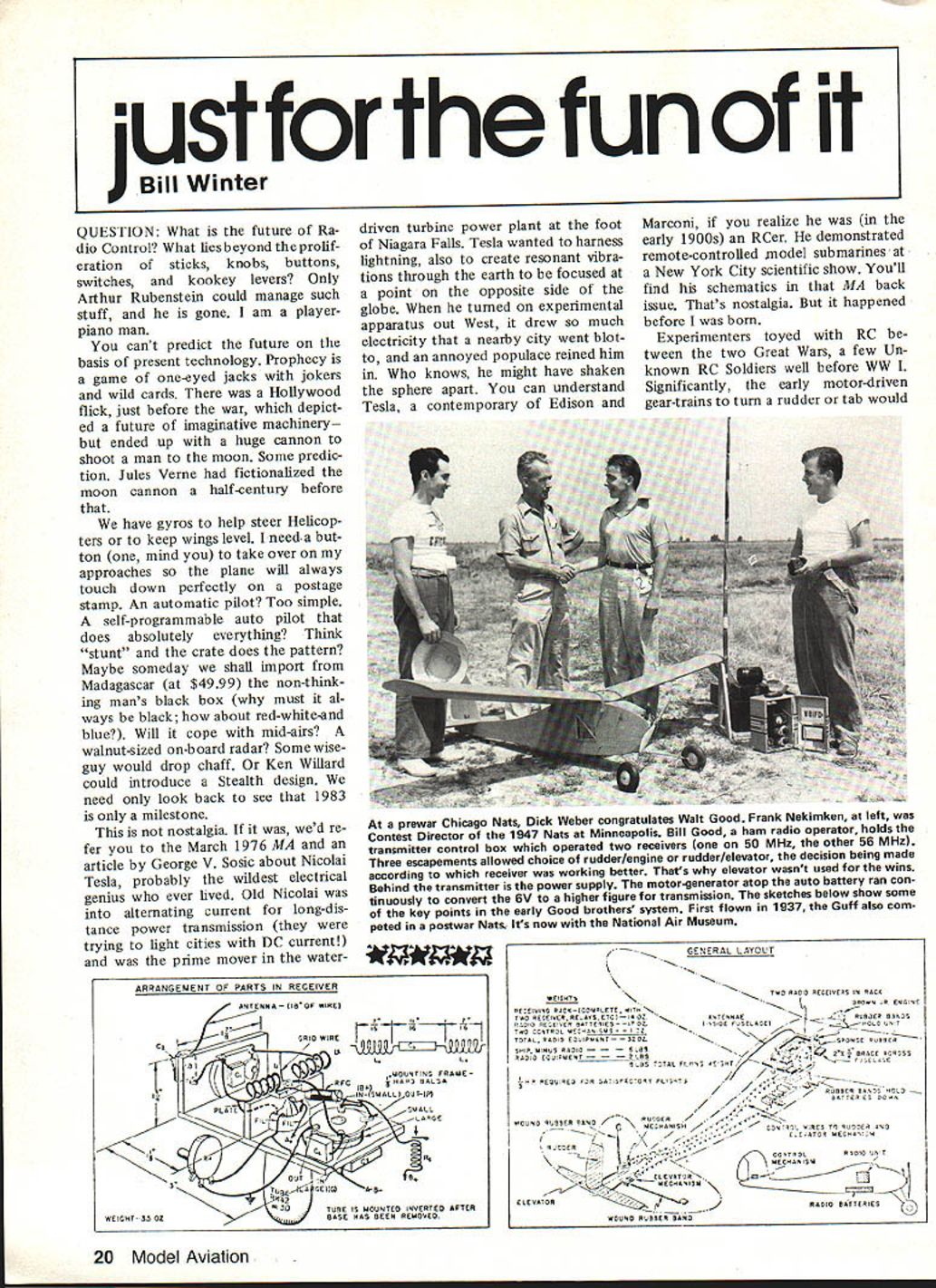
While the Good brothers' Guff ostensibly was a rudder-only aircraft, it did have elevators. In the heading photo, you can see two relays through the inspection door. The second was for tiny elevators. I don't recall Walt ever making an elevator maneuver at the Nats, and I don't have the foggiest notion as to how he triggered the second escapement—unless, as some folks tried, the Goods had two receivers. This conjures up wild notions about the transmitter (two frequencies?).
I just spoke with Walt Good by phone in Florida. Yes, there were two receivers, tuned to opposite ends of the old amateur band of 50 to 56 MHz. But there were three escapements! The Big Guff also had a clapper on its spark-ignition Brown Junior, which "sort of slowed it down." The Goods had the option of flying either rudder/elevator or rudder/engine. The Guff also had a thermal-delay engine cutoff actuated by holding rudder for five seconds—which tells you a lot about the Guff's turning characteristics. The reason I had never seen the Goods use more than rudder in competition was that when one receiver acted up, they connected the better one to the rudder; that is the way they won.
In the heading photo, you'll note a small control box held in Bill Good's hand. By using three close-up lenses stacked together, I was able to read the words Up and Down adjacent to the stick. Almost completely hidden under Bill's forefinger is a button or switch. Walt says there were two, either buttons or switches, one evidently for rudder. The left hand operated rudder, the right, elevator. The desired frequency was automatically determined by movements of the controls on the tiny box.
Until the glow plug came along (Ray Arden, who flew a powered free flight across Van Cortlandt Park in 1904—handed out sample glow plugs at the Minneapolis Nats in 1947), everything was ignition. Before 1950, we had two sets of points on ignition engines for two speeds, but the world went glow-injection bananas. Crates became spongy as fuel melted the nitrate dopes, so came fuel-proofers and, finally, butyrate dopes.
For years there was no way to throttle glow. A second escapement, triggered by a "quick blip" on the primary escapement, operated a clapper which choked the venturi. On idle—and few bothered—the plane blubbered along in low speed in a cloud of smoke. Then came two needle valves, one above the other. Inside the crate, a clapper adjacent to the end of an air line leading to the "low" needle would close the air line, and then both needles would pour fuel into a badly-flooded engine. Clouds of smoke and horrendous cleanups were heartbreakers.
Sensational developments take place constantly, but we can't always see them. Chips and stuff, you know. We take our superb radio systems for granted.
At a DCRC Club Open House in the early '70s, the stage displayed historic RC jobs which members, including Walt Good, had developed. The end of the line was a late-mark Rudder Bug, full-house controls with relatively modern proportional (circa 1955). We'll never forget Walt looking wistfully at his high-wing Bug (he was already trying Pattern with other types) and saying, "This is what we all thought it would come to!" That was eloquent proof that the future can't be predicted by today's basic technology.
What had changed things was a Californian named Dunn who, unable during the '50s to attend the Nats, amused himself by revising the Bonner cabin Smog Hog into a low-winger—the Astro Hog. (Sig has an Astro Hog kit.) Everyone "knew" that low-wingers didn't fly. After the Nats, deBolt had phoned us at MAN, and I told him to junk his cabin Pattern designs. Stunned, he murmured, "Why?"
"California has gone low-wing," we exaggerated.
"That’s impossible," he retorted. Perhaps the moral is that, in order to make progress, you must watch all kinds of models.
Many years before, a very nice low-wing model had won the Wakefield Cup. Low-wing rubber scale models were flying. A 1943 design of mine, an Italian fighter, much improved and flown by modern techniques (by Pat Dailey) won the FAC Nats in the WWII event. And before the war, the great "Kingfish" Sadler of Little Rock was successfully flying low-wing free flights at the Nats. Don't think: "This is it." It ain't.
On Autopilots and the Next Step
Just talked with Bill Hershberger who, in early April, had the opportunity to fly a transmitter with computerized sticks developed by a fellow club member. The encoder board was replaced by the computer unit. On the face of the transmitter are numbered buttons so you can program any possible maneuver. On the side, other numbered buttons from 1 to 5 enable you to use the transmitter with as many different airplanes. Apparently one takes off and uses the sticks normally. Bill says he could not tell the difference in the sticks from the feel of his own Silver 7. Until five minutes ago, I had been talking tongue-in-cheek about the future. (Bite my tongue.)
A true history of radio control would be long and glorious, with many names and many clever, often dolorous episodes. Auto pilots? Who knows. Chips and computers have arrived; what they will make possible we cannot fully foresee. The future is fun.
Bill Winter 4426 Altura Ct. Fairfax, VA 22030
Transcribed from original scans by AI. Minor OCR errors may remain.

