
Just for the Fun of It
Bill Winter
Encounters with Modelers
It is, as they say, a small world. One meets other modelers in the most unlikely places. I once bumped into Frank Heeb, a Nats FF Rubber winner that year, on the corner of 42nd St. and Fifth Ave. in New York City. Frank lived in the Midwest. I overtook Tom Mahon in a midday throng on Times Square. Tom then lived in Hawaii. I encountered Gordon Light, from Pennsylvania, now retired in Maine, working on a lower floor of a building where I roosted in downtown Washington, DC.
I've just had a call from son Mike about a chat he had with a retired Air Force man on a plane in Texas. This chap has a Quadra-powered Krackerjac, my early 1960s .15 cabin model. (He is sending plans, but such big crates, alas, do me no good without the help of gung-ho guys.) And there is Sears McCorrison. Thirty years ago I met Sears over coffee on the New Jersey Turnpike. We both were plowing homeward from a Philly Nats.
Sears had no planes, so he must have been one of the faces in the crowd who trek to a Nats when it hits their area. He comes across as an experimenter, happy in a quiet world of fiddling with little Rubber Scale jobs. He seems never to have wanted anything of me, or to have ever suggested anything for publication. We met just that once. But his short yearly letters have found me at various magazines or at home wherever I live. Sometimes he'd enclose a picture or print of some Peanut, etc. Searching through old folders of plans, I came across many of his prints of Rose Parakeets, the old-time home-builder bipe that goes back to the days of Heath and Long.
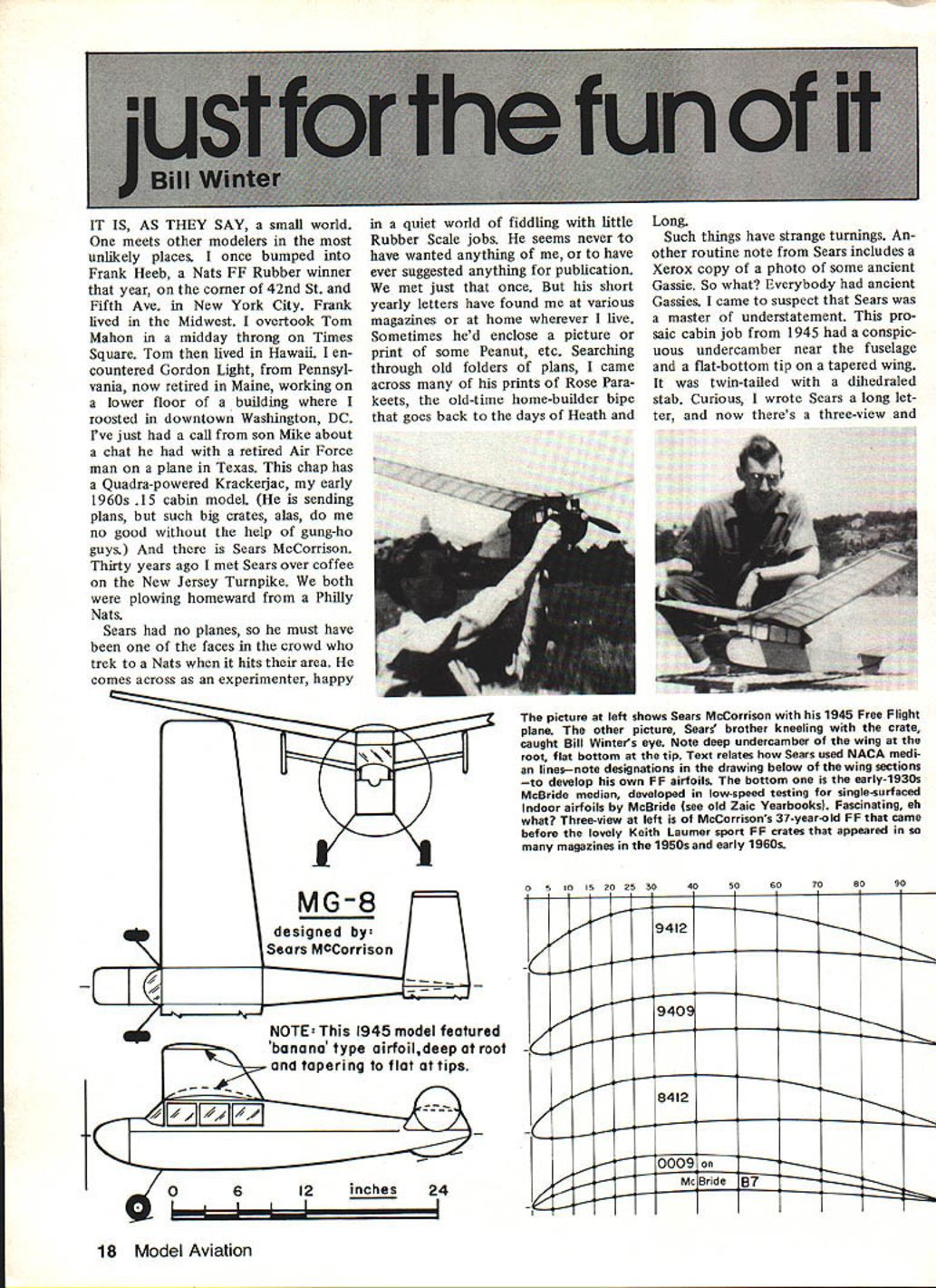
Such things have strange turnings. Another routine note from Sears included a Xerox copy of a photo of some ancient Gassie. So what? Everybody had ancient Gassies. I came to suspect that Sears was a master of understatement. This prosaic cabin job from 1945 had a conspicuous undercamber near the fuselage and a flat-bottom tip on a tapered wing. It was twin-tailed with a dihedraled stab. Curious, I wrote Sears a long letter, and now there's a three-view and negatives of the model which possibly meant nothing to anyone but Sears.
You will see from the drawing an almost 40-year-old FF that has a Keith Laumer motif of realism, with subtle touches (although Laumer had not appeared in the magazines until years later). With it came a graph-paper page of strange airfoils—heavily undercambered things one would find in the 1920s and 1930s. Almost lost was the word "banana."
Banana Airfoils and Sears McCorrison
What led to my unexplained photo was Sears' interest in comments about Ken Willard's use of banana airfoils, such as on Ken's 1/4A Schoolmaster as published some years ago in RCM. Because some modeler allowed us to fly his Headmaster, I had been thrilled by the combination of high lift for almost-parachute landings, good speed when "on the step," and lack of needing trim changes (in a cabin model!) when the throttle was jockeyed. (The M.E.N. Trainer uses the Willard theme.) Sears had been there a generation before. So we show some of these funny-looking "bananas."
What Sears says is cryptic: "Enclosed are some attempts at reproducing the airfoils using NACA mean lines with the 0009 and 0012 thicknesses. The mean lines are modified from the 6400 mean line. My original airfoils had a more-rounded leading edge, rather than the way NACA ones came out. Also included is one using the McBride B-7 as a mean line with the 0009 thickness ratio."
That's it! But note the word McBride. In the very early Zaic Yearbooks, long before WWII, you will find almost laboratory-grade work on indoor airfoils—there may have been low-speed tunnel testing at extremely low Reynolds numbers. Essentially, the McBride—known only to crafty Indoor types—was a near-arc, single-surfaced, of course. Full-scale data means zilch in lightweight, slow-flying models; it isn't until you approach 1/4-scale sizes that you'll concede that famous real sections do a superior job. Harold deBolt used a near-arc on his famous Live Wires of the early 1950s. An arc is as good as anything else on slow-flying, smaller models. With these, it is the thickness and profile that counts most.
Since we all love to look at airfoil profiles (whimsy, perhaps) this is what leads to our reproduction of the McCorrison section. After all, they are the bananas. A cup of coffee, a generation of letters, and we are reminded yet again that nothing is new. Modelers whose work we never see are all around us. Don't you wonder what they might tell us?
My Flying Adventures
I know you guys can't wait to hear about my exhilarating flying adventures. I'm no expert. Vernon MacNabb, who obtained the first FCC-approved, examination-free frequency (in the late 1940s) on 465 MHz, kidded that I was worth a million dollars to him. He once told a large get-together that, "If you want to find out what the public will do to your stuff, send it to Winter. If it can be done wrong, he will do it."
You know about the Kadet that I beat to death last year—it has 120+ flights. When I left off in late December, it had been fearfully gusty. After a long, bouncy approach—nevertheless nicely over the fence—I had only one thing to think about as the crate came in at good airspeed about 8 ft. high: break the glide, then flare. A gust tilted the crate precariously. I had made a fatal error! Assuming I had it made, I relaxed. Startled, I could not restart the gray matter. Gosh, I said to myself, give it anything (aileron, that is). I augured in vertically.
The Kadet still lives, undamaged believe it or not (on sod, of course), but its ancient K&B .40, which has outlived a Bridi 40, a Top Flite Cub, and all sorts of random junk, now makes clanking noises. Fellows, don't ever let down on your attention even if you're only an inch from touch-down. I've fallen into this trap at least six times in my flying life. Have you noted that the very last signal is the wrong one?
I have four new crates. One is a three-channel Eaglet, but I can't match the servo arm length/movement to the throttle arm without moving one servo so an arm will clear the side. That will be easy. The funny thing is that I have two Silver 7's on which you can set absolutely anything at the transmitter. Both are set up for other ships (even trim authority), and I am too pooped to adjust pots every time I fly different crates. (I also currently have a World Expert, two Futabas, several Airtronics, have flown many Krafts, and I'd be happy with any of the great stuff out there.)
I have a four-channel rubber-ducky, but one of my aileron servos turns the wrong way. Last night, the Mad Test Pilot, after a call to Merlin, performed 5-min. brain surgery—no, not on me. It was correct in the first place!
Took the new .40-powered Krackerjac to Fredericksburg, but was blown out. Steve Kaluf obligingly went through the monotony of taxiing it to get a little time on the engine (with the fuselage cloth-wrapped to hold it down). Tomorrow! Tomorrow!
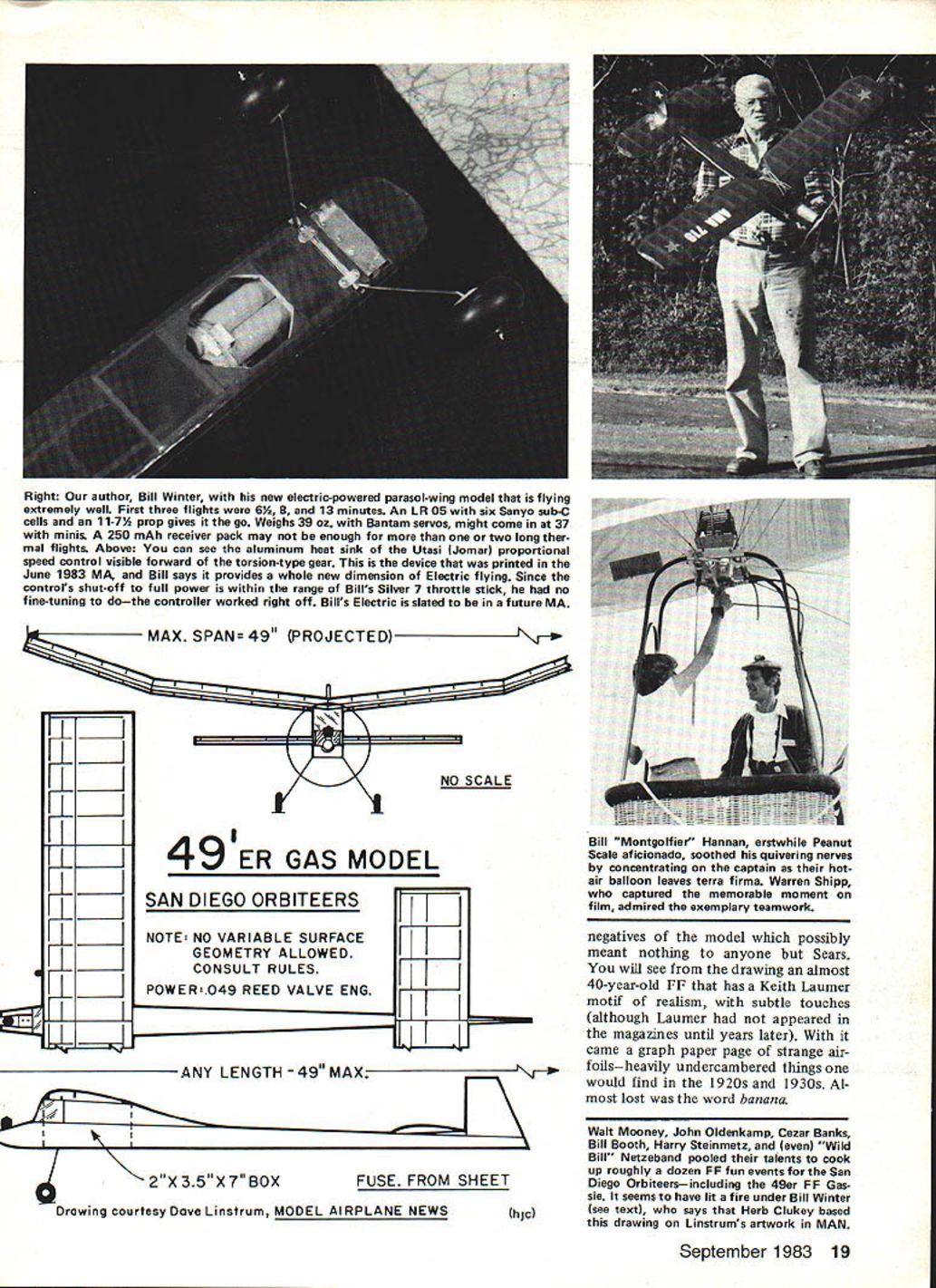
Then there is the new 56-in. low-parasol Electric, with LR 50 and a six-cell Sanyo sub-C pack. With 515 squares, it weighs 37 oz. and turns an 11-7/2. The Mad Test Pilot poised me for a hand-launch on the brow of a hill (tall grass at Shangri-la prevents ROG). Since I used a lifting tail, I was not dead sure where the C.G. should be (it turned out to be at only 42% of the chord), and it was a tad nose-heavy. It took a bit of up-trim, then the batteries were shifted 3/8 in. rearward. The launch took me over the brow of the hill. Like a runaway steam locomotive, I kept running, legs churning to avoid disaster. Down the hill, across a road, into the next field as I bled off speed—all the while my elusive C.G. increasingly out in front of my base like the Leaning Tower. They said I outran the crate. Three quick flights at 5:45 p.m.—6½, 8, and 12½ minutes. Not bad.
Strull's Electric Sparky that night took off from a nearby, narrow road like a Falcon 56. Smooth as silk, he climbed it rock-steady and leisurely to a great height, cruised, shut down, started up again, glided—on rails. We've tacked both planes with various props, so now we get to compare my 515 squares with his 464 squares, but with my plane 4 oz. heavier. This is new—and fun. We hear, now, of motors that supposedly on 12 cells will turn a 9-6 prop for 8 min. at 10,000 rpm (25s in this example), and a 12-6 at 7,000. This is direct drive, so reduction drive can be ignored (with such a prop range), unless you want to turn quarter-scale-size props. Imagination fails me.
The Kadet, RC Gear, and Krackerjac Peculiarities
I've been puzzled for years as to why my heavy, smallish-wing-area (the late) RC Special outsoared anything I had, including the Vagabond RC-Assist Old-Timer—and that big Sniffer. The RC Special had a loading of around 26–28 oz./sq. ft, and it is a drag crate. You have to get a bit more altitude than most to start with. Put in circle trim, and it grooves unattended. If it passes through lift, it tightens the turn quite a bit—always on its right wing tip—and just goes on and on, up and up. Take it out of the lift, fly straight between clouds, and it turns into lift whenever it's found—and goes round and round on its own. I have got to know why. I certainly haven't been able to repeat these characteristics in anything else.
So I tried Scott Christensen at Top Flite, designer of the amazing Metrick.
"I have, and I am sure you have, run across airplanes that just simply should not perform the way they eventually did," Scott begins. "Usually, the reverse is true—how well I know—that don't perform the way they were intended! I can't begin to tell you how many times I have designed 'the perfect airplane,' for its intended use, only to have all of the compromises gather forces and ruin yet another dream. I would suspect that the (author's crate) has the correct amount of 'dirty' in relationship to the appropriate amounts of area and weight—and all of this is working in perfect concert with the French-curve airfoil to produce an airplane which should not do what it does. Then, of course, there is always the M.A.F.T. quotient.
"The M.A.F.T. number assigned to any given aircraft design is always arrived at judgmentally since the mathematics involved would tax the abilities of IBM's latest computer, not to mention the lifetime work in just writing the ... program. The number assigned always ranges from 10, the ultimate, to one, being a total failure. Oftentimes," Scott goes on, "a given design is awarded two M.A.F.T. numbers: one collectively from your flying buddies, and one, of course, from yourself. In this case it's best to average the two in the interest of continuity. By the way, M.A.F.T. stands for Mystical Affinity for Thermals.
"Seriously," Scott winds up, "my advice is to fly and enjoy, and don't ask why—because the answer very probably does not exist, at least not in any form that we can understand."
Reading between the lines, you'll find Scott's philosophy infinitely expandable (I call that the P.I.E. factor). The words "all of the compromises" is what any design, real or model, from the Wright Flyer to the latest airliner, is all about. The aerodynamic tomes don't guarantee you how any model will fly. The compromises are, at best, intelligent guesses—a pinch of this and a pinch of that. Dihedral, vertical tail, and the two combined are factors. Mix with profile area, wing position, thrust line, even wheel areas, etc., and allow to simmer. There may never be an answer, but I have faint clues.
Such crates are not still-air floaters. They have a dynamic quality: if in flight a strong updraft hit that wingtip, it would tend to stall (its angle of attack suddenly increased), forcing the ship to turn quickly into the lift. Always to the right—never to the left—and speed would pick up. It requires stronger lift, but once it has it, the results are out of proportion to expectations. But if you slow it up to nurse lift, it merely sinks through. One thinks of ballasted sailplanes. One can't conclude that a thick airfoil is a panacea. At 26–28 oz. loading, in this case, the high-lift section happens to be a good match. If the crate were built as lightly as it should have been, the airfoil would have to be thinner.
And what happens to airflow over an airfoil with changes in angles, loadings, and speeds? Or in size of the plane? We wander in the Dismal Swamp of Reynolds Number.
For this flight purpose—there are many purposes, and everything changes according to what you want and how you fly—it is probable that in any size from roughly an Eaglet down, one or two turbulator spars, rather than sheet skinning back to the front spar, could yield better results, the more so with lighter weights. On both my Eaglet and the parasol Electric mentioned, I have two turbulator spars. I am interested in extended durations. Both ships are rather lightweight, and at lower airspeeds, these spars seem to help. Merely 1/8 squares. A small FF Rubber job seems to have more duration if you let the rear edge of the leading edge act as a turbulator (and not smooth the rib contours with sheeting). After all, the great Rubber jobs that came out of Cleveland—Korda, Lanzo, and dozens of others—had a multiplicity of light spars, bending rearward to match the curved planform shapes of the outer panels.
I'd prefer not to have all the answers. There won't be any adventure.
P-49 Power Event and the Krackerjac
That P-49 Power event—once more, a bumblebee and John Oldenkamp made me do this. And if the Mad Test Pilot had not made the first flight on my new .40/.60 Krackerjac (6 ft. with the K&B .40) just yesterday, I would not have heard about the bumblebee. The Krackerjac, incidentally, proved a bit different. With the stab on the bottom of the short-coupled fuselage, a blast of power or a retarding clump of grass brings up the stab so delicately that it takes full-up elevator until the wheels go light on takeoff before one can relax the stick.
So we have to go from 3-in. to 4-in. wheels and shim the sheet-metal taildragger gear so it tilts forward 1/2 in. at the axle. It stays level on the approach with any but the lowest idle, and this fooled the pilot into fully retarding the throttle with trim, so it actually reached cut-off—and the crate still almost overran the strip.
An ex-jet-jockey was reminded by this of the bee that buzzed around his cockpit. In desperation, the guy took the ship up to 45,000 and dumped the cockpit pressure, expecting the bee to dedicate its life to science. It continued to fly about. This air neither impaired the bee's ability to do aerobatics nor to thrive when a human would have bellied-up without oxygen. After landing, the canopy was opened, and the bee flew joyfully away. For me, the 49er is a bumblebee.
The 49er Proposal and Club Rules
You probably saw a three-view of the basic 49er proposal in Dave Linstrum's column in MAN and elsewhere by now. Since all modelers do not read all mags (who can?) it is my turn to comment. On Christmas Eve last, John Oldenkamp had summed up proposed fun/club rules (San Diego Orbiteers) for the 1983–84 seasons (copyrighted, no less).
"I gotta share this with you," wrote John. "No answer is required, nor am I asking you to write anything about this in your column. However, I think we have achieved at least a minor breakthrough in getting up a new and viable Power class — one that, incidentally, will adapt virtually as is to RC-assist, RC sport, and RC-whatever."
What happened was that our local "New Events" Committee got together—Oldenkamp and Harry Steinmetz as co-chairs, plus Bill "Wild Bill" Netzeband, Cezar Banks, Bill Booth, John Hutchinson, all multi-years in-grade, including RC, FF, and CL. Our preliminary deliberations yielded a Baseline Gas Class that we felt could handle problems and aspirations of many.
The Professor Walt Mooney and Banks got together (they work at the same aerospace facility). Mooney got a great jolt out of the whole thing and added his two bits:
- Name: 49er or Forty-Niner (call it what you like)
- Max power: .049 reed valve
- Max dimension: 49 in. wingspan
- Max weight: 490 grams (17.2 oz.)
- Fuselage: enclose a "box" of 2 x 3½ x 7 in.
Voila, we may have something after all. At any rate, Mooney and I are framing a couple of prototypes to show-and-tell at our annual banquet (this was 1982, remember). Then we are going to cover and fly these buggers as soon as possible. My 49er gets two fuselages.
Total-time/motor-run ratios are nothing new. But even for just fun, this logical concept, going back 40 to 50 years, never has captured wide attention. The late, great Jim Walker preached the idea nationally in the early 1930s, but when such a towering genius suggested anything, people listened, just listened. Jim also thought the crates had to stay on the field, and perhaps he had tied in some distance measurement from Ground Zero—who would have been too much bother. Who knows?
The original rules proposal stated:
- 120-second max flight duration.
- Unlimited engine run.
- Scoring: Flight Time in Seconds over Engine Run, times 10; highest score from two official flights is counted.
- A 15% bonus is given for unassisted two-main-wheel ROG launches.
We love that, our own interest in FF having faded when the ROG rule was abandoned. Javelin launches leave me cold. But you do have to realize that, as hot engines came in and climb speeds went up, one really needed conflicting adjustments to handle the takeoff, etc., as the crate leaped off, and then leaned over. That's tough. So here's that enjoyable ROG bonus. For an .049, one does not need end-to-end plywood or a rolling strip of tar paper—the way Admiral Nelson loved to fly.
We had Herb Clukey gild the lily to Dave Linstrum's nice drawing. There's a front view added, and since the "box" created a flat behind the cabin, Herb curved the top outline aft of the cabin. We do note the negative lifting tail as drawn and the resultant severe angular difference. Now, if you want to sport-fly a simple RC with an emphasis on primary training, or the glide and soaring (allowing for enlargement for your own fun) do note that lifting stab. It has lots of area, and it has lots of airfoiled lift. The CG probably lies at 75% or so of the wing chord.
I have fondled this drawing for months. If for RC it would be wise to make the stab airfoil thickness not more than 50% of the wing thickness and aft of its own chord. The vertical tail could be placed above the stab position, and the remainder of the aft fuselage lopped off. Since a FF is intended for a steep climb, probably turning, such deviations for RC will be superior if the wing is moved back so that its leading edge is one chord-length behind the rear prop washer. It still may balance at 50% of chord, so if you use electric power, it would be smart to lay the batteries on the fuselage floor, adjusting rearward if necessary. If a flat or streamlined stab is resorted to, the CG may have to be placed at 40% to perhaps 33% of the chord, aft of the L.E.—pure guessing, this.
If you want to wander further afield to improve RC turn characteristics, forgetting the super FF gliding mode, you'll want to shorten the rather long tail moment arm shown in the three-view. At the span and aspect ratio given, a reasonable beginning point is to measure a half-span from midpoint of the wing chord to the midpoint of the stab chord (as the drawing is now presented). This would move the stab forward almost one chord length (its own) for a short-nosed job. If you have moved the wing back, you have about the same set-up but with a longer nose, easier to balance.
While flexibility is great, a purist would build this charming little buggy as is for FF. If he wanted control to prevent chasing, and to provide a lazy man's recovery system, he would employ a tiny receiver and one mini servo for rudder (for minimum use). If that scares you non-FFers, then install a second mini servo for a small elevator just for trim as required. Once you see this FF circling in lift, you'll be hooked. Any old-time FFer who feels nostalgic about this airplane had better have a dethermalizer and a reliable engine run control (the 49er rules say no timer).
The San Diego Orbiteers include 10 other novel fun events in their summary—all of them rubber, CO₂, or arm-powered. What, you haven't heard about "Arm?"
Publications and Yearbooks
The last round-up, I've fallen in love. The object of my affection is the No. 1 SAM 35 Year Book, roughly a 6 x 8, stiff-paper-covered 142-page (excluding two fold-out plans) collection of marvelous low-key historical articles with an I-was-there flair. There are numerous two- and three-view drawings of all manner of crates from the stone-age up to what we fondly term the old-timer age. And scads of meaningful pictures. The choice selection of subjects is, in my experience, just fabulous. The copy is readable, fun, informative—a trip to the moon. One's mind plays games with the wonderful planes that are depicted.
A bunch of "mysterious" Englishmen put this thing together. Charming articles; long, short, sometimes a bit technical. Their typewriters ran amuck. One thing alone is worth the price of admission: a 23-page article by C. E. Bowden, "the Charlie Grant of England." He considered his opus a limited personal story. I doubt any man alive could write something this intriguing and informative. The master has spoken! He began at the year of my birth.
My MAP friends in England gave the SAM 35 Year Book a terse review. Possibly a major publishing company with relatively unlimited resources and salaried manpower who, for a long time (but no longer), produced the hardbacked Aeromodeller Annual, would be a bit testy. Like critics everywhere, they reflect a vision of what they would consider perfect. Perfection can be boring, and this is no such animal. SAM 35 flew high on this one, and I don't perceive that they did it on waxen wings or that they got too close to the sun. For "amateurs," they have managed five-star entertainment. Amateurs, yes—they neglected to publish either the price or the address.
I do find in a regular issue of SAM 35 Speaks the editor's name: David Baker, 22 Ellington Rd., Muswell Hill, London N10 3DG, England. A long-hand slip in my sample says that American modelers may obtain a copy at $7.00. Perhaps you'll want to inquire first. Do persevere.
Stop here, I must.
Bill Winter 4426 Altura Ct., Fairfax, VA 22030.
Transcribed from original scans by AI. Minor OCR errors may remain.

