
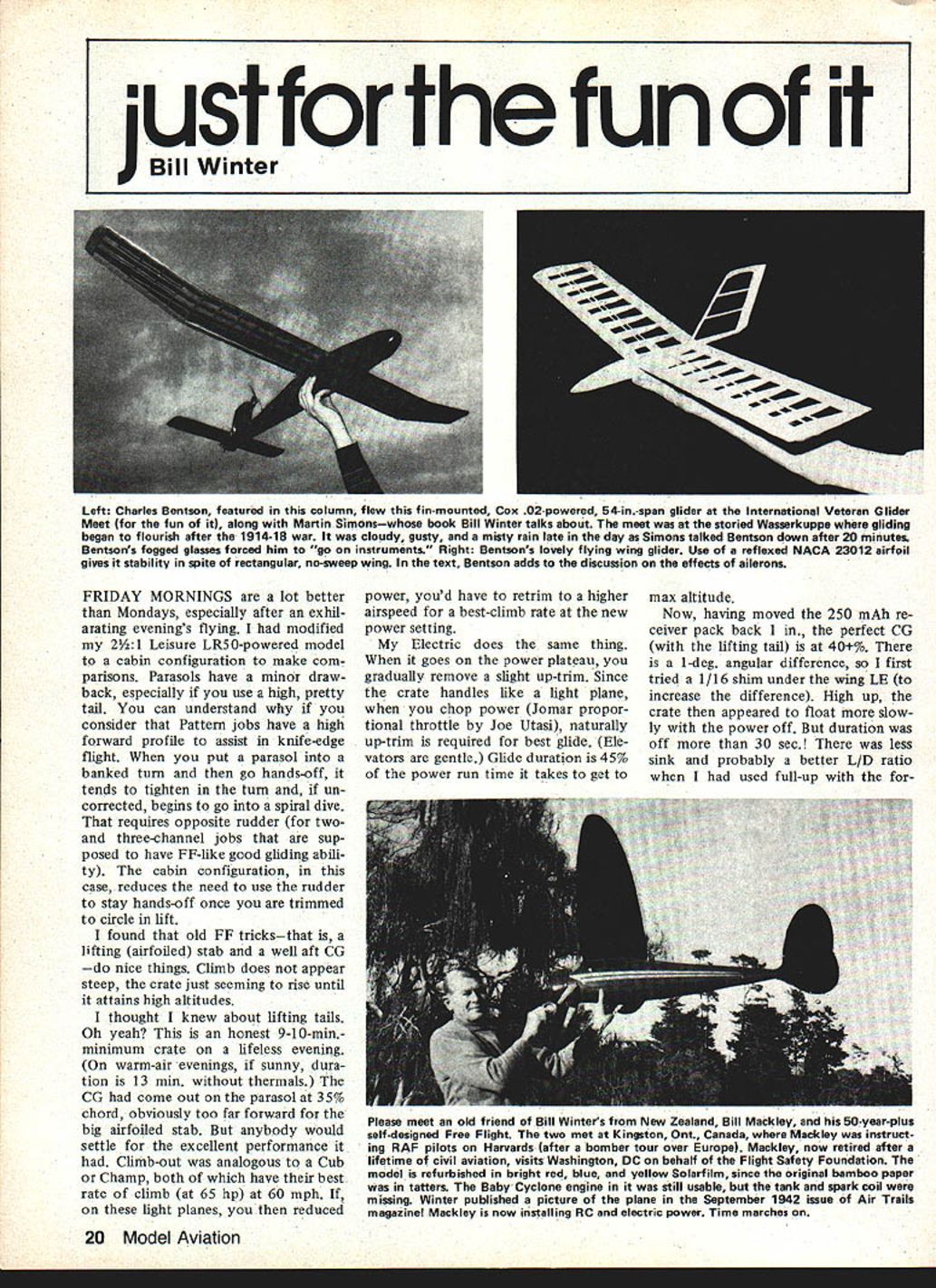
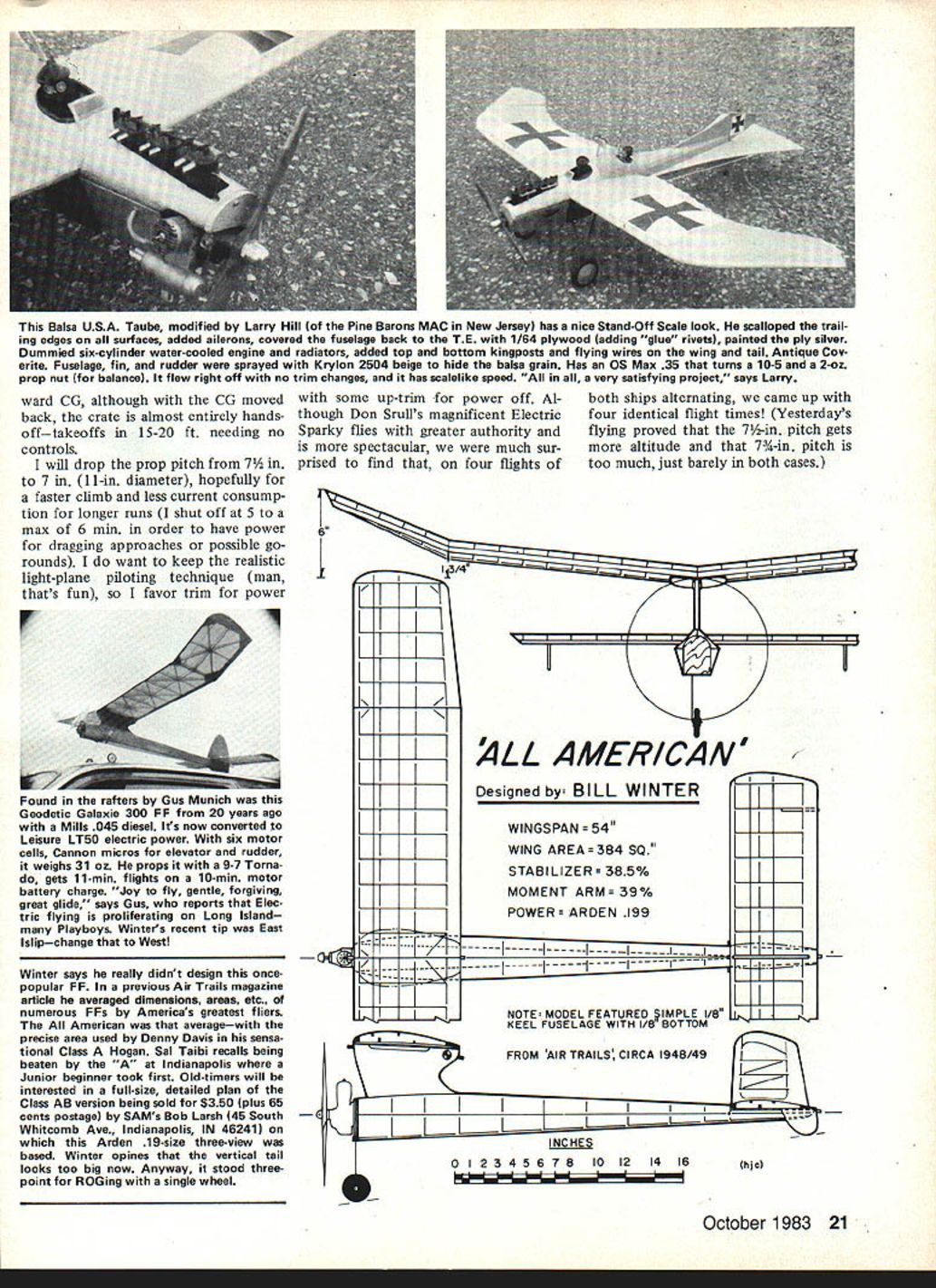
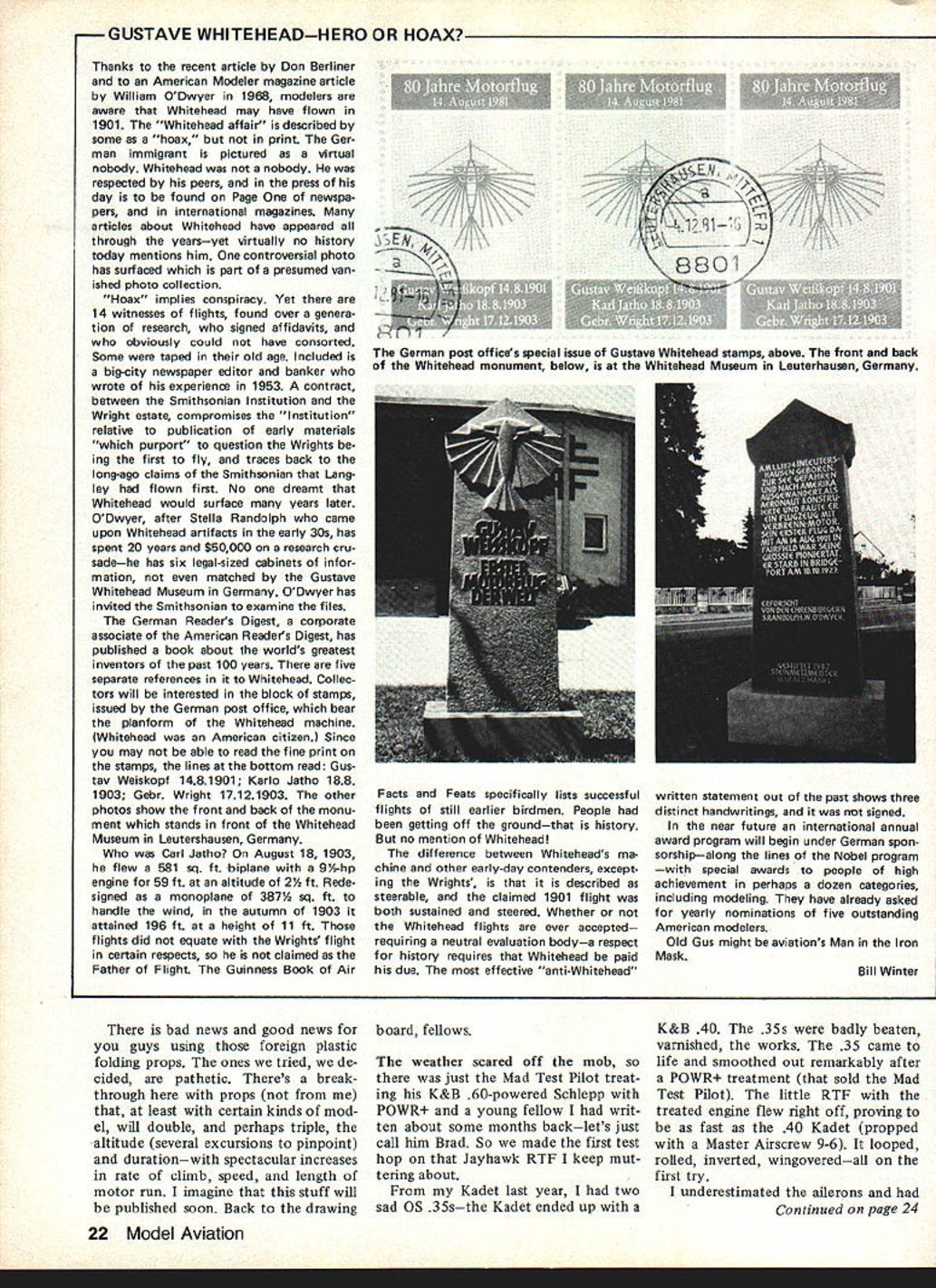
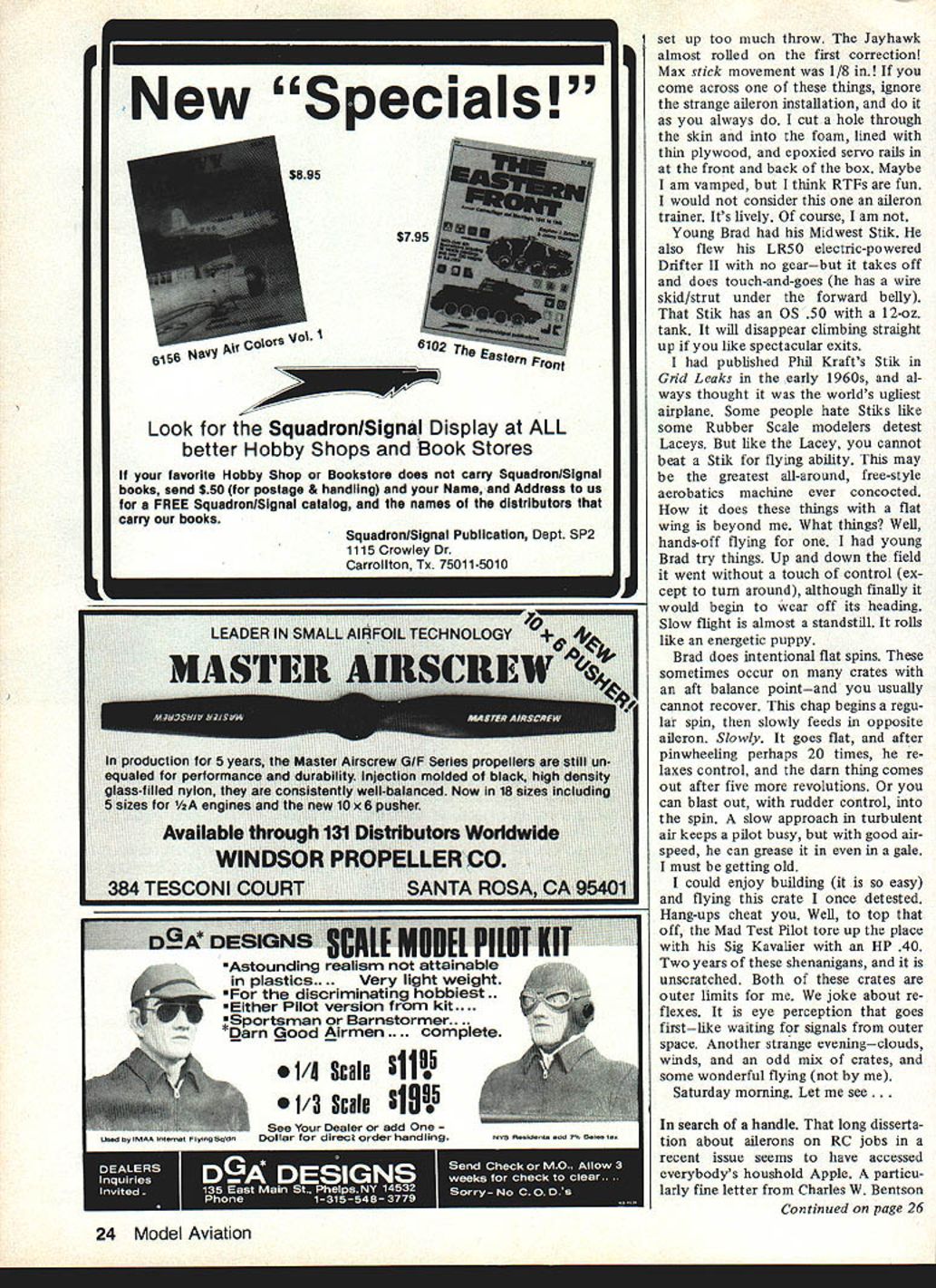


Just for the Fun of It
Bill Winter
Parasol vs. Cabin
Friday mornings are a lot better than Mondays—especially after an exhilarating evening's flying. I had modified my 2½:1 Leisure LR50-powered model to a cabin configuration to make comparisons. Parasols have a minor drawback, especially if you use a high, pretty tail. Pattern jobs have a high forward profile to assist in knife-edge flight. When you put a parasol into a banked turn and then go hands-off, it tends to tighten in the turn and, if uncorrected, begins to go into a spiral dive. That requires opposite rudder (for two- and three-channel jobs that are supposed to have free-flight–like good gliding ability). The cabin configuration, in this case, reduces the need to use the rudder to stay hands-off once you are trimmed to circle in lift.
Lifting Tail and CG
I found that old free-flight (FF) tricks—that is, a lifting (airfoiled) stab and a well-aft CG—do nice things. Climb does not appear steep; the crate just seems to rise until it attains high altitude. I thought I knew about lifting tails. Oh yeah? This is an honest 9–10 minute minimum crate on a lifeless evening. (On warm-air evenings, if sunny, duration is 13 minutes without thermals.)
The CG had come out on the parasol at 35% chord—obviously too far forward for the big airfoiled stab. But anyone would settle for the excellent performance it then had. Climb-out was analogous to a Cub or Champ, both of which have their best rate of climb at about 65 mph. If, on these light planes, you then reduced power, you'd have to retrim to a higher airspeed for the best-climb rate at the new power setting.
My electric model does the same thing. When it goes on the power plateau, you gradually remove a slight up-trim. Since the crate handles like a light plane, when you chop power (Jomar proportional throttle by Joe Utasi), naturally up-trim is required for best glide. Elevators are gentle. Glide duration is about 45% of the power run time it takes to get to max altitude.
Having moved the 250 mAh receiver pack back 1 in., the perfect CG (with the lifting tail) is at 40+%. There is a 1° angular difference, so I first tried a 1/16 in. shim under the wing leading edge to increase the difference. High up, the crate then appeared to float more slowly with the power off. But duration was off more than 30 seconds. There was less sink and probably a better L/D when I had used full-up with the forward CG, although with the CG moved well back, the crate is almost entirely hands-off—takeoffs in 15–20 ft. needing no controls.
Prop and Performance
I will drop the prop pitch from 7½ in. to 7 in. (11-in. diameter), hopefully for a faster climb and less current consumption for longer runs (I shut off at 5 to a max of 6 minutes in order to have power for dragging approaches or possible go-arounds). I do want to keep the realistic light-plane piloting technique (man, that's fun), so I favor trim for power with some up-trim for power off.
Although Don Srull's magnificent Electric Sparky flies with greater authority and is more spectacular, we were much surprised to find that, on four flights of both ships alternating, we came up with four identical flight times! Yesterday's flying proved that the 7½-in. pitch gets more altitude and that 7¾-in. pitch is too much, just barely, in both cases.
Found in the Rafters
Found in the rafters by Gus Munich was this Geodetic Galaxie 300 FF from 20 years ago with a Mills .045 diesel. It's now converted to Leisure LT50 electric power. With six motor cells, Cannon micros for elevator and rudder, it weighs 31 oz. He props it with a 9-7 Tornado and gets 11-minute flights on a 10-minute motor battery charge. "Joy to fly, gentle, forgiving, great glide," says Gus, who reports that electric flying is proliferating on Long Island—many Playboys. Winter's recent tip was East Islip—change that to West!
Winter says he really didn't design this once-popular FF. In a previous Air Trails article he averaged dimensions, areas, etc., of numerous FFs by America's greatest fliers. The All American was that average—with the precise area used by Denny Davis in his sensational Class A Hogan. Sal Taibi recalls being beaten by the "A" at Indianapolis where a Junior beginner took first. Old-timers will be interested in a full-size, detailed plan of the Class AB version being sold for $3.50 (plus 65¢ postage) by SAM's Bob Leach (45 South Whitcomb Ave., Indianapolis, IN 46241), on which this Arden .19-size three-view was based; Winter opines that the vertical tail looks too big now. Anyway, it stood three-point for ROGing with a single wheel.
---
Field Tests and RTFs
Props and a Breakthrough
There is bad news and good news for you guys using those foreign plastic folding props. The ones we tried were pathetic. There's a breakthrough here with props (not from me) that, at least with certain kinds of model, will double, and perhaps triple, the altitude (several excursions to pinpoint) and duration—with spectacular increases in rate of climb, speed, and length of motor run. I imagine that this stuff will be published soon. Back to the drawing board, fellows.
The Flying Session
The weather scared off the mob, so there was just the Mad Test Pilot treating his K&B .60-powered Schlepp with POWR+ and a young fellow I had written about some months back—let's just call him Brad. So we made the first test hop on that Jayhawk RTF I keep muttering about.
From my Kadet last year, I had two sad OS .35s—the Kadet ended up with a K&B .40. The .35s were badly beaten, varnished, the works. The .35 came to life and smoothed out remarkably after a POWR+ treatment (that sold the Mad Test Pilot). The little RTF with the treated engine flew right off, proving to be as fast as the .40 Kadet (propped with a Master Airscrew 9-6). It looped, rolled, inverted, wingovered—all on the first try.
I underestimated the ailerons and had set up too much throw. The Jayhawk almost rolled on the first correction! Max stick movement was 1/8 in.! If you come across one of these things, ignore the strange aileron installation and do it as you always do. I cut a hole through the skin and into the foam, lined it with thin plywood, and epoxied servo rails in at the front and back of the box. Maybe I am vamped, but I think RTFs are fun. I would not consider this one an aileron trainer. It's lively. Of course, I am not.
Brad and His Models
Young Brad had his Midwest Stik. He also flew his LR50 electric-powered Drifter II with no gear—but it takes off and does touch-and-goes (he has a wire skid/strut under the forward belly). That Stik has an OS .50 with a 12-oz. tank. It will disappear climbing straight up if you like spectacular exits.
I had published Phil Kraft's Stik in Grid Leaks in the early 1960s, and always thought it was the world's ugliest airplane. Some people hate Stiks like some rubber-scale modelers detest Laceys. But like the Lacey, you cannot beat a Stik for flying ability. This may be the greatest all-around, free-style acrobatics machine ever concocted. How it does these things with a flat wing is beyond me. What things! Well, hands-off flying for one.
I had young Brad try things. Up and down the field it went without a touch of control (except to turn around), although finally it would begin to wear off its heading. Slow flight is almost a standstill. It rolls like an energetic puppy.
Brad does intentional flat spins. These sometimes occur on many crates with an aft balance point—and you usually cannot recover. This chap begins a regular spin, then slowly feeds in opposite aileron. Slowly. It goes flat, and after pinwheeling perhaps 20 times, he relaxes control, and the darn thing comes out after five more revolutions. Or you can blast out, with rudder control, into the spin. A slow approach in turbulent air keeps a pilot busy, but with good airspeed, he can grease it in even in a gale. I must be getting old.
I could enjoy building (it is so easy) and flying this crate I once detested. Hang-ups cheat you. Well, to top that off, the Mad Test Pilot tore up the place with his Sig Kavalier with an HP .40. Two years of these shenanigans, and it is unscratched. Both of these crates are outer limits for me. We joke about reflexes. It is eye perception that goes first—like waiting for signals from outer space. Another strange evening—clouds, winds, and an odd mix of crates, and some wonderful flying (not by me).
---
Ailerons, Differential, and Martin Simons
Intro and Letter from Charles W. Bentson
In search of a handle. That long dissertation about ailerons on RC jobs in a recent issue seems to have accessed everybody's household Apple. A particularly fine letter from Charles W. Bentson of Los Angeles sheds much-needed illumination. To support his statements, he enclosed copies of a few pages from a mysterious book that is loaded with what, at first glance, seemed just more erudite mysteries of math and overwhelming diagrams. I wondered if I could decipher the fine print. Strangely, the book's author seemed to be talking about models as much as real-plane long-hair stuff. He obviously knew the score. By gosh, I was reading things I didn't know. I was hooked. I asked Bentson what book the pages came from—and was it, by chance, something he had published.
I'll tell you about the book. I think it is a masterpiece. I've read it over and over, and I am still at it. But let's pick up some of what Bentson had to say.
"... It is true, most modelers don't understand the effects of ailerons at low-speed flight," Charles began, "... comments on wash-in on FF models was especially interesting, and in order to find some answers, I took out Martin Simons' Model Aircraft Aerodynamics (Argus Books Ltd., 14 St. James Rd., Watford, Herts, England)."
(Editor note: You may obtain this book from Zenith Aviation Books, P.O. Box 1/MA, Osceola, WI 54020. The price is $22.95, item No. 16061B.)
Excerpts and Discussion
"... there is a big difference in the way ailerons act depending on whether the wing is straight or tapered, since the tips of a straight (constant chord) wing tend to fly at zero aerodynamic incidence. All my experience has been with tapered wings that probably needed a bit of washout (but didn't have it); hence trimming the ailerons a bit up produced, in effect, the washout and greatly improved low-speed handling."
Author: As we had said in our earlier comments, slight up-aileron for neutral can help—not on Pattern or other all-out aerobatics machines, but on typical sport jobs, like my Kadet, which has reflexed ailerons per Claude McCullough's (Sig) advice. If you have flaps, permitting them to drag slightly increases the angle of attack of the inner wing as compared with the tips, and that gives a washed-out tip effect.
Bentson: "... your statement that down-aileron does most of the work is misleading ... a bit from Martin's book ... indicates that up-aileron has nearly equal effect to down-aileron. The curves further indicate that beyond the 15° range, the aileron begins to act like a spoiler, which may be OK on the up side, but it certainly is not on the down side. Your 2½ ratio sounds good."
Author: While knowing that an up-aileron does some of the work, I had always assumed that most of the work was performed by the down-aileron—envisioning the down-aileron as creating deep camber with a high CL for that portion of the wing, and the up-aileron as a reflexed camber. Perhaps I got carried away. That 2½:1 ratio refers to the amount of up-movement of an aileron to equate with the drag of the down-aileron which, in turn (if movements were equal), demands a far larger vertical tail to overcome that down-aileron yaw so that the plane will turn and bank rather than skew around its vertical axis.
You may not be able to use differential throws with narrow strip ailerons. These would require a ridiculous amount of up to compensate for the down-aileron when large throws are required. That suggests wider ailerons and less movement to encourage differential linkages. For proof of the more-up-than-down thing, consider the Ercoupe (early models) which, using a 2½:1 aileron differential, had limited rudder movement. (Fred Weick, the designer, sought to prevent amateurs from overly crossing controls on the dreaded downwind turns.)
Because virtually all those old real planes ignored differential, lots of rudder had to be used along with ailerons—pilots know all about coordination. Today's fliers of Giant Scale models insist that, to fly smoothly, you must coordinate ailerons and rudder (or use the CAR transmitter mode), differential being as scarce as hen's teeth. (That early Ercoupe had no rudder bar—it was CAR!)
Bentson: "Alan Slater, who at 85 is still an active aviation journalist . . . once told me about a glider pilot in the 1920s who mistakenly assumed that the down-aileron did all the work, so he eliminated the opposite upward action. He went into a spiral dive . . . recovered with difficulty, only to go into another which resulted in his death."
Author: Charles isn't trying to prove something. He is merely relating a strange incident to stress his point. We don't know the circumstances. Shallow or no dihedral, inadequate vertical tail, etc., establishes a down-aileron yaw that could not be controlled by that tail and rudder response. The poor man was doomed. For such an experiment, an oversized vertical tail would be essential, as would sufficient dihedral with which a powerful rudder could couple aerodynamically for an opposite rolling moment.
If on your three-channel RC (picture an Eaglet) a slight wash-in warp (on, say, the right tip) produces a left turn, then an aileron on that tip (but with warp removed) would produce the same turn if the amount of down-aileron corresponded to the increased lift generated by a slightly warped tip. As tricky as standing on your head—on top of a flagpole. Yes, we agree, the up-aileron does almost as much work as the down-aileron.
Bentson: "I had one experience with drastically retrimming ailerons on a full-scale glider. A 1935 Rhonbussard had been restored and the ailerons reduced to half original length by a well-known sailplane designer. However, the British Gliding Association test panel would not test or approve it because the original aileron travel was not available. We had a permit to fly, so we set about to find a safe solution. My experience with large RC models had indicated that aileron differentials of about 3° actually improved aileron response, so we had a look at the Schleicher K-8 which had the best ailerons in the fleet. It had similar differential, so we retrimmed the Rhonbussard for originally-specified upward deflection and considerably reduced down travel—about 2 to 1. I had the honor of testing the machine, which was nearly my age and had not been flown in 12 years. It was a delight to fly, much more responsive than most vintage gliders.
"I fitted my 100-in. Monterey Sailplane with trailing-edge ailerons along the inner two-thirds of each wing panel. Movement was limited to upward only. Aileron control was crisp with a fast rate of roll. I strongly recommend this arrangement."
Author: I just learned something. We all seem to have a new toy!
Bentson: "I used a different approach on an 11½-ft. RC sailplane which I bought dirt-cheap because it handled so badly in roll. It had conventional ailerons which I readjusted to give some, but not good, differential. By rigging them to a rest position of five degrees up, good handling was restored, and I was able to dispense with the oversized rudder and to fit a much smaller rudder that was correct for spiral stability."
Author: Unless your requirements are for a neutrally-stable airplane (probably symmetrical section), Bentson just said a mouthful. As a hacker, I think I perceive that he is getting most of his roll control out of the up-aileron, but has some down remaining, with the net result that he has achieved differential without using traditional methods—yes, of course, one could then get rid of an oversized vertical tail and have a smoother-flying machine. Reading the book he sent, I "think" all this means he has less center-of-pressure travel, and a much more stable machine about all axes, but with an earlier stall point (though good fliers don't get near a stall; what he paid to get the good things he achieved probably is immaterial).
Bentson: "You mentioned the problems with inadequately-sized vertical tail area on old designs. I am a great believer in sticking with the original scale size and compensating by providing a thicker, more effective section. Most modelers completely ignore aerodynamics when they come to the tail and cut it out of sheet material. Because of their comparatively small size, the tail areas of models need special attention to the section used. Your suggestion of a square trailing edge is good."
Author: I half-buy that. However, the smaller the model, the tougher it is to stick to scale tail areas. By the time you get to 1/5-scale and larger, the ability to hold to scale size without penalty becomes increasingly greater. We depart from scale airfoils, or resort freely to flat-bottomed ones. Especially when thick, these have a serious CP travel with increasing angles of attack, and thus they require a larger tail area than when a symmetrical, or semi-symmetrical, or some other scale section is used. In the first case, because of our monkeying around, we might need a 30% stab; in the latter, less than 20%, even only 15% or less if the ship is at least 4½ to 5 ft. in span. With a long fuselage arm, 10% would be feasible in some cases.
I've noted that RC models with sectioned stabs, even streamlined or double-triangle end-to-end as ribs, fly better than sheet-tailed crates. I don't have the foggiest reason why, but respected pilots say it is true.
Bentson: "Perhaps the best argument for upward-rigged ailerons comes from modern sailplanes with camber-changing flaps and ailerons arranged to move up or down with flaps. Although it would be preferable to take off on aerotow with flaps slightly down, it is common practice to take off, or at least initiate the takeoff run, with the flaps up because better aileron control is obtained with less likelihood of the wing tip touching the ground. In this case, aileron drag is not a factor because of the tow attachment to the nose."
Final Thoughts on Aerodynamics and the Book
Humor me, guys, because the game plan for this column has gone up in smoke. Old-timer modelers in indoors, sailplanes, FF power, etc., have dozens of years of hands-on experience, as do the better rubber scalers—and the Wakefielders and Nordic guys. I think of them as tweakers and breathers whose fine tuning of crates seems a stream of consciousness. To many of us, books and articles on aerodynamics appear to be written for folks we've never met. The greater a man is, the more he is able to communicate matters far beyond us in a simple, understandable way—and truths are revealed.
From Bentson's copy of Model Aircraft Aerodynamics (inscribed to him by Martin Simons), I've gone back in time to that wonderful work by George Page. Simons is over my head much of the time (I'm a hack at math and plotted points, too), but I understand enough to discover many things I crudely discerned before, or didn't know, and saw countless ways of improving models as we know them. What he tells you about lift distribution, washout, tip vortices, planform, aspect ratios, and a horde of other things we think we know, and all of it related to other design and adjustment problems we have, will shake up your liver bile. These are elemental truths. What makes this book so applicable to models is that Simons is a scientist, a modeler of considerable skill, and an authority on low-speed aerodynamics in the Reynolds number ranges which apply to what we do.
Quoted from the book jacket: "The definitive detailed work on the subject of aerodynamics as applied to flying models . . . covers the entire theory of flight in relation to model aircraft and includes tables of optimum airfoil sections and dimensions, scores of diagrams, and practical illustrations . . . how to take into account the application of scale effect in model performance . . . shows how more effective performance can be achieved by careful study of aerodynamic design . . . purpose . . . is to present in practically useful form some standard aerodynamic theory as it applies to model aeroplanes and gliders."
Thanks, Charles Bentson, for the pleasant flight.
Bill Winter 4426 Altura Ct., Fairfax, VA 22030
Transcribed from original scans by AI. Minor OCR errors may remain.

