


Just for the Fun of It
Bill Winter
I've discovered that some guys won't fly when they see Bill Kaluf and your peerless scribe drive up. They say it's just too much fun watching. Ours is a Chinese Fire Drill in slow motion. That's at Fredericksburg, VA. These guys have a 560-ft. strip mowed twice a week. Overruns are hundreds of feet long. My own club's small site 33 miles west of Washington, DC separates the men from the boys.
The Fredericksburg strip centers a lovely wide-open park, site of the Union artillery when Gen. Burnside, of the glorious beard, became a cropper when he threw pontoon bridges across the close-by Rappahannock and tried to take the Rebs, who coyly were massed behind a stone wall on top of a hill. When I take off to the east, I am distracted by a big house and rose garden off the end of the park, for it was there that George proposed to Martha.
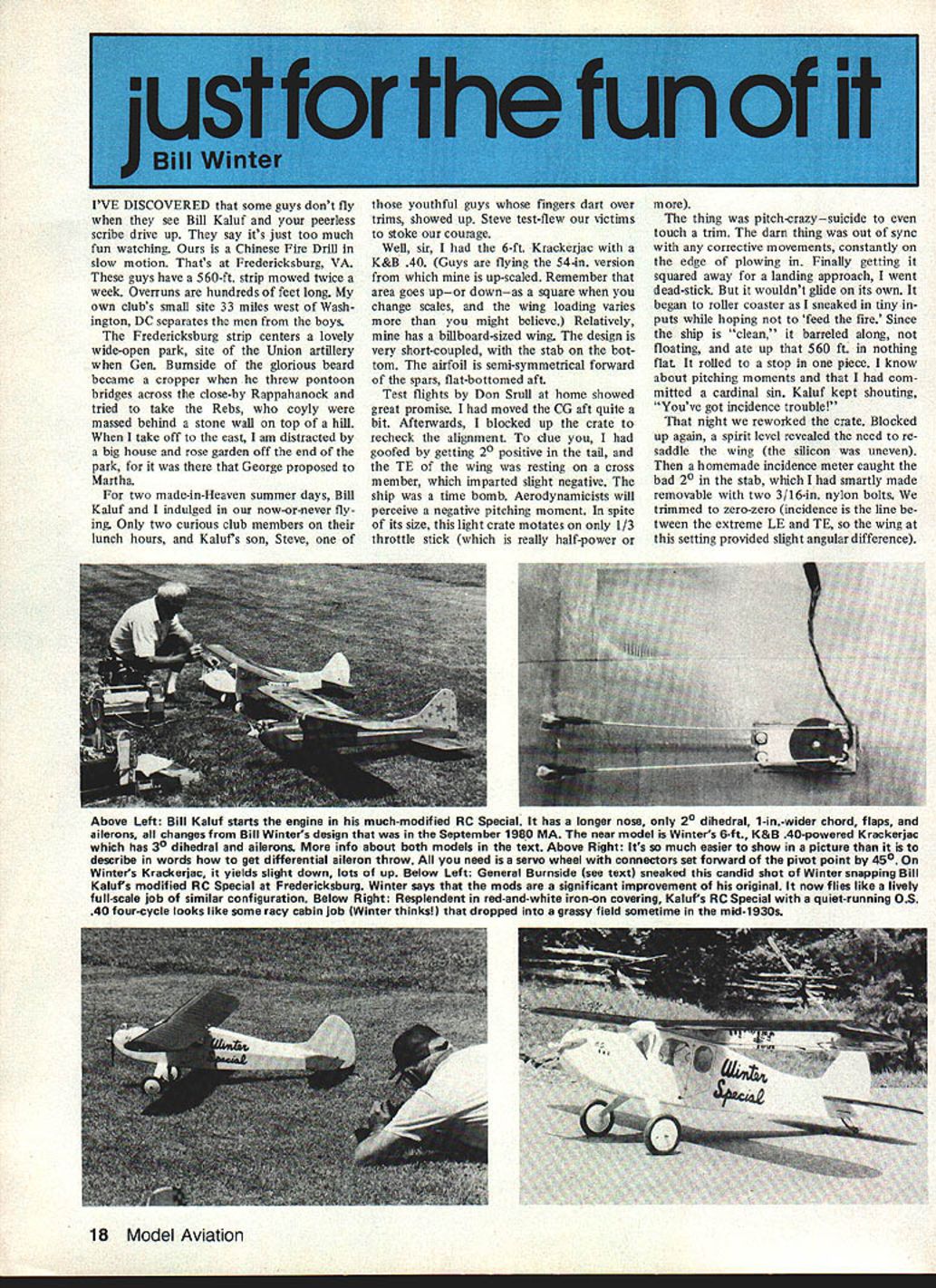
For two made-in-Heaven summer days, Bill Kaluf and I indulged in our now-or-never flying. Only two curious club members on their lunch hours, and Kaluf's son, Steve—one of those youthful guys whose fingers dart over trims—showed up. Steve test-flew our victims to stoke our courage.
I had the 6-ft. Krackerjac with a K&B .40. (Guys are flying the 54-in. version from which mine is up-scaled. Remember that area goes up-or-down as a square when you change scales, and the wing loading varies more than you might believe.) Relatively, mine has a billboard-sized wing. The design is very short-coupled, with the stabilizer on the bottom. The airfoil is semi-symmetrical forward of the spars, flat-bottomed aft.
Test flights by Don Srull at home showed great promise. I had moved the CG aft quite a bit. Afterwards, I blocked up the crate to recheck the alignment. To cue you, I had goofed by getting 2° positive in the tail, and the trailing edge of the wing was resting on a cross member, which imparted slight negative. The ship was a time bomb. Aerodynamicists will perceive a negative pitching moment. In spite of its size, this light crate motors on only 1/3 throttle stick (which is really half power or more).
The thing was pitch-crazy—suicide to even touch a trim. The darn thing was out of sync with any corrective movements, constantly on the edge of plowing in. Finally getting it squared away for a landing approach, I went dead-stick. But it wouldn't glide on its own. It began to roller-coaster as I sneaked in tiny inputs while hoping not to "feed the fire." Since the ship is clean, it barreled along, not floating, and ate up that 560 ft. It rolled to a stop in one piece. I know about pitching moments and that I had committed a cardinal sin. Kaluf kept shouting, "You've got incidence trouble!"
That night we reworked the crate. Blocked up again, a spirit level revealed the need to resaddle the wing (the silicone was uneven). Then a homemade incidence meter caught the bad 2° in the stabilizer, which I had smartly made removable with two 3/16-in. nylon bolts. We trimmed to zero-zero (incidence is the line between the extreme leading edge and trailing edge, so the wing at this setting provided slight angular difference).
I had noted a tendency for the aileron yaw to hold the nose straight for a split second when aileron was applied, indicating that either the vertical tail should be increased (it handles yaw) or differential should be cranked into the ailerons. We corrected this by using a big servo wheel, locating the connectors at 45° forward of the servo shaft. Now, up-aileron is far more than down-aileron. Kaluf swears by this, and when he told me that a real Jungmeister at a nearby museum had no down at all, I bought his argument to minimize down-aileron. (And I always thought down-aileron did most of the work!)
How well that crate flies now! I was never weaned from the old-time technique of standing behind a crate for takeoff—which leads to cries of "Get off the runway!" or "Hey, Bill, may I land?" Now, I can stand off the side of the runway like normal folks and have the thing run toward me.
I do nothing. It lifts off gently (a tail-dragger) and flies out flat as if you were holding a tad of down, then gracefully rotates and climbs at a nice angle, rock-steady. No more aileron yaw. Seeing the usual nose-down on an aileron turn, and as expected the flippers only tightened the turn, compelling you to unbank to go straight, I tried the Giant Scar's bit of coordinating aileron and rudder. Better. But then I found that with 30° dihedral (a cabin-type plane), rudder gave a gentle, smooth turn without altitude change. I coordinated rudder with elevator. Magic!
There were no thermals, but evidently gentle, smooth lift lay over the land (the night had been cool, and a hot sun does things by 11 o'clock). With trimmed-rudder circles on idle, the crate proved to be soaring-crazy. On its fourth and fifth flights, it went sky high. It was brought down, then it went back up. One could ride the air for hours. Approaches shout for spoilers or drag flaps—I'll get to this (spoilers it is).
I have soared every plane I've ever made. For me, if it won't soar, it ain't an airplane. One guy almost lost a Junior Falcon—that's Half-A! Incidentally, Bill Kaluf and I moved the Krackerjac's 1,000 mAh battery 7 in. forward that hectic night, and the receiver 5 in., plus we put on a heavy spinner. Big crates require heroic measures. Call that "Go for it."
Something else. Bill Kaluf flies a well-weathered Senior Telemaster, once equipped with a side-looking camera. He likes to ride "cracked" flaps, which makes it docile enough for an old lady. Its early-model O.S. .40 may have been flown by Julius Caesar! It tachs at 9,000 with an 11-6. I suggested he try my POWR+ treatment. The resulting jump to 10,200 rpm excited him so much that he followed the Krackerjac into lift. Naturally, we couldn't help one another, each having hands full and eyes locked in. Only a flash of a yellow wing panel saved him from losing the Senior Telemaster.
POWR+ is especially effective on older beat-up engines, because it gets rid of the carbon and varnish, and permeates the metal with a low-friction, protective finish. As you dribble the stuff into the venturi, the engine falters, then picks up rpm, higher and higher. And you find a significant change in the needle toward lean. It rejuvenated a "retired" O.S. .35—which now drags my rubber ducky most impressively. The stuff works.
Dream Transmitter Features
Flight of fancy? If you could have anything you want in a transmitter, what would you envision? Don't think of existing transmitters; this is an exercise in pure imagination, and whatever miracles we conjure up should cost less, too. How about every function and combination thereof that one might dream of—without knobs, switches, levers, and all that other stuff we can't "find" in a hurry, or we forget when in an unwanted mode, or accidentally bump to lose adjustments—or worse.
Imagine:
- Four push buttons labeled A, B, C, and D representing four different airplanes and their entire setups. Push A and you have Plane No. 1; push D and you have Plane No. 4.
- A transmitter that remembers any plane you fly and exactly how you fly it, including all trims, rates, mixes (exponential, linear, rate, mixing), and the ability to revert to a standard 4-ch layout at any time.
- An automatic trim button to flight-trim all channels.
- The ability to add dozens of channels and access the most sophisticated control worlds (boats, helicopters) while keeping your airplane setups intact.
- Flaperon, V-tail mixing, and other mixes built in.
- An LCD display that shows voltage, servo pulse lengths for accurate settings, flight timer, and anything else on demand.
- Audible warnings: a "land" alert, 15-second reminders if you're in an unusual rate, or a warning when the system detects an impending malfunction. The transmitter could answer queries (e.g., "dirty aileron pot").
Imagine a programming panel that enables you to set up virtually infinite functions. Suppose flying techniques change in three years and new demands require different techniques and gadgets. The dream transmitter never grows obsolete—just plug in one new IC chip, and you are still in business.
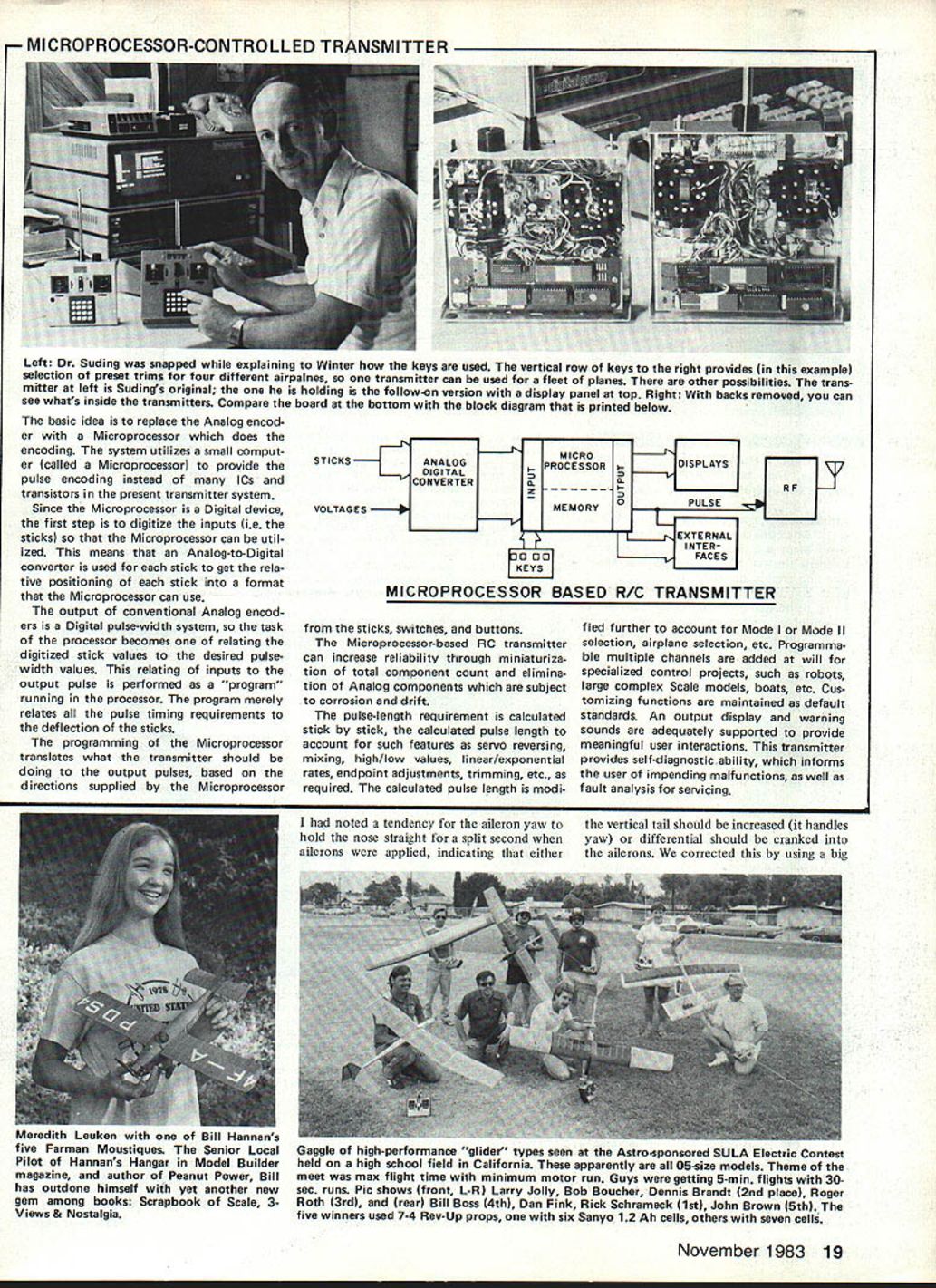
This transmitter exists. It may be on the market within six months. It may change our RC world forever. It is in everyday use. One of the nation's leading designers of RC systems had a project to develop a 14-channel unit for the RPV field and was seven months into his development program. The man with the "computer" transmitter, who has done all this, showed this engineer how he could set up that 14-channel unit in five minutes. That's the truth, so help us! This man can design, mechanically, such a transmitter in seven hours. The software is the secret—which is why I can talk about it. Writing the program has consumed 250 hours of a real expert's time, and he estimates 250 more hours to fine-tune it for even better results.
Who performed this feat? What is this transmitter? How does it work? (I don't know beans about such stuff, but I came away with notes which probably mean much to folks who are into electronics.)
The man is Dr. Robert Suding of Herndon, VA. Having made contributions to a number of telecommunications and computer companies using microcomputer-based technologies, he now has his own consulting firm. Working at home, he is engaged in development work for giant firms, brainstorming new concepts. He "plays" with all sorts of things for fun. There's a computerized pipe organ having pipes which fill a room wall-to-wall. Since it looked capable of shaking a cathedral, we didn't ask him to play it. Out back, he has an observatory with an 18-in. telescope—one of the biggest in the state. He's sent star charts into his computer, enabling it to seek out any target and follow it on a 24-hour basis. As large as a big two-car garage, the observatory has a roof which rolls back to unleash this stellar siege gun—bigger than your friendly howitzer. Even the rolling roof is computerized.
We shall describe Robert's transmitter as a separate item, but here are a few last words. The circuit board you Silver 7 owners see at the bottom of your transmitter is replaced with an equal-sized board which mounts the "magic" components. Robert claims that a skilled worker could assemble and install this board in his own RC transmitter. Robert's teenage son, Dennis, builds their models in the garage (he flies up a storm)—shelter for the car is a much lower priority.
I was invited to fly the system, but I was dizzy enough already and found the high humidity and noontime sun of a 94° day to be too much. Others who have flown it report that one cannot detect a difference. To put this in human scale, I report faithfully that the "boys" could not find the booster battery.
This system does not replace the man. It doesn't program flights (not that it couldn't). Rather, it expands enormously what the man can do with his flying skills and improves flying precision. You can still have your roll buttons, etc. Asked if the transmitter control stick pots could be eliminated, Robert answered, "Easily." The pots remain temporarily because digitized sticks would be more complex to implement.
Reading and Other Notes
I'm a sucker for tidbits of wisdom, oddities, useless facts, and tongue-in-cheek. I want a good show!
I must quote Joe Klause from Model Builder: "Misconceptions abound in our world. For example, you've undoubtedly heard that the moon is made of green cheese. Actually, it's a slice of a very large, green tomato." Joe shocked me by making clear that "explosions" don't take place (normally) in a model engine. He explained that combustion is a relatively slow burning process accompanied by the creation of light and extreme heat — "a vigorous, but not violent, union of substances with oxygen." Showing simple diagrams (based upon industrial photos of the inner cylinder combustion process), he says that an explosion is detonation—the knock-knock business of leaned, cooked engines, and squandered bucks. "Only some kind of a nut would want an explosion in the cylinders of his engines . . . the same type that likes green cheese," Joe wound up.
Clarence Lee dispenses, in question-and-answer form in RC Modeler, more practical info than one man seemingly could know. He made me chuckle.
In the olden days, Powermist (Francisco Labs) was the fuel. On bitter cold days everybody used mine to prime their engines—if they wanted to fly. I had one can so potent that a single drop dispensed by a pointed stick against the side of the piston (at top dead center) resulted in the prop banging off on the first flip of an Arden .09. I loved Powermist. It smelled lovely. When one hand-launched a crate, the aroma swirling around his noggin gave him such a high that he didn't care what happened to the crate—if indeed he ever remembered it. The prop blast smelled like the Garden of Eden. Did they put perfume in it, asked a curious reader? Yes, said Clarence. Now, I know! A dash of Chanel No. 5 in our fuel would be very nice—and reminding, too, of airplane widows.
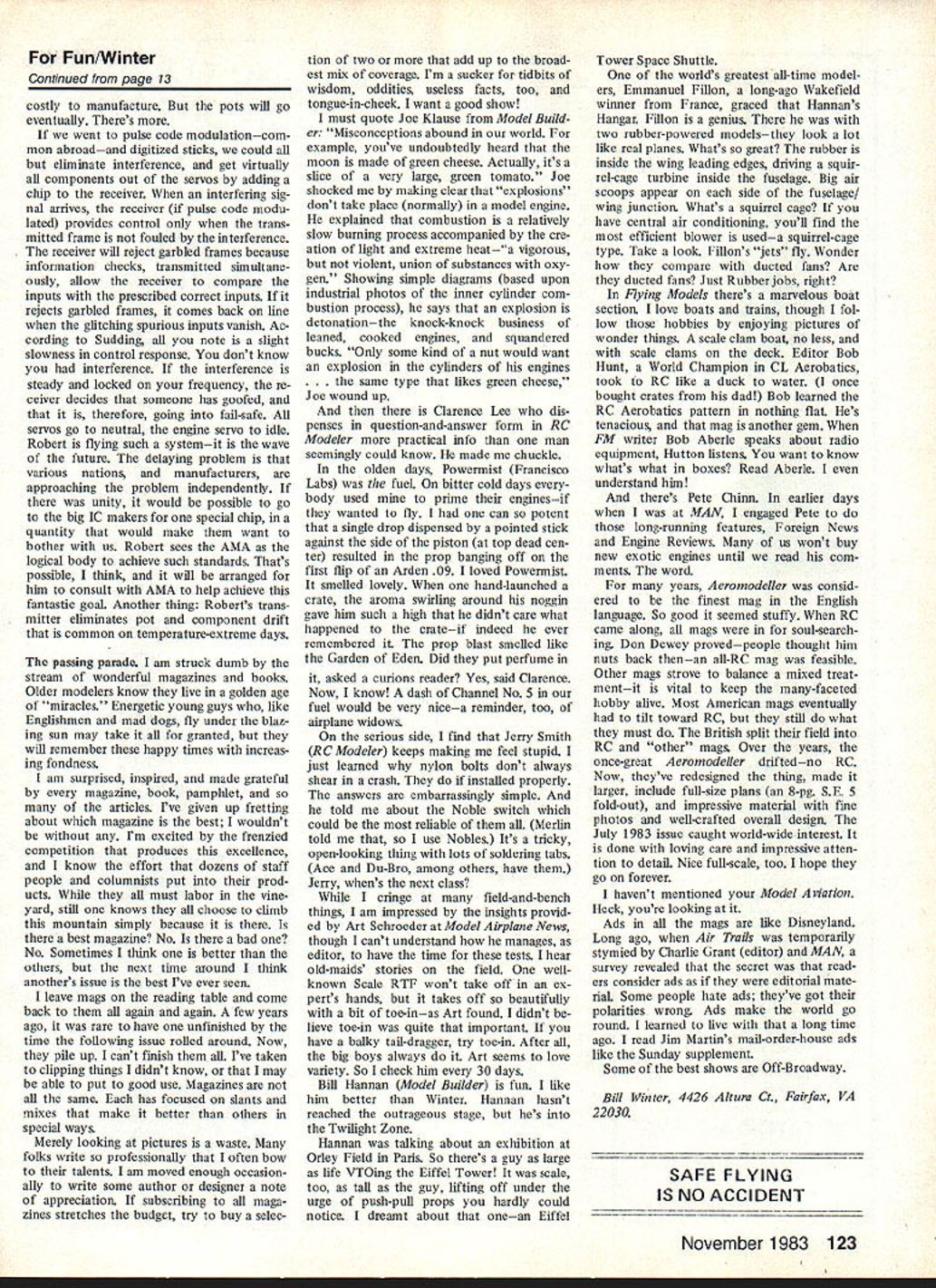
On the serious side, I find that Jerry Smith (RC Modeler) keeps making me feel stupid. I just learned why nylon bolts don't always shear in a crash. They do if installed properly. The answers are embarrassingly simple. And he told me about the Noble switch which could be the most reliable of them all. (Merlin told me that, so I use Nobles.) It's a tricky, open-looking thing with lots of soldering tabs. (Ace and Du-Bro, among others, have them.) Jerry, when's the next class?
While I cringe at many field-and-bench things, I am impressed by the insights provided by Art Schroeder at Model Airplane News, though I can't understand how he manages, as editor, to have the time for these tests. I hear "old-maids" stories on the field. One well-known Scale RTF won't take off in an expert's hands, but it takes off so beautifully with a bit of toe-in—as Art found. I didn't believe toe-in was quite that important. If you have a balky tail-dragger, try toe-in. After all, the big boys always do it. Art seems to love variety. So I check him every 30 days.
Bill Hannan (Model Builder) is fun. I like him better than Winter. Hannan hasn't reached the outrageous stage, but he's into the Twilight Zone.
Hannan was talking about an exhibition at Orly Field in Paris. So there's a guy as large as life VTOing the Eiffel Tower! It was scale, too, as tall as the guy, lifting off under the wing of push-pull props you hardly could notice. I dreamt about that one—an Eiffel Tower Space Shuttle.
One of the world's greatest all-time modelers, Emmanuel Fillon, a long-ago Wakefield winner from France, graced Hannan's Hangar. Fillon is a genius. There he was with two rubber-powered models—they look a lot like real planes. What's so great? The rubber is inside the wing leading edges, driving a squirrel-cage turbine inside the fuselage. Big air scoops appear on each side of the fuselage/wing junction. What's a squirrel-cage? If you have central air conditioning, you'll find the most efficient blower is used—a squirrel-cage type. Take a look. Fillon's "jets" fly. Wonder how they compare with ducted fans? Are they ducted fans? Just rubber jobs, right?
In Flying Models there's a marvelous boat section. I love boats and trains, though I follow those hobbies by enjoying pictures of wonder things. A scale clam boat, no less, and with scale clams on the deck. Editor Bob Hunt, a World Champion in CL Aerobatics, took to RC like a duck to water. (I once bought crates from his dad!) Bob learned the RC Aerobatics pattern in nothing flat. He's tenacious, and that may be another gem. When FM writer Bob Aberle speaks about radio equipment, Hutton listens. You want to know what's what in boxes? Read Aberle. I even understand him!
And there's Pete Chinn. In earlier days when I was at MAN, I engaged Pete to do those long-running features, Foreign News and Engine Reviews. Many of us won't buy new exotic engines until we read his comments. The word.
For many years, Aeromodeller was considered to be the finest mag in the English language. So good it seemed stuffy. When RC came along, all mags were in for soul-searching. Don Dewey proved—people thought him nuts back then—that an all-RC mag was feasible. Other mags strove to balance a mixed treatment—it is vital to keep the many-faceted hobby alive. Most American mags eventually had to tilt toward RC, but they still do what they must do. The British split their field into RC and "other" mags. Over the years, the once-great Aeromodeller drifted—no RC. Now they've redesigned the thing, made it larger, include full-size plans (an 8-pg. S.E.5 fold-out), and impressive material with fine photos and well-crafted overall design. The July 1983 issue caught worldwide interest. It is done with love and care and impressive attention to detail. Nice full-scale, too. I hope they go on forever.
I haven't mentioned your Model Aviation. Heck, you're looking at it.
Ads in all the mags are like Disneyland. Long ago, when Air Trails was temporarily stymied by Charlie Grant (editor) and MAN, a survey revealed that the secret was that readers consider ads as if they were editorial material. Some people hate ads; they've got their politics wrong. Ads make the world go round. I learned to live with that a long time ago. I read Jim Martin's mail-order-house ads like the Sunday supplement.
Some of the best shows are Off-Broadway.
Bill Winter 4426 Altura Ct. Fairfax, VA 22030.
Transcribed from original scans by AI. Minor OCR errors may remain.

