
Just for the Fun of It
Bill Winter
SNOOPY SITS on his dog house. I sit inside mine. It has been a summer of discontent. Whoever said that cabin fever is a wintertime malaise must have been talking to the penguins. Cabin fever is a summertime torture. For two months the temperature bubbled in the 90s, and all along the eastern seaboard was a wet sauna. Fantasy and reality blur.
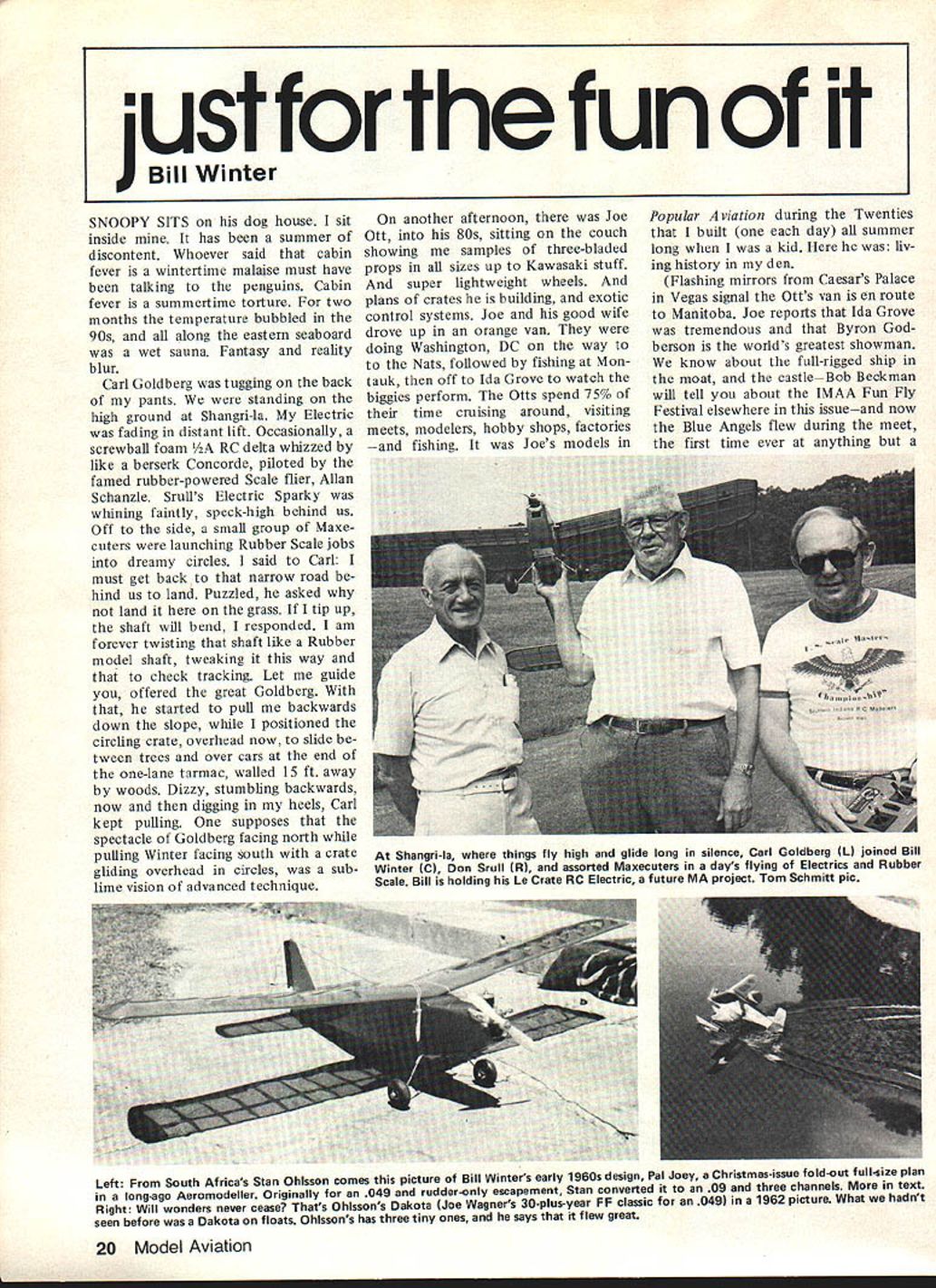
At Shangri-la
Carl Goldberg was tugging on the back of my pants. We were standing on the high ground at Shangri-la. My electric was fading in distant lift. Occasionally, a screwball foam 1/2A RC delta whizzed by like a berserk Concorde, piloted by the famed rubber-powered scale flier Allan Schanzle. Srull's Electric Sparky was whining faintly, speck-high behind us. Off to the side, a small group of Maxecuters were launching rubber-scale jobs into dreamy circles.
I said to Carl: I must get back to that narrow road behind us to land. Puzzled, he asked why not land it here on the grass. "If I tip up, the shaft will bend," I responded. "I am forever twisting that shaft like a rubber model shaft, tweaking it this way and that to check tracking."
"Let me guide you," offered the great Goldberg. With that, he started to pull me backwards down the slope, while I positioned the circling crate overhead, sliding between trees and over cars at the end of the one-lane tarmac, walled 15 ft. away by woods. Dizzy, stumbling backwards, now and then digging in my heels, Carl kept pulling. One supposes that the spectacle of Goldberg facing north while pulling Winter facing south with a crate gliding overhead in circles was a sublime vision of advanced technique.
Joe Ott — living history
On another afternoon there was Joe Ott, into his 80s, sitting on the couch showing me samples of three-bladed props in all sizes up to Kawasaki stuff, super lightweight wheels, plans of crates he is building, and exotic control systems. Joe and his good wife drove up in an orange van. They were doing Washington, DC on the way to the Nats, followed by fishing at Montauk, then off to Ida Grove to watch the biggies perform. The Otts spend 75% of their time cruising around, visiting meets, modelers, hobby shops, factories—and fishing.
It was Joe's models in Popular Aviation during the Twenties that I built (one each day) all summer long when I was a kid. Here he was: living history in my den.
Joe was saying that, in the glory days of Joe Ott Mfg., he produced 46,000 kits a day. He sold full-size plans—8,000 a day. And compressed-air motor kits for a buck, 8,500 a day. Just a few gals in one room packaged all those motor kits. If Joe's plant worked 300 days a year, that's almost 14,000,000 kits annually. Comet was bigger, Megow about the same. And there was Guillow and others. Could there have been 50 million kits a year? Lots of them were 10-centers; nevertheless, where did they all go?
Nine more years, at 80, we shall get an orange van and go bananas.
West Baden and dog-day fantasies
Then Dave Linstrum got me out of bed at 7:30. "I'll be at your house at 8:30," he said. He was. So we looked at endless color photos from West Baden, the midwest atrium that is the Camelot of indoor fliers. The summer of 1983—A Midsummer Night's Dream? Just dog-day fantasies? Tom Schmitt shows us a picture of Carl Goldberg that says it all really happened. Dave Linstrum mailed a few prints of West Baden that caught our fancy. Someday, when Joe Ott comes off the road, he'll probably send a front-yard photo of two guys with an accumulated 130-plus years of active modeling. And still the sun grows more scorching. Can humidity pass 100%? Is my thermos boiling over? Darn, darn, darn.
Modeler of the month — Stan Ohlsson, Mossel Bay, South Africa
Methinks I talk too much. Many folks visit this column, and space priorities prevent my telling you all their stories. Since they really are writing you, not me, perhaps I should yield the floor just once a month. So here is Stan Ohlsson, Mossel Bay, South Africa. He has a remarkable twist.
"I built my first model, a Japanese kit, way back in 1932 when I was seven years old," Stan begins. "There was no hobby shop, but a general store periodically got these Japanese kits—basswood and bamboo with beautiful propellers. They were stick-type ROGs, or duration types, and they all flew well. I got some lads interested, but as there were no adult modelers, we had to muddle through and learn by our mistakes.
"In 1936 I visited Cape Town," Stan recalls, "saw my first hobby shop, and discovered Model Airplane News. I was enthralled. I bought several copies and read and reread them until I knew every word by heart. I discovered balsa kits, and from then until I joined the South African Air Force in 1942, had a happy time building all those kits turned out by Comet, Peerless, Megow, etc. I built the Comet Clipper in 1939 (Carl Goldberg's elliptical-winged cabin model), powered by the famous/infamous G.H.Q. It took me six months to start the G.H.Q., but after reading a book on two-stroke engines and learning about crankcase compression, I noticed fuel pushing out between the crankcase halves. Instructions called for a metal-to-metal joint, but I made a thin card gasket, shellacked in place. After a half-dozen flips, the G.H.Q. burst into life and ran out a full tank of fuel. The next day the Clipper had its first test flight. This was the first power model to fly in Mossel Bay.
(Author's note: Hundreds of thousands of people who tangled with the cheapie G.H.Q. refuse to believe it will run. Based upon the earlier Lowrel—and not a bad engine—which may have preceded the Brown, the G.H.Q. was about the only engine you could buy during World War II. We had three mounted on a table in the Air Trails editorial office, and all visitors were invited to attempt to start one. We had failed. Paul Plecan was the only guy who ever got one running, and the flaming of its wet exhaust flickered on the office walls like sheet lightning. Sheer panic! A farm boy invited me to see his "engine" mounted on a hefty bench in a chicken coop. The kid ran the G.H.Q., but its vibration walked the bench all over the concrete floor. And at a Detroit Nats, I saw one buzz overhead in strained level flight. All this will astound many old-timers.)
"Later," Stan goes on, "I fitted an Ohlsson .60 with a marked improvement in performance. Magazines came our way, and we began to regard the Strucks, Grants, and Goldbergs as personal friends. After discharge, I settled in Cape Town and joined a model club. There I spent many happy years building and flying free flight, control line, and single-channel RC, the best of which were deBolt's Champ and your own Krackerjac."
(Author's note: Champs were extensively flown worldwide during the '50s, and you can still get an updated Champ from Midwest. deBolt built super-light, and a Champ is 'a nice old lady' if you fly it at its happy slow cruise and don't overpower it. The Krackerjac, a Jetco kit and an Air Trails feature, constantly pops up, although I can't see why! Because it is compact and short-coupled, enlarging produces an ever-increasing wing area in relation to the rest of the machine. My six-footer is an ideal giant-scale trainer—an odd bird. Scale-ups include 9 to 15 ft... they have got to be slow-motion billboards!)
"In 1972, I bought a proportional outfit, built a Falcon 56, and taught myself to fly full-house. I began flying it as rudder-only, then brought in engine and elevator, and finally ailerons.
"In 1980," Stan continues, "I retired to Mossel Bay. I managed to get about 20 chaps interested in our great hobby. Only one had previously built models, and all are RC oriented. Some profess interest in old-timers, no doubt impressed by a Clipper Mk I as well as a Playboy Sr. 70, a kit I bought in 1947 and just finished. Two friends are busy with a Clipper and your own Old Square Sides. (Author's note: A 1936–37 cabin Antique originally for a Cyclone .45.)
"Mossel Bay is a modeler's paradise. We have three flying fields, including a magnificent piece of grazing land some two miles square. There are rivers and dams for hydro and several slope-soaring sites within 10 miles of town. We are blessed with warm but not unpleasantly hot summers, and mild winters, which gives us year-round flying."
One day Stan was climbing a tall tree at a girls' school to retrieve a model that had drifted off Rondebosch Common on a summer's evening. He was surrounded by lady teachers and had a terrible time explaining he was only trying to retrieve his model—and was not a peeping Tom.
"One day I was flying a Stinson 150 free flight (gassie)," Stan recalls, "and the fellow next to me was a neighbor with whom I had grown up. He was partially retarded and could not speak properly. He could walk, but could not use his hands, and he was unable to dress or feed himself. One day he said in a longing tone, 'Gee, I wish I could build planes like you!'
"I decided to try to teach him how. The family doctor said I was wasting my time—part of his brain was dead—he would never use his hands. But I persevered, and after months he was able to hold a sanding block and a balsa knife. After about 18 months he proudly showed me a basic chuck-glider which he had cut out and stuck together.
"To further assist him, his mother also started to build models. As the years passed, aeromodelling became his life. He turned into a precise and competent modeler, as you can see from the Veron Phoenix glider he is holding.
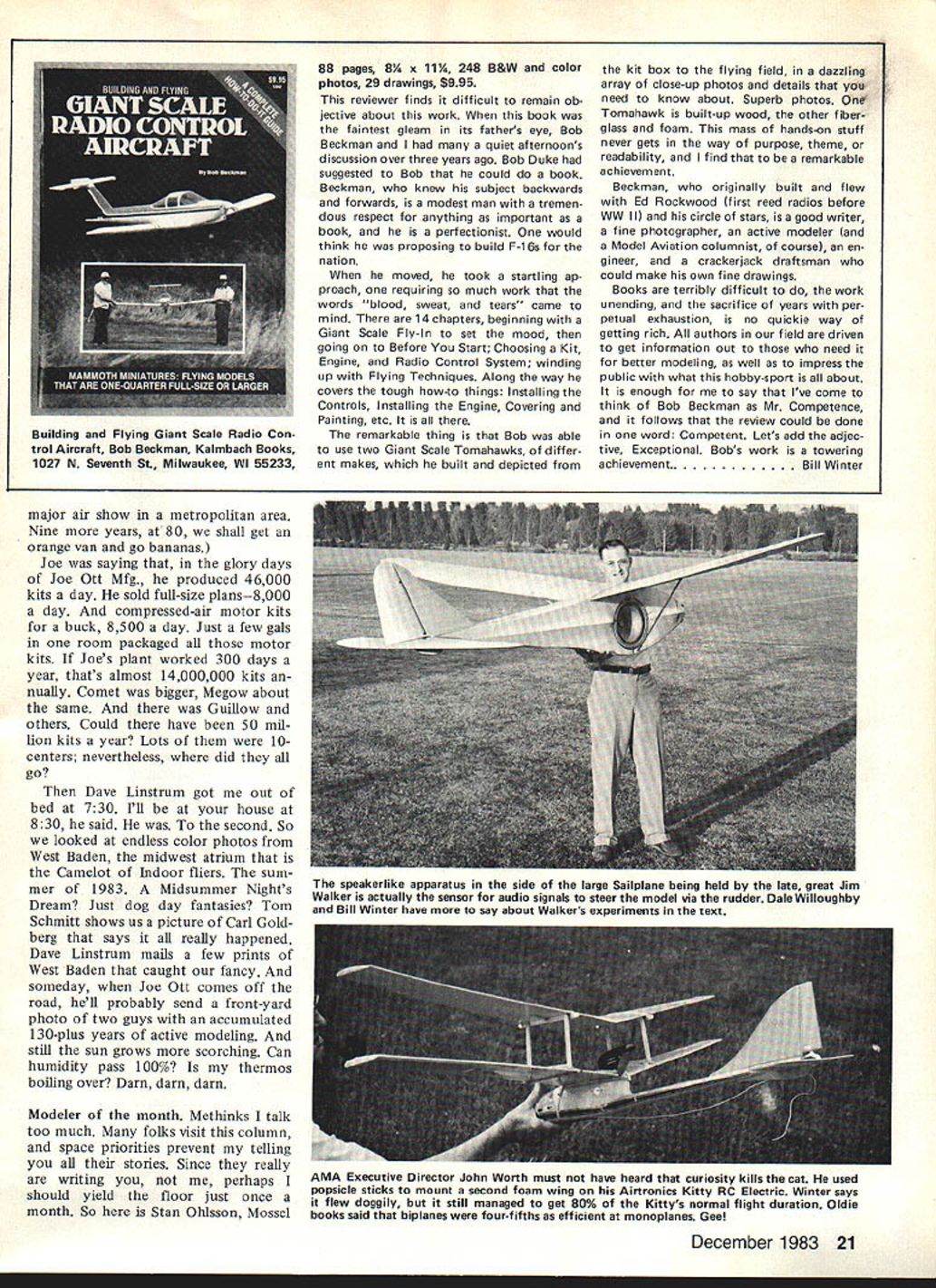
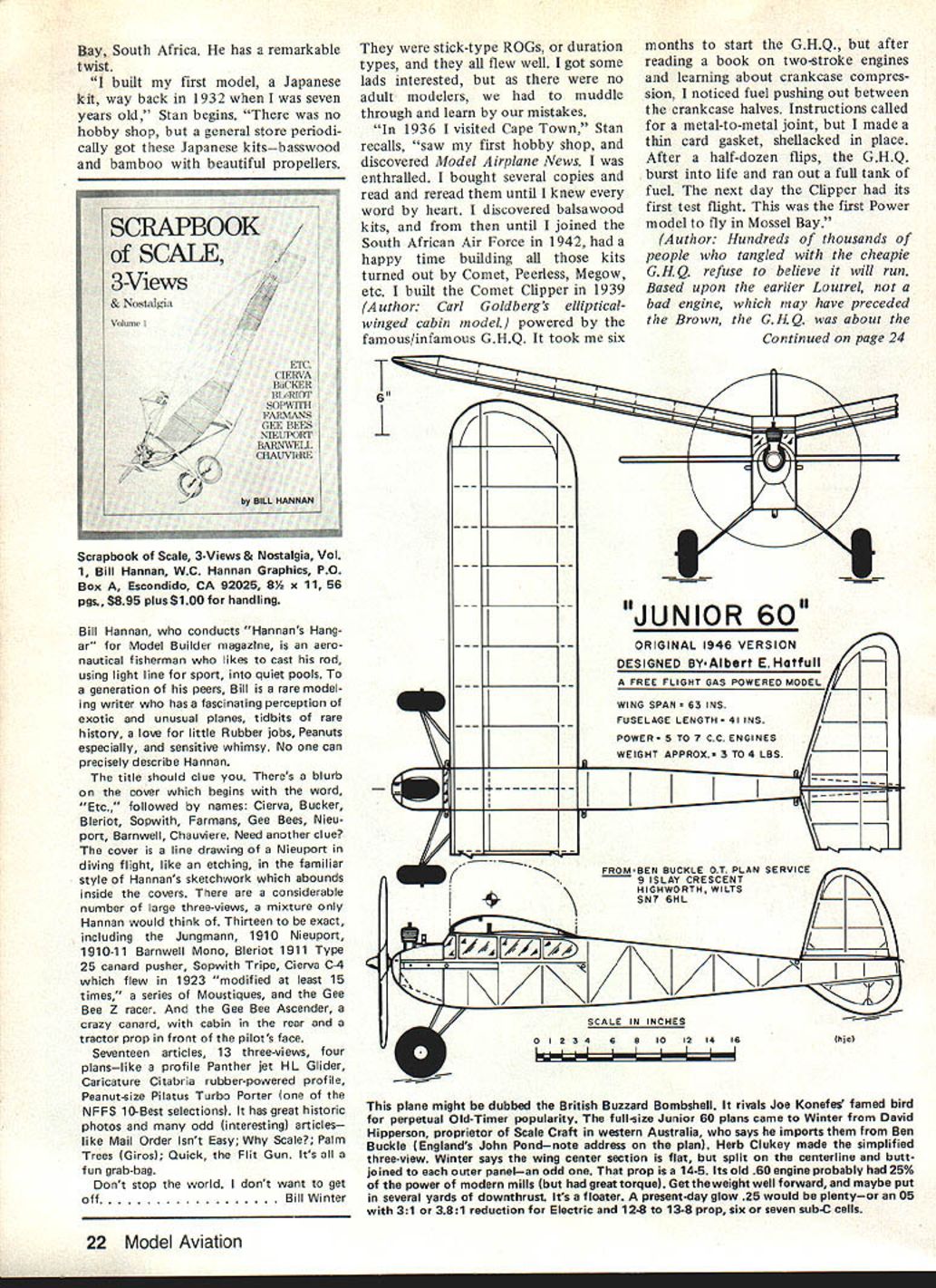
"Finally, the color photo should do your heart good. The plane was built by my friend, Pieter Breedt, from a full-size plan issued by Aeromodeller many years ago. It is powered with an Enya .10 and has been fitted with rudder, elevator, and engine controls. Last Sunday she made her first flights, and it is 'bloody marvelous.' The weight of the extra servos seems to make no difference, and she glides like a single-channel job. Loops, spins, and some perfect touch-and-goes. She is, of course, your Pal Joey."
(Author's note: In the early '60s, Aeromodeller commissioned me to do a full-size plan to be bound into the magazine's Christmas issue. For .049 and rudder, the thing was so simple that I've blocked it from memory. You'll note the picture shows a box without cabin or fake windshield, and straight open wing—just an escapement. Really, I was ashamed to take the money. Which goes to show you. The Cinderella box has been flown all over the globe, wherever Aeromodeller went. The plane was an eye-balled quickie, not even 'designed.' You can understand from this why I think that anyone can design his own models. It is senseless to be awed by some supposed geniuses. If you feel everything must be die-cut, shaped, and bent, you'll never know adventure, or the satisfaction of being able to say this is my airplane.)
Scale research and documentation
Model Research (P.O. Box 685, Orange, CA 92666) sends a sample of his work ($1.00, "Foto-Pack Listing"), 12 small-type pages containing many hundreds of aircraft of prime interest to scale modelers or aviation buffs. My sample photo pack shows intimate details in color of a historic antique plane in a French museum. Dale, a Marine Corps retiree who held two world records in RC sailplanes, went heavily into RC choppers and now also specializes in scale documentation, with agents in West Germany, Canada, Norway, Finland—and has established Scale Model Research in Tokyo with Titus Kikuchi, who is an AMA member. Dale also offers 115 scale three-views published by Koku-Fan, the historic giant Japanese mag. (The catalog is only 50 cents to AMA members.)
Bernard Klein (BCFK Publications, P.O. Box 128, Midland Park, NJ 07432) sends a review copy of a 20-page book titled Airplane 3-View Journal, $1.50 U.S. and Canada, $2.00 foreign. Each three-view presents two views on one page and another on the facing page with brief background info and stats; thus, the exterior-detailed drawings are fairly large. What appeals to me is the fact that there are a number of overlooked fighter subjects which would make great RC models—for example, the Polish P.Z.L. P.62, the Swedish SAAB 23, and the Swiss K & W C-3602 with fixed gear. Not an overwhelming book, but worth a look if you want good documentation for a plane that isn't duplicated by a zillion other guys.
Little rubber and plans
If you like little rubber-powered things, Dave Diels (P.O. Box 101, Woodville, OH 43489) sent a slew of cute plans and urges me to build a couple. Diels started with five plans three years ago and had over 30 as of last January. He was expecting to expand into printwood and molded canopies for popular subjects.
David Aronstein (50 Pasture Lane, Poughkeepsie, NY 12603) has 28 illustrated subjects on his plan listing: ultralights, racers, originals, various scales—real cute flukies, like an 8-inch Beercraft and a 12-inch Mini-Twin (an old-style twin-pusher), or a Roland trimotor for Peanut. Drawings will seem rudimentary to RC kit builders, but builders of free-flight rubber scale get inspired by basic lines.
Fran Ptaszkiewicz (23 Marlee Dr., Tonawanda, NY 14150) has listings of deBolt kit plans that he can offer—separate lists for Radio Control, Control Line, and Free Flight. Hal deBolt was world-class in all these areas. DMECO produced many great subjects, from the RC 1/4 Kitten to the 1963 World Champion Perigree and back to the Live Wire Jr., which I think was the first-ever RC kit. Send a SASE for each separate list—RC, CL, or FF.
Electrics, controllers, and gear
I don't know who is doing the tricking or the treating, but hang on. I have mentioned Jim Walker's sound-controlled airplane in the past. The crate had a speaker-like drum on its side. Jim called to it in dulcet and strident tones in all octaves of a Wagnerian voice. Although he managed to chase an occasional inquisitive sea gull, he found the model's fabric covering had to be loose or else the drumming of the covering caused serious glitching. Dale witnessed Jim's failure. Although I saw one photo of Jim shouting through a giant megaphone as the ship flew overhead, Dale says the rudder-only servo only came right whenever the French bicycle horn sounded, either fast or slow, and neutralized when no sound was heard. "He could only fly a right-hand pattern, but not in a cow pasture where the mooing of cows and the bellowing of bulls also made a change in direction."
I can also tell you about the night that Jim, loaded down with a drum, horns, whistles, and a revolver, tested responses as he walked down the street. When he fired the gun, the police arrived, and the helpful officer actually joined in the fireworks—his gun was louder!
Joe Utasi (Jomar), the chap who had the recent how-to for making your own proportional electric motor speed controller, has a second-generation controller called the SC-2. In response to my question about controlling a Keller 25, he supplied a test sample. Size is 2.3 x 1.5 in., weight is 30 grams, and it offers two extra control outputs via user-supplied relays—one to bypass the unit (zero power loss) if desired, the other for whatever, such as a braking resistor—great for use with folders and to stop windmilling. It has four, instead of three, MOSFET transistors with a resistance in parallel of less than .025 ohms—25% better than the SC-1. It will handle 40 amps at 35 volts—equal to about .8 hp.
Bob Boucher of Astro Flight has compiled a highly workmanlike set of proposed competition rules (two fine-print pages). He feels my printing the rules in this column would be a major service. I agree, but ’tis impossible. His proposed rules certainly provide a much-needed launch platform for a rules committee to come up with something that will curtail an increasingly maddening situation. I know our AMA president, John Grigg, has been researching this stuff and is flying high-performance, competition-type electric-powered gliders. If we don't get off our duffs, we'll have an electronic Tower of Babel, confused by manufacturers who are going daft in the vacuum.
Incidentally, I have Astro's new AC/DC charger, a marvelous piece of equipment, and I am impressed by the excellent instructions (a course in the art of charging). Astro has been "off line" for a year due to heavy government contracts, including servos with over 30 lb. force. Bob put $100,000 into machinery, went to night school to become a machinist, and hired fellow students. He is now poised with a flood of upcoming items. When he completes the much-needed, easy-to-understand instructions for all of this stuff, maybe we'll have, at long last, a central source of information. There is no such animal right now.
Clear basswood for giant-scale models? Over a year ago, I received a Xeroxed longhand list of sizes and prices from George McGinnis, 144 Murray Ave., Goshen, NY 10924. He listed everything from 1/8 sq. up to 1 x 3/4 in., in 3-, 4-, 5-, and 6-ft. lengths. I have a bundle—smooth-cut, clear-grained stuff. If you first deal with "unknowns," you may want to make a first order of moderate size; if you like the service, then go for the fences. George cuts special sizes; I imagine he'll send you a list for zilch (but send a SASE with requests).
Ed Rogala of Midwest Products checked in with info on new woods. At better dealers you can find an open stock of 6-ft. spruce—1/4 sq., 3/8 sq., 1/4 x 1/4—for spars and longerons for giant scale. Also 3 and 6 mm Lite-Ply (about 1/8 and 1/4 in.) in 6 x 12, 12 x 24, and 12 x 48. Lite-Ply is being used more and more and, in many cases, can be substituted for aircraft ply with great weight savings. I find that I can use Lite-Ply exclusively in my electrics, for big-holed key bulkheads. Other suppliers sell Lite-Ply as well.
Should you fuse your electric? Experts say no if you have three (not two) servos for quick shut-off ability. When Don Srull, Hurst Bowers, and I started in electrics, we burned up both batteries and motors. Stupid, of course, but anything new is strange. I still play it safe with a fuse. There was a big argument in the SEAM Newsletter over fuse/no fuse, and a fuse proponent actually stated that the fuse pops in 1,000,000th of a second. I get my flag-type fuses and holders from Radio Shack, but now Bill Doyle, 1929 Oliver St., No. A, San Diego, CA 92109, offers a right-angled blade-type fuse kit for $2.50, plus 50 cents postage. You get a 20-amp flat fuse, two fuse connectors, solder, and instructions. Mine looks good. Biggest dimension is 1-1/4 in., weight about four grams with soldering. As one hacker to another, let me tell you that burning up a motor and battery pack in a few seconds is traumatic.
By now, Doyle expected to have a Two-Meter Sportsman Class electric sailplane, the EX-Cel 05, at 37 oz. and 625 squares, for the Leisure 05 system. He said "plans in the works," so maybe it's just plans.
Resources and contacts (summary)
- Model Research, P.O. Box 685, Orange, CA 92666 — Foto-Pack Listing, $1.00.
- Bernard Klein (BCFK Publications), P.O. Box 128, Midland Park, NJ 07432 — Airplane 3-View Journal.
- Dave Diels, P.O. Box 101, Woodville, OH 43489 — rubber-powered plans and related items.
- David Aronstein, 50 Pasture Lane, Poughkeepsie, NY 12603 — small-plan listings.
- Fran Ptaszkiewicz, 23 Marlee Dr., Tonawanda, NY 14150 — deBolt kit plan lists.
- George McGinnis, 144 Murray Ave., Goshen, NY 10924 — clear basswood special sizes.
- Bill Doyle, 1929 Oliver St., No. A, San Diego, CA 92109 — right-angled blade-type fuse kit.
Final thoughts
Do you RC vets remember the DMECO (deBolt) Rebel? I think it is the best by far of any rudder-only cabin models that Hal deBolt achieved—easily adaptable to today's multi-controls. Nice looking, right on, just perfection. Present thought is of a scaled-up version for a 4-cycle engine (or maybe a lightweight upscale for my Astro 15 belt-reduction electric motor—with a 12-8 or 13-8 prop). I just got an original Rebel kit plan! The last one.
And so the summer trudges on—warm, sticky, full of memories, visits, and small marvels. Keep building, flying, and telling your stories.
Transcribed from original scans by AI. Minor OCR errors may remain.

