

Just for the Fun of It
Bill Winter
Documentation and Scale Modeling
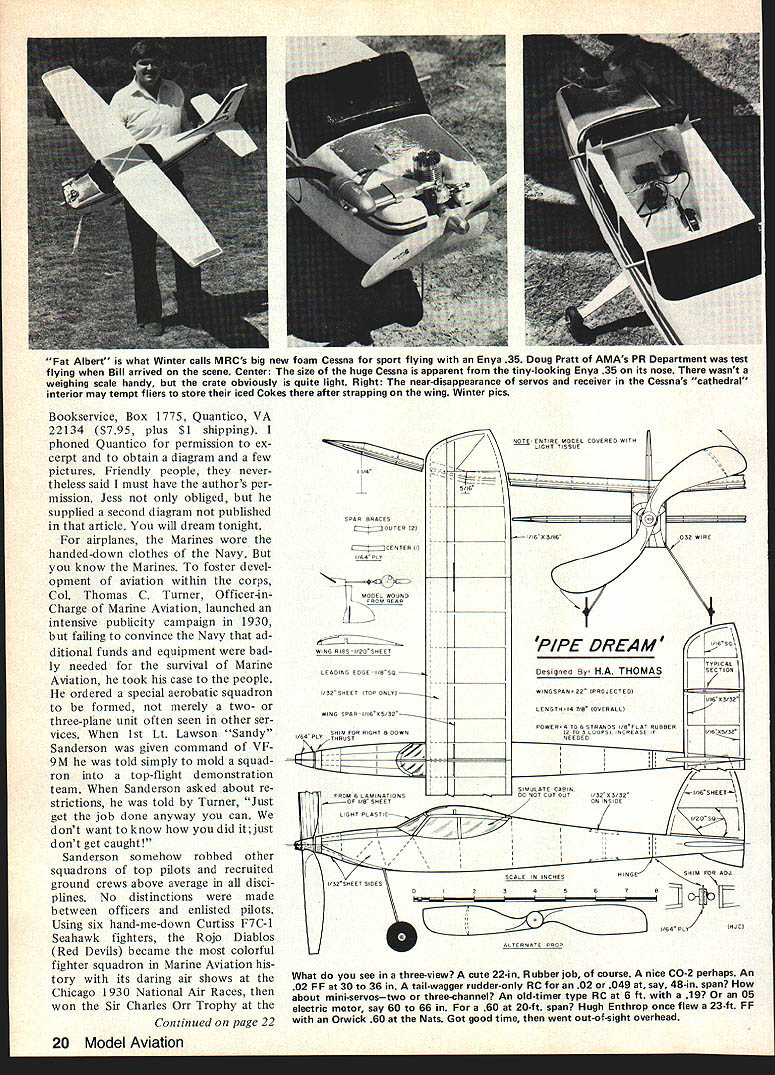
Documentation is a painful chore for folks who enter Scale events. I wonder if you share that view. In simpler days, I built a few hundred so-called Scale jobs, almost all rubber-powered.
My research was limited to stumbling over some three-view that caught my fancy. Photos just stirred the juices. I did not bother with details or authentic markings.
Many people have libraries of airplane books, drawings, articles, and photos. Documentation sounds dull. Some have a love for everything that ever flew, and the older the subject, the greater the fascination.
Fascination. Collecting data transcends research. It becomes a hobby in itself. The stories of planes, their designers and pilots in times past, of wars and exploits, glory and tragedy, are the substances of dreams.
Giant Scalers focus on some favorite to fly with breathtaking realism. Rubber Scalers have rare sensitivity for things they build, and because building time is so short, they gambol in a field of flowers, bringing to life again the mystique of subjects no one else would build. Each model, in turn, is treasured, especially when it flies well enough to conjure up visions. These guys are the happiest of all, uniquely sharing and taking pride in whatever others do. For them, life is beautiful. Interest in something no other has built becomes a long, long trail.
It may go like this. I have occasionally mentioned my fascination for the Boeing 100, a civilian version of the Boeing P-12 biplane fighter circa 1930, much like the colorful F4B-4 fighter that flew off carriers. The 100 was a premier aerobatic steed for men like Paul Mantz and Milo Burcham. Mail trickled in. A West Coast reader sent a copy of Leatherneck, May 1982 (magazine of the Marine Corps). From another reader came a book by Aero Publishers—Boeing P-12 and F4B, loaded with pix from factory floor to flight, and some full-color schemes. One picture shows a Model 100 rebuilt to resemble a Curtiss Helldiver for the movie Task Force (1947). It's two-place, has the same swept-back top wing and a Curtiss-like vertical tail. If you wanted a one-of-a-kind, this is it, and wouldn't you drive the judges mad? And vice versa.
On the cover of Leatherneck was a trio of F4Bs in a dive, but the colors were strangely different—unique markings used by early Marine Corps air-show teams. Inside was a sensational six-page article with illustrations of Marine Fighting Squadron Nine-M—by Jess C. Barrow. Pappy Boyington, the WWII Southwest Pacific ace, was a member as an Aviation Cadet. The article is an excerpt from Barrow's book of the same title, published in 1981 by Tab Books—available from the Marine Corps Association, Bookservice, Box 1775, Quantico, VA 22134 ($7.95, plus $1 shipping). I thanked Quantico for permission to excerpt and to obtain a diagram and a few pictures. Friendly people, they nevertheless said I must have the author's permission. Jess not only obliged, he supplied a second diagram not published in that article. You will dream tonight.
For airplanes, the Marines wore the handed-down clothes of the Navy. But you know the Marines. To foster development of aviation within the corps, Col. Thomas C. Turner, Officer-in-Charge of Marine Aviation, launched an intensive publicity campaign in 1930. Failing to convince the Navy that additional funds and equipment were badly needed for the survival of Marine Aviation, he took his case to the people. He ordered a special aerobatic squadron to be formed, not merely a two- or three-plane unit often seen in other services. When Lt. Lawson "Sandy" Sanderson was given command of VF-9M he was told simply to mold a squadron into a top-flight demonstration team. When Sanderson asked about restrictions, he was told by Turner, "Just get the job done anyway you can. We don't want to know how you did it; just don't get caught!"
Sanderson somehow robbed other squadrons of top pilots and recruited ground crews above average in all disciplines. No distinctions were made between officers and enlisted pilots. Using six hand-me-down Curtiss F7C-1 Seahawk fighters, the Rojo Diablos (Red Devils) became the most colorful fighter squadron in Marine Aviation history with its daring air shows at the Chicago 1930 National Air Races, then winning the Sir Charles Orr Trophy at the Miami All-American Air Maneuvers. In 1931, at the Cleveland National Air Races, flying nine F7C-1s, the first public appearance of the "Squirrel Cage" prompted papers to describe the squadron as "The greatest exhibition squadron in the world." Washington knew it had a good thing in Nine-M, and in 1932 and 1933 allocated 28 of the prize Boeings to the Marines who, wouldn't you guess it, assigned all to Nine-M. Sanderson latched onto a full 18-plane squadron. On July 5, 1934 Capt. Ford Rogers, a friend of Sanderson, took over the baton. For weeks, the team practiced every day, sometimes three sessions. They flew so close that they occasionally bumped in flight.
VF-9M and the Squirrel Cage
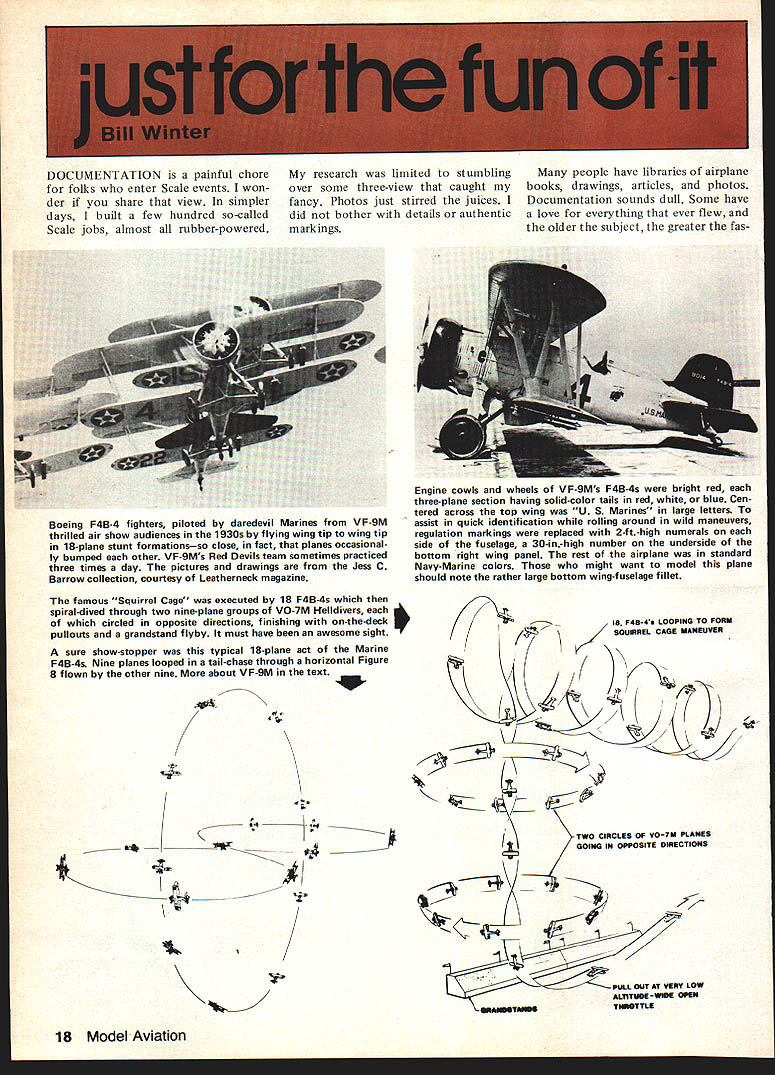
The famous "Squirrel Cage" was executed by 18 F4B-4s which then spiral-dived through two nine-plane groups of VO-7M Helldivers, each of which circled in opposite directions, finishing with on-the-deck pullouts and a grandstand flyby. It must have been an awesome sight.
A sure show-stopper was this typical 18-plane act of the Marine F4B-4s. Nine planes looped in a tail-chase through a horizontal Figure 8 flown by the other nine.
The greatest shoot-out came at the Cleveland Races in 1934. The Army Air Corps had its famed 27th Pursuit Squadron from Selfridge Field flying the new low-wing Boeing P-26As. The Navy brought its renowned Felix the Cat Squadron, which was based on the carrier Saratoga. VF-9M was granted permission to use Helldivers "to assist" at the show. ("Pursuits" of that era could be tossed around in tight quarters like you wouldn't believe.) The Air Corps and Navy put on flawless tactical shows before a sell-out crowd. The VF-9M show, on the other hand, was based upon doing the impossible with 18 airplanes.
The 18 F4B-4s took off in close formation. "Our routine after takeoff consisted of one or two low passes in a demonstration of close formation," Barrow quotes Major General A. W. Kreiser, leader of the second division. "... then, breaking into two nine-plane divisions, we performed intersecting loops, loops through a figure-8, dive bombing with miniature bombs that gave off a loud bang and lots of smoke, and ended with our grand finale, the Squirrel Cage. We landed in formation ... quite a chore with 18 airplanes."
What about those Helldivers? In Barrow's drawings you'll note 18 F4B-4s looping in a tail chase (the Squirrel Cage), obliquely to the left. On the downside of the last loop, each fighter, in succession, went into a vertical rolling dive, passing through two nine-plane layers of Helldivers, each layer circling in opposite directions. Pullouts in front of the stands were virtually on the ground with wide-open throttle. In another drawing, nine F4B-4s are looping through a horizontal eight comprised of the other nine F4B-4s.
In 1935, "Tex" Rogers' squadron performed at 20 air shows in the U.S. and Canada, flying the open-cockpit fighters cross-country in all kinds of weather. Unlike today's teams, Nine-M was required to carry a full military load in all Navy-Marine war games. In 1936 they stood Number One in the entire Naval Service, winning both bombing and gunnery trophies. Marine Aviation was now firmly established within the Navy Bureau of Aeronautics as a separate division and welcomed aboard carriers as equals. No more hand-me-downs. But in 1937, there was pressure within the Navy for the Marines to back off the promotion of its aviation branch. "To the surprise of all," Barrow recalls, "Rear Admiral Ernest J. King, Chief of the Navy's Bureau of Aeronautics, let it be known that he admired anyone who seized the initiative with gusto as the Marines had, and suggested that anyone so inclined to think otherwise should tend to his own knitting."
Scale research has wheels within wheels. When I read a later letter from Barrow, my hair stood on end. Twice in past columns I had mentioned seeing the most incredible aerobatics when passing Teterboro, N.J., in 1933. Traffic was snarled for miles on a weekday. Joining crowds of people who had deserted their cars, I saw this tiny biplane twisting and turning like a leaf in the wind. The free-style aerobatics were strung together like machine-gun fire. Stunts came in bursts. The next day I went back, hoping to find the mysterious airplane. It was there! A Curtiss Seahawk with the Semper Fidelis emblem on its side. The graceful little machine was configured like a Helldiver, with a straight bottom wing and a swept-back top wing—also like the Great Lakes, beloved by generations of modelers. Alas, I forgot the pilot's name. For 50 years I wondered about this phantom pilot. Barrow told me it was "Sandy" Sanderson, the man who molded Marine Fighting Squadron Nine-M into history's greatest air show demonstration team, and considered the greatest pilot to come out of the Marines.
When I mentioned this to Norm Rosenstock, he sent me two pages of Wylam drawings from MAN, which appeared in that mag's book The Best of Wylam, and a marvelous side-view picture. Since I had selected the contents for that book I knew Wylam volumes. I was a bit shaken up. The Seahawk is a worthy antagonist for any Great Lakes or Fitts model. You can still obtain Wylam plans. Unlike the classic Army Hawks, with their tapered wings and bulldog noses, the Seahawk had a 450-hp P&W Wasp with a bayonet stack, or a Townend ring if that pleases you. The Seahawk was designed in 1926 for battleship/carrier service, but was rejected as a tad slower than the F4B-4, which it anticipated by a few years. Rejected for sea duty, it was handed down to the Marines, where it began the meteoric career of Nine-M. Many of its features were continued in later Navy craft, and it was the prototype of the stretched Helldiver. If the Boeing had the edge on the Hawk, the Seahawk is a far better aerobatic model than either the Hawk or the Boeing. There is aerobatic magic in that swept-wing—remember the Great Lakes, Pitts, Jungmeister, et al.—and less of a CG problem.
Recent Flying and Power Systems
In the last "Only mad dogs and Englishmen go out in the midday sun" column, I told you about my spoiler caper with power on a 6-ft Krackerjack. There have been fixes and mods, and if you can hold your breath, an article is coming down the pike. I also flew again that rubber ducky, and I still can't handle its sensitive ailerons. Lucky to get down in one piece—yet again! This bird, like numerous cabin kits, has the aileron arms cocked forward (remember, high wing). Too many designs do this. Usually, there is a bulkhead in the way. What it gives you is aileron differential—more down than up. That's backwards. If you spot that in your kit, change it. I obtained some differential servo wheels for my Expert, and by putting the servo connectors far forward of the servo shaft line, I now have more up than down, and less travel. I hope to use this thing for approach practice.
Out of curiosity, and to lengthen the life of a faithful six-year-old K&B-Veco .19 in my RC-assist Vagabond, I gave the mill the POWER+ treatment. That .19 now is quite angry. Happy days! I joined John Worth in a local park electric session one cool evening—that's when flight times are highest. Airplanes love thick, cool air. The last time I saw him, John had two Kitty wings (a biplane) on that Airtronics RTF bird. This time he had a Sportavia wing on the little crate, and let me tell you, a Sportavia/Kitty is a high-climbing, perpetual-gliding, steady machine. When will we ever learn?
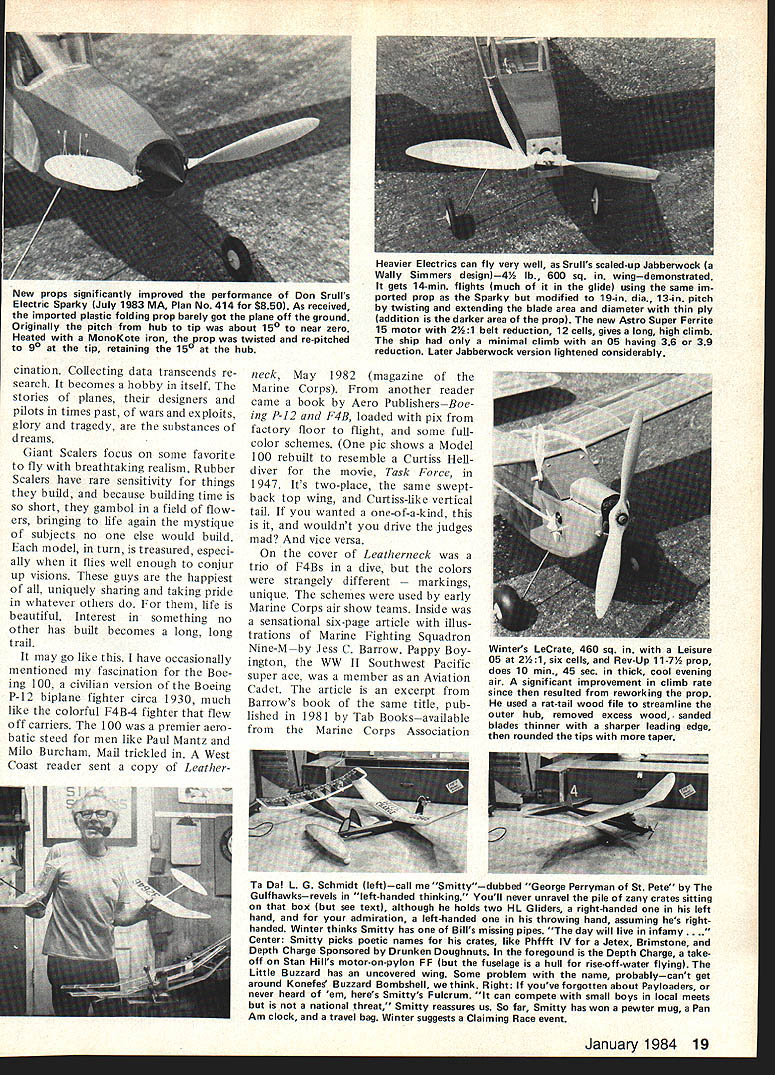
And there was a four-crate most-of-the-day session with Don Srull at Shangri-la. Four electrics: Sparky, my son Mike's lead-sled modified Midwest Champion, Don's new big Jabberwock (a Simmers rubber job scaled up), and my LeCrate. At 1 o'clock there was lift all over, and occasional local thermalling areas as well. Don had the Sparky rigged on seven cells with his own large gear reduction (for the .05) and a modified 15-15 folder using a twisted Carrera for a spine. Two quick 13-min. flights and it came down. Climb now aggressive.
They say that 35 to 45 oz. is the range for an .05, but Mike's Champ, after I dug out six more ounces, still weighed a monstrous 51 oz. With 3.8:1 reduction on seven cells (.05) and an 11-7 prop, it did 13 min. How about that? You can lighten any suitable-area gas kit and fly it on electric. The new Jabberwock is big and heavy at 72 oz., but it glides like a ghost. Climb on the geared .05 was a bit too slow—more anon.
I put my LeCrate up for 30 min., and we almost tore it up trying to get it down. Dives, spirals, stalls—everything mixed, using power as well, all over the area. It survived. The amazing thing is that, when it comes out of a thermal, it glides straight (all but once upwind), then it fades gently to either left or right to get closer to a thermal. Upon finding the thermal, it tightens up to go round and round, and up and up. Strange, but an unexpected blessing.
So Don switched his Jabberwock to my new Astro Super Ferrite 15 with belt reduction and 12 sub-C cells. The Jabberwock now goes through the roof. It spans almost 6 ft. In the cool of evening with that big pack, the glide is forever. With an 8-min. run, it did 14 min. at sundown.
I am not about to go all-electric, though tempted. I have too much fun trying to live up to my crazy .40 Kadet and flying things like the Krackerjack and 6-ft. Vagabond R/C-assist, and riding thermals which are a dime a dozen. I know I enjoy LeCrate more than the Vagabond. The reason is the challenge of Limited Available Energy—the conservation thereof. My K&B will idle over 20 min. on 4 oz., so finding thermals (then killing the power) is like shooting ducks in a rain barrel. On LeCrate, I know I have 5 to 6 min. of power to get very high for thermal hunting. It's just great to get a payoff with a long soaring flight. You get that in rubber, too, especially Scale, where your energy is good for maybe 30 sec. to a minute or so. And those rubber flights are absolutely beautiful and seem far longer than they really are.
Charging Tips
I'd like to modify charging info I passed on earlier. Until lately I have been peak-charging, using either a digital readout charger or voltmeter. You charge until the peak is observed; when a drop appears, shut it off. On a six-cell Sanyo pack, this is about 10.60 volts. On Bob Boucher's (Astro) advice, I've cut that out. If you flight-drain too far, you can end up with uneven cells, and peaking repeatedly without leveling off the cells begins to damage them. If the battery sits, the same thing is true. On Rob's advice, I trickle-charge (Astro's AC/DC charger is handy, since it allows an adjustable trickle for long periods to level off the cells). You can trickle, too, with the Leisure digital charger. I do this the night before flying. Bob claimed that any charge of 1.4 to 1.6 volts per cell is plenty good. That's 9.6 volts on six cells. You can get this on one cycle of the charger; you don't have to reset or monitor, leaving you free to fly. Spare packs help, too. I can't observe a difference in flight time, so peaking probably is a competition thing. In fact, most flights happened to occur with more moderate charging—and this way spare packs make things easier.
From "Smitty" Schmidt
'Smitty' Schmidt of St. Petersburg, FL writes: Judging by mail from my area, we have more than oranges and grapefruit.
"It is about time I pestered you again with a little more left-handed thinking," Smitty announces. "I enclose a couple of pictures. One shows the old boy with some of his Jetex efforts. That jumble on top of the box is 'Phffft IV,' a heavy-weight with good penetration, sporting a fiberglass fishpole fuselage. Atop that are two of the design that I call the 'Sirocco' which are very light and consistently good performers. They are yet uncovered, having just been completed to replace one which had the bad judgment to land on a highway. The small job in my right hand is named Brimstone. It has more angles than a jailhouse lawyer, and it was probably hatched just to prove to myself that I am not a design rut. For offerings such as this, the boys in our local club, The Gulfhawks, have dubbed me George Perryman of St. Pete. I don't object to this. They put me in some kind of company.
"While I do attend club meets from time to time," Smitty goes on, "I only go to an outside contest once every year or two. The collecting of hardware I leave in the capable hands of those who feel so inclined. I already have a Pan Am clock from a Payload model, a pewter mug from a Coupe d'Hiver, and an old trophy from one of my older Sirocco Jetex jobs. I also have an old flight bag from some long-forgotten deed in a field somewhere. This trophy is the one totally useless item. I have it in my darkroom where, with a bit of luck, I won't have to explain it.
"The other critter," Smitty revs up, "is the Depth Charge (sponsored by Drunken Doughnuts). I have no idea when Stan Hill started his VHT models. A friend told me of having seen one with the engine mounted on a forward fin. Since it seemed a good way to handle power, I developed mine independently from his. I had not eye-balled one at the time, so I started out with a fiberglass fishpole for a fuselage and keyed the plywood fin into slots.
"The hottest thing on the market in those days was the Space Bug, so I hung one on the front end. It wasn't until later that I found Hill and Ozzie Czeppa mounted their wings underneath, though I never figured out why. I had mine on a platform behind the fin and still do it that way. Oh, well, whatever makes your throes squeal, I reckon.
"About a year ago, one of our club members asked me how come mine went to the right. He informed me that VHT models should fly to the left (I don't know where some of these people get their information). At any rate, this ROW (surprise!) job is a little different in that it has a hull for a fuselage. At 400 squares, it had a Medallion .09. To keep it from leaping off the water, I replaced that with a Babe Bee. The result: a realistic 10- to 15-ft. takeoff. Tell ya how ignorant I was—and still am—I called my designs UHT for Ultra High Thrust, never knowing that the rest of the world spoke of them as VHT.
"Just finished a magic black box," says Smitty, "to help out old (censored) like me rig the wire bracing on indoor models. It is completely adjustable and only measures 6 x 7 x 26, which solves the portability problem. Although small, it opens out to create a black hole which makes inch-thick iron wire stand out like a silver dollar in a mud puddle, and it'll hold any size wing in any position. I am as proud as a dog with two tails."
Closing Thoughts
Speaking of two-tailed dogs: if a Bellanca fuselage profile is a lifting airfoil—and many others, too—isn't a deep-bellied fuselage an inverted airfoil, and (if so) what do we lose?
Bill Winter 4426 Altura Ct., Fairfax, VA 22030
When writing advertisers, mention that you read about them in Model Aviation.
Transcribed from original scans by AI. Minor OCR errors may remain.

