
Just for the Fun of It
Bill Winter
Low-Wing Free Flights
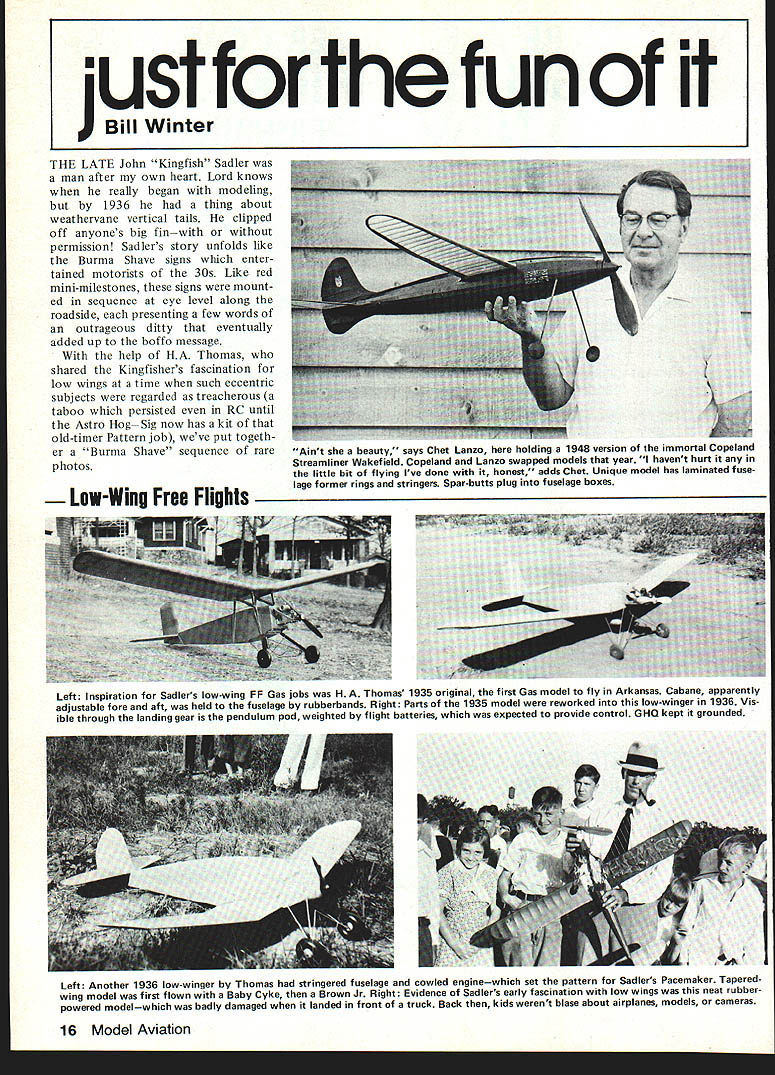
The late John "Kingfish" Sadler was a man after my own heart. Lord knows when he really began with modeling, but by 1936 he had a thing about weathervane vertical tails. He clipped off anyone's big fin — with or without permission! Sadler's story unfolds like the Burma Shave signs which entertained motorists of the '30s. Like red mini-milestones, these signs were mounted in sequence at eye level along the roadside, each presenting a few words of an outrageous ditty that eventually added up to the boffo message.
With the help of H. A. Thomas, who shared the Kingfish's fascination for low wings at a time when such eccentric subjects were regarded as treacherous (a taboo which persisted even in RC until the Astro Hog — Sig now has a kit of that old-timer Pattern job), we've put together a "Burma Shave" sequence of rare photos.
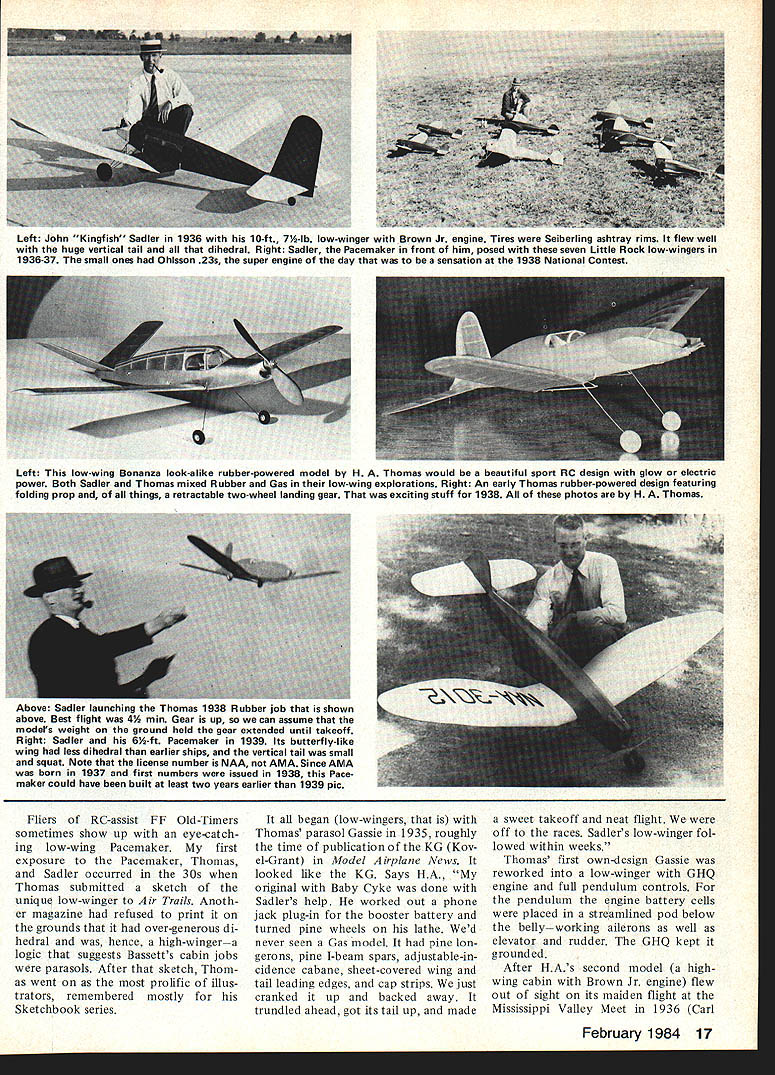
Fliers of RC-assist Free Flight Old-Timers sometimes show up with an eye-catching low-wing Pacemaker. My first exposure to the Pacemaker, Thomas, and Sadler occurred in the '30s when Thomas submitted a sketch of the unique low-winger to Air Trails. Another magazine had refused to print it on the grounds that it had over-generous dihedral and was, hence, a high-winger — a logic that suggests Bassett's cabin jobs were parasols. After that sketch, Thomas went on as the most prolific of illustrators, remembered mostly for his Sketchbook series.
It all began (low-wingers, that is) with Thomas's parasol Gassie in 1935, roughly the time of publication of the KG (Kovel-Grant) in Model Airplane News. It looked like the KG. Says H.A., "My original with a Baby Cyclone was done with Sadler's help. He worked out a phone-jack plug-in for the booster battery and turned pine wheels on his lathe. We'd never seen a Gas model. I had pine longerons, pine I-beam spars, adjustable-incidence cabane, sheet-covered wing and tail leading edges, and cap strips. We just cranked it up and backed away. It trundled ahead, got its tail up, and made a sweet takeoff and neat flight. We were off to the races. Sadler's low-winger followed within weeks."
Thomas's first own-design Gassie was reworked into a low-winger with a GHQ engine and full pendulum controls. For the pendulum the engine battery cells were placed in a streamlined pod below the belly—working ailerons as well as elevator and rudder. The GHQ kept it grounded.
At the Mississippi Valley Meet in 1936, H.A.'s second model (a high-wing cabin with a Brown Jr. engine) flew out of sight on its maiden flight. Goldberg, a spectator who hadn't built a Gas model yet, built the low-winger shown in one of the pictures. It had a tapered wing and a Baby Cyclone engine, later a Brown Jr. The stringered fuselage and cowl set the pattern for Sadler's Pacemaker. "I had a ball with this model," Thomas recalls fondly.
Sadler made a career of low-wingers. His 1934 Rubber job is shown in a photo taken after the model landed on a highway in front of a truck.
About 1936 Sadler produced his first 10-ft. low-wing Gassie. It had a Brown Jr., a hand-carved sycamore prop, and large Seiberling tires (from an ashtray) on turned pine hubs — a majestic flier at 7½ lb. The two-piece wing was joined at the center by cabinet hinges. As you learned from the Bassett articles, modelers of the day considered huge vertical tails a necessity. Many a Wakefield used half a stabilizer for the vertical — and that, obviously, provided those "ingenious" side-lifting sections on the vertical, which became part of the adjustment package. Sadler probably got away with that huge sail because of the monstrous dihedral. He soon wised up — and made his wrathful shears part of his tool kit.
Another photo shows the Kingfish with seven "Little Rock" low-wing Gassies, the smaller ones having Ohlsson .23s, the super engine of its time. The original Pacemaker is in front of John in the multi-plane picture. For a genuine thrill, consider Thomas's low-wing Rubber job that is pictured — it would look good, even today, as an RC with glow or electric power. These boys made Rubber a part of the low-wing development; note the picture of H.A.'s 1930s Rubber job with retracting landing gear and folding prop. The distinguished gent launching the ahead-of-its-time Rubber job is Sadler. The plane's best flight was 4½ minutes.
The final version of Sadler's Pacemaker, flown at the Nats, featured a highly successful "butterfly" planform with less severe dihedral and a small-area, squat vertical tail. Note the license number — NAA, not AMA. Since AMA was founded in 1937, this Pacemaker must have been built no later than 1937. Big, high tails play hob with spiral stability, especially on low-wingers and, in general, on craft with shallow dihedral. Early competition Gas models would spiral-dive to destruction almost as often as they made successful flights. Free Flight Gas events at the Nats of the day were demolition derbies, with shattered engine pieces from cabin jobs feeling like gravel on the contest runways. The only one that seems to have survived the carnage was Sadler's low-wing Pacemaker; it had been perfected. The Kingfish was quite a man.
Sitting with hands behind his head (see pic) is Luther Hux, the guy who made the Space Shuttles, those fabulous camera planes (one of his aerial shots is a National Geographic Society postcard), the parafoil, and the RC chute that can be guided back to the takeoff strip. Believe it or not, Luther is flying a model, controlling it with his toes!
You know about trainers. Anything that isn't a Pattern or Pylon model has been called a trainer. Finding the proper trainer for a raw beginner has proved more difficult than deciphering the Rosetta Stone. People argue that you must have airplanes to learn useful techniques — which may or may not be great, if you have an instructor who likes to do social work. Others say a trainer should be able to fly like a Free Flight for safety, and just be nudged gently while one learns about right and left and to fly straight. Some trainers are beyond any novice, and will shake up the liver bile of others who have already soloed happily. The truth is that trainers mostly are geared to achieving the next step up, whatever that happens to be, so some are powerful, fast-flying bombs. A beginner can, and usually does, bust anything. Luther's crate is one of a kind.
For example, on a mushing approach to an awkward landing, it can be gunned, hanging nose-high far down the wrong side of the power curve, and safely maneuvered in that mode around a 360 within the width of the mowed flight strip. It does touch-and-goes inside the strip perimeter.
I am as curious about strange things as a prairie dog. Over the phone, I got this rundown. Span is 48 in. Intended power is .09 to .20. But it was being tested with an O.S. .25 FSR — and that's a beaut! Weight is 3 lb. It's only for three channels. The secret is in the foam wing which is only film-covered (that's thin, low-temperature film applied with heat). It has an inset spar and wood leading and trailing edges. The leading edge is swept back. Since the wing is hot-wire-cut from foam, it was easy to give it a rather symmetrical root rib and a Clark Y tip. The tip is at zero, the root at 4°. He gets this washout because of the different locations of the leading edge at the root and tip — due to the airfoils used.
There is more. The leading edge is triangle stock, butted to the foam, the top edge 1/16 in. higher than the foam across the full span, permitting sanding to a smooth curve. Toward the tip, the wood falls increasingly below the foam; in rounding off this area, wood is progressively removed underneath during sanding toward the tip rib. When the center portion of the wing stalls, the aerodynamic center of the outer unstalled portion lies farther aft with respect to the C.G. because of the sweep. That's a stabilizing action, much like that found in many flying-wing aircraft. Of course, Luther's model still has the stabilizer at work. Foxy. Luther says it isn't a genuine primary trainer. It's a "next step" concept, offering good speed and more aerobatics than the usual three-channel primary trainer. Better in vertical maneuvers, too, with that .25. Luther says the mixture of go-fast stunt and go-slow-and-play keeps him from being bored.
Wonder how he coordinates controls with his toes.
Flying "circus"
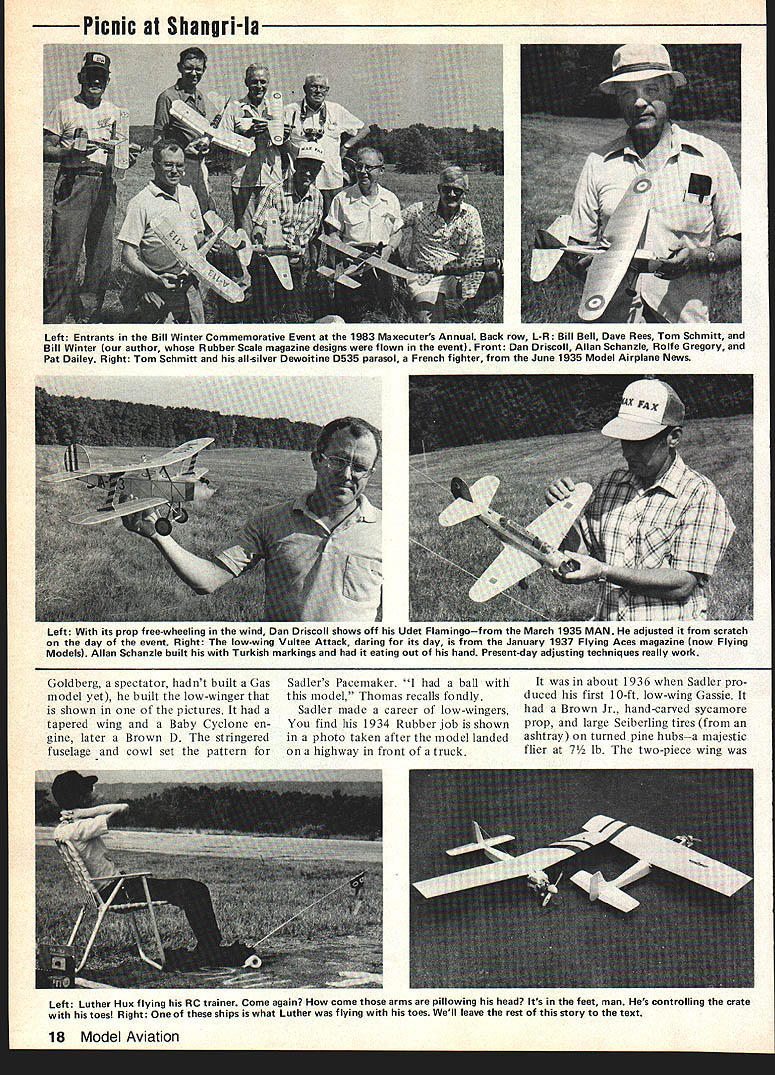
There are people who claim they leave their bodies at night to soar among the spheres, millions of light years away now less! (I am serious!) My "flying" this past month has been a perfect example of disembodied space travel. Shangri-La was a good beginning. The first time I laid eyes on the grassy hill in rural Maryland, it was a windless summer evening. A red-and-white balloon slowly arose in the distance just as a Concorde arrowed overhead. By sunset dozens of Rubber Scale jobs circled lazily like lightning bugs. These guys get more pleasure from models than any other fliers I know. I've since enjoyed this oasis of peace on many occasions, an idyllic spot for Rubber jobs, low-powered Old-Timers, soaring sailplanes, and electrics. It was there, in September, that I had the nicest experience in my 57 years of modeling.
The day was hot and windy, thermals good for 5 to 6 minutes. The angry thermal god, Hung, took a holiday. Strangely, none of the many Rubber Scale jobs — they were everywhere — drifted beyond a reasonable chase. This was world-class stuff, superbly built and flown, more of it than you find at a Nats. Under the cool shade of some convenient trees, I sat with the great Earl Stahl, taking in this three-ring flying circus and chatting about our shared magazine experiences of other days.
The event was the Maxecutters Annual. These guys have events which peak excitement and fun — like WW I, WW II, Golden Age, a combo speed-and-navigation thing, and much more. What makes it exciting is the mass launch by groups of five or six in eliminations — last-man-down stuff. You can't imagine how wild that gets.
In 1982 there was a commemorative event honoring Earl Stahl — which specified only his published models. It was my turn in 1983. I was awed by what I saw.
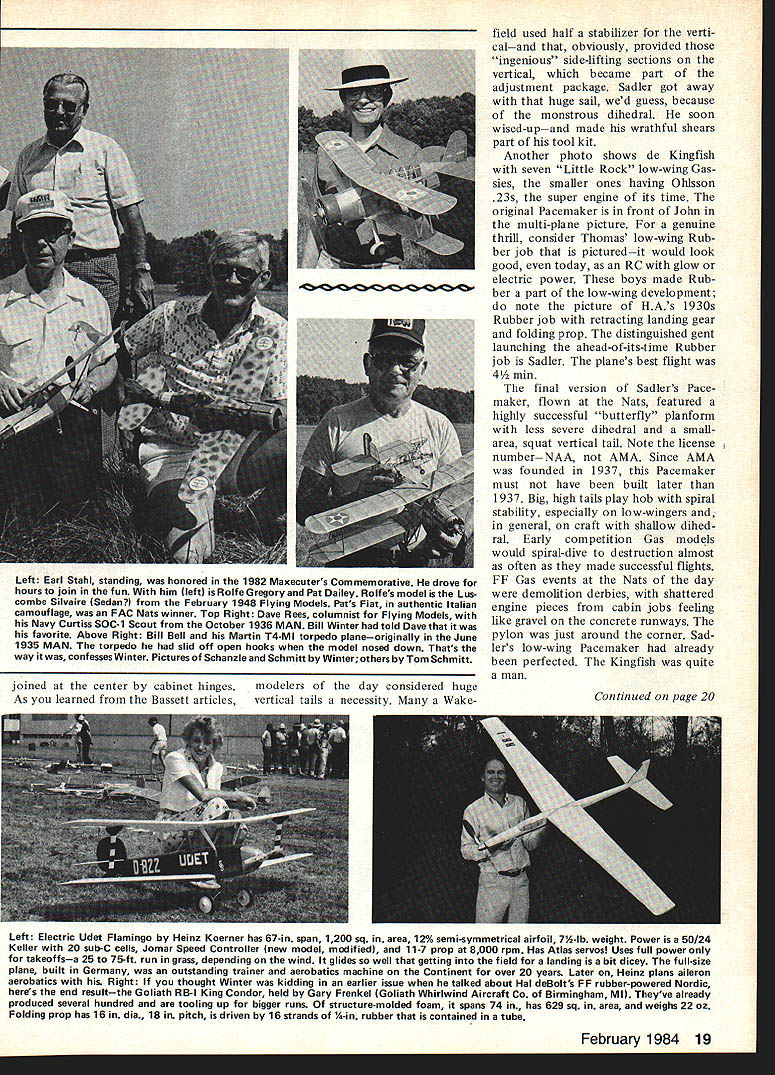
There was a Udet Flamingo, designed 51 years ago . . . a Great Lakes/Martin bomber that came a little later . . . planes from all periods of my life, done in various towns and states . . . before I had children . . . from when we were flat broke or riding the crest. No flier spoke to me about his (my) plane. They left Stahl and me to our daydreaming. Each plane was a work of art — far, far better than I had done. All markings were perfect, and all showed the builder's search for details that weren't shown on the plans. (I had 21 Rubber Scale jobs published.)
Every plane was perfectly adjusted and flown the same way, exhibiting performance I hadn't dreamed of. In the old days, one hand-glided his new design over the proverbial tall grass. Trimming was with nose weight, since the rubber motor then usually ran all the way to the rudder post. We added a few turns at a time until we saw the thing would fly. That was it. There was no tensioning of the rubber motor or any other of the tricky stuff that is part of today's skill. We knew little about flight adjustments. Motors were short and powerful — now, they are long and run more slowly with fewer strands.
When the simultaneous launch of the models (as seen in the pictures) took place, every airplane circled in a stable climb and gradually drifted, as in a swarm, down the field. This could not be! But it was. I know how hard these guys had to work to so perfectly trim these things. "I remember it well!" Days later I felt the impact of their silent statement.
Let me tell you about that distance/navigation thing. Two lengths of toilet paper were laid crosswise to mark the entry and exit of the course; on the far side, a paper cross marked the target for the navigation bit. Keep in mind that it was windy and that a large number of the planes had logged hundreds of perfect flights, always circling downwind. For this event they tried to fly them in a straight line. Hilarious. Two planes hit the trees behind us, well upwind. Only one managed to cross the finish line. All others came down in no-man's land. It was as if a flock of Thompson Trophy racers of prewar days had suffered engine failure short of the first pylon.
You know what? I'd like to see the Society of Antique Modelers (SAM) hold a commemorative event for Bassett or Goldberg Gassies — a sky full of Zippers, Miss Philadelphias, Sailplanes. Or maybe for planes flown at some long-ago Nats. That would combine Taibi Konfes (Buzzard Bombshell), Struck (New Ruler), and so on. And why not RC antiques and Old-Timers, such as circa 1950 Rudder Bugs and Foxworthy's Hootsies. Still later, such as DeBolt's Bipe and Bonner's Smog Hog. Still later, the low-wing Astro Hog by Fred Dunn. Maybe chop it off with the Astro Hog. In that melange are Beams, Live Wires, Esquires — a host of nice-flying aircraft, created by people who stuck to Radio Control through its trying years to give us what we've now taken for granted.
Ramblin'
This month I'd like you to meet Eldon Wilson of San Angelo, TX. "I'm 1,800 miles from home (Author: in San Jose, CA), working on a new experience, an electric typewriter — with my left arm in a cast and baby-sitting a nine-year-old while his mother has gone to Japan to visit my son, who just took over as CO of Navy VP-40, a P-3 outfit.
"I've competed for years, grew tired of RC Pattern, still do a lot of Scale, but mainly enjoy the association with fliers out for fun. For me, fun flying is an Old-Timer Miss America with a Super Cyke . . . (You should see the climbout and glide. Some of the younger guys liked what they saw.) Now, we climbed out in pairs and go for duration. I just wonder if our overgrown kids, who run things, ever stop to think that we start a new bunch of fliers about every five years and rediscover the wheel on that basis."
During his 30 years in the hobby business, Eldon constantly promoted modeling, so he is worth listening to. He brought a "bunch" of 20- to 30-year-old modelers all the way to the Massachusetts Nats and was dismayed that they were totally ignored. They departed depressed (despite the fact that this was one of the happiest Nats ever). One wonders if folks knew they were there or what, if any, contact was made. It does suggest that perhaps AMA needs an equivalent facility to the well-known Welcome Wagon. After all, modelers are spectators as well as competitors.
From the very beginning, have we ever thought about this golden opportunity to make people part of the act, to make them feel they belong, or to recognize their importance? For many of these far-traveled watchers, the Nats is a looked-forward-to tour, even though brief. But there are no tour guides.
"I enjoy watching what I call the fourth-generation RCers getting under way. It's now the '80s. We started RC in the '50s and seem to do a complete turn-around about every 10 years," Eldon goes on. "Just a few diehards hang on forever. I've enjoyed your write-ups on electrics, and am having a go at that. I've been through fly power, rubber power, tune it — anything that looks like fun.
"It is a shame, but where I live in West Texas we're a long way from hubs of activity . . . over 200 miles in any direction to the nearest city. I once was asked if there is anything in Texas less than 100 miles away. There certainly is. My front gate is 50 miles from the house. But before I retired from the hobby business, I pushed modeling heavily. I promoted and built a beautiful modeling park for all types of flying models. Secured some spillway land from the Corps of Engineers and, through city politics, got it improved with paving and Control Line circles."
Total land is about 200 acres and, best of all, just one mile from town. It is a truly busy place and open for public use.
To wander a bit, I've mentioned many planes I'd like to build, and my frustration is allayed by guys who then build them — like Koerner's electric-powered Little Old Flamingo in an accompanying photo. Heinz built that and a long-winged Connie with four electric motors. The Connie is a true bird, a sailplane compared with a DC-7, even with full-size ones. So back to Eldon Wilson.
"I was amused by your mention of the electric-powered Connie. I see it has been done, but the question is, 'Was it done right?' A friend, 'Little George' McIntyre, was chief pilot for Lockheed during the Connie series. During his later years on the Super Connie, he was referred to by P-80 jocks as 'granddad.'
"One day, a P-80 operator did an Immelmann turn on takeoff, and the younger guys went ape. (Author: The Blue Angels did that with Bearcats as part of their act — and close to the ground.) Well, George didn't see anything so hot about that and offered a wager of a month's pay to do the same thing with a Connie . . . It was done. George did retire, but at the insistence of the FAA (after 33 years, he said he was ready, anyway). Daredevil he was not. The wing loading and power were far less favorable on the P-80 than on a Super Connie empty — this guy would have you know. (Author: Don't ask me. I only live here.)
"When the Cuban Air Force bought a Vega and installed the radio loop on top, instead of under the nose as recommended, George went to Cuba, but could not convince them to move the loop. So he took a Vega up to 14,000 ft., killed the engines, rolled to inverted, and dead-sticked down 4,000 ft. to the loop on the bottom to demonstrate that it had to work. He rolled out, restarted, and landed . . . the general was convinced. Dead-stick for 10,000 ft. wasn't even mentionable, just normal in that part of the world. Little George is retired now, living in Del Rio. His last log book quit at 16,000 hours, but he still flies a Beech Baron. So when you build your Connie, learn what it will do, and thrill the crowd. (Author: I sure hope this doesn't scare the wits out of Heinz Koerner!)
"'I especially like all the strange types of models you picture,' says Eldon, getting back to what matters most. 'Strange is what I am. WWI and strange types. My latest is the Loening M-8 in Sport Scale. A 60- to 70-in. plane is easy to transport. My newest is a Wildcat. Fully functional . . . I enjoyed the retract system. Did all the good model checks, and it is a bird-on-a-string capable of doing a loop, a roll, and a snap.' (Author: The scheme is like the Confederate Air Force, which is VF-41 from the Ranger back in 1940 — green/gray body, yellow wings, and white bands on the cowl) — totally scratch from Nye three-views. (Nye plans are from MAN.) The Confederate club who flies the Wildcat (the full-size one) includes Gerald Martin of Hertford, TX — a very good flying buddy. He was in the Battle of Britain series and Baa Baa Black Sheep. My next project will be the obscure Dayton-Wright of 1918 or so, which had an early retract gear and the star round cowl. Still researching.
"'I leave you with the thought that 'Just for the Fun of It' is certainly the name of the game . . .'"
Now, as we were saying . . .
Notice
Would the contributor who sent the photos of Ray Arden's miniature historic engines please contact the editor.
Bill Winter 4426 Altura Ct. Fairfax, VA 22030
Transcribed from original scans by AI. Minor OCR errors may remain.

