
Just For the Fun of It
Bill Winter
I've made another epic decision. Having sworn to build a Joe Ott rubber SE-5 (Popular Aviation) from the late Twenties—plans from Bill Hannan out of Joe's own book—and having sworn never to make another quarter-scale monster, I am building a quarter-scale Piper Vagabond. I have met the devil, and I am his.
Radio and Controls
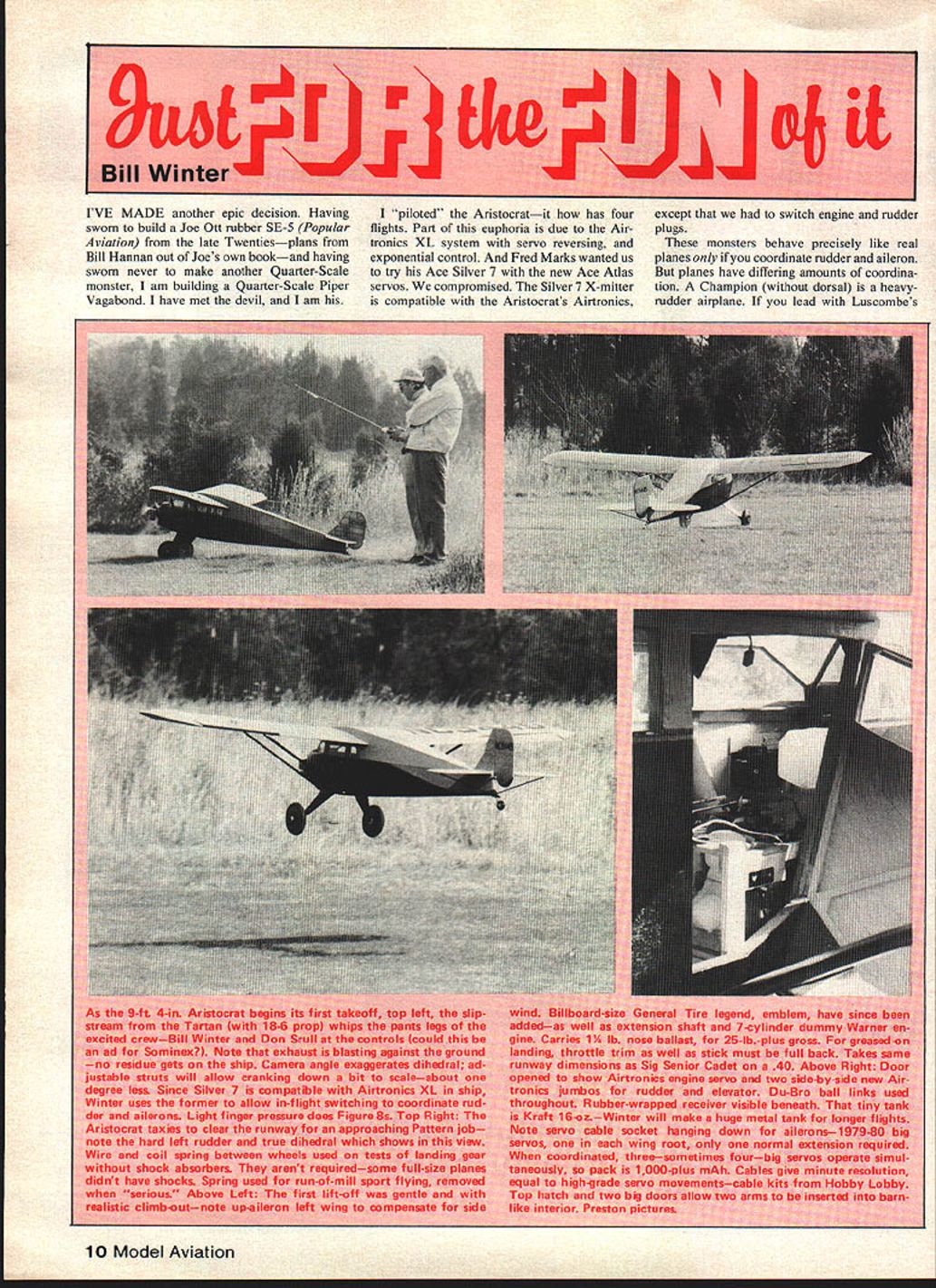
I "piloted" the Aristocrat—it has four flights. Part of this euphoria is due to the Airtronics XL system with servo reversing and exponential control. Fred Marks wanted us to try his Ace Silver 7 with the new Ace Atlas servos. We compromised. The Silver 7 transmitter is compatible with the Aristocrat's Airtronics, except that we had to switch engine and rudder plugs.
These monsters behave precisely like real planes only if you coordinate rudder and aileron. But planes have differing amounts of coordination. A Champion (without dorsal) is a heavy-rudder airplane. If you lead with Luscombe's aileron, you've got a problem timing the rudder.
Don Srull, the Mad Test Pilot, finds rudder-on-left-stick (Aristocrat) awkward because he flies scale with a Kraft single-stick. I could suggest the amount of rudder, and Fred would set up the combo with quick pot adjustments. You can adjust relative amounts of coordinated aileron and rudder throw—a mixer can be switched on and off in flight, so side and forward slips are possible.
The slightest finger pressure against the side of the stick produces a gentle turn. A figure‑8 is like falling off a log; gentle pressure on the other side of the stick produces the crossover. Ailerons are not sensitive, either!
Flight Impressions
A power stall hangs the big ship nose-high forever. Nose-high, you can walk rudder to keep heading, and you can still use aileron at the stall point, as on a Stinson 150. Once the wing dropped slightly, but picked itself up!
The Tartan with Top Flite 18 x 6 prop pulls this 25‑pounder off the ground like, say, a .40 Cadet, and climb-out is near scale speed for a Mustang. Every landing greases on—no shocks needed. Gear is rigid, with thin scale tires. One landing skimmed, then dropped on full stall. Get this: the real Vagabond (PA-15 version) had no shocks. Just doughnut tires. If a real plane needs no shocks, why do models?
We talk of lightplanes (mostly flapless) with a loading of 20 oz per sq. ft. (Aristocrat's). If the gear is not attached to concentrated stress points, it is adequate. Ours has two pieces of 3/16" wire (buried in cantilever struts) across the fuselage bottom with metal screw-on straps. The fuselage is 11" wide, so the bearing area is almost 1/2 sq. ft. So what can break?
Fast, heavy Pitts, etc., with those really big engines, may be something else—and fighters and racers. My 8‑ft. K&B .19‑powered soarer has excellent power performance. It weighs 5 lbs. plus. Suppose we hung on a 6‑pound engine. How heavy would that plane have to be to stay together? Structure could climb at least another 12 pounds—gross near 20 pounds. And power-to-weight ratio of the engine is a mighty big factor. Our Tartan is light. We plan an OS .90 for the Vagabond, since Tartan is overkill.
Covering and Finishing
Covering is Sig's Koverall. This is a heat-shrink material like polyester, but is applied wet like silk, with edges doped down with 50-50 butyrate. Shrinking afterwards requires little heat, is rapid, and the surface is drum-like. Then apply one coat of 50-50, followed by one coat of 50-50 Lite-Coat. Further shrinking is not desirable, and Lite-Coat eliminates the typical butyrate pull which takes place for months.
We applied a third coat to make sure there were no small leak-through areas, then followed with two coats of sprayed Sig color thinned 50-50 or more (to suit spraying needs). Sig colored dope is Lite-Coat, so delayed shrinking does not continue.
Bill Cavanaugh (DCRC) once was part owner of a Vagabond. He has photos of everything, even fittings, a detailed three-view from Piper, and larger factory drawings of parts, some in 1/4- and 1/3-scale. Srull has details of Walt Mooney's beloved Vagabond, entirely yellow, and upholstery colors. This time we'll hide servos and junk.
At 7 ft. plus, 15 to 18 lb. top, this is a one-season job. Allow two. If any of you see us with the Aristocrat, ask to fly it. If you can't, you don't know how to boil water.
I do want that Joe Ott rubber SE-5 (his Nieuport 17 is tops) so bad I can taste it. But Vagabond, here I come—Lord willing.
The Aldrich Chronicles
Early Memories
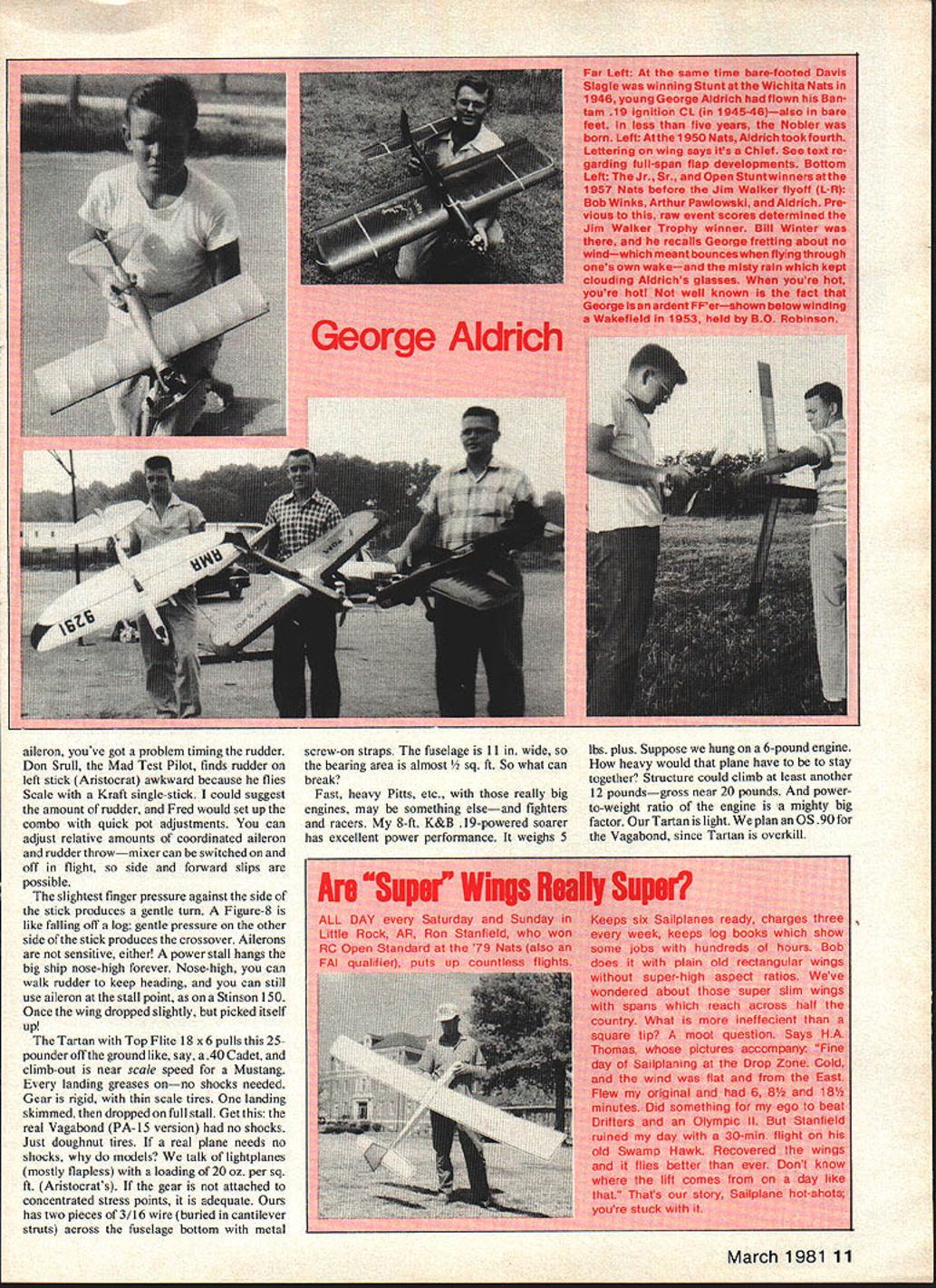
In 1946 at the Wichita Nats, a barefoot kid named Davis Slagle upset the CL world with his crudely built, rather small, super-light Stunter. Ray Arden, who introduced the glow plug the following year at Minneapolis, obtained the model, and it hung in Don Grout's hobby shop in Danbury, CT, where we analyzed it.
J.C. "Madman" Yates was on the scene that year. He gave me an unforgettable demonstration at Minneapolis of an Orwick .60 ignition Madman. J.C. left spectators limp. He liked to fly close to the ground. Loops, inverted flight, and wingovers always raised dust. You barely saw daylight between him and the ground. Strangely, his high stuff seemed to free‑flight, with the lines bowing spectacularly. Asked about this, he answered: "Oh, I simply steer it around." (It had dihedral.)
Then, one still evening at Olathe in 1948, we looked out a window and saw this kid flying silky-smooth, spectacular maneuvers—with a dead engine! That was George Aldrich.
At Olathe, Bob Palmer, whose huge .60 Chief—lightweight, and the first with unequal semi-spans—set us afire in the 1947-48 between-season, showed up with agile, flapped .35‑powered models which he demonstrated to the awe of a nearby golf course. Palmer and Yates were flying partners. Yates flew Bob's glorious Sammy Mason Stearman at the Nats. He did the pattern thought impossible for scale in those days. Assistant Editor Ross McMullen still drools at the remembered sight.
George Aldrich
Young Aldrich idolized Palmer, who corresponded with the enthusiastic kid for years. "I grew up with my bedroom ceiling covered with the various rubber kits of the mid‑Thirties," George tells us. "My big brother, Oliver, bought a Brown .109 in 1935. My first win was with a Scientific Victory, the prize a book of war stamps (1942)—a nice Korda miniature. Then an Atom in '42, a Vivell .33 in '45-'46. A 1946 Bantam, '19 started me winning in FF. Learned to fly CL on an Ameco Trainer with a Bunch Tiger. Traded it for McCoy .60. Won FF again with a Buzzard Bombshell with a Barker (.285?). It was stolen where it landed. Then I saw a CL fly inverted! I had to do it."
George continues: "The Dinky Box Car and K&B .29, first loops. The Cyke monsters that towed you around. Finally, a big Cut Up with Anderson Spitfire—pulled out in one piece!"
"The Go Devil was designed by Bob Palmer while recuperating from an accident that cost him most of his right hand while die-cutting Madman parts." (Note: Bob tells us that he was forced to design a special glove for his right hand in order to manage the lines, that he could not handle the pull of a .60, and hence the .35 jobs in 1948—and that is why the entire country went to smaller stunt jobs for many years.)
"I was the first flapped stunt ship, and started the trend to today's state." (Bob informs us that he saw an H.A. Thomas sketch of the same system published in Air Trails.) "At the big San Antonio meet," continues George, "there were big Zilches." (Note: Jim Saftig made Zilch famous—kits then by Berkeley; Jim was killed when a student froze the stick.) "Who took the next logical step? Palmer with the Veco Warrior—full-length wing flaps!"
"Those flapped ships would corner better—just before the Go Devil. Russ Snyder (Laredo, TX) showed us the first real pattern with a Zilch and Orwick .64 (and in 1946 the first loop with a goat, a Scientific Mercury)." (Note: now a popular Old-Timer RC.) "Don Still was winning with loops and eights at 30 feet. Big brother Oli kept bugging us—do it smooth—that's not the way a real airplane does maneuvers."
"Then the 1949 Nats," George recalls. "The first time I met Bob and his beautiful Chiefs. He sent me the first Chief off the line with a note written on the box—and his signature. I was only 16! Thirty-odd Chiefs later, and the 1950 Nats told me something was missing. The Nobler came from these models." (Note: using coupled flaps and elevator, the RC Nobler was kitted as an RC pattern model by Top Flite many years later—they also kitted the CL Nobler.)
"The Chief #1 had a stretched-fuselage Chief #3, but #2 was the one that glued me in. An old Warrior with short Go Devil-type flaps two inches wide, mounted on a shortened fuselage that had two inches between the trailing edge and the leading edge of the stab. K&B .29 glow—what fun to fly. Start an outside loop from around 45-60 degrees and when inverted about three feet off, pop full down and it would stop dead still, hanging on its props as long as down was held. Ease off, and it would start off inverted; pop full down, and it would stop again."
"From this," George warms to the task, "we figured the Chief was bouncy from turbulence (downwash off the wing). So #3 was built as a Chief wing and 12 inches between wing T.E. and stab L.E. This was a compromise of Nobler moments, trying to resemble a Caudron of 1936. At school, age 17, I did the first Nobler plan in 1950. Showed it to Don Still—we were fierce competitors then—and he told me in 1976 that he sure had hoped I would build it, because it looked like... The Navy judges at Olathe didn't like the big smooth pattern, but Walt Stevenson's judges did like it at Detroit." (Note: Plymouth Internats.)
"Then I did the first article on flying Speed with mono-line. Then the Foxy, the most fun ship with length and flaps. Then the Quick 60 plans with Leo Holliday." (Note: most of these in M.A.N. when your columnist was editor there.) "Even the Pacemaker, the first really competitive diesel ship in the United States." (Note: in spite of Tucker's win in 1947 with a Drone diesel.) "Out of competition when things got unfriendly. Some wouldn't speak. Some would rot on me when I got a model out—this in the early 60s. I still flew FF, indoor, etc., for my own amusement." (George would like to fly a .60 Nobler at the next Nats!)
He took second in A FP at the '51 Nats—McCoy .19 Zeek. Also first 1/2 A at Dallas Southwestern in about 1954. Blew everybody's mind, he sez. Don't doubt it. He blew mine (he being a CL champ) at a Dallas Nats with a quick out-of-sight in the 11 o'clock boomer.
You RC guys stick around. Next month, we'll have some fantastic stuff from George about engines and fuels, and for you CL people, a bit from Bob Palmer. Nice FF stuff, too.
John G. Chapis — "Inflation Fighters"
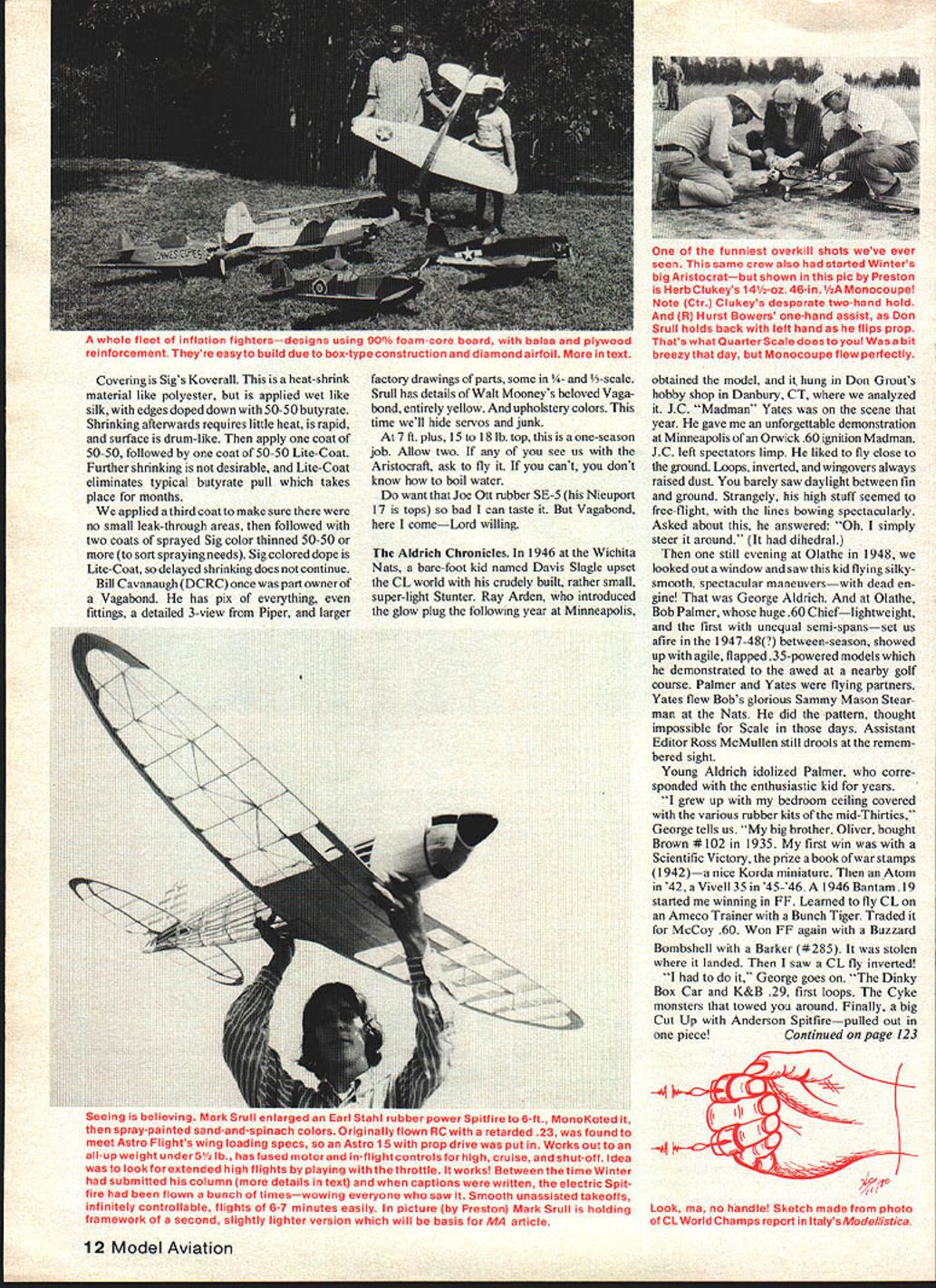
"Your search for ideas," John G. Chapis of Seaford, DE, writes, "I am submitting photos of models built using my 'inflation fighters' technique. This construction method is 90% foam-core board with balsa and plywood reinforcement. Unique for the sport builder is the scale appeal, but with the ease of assembly due to the box-type construction and easy-building diamond airfoil. Coupled with the lifting stab, this makes these models super-stable and just plain fun to fly.
On a commercial thought, the plans for the two trainers—an ME 109 and Spitfire, both for 2-3 channels and .19-.30; and four advanced models: AT-6, Stearman, Pitts and Corsair, all for 3-4 channels and .35-.40—are available from Connie's Copies, Rt. 1, Box 209C, Seaford, DE 19973 for $5.00 a set, postpaid. For those not into scratch-building, kits of these models are available from Chappell Model Products, Box 441, Ridgely, MD 21660. The two trainers are presently $29.95 plus $2.50 for postage and handling. The advanced sport models will follow soon. With the cost of everything going up, this construction method can give a modeler 'more for less.'"
We are into this, too. And we have licked two "problems" which some folks object to. While diamond foils are acceptable (Riley Wooten, the old Combat king, used them), some purists don't like the sharp line along the high-camber point. You really ought not to let that deter you. And, since foam-core board is brittle (OK reinforced), it must be used in flats; bending cracks it. We've got that licked. You can roll foam-core board quite easily into any airfoil you wish, and for curved fuselage bellies, etc., the curved top of a wing (that baffles guys who use cardboard). Use flat foam-core for the bottom of the wing—you don't need spars, just a wood leading edge (maybe trailing edge, too) that can be shaped and sanded (maybe it, too, can be rolled with practice for a one-piece wing, with just a few ribs—à la Walker's old Fireball).
With a nose-mounted 1/2 A engine, we opted for "low start" launching. This is a short monofilament line with a very short piece of rubber (maybe 10 feet, one foot being rubber) to position the ship from five to ten feet in the air. The launching arc allows the towline to drop from one of a series of small vertical brass tubes in the belly (allows adjustment), and the ship, once running, is in the correct post-launch attitude ready to be steered. Drive the stake into the ground, and walk the crate around until you are faced into the wind. We have a half-size version made of sheet balsa, no engine, just for hand-glide tests to check the configuration. The plane is a vastly scaled down version of an endurance-effort RC we had with Rosenstock around 1960, an excellent flying machine. This exciting concept rusts while we cavort with quarter-scale models.
Foam-core is great for ribs, fuselage sides with thin wood longerons (not needed on small jobs) and critical cross pieces. (Use white glue.) If you want to roll larger-span panels, use two people and a long pole. With Herb Clukey we tried this one night—easy, fast and durable. As Chapis suggests the possibilities are bright—just waiting for you. (Note: MA has a foam-core RC trainer construction project coming up very soon.)
Electric Spitfire
Guys who are successfully into electric go ape when we mention this one. How can you do it? Simple. This story begins some years back when Don Srull's son, Mark, made a 6‑ft. lightweight for RC, scaled up from Earl Stahl rubber model plans. (Incidentally, Earl had the wing too far forward.) It is Mono-Kote'd and spray-painted. On an old .23 it cruises well retarded, a real ghost-scaler.
Combining forces with Don—who did all the work (you don't catch old Bill sweating much)—we installed my Astro Flight 15 with belt drive and a 13x8. With all that heavy electric stuff, the big Spitfire comes in at less than 5 1/2 pounds, and it has the area to match Bob Boucher's tough loading parameters for electric scale. We barely missed the loading for his 6‑ft. Porterfield, or Kopski's 6‑ft. J-3 (see last issue).
Since I have two receivers for the Airtronics XL, we used the miniature XL servos (and they are something else), since servo reversing allows us to match the transmitter ship to ship. Advanced stick for full throttle, middle position for cruise power, back to shut-off. The system is fused, and Astro's on-off-cruise control (a tiny thing) allows all sorts of cruise combinations, even shutting off and turning on in the air. We are shooting for high, long flights, and in the event of a ground mishap, we can shut off by radio before damage is done to motor or battery. Taxiing this wind machine around the basement has this unflappable ancient excited, indeed. Weather permitting, we just may have great news for you next month. Wish us luck.
Other Urges
Other urges: to test sheet-balsa flying-wing gliders for a future RC. Like a delta, you have only one major assembly instead of three. And for years we wanted to build a mass of little ROGs—wings, deltas, parasols, bipes—everything. A flying circus. Unimaginable fun. Sometimes the simple things make one happier.
Thanks, guys, for the tremendous input—we'll get around to answering everybody. We badger the poor publisher for more space, but the magazine isn't made of rubber.
Bill Winter 4330 Alta Vista Dr. Fairfax, VA 22030
Transcribed from original scans by AI. Minor OCR errors may remain.

