



Just for the Fun of It
Bill Winter
Martin Bunn was a terrifying math professor in the George Patton mold. He read the Congressional Record. Students who passed deserved the Congressional Medal of Honor. All I got were Purple Hearts. Bunn never called on me; I was that far out of it. But he dubbed me the "Perfessor." He might begin by drawing a line on the end blackboard (having told us there was no such thing as a straight line—and there isn't), and then fill boards around two sides of the room with some incredible adventure in logical wizardry. As Bunn would say, "Let's assume a straight line."
My straight line is a request for Dick Korda's address from a Bob Nevin. Bob is an old-timer. He's not an AMA member, but he has a brother in Baltimore who is. Like thousands of others in the gray area, Bob gets to see Model Aviation. Nevin lived in Cleveland, flew with Korda, and once took a Nats second in Mulvihill (Akron in 1934, with a twin pusher). He flew Free Flight and Control Line before turning to Scale models—with a difference. He began with an endless procession of those fabulous Cleveland rubber-powered Scale models which were intended to fly—although I never saw one that did. The Cleveland models were delicate and made beautiful replicas which people like Bob loaded with details and then hung up to admire. Now, he builds incredible models for the Smithsonian's National Air and Space Museum.
Bob spent 37 years with Glenn L. Martin in the Flight Test and Experimental Departments and as a mechanical engineer in the Special Test Section. He loves Pietenpols (and talks of "Bernie") and just finished, after 18 years, a showcase full-size airplane to fly in.
Bob Nevin and the Museum Models
Nevin's Curtiss 1911 Hydro, single seat, in 3/4-in.-to-the-ft. scale, was just delivered to the museum (Bob's ninth museum project!). The model required a mere 500 hours to build, but his first project, a Martin MB-1 bomber (a twin-engined biplane with a forest of struts and wires) required 1,200 hours. Assign any hourly rate you think a craftsman deserves, and you'll have an inkling of what things cost. (I once helped referee a committee deciding a fee for another man's museum model—which ran to a modest $7,000.)
"It is valuable," Bob says, "to have an engineering mind in order to visualize constructional methods of early aircraft. On many occasions complete data and pictures are not available, so past experience and mechanical design background is most important."
You won't find the display of models on the main floor of the National Air and Space Museum. You will have to ask, when visiting, to see them. The extensive collection is housed upstairs in large glass display cases under atmospheric-controlled conditions.
Ordinary modeling techniques are not used for the museum models, because any normal model would deteriorate. "The wing and flying surfaces have to be very strong, so no balsa can be used," Nevin begins. "An ideal material is 1/16-in. O.D. brass tubing. It can be formed to shape, then soldered together to give a final structure which duplicates the thin double-covered wings of the early Curtiss, Wright, Bleriot, and similar machines. Generally, the covering is silk with dope sealing, then proper colors."
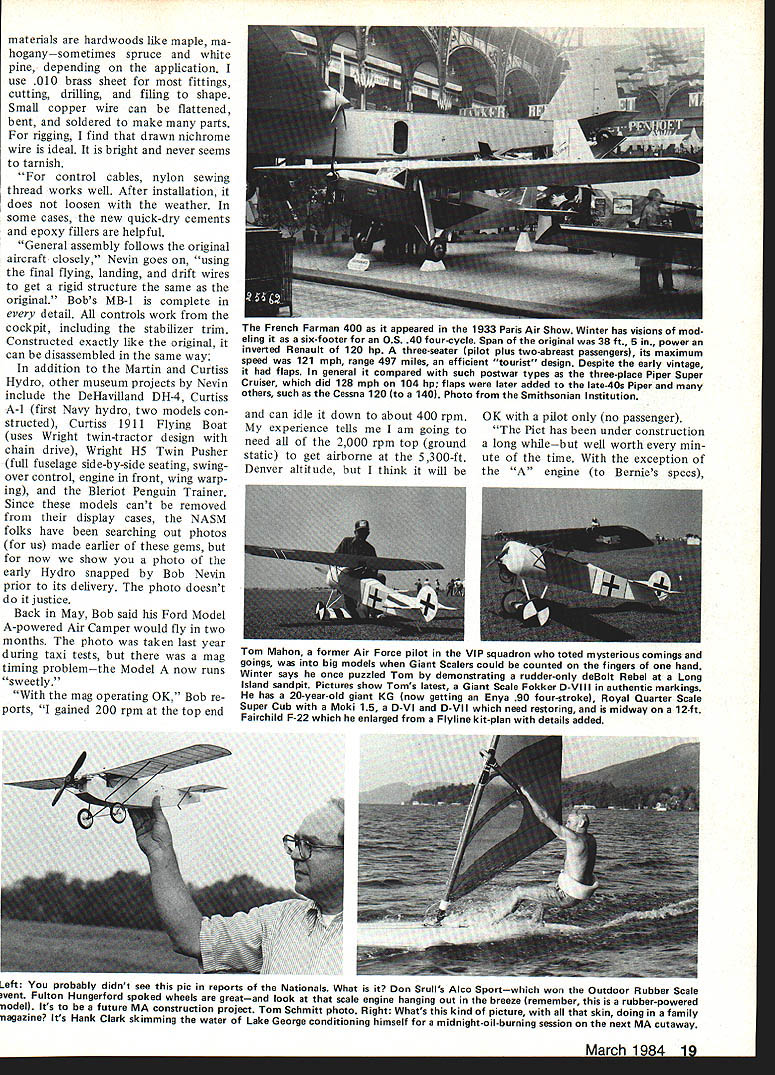
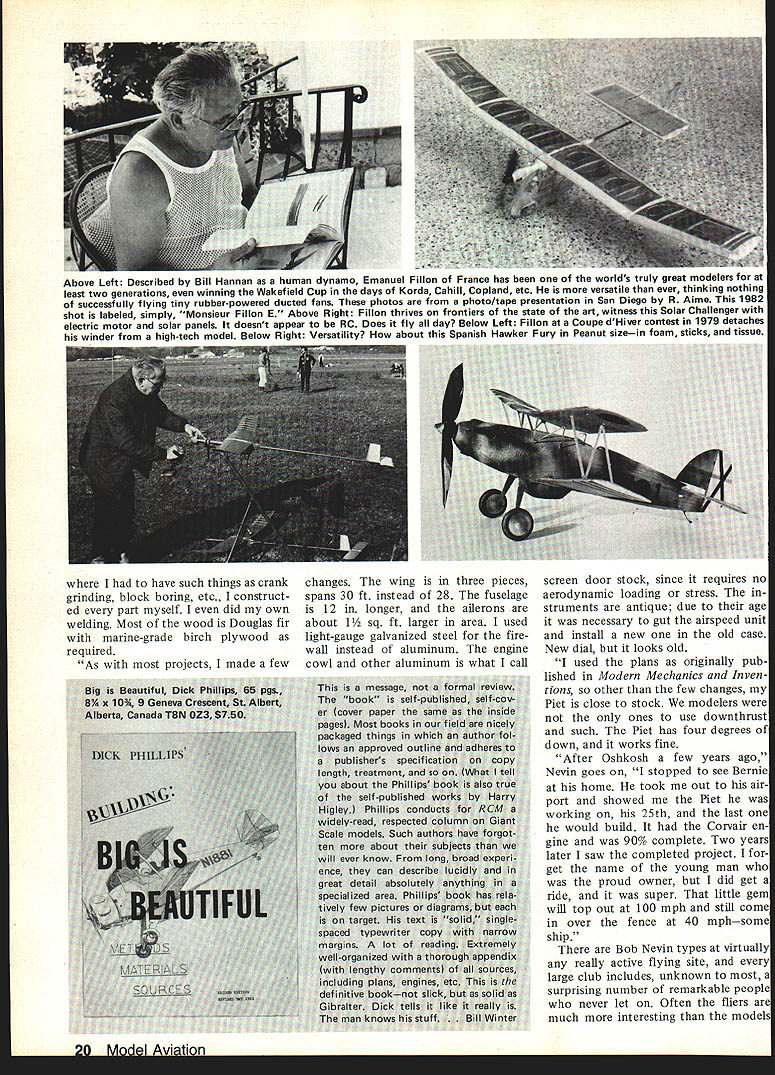
Other Curtiss 1911 Hydro—two views are shown in the latest series of super-detailed models built for the National Air and Space Museum.
In addition to the Martin and Curtiss Hydro, other museum projects by Nevin include:
- DeHavilland DH-4
- Curtiss A-1 (first Navy hydro — two models constructed)
- Curtiss 1911 Flying Boat (uses Wright twin-tractor design with chain drive)
- Wright HS Twin Pusher (full-fuselage side-by-side seating, swing-over control, engine in front, wing trainer)
- Bleriot Penguin Trainer
Since these models can't be removed from their display cases, the NASM staff have been searching out photos (for us) made earlier of these gems, but for now we show you a photo of the early Hydro snapped by Bob Nevin prior to its delivery. The photo doesn't do it justice.
Full-Size Projects and the Pietenpol
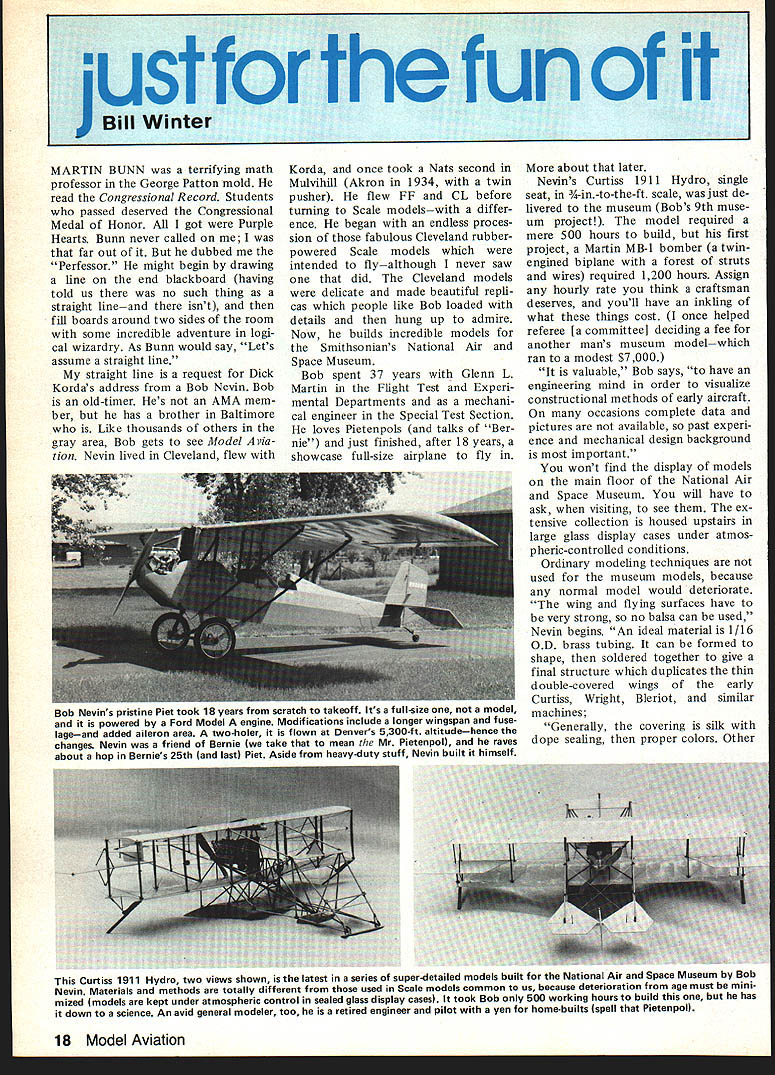
Back in May, Bob said his Ford Model A–powered Air Camper would fly in two months. The photo was taken last year during taxi tests, but there was a nagging problem—the Model A now runs "sweetly."
"With the mag operating OK," Bob reports, "I gained 200 rpm at the top end and can idle it down to about 400 rpm. My experience tells me I am going to be able to get all of the 2,000 rpm top (ground static) to get airborne at the 5,300-ft. Denver altitude, but I think it will be OK with a pilot only (no passenger)."
"The Piet has been under construction a long while—but will be worth every minute of the time. With the exception of the 'A' engine (to Bernie's specs), the Pietenpol is being built by Nevin from scratch. Its full-size model is powered by a Ford Model A engine. Modifications include a longer wingspan, a longer fuselage and added aileron area. The two-seater has been flown at Denver's 5,300-ft. altitude; hence the changes. Nevin's friend Bernie just finished a full-size Pietenpol after 18 years—Bernie is a mean Mr. Pietenpol, raves about his hops."
"As with most projects, I made a few changes. The wing is in three pieces, spans 30 ft. instead of 28. The fuselage is 12 in. longer, and the ailerons are about 1½ sq. ft. larger in area. I used light-gauge galvanized steel for the firewall instead of aluminum. The engine cowl and other aluminum is what I call screen-door stock, since it requires no aerodynamic loading or stress. The instruments are antique; due to their age it was necessary to gut the airspeed unit and install a new one in the old case. New dial, but it looks old.
"I used the plans as originally published in Modern Mechanics and Inventions, so other than the few changes, my Piet is close to stock. We modelers were not the only ones to use downthrust and such. The Piet has four degrees of down, and it works fine.
"After Oshkosh a few years ago," Nevin goes on, "I stopped to see Bernie at his home. He took me out to his airfield and showed me the Piet he was working on, his 25th, and the last one he would build. It had the Corvair engine and was 90% complete. Two years later I saw the completed project. I forget the name of the young man who was the proud owner, but I did get a ride, and it was super. That little gem will top out at 100 mph and still come in over the fence at 40 mph—some ship."
Materials and Techniques
Aside from the heavy-duty stuff Nevin has built himself, materials are hardwoods like maple and mahogany—sometimes spruce and white pine depending on the application. He uses .010 brass sheet for most fittings, cutting, drilling, and filing to shape. Small copper wire can be flattened, bent, and soldered to make many parts. For rigging, drawn nichrome wire is ideal. It is bright and never seems to tarnish.
"For control cables, nylon sewing thread works well. After installation, it does not loosen with the weather. In some cases, the new quick-dry cements and epoxy fillers are helpful.
"General assembly follows the original aircraft closely," Nevin goes on, "using the final flying, landing, and drift wires to get a rigid structure the same as the original." Bob's MB-1 is complete in every detail. All controls work from the cockpit, including the stabilizer trim. Constructed exactly like the original, it can be disassembled the same way.
Where I had to have such things as crank grinding, block boring, etc., I constructed every part myself. I even did my own welding. Most of the wood is Douglas fir with marine-grade birch plywood as required.
The Museum Research Adventure
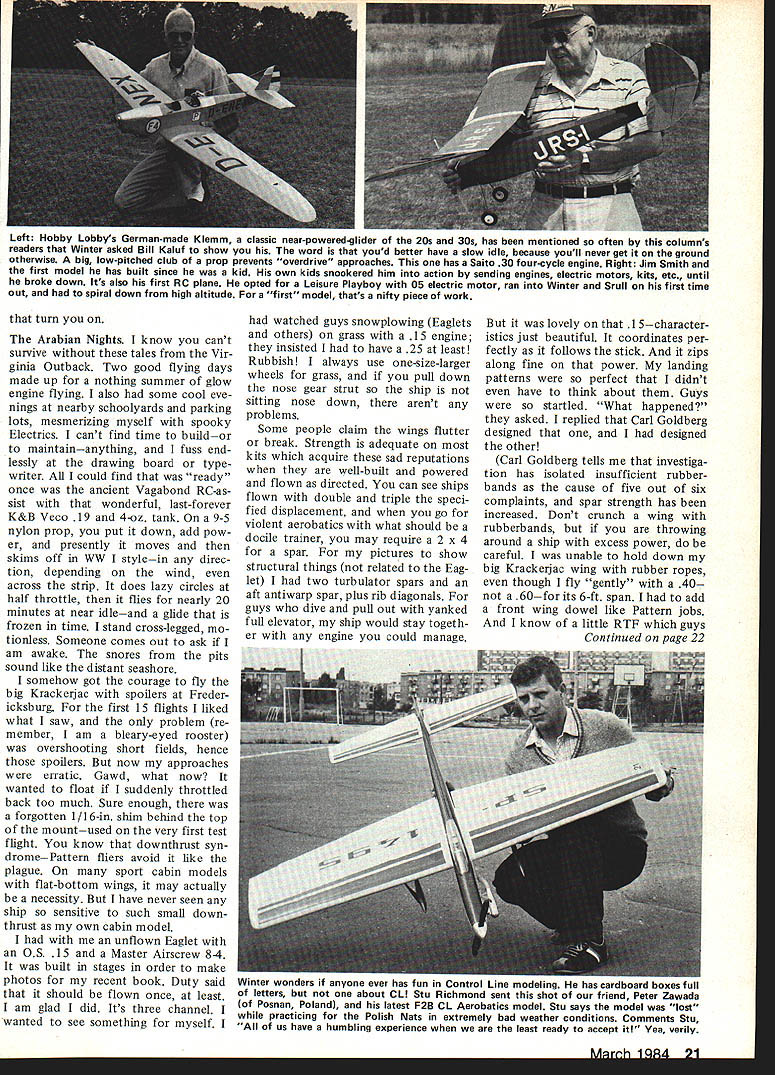
Very little information exists on many French aircraft because of the destruction during the WWII occupation. Hurst Bowers found the Farman 400 in the 1933 Jane's All the World's Aircraft, rather early for a flapped private aircraft — which had to exist by, or before, 1932. The 400 had a fixed tail skid, obviously a grass-field airplane. Examining the single photo under magnification, a faint line suggested strip ailerons, a la the Fairchild 22. A French model plan in Hurst's file showed a broken outline for a flap — which implied it was split, if it did exist, but it was of wider chord than the aileron shown. The bottom of the fuselage was rounded off, as on the AMA Museum model.
Bill Hannan, the Farman specialist, could not help; Warren Shipp didn't know, either. Hannan suggested contacting Alain Parmentier, a French modeler who, it proves, knows much about the big museum in France.
Alain returned an accurate wing planform with measurements in meters. The flap is of much longer span than the aileron, and both have the same chords, both tapering in proportion to the cantilever wing outline. The fuselage bottom was flat as a board! The extended exhaust that ran under the cabin, far aft, was not on the centerline, but much to the starboard side. The Smithsonian photo which is printed was taken at a long-ago French Air Show where the 400 first appeared. Tail cross sections finally were determined (from copies of old French photos) to have a slight symmetrical camber, but one ground shot suggests the stab was flat-bottomed — a model-type lifting tail. Alain's examination of an early magazine appears to confirm this, but no one is absolutely sure.
The 400 also has a very wide strut from the axle up to the cabin top. Jane's says the upper portion was rotatable as a drag brake. Imagine! But was this before the flaps, or in addition to them? In those days, manufacturers rarely built two civil craft in a row that were exactly alike. The search for truth about old airplanes is an adventure filled with gee-whiz surprises.
Don Berliner, who frequents our National Air and Space Museum, pitched in. He located our photo and a brochure on the 400. This created a stir, since a 400 brochure was not known to exist after the war. Berliner arranged Xerox copies for us, Parmentier, and presumably the museum in France.
Bill Kaluf took a fancy to the 400. He builds like a cabinetmaker. So we traded. He'd build it, and I would supply materials and an O.S. four-cycle. It will be hangared south of the river, but I suppose I will fly it occasionally.
The Eagle? Another trade with Kaluf ("the airplane factory"). He takes one of my old Futaba systems and gets to keep the four-cycle from the Farman—probably in the year 2001. Since Kaluf has my four-cycle, Doug Pratt lends me his MRC .35 four-cycle! And I supply the power system for Doug to build the test model of my new Electric. You still there?
At the Field — Personal Flying Notes
There are Bob Nevin types at virtually any really active flying site, and every large club includes, unknown to most, a surprising number of remarkable people who never let on. Often the fliers are much more interesting than the models that turn you on.
The Arabian Nights. I know you can't survive without these tales from the Virginia Outback. Two good flying days made up for a nothing summer of low-engine flying. I also had some cool evenings at nearby schoolyards and parking lots, mesmerizing myself with Electrics. I can't find time to build—or to maintain—anything, and I fuss endlessly at the drawing board or typewriter. All I could find that was "ready" once was the ancient Vagabond RC-assist with that wonderful, last-forever K&B Veco .19 and 40-oz. tank. On a 9x5 nylon prop, you put it down, add power, and presently it moves and then skims off in WW I style—in any direction, depending on the wind—even across the strip. It does lazy circles at half throttle, then it flies for nearly 20 minutes at near idle—and a glide that is frozen in time. I stand cross-legged, motionless. Someone comes out to ask if I am awake. The snores from the pits sound like the distant seashore.
I somehow got the courage to fly the big Krackerjack with spoilers at Fredericksburg. For the first 15 flights I liked what I saw, and the only problem (remember, I am a bleary-eyed rooster) was overshooting short fields, hence those spoilers. But now my approaches were erratic. Gawd, what now? It wanted to float if I suddenly throttled back too much. Sure enough, there was a forgotten 1/16-in. shim behind the top of the mount—used on the very first test flight. You know that downthrust syndrome—Pattern fliers avoid it like the plague. On many sport cabin models with flat-bottom wings, it may actually be a necessity. But I have never seen any ship so sensitive to such small downthrust as my own cabin model.
I had with me an unflown Eaglet with an O.S. .15 and a Master Airscrew 8-4. It was built in stages in order to make photos for my recent book. Duty said that it should be flown once, at least. I am glad I did. It's three-channel. I wanted to see something for myself. I had watched guys snowplowing (Eaglets and others) on grass with a .15 engine; they insisted I had to have a .25 at least. Rubbish! I always use one-size-larger wheels for grass, and if you pull down the nose gear strut so the ship is not sitting nose down, there aren't any problems.
Some people claim the wings flutter or break. Strength is adequate on most kits which acquire these sad reputations when they are well-built and powered and flown as directed. You can see ships flown with double and triple the specified displacement, and when you go for violent aerobatics with what should be a docile trainer, you may require a 2x4 for a spar. For my pictures to show structural things (not related to the Eaglet) I had two turbulator spars and an aft antiwarp spar, plus rib diagonals. For guys who dive and pull out with yanked full elevator, my ship would stay together with any engine you could manage.
But it was lovely on that .15—characteristics just beautiful. It coordinates perfectly as it follows the stick. And it zips along fine on that power. My landing patterns were so perfect that I didn't even have to think about them. Guys were so startled. "What happened?" they asked. I replied that Carl Goldberg designed that one, and I had designed the other!
Carl Goldberg tells me that investigation has isolated insufficient rubber-bands as the cause of five out of six complaints, and spar strength has been increased. Don't crunch a wing in rubber-bands; it does hurt if you are throwing around a ship with excess power, so be careful. I was unable to hold down my big Krackerjack wing with rubber ropes, even though I fly "gently" with a .40—not a .60—for its 6-ft. span. I had to add a front wing dowel like Pattern jobs, and I know of a little RTF which guys insisted on flying with .40s, so the manufacturer put in a Brooklyn Bridge joiner to stop collapses, and now the plane is a mongrel (due to its weight).
Inspiration! The bigger Eagle with ailerons is just what I need for 1984. A .40 four-cycle, too! I was already involved with a highly modified Sig Kadet, a Farman 400 6-ft.-plus Scale job, and another truly crazy Electric. If you can't build, what then? Let's begin with the Kadet. My son Mike, up north, offered to build me another Kadet (the first one still goes, but it is a demolition-derby survivor). So I am having him customize the new one to mimic a certain full-size plane—a tail-dragger with flaps. The Farman 400? Several outlines and rubber model plans exist, notably one by Hurst Bowers, from whose plans the late George Meyer of Texas had built the one now hanging in the AMA Museum. It's green and silver, a high-wing (cantilever) cabin of early '30s vintage—but with huge flaps. We all do inexplicable things.
Trades and Projects
Bill Kaluf took a fancy to the 400 and built like a cabinetmaker, so we traded: he'd build it and I would supply materials and an O.S. four-cycle. The Eagle was another trade: Kaluf takes one of my old Futaba systems and gets to keep the four-cycle from the Farman—sometime down the line. Since Kaluf has my four-cycle, Doug Pratt lends me his MRC .35 four-cycle, and I supply the power system for Doug to build the test model of my new Electric.
Fellow modelers, let me tell you some wild things about Electrics. I have a control-liner's viewpoint of any model. They're supposed to fly when you want them to, and no nonsense, and I hate to tweak low-speed needles or troubleshoot anything. I just expect it to perform—and I refuse to become a nuclear physicist. So don't expect textbook stuff.
Electrics remind me of the comedian Red Buttons, who used to say, "Strange things are happening." These days, Buttons says, "It deserves a dinner." Red is great at roasts. Electrics deserve a dinner. Churchill once said Russia was a mystery wrapped inside an enigma, etc. Electric modeling is like the series of toy eggs that fit inside each other—to infinity.
Every aircraft, jet fighter or lightplane, and all models (be they Rubber, Gas, Electric, or CO-2) have a level-flight maximum duration capability that depends, among other things, on the percentage of the weight of the energy source to gross weight and the wing loading. Electric crates having these similar attributes all come down to earth at about the same flight time. Precisely the same thing is true of Indoor models and those divine Rubber Scale jobs—if you forget artificial inputs of chancy "lift."
The same laws apply to your glow-powered RC, but with virtually unlimited energy you don't worry (much) about weight, and you dump energy at wild rates with howling Schnuerle's and pipes. But you can design a gas model that spends energy so slowly that it can fly for two days! Limit your RCM .40 to 2 oz. of fuel, and you'll be driven to clever ideas. Bob Davis, the diesel man, turns a 7-in. prop at good rpm on that CO-2 .02 conversion, and he has turned an 11-8. An .02 and an 11-8—no way! Davis Diesel has good support stuff now (new tanks, etc.), so one can fly RC CO-2 duration indoors—and possibly outdoors.
Gus Minich flies a 300 sq. in. plane on a 5-to-1 geared .05 electric motor with huge folders and gets 10 min. from a 10-min. charge. The spectrum is incredible. The same combo will fly a six-footer with over 700 squares, weighing as much as 80 oz., and still do over 10 min. with a full charge. Suppose your nice little O.S. .15 or .25 was available with gear ratios for reduction up to 5:1 or even 10:1. Will a .25 turn a Quarter-Scale-size 18-6? Take off lots of fat wood from the prop, and Lord knows what sort of designs you might fly. Your direct-drive glow .25 will turn an Eagleite out; a .40 turns a .55 into a demon—but (as in Electric) if you varied energy-consumption and used high reduction ratios, two engines would manage the task (we don't suggest this). Lightly-built giants would not fit in your station wagon unless they came apart.
Bob Boucher kept asking me to please at least try his Astro Cobalt .05 direct-drive with a 7-4 prop. I put it in my LeCrate and was astounded to find that the duration was about equal to an .05 with 2½:1 reduction and an 11-7 prop. I guess that kind of proves that equal battery weight and equal wing loadings should give equal duration. You could go to a smaller motor and still have a bomb with ailerons and even flaps, so not that this old man could not handle it—and yet do 8 min. or more. I suppose with 5:1 or more reduction on a .40 you could carry your small son—if he were a pilot (please don't try that!). A special Astro .40 has carried a man.
Don Srull, a scientist and once an engineer for Convair, opens tantalizing vistas for me. Now, before I tell you about the odd Electric I have on the boards, let me try to report on his magic formula. I will extract a few things from four pages of notes.
First, we know that to achieve reasonable duration with an Electric RC model, 25 to 35% of battery weight (forget the motor) to gross is good. The higher that percentage, the greater the duration (up to 66%, as on the B-36 bomber), no matter whether spent in a burst or over a long flight. But it is tough to build an airplane frame light enough to allow such high percentages. The formula applies to anything. For example, it shows that Bob White's great Twin Fin Rubber job, with 50% of its weight in energy, should do about 5 min. in dead air. It does. It is incorrect to think in terms of reducing battery weight in Electrics, since added battery weight increases duration even though the wing loading would be higher.
Consider this. I have a Ranger 42 (the Goldberg foamie). It is among the most efficient models ever designed, ideal for electric motors as well as glow for R/C. At 42 in. span, it is tiny for my Astro Super Ferrite .05, which Srull installed. With a six-pack of sub-C cells, it grosses an incredible 38 oz., giving a wing loading of 10.8 oz. per sq. ft. That's probably equivalent to (very roughly) a 50-oz. loading in Quarter Scale. With a hard heave and an 8-4 nylon it did 6-min. plus. With a wood TF Power Prop 7-5, it did over 8 min. with an easier launch; it was as high as one would wish to get. It glided a bit fast, but it was clean (about like an RCM .40), and the landing was just fine. It probably would ROG off a long strip of pavement. (An .035 motor would be correct.) Seemingly, that violates all the rules, all common sense. Yet there it is! Incidentally, for you Electric nuts, it draws (static) 10.6 amps at 8,400 rpm on the higher-pitched, smaller-diameter wood prop and 13.6 amps at 8,800 rpm on the nylon. Those figures tell the story. That 8-min.-plus approach may be a 460 sq. in. floater! (The Super Ferrite Astro .05 is an .075 with seven cells—same motor—and it is a lower-priced sleeper.)
Don's formula tells us the Ranger 42 was doing about 24 mph and my LeCrate 16 mph with a six-cell load (or 18 mph with seven cells). Now, the formula:
Maximum Duration = 132 × (battery weight / total weight in ounces) × (1 / sqrt(wing loading in oz/sq ft))
The answer, duration, is in minutes. The equation's "132" factor was calibrated by Srull with the Sparky and LeCrate tests during last year. These are typical sport models. For ultra-clean powered sailplanes, a factor of 150 may be closer; for draggy Scale jobs or biplanes, this factor could drop as low as 110.
At 10.8 oz. per sq. ft. for 38 oz. gross, my six-cell battery weight is 28% of gross. Now take the wing-loading square root; that equals 3.29. Then divide .28 by 3.29, and multiply by 132. The answer is about 11 minutes maximum flight. My so-so flights average about 9 minutes. I have done 10:45 under ideal conditions—heavy, cool air after sundown. My son's .05 Leisure in a very heavy converted Midwest Champion (originally for a glow .15) predicts 8½ min. on its seven cells, and we get about 8½ min.—he used an 11-8 prop, though the manufacturer (Leisure) recommends an 11-7. My LeCrate with seven cells (41 oz., 13.4 wing loading) should do 10:06 according to the formula. That's my exact average. If you don't come up to the formula's prediction, something is wrong—like your prop.
I can't go into Don's prop work too much. But this relates: the best propeller diameter to the airplane flight speed and wing loading for LeCrate is 12 to 14 in. An efficient pitch/diameter figure is in the region of 60 to 70%, indicating a 7- to 10-in. pitch. I am using an 11-7 Rev-Up with 2½:1 reduction. I am now flying a 12-7 (deBolt-modified Y-O) on seven cells with a 3.8:1 reduction, so I was guessing the right direction.
In the glide, I find that my LeCrate is two different airplanes depending on whether I use direct drive or reduction drive. That is because I don't have a folder on the 2½:1 or the 3.8:1, and these larger props really change the glide. With seven cells, the glide is faster. (That's the wing-loading factor at work, though in terms of max duration, it is not as important as the advantage of more battery weight.) The prop freewheeler wheels, even against the motor magnets, and if you speed up the glide, you can hear the gear whine. They claim a freewheeler costs you 40% of the glide. On top of this, if (with seven cells) I allow the glide to be fast, glide duration is cut to 50% as compared to holding a near-mush glide (normally that spells unacceptable sink, but it is far better than freewheeling rpm which is driven higher by a fast glide speed). Also, with a freewheeler, the plane is extremely insensitive to glide trim and slow large up-elevator movements. With the small 7-4 on direct drive, not only is the drag way down in the glide, but the big freewheeler is evidently a dampener of control sensitivity and stalls. On the 7-4, trim is quite sensitive, and it is surprising how easy it is to partial-stall or mush through a turn. That's largely due to being able to permit the ship to glide at a more efficient airspeed, resulting in greater control sensitivity.
The Mad Test Pilot (Srull) reminds me that amperes times volts equal power (watts), the rate of energy expenditure of your motor. Heat loss in your electric system is proportional to current squared. If you halve the current, the loss decreases by four times. So he says with more cells, the more voltage (suggesting, maybe, smaller cells—like the new 800s), allows you to use less current drain (unless you load things up with a screwball prop) and still keep the same power. This is probably the direction we will go as we try to improve the efficiency of electrics. All this varies as you fiddle with the way you want your machine to fly—skyrockets or floaters, to oversimplify.
For Fun/Winter
More cells probably means more cost, more complex charging, and the need to balance cells by trickle charging. Nice to know, but I don't expect I'm ever going to get that far into it.
My new airplane (on paper) is predicted by that formula to do 8 min. plus on six cells with a direct-drive .05 Cox, between 9 and 10 min. on seven cells and a 7-4 prop (I wonder about that 7-5 wood prop). The Super Fretter .05 turning its 8-6 at a surprisingly reasonable drain may be interesting. I went down from LeCrate's 460 squares to 405 squares for a Heinkel look-alike low-winger with a flat center section, Contender-type flap (for approach and landing), and ailerons (no rudder). A hot pilot could fly with a 10 or 15-size motor and direct drive. If the test ship is OK, the plans can be blown up (or reduced) to any size for several ranges of motors, in large sizes with either direct or reduction drive. Things can be further juggled by size choice for anything from a bomb to near-sailplane performance. Doug Pratt will build one size, Bill Kaluf another, and I will make a third. Motor cells are under the wing for a low C.G., mounted in radiator-like detachable tunnels. It's as thin as a paper dart, but in larger sizes the cells could be internal. Also a rudder version—two different dihedrals, for rudder or ailerons. More news next spring.
Always the gas modeler, I think my proposed Electric would make a tremendous sport gassie—aggressive looking and simple. Now, I feel like building that, too. There are never easy answers. Wanna trade?
Bill Winter, 4426 Altura Ct., Fairfax, VA 22030.
When writing advertisers, mention that you read about them in Model Aviation.
Transcribed from original scans by AI. Minor OCR errors may remain.

