
Just for the Fun of It
Bill Winter
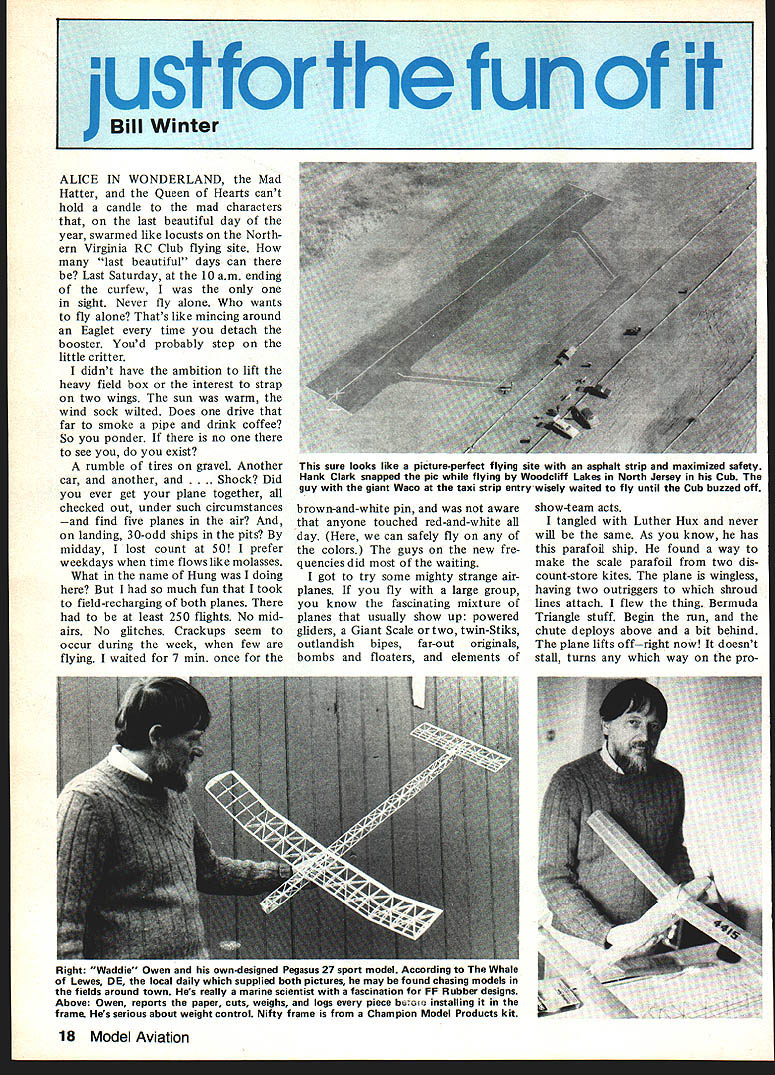
ALICE IN WONDERLAND, the Mad Hatter, and the Queen of Hearts can't hold a candle to the mad characters that, on the last beautiful day of the year, swarmed like locusts on the Northern Virginia RC Club flying site. How many "last beautiful" days can there be? Last Saturday, at the 10 a.m. ending of the curfew, I was the only one in sight. Never fly alone. Who wants to fly alone? That's like mincing around an Eaglet every time you detach the booster. You'd probably step on the little critter.
I didn't have the ambition to lift the heavy field box or the interest to strap on the two wings. The sun was warm, the wind sock wilted. Does one drive that far to smoke a pipe and drink coffee? So you ponder. If there is no one there to see you, do you exist?
A rumble of tires on gravel. Another car, and another, and a ... Shock? Did you ever get your plane together, all checked out, under such circumstances—and find five planes in the air? And, on landing, 30-odd ships in the pits? By midday, I lost count at 50. I prefer weekdays when time flows like molasses.
What in the name of Hung was I doing here? But I had so much fun that I took to field-recharging of both planes. There had to be at least 250 flights. No midairs. No glitches. Crackups seem to occur during the week, when few are flying. I waited seven minutes once for the brown-and-white pin, and was not aware that anyone touched the red-and-white all day. (Here we can safely fly on any of the colors.) The guys on the new frequencies did most of the waiting.
I got to try some mighty strange airplanes. If you fly with a large group, you know the fascinating mixture of planes that usually show up: powered gliders, a Giant Scale or two, twin-Stiks, outlandish bipes, far-out originals, bombs and floaters, and elements of show-team acts.
I tangled with Luther Hux and never will be the same. As you know, he has this parafoil ship. He found a way to make the scale parafoil from two discount-store kites. The plane is wingless, having two outriggers to which shroud lines attach. I flew the thing. Bermuda Triangle stuff. Begin the run, and the chute deploys above and a bit behind. The plane lifts off—right now! It doesn't stall, turns any which way on the proverbial dime, and you can fly it almost motionless right in front of your face. It hovers, does copter-like touch-downs. Until you've looked at a wingless airplane like a goldfish in a bowl, you haven't lived—and there's that gaily colored chute up there above it.
Luther had that trainer I mentioned before. It can fly (almost) like the parafoil, but it can also be opened up for aerobatics. Run it a short distance for takeoff, don't wait for a safe speed, and just horse it off. The darn thing hangs there, doesn't stall, snap, or fall off. Bang the stick and the ship recovers from virtually anything. If you wished to crash, you'd probably have to hold down control. It waits as it asks, "Well, buddy, where do we go from here?" It will come around and fly by in that preposterous nose-up mode—provided you keep holding back-stick—and plunk down like a pancake, then go round, after touching, with a bit of throttle. All this it will do within the width of the smooth-mowed strip down the center of the skinny field. Hold up when high up and let it settle; it's a darned good way to enjoy an afternoon of flying for the fun of it.
The secret is in the foam wing, with leading-edge sweep, a symmetrical section at the center, a flat bottom at the tip, with the leading edge dropping severely due to the change in airfoil sections to the tip; the result is no-warp washout. Since the tips, which stall last, have a far-aft aerodynamic center, they become a powerful stabilizing force.
Luther calls this the Next Step. I can't imagine what the First Step would be. That probably would take off, go round, land, and then suggest, "Now, turn on my radio." The day beggars description.
Hypnotized by Luther's strange flying machines, I had told Doug Pratt to fool around with my Krackerjack with spoilers. When, later, I remembered him, there was the K way off in the distance, near thermalling height—on a serious landing approach! He kept popping the spoilers in and out, with a stair-step approach, to float over the weeds at the runway's near end. If he needed "power," he'd pull in the spoilers; to get rid of "power," he'd put them out—never touching the idling engine.
The Cuckoo's Nest
I have a name for that field: the Cuckoo's Nest.
Beyond the beyond
Don Dewey, who began a great magazine on a back porch and never cried "Uncle," once commented that the supposed everyman has his Shangri-La. Mine lies 45 miles away in the Maryland hills. As there are galaxies beyond galaxies, and quasars beyond quasars, the modeling heavens are filled with Shangri-Las. I've discovered another—the nearest Shangri-La to mine—which lies only a few tens of miles farther west, in Frederick, MD. I hope Carlton Molesworth doesn't mind my thinking of him as a kind of celestial ... we encountered each other at last fall's Maxecuter contest which had one event for my old Rubber Scale planes. I know I shall go to his "home" this spring. He writes:
"The more of your stuff I read, the more I am convinced we are kindred spirits.
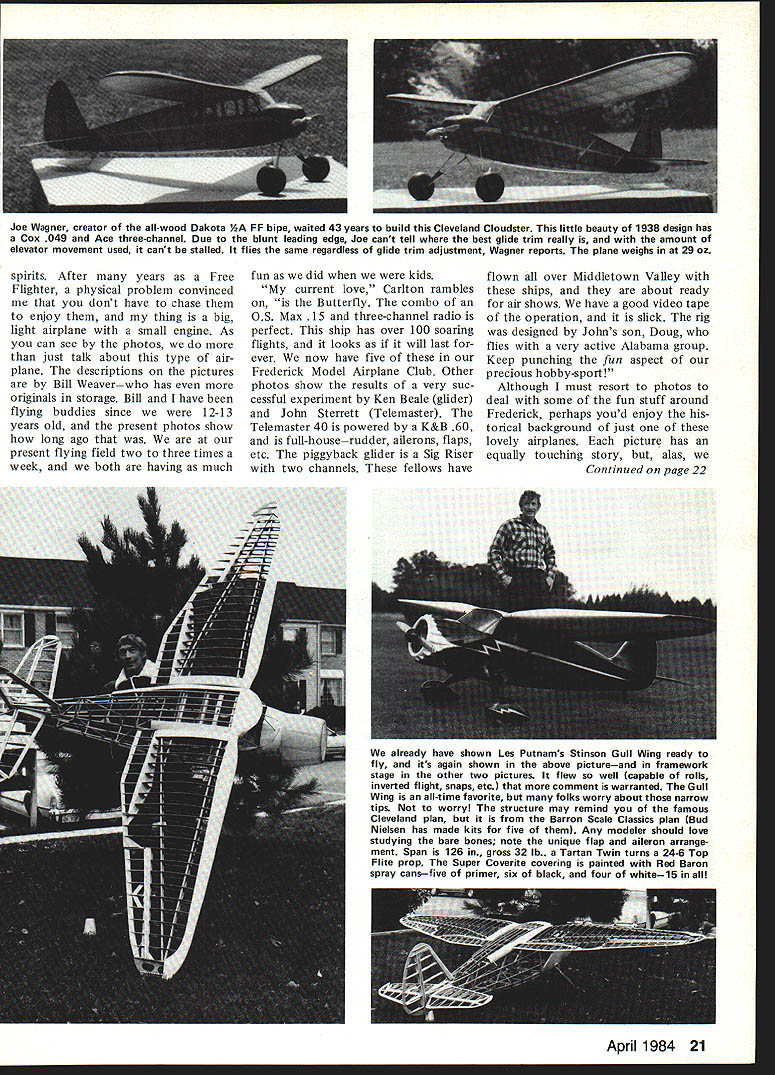
After many years as a Free Flighter, a physical problem convinced me that you don't have to chase them to enjoy them, and my thing is a big light airplane with a small engine. As you can see by the photos, we do more than just talk about this type of airplane. The descriptions on the pictures are by Bill Weaver—who has even more originals in storage. Bill and I have been flying buddies since we were 12–13 years old, and the present photos show how long ago that was. We are at our present flying field two to three times a week, and we both are having as much fun as we did when we were kids.
"My current love," Carlton rambles on, "is the Butterfly. The combo of an O.S. Max .15 and three-channel radio is perfect. This ship has over 100 soaring flights, and it looks as if it will last forever. We now have five of these in our Frederick Model Airplane Club. Other photos show the results of a very successful experiment by Ken Beale (glider) and John Sterrett (Telemaster). The Telemaster 40 is powered by a K&B .60, and is full-house—rudder, ailerons, flaps, etc. The piggyback glider is a Sig Riser with two channels. These fellows have flown all over Middletown Valley with these ships, and they are about ready for air shows. We have a good videotape of the operation, and it is slick. The rig was designed by John's son, Doug, who flies with a very active Alabama group. Keep punching the fun aspect of our precious hobby—sport!"
Although I must resort to photos to deal with some of the fun stuff around Frederick, perhaps you'd enjoy the historical background of just one of these lovely airplanes. Each picture has an equally touching story, but, alas, we can't have it all ways.
The Interstate Cadet
Won't you greet, please, the Interstate Cadet. Weaver tells us he "Built it from MAN plans by Earl Stahl in January 1941; it didn't fly until after the war. In about 1948, some modelers around Hagerstown, MD started flying Free Flight. When Rolfe Gregory (once a Luscombe engineer, now with Fairchild, and the 'dean' of the Maxecraft Rubber Scale fliers) joined us, flying Rubber Scale I began to fly some of mine, including this Interstate. About this time the K&B Infant appeared (the first was an .02, preceding the .035s and .049s). I made a five-wall-type nose plug and held it with rubber bands. It had just enough power to fly this 30-in. model after trying various props to get it to climb slowly but steadily—and much higher and longer than with the rubber motor. (Precisely my experience with a 'similar' Velie Monocoupe that was published in American Modeler.) Soon, everyone was flying their Rubber Scale models or Infants and .045 Spitfires, etc."
"I flew this model for sport until the late 1960s when the covering had about rotted off," Weaver continues. "Probably hundreds of flights. I just recovered it. The old Infant runs like new. Perhaps I will try it on a rubber motor again."
"This model was the first airplane to land on the runway of the Baltimore-Washington International Airport. When they were building the airport, we had permission to use the huge area for Free Flight contests. (It is 2 by 2½ miles.) In those days, after we made our competition flights, we would fly sport models until the competition was over and the winners decided. My Cadet caught a thermal while drifting north toward unfinished airport buildings on the horizon. It was nearly calm, and I hoped that, if I followed it, I might recover it. I walked more than a mile, and crossed a stream. When I got to the end of a paved main runway, there there could see the Cadet sitting on its wheels in the center of the runway on the right heading. As the airport had not been opened for traffic, this should make the Cadet the first airplane to land upon it."
"Memories! I'd like to add that a Nats-winning Interstate was designed by Hank Struck, kitted by Berkeley, who sold out to Fox, who passed on many Berkeley designs to Sig. Cadets will outrun any P-40 and at least equal Porterfields. I think Sig still has Struck's Interstate—if you want a beautiful sport ship, try a Sig Cadet near the top in price, design and servos, or FF Gas and Rubber: Just let them sail and enjoy."
Gold is where you find it
At first I didn't know what to believe. I received this card to which was taped tiny washers, thrust bearings, and the like. This resulted from a past column opening which wisecracked about Frank Perdue, the straight-faced man on TV who is forever pushing his chickens. The card was signed by a Wadsworth Owen, and he strongly conveyed the impression that Frank P. was in the Rubber model cottage industry. I can't resist tongue-in-cheek stuff.
After many exchanges, "Waddie" informed me that: "The plastic device from Frank Perdue (who probably never heard of either of us) is a pop-up thermostat from an oven-roaster chicken. As a boy, I was always looking for springs and things — it seemed that part of the challenge and most of the fun was to improvise on a non-existent, or low, budget. The little spring in this thermostat is great for small-model rubber tensioners and other things. I have used them for dummy valve springs (shortened) on a Glenney Henderson Peanut."
Since we all are faithful readers of The Whale, the Lewes (Delaware) equivalent of the New York Times, we find on page 7 of the March 9, 1983 issue a wonderful interview with good old Waddie — five columns, in two pix of the gadgeteer humorist, a bold headline reading "Model Airplaning," and a prominent blurb: "Waddie Owen's Serious About a Matter to be Taken Lightly." It's all about Rubber models and kids. The reporter, Dennis Forney, ought to be an AMA member. There's even a box: "Here's How to Get Started in Model Airplaning," which includes school sources as North Pacific, Sig, Peck, AMA, and Ed Whitten — addresses and prices of catalogs, and of the beginning Aero Modelers Assn (c/o Ed Whitten): a copy of the association's Star Skippers for 30 cents. With more people like Owen, we would have plenty of young people getting into modeling.
All stories must have a beginning and an end—and meat in the middle—so share with me Forney's opening and closing paragraphs. He began: "When Wadsworth Owen of Lewes isn't chasing down contracts for the University of Delaware's research vessel, Cape Henlopen, he can often be found chasing down home-built airplanes in the fields around town."
He ended: "But the bottom line for Waddie, and others like him, is enjoyment. 'I for one am like a greyhound: when I jog I need a rabbit to chase, intellectually and physically. My rabbit is a rubber-powered model.'" Owen is director of Marine Operations for the College of Marine Studies in Lewes. He flies a Cessna Skyhawk for business and pleasure.
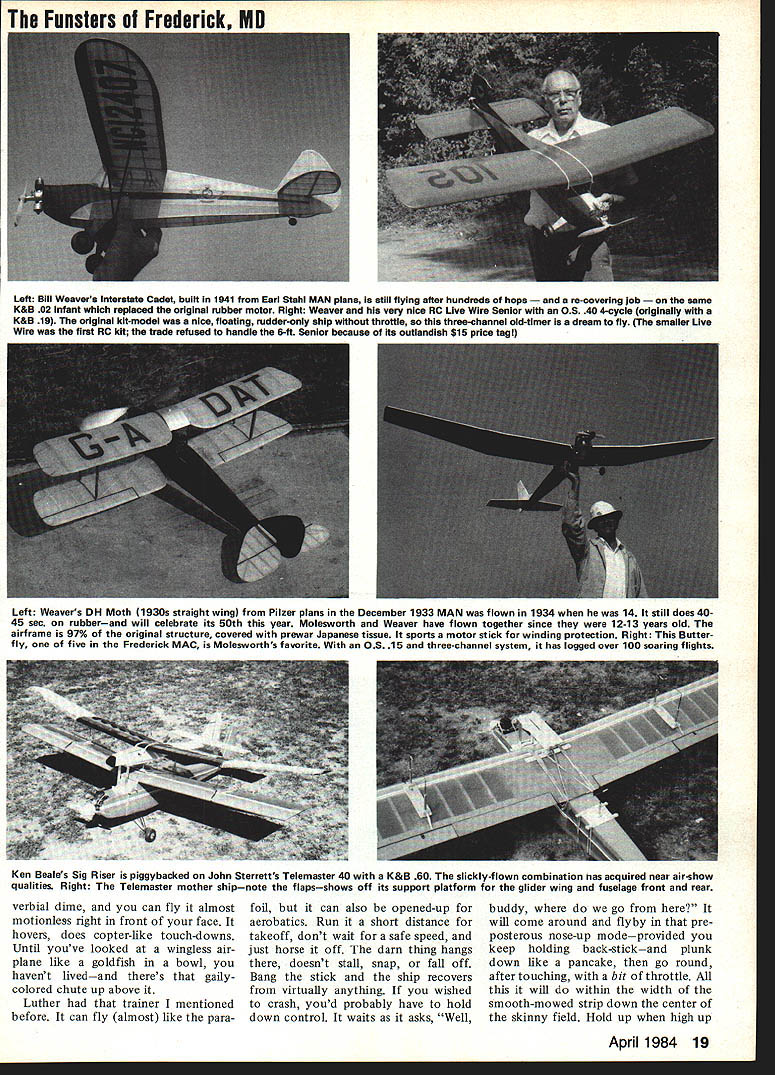
"My interest is in fluid mechanics and design," Waddie informs us, "hence Free Flight models which are controlled by design. I find, however, that my academic training just scratched the surface in preparing me for model designing. I still have trouble with certain concepts. I am interested in the analytical approach to model design; the risk (for Rubber models, anyway) is small and the benefits great. My approach is not to try to optimize everything in sight, but to separate the important from the less important without neglecting the empirical, natural selection of other designers." (Means don't reinvent the wheel.)
For example, he has developed an approach he calls "elliptic wing twist," the concept being the application of non-linear wing twist functions. With the model gliding at a certain CL and CD max relationship, induced drag is dominant. The elliptic twist allows a full-chord wing tip to avoid the inescapable low-Reynolds Number effects (as opposed to linear twist and taper) and yet keep an elliptic lift distribution. What about climb? he asks. A properly adjusted Rubber model should climb at low angles of attack, but high angles of climb where profile drag is dominant. I was struck by the similarity of my own electric-powered LeCrate in this respect—duration electric being so much like Rubber—and purely from hindsight, I concluded that, in my case, the use of a big lifting stab and an aft CG was responsible. Waddie submitted a proposal for an NFFS Symposium paper which would show the calculation and building methods. A successful P-30 was used, since the concept appears most effective at lower aspect ratios. Another proposed paper deals with prop shaft bearings on Rubber models; he states that a poor arrangement costs as much as 35 ft. of altitude in a Wakefield and 10 to 15 ft. in a Coupe. Waddie's best test results came when he used a system of two radial ball bearings, with the inner race of the forward ball bearing taking the thrust load. Waddie says prewar Zaic Yearbooks show at least six such examples, but the techniques are all but lost today. Waddie's suggestions seem to have fallen down the hole along with Alice in Wonderland. I don't understand that twist thing, but if one can eliminate taper and typical twists and have a better plane to boot, I sure would love to hear more about it.
The look of Eaglets
Franklin D. Roosevelt's wartime declaration of The Four Freedoms captured universal attention. We modelers revel in a fifth: the freedom to change. For many of us there is no greater joy than modifying and customizing. (There's a difference between the two.) We modify to make things better—so we tell ourselves. We gild the lily. We don't read the directions. We know better. We are lazy—that's relative and often justifiable. Customizing changes the very look of things. An Andrews Aeromaster biplane makes a great Curtiss Falcon or a Great Lakes; some guy's low-winger a magnificent Me-109. When modifying and customizing are mixed, exciting half-familiar sport ships kick up their heels.
I have a vision of making my next Kadet unrecognizable to ol' Mac at Sig. (He says it has been done before, so I'll have to try harder; basically, I'm thinking of a Grasshopper with a lot of windows and a cut-down rear fuselage with a tail-dragger gear.) Of significance is the fact that I have a three-channel Eaglet and hope to fly the bigger Eagle this year on four channels. What's important about that?
The NVRC Newsletter arrived. Someone had waved the magic wand over the Eaglet. Sketches all over the place. The perpetrator was none other than John Hunton, the architect of our fabulous new National Center for Aeromodelling in Reston, VA. (John wields an artistic, bold pen, and in the long ago I had published simple, flukey stuff for kids that John had dreamed up for his boys.) His Eaglet fired this columnist's imagination, but dang it, it was too much to squeeze into this thimble. Before me now is a stack of fascinating rough sketches and a pile of pix. Editor-Publisher Wheeler agreed it was too important for me to "waste," so John is working on a feature article for a future issue that you'll love. I am privileged to show a few pictures—and tell you in oversimplified terms what magic Hunton has wrought.
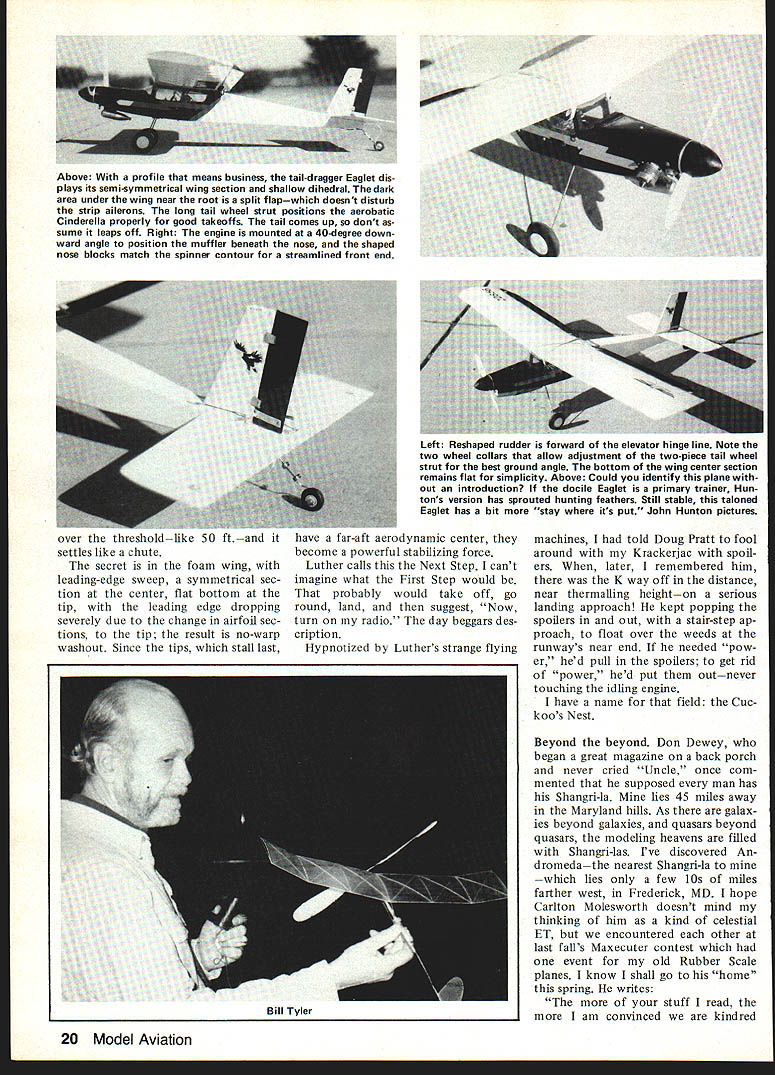
Having had fun with an Eaglet, and casting around for a new plane to build, John had this thought: If the Eaglet had been fun, why not build another—but different? It's different! A tail-dragger, and that saves weight. He took 1/4 in. off the top of the rib and added it on the bottom for a semi-symmetrical section. This raises the performance to a new order—truly aerobatic, easier to invert, and groovy. He used shallow dihedral with ailerons, and added big, split-section flaps (not a difficult mod). His engine is mounted at 45 degrees, but to the side, which puts the muffler unobtrusively under the nose. The nose is blocked-in and shaped to contour with the spinner. He used a flat-bottomed center section, so there's no tricky cutting away of the fuselage top; alignment isn't a problem. By using split flaps with a trailing edge just forward of the aileron spar, he retained full-span ailerons. The gear is a 1/4 in. forward of the stock main gear to put the axles an additional inch toward the nose. Don't jump the gun. There are many neat points you'll need to see in the article that's to come.
Modelers could not live without that fifth freedom. Messing around is the name of the game.
Transcribed from original scans by AI. Minor OCR errors may remain.

