


Just for the Fun of It
Bill Winter
Five minutes ago I was bellyaching about the superheated summer of 1983. Now, as I write, it is shortly after New Year's Day — the low sky lead gray, the temperature bone-chilling, and snow is falling. The one resolution I made was involuntary: stay away from epoxy! (For the past five years I've had increasing sensitivity to it. A whiff produces angry welts and itching that lasts for months.) I did resolve to fly more this year.
Projects and plans
I want to fly an Electric — a high-performance, fighter-like thing with flaps for the cobalt direct-drive .05 — and some ultimate, efficient design, not yet on paper, which will run 13-minute-plus and perhaps attain a total duration of 15 to 18 minutes without thermal assistance by using a reduction setup and a huge folding fan. I have five glow-powered slow ships with soaring ability, but each is shy either a radio or an engine.
Other projects around the shop include:
- Two Giant Scale jobs roosting on rafters up on Long Island (10-ft. monsters — ever hang those in your shop?).
- A battered Kadet and a fun Eaglet.
- An Enya .40 four-cycle Eagle by spring — with flaps.
- A big Krackerjac with spoilers (a study in procrastinated maintenance).
- A Midwest Sniffer with an Astro .035 electric motor (if I get too confused I will fly it at a nearby schoolyard until I sort things out).
- A Scale Farman 400 project shared with Bill Kaluf — a taildragger with no dihedral, cantilever wing and huge flaps for an O.S. .40 four-cycle.
- A rubber-powered Lincoln monoplane on my mind (rubber power isn't peculiar — Flying Models sold over 800 plans in a year for Srull's Shinden canard; only rare RC ships surpass that).
- The rudder-only (and throttle) 22-year-old make-believe Airknocker to be republished in April Flying Models (first printed in 1963). Its wheels are almost shapeless blobs of pocked rubber, treads long gone. The engine, an Enya lapped .09, is also over 20 years old.
- A Wankel engine I haven't yet figured out what to do with.
- A rack of mysterious wings telling me I have other ships hidden somewhere (I should trash them!).
You can see I don't want to face up to writing. Too much to talk about. For every ship I have there are ten stories to tell. The cat is asleep on a foot-high mound of photos. I'm asleep on top of the Hermes. I just told the editor I demand the entire magazine, and he reminds me how bad it would be if I had nothing to write about.
Four-cycle engines and lost flying sites preoccupy me. We drag Doug Pratt along to nearby sites. He sits on a folding chair and flies back and forth to extreme distances, usually for about 45 minutes. (After one such session he found the antenna to an Adcom receiver had not been unwrapped.) I identify with two of his planes.
When my son Mike started RC, he began with a .24-powered Gentle Lady and a Top Flite Metric (the latter more "slippery"), so I got him to try the Air Scout (then by Concept Models) with an O.S. .15. I liked it enough to urge Doug to try one. By then Ace RC had acquired Owen Kampen's design and reengineered it for simplicity with Lite-Ply sides. Doug's now has a Saito .30 four-cycle turning a big prop. Meanwhile, Mike had been transferred after framing a G-S Stinson (design by Bob Smurthwaite). Pratt powered it with the Saito .40 four-cycle.
Years ago that G-S Stinson won RCM's "Best Scale of the Year" award. It's not too big, but has scale ribs, etc., and is seemingly quite heavy. I had seen many pictures of Smurthwaite's Stinson and Howard flying on floats, but had nagging doubts. If you use the flaps properly, with ailerons slightly reflexed, it is a joy. Doug has RAM lights, including a strobe on the rudder, tip running lights, and bright landing lights. Touch-and-goes with those lights are quite an experience when it is normally too dark to fly.
Four-cycle engines and noise
A superb flier, Kaluf's redesigned RC Special will be a two-parter in the Australian Airborne magazine. He also has a Saito .30 in Hobby Lobby's Klemm, which can only be landed at a tick-tick idle. (Doug's Saito .30 idles as low as 860 rpm — OK, don't believe!) My O.S. .40 four-cycle is in that Farman. The four-cycles are vastly underrated.
They turn big props, and with large disk areas they have great thrust. They burn fuel at 50% or less of the normal rate. Since four-cycles are quiet, they may be the answer to the noise problem. Muffled Schnuerles have not improved a horrendous situation that goes back many years. We do not fully understand "noise." The sound frequency annoys people — there's nothing more irritating than a whinnying .049. I've been involved with one ongoing battle between people roughly a mile from the flying site and the guys who fly from this park. Those guys use strict muffler rules and stern practices. These guys measure sound. With officials observing, sound has been measured in the area of the complaints. The result was lower — using the noisiest engine in a dive — than a passing truck several blocks away, or a car starting up three driveways from the equipment. When the park officials agreed the complaints were groundless, 35 people signed a petition and threatened legal action. Will a public park organization want legal pursuit from town citizens? The answer would seem obvious.
These modelers now, belatedly, encourage four-cycle engines and limit the number of planes simultaneously in flight. Consider that if one engine sound is measured one mile away, and a club flies five or more planes together (not this club), the modelers are only rubbing salt into the wounds of the antagonists. Forget lawnmowers, passing freight trains, or full-size planes overhead — all that means absolutely nothing for us. With different sizes of engines in simultaneous flight, all doing aerobatics, what sort of sound frequencies result?
Perhaps you have noted that the AMA Contest Board has approved a limit of 1.24 cu. in. for four-cycle engines in RC Pattern. And there are special meets and fly-ins for four-cycles only.
Round-the-Pole and Vince Bentley
Twilight zone. I am looking at a letter from R. Vince Bentley of California. It's on stationery of the Control Research Model Division. Control Research vanished in the early 1950s; its crowning achievement was a very limited single-tuber because gas-filled tubes gave up the ghost if you idled them too low. They cost $3, and after the war few modelers had such money.
Vince's letter is Warp 4 stuff. He wrote: "Your mention of Ed Lorenz, John Worth (the same?), and Control Research triggered me. In 1949/50, John had three other partners — Ed, myself, and Dick (don't remember his last name). Dick 'broke the ties in 1950, I backed out in 1951, and Ed wound up the firm's affairs."
"Then, in July 1983, you started talking about Wakefields, Ron Warring, Bob Copland, etc., and sent me looking up some of my memorabilia — thought your readers might like to share it with me." (Vince and his wife emigrated from England in 1947, and Ed was the Bentleys' witness when they acquired citizenship in 1954.)
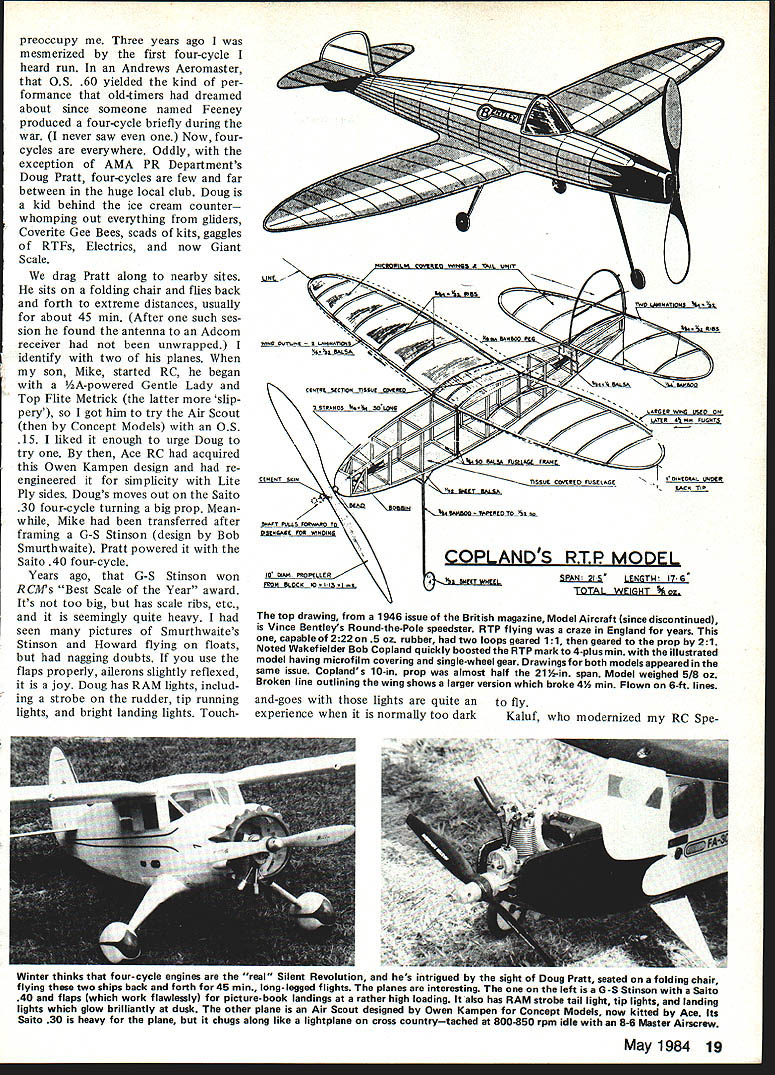
"During the war years in England," Vince recalls, "a new flying sport was introduced — Round-the-Pole (RTP) indoor flying with a radius of 6 ft. permissible around the pole, thus allowing sport flying in the average room. Clubs competed each month and mailed in their times (duration) to the SMAE monthly.
"With winning times in the 45–60-second mark," Vince goes on, "I decided to go out for something more outstanding — a semiscale low wing weighing .5 oz. With slightly less than .5 oz. rubber, it was in Class A; with slightly over .5 oz. rubber, in Class B. There were two 1/4-oz. loops of rubber, geared together 1-to-1, then geared 2-to-1 to a faster-turning propeller. The prop was an automatic variable-pitch affair, which started in high pitch and went into finer pitch progressively as torque diminished. The model set a new duration mark of 2 minutes, 22 seconds, which stood until a super-duration design came from Bob Copland. But my low wing later won several speed contests."
After converting a 300 sq. in. rubber job to RC in 1949/50, with the help of Lorenz who installed an early single-tuber and four-arm escapement, Vince became a photographer, then migrated into aeronautics at Lockheed in Burbank, where he spent 25 years in Libson Engineering.
He corresponded with Don Dickerson, who was developing his B&D proportional system about 20 years ago. Many of us flew the B&D system — which had a hernia-threatening hand-held transmitter. Don's system was contemporary with Zel Ritchie's — the latter the first "brick" produced in 1956 because it housed all the servos in the same case as the massive receiver. Called Space Control, it later became Orbit's first attempt at a proportional radio.
Vince added a fourth channel to his B&D. The unflown ship, a VK cabin, was given to Tony and Addie Naccarato, then of Hobby Lobby, to pass on to some deserving youngster. Vince then spent 18 years fooling with live steam — still at it, but getting back into RC. "I wish I could fly the darn things," he laments.
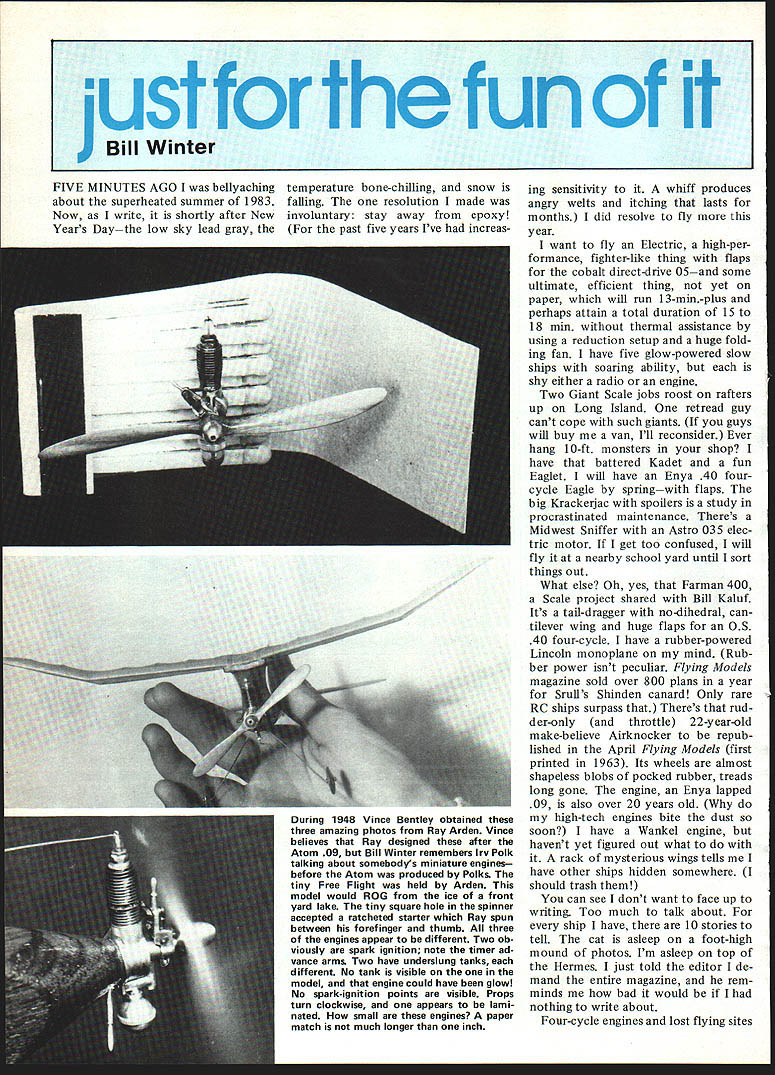
Vince met Ray Arden. Ray had flown a gas-powered free flight across Van Cortlandt Park in New York City in 1904 and married the girl at whose feet it landed. He was known to modelers worldwide by the development of the glow plug in 1947 — and the wonderful postwar Arden .09 and .19.
"Astro Spook" and a multi-size theme model
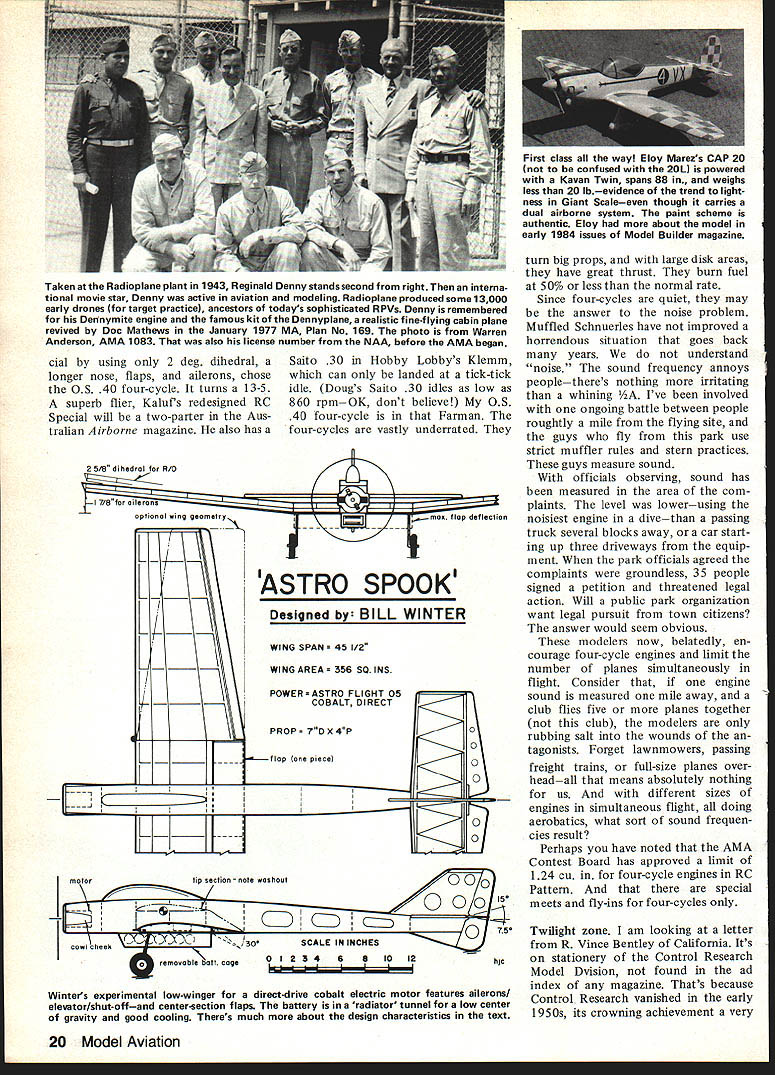
Spook stuff. Like many other creaky guys, I have been through twin-pushers, ROGs, gas engines, FF, CL, RC from rudder-only to whistles-and-bells, and Scale. Every new worthwhile technical development is to be relished. You don't need to be "electrified" to dig this discussion of an "X" design. We've had Astro Hogs and Astro this-and-thats, so I call it the Astro Spook. Bob Boucher at Astro Flight is tickled pink with the name, because this ship is motivated by an Astro Cobalt .05. He refers to geared, big-prop floaters as the "Winter Syndrome" — although he sells plenty of reduction-drive systems, both geared and belt. These lovely things please my Free Flight soul — but he challenged me: he says guys want "raw power." Can one have the best of two worlds?
The design in the three-view obviously can be powered by a glow engine as well. What is different about it is that it is a "theme" model which I think of as a "unit." This unit can be enlarged to provide three basic sizes, for both glow and electric-powered sport:
- Small electric: right-on for an .05 or .075 direct drive (.035 in some cases).
- Mid-sized: for .15s to .25s, both geared and direct.
- Big brother: for .23s to .40s.
In glow it can be .049s to .09s, .15s to .20s (perhaps .25s), and then from .30s to .40s. Each size can have the wing cut off by one tip-bay, or extended (for soaring) by adding one more bay. That yields nine versions. Naturally, wood sizes would be beefier for glow.
Bob wanted me to go to 300 sq. in. for an all-around, high-performance, aerobatic thing. I'm not a hot pilot, so I compromised at 356 sq. in. (cut off a tip if you wish). I wanted a good glide and perhaps a bit of hard-bought soaring. I'd need every design trick in the book so I could fly it safely. If we are ever to get away from powered gliders and conservative high wings, we must be able to duplicate the glow engine designs that we see. Thus, it had to be a low wing.
I've always been impressed by the appearance and performance of Don Srull's rubber-scale model of the Heinkel fighter, produced as a kit by Flyline Models. The swept-forward trailing edges give it an aggressive appearance — but make the design more difficult. On a minimum-area model, ailerons scare me. Low drag requires a thin wing with the area shown, and the tip rib on my model is even thinner than the one drawn on the three-view. If you are familiar with the center-section flap on Top Flite's Contender, especially the poly version, you know how much that ship can be slowed. Small increments of flap (proportional) could boost lift when needed for slowed approaches, with more flap when close to touchdown. Even 2 to 3 degrees of flap produces a tremendous washout effect, insurance against a snap.
An optional swept leading-edge geometry is shown — à la the Zlin, DC-3, AT-6, etc. Because of the washout, this rearward-swept version would be more stable around the stall, and safer in awkward attitudes with less proficient piloting.
To save weight in the small version, no rudder is used, although a rudder hinge line is shown should you wish it. A swept-back rudder hinge line has a substantial effect in holding up the inside wing when turning. On the small version, four servos would be required for rudder (due to flaps), and we have only three, relying on ailerons for turn and roll. For smooth aileron turns, we can't afford down-taileron yaw effects, so the vertical tail must be large enough to prevent that yaw fighting against smooth turns.
For maximum roll-axis stability, the tips are washed-out by slightly inclining the aileron spar up to the tip during construction. The aft tip section is sanded beneath to yield a more stable tip airfoil — thus still more washout. In addition, the center-section leading edge is more rounded, with the lines of the extreme leading edge then descending to the tip rib. More washout! The tip rib is flat on the board with no Phillips entry.
In small ships, the motor battery consumes much internal space and is more difficult to cool. In the case of a mishap those cells become a battery ram. Why not have a quickly detachable simulated radiator tunnel? My small version will take either six or seven sub-C cells for an .05 or five or more 800 mAh cells for an .035 — easily shifted for balancing. With this, the battery can pop out the front of a fixed tunnel with little or no harm being done.
On bigger versions, twin tunnels (each located outward from the center) would accommodate twin six-packs. Or the tunnels can be eliminated in favor of side scoops, jet-fighter style.
The side-view profile configuration minimizes diving turns and spiraling. The side area at the front is high, at the rear low. The fuselage is flat-bottomed, the top swept down to the tail. Vertical tail height is limited; tall tails produce excess leverage around the rolling axis and a tendency to "cone" with glide-turn trims. Much of the vertical tail area is below the centerline. As in Pattern, we need high profile area forward, so a thin tail canopy is made from foam — for a bit of knife-edge-holding effect. To keep the CG as low as possible — another reason for the tunnel-battery — the flap and aileron servos are mounted flat, in line, inside the wing center section, one forward of the main spars, the other aft.
Probably six sub-Cs is a good beginning point, and since the ship is clean, a 7x5 wood prop could be better than the traditional 7x4 plastic. The all-up weight should fall between 30 and 35 oz. The fuselage seems long; my reflexes don't permit jackrabbit responses. My fingers are crossed.
The Bionic Bat and human-powered flight
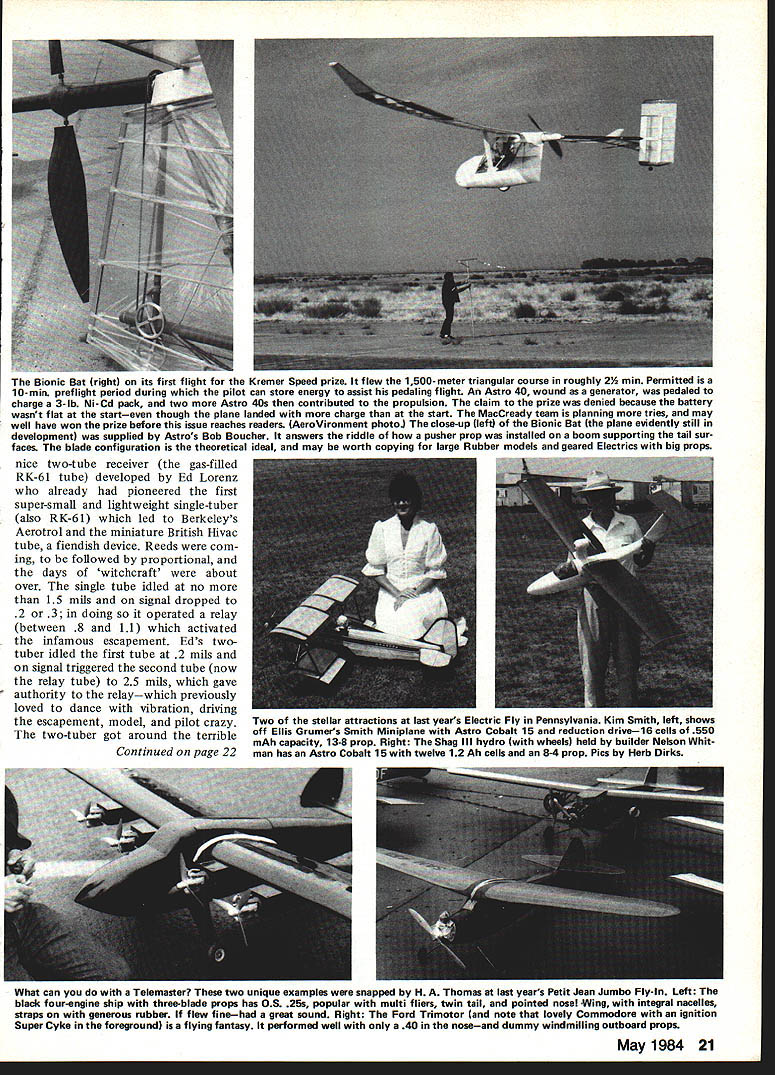
See-through magic. Only Charles Dickens could plot the course of this item. Let's begin with that stunning shot of the Bionic Bat, taken last September 25 during the first of its two qualifying flights (at Shafter, CA) for the Kremer Speed Prize — to be awarded for achieving an average speed of more than 20 mph around a 1,500-meter triangular course with two turning points 750 meters apart. Required to fly the course in opposite directions, the Bionic Bat (Bionic for muscle power; Bat for the battery used to store the air crew's energy during a 10-minute period prior to takeoff — employed, in this case, to power two special Astro 40s which assisted the pedaling pilot) made its second pass two... [photo notes and close-ups indicated intriguing details about prop and chain-drive systems].
Bob Boucher, who tipped me to the story last September, sent scrawled notes and some fascinating close-ups of the prop and chain-drive system. Many months went by as we chased loose ends. He and Astro Flight also supplied the propulsion system for the Gossamer Penguin, which in 1980 became the first airplane in history to fly by the direct power of the sun (solar cells). In 1981 the solar-powered Solar Challenger flew 163 miles from Paris to England at an altitude of 11,000 ft. Astro 40s translated that energy into the propulsive force of big props that ticked over like indoor rubber stuff. We remind you that the Gossamer Condor, purely man-powered, won the first Kremer prize for fuel-less flight in 1977 (this craft is in the National Air & Space Museum). In 1979 the Gossamer Albatross won another Kremer prize for a human-powered flight across the English Channel; that plane is in the London Science Museum. Paul MacCready was a well-known modeler, as is Bob Boucher, so we take great pleasure in "our" effects on full-scale aviation.
Gorham Model Products
One for the books. Inc., "the magazine for growing companies," released in November its annual selection of America's 500 Fastest Growing Private Companies, ranked according to percentage of sales increase from fiscal 1978 through fiscal 1983. There, at No. 269, is Gorham Model Products, the model helicopter people! It boggles the mind. The company employs 12 full-time office and factory personnel, and uses the services of about 35 American companies as subcontractors in manufacturing its helicopters. The sale of the popular Cricket is given as nearing 10,000 kits. That's a modest figure, but still a lot of choppers in our modeling world. They do have others, of course, including one with a rotor span of 10 ft. for the Army. Another requirement of the magazine's selection was that sales be above $100,000 but less than $15,000,000.
The drone connection and the OQ-2A
Although the first patented remotely piloted vehicle or "drone" dated to World War I days, it was not until World War II that RPVs became a practical part of military hardware, mainly as lifelike targets. Things like the OQ-2A, remembered by modelers, and later the full-scale, all-wood Culver Cadet, were used. About 12 ft. in span with generous dihedral, the OQ-2A, powered by a McCulloch engine (I've been told everything from 5 to 10 hp, up to 18), looked like an overblown outdoor rubber job, with a flat-topped, triangular cross-section fuselage. It was catapulted by shock cord off a long launcher of open-frame, tubular construction and could hit high speeds. For retrieval when hit, it shut down the engine and popped a chute from a top hatch.
At the first Mirror Meet in 1947, at Grumman's in Bethpage, Long Island, the Army demonstrated three. One shot vertically over my head; I heard, but did not see, the thunderous impact on the concrete runway. I was under a Good Humor truck. As a free flighter, I knew what to expect! Another tore up the sky until the pilot goofed (the radio glitched), demolishing a chicken coop and its feathered inhabitants.
Warren Anderson, who started with Ohlsson .23 free-flight gas jobs before World War II, wrote: "One of my military assignments was as crew chief on the Radio Airplane Target Detachment flying OQ-2A drones. This was the first crew trained by Army personnel at Fort Bliss, TX, in 1943. They had related to us that the Good brothers had taken their RC idea to several military units but were unable to stir up much interest. Finally, the U.S. Cavalry accepted the idea, according to them, and it was developed into the OQ-2A."
Reginald Denny was involved in the early manufacturing of the plane, as was a "Mr. Smith," pointed out in an article in American Aircraft Modeler in March 1971. The picture I took at the Radioplane plant in 1943 shows both Smith and Denny.
Reginald Denny and the Dennymite
Reginald Denny, a handsome movie actor of considerable fame, was a truly good guy for aviation. He was interested in air schools and was a major model airplane manufacturer who advertised a grand free-flight gas model kit (the Dennyplane) and the fondly remembered engine, the Dennymite. The Dennyplane is famous to this day. It is a round-nosed (aluminum cowl), high-winged cabin model which flew superbly and looked like a full-size plane. Many people have built it in recent years, thanks to Doc Mathews' revival in the January 1977 Model Aviation (Plan No. 169 for $4). Power is a .19 to .25. Denny was far more than a celluloid hero. He was one of us. Incidentally, Radioplane produced 13,935 drones under three designations.
Bill Winter 4426 Altura Ct., Fairfax, VA 22030.
Transcribed from original scans by AI. Minor OCR errors may remain.

