


Just For the Fun of It
Bill Winter
I am an airplane watcher. I never fail to look up at any passing aircraft. I also count cars on passing freight trains. The colorful place names that adorn them aren't what they used to be. Nor are passing airplanes very romantic now—the sausage machine grinds out Cessnas.
Watching models fly never grows boring. I enjoy the beauty of the model itself more than what a gifted stick-pusher does with it. When I fly my own, I like them to sail high and wide and to be disturbed as little as possible—but, alas, one does have to bring them closer, turn them around, or bring them down.
If, like me, you also watch everybody's machine do its thing, you'll find another quality comes through: realism. We all like models that look like full-size ones and fly smoothly. I am more moved by look-alikes than I am by pure scale. I admire beautiful scale jobs on the ground as if they were set pieces in a grand museum. When they fly decently, I am pleased—but sometimes that is anti-climactic.
I go bananas, on the other hand, over some customized thing that says to me, "Hey, I am supposed to be a Zero, a P-40, or an Aeronca." Or an original that cleverly mimics some famous aircraft without giving up its performance as a model. Theme models—that's what I love: the clever, creative approach. True scale is the photo-like painting, but a looser treatment of the master's brush lets us feel many different things. I don't care if struts are missing, if a bit of dihedral was added, or if the sides were left off.
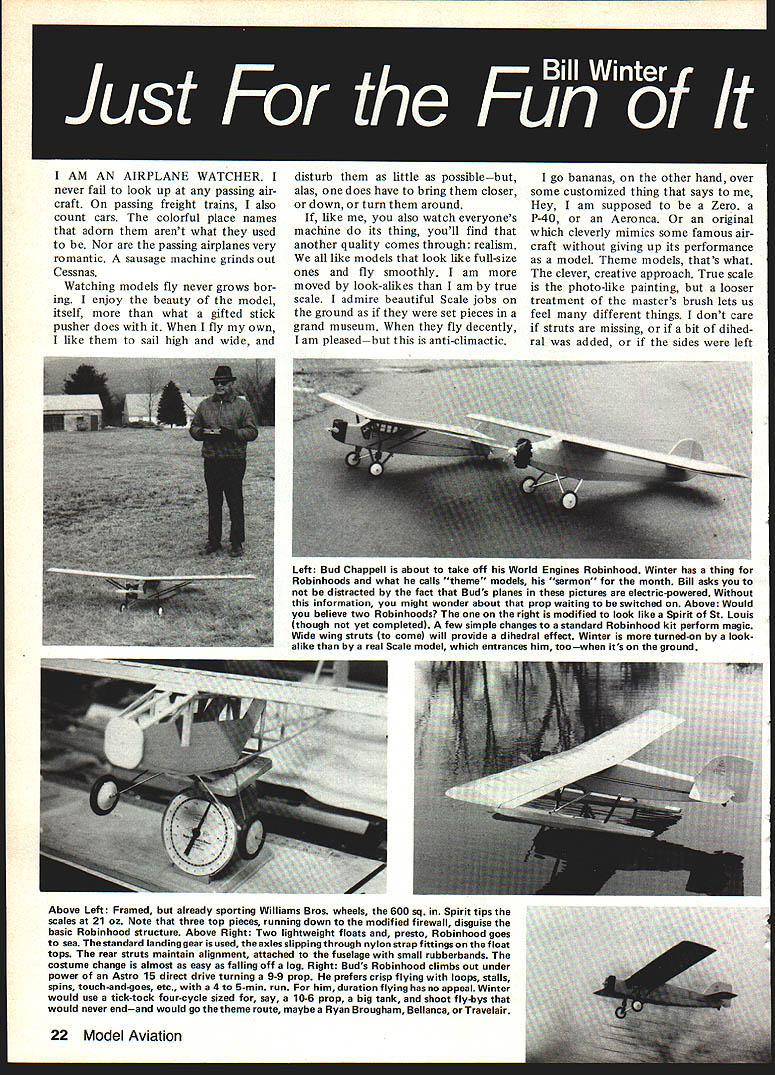
I am touched by the World Engines' Robinhood "nonsense." And I suspect John Maloney has had a world of fun playing around with his Robinhood. "Lord, what an ugly Robin," some friends say. They miss the point. It is simple, fun to build, flies great, and you know it claims kinship with a Robin. Since it will fly like any cabin model I might concoct, I'd be immensely pleased to watch it high in the air—a "Robin" and not some nondescript conglomeration of wood, MonoKote, and glue that is a 500-mph Jennie.
I gotta tell you about Bud Chappell and his Robinhoods. He has a Robin to write home about and, believe it or not, a Spirit of St. Louis which resembles it in no way—but which also is a Robinhood. It is a theme model out of another theme model.
I really don't wish to talk electrics, but Bud's models happen to be electric-powered. Robinhoods are glow-engine models so, if you wish, ignore Bud's energy source. We are talking theme. Let's get his electric background quickly out of the way.
"My approach to electric," Bud explains, "is to give to many modelers who are teetering on the edge of it a tried-and-proven (and currently available) group of items—kit, motor, radio, prop, covering, battery, etc.—that can be assembled by builders of average experience to get consistent results by following text and procedures. I think there are thousands of people, like me, who paid no attention to electric power because they want an airplane to look like a full-size one, that does not have to be hand-launched, and is easy to maintain, etc. Not until I saw an article on European Electrics did I pay any attention to them—for then I saw many varied and diversified scale types of planes.
"In the same vein," Bud continues, "I know a Cecil Peoli twin-pusher flies, but I never would build one because it is totally unappealing to me. If this sounds like a narrow, inflexible attitude, it is simply being selective and not settling for less than what have become standards embedded in one's mind. A brisk, crisp 4- or 5-minute flight packed with loops, stalls, spins, touch-and-goes, and feather-touch landings is the kind of flight I seek. Height and duration is the extreme for others to enjoy."
Chappell, who did the China Clipper in the December 1983 MA, bought two Robinhoods. Except for the dummy front on the Robin version, which suggests the OX-5 liquid-cooled nose, it seems to be to scale—struts and all—but, of course, it isn't. Like the contemporary Fairchilds, the Robins of those golden days had a nose that pinched in sharply at what would be the front cabin bulkhead on a model, to the front windshield line; the nose was much narrower than the passenger-carrying cabin. That gave look-down ability—pleasant on a cross-country flight, and perhaps it made landings sharper.
The Spirit, Bud says, has a 600 sq. in. wing, very nice for a glow engine or electric sport. He reproduced the flat wing, sans dihedral. It wasn't finished in the pictures, so perhaps he has added the wide wing struts. Mountain men, like Hank Struck, found that for Free Flight those struts conferred a dihedral effect—as would the Bellanca (and others) struts. If that worked in Free Flight, what's to worry about in RC? What seems amazing is the slight rework evident in the weighing photo, which resulted in a total change of image. The radial engine is lifelike. Altered tail outlines for the Spirit, plus two bold stringers, enhance the illusion.
Bud says when you think about the floats on the Robinhood, or about flying off the water, the floats appear to be built lightly and the main axle is run through a nylon landing gear strap fitted atop the float, taking the main load. In fact, the gear is fully utilized, and only one aft strut per float has been added.
If I did not have so many other commitments, I'd spring for that Robinhood! That "Spirit" turns me on. The frame weighs only 21 oz. Since Bud flies these beauties with only a Super Ferrite 15 with a 9-9 Rev-Up on direct drive, it is plain that a relatively small four-cycle engine would be delightful in it. You could do much worse than to try that Robinhood and join the fantasy world of airplane watching. It would be nicely aerobatic on glow. How about your own look-alike fantasy?
Bewitched, bothered and bewildered
For the life of me, I cannot understand why more people don't take advantage of Schoolyard Scale. Maybe that name is a turn-off. The ships really are Small Field models—not too exciting a name, either. Sticking labels on models conjures up impressions that don't square with reality. For me, such flying is heaven. Simple scale, old-timers, or originals with .02s to .10s, and all-sport electrics, are rewarding subjects. One need not give up anything else, but no pressure, quiet evenings after work weave an enchanting spell. Another perk.
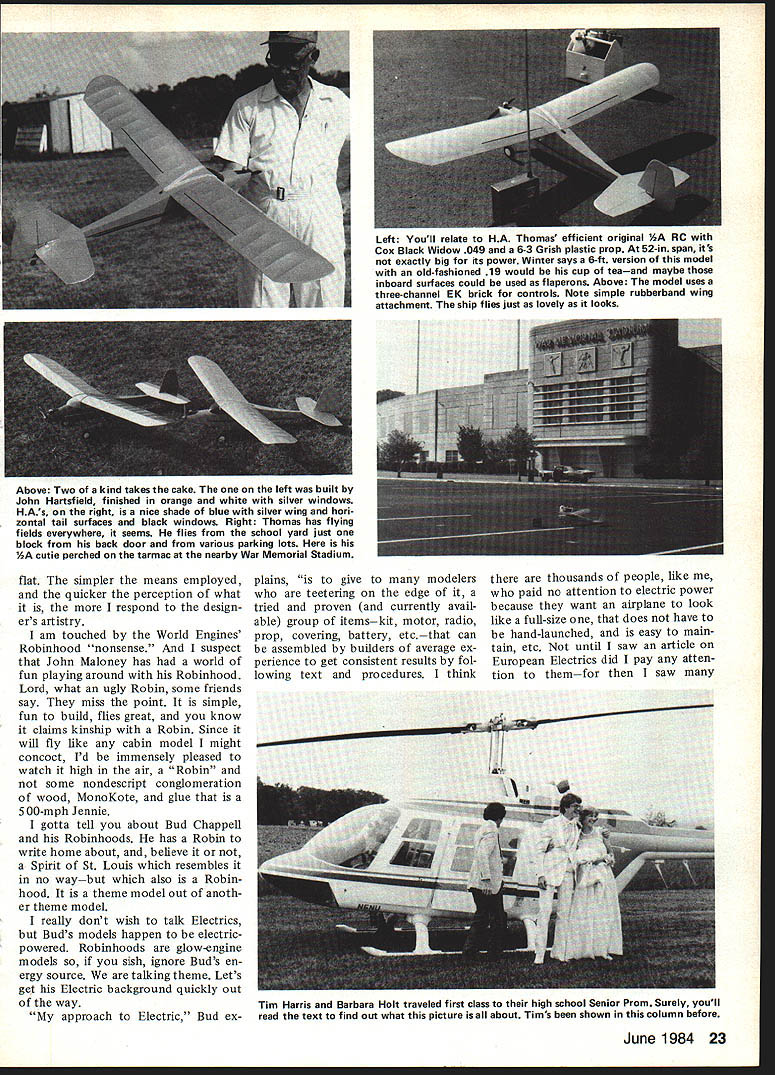
"For the past 10 days, I have been enjoying RC as never before," writes H. A. Thomas of Little Rock. "The little Black Widow silver-and-blue model must have 35–40 flights, each one a delight." My private airport, the high school ground, is about 100 ft. from his back door, and he gets in a batch of flights almost every late afternoon, sometimes almost by moonlight. He finds he has room to burn, and the field looked so small at one time. The other afternoon they had two giant sprinklers which occupied half the field, so he flew with no trouble on the other half.
Somehow, he's stumbled onto just the right combo of light weight, ample span (52 in.), and area, and fairly clean lines. The energetic Black Widow does the rest. The ship soars readily, loops easily, and spins like a top, but it recovers immediately when you neutralize. It tracks great, has no vices, trims for straight flight easily, and it is a pleasure to fly. The Grish 6-3 prop, cleaned up, steel-woolled, and sprayed with black Rust-Oleum, is the best performing one he's ever used. This little ship carries an EK Brick three-channel with an extra servo and a big 500 mAh battery, and it is still light.
About that Black Widow: after two Dragonfly engines proved to be disasters, he found the BW in a dealer's showcase where it had sat for years. It runs like a dream, is simple, and starts on the first flip. I've watched countless folks beating props to death trying to start 1/2A engines, coupled with desperate wild screwing in and out of the needle. Those in the know use fine-thread needles and high-nitro fuel. You can run on 10%, but I wouldn't fuss with less than 15% nitro; usually, special fuels go as high as 40% nitro. Thomas advises that he gets instant starts from the recoil spring starter using the small can of high-nitro fuel sold for small engines.
H. A. Thomas is a very special guy. I bought his first magazine submission in 1938. With the exception of columnists, he probably was published more than any man alive, and he will always be remembered for the magnificent two-page "Sketch Book" which ran for perhaps 25 years in the old Air Trails, later the American Modeler. He is a complete artist with the pen and he retired from his own ad agency. I know he was a wing-walker and parachutist in the days of forgotten biplanes. He's good with model sailplanes, too, and cute rubber stuff with a distinctive flair. In 45 years of editing, I would be hard-pressed to choose between H. A. and the late Cal Smith as my all-time favorite, money-in-the-bank artist and singer/flying contributor. It pleases me no end to show you pictures of his work.
The continuing saga of young Tim Harris
Those of you still standing at attention may remember Henry Haffke's story about spotting a youngster flying a glider in a field close to Covente's plant. What the kid was doing with the glider led us to present pictures so skeptical readers would buy the tall tale. This lad was hand-launching the big bird and then doing a repertoire of aerobatics, including inverted flight, with the ship buzzing around his head like a benign bee. Naturally, Henry hired the lad.
Before he left high school, Tim Harris had acquired his full-scale license to fly powered aircraft and helicopters. When Henry first spotted him, Tim already had his full-size sailplane license. When Tim graduated last June from Dublin High School (Pennsylvania), he did what came naturally and escorted his date, Barbara Holt, to the Senior Prom—in a helicopter! Tim got his instructor to land the chopper in a neighbor's yard to pick up the young couple for what has to be the world's classiest arrival at any school prom. Tim is now training in Aerospace at Virginia Tech, and Barbara Holt attends Radford, pursuing an education in music.
The Seekonk Air Force
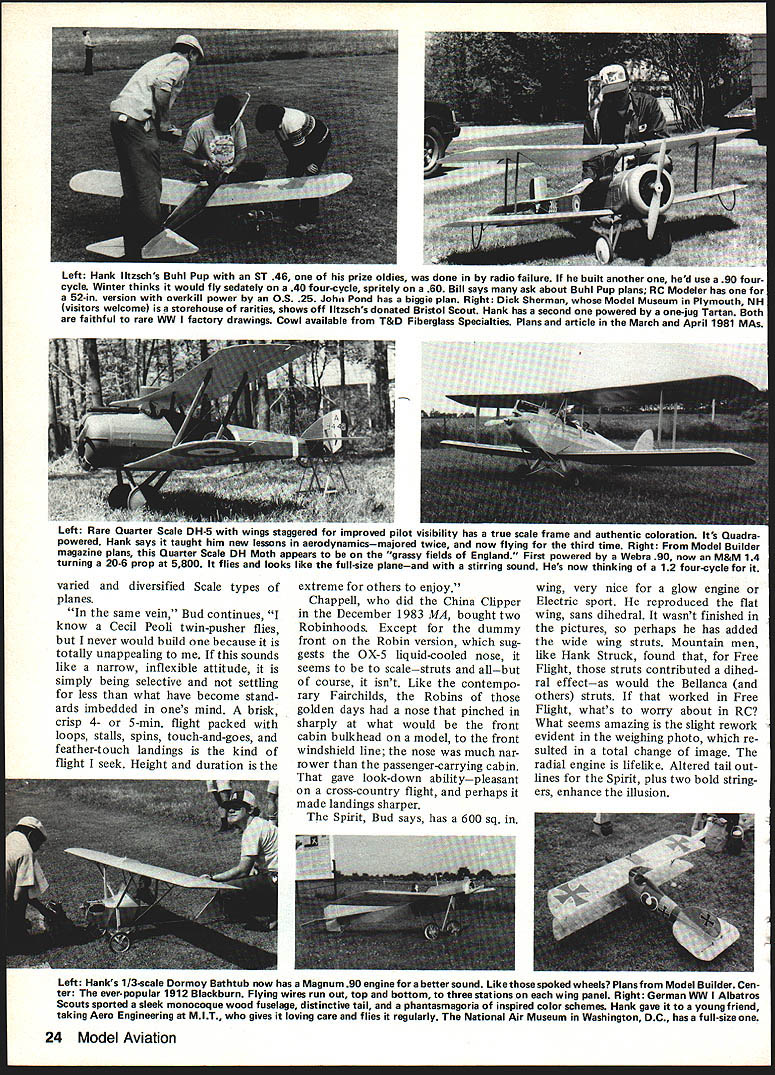
Hank Ilzsch's fleet of airplanes, mostly scale and ranging from big to bigger, is a population explosion. Six years ago, when Hank submitted a huge Bristol Scout to Model Aviation, I assumed the project was the culmination of a lifetime. Confronted with the problem of printing—requiring huge reductions without lines and lettering vanishing—and soon to retire, I figured Wheely would solve the puzzle. He came up with a two-part presentation in the March and April issues of 1981 (plans for the .91-powered model are still available). Hank has his "Confederate Air Force" of benevolent giants as well as a minestrone soup of things like Powerhouses, Red Zephyrs, and Falcons.
The Bristol was based on information supplied by Leo O'Doycke, world renowned in such circles for his publication of the WW I Aero Journal. Leo, then building a full-scale Scout, provided Hank with factory drawings. Hank knew about as much chance of finding detailed factory drawings of many WW I subjects as the Spaniards did in chasing the fabled Fountain of Youth. Even while firming up his rough plans for Model Aviation, Hank was building a second Scout. Several months ago, Hank presented the first to Dick Sherman, the ex-airline and glider pilot who turned his home into an incredible modeling museum (visitors welcome: Plymouth, NH).
After seeking sanctuary from the slam-dunking world of editing, I discovered another mystery in the Ilzsch ghostly armada. There had been photos of an uncovered DH-5. The DH-5, which the British did not have much luck with, was prophetic of the Beech Staggerwing of the Thirties in that it had generous negative stagger. Some modelers know that negative stagger works well, although it scares most of us. The DH-5's so-so performance probably can be laid to typical snares of the day. The reason for the then-odd configuration is evident from Hank's pictures: the DH-5 put the cockpit under the leading edge of the rear-shifted top wing, giving the pilot exceptional visibility.
"I have been struggling with a Quarter Scale DH-5," Hank confides. "It is apparent to me why this plane is seldom done. It has been a hard-learned lesson in aerodynamics, but it will turn out OK. Other than the usual sorting out of problems, I had two major shocks. One was when the starboard wing folded coming out of a Split-S — a tough plane even though it went straight in from the top. The other little shock was the realization that I, like most modelers, am an airplane watcher.
"I won't start anything like that again," Hank concludes—but adds: "...but I constantly find myself poring over drawings. So I think I will do it all again, because pain and distress are soon forgotten when we finally achieve success." When Hank is satisfied, his DH-5 will appear in Model Builder magazine.
"My stable of aircraft is getting larger," Hank continues, "and my leaning toward four-cycle engines is very strong. I now have them in seven planes:
- a Saito .40 in a Scientific Mercury (a Ben Shereshaw beauty);
- an O.S. .60 on my second Taibi Powerhouse (messing with an ignition conversion);
- an O.S. Twin on my Quarter Scale Aeronca C-3 (the 'Bathtub');
- a Magnum .90 on my 1924 Dormoy;
- my test bed, a Stand-Off Scale DH-4 based on a Boddington (England) design, has an Enya .90."
It's fun looking at so many photos of a versatile builder's output, but it's downright painful trying to pick out a representative selection. He mentions many fun-type things not in the photo collection. One is a Quarter Scale Super Stearman with a Kioritz 2.4, "a striking plane on the ground and in the air." Another, one I have always wanted to build for more years than I can remember, is a Dallaire Sportster Antique with an O.S. .40 four-cycle. Joe Dallaire, with a long career in various areas of our hobby trade, was an inspirational pioneer in the days of what we now call the Antiques and Old-Timers. His Sportster was a huge, boxy cabin model with classic lines, a favorite with SAM-type guys who relive the great deeds of long ago.
I love the Sportster. John Pond has plans. It is a neat-looking, fabulous flier—easy to build in spite of its size. Hank's weighs only 8 lb. for a 12-oz. wing loading. Among the unpictured odds and ends are things like an ST .23-powered Butterfly, a .40 Senior Falcon for the "kids," Powerhouses, Red Zephyrs, and off-beat originals. As much as I build, I am awed by the incredible achievements of folks like Ilzsch and his Seekonk Air Force.
Scrap box
Up to your ears in hard-sell? After churning through 21 reviews of this and that, I think "a plague on all their houses." But publicity and promotion are essential for those who take the risks that provide publication and products indispensable to our pleasure. Many reviews help, but some are ho-hum.
I worry about those little guys whose nice things are tucked away in so many columns. We are all hesitant about sending off for anything we can't see and feel, no matter how intriguing it sounds. Sample products—solder, debonders (for instant glue), and gadgets—as well as exciting catalogs, pamphlets, and releases arrive almost daily. I don't do product reviews; I like many things and I try some. I hand off others to modelers from whom I get opinions, and squirrel away much that I think I'll try, build, or fly.
I knew next to nothing about Full Command Systems in Spokane, WA. A letter states optimistically, "We at Full Command Systems have been trying very hard to help improve the RC industry by adding totally new designs or improving those already available." Well, why not check it out? Bryan Batch, the manager, describes their effort as adding all necessary items to supply every part from prop to tail, for boats, cars, choppers, as well as aircraft. Besides their own radio system (FCS) and a mess of servos and other company items, they offer a wide range of accessories and support aimed at helping modelers get the most from their equipment.
Full Command sent me a complete line of Master fuel tanks, which fortify a favorable impression. Made of polyethylene (OK for gasoline, too), from 1 to 16 oz. capacity, the front end combines the Sullivan-type slant and the toe as pioneered by Kraft. Bores are molded to provide a generous passageway for pushrods and other items. The tank has a tab at the back handy for removing it from a model. I've used it to insert through a slot in a plywood mounting, then glued another small tab to thin ply across the bottom of the slot so the tank is suspended in space at the rear. The cap is said to be of anti-split design. (Full Command Systems, 908 E. Rosewood, Spokane, WA 99208.)
For two bucks, Proctor's General Catalog is a must for giant scalers or anyone who needs turnbuckles, steel wires, and fittings. Besides the super Proctor kits—you probably know about them—there's an infinity of hardware: cable anchor fittings, wires and cables, pulleys and blocks, turnbuckles and eye bolts, cockpit accessories, giant scale spoked wheels, instrument housings, machine gun kits, etc. It's like an old-fashioned hardware store where you could find anything imaginable. Lou Proctor was one of a kind, and so is his business. (Proctor, P.O. Box 1333, La Jolla, CA 92038.)
I've mentioned Dick Gleason before; he has several columnists, but since then I have had a ball with this guy and his scale services. He calls himself the Scale Model Plan Finder. Maybe he is Superman. He is a dedicated light in the wilderness, an old-timer in full-scale aviation, too (he's a licensed A & E), off the beaten track in Minnesota, and he has the ability of Santa to come down a million chimneys while we sleep. He's got a 24-page catalog listing a vast number of items, ranging from many hundreds of full-size plans, listed according to designers, magazines, and manufacturers. He offers a search service of sources on over 1,900 models and 625 makers of aircraft. You want a scale three-view—ask him. Aircraft engine drawings, too. Back issues of mags into the dim past. He may have redrawn many old model plans; his work is professional and neat.
Gleason corrects previous errors as he goes—like some bulkhead notches in my Waco D and Grumman F3F—and improves scale accuracy, even adding things like guns and bomb racks. He claims to have 99% of the scale plans published over the past 50 years. If you merely want a source, he'll provide that at $1.00 for the first model, 50 cents for each additional in the same request. (Gleason Enterprises, 1704 29th Ave. S.E., Rt. 2 Box 125, Austin, MN 55912.)
United Parcel Service (UPS) leaves strange boxes at my door. One contained a flat red plastic jug with a molded handle and screw cap. Big black letters read Klasse. A note from Dave Herbert at KDH Distributing (P.O. Box 16443, San Juan Capistrano, CA 92693) said he was handling a new line of products imported from Germany. Dave said it worked wonders on MonoKote. I tentatively tried and rubbed spots here and there. Goodness! Two new ships polished up and glistened. It costs $15.95 for 300 milliliters (10.6 oz.) and also comes in 600 and 1,000 ml sizes—but a little dab will do.
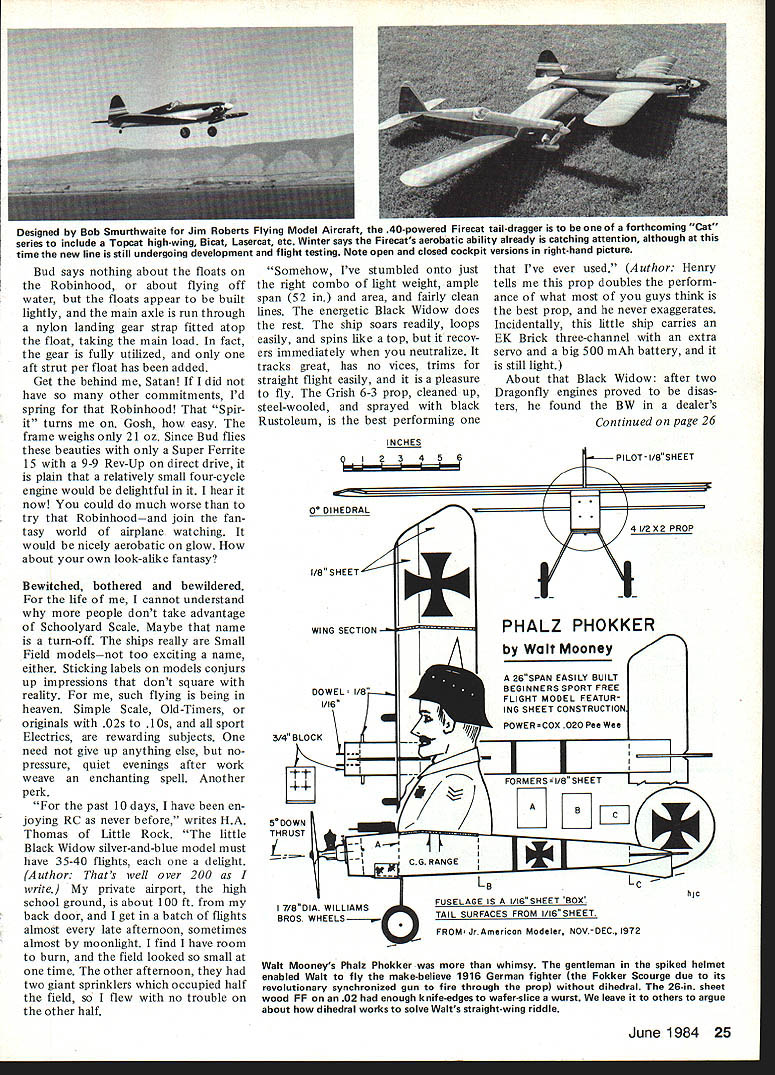
I've talked a lot about the G-S Products' Stinson and Howard .40-powered scale jobs, engineered by Bob Smurthwaite. If you are one of those who has wondered where Bob disappeared to, let me tell you. On September 24, 1981 his company was trashed by a mob of 30 idiots. Bob almost lost his wife that night, and he did lose over $125,000 in tooling and inventory. He'll never be able to produce those kits again.
Bob finally joined hands with Tom Payne, owner of Jim Roberts Flying Model Aircraft. Bob is design/development; the two are well on their way to production of a "Cat" series of .40-power, nice-flying tail-draggers with many innovative features.
Transcribed from original scans by AI. Minor OCR errors may remain.

