
Just For the Fun of It
Bill Winter
Several years ago I received a note from Ward Maitre of Hollywood, MD. "I've enclosed a Xeroxed picture of a three‑channel airplane that was shown on the index page of a 1975 Sport Modeler which listed you as editor. Can you recall anything about the airplane—its size, engine, and availability of the plans?" He added, almost as an afterthought, "I used Dave Robelen's Pronto plan, areas, and moments, and tried to duplicate the fuselage shape. It made a fine three‑channel flier, but working from such a small picture, I wonder how close I came to the original."
The thumbnail picture in Sport Modeler did reveal a very attractive low‑wing sport model. I searched my bound volumes of Junior Modeler and Sport Modeler (the former later evolved into the latter) but could not find the mystery plane. Since the picture was on the contents page of the February 1975 issue with a heading of "In the next issue," I suspected the announced issue might not have been produced or that material intended for Sport Modeler later appeared in American Modeler after the publisher, Potomac Aviation Publications, moved from Washington, D.C., to Reno, NV. If anyone has a March 1975 issue of Sport Modeler, Ward and I would like to know about that plane.
After a long delay Maitre wrote again, enclosing Xerox copies of a Pronto plan—plans that initially did not register with me—saying he had been flying it since 1975 with a .15 or .19. What surprised me was that his working drawings showed he had modified the fuselage to make a shoulder‑wing, then a high‑wing version by adding a 1‑inch‑high cabin top to the fuselage (a la the old Midwest Esquire). He added, "I am currently enlarging the plan (Author: This was October 1982) to a 56‑in. version for a Fox .36 using a Swizzle Stick wing from Balsa U.S.A. and reducing the plans to a 40‑incher for an .09." He was considering a 90‑in. Pronto "for the big plane craze," resembling a single‑place home‑built with a Fox .60 for power.
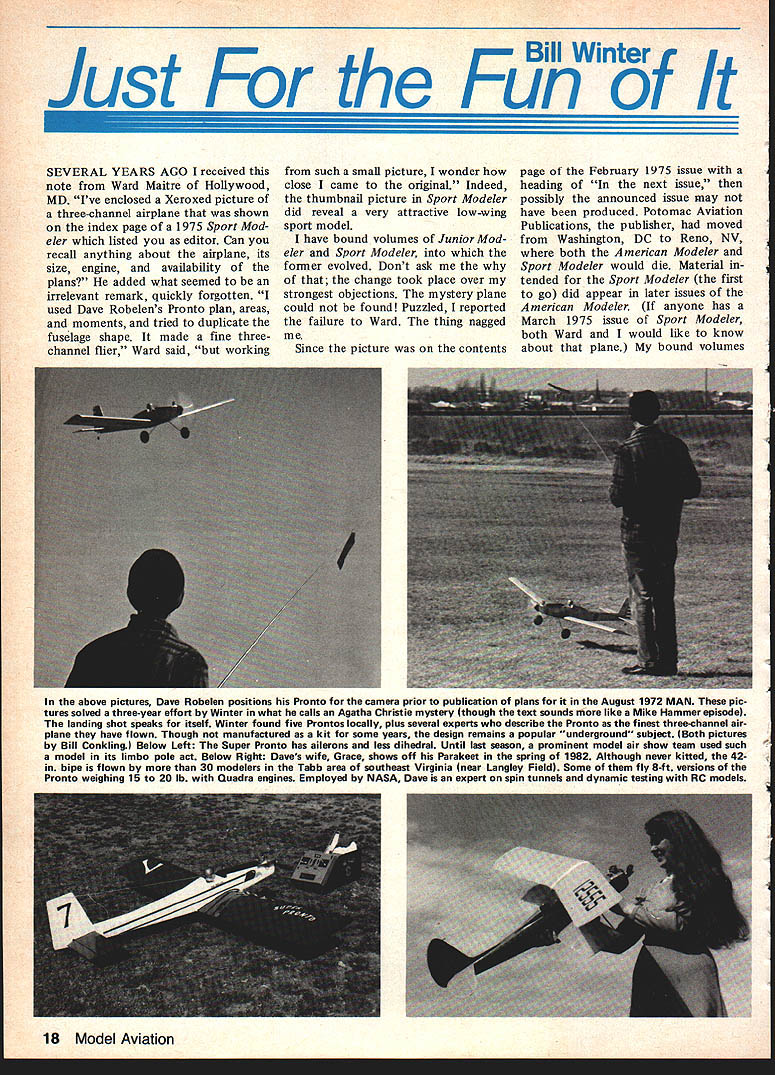
Maitre's file grew into a giant envelope marked "Unfinished Business" containing cut‑up plans of a Pronto. Time passed and the Pronto plans were forgotten, but the mystery nagged me. I fished out Ward's tear sheets from another magazine, but many magazines omit identifying running heads and change formats often, so I could only guess at the source. The photos in the Pronto article fascinated me—the plane was ingeniously simple and functional, bearing a good designer's touch. The sequence of clear photos looked like a presentation from RCM, so I wrote to them. Dick Kidd of RCM searched plans lists and said they hadn't published it. Later he found a kit review of the Pronto in a 1975 issue: Tidewater Hobby Enterprises had produced a kit, but the company was out of business.
One day at the flying field I saw a cute, strange low‑winger. The fellow told me he'd made it from an old kit plan—it was a Pronto. Among local club members I found five Prontos still being flown. A sixth had been scaled up from a prekit picture and was so close to the authentic planes it could not be distinguished from them. One was used as late as last year in a show team's limbo‑pole act. I even came across a Super Pronto with ailerons. The Pronto and its variants have become almost an "underground" subject—popular well beyond the original kit's lifespan.
Why am I telling this story? As I located members of our 250‑man club who had Prontos or Super Prontos, I noticed that all—some of them past‑presidents—were superb pilots. Each told me, unasked, that the Pronto was the finest three‑channel airplane he had ever flown. The enthusiasm was infectious.
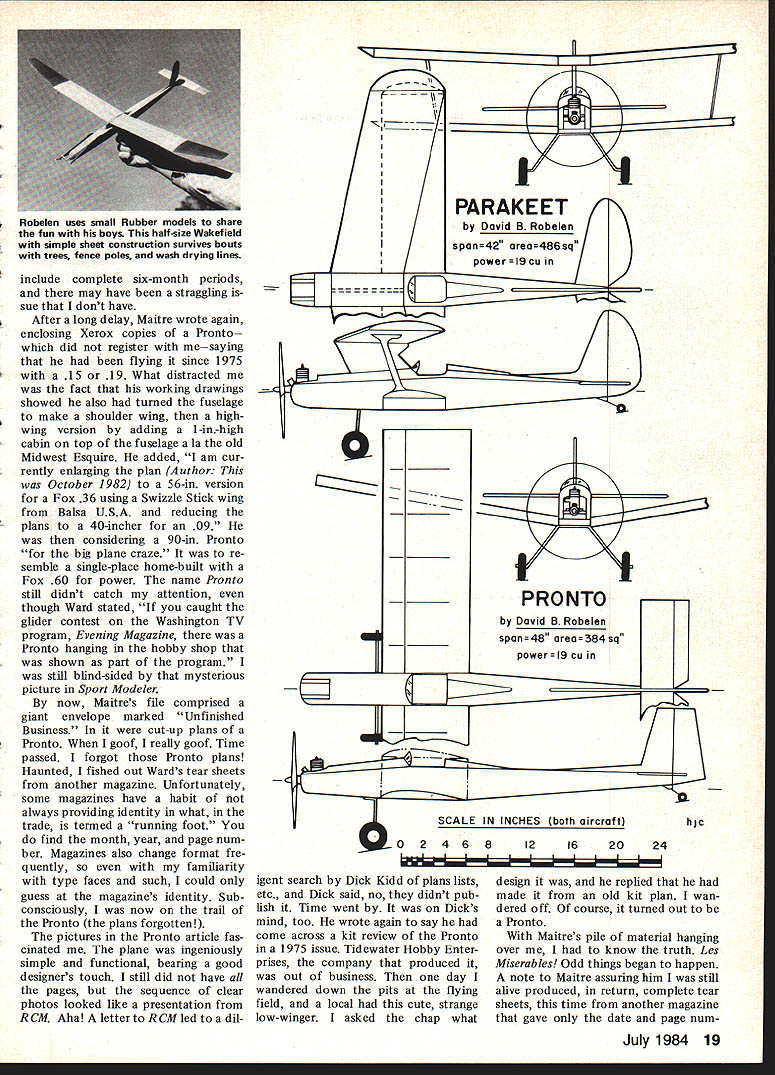
Those who know the Pronto may chuckle, but you might not know there is a biplane Pronto called the Parakeet. In the Tabb (Virginia) area, some 30‑odd Parakeets are flying (the plan is to be published in a future Model Aviation), along with assorted Prontos and Supers, including a gaggle of eight‑footers equipped with Quadra engines. I have an 8‑ft. lightweight low‑winger that climbs well and flies fine on only a K&B Veco .19. The Quadra crowd in Tabb likes to go to the lumberyard and cut up timbers—those Prontos or Supers wind up at about 15 to 20 lb to take the "giant" engines. They fly all this at an in‑town site close to a highway.
Dave Robelen and Tidewater
Dave Robelen is low‑profile, a career man at NASA, and one of the cleverest minds among modeling's old‑timers. The Langley Field (Virginia) area has produced many famous modeling experts per capita. Among those associated with the area were:
- Sal Taibi
- Bob Chambre
- Hewitt Phillips
- Caldwell Johnson
- Woody Blanchard
- John Worth
Robelen is a specialist in indoor tunnels and dynamic scale RC models and an authority on flight characteristics. He developed tiny RC actuators and worked on many tiny landmark RC models. You may remember his spin tunnel—a home‑built device in which he tested characteristics of many well‑known aircraft in miniature (see March 1980 Model Aviation). He published designs such as the Prophet in American Modeler in the late Sixties (a 24‑in. span, 7½‑oz. miniature of Bill Winter's Rookie, powered by an .02), and his Pipsqueak appeared years ago.
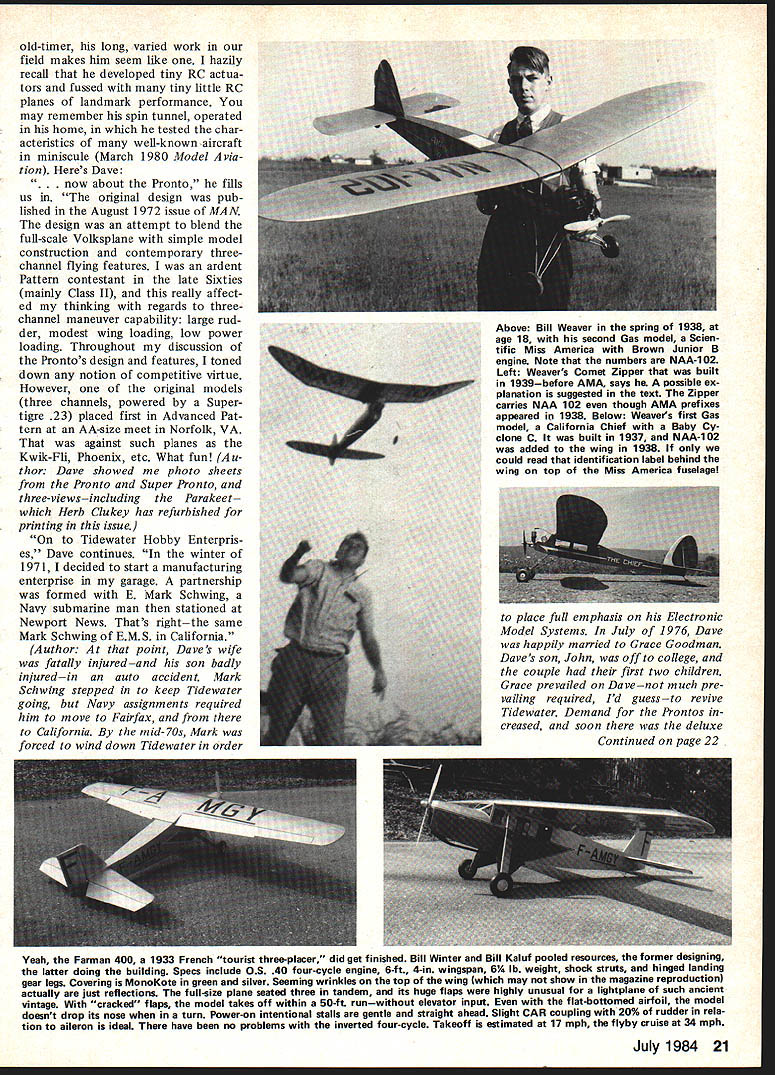
About the Pronto, Robelen writes: the original design was published in the August 1972 issue of Model Airplane News (MAN). He attempted to blend the full‑scale Volksplane with simple model construction and contemporary three‑channel flying features. His Pattern background influenced the Pronto’s characteristics: large rudder, modest wing loading, and low power loading. One original model (three channels, Supertigre .23) placed first in Advanced Pattern at an A‑size meet in Norfolk, VA—beating planes such as the Kwik‑Fli and Phoenix.
In the winter of 1971 Robelen decided to start a manufacturing enterprise in his garage. A partnership was formed with E. Mark Schwing, a Navy man then at Newport News—the same Mark Schwing of E.M.S. (Electronic Model Systems) in California. After a tragic auto accident in which Dave's wife was fatally injured and his son badly hurt, Mark Schwing stepped in to keep Tidewater going. Later Navy assignments moved Mark to Fairfax and then California; by the mid‑70s he wound down Tidewater to focus on E.M.S.
In July 1976 Dave remarried (Grace Goodman) and the family grew. Grace persuaded Dave to revive Tidewater as demand for the Prontos increased and the deluxe Super Pronto with ailerons appeared. A modeling buddy, Chuck Cusick, helped with wood cutting and shipping; Chuck later became a pastor. With family responsibilities and full‑time work at NASA, Dave eventually stopped production—"the brood of mine needs a good father much more than a super‑modeler, kit manufacturer, and sometimes‑dad," he explained.
Robelen also developed a biplane version of the Pronto called the Parakeet, a simple sport biplane embodying many Pronto features. His spin tunnel work grew more sophisticated, and NASA installed a copy of his tunnel at the Langley Visitor Center. His current modeling activity shifted toward small rubber models, helping his boys build such models as the AMA Cub and Ranger 21 and scratch‑building a little Wakefield look‑alike that flew well.
If you'd like to investigate the Super Pronto further, Dave notes that the Corkscrew (Stu Richmond design) published in the January 1983 RC Modeler is similar—an attractive sport/aerobatic ship for a .19 to .30 with a sturdy dowel leading edge, reminiscent of the Pronto and the low‑wing Eaglet.
Dave was central in the development of lightweight RC systems and tiny RC models. He and Woody Blanchard flew tiny models under lights between 10 p.m. and midnight in a shopping center parking lot, including a 13‑in. SE‑5 and other micro models weighing as little as 3 oz. He also experimented with pulsed‑relay actuators and early multi‑channel tricks (Kicking Duck, Galloping Ghost, WAG systems).
All of this interest in early RC proportional systems ties together names such as Ed Lorenz, Howard McEntee, John Worth, Walt Good, and Jerry Pullen—men who shaped proportional as we know it.
A few of us expect to fly with the Tabb guys; Dave's dad, Horace, is active in the Richmond area at age 73. What began as Ward Maitre's curiosity about a picture has led to an entire local scene of enthusiastic Pronto fliers. Don't ever stare at a photo!
I think I've lost my marbles.
Who Is Number One?
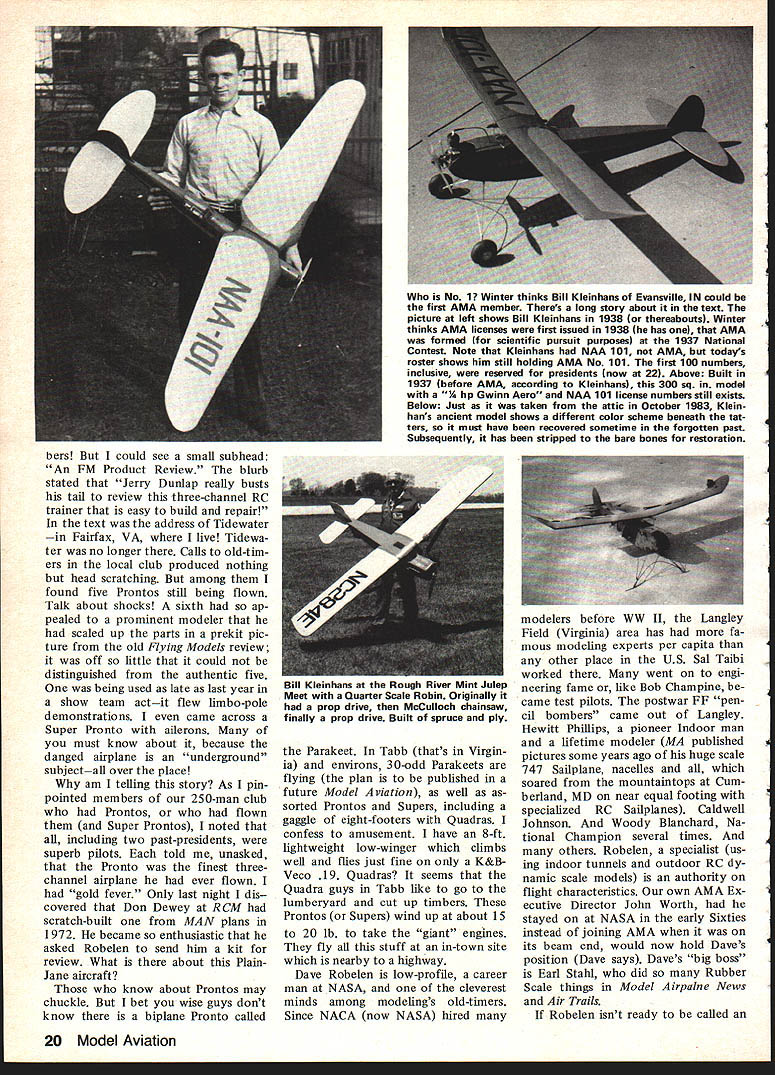
Ever wonder who was our first licensed AMA member? During the mid‑1930s, when Charlie Grant edited Model Airplane News, a newspaper syndicate that sponsored nationwide model competition took a dim view of new gas‑powered planes. After two states barred gas models, Charlie formed the International Gas Model Airplane Association (IGMAA). When IGMAA membership grew, he turned it over to the National Aeronautic Association, which passed it to the newly formed AMA. The first AMA number could have been issued in 1938.
The present allocation of the first 100 numbers (inclusive) for presidents was in place from the beginning. The current president is No. 22, so the first membership number cannot be lower than 101. I theorized organizations often avoid issuing No. 1 and might start at a number like 101. Later AMA policy reserved three‑digit numbers for Contest Directors, so many three‑digit numbers have been reissued over the years. Some old‑timers still hold authentic three‑digit numbers; some have passed on or dropped out. I lost my number for years when I forgot to pay dues, but it was later restored.
I first heard about Bill Kleinhans in a letter from Fred Williams of Evansville, IN. Fred, 50, who coaches high school soccer and maintains antique cars, puts out the newsletter for the 55‑member Thermal Thumbers Club, which has a 26‑acre flying site with a four‑acre lake and a lease costing $1 a year. Fred mentioned a phenom old‑timer, Bill Kleinhans, who holds AMA license No. 101. A check of the AMA membership roster shows Kleinhans has held 101 since the 1930s.
Fred prepared the following notes about Bill:
- Bill graduated from high school in 1938 but had already built rubber‑powered models in the early 1930s.
- He received Certificate No. 29 from the Gas Model Pioneers, signed by Charles H. Grant.
- He obtained the AMA 101 card in February 1938 while in high school and belonged to the International Gas Model Association of America (sponsored by Model Airplane News) around September 1937.
- His first gas model was a Scientific Red Zephyr kit. His second is the plane he still has—the Flying Midget (recently featured in the August 1983 Model Builder).
- He won his first contest in Henderson, KY, in 1940 using a Baby Playboy with Atom power.
- His first control‑line plane was a Baby Stanzel Shark with O&R .23.
Bill worked for NACA at Langley Field when Pearl Harbor hit—likely as a model maker in the flight test hangar. He then went to Republic Aviation, followed by military service as an aviation cadet. He trained at Amarillo, TX to be a B‑29 flight engineer; the training was canceled by the end of the war. He did some control‑line flying while in Texas.
After the war he built and flew nearly everything—free flight, rubber, control line—and entered RC about 1956 or 1957. He was a leader in forming the first local club, the Thermal Thumbers (mostly free flight) in 1946. That club led to the Air Whirlers (mostly control line) and later evolved into the Evansville RC Club. Bill remains one of the elder statesmen still active, now mostly in RC but occasionally building other types.
Fred reports Bill is a master at devising simple solutions to engineering problems, teaching many local modelers over decades. He builds mostly RC scale and giant scale. He keeps a list of every RC plane he has built and marks each plane with its number; the count stands near 75. His newest is a Fieseler Storch from a European kit that he had to adapt.
Transcribed from original scans by AI. Minor OCR errors may remain.

