
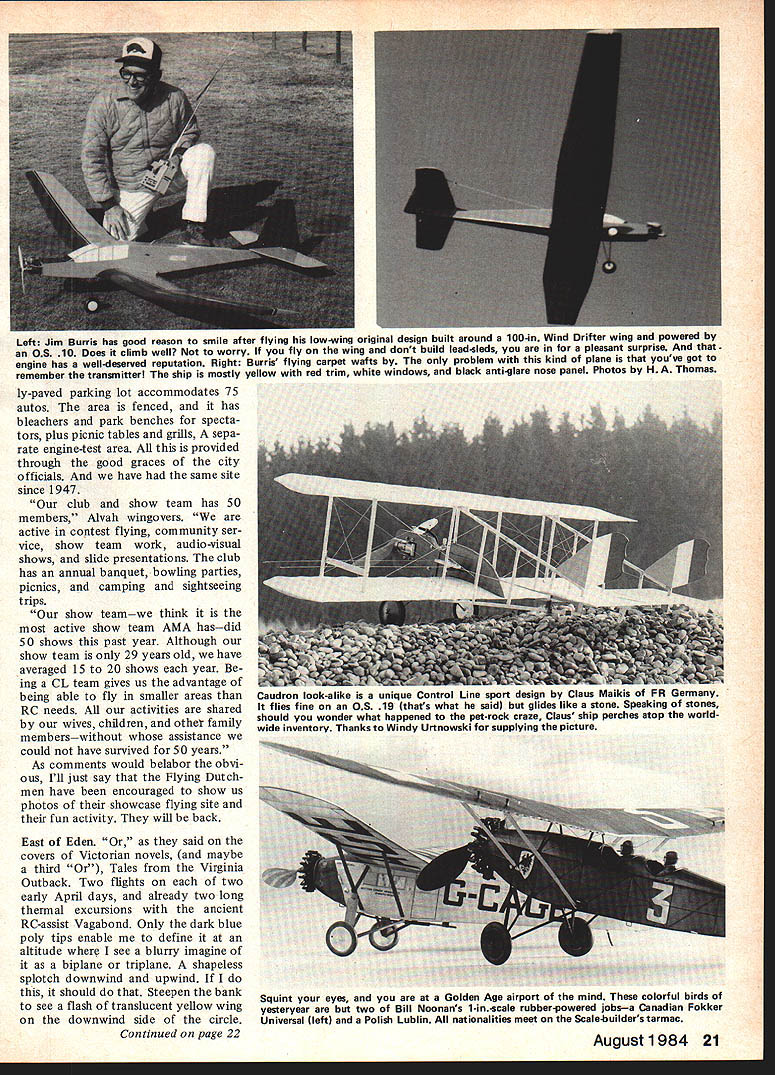

Just For the Fun of It
Bill Winter
Moonless Madness
When I fly these days, I expect to be transported to the flying site in a curtained sedan chair. I don't want the weather too cold or too hot. It must not be windy. The grass must be neatly mowed. The pin I need must be labeled “Reserved.” Kindly guys must assemble my plane, do a range check, and set the idle. Pour me another coffee, light my pipe. Play it again, Sam!
It was not always thus. In the days of Charlemagne, neither wind, nor cold, nor snow nor sleet stayed our appointed rounds. The natives of far-off Cathay, beyond the Sierras, and the Sun Belt know nothing of the lives of snowbirds and polar bears. Or Vikings.
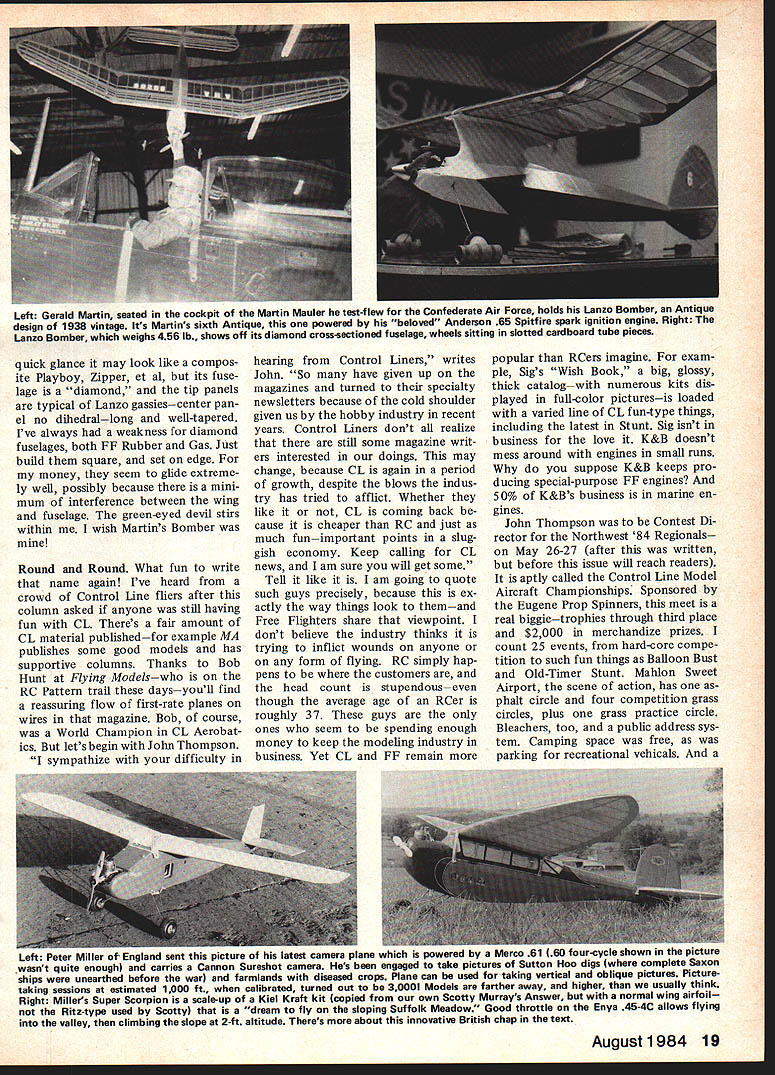
The gentleman with the horns in the picture is Lloyd “Pete” Peterson. No, the snow really is not that deep. The caption says, “Don't fall in the creek, Pete!” Pete? “What creek?” The occasion was the First Annual February 29 Spur-of-the-Moment Fun Fly.
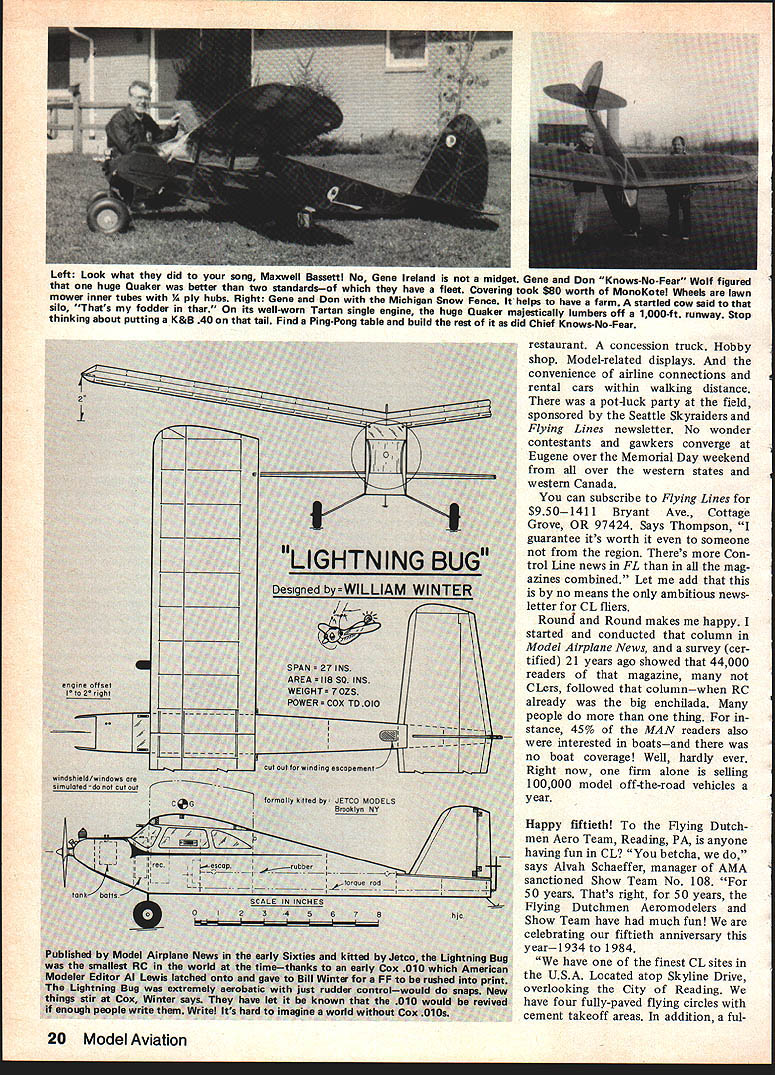
The decision to fly was made in spite of wind and snow “because it will be a long time before we get another February 29 like this,” writes Pete Peterson. The afternoon was another activity of Uff-Da Air, a splinter group of the Vincennes-based TriCounty Aero Club. This group also sponsors and participates in Moonless Madness, a dark-night sailplane event (the pictures didn't turn out), and the Dining Tarp Flyoff at the Spring Glider Contest. Just having a little fun on a beautiful winter day. Flight times were short.
Phone reservations are now being accepted for the Second Annual February 29 Spur-of-the-Moment Fun Fly.
Think About It
When various writers tell me to “Think about it,” my eyes glow red. What in the dickens do such writers think I am doing? So … think about it. Leap Year — you got it at long last?
Look Away, Look Away — Dixieland
I was born in Jersey, lived in New York and Brooklyn (as well as in the boondocks), but I have just learned the Rebel Yell. Gerald Martin made me do it. He writes on the letterhead of the Hereford Flying Ag. Service in Texas. He recently test-flew the Martin Mauler (AM-1) for the Confederate Air Force when the accompanying pictures were snapped. You'd expect he would fly 100-mph model bombs, passion for antiques. Since the Mauler (he says he really doesn't care much for that name) is a hoary 31 years beyond its last previous flight, he thinks of it as an antique.
The other antique is his sixth, a 1938 Chet Lanzo Bomber powered by his beloved Anderson .65 spark-ignition engine. “I sure like the way it performs,” Gerry states. He bought the plans from Chet and cut all the sticks to size himself for a fun project. The Bomber comes out at 4.65 lb and an 8.34 oz/ft² wing loading. Gerry isn’t sure what the horsepower rating is on the Anderson, but for comparison he notes the Pratt & Whitney “Corncob” — a 28-cylinder, 4,360 cu. in. engine rated at 3,000 horsepower.
You can't tell the Bomber's colors clearly from the photo, but it appears to be MonoKoted with translucent yellow on the wing and tail, red on the fuselage, and generous white trim forward.
Control Line, Free Flight, and Newsletters
Many control-line fliers have turned to specialty newsletters because mainstream magazines have given them the cold shoulder in recent years. Control Line (CL) is again in a period of growth despite blows from the hobby industry. Whether the industry likes it or not, CL is coming back because it is cheaper than R/C and just as much fun—important points in a sluggish economy. Keep calling for CL news, and you’ll get some.
The modeling industry still supports CL and free flight in various ways: Sig’s glossy “Wish Book” carries an array of CL kits, K&B continues to produce specialized free-flight engines, and many small firms serve niche markets. There are also ambitious regional newsletters that cover CL in depth.
Northwest '84 Regionals
John Thompson was to be Contest Director for the Northwest ’84 Regionals (Control Line Model Aircraft Championships), sponsored by the Eugene Prop Spinners. This meet is a real biggie, with trophies through third place and $2,000 in merchandise prizes. It counts 25 events, from hard-core competition to fun events such as Balloon Bust and Old-Timer Stunt.
Mahlon Sweet Airport, the scene of action, featured:
- one asphalt circle and four competition grass circles, plus one grass practice circle
- bleachers and a public-address system
- free camping space and parking for recreational vehicles
- a restaurant, concession truck, hobby shop, and model-related displays
- convenient airline connections and rental cars within walking distance
There was a pot-luck party at the field, sponsored by the Seattle Skyliners and the Flying Lines newsletter. No wonder contestants and gawkers converge on Eugene over Memorial Day weekend from all over the western states and western Canada.
You can subscribe to Flying Lines for $9.50 — 1411 Bryant Ave., Cottage Grove, OR 97424. “I guarantee it's worth it even to someone not from the region,” says Thompson. “There's more Control Line news in FL than in all the magazines combined.”
Round and Round
I started and conducted the “Round and Round” column in Model Airplane News. A certified survey 21 years ago showed that 44,000 readers of that magazine, many not CLers, followed that column—when R/C already was the big enchilada. Many people do more than one thing; for instance, 45% of MAN readers also were interested in boats even though there was little boat coverage.
Flying Clubs and Anniversaries
Happy Fiftieth — The Flying Dutchmen
To the Flying Dutchmen Aero Team of Reading, PA: “Anyone having fun in CL? You betcha, we do,” says Alvah Schaeffer, manager of AMA-sanctioned Show Team No. 108. “For 50 years. That’s right, for 50 years, the Flying Dutchmen Aeromodelers and Show Team have had much fun! We are celebrating our fiftieth anniversary this year—1934 to 1984.”
Their C/L site is atop Skyline Drive, overlooking the City of Reading. They have four fully paved flying circles with cement takeoff areas, a fully paved parking lot for 75 autos, fencing, bleachers and park benches for spectators, picnic tables and grills, and a separate engine-test area. All this is provided through the good graces of city officials, and they have had the same site since 1947.
“Our club and show team has 50 members,” says Schaeffer. “We are active in contest flying, community service, show team work, audio-visual shows, and slide presentations. The club has an annual banquet, bowling parties, picnics, and camping and sightseeing trips.
“Our show team—we think it is the most active show team AMA has—did 50 shows this past year. Although our show team is only 29 years old, we have averaged 15 to 20 shows each year. Being a CL team gives us the advantage of being able to fly in smaller areas than RC needs. All our activities are shared by our wives, children, and other family members—without whose assistance we could not have survived for 50 years.”
They’ll be showing photos of their showcase flying site and fun activity in a future issue.
East of Eden — R/C-Assist and Design Notes
Thermal Flights and Vagabond
Two flights on each of two early April days produced two long thermal excursions with the ancient R/C-assist Vagabond. Only the dark-blue poly tips enable me to define it at altitude, where I see a blurry image that could be a biplane or triplane. Endless 360s turn into long crosswind ellipses before heading for terra firma, then floating off the end of the grass. Why do I bother with anything else?
I can't fly cranky stuff worth a hoot anymore, but the experts second-guess me. At every 360 late on final, they twitch and predict doom. “You'll never make it,” they say. They give up after a while, avowing they never could get down such a plane. It's a flicker of upmanship.
Channel Interference and Receiver Checks
I've found that the channels other guys fly on can affect my model even when they're not on my channel. Merlin gave me the lowdown about unexplained hits. Always check your receiver tuning after a crystal change—do that before flying.
The Eagle (Kaulf's Modifications)
I traded an old Futaba and an OS .40 four-cycle to Bill Kaulf (40 miles south) to have him build me an Eagle. He removed positive incidence from the stabilizer and substituted a “lifting-type” stab, and moved the balance point back a tad. Kaulf makes his flaps so their chord extends a little behind the wing trailing edge and aligns the top surface of the flaps with the top wing camber. From the bottom, you have a slight flaps-down when in flaps-up mode. This produces a washout effect, much appreciated by an approach bunger like me. In combination with the lifting stab, one can loaf along in a lazy cruise.
“How deep should I make the stab airfoil?” Kaulf asked. Since he had a Telemaster with a lifting stab, the suggestion was to follow the same ratios of wing and stab percentage depths.
Bill Evans and the Simitar (Slo-motion)
Bill Evans’s planes look like X-ships intended for a future Star Wars. I asked Bill for a slow, light ship: 5- to 6-ft. wing, no more than a .19, a taildragger, lightweight, and capable of easy soaring. Sketches flew back and forth while Bill made five evolutionary planes in the process.
Bill reports his latest, on a Cox .15, has a 5-oz. loading and flies off his hand (no landing gear—just skids) without assistance. He has thermaled with gulls at Bishop in high wind to pinpoint height. It controls well on either rudder or elevons (he has both). I may go for rudder and elevators only—just to see what happens. Evans calls it “Slo-motion.” Speed range is 15 to 80 mph. That is crazy!
Across the Pond — British R/C and Scale Models
Being a British R/Cer is like living on a world with three moons. While we have just one all-radio magazine here, the Brits now have three! Radio Control Model World (Hunters Ride, Suckley, Worcestershire WR5 5DG, England — cover price two pounds) bursts forth in full glory. Contents are lively and diversified, with quite a bit of excellent full color and plenty of ads.
Peter Miller has contributed intriguing items to this column on aerial photography from models (like discovering Roman ruins). Under the name Miller Aviation Models (Red Cot, New Street, Glemsford, Sudbury, Suffolk CO10 7PY, England), he makes 1/32-scale sailplanes in lime wood to order, with painted canopies and presentation bases. He will custom-build models in any scale and degree of detail and will make special presentation bases and trophies. The scaled models are handmade classics—a 1/32-scale sailplane goes for 2.50 British pounds. Miller also builds and flies R/C jobs and is unique on the international scene.
“Latest idea for a Vintage R/C-Assist contest is arousing a lot of interest,” Peter reports. “This calls for any vintage model at the original size (no scaling up or down), powered by a 1.5 cc (.09) engine…”
For Fun / Winter — Continued Notes and Tales
Ireland’s Buzzard and Old-Timer Advice
Gene Ireland has been experimenting with old-time designs. One example is a conventional cabin ship with an 88-in. span that weighs about 6 1/4 lb and uses an .46. It has a flat-bottomed wing airfoil but a lifting-type stabilizer. It trims to neutral at full bore but requires too much up-control in the glide. Adding 1/4 in. incidence to the wing had little effect on takeoff or at full throttle. Gene planned to remove nose weight after he recovered from the flu.
I found the same thing in early stages of developing the LeCrate (last month’s featured electric construction project). Like any old-fashioned free-flight rubber or gas model, the CG often needs to be moved back. With a lifting tail, both surfaces act as wings, and the CG should be aft of the main wing’s center of lift—perhaps around 45% in some cases. Downthrust and low-pitch props can exert a nose-down moment; removing downthrust or using a higher-pitch prop can help.
Gene also modified a Buzzard: he lengthened the wing 6 in., reduced the angle of attack, strengthened the wing, and added another .46. The result is a very aerobatic Buzzard. He recommends caution: built per the plans, Buzzards are fragile and can flutter or behave badly if stressed.
Jim Burris and the Wind Drifter
Enclosed snaps show Jim Burris and his big ship using a 100-in. Wind Drifter wing with a D-box leading edge and OS .10 power. A 100-in. wing on a .10? It flies like a dream. These “fly-on-the-wing” ships float off with weeds whipping the leading edge, climb quite well, and approach sedately. They won’t stall and can do tight, flat eights within 100 ft.
If you want to try something similar:
- Be generous with dihedral—7 or 8 degrees on a three-channel low-winger is common.
- Be careful with high tails; the plane may want to spiral down with insufficient dihedral.
- A straight or long glider wing can serve as a great relaxer between other flying chores.
Be warned: you can get hooked.
Mrs. Clayton and a Slice of Midwest Modeling History
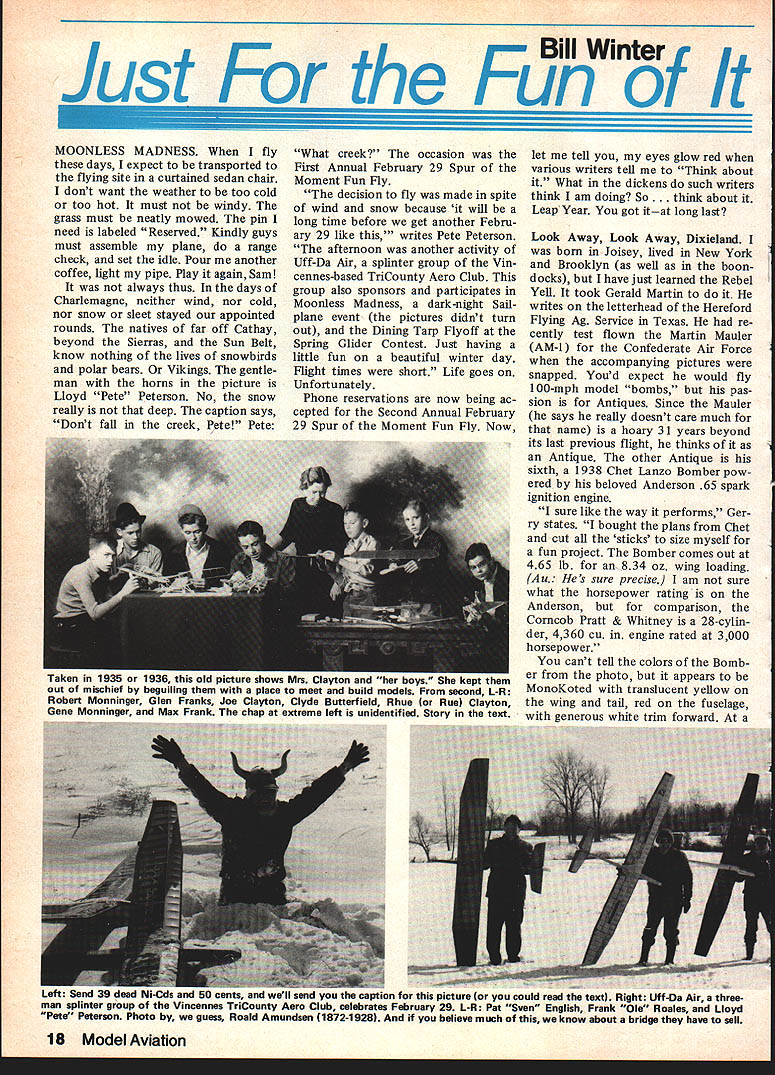
A photo of Mrs. Clayton and “her boys” was taken in the Gates Studio in Macomb, IL, in 1935 or 1936. According to Charles V. O'Donnell (Bloomington, IL), Gene Monninger’s group met at Mrs. Clayton’s house to build model airplanes to keep them out of trouble.
Gene says the model he was holding was his favorite; it had been drawn by Joe Clayton from Smilin’ Jack comic-strip pictures. Dave Shipton identified some of the planes as a Comet Moth, a Rearwin, a Comet Robin, and perhaps a Megow Monocoupe or a John Paul Jones kit.
Gene recalls most of the planes made just one flight—off the top of a water tower, often with a firecracker aboard. Several of the boys later served in the military: Bob Monninger was a forward observer and later with the Air Guard; Joe joined the Navy early and was at Pearl Harbor; Glenn Franks was an intelligence officer who parachuted behind enemy lines; Max Frank was a Marine captain; Gene believes Clyde Butterfield was killed in WWII.
Gene preserved a 3 x 5 copy of the picture for decades. It’s a happy bit of Midwest modeling history.
Corrections and Notes
Correction: In the June column it was stated that Bud Chappell's electric-powered Robinhood used a 9-9 prop on the Astro 15 with direct drive. Actually, it is a 9-4 according to Bud. There's a world of difference!
Bill Winter 4432 Altura Ct. Fairfax, VA 22030
Transcribed from original scans by AI. Minor OCR errors may remain.

