
Just For the Fun of It
Bill Winter
MONDAY — RAINING
I'm glad I can't go flying. So I don't have to choose between gross self‑indulgence and a head‑to‑head with a messed‑up fuel‑tank filler gadget on the defective new Eagle. What will I write about? I am thinking farmers, levers, and the radio playing "Sentimental Journey." Bucky Taylor sang, endlessly gallivanted the Super Cruiser, and the writer's code beckons "end."
Having tossed its rider, Hermes heads for the barn and the oats. Sentences appear like the printout of some faraway computer pleading insanity.
Farmers and Levers
Farmers' levers — the subconscious puts wings on anything. What would a shrink say? A high‑school physics teacher who banished me for looking out the window would have known: I was visualizing force diagrams. Rubber models are a really scientific exercise.
I remember disputing a teacher's statement that if an engine failed, an airplane fell to earth. I asked, "What about gliders?" She did not cope with the notion that gravity could be the "power plant." Even at 14, a modeler is beyond understanding. I also remember her explanation of the three classes of levers.
Archimedes said, "Give me a lever long enough and a place to stand, and I will move the world." Picture an ultralong pole resting on a fulcrum with the world squatting on the short end like a seesaw. Isn't that a tossed salad of levers — an airframe's geometry represented as force diagrams?
A conventional aircraft is set up with the center of lift (CL) a bit aft of the center of gravity (CG), and the stabilizer, exerting downward force, keeps the whole shooting match in equilibrium. What about free‑flight models (rubber, gas, glider, etc.) that incorporate lift into an airfoiled stabilizer and locate the CG between the CL of both wing and tail — say 75–100% of the wing chord?
Modelers aren't unique here. A canard does the same thing: the CG must be forward of the overall aerodynamic center, which places it between the wing and canard CL. Consider Burt Rutan and his super‑efficient aircraft — forget Archimedes for a moment and think of a wheelbarrow.
Is the wheel the fulcrum, the load in the middle, and the guy prying the handles the force? A plane can't fly that way. Maybe, if for every action there is a reaction, the fulcrum shifts. Suspend those levers in air and it would take Einstein to pinpoint the fulcrum. Confused? Good — so am I.
Webster's New Collegiate Dictionary describes the three classes of levers, in case you can't sleep. I phoned a scientist/modeler who called lever classes "stone‑age stuff" in the computer age, and said: (A) you can't do that; (B) forces applied wherever must equal the load for level flight; and (C) what about a "wedge"? My piqued physics teacher called that an inclined plane — a screw is an inclined plane. Are we now talking about props? Draw a triangle with the base representing the distance traveled forward by the prop tip in one revolution. Before 10,000 aerodynamicists rush forward to pull me out of my tar pit, let's switch to farmers.
Farmers, Slickers, and Barnroom Bull Sessions
I'm a city slicker who would prefer to be a farmer — but I don't like work. Once, as a gentleman farmer, I read in the county paper about a man who'd lived 93 years and "moved here at three years of age." When the farm kids came down with the mumps, the old boys formed a pool betting when the slicker would catch it. All the farmers blossomed with chipmunk cheeks, but the slicker who built flying machines — by then a local hero — did not. We sat around barns and hot stoves, aeronautically allowing this and that. Farmers are equal model builders.
Got a straw to chew on? (A plastic pushrod works fine.)
Jimmy Hedges — A Builder's Story
"I started model building in 1930 and have never stopped," Jimmy Hedges begins. "At 13, a couple of us in Port Elizabeth entered the 1st South African Nationals, sponsored by the Ford Motor Co. I flew gas and rubber. I had a 6‑ft Peerless Taylor Cub with a Baby Cyclone Model F and a lovely dural tank — it cost £5 complete. I was up against all the 'big' guys, won no places, but had fun.
"The war began. I qualified as a pilot in the S.A. Air Force and flew Martin B‑26 Marauders in Italy. After that, I joined the R.A.F., converted to Bristol Brigand dive bombers (two Centaurus 18‑cyl., 2,750 hp radials, four‑bladed props) and was posted to Iraq, then Singapore to bomb Communist bandits in the Malayan jungle. I carried on model building in Iraq and Singapore. I had a Hornet .60 in 1946, took it to the U.K. in 1947, built a speed job, and won the All Herts Open Speed Contest at 105.8 mph — but did 132 unofficial on the next meeting."
The KG, Tom Mahon, and Soaring
Maxwell Bassett may have changed things forever when he won an early Nats with the Brown Jr., but it was the KG (Kovel‑Grant) published in 1934 in Model Airplane News that helped bring the world into the gas age. Charlie Grant, an engineer who had worked under Orville Wright, developed slots and flaps for racing monoplanes and edited Model Airplane News for a decade. Old‑timers like Wakefield‑winner Gordon Light and Joe Kovel were instructors at model camps. The great KG is of enduring interest.
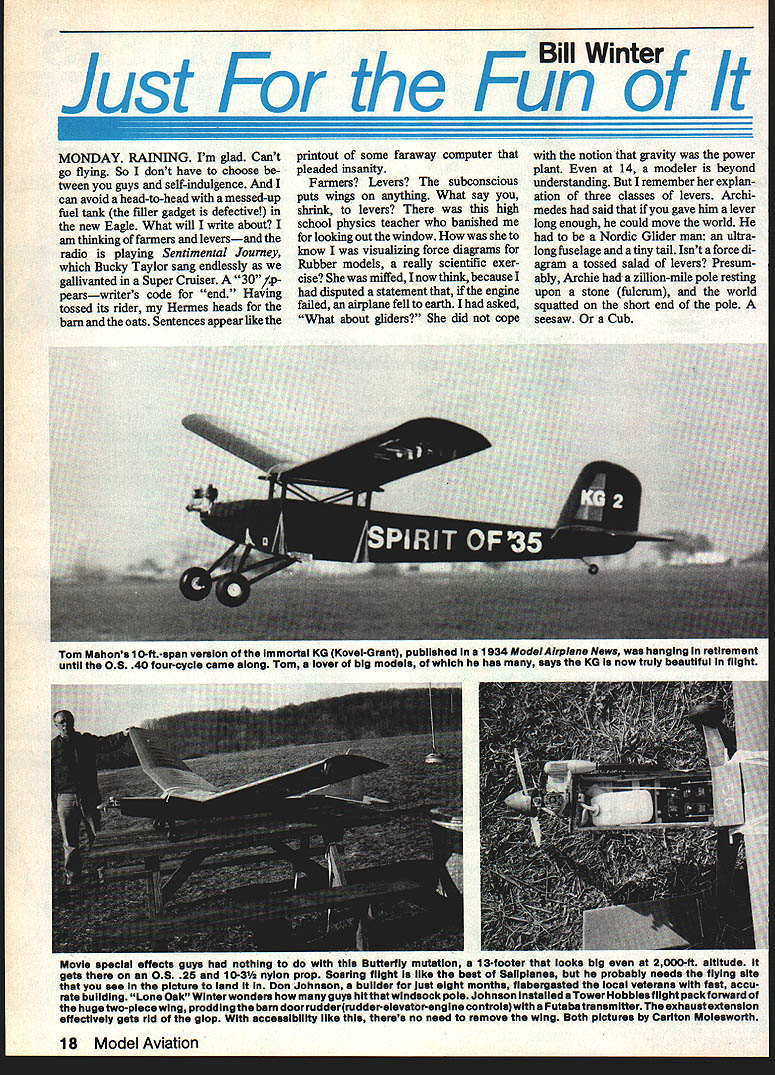
Tom Mahon yearned to produce a 10‑ft KG and fulfilled his dream — it took 11 months to build. Hung from the ceiling until the four‑cycle craze, with an O.S. .40 four‑cycle it's a dream to fly. Tom reports a marvelous flying site at Merwin Ranch south of San Francisco with a 370‑acre dichondra patch, oak trees, and a friendly $6.00 annual permission sticker.
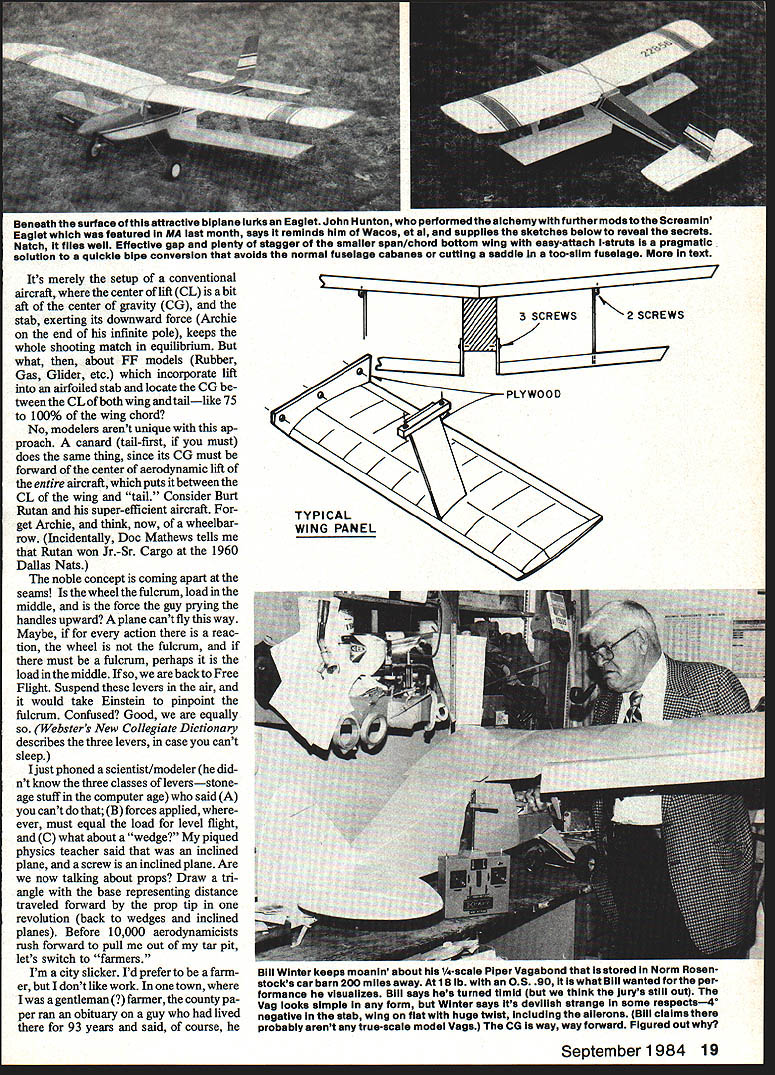
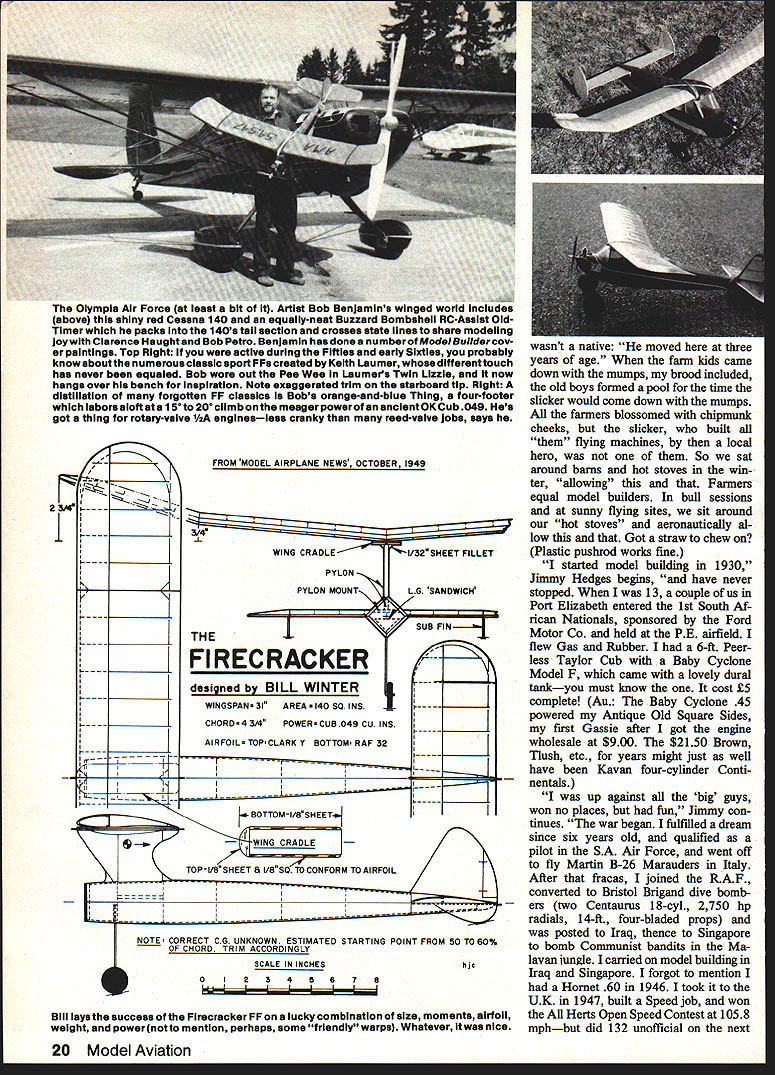
Soaring flight is what I like best. Sailplanes probably need a flying site; see the builder Don Johnson, who in eight months flabbergasted local veterans with fast, accurate building. Johnson installed a Tower Hobbies flight pack forward, a huge two‑piece wing, barn‑door rudder, rudder‑elevator‑engine controls, and a Futaba transmitter. An exhaust extension helps accessibility — no need to remove the wing. Those big floaters soar like condors, but if you fancy them think about including spoilers unless you have a monstrous runway.
The Piper Vagabond and Biplane Notes
Bill Winter keeps moaning about a scale Piper Vagabond stored in Norm Rosenstock's car barn 200 miles away — 18 lb, odd engine choices, and peculiar handling that Bill wanted to fix. The Vagabond looks simple in form but is devilishly strange: negative stab, flat wing, huge twist including ailerons, and a CG way forward. The jury's still out on its performance.
Beneath the surface of attractive biplanes there is often a lot of compressed‑wood and heavy structure. Two‑piece wings can use vast amounts of balsa, spruce, and pine block; a 5/16" rolled‑steel rod may hold wing halves together, and several rolls of MonoKote cover the works. A radio installation forward of the wing — a Tower Series 500 flight pack with a Futaba transmitter — can handle a big rudder just fine. Davis Diesel conversions and other power experiments keep builders busy.
Firecracker and Sport Pylon Nostalgia
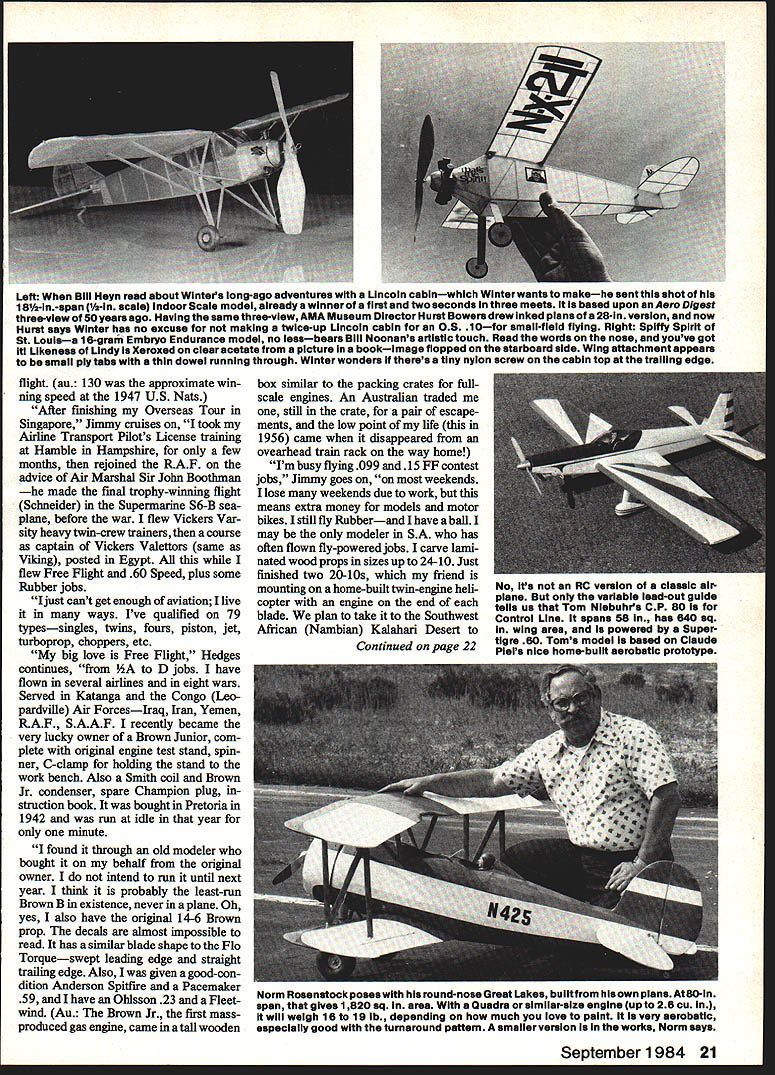
I have fond memories of the Firecracker from the late 1940s. The Cub .049 Firecracker was a pasture‑fun job. I had swiped the Sniffer airfoil with its Clark Y top and RAF 32 bottom, which gave excellent glide for the size and power. I flew the thing among cows at every opportunity. I once carried a pocket full of props — small to large — and saw the model's power circle and corkscrew change with prop size until one prop nearly looped it. If a pylon model could veer fully left or right and still fly, perhaps pylon height and area were fortunately able to handle slipstream/torque combinations — a fluke.
I'd like another Firecracker, sized a bit big for an O.S. .15 or a .10, or converted to electric with an .05 cobalt or geared job. With new 800 mAh cells you could reasonably simulate a high corkscrew climb and floating glide. Use throttle as a shutoff at altitude and rudder for trim; rudder and flaps (or "flippers") will bring it home.
Windy Urtnowsky, PAMPA, and Pro Stunt News
"Windy" Urtnowsky, whose world is models on wires, is one of the most colorful characters to come down the pike. He writes a column in Flying Models, contributes stunt news to Prop‑Wash, and took over Pro Stunt News, a lively 21‑page collection of news, results, pictures, hints, diagrams, and cartoons. The first issue of the Precision Aerobatic Model Pilots Assn. (PAMPA) paper by Windy went to 450 members and was growing.
Windy was saved by his daughter, who suggested a $20 increase in her weekly allowance and wanted to know if she was the Pro Stunt. She was to go to the Reno Nats. Windy says I lifted his spirits on a dismal March evening and that he is building a 3/4 A F‑16 "just for the fun of it."
If you lost sight of why you started building things in the first place, consider joining PAMPA. Membership was $7.00 to PAMPA, 329 Lincoln Pl., Brooklyn, NY 11238. Windy would especially like to hear from old‑timers.
Goldberg's Eaglet and Variations
Goldberg's Eaglet, described by instructors as "too easy to fly," inspires strange goings‑on. There was a nice low‑wing version in RC Modeler and a highly modified flapped tail‑dragger in Model Aviation. John Hunton designed an Eaglet biplane and notes its nostalgia factor: it reminds him of old cabin Wacos. The lower wings are not continuous — screwed to the fuselage and strut‑braced to the upper wing. Structural calculations show less stress on the upper wing because lift depends on velocity squared.
What's left — a twin Eaglet?
Tiny Sport Free Flight and Bob Benjamin
I've never lost my fascination for tiny sport free‑flight models — doodled dream ships that synthesize countless admired three‑views of the Golden Age. Creative fulfillment is scarce in this stereotyped age of space ships, big engines, and expensive timers. If a field is large enough for a one‑minute plus rubber scale ship, it's large enough for a vee‑powered cutie with a tiny engine and strict control on run time.
Bob Benjamin writes of having the best of two worlds: a Q‑T RC Buzzard Bombshell that flies and wins, and a 12‑in‑to‑the‑foot 1946 Cessna 140 model that is thoroughly lovable. Bob makes a living as an artist and paints full‑size planes for magazine covers; his Model Builder covers are faithful and pretty. He has carried the Buzzard, disassembled, in the 140's tail to fly with friends — the 140 doesn't mind.
Bob also enjoys tiny sport free flight. He built a 48‑in. span "old ruler" with a concave undercambered section stolen from his Brooklyn Dodger. With a venerable Cub .049 it climbs at a stately 15–20 degrees. He likes Cubs and their nostalgic charm; rotary‑valve .049 users sometimes find them less fussy than reed jobs.
On the RC bench he has plans for a 44‑in. long‑wing taildragger designed around a G‑Mark .12 twin, with four 1/6‑oz servos. He intends a flight‑test program to evaluate the .12 engine and other multis and radials.
SAM '35 Yearbook and the Land of Oz
Who am I? Can Englishmen be more American than Americans? British old‑timers confuse me. When I reviewed the first SAM '35 Yearbook, dedicated to preserving vintage aircraft, I took issue with a stuffy British review and then forgot about it. SAM leans toward competition, while many of us fly Old‑Timers and Antiques for pleasure. The Yearbook, however, drips with nostalgia: wonderful drawings, charming articles, unique images, and lovable flora and fauna.
A phone call from Marty Schindler told me that my copy of SAM '35 No. 2 Yearbook arrived at the Toledo R/C Show. Between its stiff green‑and‑black cover there's 144 pages of priceless material. My copy is inscribed by David Baker, and three pages are covered by autographs from dozens of folks, including writers, designers, and editors. It's that good. You can get a copy for $7.00 from SAM Speaks, 2538 North Spurgeon St., Santa Ana, CA 92706, or from Dave Baker, 22 Ellington Rd., Muswell Hill, London N10 3DG.
Closing Notes
President John Grigg says there have not been 22 AMA presidents as stated recently in this column — he is Number 20. That's from a higher authority.
Bill Winter 4432 Altura Ct. Fairfax, VA 22030
Transcribed from original scans by AI. Minor OCR errors may remain.

