

Just For the Fun of It
Bill Winter
Things Are funky
Things are funky on the Funny Farm. We moved three houses down the block. The Oregon Trail should be so long. The slumbering cat, the source of my aerodynamic insights, has declared the desk off limits. The workshop is a shambles. I am grounded. It is 97° again. Is the flying season that I enjoy over before it began?
The desk reminds me of Louis Garami's workbench. Louis never cleaned anything. He'd push everything against the wall. A sneeze set off fearful avalanches. So Louis would do a breast‑stroke with his hands to clear a spot no bigger than the one on which my Hermes sits, and there he'd build a classic like the Strato Streak. He worked in the air most of the time, ignoring the plans—no space, anyway. If an editor asked for the plans, Louis would answer, "Plans? What do you need them for?" With wings detached, the plane poked its wing and tail feathers out of a brown paper bag. For plans, Louis would bring in cardboard.
Hassles come in cycles. A million reasons why you can't get out to fly—last ship falling apart, too many commitments, not enough hours in the day. You vow not to start another big project, but an empty room and a box will conspire against you. Inside the box: a deBolt Rebel kit. Thus begins another relapse.
Purple Plan One (PP1)
Purple Plan One, or PP1, may save your skin when you're too busy to build in one long stretch. It's a one‑piece‑a‑night caper:
- Night 1 — Pin down the plan.
- Night 2 — Cover the plan with wax paper.
- Night 3 — Glue down the leading edge.
- Night 4 — Add the trailing edge, a spar, and one rib.
- Repeat — Add one more rib, then another, then stabilizer edges.
Go slow—no frantic binges. Over weeks the fuselage sides get built (maybe just one at first). Join the sides when you can, and before you know it—February or March—Holy cow, the thing is almost ready to cover.
Then days grow longer and the first robin appears. You install the servo and clevis late one night—why do those last tasks always wait till midnight? Paint it, hang it to dry, hunt for the charger, postpone the field trip. And then: an unbearably beautiful four‑day stretch of cobalt sky and calm. Moment of truth. The Rebel didn't do much—just rudder and throttle—but it flew beautifully on its .10 engine. Time to find another figurative Rebel: six to eight feet span, .40–.45 size, four‑cycle old‑timer? Or electric? I can't make up my bloody mind—hence Purple Plan Two.
Hand‑Launched RC Gliders
Tim Harris, in his first year of college, has an intimate relationship with hand‑launched RC gliders—"intimate" in the only sense that fits. Sometimes the affinity of man and machine is so close you can feel a resonance projected between them. Once in a while, a vision of a model in flight lingers in memory.
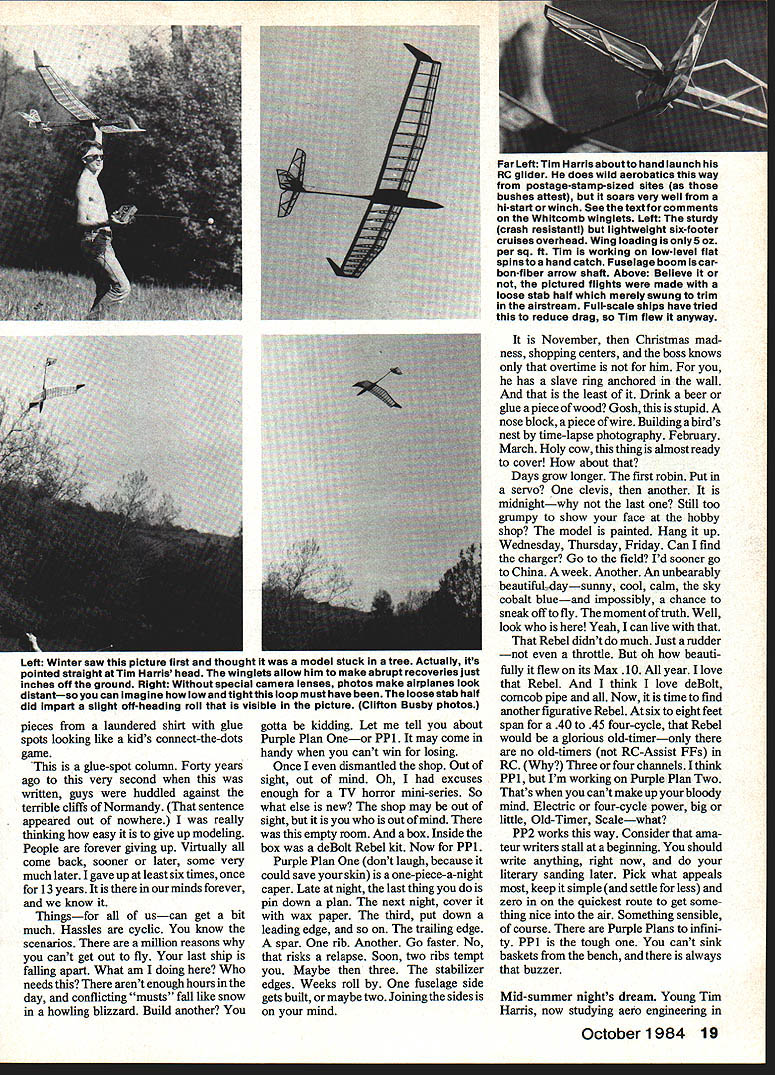
At a past Nats I glanced out a window and saw a lone kid on a ball diamond running through an endless repertoire of smooth aerobatics with a CL stunt model—the engine dead, control seemingly effortless. The model was a Nobler and the "kid" was George Aldrich. Likewise, Tim Harris has been doing wild aerobatics from a hand launch—including inverted flight and spins, much of it under 10 ft. altitude. Henry Haffey photographed Tim's flying and was astonished; Tim was later hired at Cover‑ite.
Tim writes about his machine:
"It's a 6‑ft. machine with Whitcomb winglets. It weighs around 22 oz., which gives it about a 5.5 oz./sq. ft. loading. The airfoil is reduced and static, giving excellent maneuverability even at low speed, as can be seen. All shots are from hand‑launched flights in an isolated field outside Virginia Polytechnic Institute. The mountains in this area are known for their wind, and the machine does fine at midday low to the ground, even at this light loading.
"I am mailing this during a conference of the American Helicopter Society. I'm one of a group starting a student chapter at Tech (right now I am rated in gliders, fixed‑wing aircraft, and rotorcraft helicopter). The knowledge I gain from model gliders is irreplaceable for a solid engineering background."
Hand‑launched RC gliders are practical and popular. Contests for these nimble birds are taking place. Model Aviation's all‑time best‑selling plan is Bob Owens' Zephyr (Plan No. 332). It is fine for slope soaring and thermal soaring, and it can be used with a short hit‑start. It's dynamite.
Vintage kits and the Dakota story
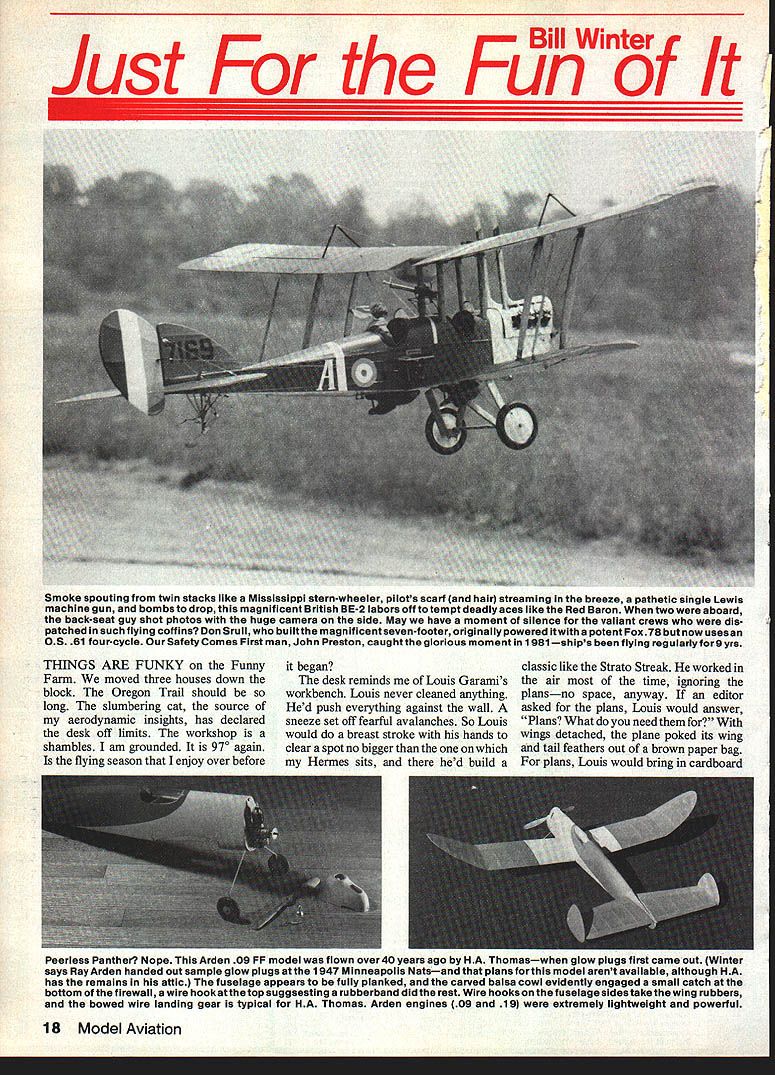
Peerless Panther? Nope. Ray Arden's .09 free‑flight model from 40 years ago—plans scarce, parts in the attic. When glow plugs first came out, Ray Arden handed out samples at the 1947 Minneapolis Nats. The old fuselages (fully planked, carved balsa cowl, simple rubber‑band mounting hooks) tell the tale of lightweight, powerful early engines (.09–.19) and simple clever construction.
A special note for the Veco Dakota: introduced just after the war, Joe Wagner's design is legendary. The kits were highly prefabricated; there were no formal plans, just diagrams showing how to slot pieces together. It flew like no other little biplane—sturdy, simple, and forgiving of CG mistakes. On an OK Cub .049 the Dakota would circle tightly for the duration of the fuel, and on an Infant it would climb barely but enchant any kid. Thousands remember it fondly.
Joe Wagner (with the late Hal Johnson) has drawn high‑quality, magazine‑size plans for the Dakota, the Comanche Payloader, and the Veco Squaw. Each of these is one sheet and worth the $5.00 Joe asks for them. Available from:
- Fun Flyers, P.O. Box 95, Volant, PA 16156
Tales from the Virginia outback
When the British surrendered at Yorktown, "The World Turned Upside Down." Lately I've been dragged out to several odd flying sessions by strange characters like Doug Pratt, Bill Kulaf Sr., and John Worth—there is no rest for the wicked.
John Worth putters with electrics and occasionally flies in nearby schoolyards and parking lots in the cool of the evening. In a pile of "rubble" the only ready plane was son Mike's modified Midwest Champ with a Leisure .05 (3.8:1 gear ratio) and a modified Rev‑up. The plane weighed a horrifying 53 oz. with seven sub‑C cells, yet on a 5‑minute run it could drift for a nine‑minute flight without assist.
I had a scary moment: the air was dead, then the model looked smaller and started to drift toward trees. One wrong input and it would be gone. I shut off, down‑trimmed, pushed over, held full stick. It sat. Power on again and, after two minutes of full down, it inched back to salvation and landed at my feet.
John Worth also flies a venerable Kitty that seems to run forever now on 800 mAh Sanyo cells, though it can be dicey on the sticks. He put on a Sportavia wing and the ship wandered for 12+ minutes. If a big Goldberg Ranger 42 couldn't beat that for ready‑to‑fly endurance, I'd be surprised.
Don Srull and Doug Pratt took me to Shangri‑la where Pratt had four‑cycles galore. Srull did 14:45 without assist on his Sparky using a 3.8:1 Leisure .05 and a huge reworked folder on seven sub‑Cs. A lead‑sled Champ did another nine‑minute jaunt evading atmospheric black holes. The RC‑assist Vagabond floated with the hawks. Near sundown it was Rubber Scale: Srull showed off a Lippisch flying wing—a push‑pull rendition of a WWII fighter with breathtaking flight characteristics—and a jumbo Heinkel 100.
Other recent arrivals included:
- Steve Kalu's smooth first test hop on the Farman 400.
- An Eagle with flaps on a K&B .40, built by Steve's dad (Bill).
- A 1½‑times‑up Sig Kadet with up‑flared Hoerner tips flogging around on a four‑cycle .90.
- A rock‑steady Dirty Birdy that made light ships look tempting.
Robbe SF 36 motor glider
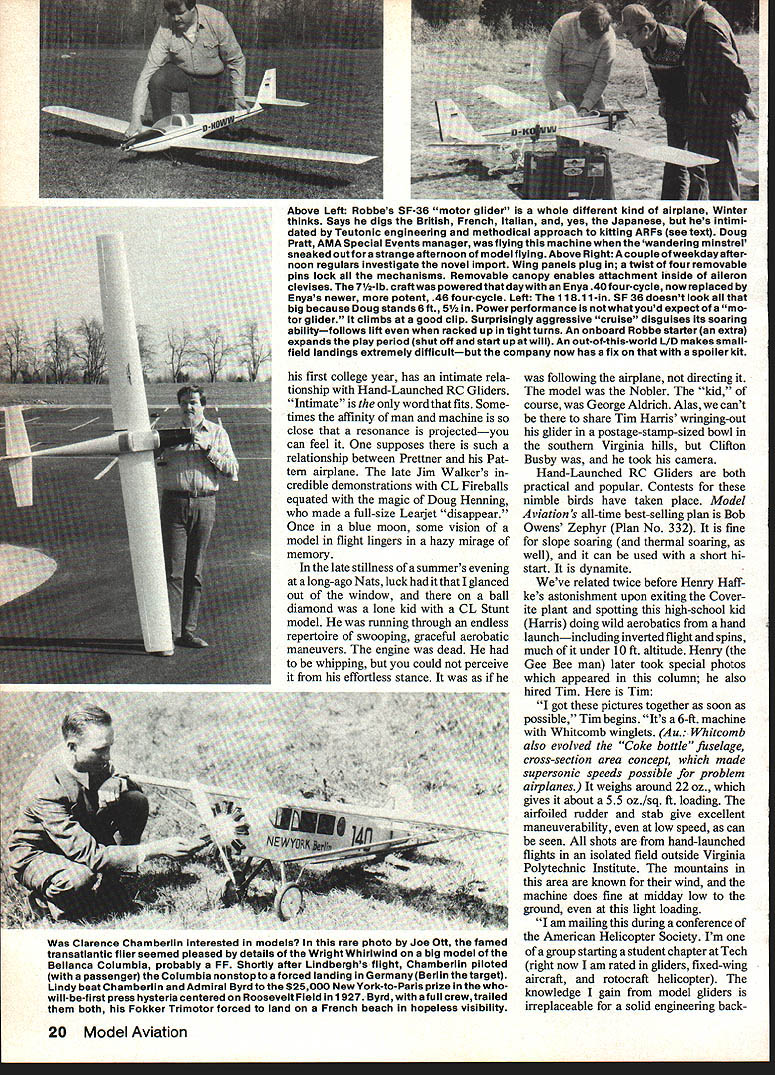
Thanks to Doug Pratt I spent an enthralling afternoon observing the Robbe SF 36 motor glider. Specs (approximate):
- Span: 118.11 in.
- Fuselage: 53.15 in.
- Wing area: 1,038.44 sq. in.
- Weight: ~123.45 oz.
- Power: .19–.40 two‑stroke, .29–.40 four‑stroke
- Suggested airscrew: Wortmann FX 126
Wing panels plug in, and everything is well engineered. Doug used an Enya .40 four‑cycle (later replaced by an Enya .45 four‑stroker). The bird, about 7½ lb., climbed well and cruised with respectable performance, yet it also soars easily and can be racked around in steep, small‑diameter turns.
Landing it is another matter. At idle it can skim along for hundreds of feet; learning to bleed off speed and slow it enough for a 300‑ft. strip is tricky. Robbe is now incorporating spoilers. The SF 36 lists at about $200—rich for some, but it is a thoroughly engineered kit.
A warning about hearing loss
We've had a letter about tinnitus and hearing loss from a modeler who stood next to a .60 engine with a poor muffler and developed a loud buzz that never went away. His hearing is down about 90 dB at 4 kHz. He has consulted doctors and audiologists and tried hearing aids and maskers; the prognosis is that he'll have to learn to live with it.
A few points to remember:
- Loud noise from engines and other sources can cause permanent damage.
- Use hearing protection when starting and running models.
- Four‑stroke engines and better mufflers may reduce noise exposure.
All I can add is that you have been warned. Buy the best hearing protectors you can find and use them.
Have a safe month.
Transcribed from original scans by AI. Minor OCR errors may remain.

