

Just For the Fun of It
Bill Winter
Defining "fun"
How do you define "fun?" I don't have a marimba band in my shop. My eyes don't dance when I think of flying, building, or—horror of horrors—maintenance. The three‑letter word "fun" is short to look up; the dictionary says: providing entertainment, amusement, or enjoyment. "Enjoy" sounds right. And there was a note: "...a person to be with."
Joe Wagner is a person to be with. I have not met Joe face to face, but he has been with me a long time.
Joe Wagner and his models
Joe is the Dakota man. That versatile little all‑balsa biplane lives on. Joe is an authentic pioneer in FF rubber, FF gas, and CL stunt. Long ago he was a designer/production engineer for Veco. He is not "above" RC and has surprising interests beyond modeling. Thanks to Ed Whitten's April writeup, you probably know about his organization, Fun Flyers. Joe does know how to "enjoy," as you will see from his comments and pictures.
"The Grasshopper," he explains, "is a revamped Ace Scout done in the markings of the 'White Army' of the 1941 'War Games' in South Carolina. Power is a Lee Custom .19 — the best RC engine I own. Finish is Aero Gloss dope on silk covering, all insignia hand painted. Decals don't work well for me."
"The biplane is an original design called the Screech Owl, 450 sq. in. wing, Enya .15 power, weight 51 oz.—my usual Aero Gloss dope on silk. One of these days I have to try one of the iron‑ons. Again, markings are freehand. Masking tape leaks too much for me, and I find it's really quicker for me just to pencil on the insignia and have at it with my faithful sable brushes."
"The open‑framework pix are of a Cleveland Norseman, more or less stock, and a Wiley Post Model A, Cox Pee‑Wee powered, being built as a replica of the airplane WWII ace Bob Johnson learned to fly in. I've been corresponding with Bob," Joe reports, "and he's been very helpful in furnishing details of color scheme, license number, and other hard‑to‑locate information on this rather obscure side‑by‑side trainer of the early 1930s."
(Author's note: A fairly large rubber‑powered Wiley Post biplane by Hurst Bowers appeared in the first issue—July 1975—of the "modern" Model Aviation, and plans, which include data sources, are still available. The model hangs above me as I write, a gift from Hurst. It is an ideal subject for any size and power.)
Fun Flyers — philosophy and goals
How goes Wagner's organization, Fun Flyers? He now agrees with papa that administration is a task the good Lord imposed on Job, but Joe is still expanding from the initial "Big Bang."
"On the Fun Flyers," Joe comments, "our basic idea is to encourage building and flying the kinds of model airplanes that can be flown right in a person's own neighborhood, the way they were in the good old days. If performance is kept sedate, even FF models can be safely flown from schoolyards and ball parks. Remember when FF contests were held in Van Cortlandt Park in NYC? They don't do that any more, mainly because the pressures of competition have escalated model performance too much. But the kinds of models that old codgers like us used to fly in parks can still be flown there. To prevent the high‑performance types from superseding sport models, the Fun Flyers have no formal competition. Without competition, we need no model classifications, engine displacement categories, or other such limitations. If we feel like building small rubber models with 14‑in. wingspans, we do so without a qualm. (Qualms don't fly well, anyway.)
"Another of the Fun Flyers' goals is to bring back the marvelous variety of model designs that used to be seen at the flying fields: biplanes, canards, flying wings, autogiros, tandem‑wingers ... we'll encourage creativity and originality in every way we can manage. The club is highly informal. We are just fellow modelers out for enjoyment and recreation together."
Super stuff. Most of us stick pushers never saw, or ever will see, models like these except in pictures. While I was there when rubber power was the only show in town, I confess to visualizing (in my dotage) where I would put the mini servos. We all are interested in design, perhaps only out of curiosity, and we speculate on what went through hotshot designers' noodles in the 1930s. A heck of a lot, apparently. The three‑view this month will make an Electric (in some size) good for 10–15 minute RC flights. These ancient rubber jobs are, on the whole, better RC Old‑Timers than the stubby‑nosed Gassies with their snow‑plow landing gears.
Otto Cuth and "Super Stuff"
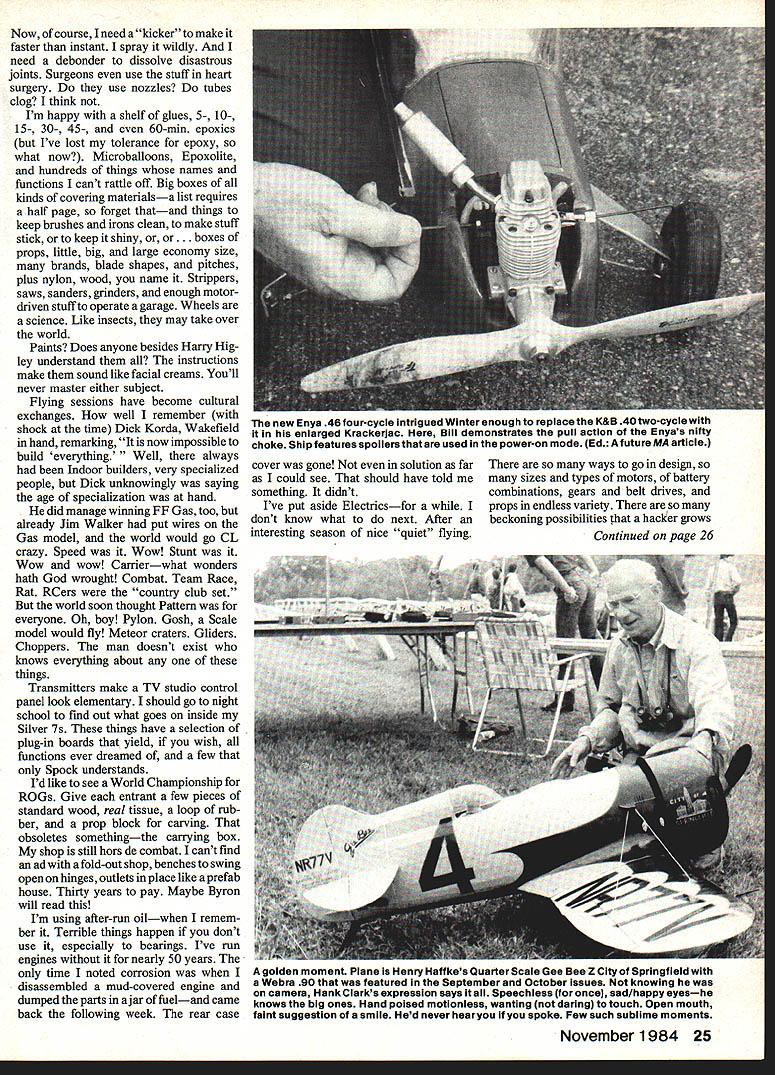
Otto Cuth, a long‑time member of the famous Chicago Aeronuts (one of the oldest clubs in the U.S.), is with a consulting and research firm in Northbrook, Illinois. He's been refining "Super Stuff" ever since 1939, winning many meets along the way and taking second at the 1980 SAM (Society of Antique Modelers) Championships (shy of 14 seconds).
Why the airfoil‑shaped fuselage? For the lowest possible center of gravity (CG). Rubber weight was 50% of gross. (If you could get 50% of your Electric gross into energy—batteries—you'd pierce a high cloud!) Fuselage cross section was almost square to minimize the fuselage wetted area. If you are into RC sailplanes you know about wetted area. The fuselage was short because rules specified for years that the minimum cross section had to be the fuselage length squared, divided by 100—so he was minimizing the draggy cross section. The large tail (about 50%) prevented stalls and loops during the climb. Rubber modelers know what a power burst can do.
RCers will say "no way" to that CG position—the ship would be a flying squirrel. With a large‑area, lifting‑type tail (really a smaller wing), the stab shared the load with the wing, and that moved the CG to 75% of chord—to 100% or more on some daring Gas ships. You could fly that setup with RC Old‑Timers, duration Electrics, etc., if the vertical tail area was big enough and elevator action and area were minimized.
Before your eyes turn glassy, note that more sticky stuff appears with the three‑view. You might be curious about prop sizes, pitches, and power jammed into those stick‑and‑tissue blasters. Vertical performance is not a new term. Incidentally, John Pond has plans for the five‑panel‑wing version with a DT (nothing to do with alcohol) tail conversion.
KISS, complexity, and tooling
Whatever happened to KISS? Ken Willard used that term many times—"Keep it simple, stupid." Is anything simple any more? The sum total of what we see (advertisements especially) in all the magazines assaults the senses. New technologies blow by like cold fronts. Nothing disappears. Things accrue. Most of us glom onto something, do our thing, and let the chips fall where they may.
Take away my instant glue? You are kidding. Or my witch's brew of fuels—I don't know what's in some of those bottles and cans. I don't want to go back to cements and pointy sticks, or Ambroid oozing all over the bench. Who wants a 10‑cent tube of glue, anyway? I want instant joints. Magnetcraft isn't inexpensive. Who cares? Now, of course, I need a "kicker" to make it faster than instant. I spray it wildly. And I need a debonder to dissolve disastrous joints. Surgeons even use the stuff in heart surgery. Do they use nozzles? Do tubes clog? I think not.
I'm happy with a shelf of glues, 5‑, 10‑, 15‑, 30‑, 45‑, and even 60‑minute epoxies (but I've lost my tolerance for epoxy, so what now?), microballoons, Expoxolite, and hundreds of things whose names and functions I can't rattle off. Big boxes of all kinds of covering materials — a list requires a half page, so forget that — and things to keep brushes and irons clean, to make stuff stick, or to keep it shiny. Boxes of props, little, big, and large economy size, many brands, blade shapes, and pitches, plus nylon, wood, you name it. Strippers, saws, sanders, grinders, and enough motor‑driven stuff to operate a garage. Wheels are a science. Like insects, they may take over the world.
Paints? Does anyone besides Harry Higley understand them all? The instructions make them sound like facial creams. You'll never master either subject.
Specialization and transmitters
Flying sessions have become cultural exchanges. I remember, with shock at the time, Dick Korda, Wakefield in hand, remarking, "It is now impossible to build 'everything'." Well, there always had been indoor builders, very specialized people, but Dick unknowingly was saying the age of specialization was at hand.
Transmitters make a TV studio control panel look elementary. I should go to night school to find out what goes on inside my Silver 7s. These things have a selection of plug‑in boards that yield, if you wish, all functions ever dreamed of, and a few that only Spock understands.
I'd like to see a World Championship for ROGs. Give each entrant a few pieces of standard wood, real tissue, a loop of rubber, and a prop block for carving. That obsoletes something — the carrying box.
After‑run oil and engines
I'm using after‑run oil—when I remember it. Terrible things happen if you don't use it, especially to bearings. I've run engines without it for nearly 50 years. The only time I noted corrosion was when I disassembled a mud‑covered engine and dumped the parts in a jar of fuel—and came back the following week. The rear case cover was gone! Not even in solution as far as I could see. That should have told me something. It didn't.
Electrics, four‑cycles, and bewilderment
I've put aside Electrics—for a while. I don't know what to do next. After an interesting season of nice "quiet" flying, there are so many ways to go in design: so many sizes and types of motors, battery combinations, gears and belt drives, and props in endless variety. There are so many beckoning possibilities that a hacker grows humble. I'd have to specialize. Let the experts hack!
And I must look at four‑cycles. That looked simple, too. But all four‑cycles are not alike. Some aim at nice running. Others at minimizing the operational gap between two‑cycles and four‑cycles. Some run on only one make of plug (decently, that is). Some go on standard fuels, most like different mixes, and the fuel people are pushing more mixtures of nitro and oil types and content than there are hair tonics. For Heaven's sake, wait for me! I'm confused, and I haven't even begun.
If you want to avoid temper tantrums, teach yourself to really follow instructions—to the word. And don't run then learn, or you'll lose a lot of prop nuts. Do what the man says, or you'll find out. Some shoot for higher rpm, pushing the competition two‑cycles you know about. Valve adjustments—be careful.
Anecdotes: Roy Rogers, Bill Hinnant, and the Rookie
Roy Rogers. Rubber Scale guys passing around an HP .21 and a new Enya .46 four‑cycle—it has a beautiful choke. So many wonders. Discussion zeroed in on a rubber‑powered car by Bill Hannan: shaped like a piece of cheese, it has a carved mouse head for a driver and a prop to push it. What would be in your mind while building it? The bottom line: Why am I doing this? Then, how best to enjoy the hobby.
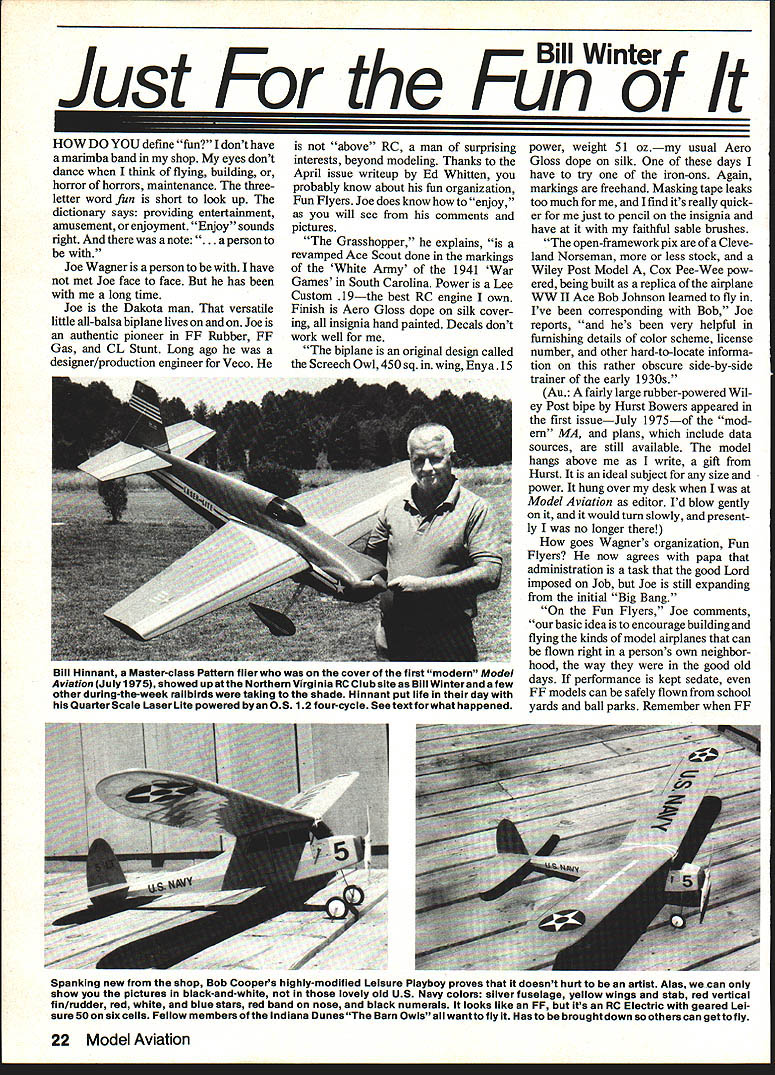
Two weeks ago Bill Hinnant showed up at the Northern Virginia RC Club site, where we during‑the‑week escapists regale each other with tall stories and a bit of quaint flying. Bill graced the cover of the first issue (July 1975) of the modern Model Aviation; in 1975 he was already a Master‑class Pattern flier. This time the plane was a Laser Lite which he kits as a quarter‑scale. He intends to fly this Quarter Scaler in the Masters Turnaround event. Power is a 1.20 O.S. four‑cycle (the limit allowed for four‑cycles). Bill flies single‑stick, left‑handed. He had an order for 100 kits from Taiwan—quite a switch.
If you have watched a good Giant Scale pilot do aerobatics, you know how realistic such machines can be. Rolls and such are more like full‑size airplane. Hinnant's Laser Lite weighs only 9 lb., so it is lightly loaded. Without dihedral the shoulder‑wing model can be slowed up to stand almost motionless in level flight, and it doesn't fall off. He is flying with a 13x10 maple prop, much thinned down. His fuel has 15% nitro and 15% oil, half synthetic and half castor. For his own reasons he has modified the big O.S. by removing .0045 in. from the lower piston. His engine puts out, is reliable, and starts right now. Impressive.
While Hinnant's lovely machine is not this double‑visioned old‑timer's cup of tea (not much is), I fell to thinking about the Rookie again. In self‑defense (in 1961) I designed a 6‑ft. low‑winger with 6 sq. ft. of area. It was a tail‑dragger with big tip plates, medium dihedral, and rather small barn‑door ailerons. That will roll? You gotta be kidding. I could do consecutive rolls and walk beside the thing as it flew nose‑high in ground effect, which tells you how slow it would land. During low inverted flight (control was lost—reeds held neutral), the ship continued across the site in rock‑steady inverted flight, circled the entire area, and eventually came by overhead where control was regained for an emergency landing. On another occasion all controls but the rudder went dead during aerobatics; the plane was saved and landed with just rudder control. This plane, the Rookie, was published in MAN during the early '60s and was widely built; even now I receive pictures of new ones from readers, sometimes on floats.
I have a plan, thanks to Norm Rosenstock. He asked for permission to add it to his line a year ago; he'll release it soon. It's a good trainer for the new world of Pattern. Since I have requests for plans (one forwarded from RCM), I phoned Norm for details. His plans are $17.
Plans bonanza
If, like me, you are forever searching for some remembered plan, you know how frustrating boxes, drawers, envelopes, tubes can be. The magazines make complete listings available (Model Aviation has such a list). RC Modeler also has a list and advertises the RCM Illustrated Plans Guide. It's extraordinary: a looseleaf, soft‑polished cover volume with supplements issued to update it. Each plan is numbered and categorized to avoid searching through hundreds of plans. Each full‑size plan has been greatly reduced to allow printing two to a page; a magnifying glass makes many readable. The basic volume contains 540 plans from October 1963 through October 1979. Supplement No. 1 adds plans through June 1981, and Supplement No. 2 updates to January 1984. RCM sells each item separately, or the whole set for $20. Give the plans guide an "A" for effort.
Mail call, artists, and community
Mail call! For every word you read, the mail brings 1,000. For each picture you see, there are many dozens I can't show you. People want to talk. Most of them don't expect to see themselves in print. Some longhand letters cover both sides of a few to 10 or more pages, and it is not rare to receive packets of 10 to 30 or more photos: war stories, full‑size planes, all manner of models and ways of flying, life histories. There's seldom a technical letter. Virtually none touch on how‑to stuff. I am bewitched, somewhat bewildered, but never bothered. Magazines, articles, ads — really, almost everything — are about things. But people make the world go round.
Bob Cooper (who says he had an ad in the December issue) is an artist, a darned good one. He runs something called Nostalgi‑Air — "Aerodrome for the Immortal Eagles" (pen and ink prints). Examples he sent: Consolidated PBY Catalina and Boeing P‑26A "Peashooter," plus North American F‑86 Sabre Dog and Beechcraft 17 Staggerwing. They hold the eye until worldly sense fades. He also sent a sample book showing roughly 30 others in 4 x 5 size — actual prints are much larger, perfect for framing. He sells them framed, 11 x 14 in brushed silver‑tone metal with non‑glare acrylic and wire hanger ready for the wall; and 16 x 20 matted and framed. ("A" Flt. Cdr. Robert S. Cooper has been doing this for over 30 years.)
This is not a plug. Cooper doesn't expect me to mention his work. I am supposed to mention his model — as with most of us, it is the model that is important to him. He wrote:
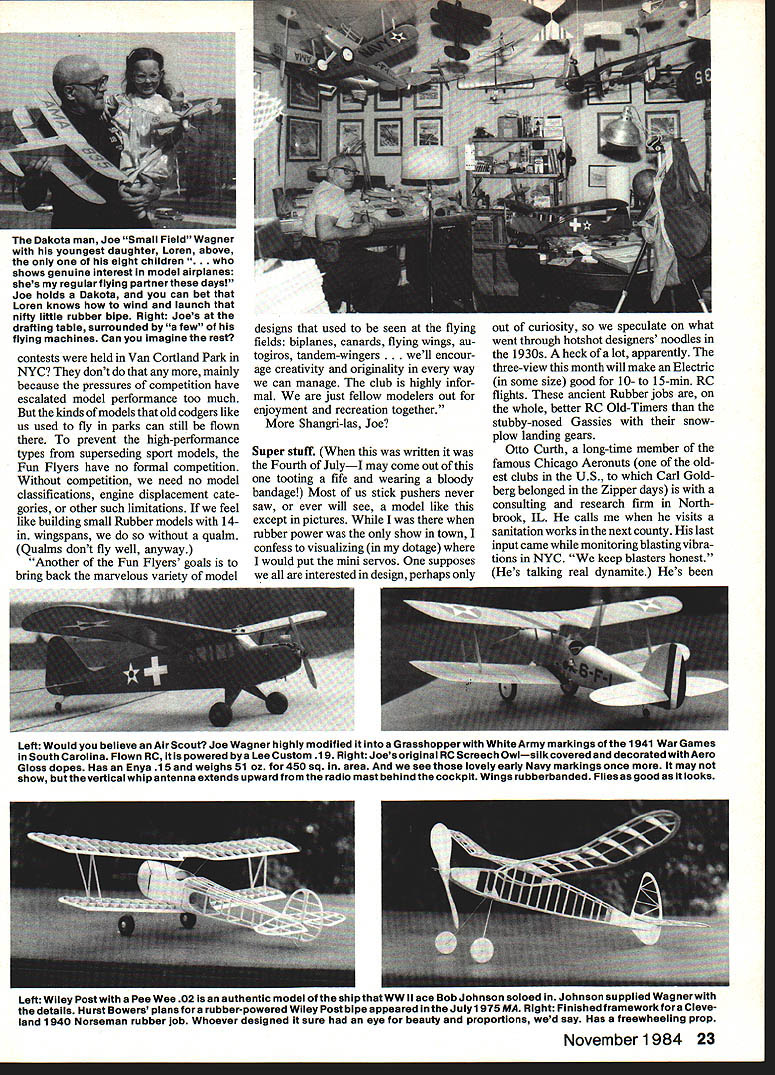
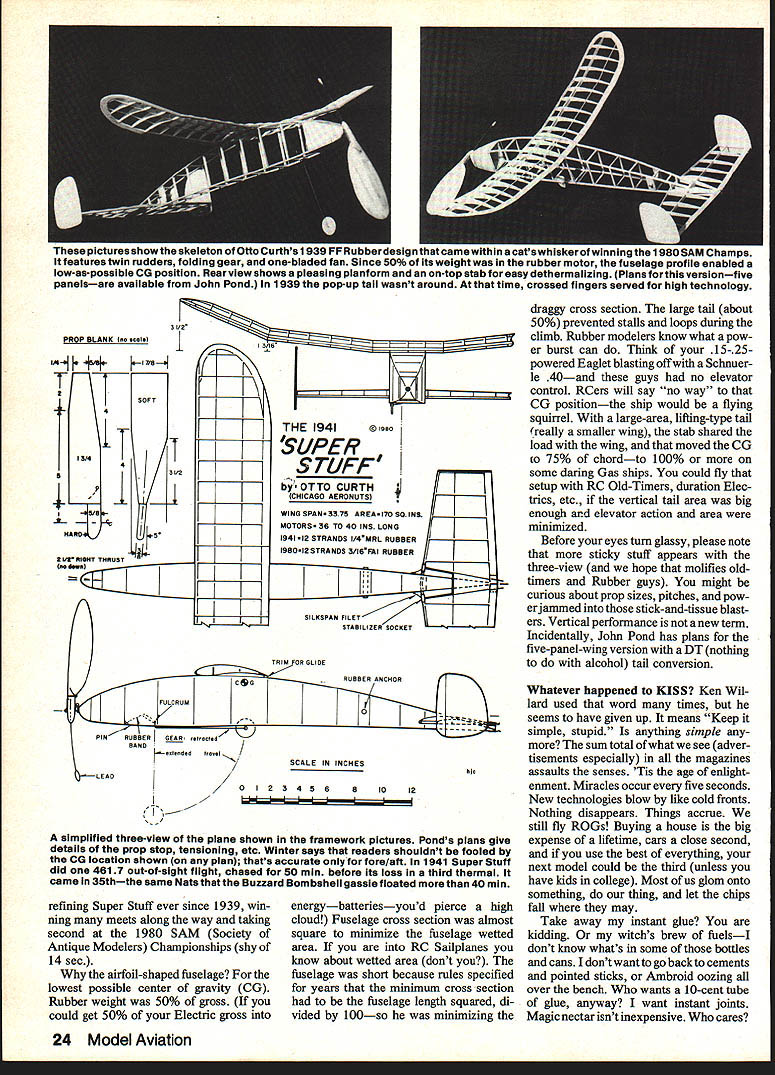
"Your stories about LeCrate and other Electrics have really put the bug in my ear ... I went out and did it, as they say. Enclosed find pix of my Electric Playboy Senior (much‑modified cabin version) ... a real bear to build. Leisure .05 gear drive with six cells. And she flies like the proverbial bird, didn't need one ounce of trim (lucky). I almost hate to bring her out to the field. All the Barn Owls (our RC club) want to fly it. They can't get over the no‑mess‑no‑go and what a floater it is. You have to bring her down to the prop wash or come on and close air time."
I don't show you Bob's Playboy because it is an Electric — it is a thing of beauty that keeps its promise in the air.
Turnaround, pattern, and a new kind of fun
Dipsy‑do and turnaround. Believe it or not, this new "turnaround" thing has turned me on. No, I'm not about to fly Pattern in any shape or form. If I tried, the Contest Board would have to hold Salt Talks. I see fun in the turnaround airplane—flown for enjoyment.
Many of you can design your own stuff, a bit bigger (area mainly), much lighter, and slower than present competition machines. There's a void here; nature abhors a vacuum. There's a new kind of fun to be had for RC. Turnaround has turned me on. But only for fun in my case.
Article of the month and closing thoughts
Article of the month? "Dino‑Mite Radio," by Frank Tiano, in the August 1984 Model Airplane News—one of the best ever. Frank saved my day. Nothing like a belly laugh.
If I had a nice lake outside the door, I'd put floats on an Old‑Timer and shoot touch‑and‑goes from here to eternity. But the lake is a mirage. Lord, what a beautiful vision. Maybe I could move to the nearby rolling Shenandoah Valley hills and toss sailplanes to soar on high like those graceful hawks and buzzards. Give me beauty—of flight—wherever it may be.
Bill Winter 4426 Altura Ct. Fairfax, VA 22030
Transcribed from original scans by AI. Minor OCR errors may remain.

