
Just For the Fun of It
Bill Winter
For a guy who "never" builds, my planes appear from nowhere. I keep getting new airplanes—another new one in spite of draconian efforts to get rid of old ones. With today's radios I never seem to totally crash anything. I don't deserve such luck. The rafters are filled with dust-gatherers, heirlooms as hardy as attic trunks. I did take a saw to a cardboard monster that loomed like a dinosaur in the Museum of Natural History. I dish out airplanes to helpless victims. Nondescript vagrants are scattered from here to New England, and two are beyond the Mississippi. Some gather dust in other guys' rafters; some sail on like the Flying Dutchman. Three that are actively flown are over 20 years old. You can't take them with you! Every cannibalized radio adds one more hulk to the graveyard of ships. Ever meet yourself coming and going?
On a Sunday afternoon ("Bloody April" at the club site) a few of us threaded the back roads to a tiny, rough strip set in the middle of a huge field of waving long grass—wheat-like—where we flew the most unlikely mixed bag of gas and electric planes the mind can imagine. In the general lend-lease operation these barnstormers have fallen into (so many things get passed around—planes, engines, and even radios), some poor things don't even know to whom they belong. Cruising around in lazy flight with flaps down on an Eagle, I watched "my" Krackerjack flashing by underneath, back and forth. Far above, whining steadily, was my own LeCrate Electric. Other planes sat, waiting to fly.
Can you imagine three of your models flying together? I get more pleasure from seeing others fly my "stuff" than I do in flying it myself. I even get invited, occasionally, to try the sticks! You learn far more by watching than by flying, if design and flight characteristics are your bag. Literally hundreds of flights must be made on any plane before you note the myriad subtle things, good and bad. They may be visible in just one session of observing a good man pilot your planes. One thing is understood: if anything bites the dust, that's the way the cookie crumbles.
Now, about this new, crazy airplane
What is a Simitar? For some years the Simitar led the MA plans sale as the first of the Star Wars madness series by Bill Evans. The Simitar is a weird flying wing—highly aerobatic and flying fast, like a "bomb." The flat wing has a straight leading edge (LE), a swept-forward trailing edge (TE), and a truncated fuselage—chopped off at the TE of the elevons on its low wing—sticking out well forward, tractor engine on the nose and a trike or tail-dragger gear. It is the last airplane in the world I thought I would build, as I could never handle it. But, like a fool, I dashed in where angels fear to tread.
I cajoled Bill Evans with a quip that, if he had one slow enough, I'd consider flying it. "What do you want?" he asked. Feeling the hot breath of the devil on my neck, I gave him a list of impossible requirements:
- a bigger wing with much reduced loading
- low power requirement
- the ability to soar with the greatest of ease
- hands-off flight possible on either three or four channels
- stable, groovy flight on rudder-only as well
- make it a tail-dragger (and be able to taxi without nosing over)
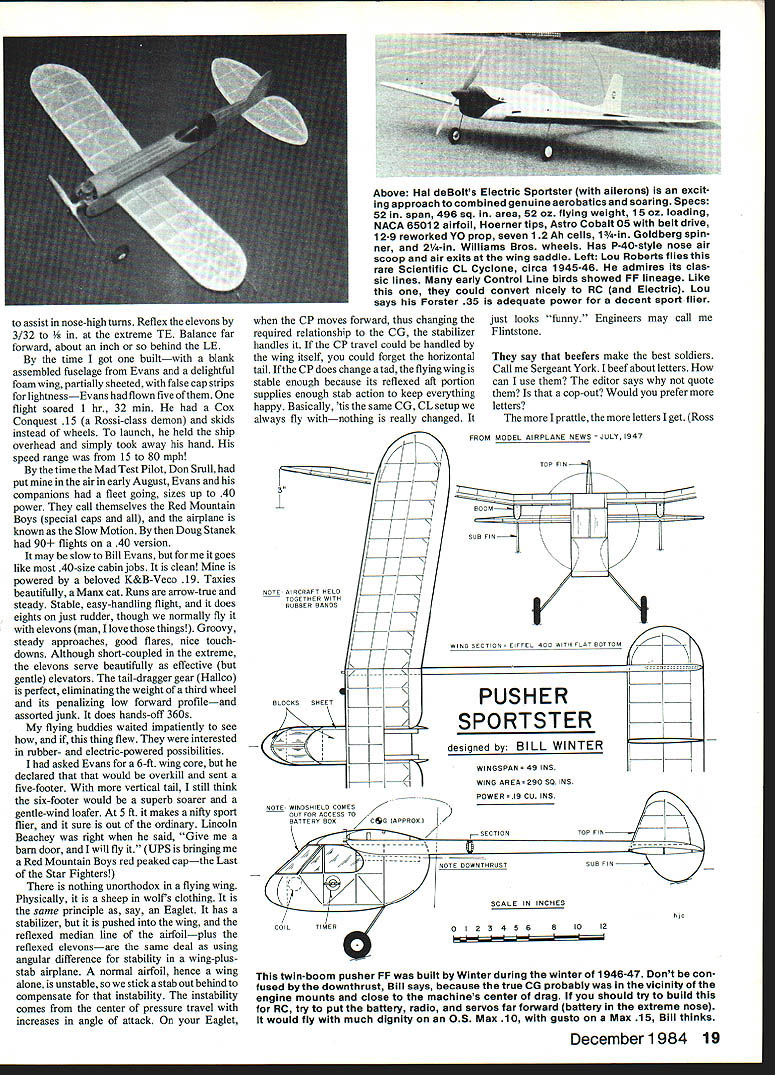
I thought he would go away. Sketches flew back and forth. Odd problems arose. Dihedral proved necessary, so we put twist in a reflex airfoil (you'll find the reflex median line of the airfoil). What about hands-off stability in a 360° soaring turn, and no spiraling down on rudder control? We extended the fuselage aft, lowered the billboard-size vertical tail of the original Simitar (the Simitar Deuce), and moved it back—the fuselage was extended 8 in. aft to the rudder TE. We lowered the aft profile, raised the forward profile, and added a good-sized canopy far forward.
Reflex the elevons back about 3/32 to 1/8 in. at the extreme TE. Balance far forward—about an inch or so behind the LE.
Flight tests and first impressions
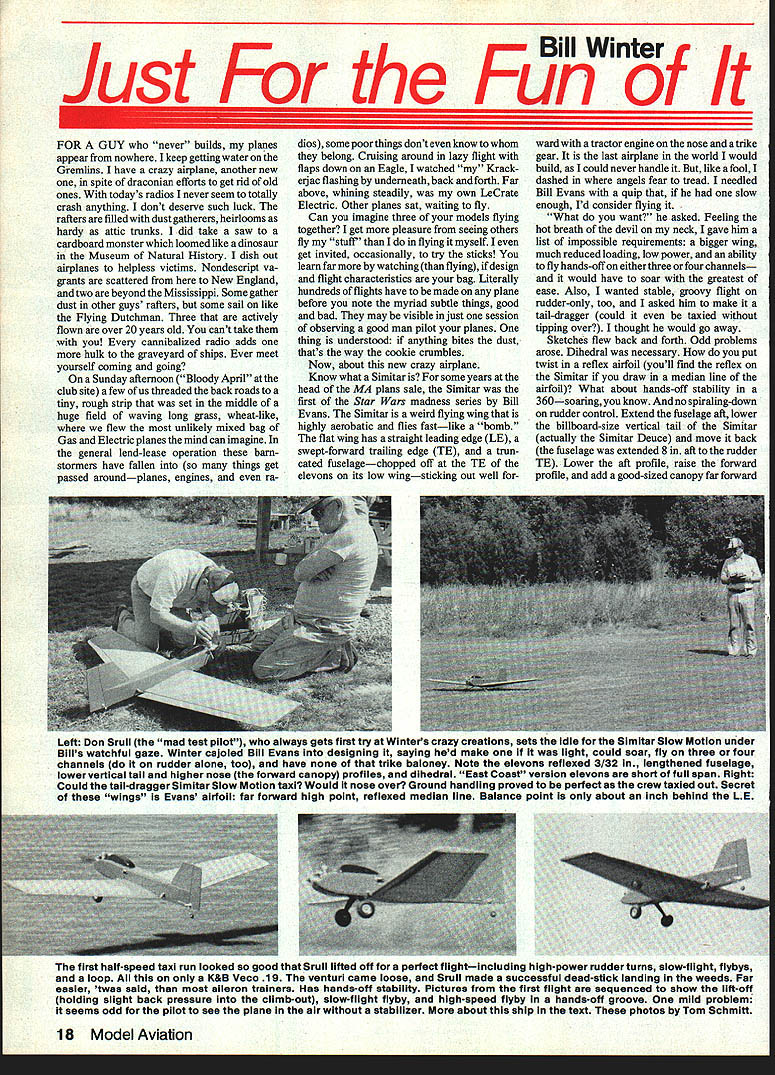
Don Srull, the "mad test pilot," who always gets first try at my crazy creations, set the idle for the Simitar Slow Motion under Bill's watchful gaze. The secret of these wings is Evans' airfoil: a far-forward high point and a reflexed median line. Balance point is only about an inch behind the LE.
The first half-speed taxi run looked so good that Srull lifted off for a perfect flight—including high-power rudder turns, slow-flight flybys, and a loop—all on only a K&B Veco .19. The venturi came loose, and Srull made a successful dead-stick landing in the weeds. Easier, 'twas said, than most aileron trainers. It has hands-off stability. Photographs from the first flight show the lift-off (holding slight back pressure into the climb-out), slow-flight flyby, and high-speed flyby in a hands-off groove. One mild problem: it seems odd for the pilot to see the plane in the air without a conventional stabilizer.
By the time I got one built—with a blank assembled fuselage from Evans and a delightful foam wing, partially sheathed with false cap strips for lightness—Evans had flown five of them. One flight scored 1 hr., 32 min. He had a Cox Conquest .15 (a Rossi-class demon) and used skids instead of wheels. To launch, he held the ship overhead and simply took away his hand. His speed range was from 15 to 80 mph!
By the time the Mad Test Pilot had put mine in the air in early August, Evans and his companions had a fleet going, with sizes up to .40 power. They call themselves the Red Mountain Boys (special caps and all), and the airplane is known as the Slow Motion. By then Doug Stanek had 90 flights on a .40 version.
It may be slow to Bill Evans, but for me it goes like most .40-size cabin jobs. It is clean! Mine is powered by a beloved K&B-Veco .19. It taxies beautifully on a Marx cart. Runs are arrow-true and steady. Stable, easy-handling flight, and it does eights on just rudder, though we normally fly it with elevons. Groovy, steady approaches, good flares, nice touchdowns. Although short-coupled in the extreme, the elevons serve beautifully as effective (but gentle) elevators. The tail-dragger gear (Hallco) is perfect, eliminating the weight of a third wheel and its penalizing low forward profile. It does hands-off 360s.
My flying buddies waited impatiently to see how it would perform—and, at this, the thing flew. They were interested in rubber- and electric-powered possibilities. I had asked Evans for a 6-ft. wing core, but he declared that that would be overkill and sent a five-footer. With more vertical tail, I still think the six-footer would be a superb soarer and a gentle-winded floater. At 5 ft., it makes a nifty sport flier, and it sure is out of the ordinary. Lincoln Beachey was right when he said, "Give me a banjo, and I'll fly it." (UPS is bringing me a Red Mountain Boys red peaked cap—the last of the Star Fighters!)
Flying-wing principles—why it works
There is nothing unorthodox in flying a wing, physically; it is a sheep in wolf's clothing. It is the same principle as, say, an Eagle. It has a stabilizer, but it is pushed up into the wing, and the reflexed median line of the airfoil plus the reflexed elevons are the same deal as using angular difference for stability in a wing-plus-stab airplane. A normal airfoil, hence a wing alone, is unstable, so we stick a stab out behind to compensate for that instability. The instability comes from center-of-pressure travel with increases in angle of attack. On your Eagle, when the C.P. moves forward, thus changing the required relationship to the C.G., the stabilizer handles it. If the C.P. travel could be handled by the wing itself, you could forget the horizontal tail. If the C.P. does change a tad, the flying wing is stable enough because its reflexed aft portion supplies enough stabilizing action to keep everything happy. Basically, it's the same C.G., C.L. setup we always fly with—nothing is really changed. It just looks "funny."
Reader mail
Mrs. G. Ross, Denver: "You write a great column. I love reading about all the different types of airplanes. My husband and I are new to RC, but when I read the section on Peter Miller, 'Put Wings on Your Camera,' I knew I had to ask how I can get a copy of this article. Also, what types of kits would this idea work best with? What are Old-Timers? How can I find out more about them? Thank you for your patience with my questions."
That letter strikes home. I truly enjoy flying late in the day and cool evenings with one or two other guys who want quietly to watch the birds sail on high, invariably at some hidden-away field or parking lot. Across some wide field appears a young man, or an old man, or a hand-in-hand couple. They want to get into RC. They know RC exists. Few know about magazines and most often haven't heard about AMA. An AMA T-shirt leads to questions. I have met six such couples this season—and at least a dozen men and boys. Usually, they have seen something on TV or in a newspaper. AMA cranks out a mountain of stuff for media folks, and the reporters do impressive jobs.
Questions arise: Where can I fly? Where can we meet people who fly? What's a good kit? How much? How do I fly it? Ouch! Mothers waiting for kids to finish soccer, fascinated with drifting, soaring planes, often remark, "How beautiful." It must seem like sailing to them, and they can identify with that. At big nearby flying sites, I fear experts who will tell newcomers they must have a "bomb" with ailerons to do it right. Gadzooks! One feels humble and helpless. How much can you do for them? Point them in some direction and cross your fingers; that's it.
There is nothing in print, in any language, that properly or adequately serves this purpose. I have come to believe nobody knows how to do it. Insights and understanding are almost totally nonexistent. Even a booklet of just 100 simple questions and answers would help. I don't expect to see one in my lifetime. I haven't seen one in my 55 years of modeling. Why now? Oh, we have tried. But we just focus impressions. This may be the most complex hobby in the world, and we shine lights into a thousand different corners, never illuminating the stage.
Try this: the next time you go out to fly, think about every object, every action, so simple because you are lucky enough to know about them—and there is much that none of us know. The field box. What's in it? The plane, the radio, everything from tank, clunk, pressure, plugs, props, connectors, boosters, starters, batteries, chargers, gizmos, and gadgets. Think of what you do at the field, each action taken and why, from a range-check to starting an engine. Think how you start and run that engine, and remember how it was when this stuff was Greek to you. Your head is full of buzzing bees. I have a partial answer. So do you. So does everybody, including the modeling industry—the Tower of Babel.
Want a shock? After five decades of magazines, associations, clubs, and national programs which cost the well-intentioned a bundle, I can assure you that within every two-year period there is a 50% turnover. Many have hung on, but over the years millions have turned off. Some come back. Most never do. Mrs. Ross, my dear, and your hubby—you can do it. Would you tell us regularly about your progress and achievements? We dearly want to know how you make out.
Clarence Lee: "Just a note to let you know your column is the first thing I read in Model Aviation each month. I was quite surprised to suddenly see my name in print in the current issue in regard to Wally Francisco turning cologne in his fuel. I only met Wally on two or three occasions, but I did ask him one time what made his fuel smell like it had perfume in it, and his answer was, 'We put cologne in it.'
"I guess as we get older we tend to reminisce about the past, and reading your column every month brings back many old memories. My first gas engine was a 1937 Bunch Mighty Midget purchased in knock-down form. I built a Meiggs Quaker Flash but do not think I ever had one successful flight. The wing was badly warped, and I tried to correct this with an aluminum trim tab. At low speed the tab had some effect, but as the model picked up speed the warp in the wing took over, and it would spiral-dive into the ground. Later I bought a Miss Tiny and Ohlsson 23 and began to get some successful flights. However, this was not before I had crashed a few times, because I did not like the looks of the Burgess battery sitting up in the cabin and placed it on the floor. I figured the weight in the belly of the plane would make it more stable. I did not know at the time a gyro or auto-gyro to turn; the pendulum effect of the weight only tightened the turn more, and the ship went in just like the previous Quaker Flash. One day an older modeler suggested I try placing the battery as shown on the plans. I did, and I had no more problems. I guess this was the start of an accumulation of knowledge that I try to pass along in the Engine Clinic column now.
"I do not think modelers nowadays can appreciate some of the things we went through back in the early days of model and engine development. A lot is just taken for granted. As a small boy I lived about five miles from Grand Central Air Terminal in Glendale, CA, where many historic flights took place. I used to ride my bike over to the airport several times a week just to watch the Ford Trimotors and Curtiss Condors take off and land. There is no way young fellows of today can experience this type of pleasure. The Baby Cyclone engine was also made at Grand Central in a tin shed alongside one of the hangars. I used to spend hours outside the fence behind the shed watching them run the engines. Actually, I was hoping someone might offer a reject to the poor kid. In later years when I had met Bill Atwood, Mel Anderson, and Ira Hassad, I told them about this, and they all said I should just have come to the door and asked. They had plenty and probably would have set me one. That was an era that can never be duplicated. I believe now that I was going to be an airplane pilot when I grew up—and eventually spent 11 years as an Air Corps/Force pilot during and following WWII.
"Enough about the past. Your column just brings back many old memories—all the way back to Bill Barnes' Air Trails and the Silver Lancer."
Wendell Hughes, Prince Edward Island, Canada, notes that "you are not too far from here." He writes: "Your remarks about Theme models spell out something I have always suspected. I have a Theme model. It's an Me-109 slope glider, with which I have taken many deviations from scale. It keeps the correct 'sit' of the airplane. It's a little vicious due to the small stab, but it's a real floater at 24 oz. with an Eppie 205 airfoil. Rudder and elevator controls. It is positively indecent fun.
"I've enjoyed your writing from MAN in the '30s, Air Trails, etc. I hope someday you'll explore the artistic ramifications of the model airplane. Our art has a raison d'être in that it moves in three dimensions in a natural element. I have my own flying field on the farm and an empty house. Write sometime."
One could write endlessly about "artistic ramifications." Construction is an art form, particularly in Rubber Scale and Indoor models. Beautifully done machines of any type capture the elusive essence of the full-size thing as art forms. So are some color schemes and finishes. So is flight. For me, the greatest thrill Hughes calls "artistic ramifications" is flight itself. When any craft truly becomes one with the air, it is a highly individual experience, rare at that. You will know when. The plane takes you with it.
Doug Dahlke, "EAA-ville," WI: "Fun" is his game. He wrote: "Check your files, July 1982. Sent you six pix for the stuff. Heard nothing more, so naturally assumed lack of interest, plus your mountain of mail." (Editor: That ain't a joke, son.) In March 1984 you wondered if anyone has fun in C/L modeling. Doug reports:
- He's teaching a young beginner how to fly; the youngster knows nothing of recovering, is having a ton of fun, doesn't crash much, and is getting his father interested. He didn't take out a bank loan to do it with.
- He taught an older fellow how to build mechanically sound stunt models; the student is learning how to teach.
- He has a TD .02-powered ping-pong-pilot plane—fun and inexpensive.
- He enjoys Balloon-Bust with Midwest rules. His design, the Goat, will stop dead in midair with no throttle and will also back up.
- He won a "Spirit of 1952" award for the most authentic construction of his Old-Time Stunter (Barnstormer), and that Barnstormer took first overall in a PAMPA-class event—beating intermediate and advanced competition.
- He designed an indoor CO2 stunt model spanning 21 in. and weighing 30 grams total. It flies on 9-ft. lines in medium power settings and allows little folks to fly Stunt in local libraries.
Doug sums it up: "If you’re not having fun, you’re simply not in touch with what is going on." (Editor: Doug, rattling your cage is fun, too. Good pix are fun as well.)
Joe Kovel: "Read 'Just For the Fun of It' in the September issue and enjoyed the references to the KG. For the sake of the record, the plans for the KG appeared in the April and May issues of MAN in 1935, not 1934. I've been trying for a number of years to restore the original KG. Barring any unforeseen delays, the project should be completed in 1985. I also have a KG-2 in the works (RC?-Assist?)—but the KG restoration is my priority."
Imagine the original KG in the AMA Museum! I'm trying to talk Joe out of some pictures—cross your fingers.
Clubs and closing notes
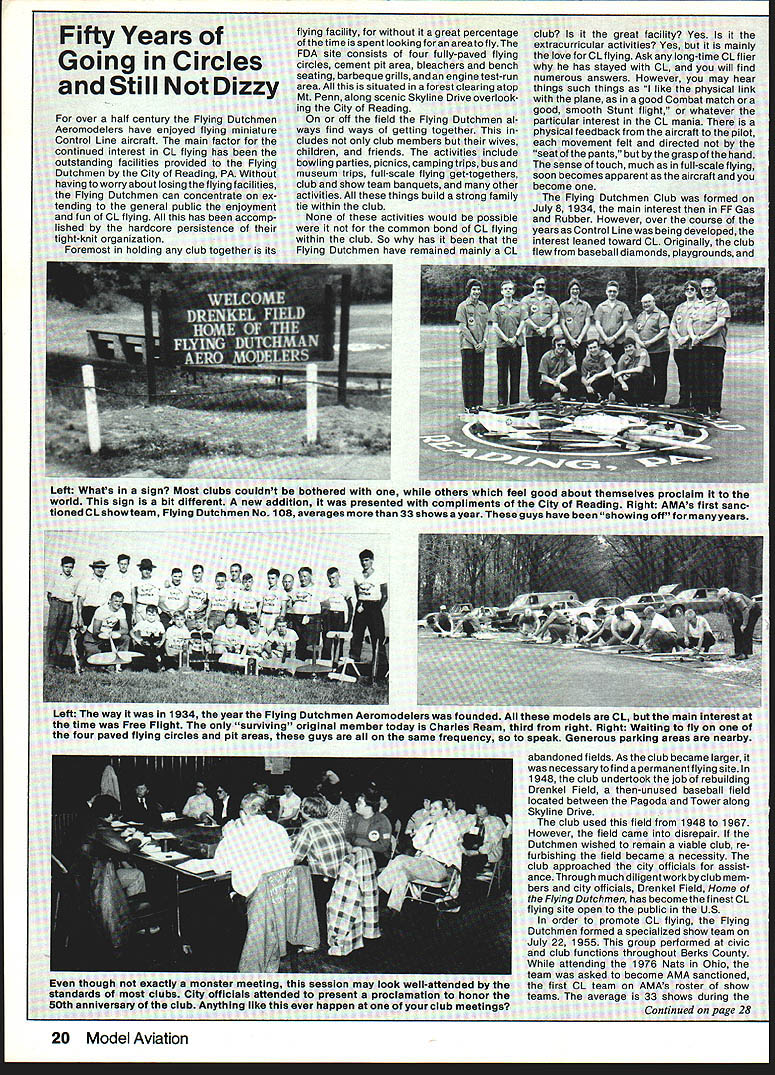
Formed in 1934, the Flying Dutchmen Aeromodellers (Reading, PA) is one of the nation's oldest continuously active clubs—you can number such outfits on the fingers of one hand, maybe two. The FDA is a big one and a premier example of what can be done in, and with, a community. Unique for its exceptional close ties with families, the FDA is a shining example of what a club can be. The FDA Show Team, one of AMA's oldest, claims to fly in more exhibits than any other. We promised a few months ago that FDA would be back. We give them a justly earned spot of their own. This is a Control Line club. Modeling is a many-splendored thing.
Bill Winter 4432 Altura Ct. Fairfax, VA 22030
Transcribed from original scans by AI. Minor OCR errors may remain.

