
Just For the Fun of it
Bill Winter
This is about Bob Palmer, a legendary name in Control Line Stunt, who also actively flies RC. A career man at Lockheed, Bob has a sideline business making fiberglass fuselages, patterns, and prototype models—mostly for RC manufacturers. He taught his methods to Bob Smith, Terry Prather, Don's Models, Joe Bridi, and American Helicopters. You may have noticed ads by Parker R/C Planes for a 1/4-scale Cessna (9 ft., 24–28 lbs., Quadra) at $398.00. Bob carved the fuselage pattern, including the fin. Just beautiful. He has a fiberglass fuse for Dave Platt's and RCM's Bucker Jungmeister (Bob Palmer's Models, 9161 Morehart Ave., Arleta, CA 91331) which includes rivets on the fillets, stringers and ribs, doors, cable outlets—at only 28 oz.
In 1941 Bob went to California to join Lockheed. Six months before he saw anyone fly control-line, he taught himself with converted free flights. He won first and second in his first two contests. So he joined the contest circuit and won first for seven years running at the Western Open.
He formed a team with J.C. "Madman" Yates. In 1948, the year Bob lost most of four fingers in a die-cutting accident, Yates won first in CL Scale at the Nats that year with Palmer's Sammy Mason Stearman—which stunned everyone by its full-stunt capability. Yates, incidentally, was aptly named "Madman" for his incredibly fast flying with a big-Orwick Madman. Not only did J.C. skim the earth during maneuvers, raising a plume of dust, but he could place his wheels on Palmer's wing while the two ships flew formation.
After Bob developed a special flying glove, he was forced to fly .35 engines, setting a worldwide trend in stunt. Within three years, you couldn't buy a big stunt engine.
When he saw the Whizzer trainer (was that a Goldberg kit?) that used flaps only, he reasoned: why not have elevators as well, and move everything? The first kit to use flaps was a Go Devil Sr. Bob built with an Ohlsson .23. He won first on his next try. Bob demonstrated at the '49 Nats, won second in 1950, and later placed first in 1955 and 1959. He was on the first team ever fielded for the World Championships which took third. In 1956 he joined Howard Bonner and flew the RC Smog Hog on a four-week demo tour of Africa; a week in England followed by three weeks of demos in Argentina.
In 1952 he became interested in RC, eventually winning some thirds and fourths. He became a scale judge twice at the Nats. Now he flies out-of-this-world RC scale jobs. Lockheed built an all-glass plane and flew it RC, saving the firm over $1 million. As guys in the industry know, official commendation is rare. Bob got a quote commending his initiative and craftsmanship: "demonstrated support of research program conducted at Lockheed" (July–August 1980). Since Lockheed's experienced men were getting long in years, a training program started; Bob led and taught trainees model building.
Recently given a one-in-a-hundred chance—four simultaneous bypass operations—he, as usual, won.
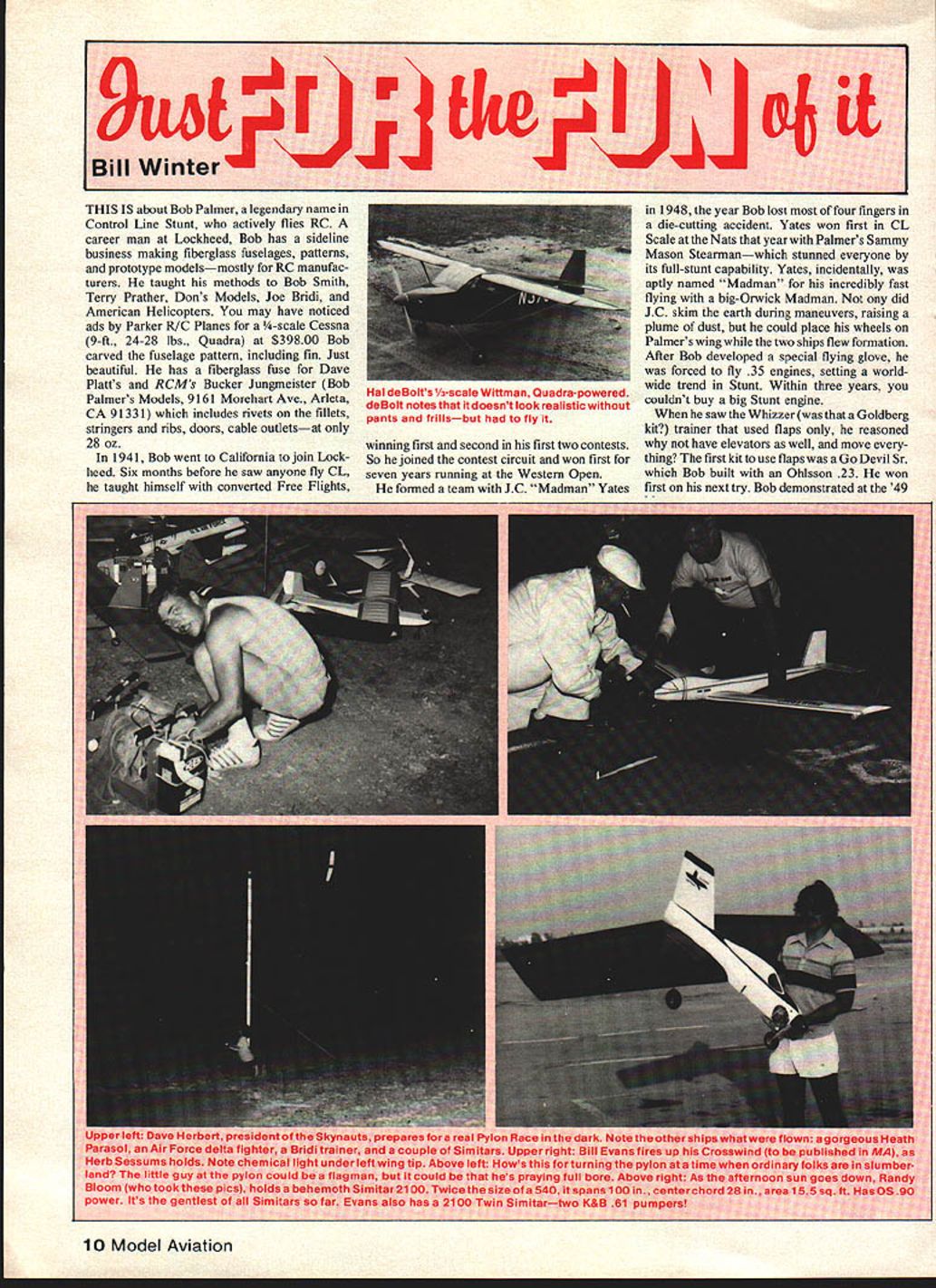
Would you believe pylon racing at night? We rest our hand on the Good Book. You can ask Dick Kidd; not only was he there, but he flew a Cox Centurion and Bill Evans' Crosswind. What's with these Californians and their night flying? For years they've done it numerous times with free flights, and that rubbed off on a few other adventuresome souls.
The runway at the Skynauts field near El Toro was marked on both sides by lights spaced 2 ft. apart. Full-scale fashion, there was a strip of flashing approach lights (lighting built by Dave Duncan). Evans, who will try anything—including leisurely gliding from high Rocky Mountain cliffs—remarks: "Four sets of navigation lights racing around a pylon is an amazing sight. Keeping track of which is yours is mind-boggling."
Flying went on until after midnight. Club pres. Dave Herbert, Dave Duncan, John Elliott, and Bill Evans put on a genuine race, pylons and all. Wonder if the helpers wore fluorescent clothing?
"Night flying, at half-throttle, is equal to flying full-throttle during the day," says Bill. "It will take practice before I can night-fly a 7.5cc-powered Simitar .540 at full bore. Fueling, starting, launching, and frequency control (can't see flag in the dark) are totally new experiences."
You don't have to be an old-timer to know who H.A. Thomas is. One of the greatest illustrators in our field, H.A. is remembered for his "Sketch Book," which ran for many years in Air Trails and, after that, in the American Modeler while it was still under the editorial genius of the late Al Lewis. H.A. illustrated two hard-cover books we did for T. Y. Crowell. We learned he had been a wing-walker in the days of the Jennies and Standards. There are few people in his class: the late Cal Smith, Jim Newman, and that daring pilot of the ancient Cub on floats—our very own Hank Clark. H.A. ran his own ad agency in Little Rock since before we first met him in, oh, 1937, and by the time you read this, he will be packing it up for another of those "just for the fun of it" retirements.
H.A. wrote us recently, and included a paragraph we would like to share about his wing-walking days:
"When I was 18 or 19 I flew around with a group of starving (literally) barnstormers. These were deep depression days. I made eight jumps in Arkansas and Texas, a couple delayed drops from 8–9,000 ft. while trying to release a 20-lb. sack of flour (I can tell you this is not worth a darn in a rain). The wing-walking was a fill-in when we couldn't afford to repack the chute. The planes were a Command-Aire, built in Little Rock, with Wright J-6-5; occasionally a neat Waco F-2 with 165 Continental; an old Stinson cabin 4-placer with Lycoming 210; and an American Eagle biplane with Kinner 100. We flew on automobile gas, and when we'd have tire trouble due to the rough fields, we would patch them up with automobile tubes in the nearest size. All of this was in the days before the paratroopers and the jump clubs made parachuting pretty commonplace. I had a couple of close shaves."
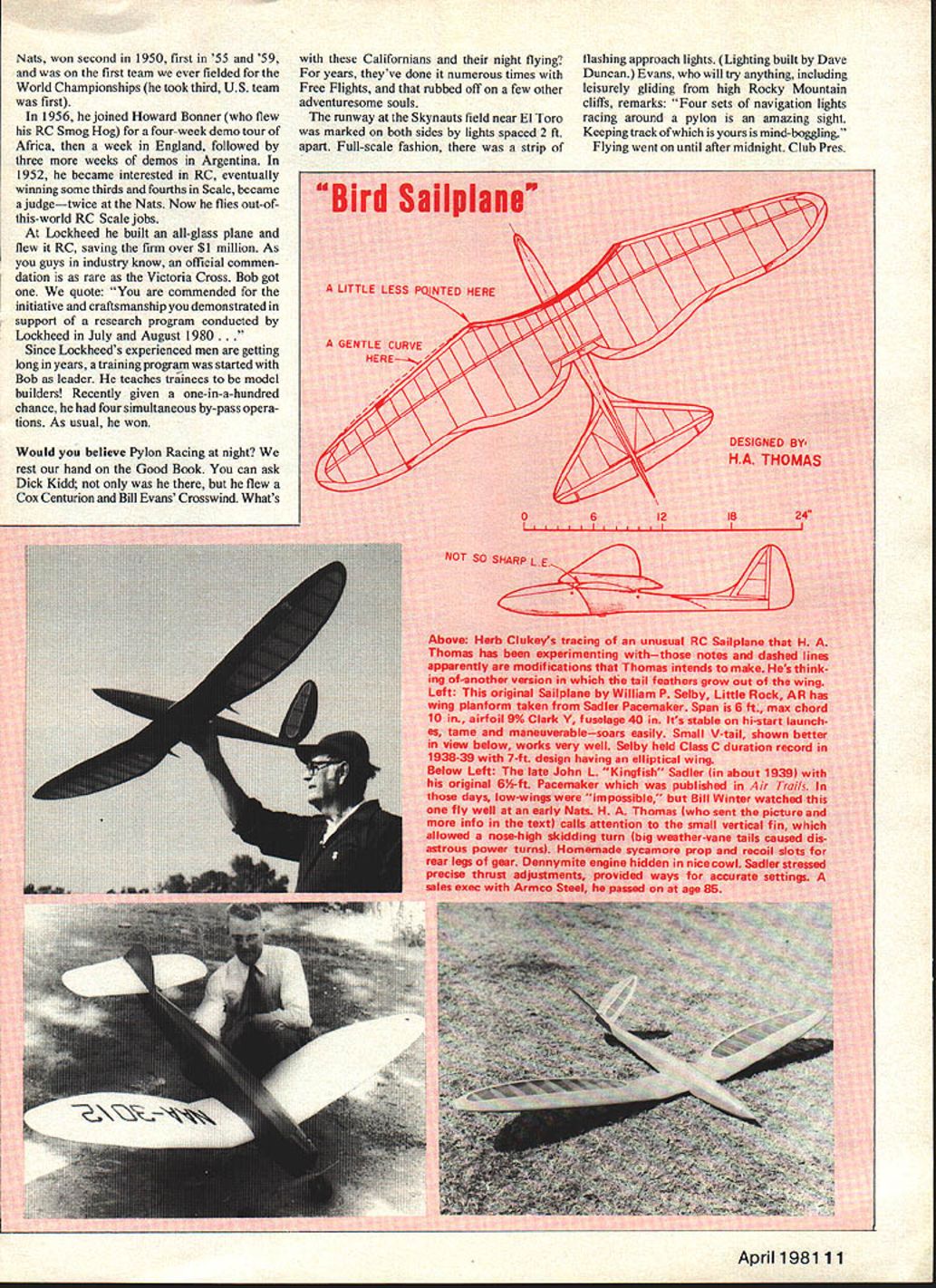
For the last two years we've been discussing H.A.'s sailplane. It has 20 successful flights—except for one snafu hi-start with the transmitter antenna not extended. He lost control halfway up on the launch, then fought a battle with intermittent control. It went in like a javelin—into the only mudhole on the field—snapped the fuselage forward of the tail, but was back in the air the following week.
It flies most satisfactorily, proving (in H.A.'s words) that sailplanes don't have to be "so darn long to get the job done." Our prodding got him into a 50-in. version, with the stab growing out of the wing—just like a bird. Little Rock, AR, was the center of some great things; both free flight (particularly John "Kingfish" Sadler), and many of the hottest speed fliers came from there. And there are a couple of Nats-winning sailplaners there now. So watch this space for more next month, if you think that L.A. is the only place where ideas come from.
We are reminded of H.A.'s first magazine submission to Air Trails, a little sketch of Sadler's low-winger. Our mentor, Charlie Grant, then editor of MAN, turned it down, saying it was in reality a high-winger because of the severe dihedral. To us, it looked different, and besides, we didn't know what we were doing. (We still don't, and that's where the fun comes in.) Anyway, for some time H.A. would not accept payments—which went into the local club treasury. That got to be ridiculous, and H.A. was off to the races. When they made H.A., they destroyed the mold. When he reads this he'll blush MonoKote red. For that's the way he is.
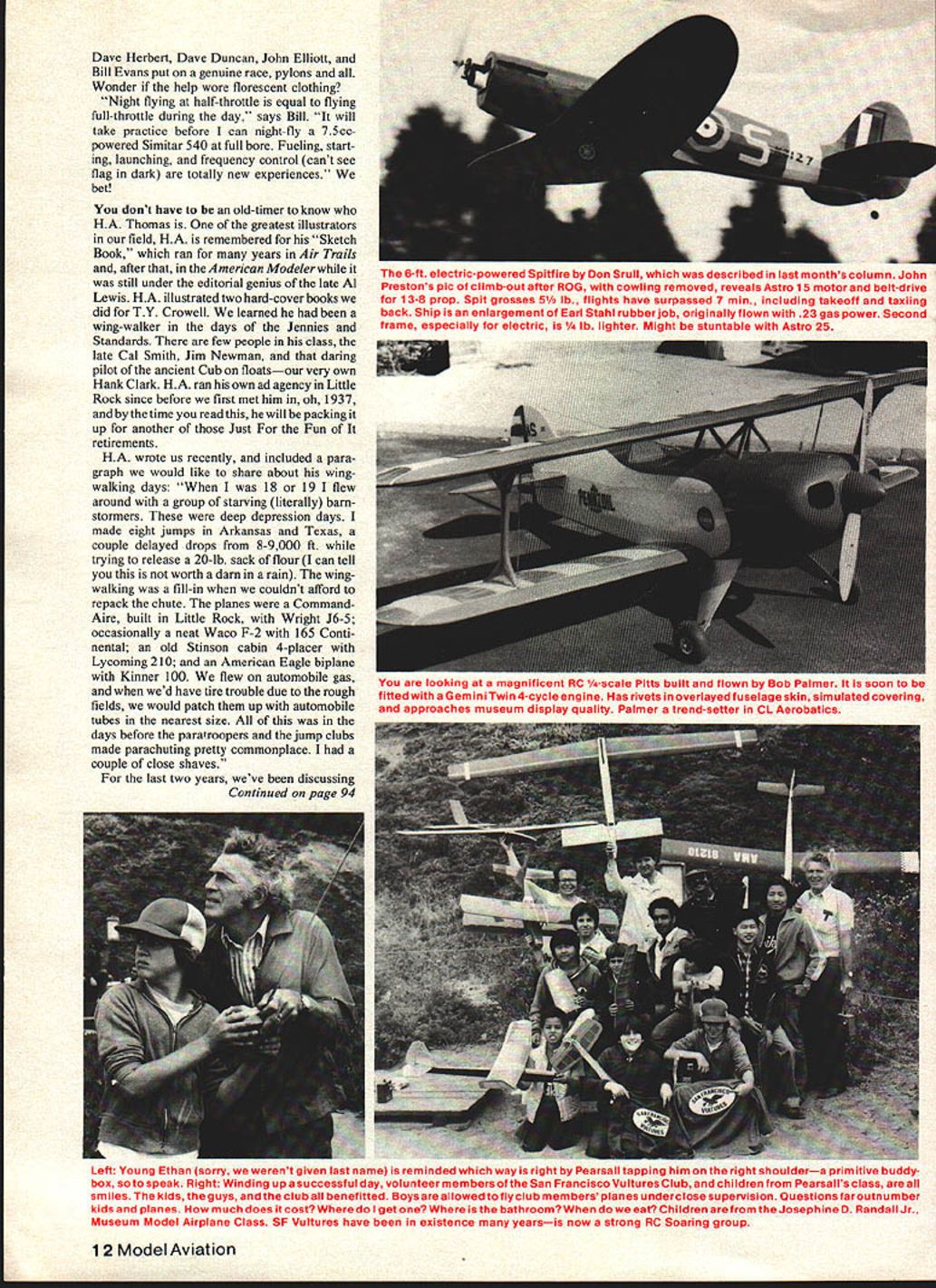
Do you know the answers to these questions? They were asked by the kids in Richard Pearsall's class who have a lot of fun flying RC airplanes.
- How much does it cost?
- How does it fly?
- Will it crash?
- When do we eat lunch?
- How does it land?
- How much does a broken one cost?
- How long does it take to build?
- If I got one, what kind should I get?
- Where do I buy it?
- If I need help, where can I get it?
- Why does it look like it's flying away from me when it really is coming towards me?
- What is it made of?
- Can it do stunts?
- What are the colors on the antenna for?
- Why do some radios have two sticks, and others just one?
- Where is the bathroom?
- Where can you fly the planes?
- Can I make my own radio?
- Etc., etc.
"After answering all these questions in the field (by the way, Dick, where is the bathroom?), I hand out a prepared information sheet to the children on the way home," Pearsall explains. "It's a basic source guide for RC gliders in the San Francisco area." Is it all worth it? Pearsall answers us: "Just look at the faces in our group picture. It's smiles for the youngsters, smiles for the club members because we did it just for the fun of it." A great source of publicity for the club, its members, and modeling in general. So we asked for suggestions on how other clubs should do it.
Following are a few suggestions for a successful day.
- With the club members:
- Tell them how many children to expect, their ages, backgrounds, and interests.
- Get as many volunteers as possible to bring lots of different kinds of planes that they are willing to let the children fly.
- Set the time and date for flying.
- With the children:
- Show them a typical airplane, and allow them to work the controls and simulate flying.
- Tell the children not to touch other people's "stuff," and not to switch on or off radios without direct permission of the owner.
- While flying:
- Introduce people (split into small groups assigned at first by the instructor), and encourage questions.
- Take pictures.
- Have the children switch instructors so they can fly different types of planes and experience learning from each club member.
- After the field trip:
- With the children—hand out an information sheet on flying in your area; be prepared to answer all questions; display all those great pictures.
- With the club members—thank all the people who participated; show the great pictures; discuss the field trip in order to encourage participation and to improve it for the children.
For more than 30 years we've been exchanging notes with Hal deBolt on all sorts of things. Pappy does all the things we do, only much better. We've long admired the old corn-cob pipe he smoked, his distinctive feel for things that fly, his insights into model engineering, his superior building ability, and his piloting. He started out in the days of the Junior Birdmen, and has competed nationally in indoor, free flight, CL speed and stunt, and radio. It has been some years since his firm, DMECO, stopped producing all those great kits. He is currently associated with Midwest Products Co.
We recently shared a thrilling race to get our first monster-scale planes into the air, hanging on last year for a final hoped-for weather break, and we both made it. Both our Aristocrat and his 1/6-scale Wittman flew right off the board, but his first hop was more exciting, since it included loops. As you'll see from the pic, his Wittman would look well in a museum. With an 8-ft. span, it has 1,460 sq. in. of area, weighs 20 lbs., Quadra-powered, and it uses Proline PLS-1 servos. In the rush, we flew our Aristocrat without nose details, and Hank postponed wheel pants and frills. His impressive ship fits into a Plymouth compact—and that is 1/6 scale!
Bill Winter 4330 Alta Vista Dr., Fairfax, VA 22030
Transcribed from original scans by AI. Minor OCR errors may remain.

