
Just For the Fun of It
Bill Winter
This is a "rainy day" column—but the sun is shining. "They" dragged me off for two weeks in "solitary"—the first back-to-back, do-nothing weeks in 39 years, spent appropriately in Kitty Hawk, N.C. No TV, no radio, no phones, no models. I took along two untouched fat folders of "Fun" letters. The Outer Banks swarm with sea and sun worshippers and funny plastic kites flown with two handles. Somehow I doubt that few of these frolickers felt the haunting presence of the "Brothers" in the wind and mist. I reached four to five degrees above mental absolute zero, the residual temperature of the 15- to 20-million-years-ago Big Bang.
The subconscious, in this near vacuum, buzzes like hoss flies. Gulls, herons, fish eagles, terns, and soaring hawks catch the lazy eye—taped, as it were. A miles-long armada of porpoises in the dusk, arcing the surface, north-bound. Charlie Grant's X-8 airfoil was outlined by tracing the contours of a trout. A seaful of X-8s. Really, now, bugle blows charge. The shades of Wilbur and Orville had cast a spell on my mail. This is a very small world.
Model Photos and Early Gas Models
Carl V. Carlson's "Big Crate" (1931)
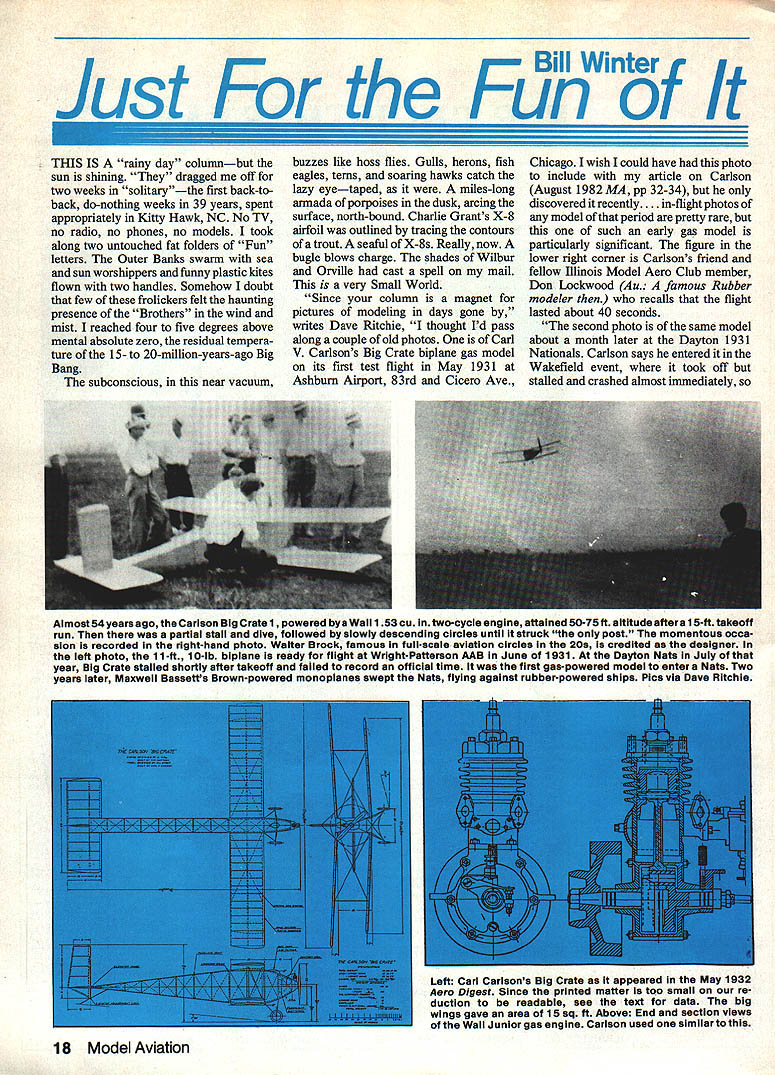
Dave Ritchie sent along two rare photographs and background on Carl V. Carlson's Big Crate biplane gas model:
- First test flight: May 1931 at Ashburn Airport (83rd & Cicero Ave., Chicago). The flight reportedly lasted about 40 seconds. Don Lockwood, a famous rubber modeler and Illinois Model Aero Club member, is visible in the lower right corner of the photo.
- Dayton 1931 Nationals: About a month later Carlson entered the Big Crate in the Wakefield event at Dayton. It took off, stalled, and crashed almost immediately, failing to record an official time. Carlson's Big Crate I was the first gas-powered model to enter a Nats.
Specs and performance (from period sources and Aero Digest coverage):
- Designer credited: Walter Brock (full-scale aviation figure of the '20s).
- Wingspan: 11 ft.
- Weight: ~10 lb (drawing notes give 174 oz plus).
- Wing area: about 15 sq. ft.
- Typical takeoff run: ~15 ft; altitude reached on test ~50–75 ft.
- Flight profile: climbed steeply, experienced a partial stall and dive, then slowly descending circles until striking a post at Dayton.
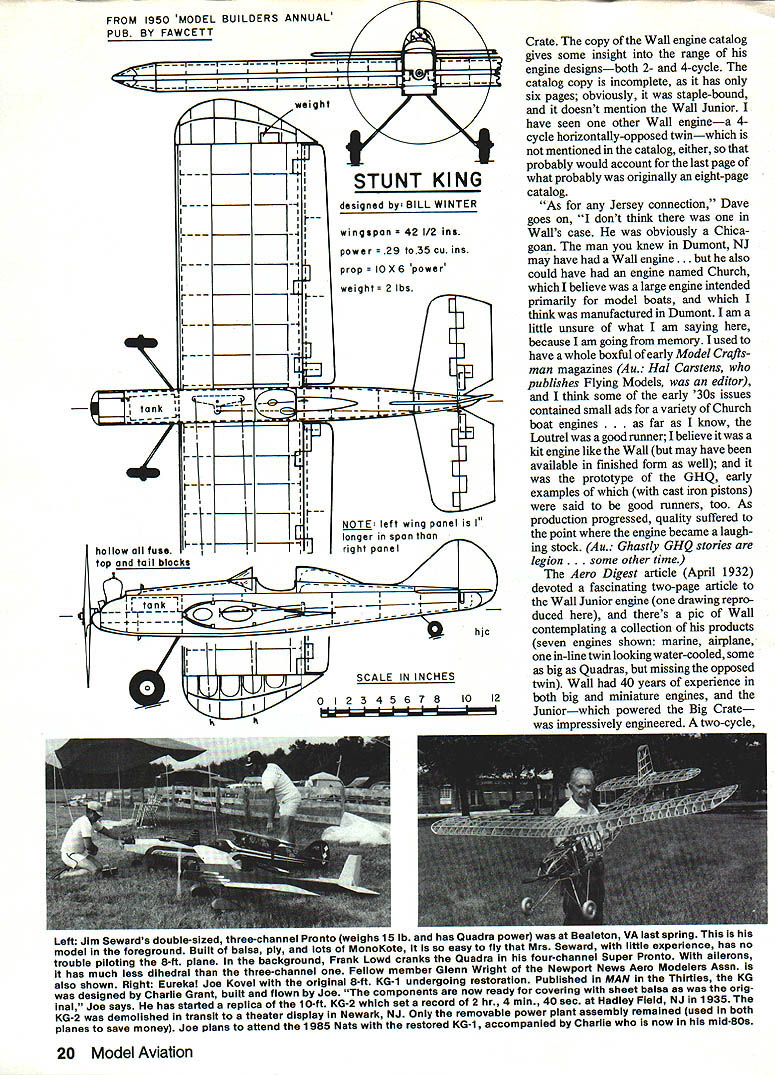
- Construction notes: wing panels attached to fuselage sides to simplify assembly; two-piece fuselage assembled with cotter pins and fittings; longerons 1/2 sq. spruce laminated from two pieces forward of Station 5, 1/4 sq. spruce aft; nose cowl shaped from an aluminum saucepan; covering paper; internal wire bracing; 45-oz fuel tank (moved forward for balance); four flashlight batteries used for ignition.
The Big Crate was built by Carlson with H.W. Hartman (Chicago) making the engine from Wall-supplied castings. It got off cardboard in about 15 ft and made several flights before the Nats stall.
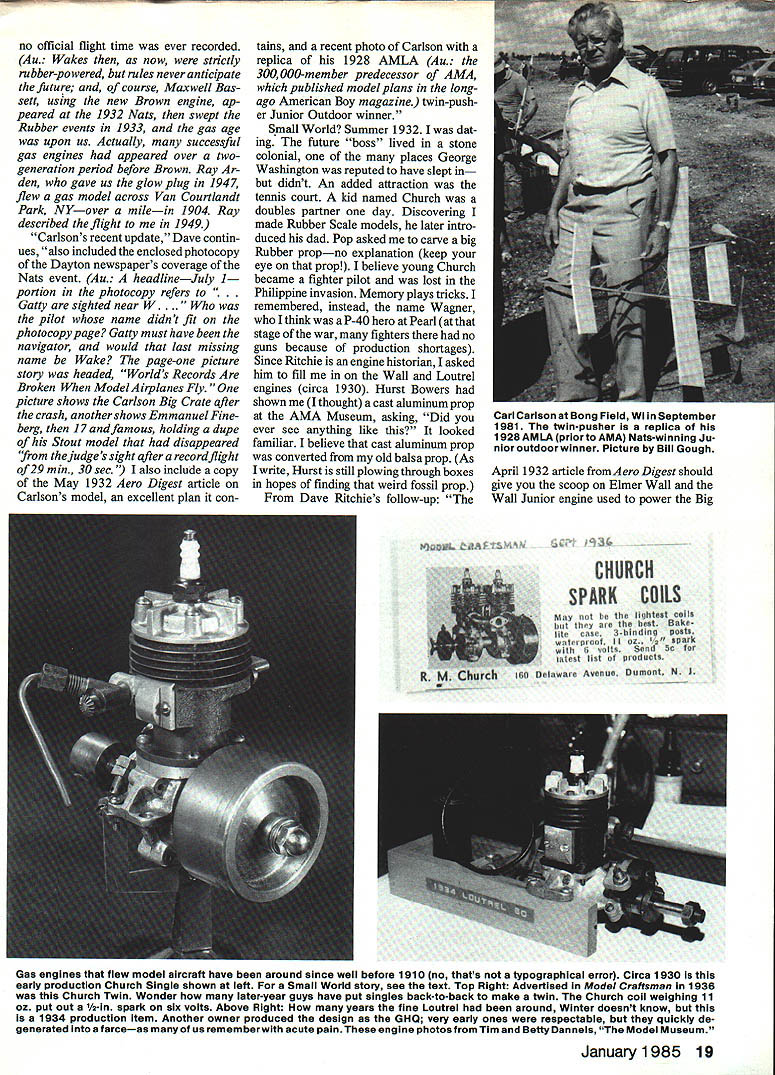
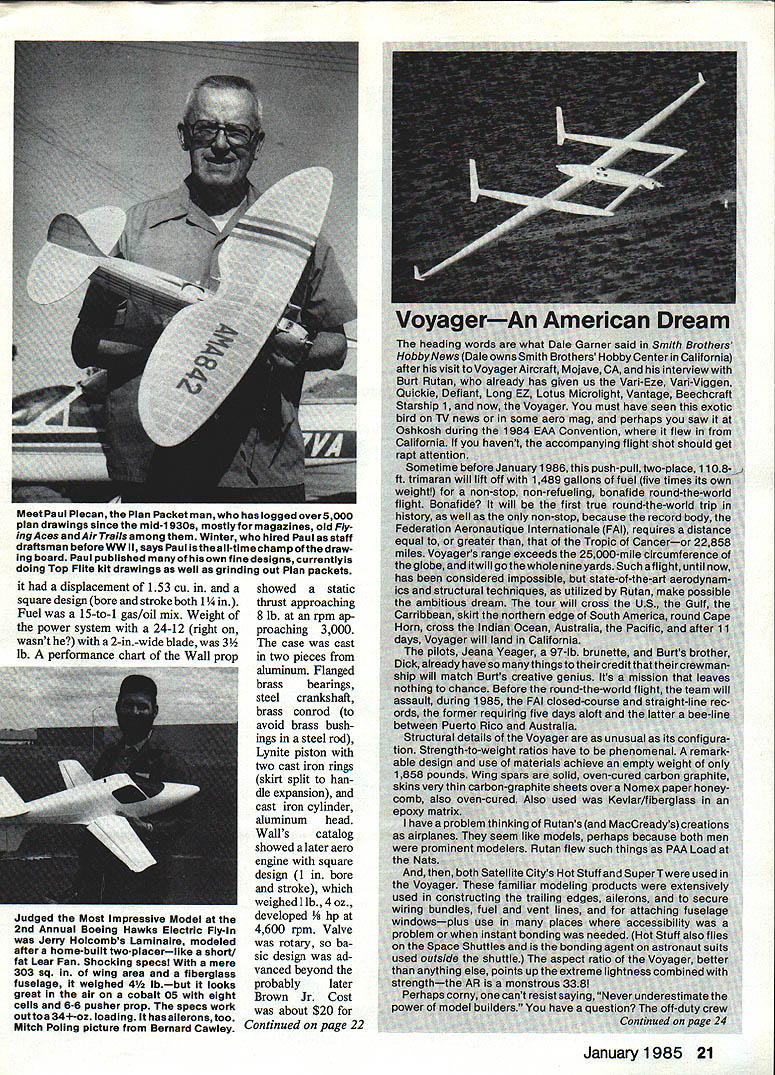
The Wall Junior Engine
Dave Ritchie's research and an April 1932 Aero Digest article provide a detailed look at the Wall Junior engine used to power the Big Crate:
- Type: two-cycle
- Displacement: 1.53 cu. in. (bore and stroke both 1 1/4 in.)
- Fuel: 15:1 gas/oil mix
- Typical prop: 24 x 12, 2-in. wide blade
- Power-system weight (engine + 24x12 prop): ~3.5 lb
- Performance: static thrust approaching 8 lb at around 3,000 rpm
- Construction details: two-piece aluminum case; flanged brass bearings; steel crankshaft; brass connecting rod; Lyntic piston with two cast-iron rings (split skirt to handle expansion); cast-iron cylinder; aluminum head.
- Later Wall aero engine (catalog): square design 1 in. bore/stroke, weight ~1 lb. 4 oz., ~1/2 hp at 4,600 rpm; rotary valve; assembled engines cost around $20.
The Aero Digest piece featured a photo of Elmer Wall with a collection of his products and a drawing of the Wall Junior.
The Gas Age and Wakefield Contests
- The Wakefield (rubber-powered) contests originally never anticipated the rise of small gas engines. In 1932 Maxwell Bassett's Brown-powered monoplanes swept the Nats, marking an early ascendancy of gas power in contests traditionally dominated by rubber ships.
- Two years after Carl Carlson's Big Crate, gas engines were making a greater impact on competitive events and design thinking.
Big Crate Design Details (from plan and articles)
Notable construction and layout features:
- Wing section: RAF 15
- Leading edge: 1 x 1-1/4 balsa (front spar); rear spar 3/8 x 3/4 spruce; trailing edge 1/4 x 1/2 spruce
- Tail surfaces: symmetrical sub-fin attached to elevator and stab; stab hinged at elevator line for adjustment
- Fuselage: long fuselage possibly intended to aid straight flight; two-piece assembly for transport
- Covering: paper over internal wire-braced frame to withstand impact
- Rigging: full-scale-type rigging wires with turnbuckle adjustments
- Suggested causes for crash at Nats: stretched rigging, misalignment, possible wind conditions, or quick power stall
Old-Timer Control-Line Stunt and Related Anecdotes
Davy Slagle and the Barefoot Phenomenon
At the 1946 Nationals in Wichita, young Davy Slagle (a California lad who flew in his bare feet) dominated the Stunt event with an ultra-simple, super-light ship that flew more like Combat than a conventional Stunter. The model later found its way to Ray Arden and then to Don Grout. It was paper-covered, open-frame, and extremely light—about two-fifths the weight of a modern Stunter.
J.C. "Madman" Yates, Bob Palmer, and Early Stunters
- J.C. "Madman" Yates was famous on the West Coast for flying extremely low and aggressive routines; his style inspired many.
- Bob Palmer (later a fiberglass-products manufacturer) teamed with Yates, producing advanced models in the late 1940s.
- Veco and designers such as Joe Wagner were involved with coupled-flap ships that led toward later kit designs.
Personal Experiment: Torp .29 and a Kid Pilot
The author recounts building a first Stunt model (a Torp .29-based design) and taking it to Don Grout for trimming. A farmhand and his laid-back eighth-grade son were enlisted to fly it. Despite expectations of immediate crash, the boy handled the model successfully—even achieving prolonged inverted flight—until line twist and fuel exhaustion ended the trial. The boy's technique was simple: watch the wheels and use down control to steer "toward the wheels."
Sky King and Flap Coupling
- The author sold plans for the design called the Sky King in 1949.
- Coupled flap/elevator mechanisms had been invented earlier by H.A. Thomas (circa 1946); similar ideas reappeared in later kits and designs.
- The author used double pushrods and two holes on the crank arm to yield differential movement—an improvised solution later adopted by others.
Who Is an "Expert"?
A short reflection: Clarence Lee, Peter Chinn, Don Lowe, Bob Wischer, and others are bona fide experts. The author humbly claims to be a doubting Thomas and a practical hacker who learned from building and observing. The point: study what exists and you can begin to design your own airplanes.
Paul Plecan — The Plan Packet Man
Paul Plecan is a prolific illustrator and plan designer whose work graced many hobby publications. Highlights:
- From 1937 to 1965 Paul produced roughly 3,000 illustrations; total output since then likely exceeds 5,000.
- 1940 was a particularly productive year; plans Paul drew and inked that year include (among others):
- Bill Gibson's Arrow (Class A winner at the 1940 Nats)
- Louis Garami's Half Pint and Skylark
- Plecan's own Falcon
- Gene LaChaille's pod-and-boom O&R .23 gas FF
- Maurice Schoenborn's Gladiator
- George Reich's 80-in. Albatross
- Bill Englehardt's B Gas "So Long"
- Joe Konefes' Bombshell
- Wakefields: Bob Copeland's British Winner, the Baker-Engle California Champ, Roy Nelder's Moffett Trophy winner
Other Plecan designs over the years include Grumman Widgeon, K-Wilt Stosser, Pesco Special, Arado 76, Curtiss Seabawk, and Heinkel 112.
Paul's background and career:
- Grew up in Brooklyn, with early exposure to model flying and technical illustrating.
- Served in World War II (Signal Corps/Army Air Forces), flying missions as a gunner on B-24s and B-29s.
- After the war, he returned to drawing and eventually produced Plan Packets and worked for kit companies such as Top Flite.
Plan Packets:
- Plecan sells plan packets (example: No. 4 contains the Page Racer and the Sperry Messenger). Each packet includes full-size 22 x 34 in. plan sheets with building notes and prototype history.
- Pricing (as noted): $5.00 each, or $18.00 for five.
- Contact: Paul Plecan, 3723 Polk St., Riverside, CA 92505 — phone 714/785-5114.
War Anecdotes and Aircraft Handling
Paul's wartime experience included challenging multi-engine management (notably with troublesome Wright engines). Tales of feathering engines and making difficult landings highlight the stress crews endured—especially on early B-29 operations where engine trouble could lead to catastrophic outcomes.
Sepulveda and Giant Scale Flying
The author returns from vacation with an anecdote about nearly being hit by a runaway truck—note to readers: wear seat belts.
About Sepulveda and a Giant Scale/BIG BIRD event:
- The site has long been a Free Flight location and has evolved into a well-developed model flying field with:
- A large paved runway
- Paved pit area and taxiways
- Picnic benches
- Large grassed areas supported by a buried sprinkler system
- Weather: some heavy rain earlier in the week, then high humidity during the festival; not ideal summer warmth but adequate for flying.
- Attendance estimates: Sunday morning had about 212 registrants and 250–300 aircraft—respectable though lower than some East Coast events.
- Observations: Central locations usually draw the largest crowds due to population distribution. The author encourages moving Big Bird events around the country so Giant Scale modelers have opportunities to attend at least once every few years. Inflated early attendance estimates can deter participation.
— End of column —
Transcribed from original scans by AI. Minor OCR errors may remain.

