
Just for the Fun of It
No flying is remembered more fondly than the occasional offbeat sessions at the place I call Shangri-la — spontaneous, getaway stuff. Potluck planes, come-as-you-are. Four of us would meet there, 45 miles away, even though Arcola International is just 13 miles down the road. At Arcola, 50 to 75 Sunday Schnuerle-snorting fliers, four or five at a time, would be zooming, looping, spinning, rolling, twisting in Gordian-knot traffic. An early telephone call: "Find something to fly!"
The Gang and Their Planes
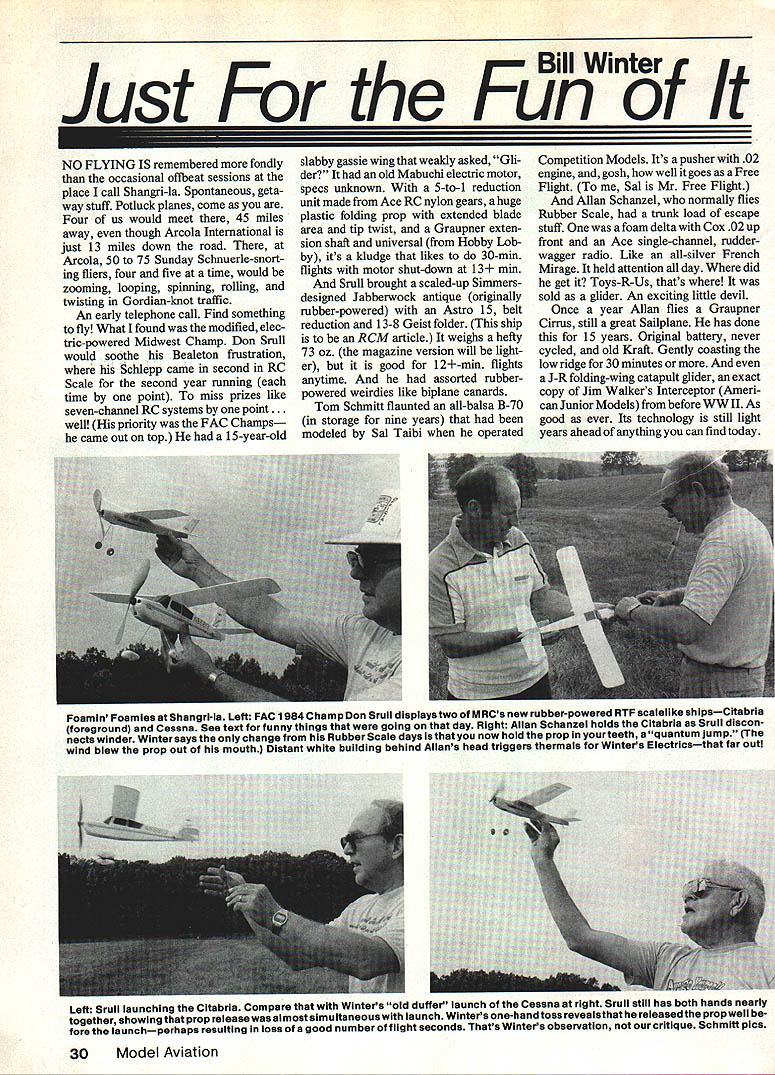
- Don Srull
- Modified, electric-powered Midwest Champ: a kludge that likes to do 30-minute flights with motor shutdown around 13+ minutes. It uses an old Mabuchi electric motor with a 5:1 reduction unit (Ace RC nylon gears), a large plastic folding prop with extended blade area and tip twist, and a Graupner extension shaft and universal (from Hobby Lab).
- Scaled-up Simmers-designed Jabberwock (originally rubber-powered) with an Astro 15, belt reduction and 13-8 Geist folder — a hefty ship (~73 oz.) good for 12+ minute flights.
- Assorted rubber-powered oddities (biplane canards, etc.). Don was also the FAC champ and a devoted FAC competitor.
- Tom Schmitt
- An all-balsa B-70 (in storage for nine years) modeled by Sal Taibi when he ran Competition Models. It's a pusher with a .02 engine — surprising performance for such a small motor.
- Allan Schanzel
- A trunk load of escape stuff: a foam delta with a Cox .02 up front and an Ace single-channel, rudder-wagger radio (toy-store glider with exciting performance, like a little silver Mirage).
- A Graupner Cirrus sailplane flown once a year for 15 years — original battery never cycled, coasting a low ridge for 30 minutes or more.
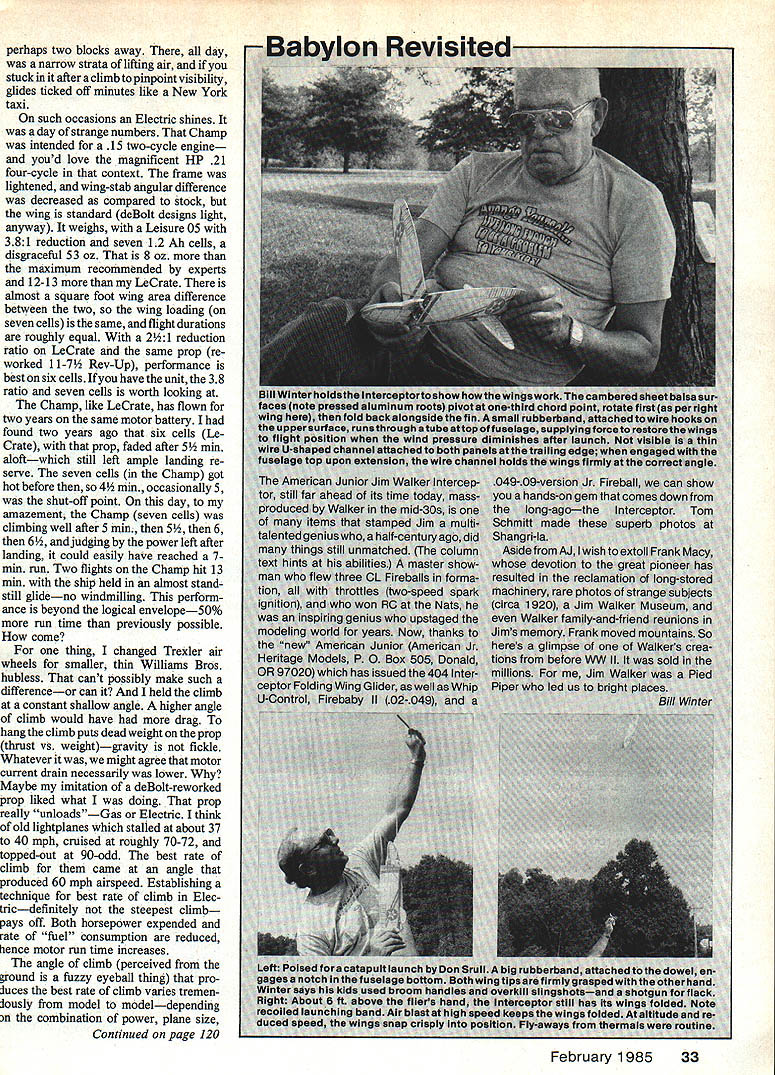
- A J-R folding-wing catapult Interceptor (an exact copy of Jim Walker's prewar Junior Models) — as good as ever, and technology still light years ahead in many ways.
Foam Scale and MRC Models
MRC's new foam "scale" models fly great. One with a double-length motor climbed to 75 ft and then had a glide on par with good-quality Rubber Scale. People send samples of kits and models; I often pass them on so they get used. Foam models like the Maxecuters have attractive packaging and are very light with sexily printed surfaces. The fuselage is a molded channel, open at the bottom and closed by a thin flat-bottom piece. Don Srull reported that by doubling the rubber length and stretch-winding one of these foam models, they flew "as well as a good Rubber Scale." That endorsement came from field experience, not an advertiser plug.
Memories: Jim Walker and Interceptors
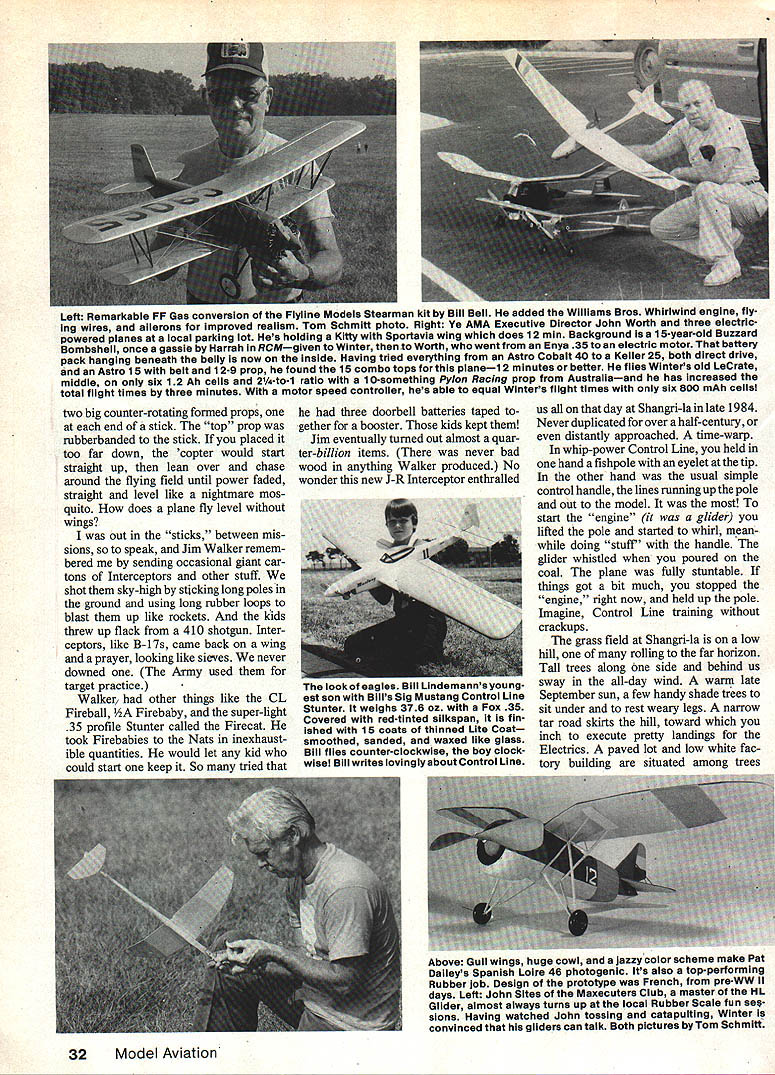
Two of my pre-school kids — who will be grandfathers before long — flew Interceptors as I did. Jim Walker produced the ROG Hornet in 1938 with a plastic prop (imagine that!), a plastic nose bearing with right- and down-thrust, and printed-wood cambered-wing chuck gliders that remain excellent. After WWII and into the early '50s we still flew Interceptors and Walker oddities like whip-powered Control Line Ceiling Walkers (big counter-rotating formed props, one at each end of a stick). Walker produced massive numbers of inexpensive and durable models over the years — no bad wood in anything he made — and a J-R Interceptor still enthralled us at Shangri-la in late 1984.
Walker also produced CL (U-Control) models like the Fireball, Firebaby, and Firecat. The Fireball helped launch U-Control demonstrations at prewar Nats; the Firebaby was widely used by kids at meets and contests.
Electric Performance at Shangri-la
The Champ mentioned above was intended for a .15 two-cycle engine. We lightened the frame and decreased wing-stab angular difference; the wing remained standard. With a Leisure 05 motor with 3.8:1 reduction and seven 1.2 Ah cells, the Champ weighed a disgraceful 53 oz — 8 oz over the recommended maximum and 12–13 oz heavier than my LeCrate. Despite that, flight durations were roughly equal between the two because of differences in wing area and wing loading.
Previously, six cells on the LeCrate with that prop faded after about 5½ minutes aloft. The Champ (seven cells) used to shut down around 4½ to 5 minutes because the pack got hot. On this Shangri-la day, however, the Champ climbed well after 5, 5½, 6, and 6½ minutes and could have reached a 7-minute run based on remaining power after landing. Two flights hit 13 minutes with the ship held in an almost standstill glide — no windmilling. This was about 50% more run time than previously possible.
Possible reasons:
- Swapping Trexler tires for smaller, thin Williams Bros. hubless wheels reduced drag.
- Holding the climb at a constant shallow angle reduced drag compared with steep climbs; best rate of climb for an electric often occurs at a shallow angle that produces a favorable airspeed.
- The particular reworked prop (deBolt style) unloads well, reducing motor current and extending run time.
The optimal angle of climb varies by model, power, and prop combination — definitely not the steepest climb.
LeCrate, Pylon Props, and Cell Sizes
A friend now has my LeCrate and experiments with every approach. Gordon Burford of Australia gave him a 10-inch-diameter Pylon prop (odd geometry: squared blade tips, lots of blade area, high pitch near the hub). I would not have chosen it for Electrics, but John added 3 minutes to my best time with it — on six 1.2 Ah cells and 2½:1 reduction. He then switched to 800 mAh cells and got similar durations (around 13 minutes) while still getting pinpoint height twice in a flight when using a speed controller for extended cruise or shallow climb. Cell size, reduction ratio, prop choice, and controllers interact in complex ways; experimentation often pays off.
Evans Wing (Slow Motion) — Characteristics and Technique
My "Evans Wing" — Bill Evans' modification of his Similar Deuce — is an extremely happy airplane. After several flights and on-the-spot trimming, we found a few special traits:
- It's a taildragger that starts the roll with full up; hold full up until about 5–6 ft. high, then steer with rudder and two-thirds throttle for snappy turns and loops.
- For soaring circles, use aileron trim with the engine idling or off and apply occasional stick inputs as it winds down.
- I use 23% added dihedral at each tip of the 5-ft wing.
- If you trim a circle with rudder alone, it maintains altitude; adding small amounts of inside aileron and rudder produces hands-off, nearly flat-circular soaring.
- At extreme crossed controls you may see what looks like rudder reversal and the model will come out of the circle — a lower vertical tail or a dorsal fin would cure that, but it's rarely necessary.
The Evans Wing has a wide speed range and is highly efficient; with an enlightened electric structure it could be an absolute world-beater. It is grossly overpowered on a .19 and would be happier on a .15.
Walker, Stanzel, and U-Control Classics
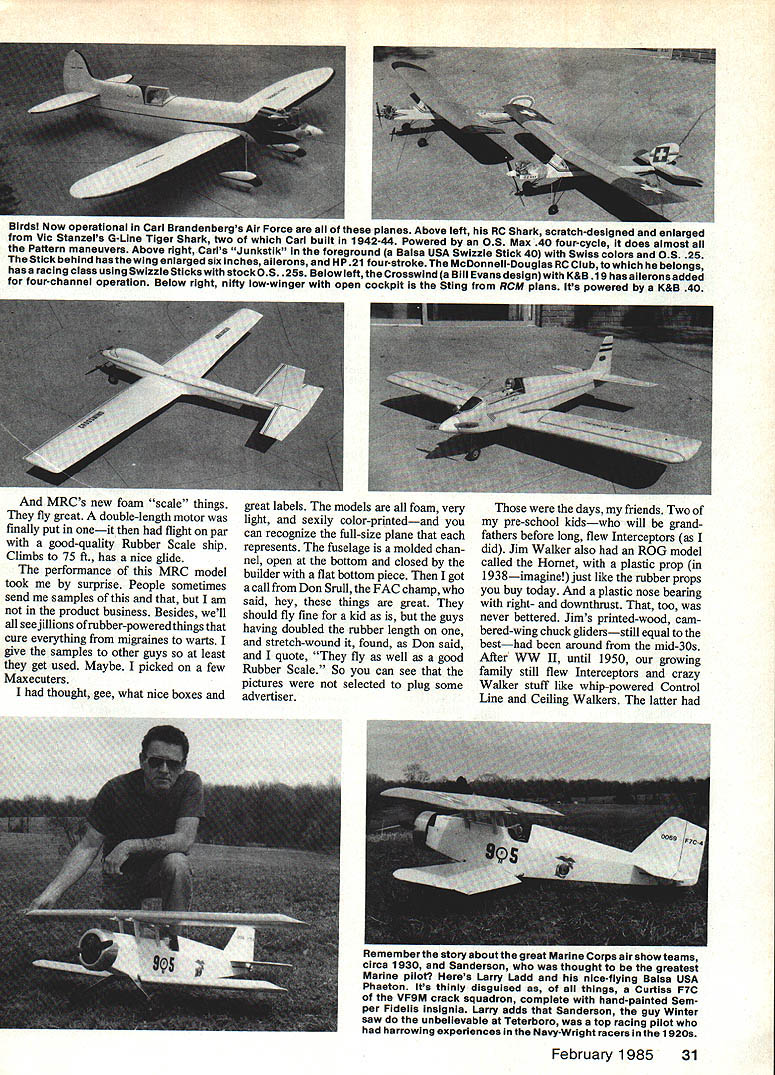
Jim Walker's Fireball remains an excellent-flying model by any standard — once derided as a "brick on a string" but a classic of Free Flight and U-Control demonstration. The Victor Stanzel G-Line Tiger Shark is another revered classic: flown like a tethered free flight in early use but in size and performance a genuine Control Line model. Old-timers love its appearance and performance even if they never built one originally.
Carl Brandenberger — A Modeler's Story
"I have been modeling since the early '30s," Carl begins. He recently retired from McDonnell-Douglas where he worked in aircraft design on F-4s, the F/A-18, and AV-8 advanced design. He was a section chief responsible for fluid systems, flight control actuation, and landing gear systems. He did not begin flying RC until recently and prefers more leisurely sport flying.
His early models included a Sig Kadet with an O.S. Max .40 (a handful for a beginner), a Piece of Cake with a Cox TD, and an enlarged Craft Aire Butterfly II with an O.S. .10. He built an Evans Crosswind with an old Veco .19 and experimented by adding ailerons. He fell in love with the Sting (scratch-built with a K&B .40) and now flies with the McDonnell-Douglas RC Airplane Club.
He participates in a racing class using the Balsa USA Swizzle Stick .40 (powered by a stock .25). His "Junkist" uses an O.S. Max .25 ABC and is finished in Swiss Air Force colors. He built another Swizzle with ailerons and added 3 in. span to each wing half — a bit underpowered with an HP .21 four-cycle, but fun with working ailerons.
A household find of 5x7 photos of planes Carl built in 1942 and 1944 reinforced that many models from that era used surprisingly small powerplants. Skeptics would say it's impossible to fly with such low power, yet those who see them fly ask about the O.S. four-cycle. For planes that benefit from larger props, lower rpm is a plus; prop selection remains numero uno.
Carl's experience illustrates how open-minded flying — trying different engines, props, and setups — keeps the hobby vibrant.
Late Afternoon at Shangri-la — Pratt, Hershberger, and Kurwi
A perfect mid-October afternoon: no wind, balmy, golden. At day's end Doug Pratt was still flying a G-S Stinson with RAM lights and a Saito .45 — landing lights, tip lights, and a blinking strobe on the rudder trailing edge. Doug also flew my 50%-up Krackejac with spoilers (early '60s design) powered by an Enya .46 four-cycle — a superb airplane for high-approach STOL pop-downs and short-field work.
Bill Hershberger, ex-Nats pylon race winner and long-time RC researcher, was there too, always testing radios and conditions. He flew a Kurwi glider powered by an O.S. .15. Bill has a long history with the Kurwi — flying with Kurt Wilhelm in Munich and bringing home three Kurwis in the '60s. He later put an O.S. .10 and then an O.S. .15 in an 8-ft Kurwi, trimmed the wing, and strengthened the spars for aerobatics; the result is a very wide performance envelope.
Don Srull brought a Mew Gull scale racer with an O.S. .25 (published in RCM years ago) and also got involved with my lightened Evans Slow Motion with its oversized 5-ft wing and K&B/Veco .19. The non-Schnuerle Veco/K&B .19 (Clarence Lee design) is out of production but still available in some markets and remains notable for its linked exhaust/venturi barrel and characteristic idle tick-tock.
I flew Doug's Enya .46-powered motor glider for a while, with Hershberger's souped-up Kurwi in the air. The two aircraft made a dramatic sight: a large motor glider at cruise and a small, acrobatic Kurwi working to keep up — like a WW I dogfight reenactment. Doug discovered new possibilities for motor glider aerobatics that day.
Passing Planes, Aileron Advice, and Night Flying
We pass planes around at Shangri-la. One day I grabbed the transmitter from Don to land a wing at my feet; you only need a sense of daring sometimes. A word on ailerons: for an RTF that dropped a wing with full up aileron, the diagnosis was narrow aileron chord and excessive up-aileron angle at high load. Conclusions:
- Don't use too much movement on narrow-strip ailerons.
- Widen the ailerons and use modest travel.
- Avoid differential unless you have a large aileron chord or barn-door ailerons.
Differential helps with down-aileron yaw but is also a sign of inadequate vertical area.
Almost dark, railbirds linger. One night the full moon rose and a flier offered another his plane to shoot go-arounds in the moonlight; when a cloud hid the moon on one approach, the pilot still got in — full moon flying is a thing.
Eloy Marez (writes on four-cycles in MAN) urges, "Enjoy your upcoming building season" — though some of us are forced to fly year-round. An October day like that can make your year in this land of flying.
Bill Winter 4432 Altura Ct., Fairfax, VA 22030
Transcribed from original scans by AI. Minor OCR errors may remain.

