
Just For the Fun of It
Bill Winter
John Morrill — Modeling Life
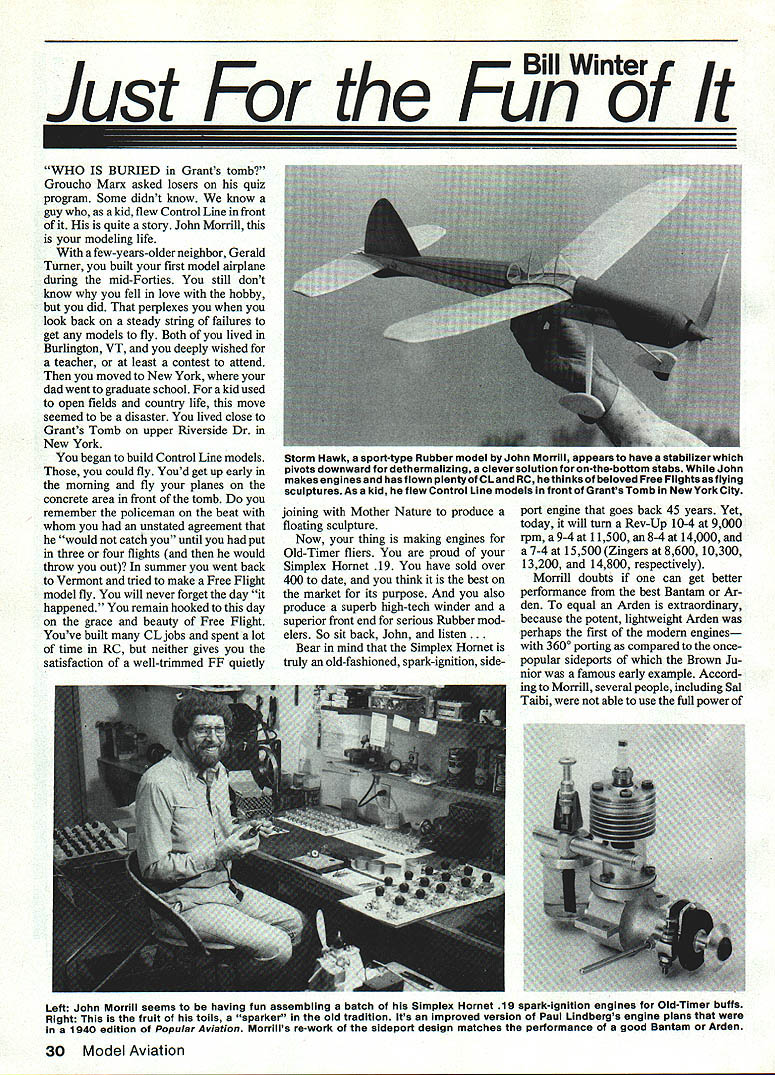
"Who is buried in Grant's tomb?" Groucho Marx asked losers on his quiz program. Some didn't know. We know a guy who, as a kid, flew control-line models in front of it. His is quite a story. John Morrill, this is your modeling life.
With a few-years-older neighbor, Gerald Turner, you built your first model airplane during the mid-Forties. You still don't know why you fell in love with the hobby, but you did. That perplexes you when you look back on a steady string of failures to get any models to fly. Both of you lived in Burlington, Vt., and you deeply wished for a teacher, or at least a contest to attend. Then you moved to New York, where your dad went to graduate school. For a kid used to open fields and country life, this move seemed a disaster. You lived close to Grant's Tomb on upper Riverside Drive.
You began to build control-line models. Those, you could fly. You'd get up early in the morning and fly your planes on the concrete area in front of the tomb. Do you remember the policeman on the beat with whom you had an unstated agreement that he "would not catch you" until you had put in three or four flights (and then he would throw you out)? In summer you went back to Vermont and tried to make a free-flight model fly. You will never forget the day "it" happened. You remain hooked to this day on the grace and beauty of free flight.
You've built many CL jobs and spent a lot of time in RC, but neither gives you the satisfaction of a well-trimmed free-flight model quietly joining Mother Nature to produce a floating sculpture.
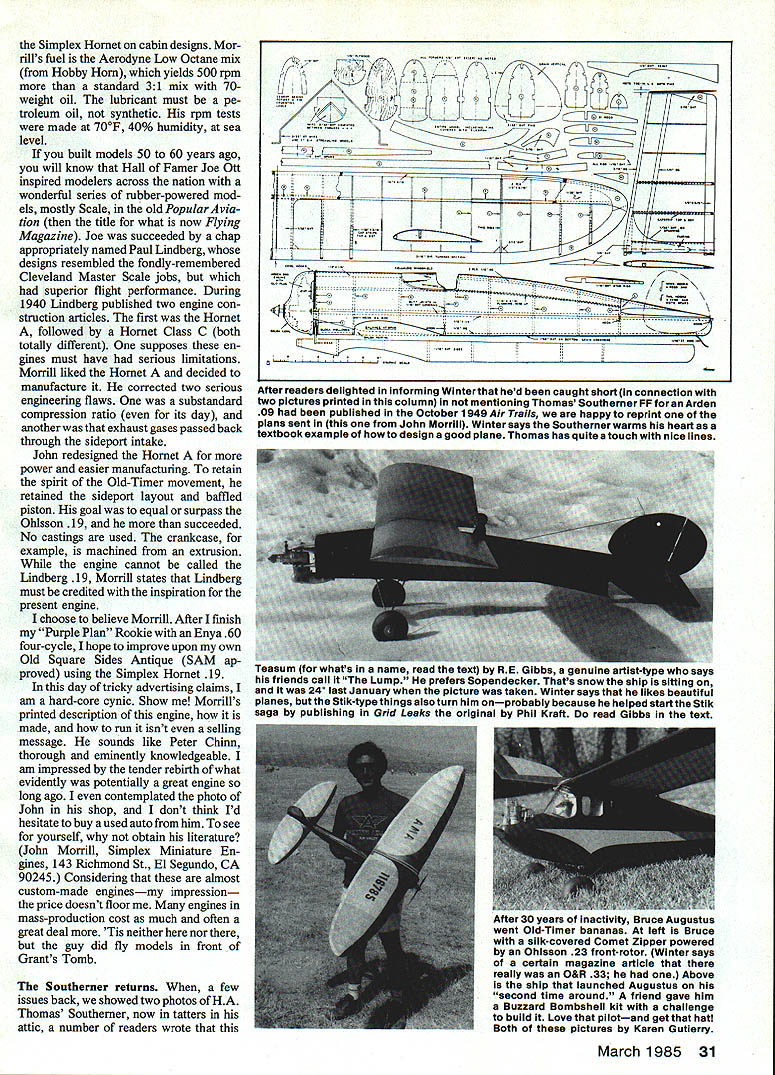
Now your thing is making engines for Old-Timer fliers. You are proud of your Simplex Hornet .19. You have sold over 400 to date, and you think it is the best on the market for its purpose. You also produce a superb high-tech winder and a superior front end for serious rubber modelers.
Bear in mind the Simplex Hornet is truly an old-fashioned, spark-ignition, side-port engine that goes back 45 years. Yet today it will turn:
- Rev-Up 10-4 at 9,000 rpm
- 9-4 at 11,500 rpm
- 8-4 at 14,000 rpm
- 7-4 at 15,500 rpm
(Zinger figures: 8-6 at 8,600; 10-3 at 10,300; 13-2 at 13,200; 14-8 at 14,800 rpm.)
Morrill doubts if one can get better performance from the best Bantam or Arden. To equal an Arden is extraordinary because the potent, lightweight Arden was perhaps the first of the modern engines — with 360° porting as compared to the once-popular sideports of which the Brown Junior was a famous early example.
Morrill's fuel is the Aerodyne Low Octane mix (from Hobby Horn), which yields about 500 rpm more than a standard 3:1 mix with 70-weight oil. The lubricant must be a petroleum oil, not synthetic. His rpm tests were made at 70°F, 40% humidity, at sea level.
If you built models 50 to 60 years ago, you will know that Hall of Famer Joe Ott inspired modelers across the nation with a wonderful series of rubber-powered models, mostly scale, in the old Popular Aviation (the title that later became Flying). Joe was succeeded by Paul Lindberg, whose designs resembled the fondly remembered Cleveland Master Scale jobs but had superior flight performance. During 1940 Lindberg published two engine construction articles: the Hornet A, followed by a Hornet Class C (both totally different). One supposes these engines must have had serious limitations.
Morrill liked the Hornet A and decided to manufacture it. He corrected two serious engineering flaws: one was a substandard compression ratio (even for its day), and another was that exhaust gases passed back through the sideport intake. John redesigned the Hornet A for more power and easier manufacturing. To retain the spirit of the Old-Timer movement, he kept the sideport layout and baffled piston. His goal was to equal or surpass the Ohlsson .19, and he more than succeeded. No castings are used — the crankcase, for example, is machined from an extrusion. While the engine cannot be called the Lindberg .19, Morrill states that Lindberg must be credited with the inspiration for the present engine.
I choose to believe Morrill. After I finish my "Purple Plan" Rookie with an Enya .60 four-cycle, I hope to improve upon my own Old Square Sides Antique (SAM-approved) using the Simplex Hornet .19.
Morrill's printed description of how the engine is made and how to run it reads like the work of Peter Chinn — thorough and eminently knowledgeable. To see for yourself, obtain his literature: John Morrill, Simplex Miniature Engines, 143 Richmond St., El Segundo, CA 90245. Considering that these are almost custom-made engines, the price doesn't floor me. Many mass-produced engines cost as much or more. And, after all, the fellow did fly models in front of Grant's Tomb.
The Southerner returns
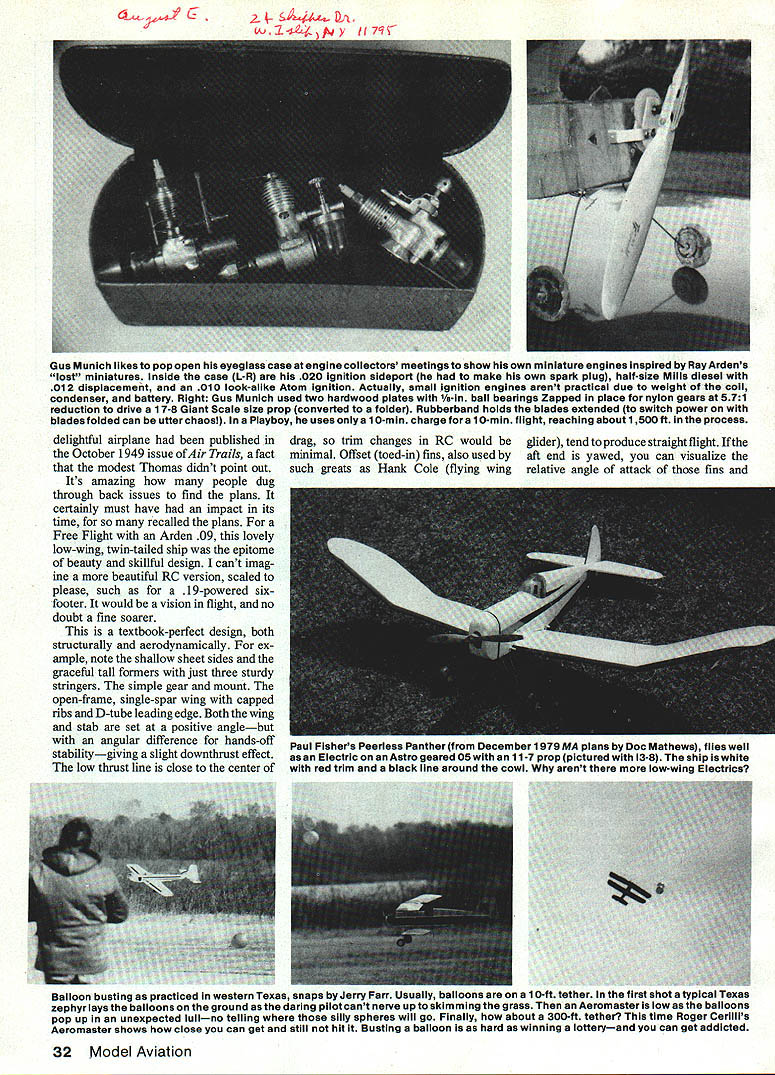
When, a few issues back, we showed two photos of H. A. Thomas' Southerner — now in tatters in his attic — a number of readers wrote that this plane had been published in the October 1949 issue of Air Trails. The modest Thomas hadn't pointed this out. It's amazing how many people dug through back issues to find the plans. For a free flight with an Arden .09, this lovely low-wing, twin-tailed ship was the epitome of beauty and skillful design. I can't imagine a more beautiful RC version, scaled to please (say a .19-powered six-footer). It would be a vision in flight and no doubt a fine soarer.
This is a textbook-perfect design, both structurally and aerodynamically. For example, note the shallow sheet sides and the graceful tall formers with just three sturdy stringers. The simple gear and mount. The open-frame, single-spar wing with capped ribs and D-tube leading edge. Both the wing and stab are set at a positive angle — but with an angular difference for hands-off stability — giving a slight downthrust effect. The low thrust line is close to the center of drag, so trim changes in RC would be minimal. Offset (toed-in) fins, also used by such greats as Hank Cole (flying wing glider), tend to produce straight flight. If the aft end is yawed, you can visualize the relative angle of attack of those fins and understand what happens.
To quote Thomas' 1949 opening: "Few modelers realize the extent to which the average contest model is overpowered. Never appreciating the fact that this is responsible for their critical adjustments and numerous crack-ups, they assume this to be the criterion for all free-flight gas modeling. This is the reaction of the confirmed control-line fliers, especially. What with screaming power spins and out-of-sight flights, it is no wonder they stick to tethered flight. What so many modelers miss out entirely is the sport gas job, designed and built solely for pleasure flying."
It is as true now that beauty of flight depends on flying on the wing, not on the engine. Of course, if you like aerobatics, with power to burn, tuned pipes and hot fuels must be your way of life. I know as well as anyone that power has its place. But it too often gets into the wrong places.
I recall a lecture to modelers by a NACA engineer (1939) which posed the astounding observation that, then, hot free-flight ships had proportionally 60 times the power of a P-40. Picture a P-40 with a 75,000-hp engine! Look through the ads and you'll find a nice Bleriot — overpowered several times by a big Schnuerle engine. Louis would be spinning in his grave.
The Southerner, in the same size that climbed at a great rate on an old .09, some guys would call underpowered with an O.S. .25. I'll meet you halfway. I actually like Ugly Stiks. I often see the pleasure in flying one of these clever machines, but with very slight dihedral (so I could breathe occasionally) and power in the middle of the recommended displacement range. I'm not afraid of a Stik. But I suspect many thousands are scared to death by planes that fly like airplanes. A Laser is fine. So is a T-Craft. Like East and West, they shall never meet.
Bruce Augustus
My interest has peaked. Why? Bruce Augustus. Bruce is rolling in Old-Timer clover. His letterhead logo: Augustus Airlines. He asks all sorts of questions about my old WOG, published in Air Trails and kitted by Megow, collects (and uses) funny old engines, and evidently owns an airline.
"What's Augustus Airlines?" we asked. Augustus Airlines proves to be an air charter service operating out of Sun Valley under Part 135 of the federal aviation requirements. They have a V-tailed Bonanza and a Piper Seneca II, a six-place with turbo and de-icer. "I have to keep the wings level while being an airline pilot, so I get my kicks with models." He's returned to modeling after a lapse of 30 years.
"In 1953 I began building a Megow WOG (tough with Ambroid) and was accepted into aero engineering at Cornell," Bruce begins. "My folks retired to Florida. More interested in AE than models, I told them to get rid of the workshop. Regrets. I saved only a McCoy .29, a Mills 1.3, Super Cyke, Forster .29, and an RC receiver built from Ed Lorenz plans."
Then, in 1983, a friend gave him an original Buzzard Bombshell and challenged him to build it. The end of that tale is that he now has 12 Old-Timer free flights and RC-assist models and over 40 Old-Timer engines. He just acquired an original Megow WOG kit in perfect condition.
Let me freewheel. The WOG was a planked-fuselage, streamlined shoulder-wing ship with polyhedral and an NACA 6409 airfoil (a favorite of free-fighters in those days) and a thin, symmetrical stab (non-lifting tail). The top of the wing was sheeted for efficiency and strength. The planked fuselage was a technique dating back to great earlier designs.
The Megow WOG kit had terrible wood — over-thick, stringy, and very heavy. If you got a wing down in a tight turn, well, there it stayed. With an Ohlsson .23 enclosed in a rather bulbous front end (hence the name, WOG), mine was sport-flown on less than full power, and I enjoyed its very fine glide. People think it a nostalgia-period airplane because it was published in 1944, but it is a SAM-approved Old-Timer, as I had the airplane before the 1942 cutoff date.
No, the WOG can't stand up to a postwar Civy Boy or Ramrod. The former, a Paul Gilliam masterpiece, was balanced on the razor's edge — at 110% of chord. St. Jean's Ramrod was one heck of a competitor, in the Hogan tradition, still a sensational machine.
Like others, Bruce wants to climb the WOG straight up. No, a thousand times no. This machine must be flown under power in a wide, fast circle, exactly the way Korda flew his Powerhouse. Korda had good altitude after 180° of turn. Bruce asks if it's good enough to build for free-flight competitions, or if he should make it RC-assist. If you want an Old-Timer for free-flight competition, build the Vagabond; it could compete with sailplanes. It, too, is SAM-approved.
Bruce likes the idea of using delightful English diesels — Elfin 2.49, Albon Javelin, Mills, and Elfin 1.49 — any of which provides plenty of power for a light model. For RC he thinks he'll use an Amco 3.5cc diesel, or maybe an O&R .29 front-rotor. With either it will climb vertically, he says. He should be able to build the WOG at about 8.9 oz per sq. ft. He'd prefer a flat-bottomed wing and stringered fuselage, but worries such changes might be outside SAM rules. My advice: forget SAM for that one and just have fun — use stringers and MonoKote if you wish.
The Megow WOG and other classics
Briefly: the WOG was planked, shoulder wing, NACA 6409, sheeted top, and a non-lifting thin stab. The kit wood was poor; flying technique and trim matter more than raw power. For competition, many older designs are still excellent if well-trimmed and flown properly.
Letters — Readers write
David G. Manley: "I must decry the loss of several FF and CL columns in the various modeling magazines. Though I fly primarily RC gliders, I got my start in modeling about 30 years ago with FF and CL. I hope the AMA will at least remind beginners that entry into modeling need not require seven channels, a balsa forest, and a deed to a gas farm. Publications that build up a devoted readership do the hobby no good by cutting out the modeler who will continue to give guidance and support to contests, fun-flying, CL and FF."
Paul Fisher: "I was amused at your remarks about depth perception and flying RC — amen to glasses and my dear wife's spotting for me. It is much easier to fly the full-size thing! I have been enjoying modeling for 45 years and on. During my late teens I had to leave FF activities — too expensive. They kept flying away.
"Now, electric-powered flight has been my most recent interest. Enclosed is a picture of D. B. Mathews' Panther, with an Astro 05 gear drive. It allows my slow reflexes enough time to keep up with what's happening. Currently an 11-7 is being used, but the picture shows a 13-8. Flying from small fields in the East with tree interference and shifty winds is a challenge. Ours is a great hobby."
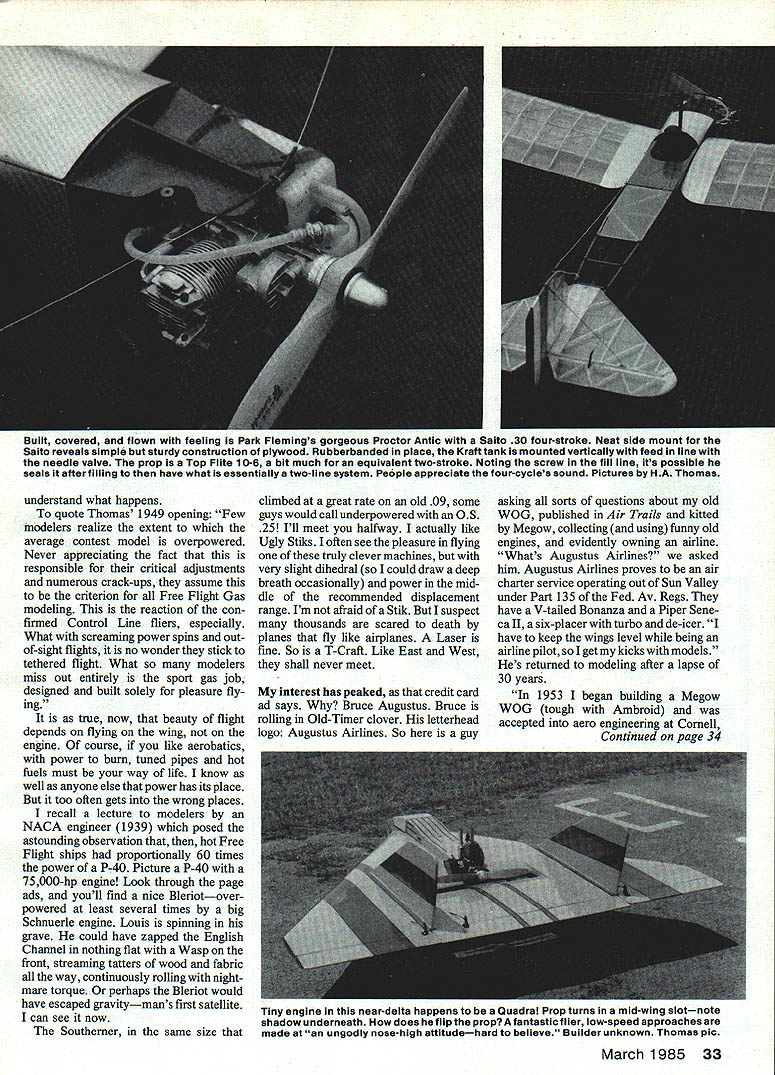
Balloon busting: ever try it? If you get carried away with RC tilting at balloons, a single-minded passion takes over. You sweat bullets until you can barely see. Balloon busting was always a great fun/novelty event in CL, and perhaps still is. If you're going to stay around that balloon and maximize passes, try a three-channel cabin ship that can twist and turn on a dime. The late Jack Port, a national champ in rudder-only days, and I had a simultaneous session at a lone balloon about 50 ft. high at Selinsgrove, PA. Jack splattered pieces for a good 100 ft.!
Jerry Farr: "Tie helium balloons to a 10-ft.-long string and try to hit a balloon with your plane — ain't easy." A man of few words.
Those Arden miniatures
"Your recent article on the Ray Arden miniatures prompted me to take some pictures of a few miniature engines I have built," says Gus Munich (coordinator for MECA — Model Engine Collectors Association). "I've always been fascinated with those tiny Ray Arden engines. As a collector, it has always been my dream to find Ray's missing miniatures. They disappeared after his death. I hear he used to carry them around in an old eyeglass case and nonchalantly pop it open when he went to engine collectors' meetings 'just for the fun of it.'"
The pictures show an .010 configured just like an Atom. The second is an .020-size ignition sideport which has a brass spinner, tank, venturi, and exhaust stack. Gus had to make his own spark plugs for these two engines. The third is a half-size replica of the Mills .045 diesel (one-quarter volume), made from a casting given to him.
"The small ignition engines really are not practical due to the size of coil, condenser, and batteries," explains Gus, "but the half-size Mills replica is good for walnut-size models. I have also built two smaller diesels, .008 and .006, but have been unable to get them to run. So far I have built about 30 engines from castings or bar stock, using a 6-in. Atlas lathe and a 3-in. Unimat."
Gus builds many clever models as well. His two most recent are Old-Timers from the 1940s. One is an Ohlsson .60 ignition-powered cabin job (a Toughie). The second is a Gooseneck pylon free-flight repowered with electric: a Robbe EF76 with a 3.6:1 gear ratio and a Top Flite 14-6. It turns 4,600 rpm on 12 Sanyo cells. "Both, RC-assist, fly great."
Some folks tinker; some fly. Few tinkerers do much flying. Gus is an inveterate tinkerer who is forever flying his test and fun ships. It amazes me that a man who has done so much with electrics can go virtually unnoticed.
In June of 1983 he told me he was getting 10-min. flights off only a 10-min. charge, all day long. He eventually got down to 300 sq. in. old free-flights with high gear ratios and huge folding props on a .05. Electric guys will dig this.
A windy Saturday gave me the opportunity to make a 5.7-to-1 gearbox for the Leisure LT .50. I then flew it with a 17-8 folder (a standard-size quarter-scale wood prop). The gearbox used ply hardwood spacers with 3/8-in. ball bearings pressed in place. Ten flights: performance about 2,100 rpm on six cells. The plane climbs to about the same altitude on a 10-min. charge as a 10-6, 11-7, or 11-6 on a 2.5-to-1 gear ratio. The plane weighs a certain amount and rises to, say, 1,500 ft. — that is a certain amount of potential energy. That climb requires a certain amount of energy in the cells. There is no magic involved.
Gold is what you find in it — Purple Plan
I wish I had done a book called Purple Plan. PP-1 is gluing a piece of prop up at night when you are in big trouble. PP-2, incidentally, is trying to make up your mind what to make next. The PP-1 underground is going full tilt.
R. E. Gibbs: "Somewhere I read, 'The purpose of art is to make the viewer (reader) aware of what he knows but does not know he knows.' Since your latest column was obviously written for me personally, it represents a piece of writer's art rather than writer's craft.
"After a 1934 beginning in modeling, I have been exposed to all the arcane meanderings imposed on the faithful by this hobby as spelled out in your column. My latest layoff lasted about six years and I ended in early 1983 when I saw and heard my first four-stroke. Nothing would do except trade the old Orbit single stick for a new Ace Silver Seven and drag all the junk from the attic into the studio. Again!
"And so all of the old problems (mainly with the delights) surface again. As a so-called fine art painter (I paint what I wish and try to sell it), self-discipline is the order of the day. It is absolutely necessary to paint every day or the Muse, rebuffed, wanders off to sulk among the old brass des Bolt fuel tanks, framed Westland Widgeon (Swayne's), framed own design (OS . . . 1.0), model mags (with gaps back to 1929), and a large pile of 'must do' plans which are gradually, but surely, being converted to mouse dirt. No doubt about it, Purple Plan 1 is the only answer."
Gibbs laments the fallout from PP-2 — the expression of pure disgust as the Muse picks her way through all the unfinished projects collecting dust. He is trying to make a list of what he should finish, but keeps adding new stuff. He reports that with the four-strokes having punched his start button again, he has readied three projects he flies regularly: an 18-year-old Mayfly, Doc Matthews' '42 Kloud King, and a quick project called Teasum (Three Evenings And Saturday Until Midnight). He also praises the Saito 30 four-stroke for its reliability and idle characteristics.
"Our club (York Area R/C Club, Inc.) adds about three to four new members a month, with total membership of about 90. I prefer Wednesday mornings with a couple of retired guys who don't need PPI. Fly from 9 a.m. until 2 or 3 p.m. No crowd, no problems, just set your own pace — fun. And we do it year round. In January with the thermometer at 2°F, we have the field to ourselves! We do have a field house with facilities for making coffee, so the winter affairs are a series of Keystone Cops routines."
Gibbs closes: "I have the sorry feeling that many of today's RC'ers are not aware of the tantalizing mystique of small man-made flying things. At any rate, you remind us older rIs that the feeling is not lost among all the nuts-and-bolts words that are published."
Now hear this — NVRC and corrections
"As a fellow member of NVRC, I read with great interest your feature on Aerodrome International in Model Aviation. The changes at the field over the past year have been nothing short of amazing. The majority of these improvements have been accomplished by Fred Locks, 1984 NVRC vice-president, and his son, Sean. The hardest part of his labor is lobbying for the funds. I, along with many others, feel his labors should be acknowledged." — David Beazley, NVRC secretary, 1985.
Correction: the address for Frank Mackey, co-creator of Jim Walker's catapult 404 Interceptor and other models, is A-J Fun Pak, P.O. Box 545, Oregon City, OR — not as shown in this column last month. See A-J Fun Pak ads in this issue.
For Fun / Winter (continued)
My flying season ended the way it began, with a lovely, long thermal flight of my Vagabond (Old-Timer). Just the right lift to hold altitude. Such an inner glow! For me, Fun is an objective, not subjective, airplane — one on which you do not constantly impose your will. One that asserts its liberty in doing its own beautiful thing: circling silently, high, graceful, trance-like. Surely the epitome of all flying, full-scale or model.
Beholding it, I am, in my subconscious, a bird watcher — hawks and buzzards and pelicans and frigate birds. A word: Audubon. Preserve the species.
Bill Winter 4432 Altura Ct., Fairfax, VA 22030
Transcribed from original scans by AI. Minor OCR errors may remain.

